Recognition: no theorem link
Hilbert space fragmentation in quantum Ising systems induced by side coupling
Pith reviewed 2026-05-13 18:01 UTC · model grok-4.3
The pith
Resonance between transverse field and side coupling fragments the Hilbert space of quantum Ising systems into exponentially many decoupled sectors.
A machine-rendered reading of the paper's core claim, the machinery that carries it, and where it could break.
Core claim
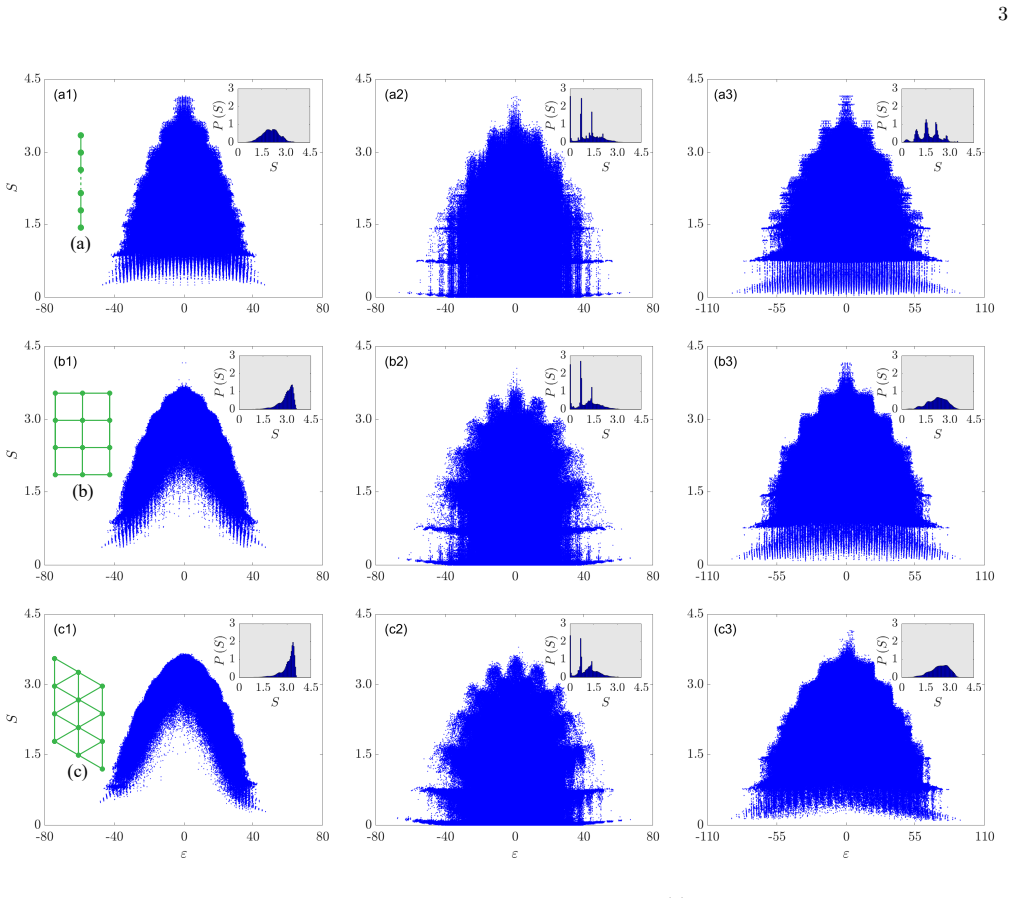
In the resonant regime where the transverse field equals the side coupling, the Hilbert space of the combined A-B spin system decouples into exponentially many invariant subspaces. Each subspace evolves independently, leading to quantum scars that persist in the eigenstates and dynamics. This holds for arbitrary lattices in the parent Ising model A, with the fragmentation becoming pronounced as the system approaches resonance, as shown by analytic examples and numerical probability distributions of entanglement entropy.
What carries the argument
The resonance condition between the transverse field on lattice A and the side coupling to free spins B, which exactly decouples the total Hilbert space into invariant sectors for arbitrary lattice geometries.
If this is right
- Quantum scars appear in the eigenstates of typical systems like chains and lattices when resonance is satisfied.
- Entanglement entropy distributions develop distinct peaks corresponding to the fragmented sectors, observable in finite-size Monte Carlo sampling.
- Dynamics remain confined within individual sectors, preventing full thermalization even in clean systems.
- The fragmentation applies to arbitrary lattices, allowing the effect in two- and three-dimensional geometries beyond one dimension.
Where Pith is reading between the lines
- This resonance-induced fragmentation could be realized in programmable quantum simulators by tuning laser or magnetic fields to match coupling strengths.
- It suggests a route to engineer protected subspaces for quantum information storage without relying on topological order.
- Similar side-coupling mechanisms might apply to other spin or qubit models to induce scars in higher dimensions.
Load-bearing premise
The exact resonance between transverse field and side coupling strength decouples the sectors for any lattice without requiring additional constraints on the interaction form.
What would settle it
A direct count of conserved quantities or measurement of zero transition amplitudes between proposed sectors in a small finite lattice at exact resonance, which would show no leakage if fragmentation holds.
Figures


read the original abstract
We study Hilbert space fragmentation and quantum scars in quantum spin systems with Ising interactions. The system consists of two sets of quantum spins, A and B. As the parent system, set A is an Ising model on arbitrary lattices with a transverse field, while set B comprises free spins that are coupled to set A. We show that the Hilbert space is fragmented into exponentially many decoupled sectors when the transverse field and the side coupling strength are at resonance. As examples, several typical systems with quantum scars are studied analytically. Numerical simulations of probability distribution of entanglement entropy for finite-size chains, square and triangular lattices are performed using the Monte Carlo method. The results show that Hilbert space fragmentation and the corresponding quantum scars become pronounced when the system approaches resonance.
Editorial analysis
A structured set of objections, weighed in public.
Referee Report
Summary. The manuscript studies Hilbert space fragmentation in a quantum spin system with two sets of spins: set A is an Ising model with transverse field on arbitrary lattices, while set B consists of free spins side-coupled to A. The central claim is that resonance between the transverse field h and side-coupling strength J fragments the Hilbert space into exponentially many decoupled sectors. This is illustrated by analytical solutions for several typical systems exhibiting quantum scars and by Monte Carlo simulations of entanglement-entropy distributions on finite-size chains, square lattices, and triangular lattices, which show pronounced fragmentation signatures near resonance.
Significance. If the resonance-induced fragmentation holds, the work supplies a concrete, tunable route to Hilbert-space fragmentation and quantum scars in Ising-like models, with potential implications for ergodicity breaking and many-body scars. The combination of analytical examples on specific geometries and Monte Carlo data on multiple lattice types constitutes a strength, though the generality to arbitrary lattices remains the key open point.
major comments (2)
- [Abstract] Abstract and model section: the assertion that resonance (h = J) produces exact decoupling into exponentially many sectors for arbitrary lattices is load-bearing for the central claim, yet only specific systems receive analytical treatment; no general construction of the conserved projectors P_k satisfying [H, P_k] = 0 for arbitrary coordination numbers or geometries is provided.
- [Numerical simulations] Numerical results section: the Monte Carlo probability distributions of entanglement entropy lack reported error bars, sample sizes, and data-exclusion criteria, preventing quantitative assessment of how robust the resonance signatures are on finite 2D lattices.
minor comments (2)
- [Model] Clarify the precise form of the side-coupling Hamiltonian term, including whether the coupling is uniform or site-dependent.
- [Discussion] Add a brief discussion of the resonance condition's sensitivity to next-nearest-neighbor or disordered couplings.
Simulated Author's Rebuttal
We thank the referee for their careful reading of our manuscript and for the constructive comments, which will help improve the clarity and completeness of the work. We address each major comment below and will revise the manuscript accordingly.
read point-by-point responses
-
Referee: [Abstract] Abstract and model section: the assertion that resonance (h = J) produces exact decoupling into exponentially many sectors for arbitrary lattices is load-bearing for the central claim, yet only specific systems receive analytical treatment; no general construction of the conserved projectors P_k satisfying [H, P_k] = 0 for arbitrary coordination numbers or geometries is provided.
Authors: We agree that an explicit general construction would strengthen the presentation. The resonance condition h = J permits rewriting the Hamiltonian such that local operators built from the side-coupled spins commute with H for any lattice geometry, because the transverse-field and coupling terms cancel within each sector. Although we illustrate this explicitly only for representative cases (chains, square and triangular lattices), the same local cancellation holds for arbitrary coordination numbers. In the revision we will add a dedicated paragraph in the model section that constructs the projectors P_k in general form, showing [H, P_k] = 0 without restricting the lattice type. revision: yes
-
Referee: [Numerical simulations] Numerical results section: the Monte Carlo probability distributions of entanglement entropy lack reported error bars, sample sizes, and data-exclusion criteria, preventing quantitative assessment of how robust the resonance signatures are on finite 2D lattices.
Authors: We thank the referee for noting this omission. In the revised manuscript we will (i) state the number of Monte Carlo samples and sweeps used for each lattice, (ii) add statistical error bars to the entanglement-entropy histograms, and (iii) describe the equilibration and data-exclusion protocol (discarding the first 20 % of sweeps after checking convergence of the energy). These additions will appear in the numerical-results section and in the associated figure captions. revision: yes
Circularity Check
No circularity: fragmentation derived from resonance commutator condition independent of inputs
full rationale
The paper constructs the fragmentation by showing that at resonance (transverse field h equal to side-coupling strength J) the Hamiltonian commutes with a set of projectors onto exponentially many sectors for the A-B coupled system. This is presented as a direct algebraic consequence of the resonance tuning on the Ising-plus-transverse plus side-coupling Hamiltonian, without fitting parameters to data or redefining the fragmentation via the sectors themselves. Numerical Monte Carlo on finite chains, square, and triangular lattices serves only as verification of statistical signatures (entanglement entropy distributions), not as the source of the general claim. No self-citation chain, ansatz smuggling, or renaming of known results is load-bearing for the central decoupling result. The derivation remains self-contained against the stated Hamiltonian.
Axiom & Free-Parameter Ledger
free parameters (1)
- resonance condition
axioms (1)
- domain assumption The parent system A is an Ising model with transverse field on arbitrary lattices and B consists of free spins coupled to A.
Forward citations
Cited by 1 Pith paper
-
Hilbert Space Fragmentation from Generalized Symmetries
Generalized symmetries generate exponentially many Krylov sectors in quantum many-body systems, showing that Hilbert space fragmentation does not by itself imply ergodicity breaking.
Reference graph
Works this paper leans on
-
[1]
J. M. Deutsch, Quantum statistical mechanics in a closed system, Phys. Rev. A43, 2046 (1991)
work page 2046
-
[2]
Srednicki, Chaos and quantum thermalization, Phys
M. Srednicki, Chaos and quantum thermalization, Phys. Rev. E50, 888 (1994)
work page 1994
-
[3]
L. D’Alessio, Y. Kafri, A. Polkovnikov, and M. Rigol, From quantum chaos and eigenstate thermalization to statistical mechanics and thermodynamics, Advances in Physics65, 239 (2016)
work page 2016
-
[4]
F. Borgonovi, F. M. Izrailev, L. F. Santos, and V. G. Zelevinsky, Quantum chaos and thermalization in iso- lated systems of interacting particles, Physics Reports 626, 1 (2016)
work page 2016
-
[5]
C. Gogolin and J. Eisert, Equilibration, thermalisation, and the emergence of statistical mechanics in closed quantum systems, Reports on Progress in Physics79, 056001 (2016)
work page 2016
- [6]
-
[7]
R. Nandkishore and D. A. Huse, Many-body localiza- tion and thermalization in quantum statistical mechan- ics, Annu. Rev. Condens. Matter Phys.6, 15 (2015)
work page 2015
-
[8]
D. A. Abanin, E. Altman, I. Bloch, and M. Serbyn, Col- loquium: Many-body localization, thermalization, and entanglement, Reviews of Modern Physics91, 021001 (2019)
work page 2019
-
[9]
H. Bernien, S. Schwartz, A. Keesling, H. Levine, A. Om- ran, H. Pichler, S. Choi, A. S. Zibrov, M. Endres, M. Greiner,et al., Probing many-body dynamics on a 51-atom quantum simulator, Nature551, 579 (2017)
work page 2017
-
[10]
S. Choi, C. J. Turner, H. Pichler, W. W. Ho, A. A. Michailidis, Z. Papi´ c, M. Serbyn, M. D. Lukin, and D. A. Abanin, Emergent su (2) dynamics and perfect quantum many-body scars, Phys. Rev. L122, 220603 (2019)
work page 2019
-
[11]
C. J. Turner, A. A. Michailidis, D. A. Abanin, M. Serbyn, and Z. Papi´ c, Weak ergodicity breaking from quantum many-body scars, Nature Physics14, 745 (2018)
work page 2018
-
[12]
S. Pai, M. Pretko, and R. M. Nandkishore, Localization in fractonic random circuits, Phys. Rev. X9, 021003 (2019)
work page 2019
-
[13]
Y. H. Kwan, P. H. Wilhelm, S. Biswas, and S. Parameswaran, Minimal hubbard models of maximal hilbert space fragmentation, Phys. Rev. L134, 010411 (2025)
work page 2025
-
[14]
X. Feng and B. Skinner, Hilbert space fragmentation pro- duces an effective attraction between fractons, Phys. Rev. R4, 013053 (2022)
work page 2022
-
[15]
H. Zhao, J. Vovrosh, F. Mintert, and J. Knolle, Quantum many-body scars in optical lattices, Phys. Rev. L124, 160604 (2020)
work page 2020
-
[16]
C. J. Turner, J.-Y. Desaules, K. Bull, and Z. Papi´ c, Cor- respondence principle for many-body scars in ultracold rydberg atoms, Phys. Rev. X11, 021021 (2021)
work page 2021
-
[17]
B. Mukherjee, S. Nandy, A. Sen, D. Sen, and K. Sen- gupta, Collapse and revival of quantum many-body scars via floquet engineering, Phys. Rev. B101, 245107 (2020)
work page 2020
-
[18]
B. van Voorden, J. Min´ aˇ r, and K. Schoutens, Quantum many-body scars in transverse field ising ladders and be- yond, Phys. Rev. B101, 220305 (2020)
work page 2020
-
[19]
D. Bluvstein, A. Omran, H. Levine, A. Keesling, G. Se- meghini, S. Ebadi, T. T. Wang, A. A. Michailidis, N. Maskara, W. W. Ho,et al., Controlling quantum many-body dynamics in driven rydberg atom arrays, Sci- ence371, 1355 (2021)
work page 2021
-
[20]
F. M. Surace, M. Votto, E. G. Lazo, A. Silva, M. Dal- monte, and G. Giudici, Exact many-body scars and their stability in constrained quantum chains, Phys. Rev. B 103, 104302 (2021)
work page 2021
-
[21]
F. Yang, M. Magoni, and H. Pichler, Construct- ing quantum many-body scars from hilbert space fragmentation, arXiv preprint arXiv:2506.10806 10.48550/arXiv.2506.10806 (2025). 7
-
[22]
M. Schecter and T. Iadecola, Weak ergodicity breaking and quantum many-body scars in spin-1 xy magnets, Phys. Rev. L123, 147201 (2019)
work page 2019
-
[23]
Z.-C. Yang, F. Liu, A. V. Gorshkov, and T. Iadecola, Hilbert-space fragmentation from strict confinement, Phys. Rev. L124, 207602 (2020)
work page 2020
-
[24]
S. Moudgalya and O. I. Motrunich, Hilbert space frag- mentation and commutant algebras, Phys. Rev. X12, 011050 (2022)
work page 2022
-
[25]
Y. Li, P. Sala, and F. Pollmann, Hilbert space fragmen- tation in open quantum systems, Phys. Rev. R5, 043239 (2023)
work page 2023
-
[26]
G. Francica and L. Dell’Anna, Hilbert space fragmenta- tion in a long-range system, Phys. Rev. B108, 045127 (2023)
work page 2023
-
[27]
E. Nicolau, A. M. Marques, R. G. Dias, and V. Ahufin- ger, Flat band induced local hilbert space fragmentation, Phys. Rev. B108, 205104 (2023)
work page 2023
-
[28]
I. Lesanovsky and H. Katsura, Interacting fibonacci anyons in a rydberg gas, Phys. Rev. A86, 041601 (2012)
work page 2012
-
[29]
A. Lingenfelter, M. Yao, A. Pocklington, Y.-X. Wang, A. Irfan, W. Pfaff, and A. A. Clerk, Exact results for a boundary-driven double spin chain and resource-efficient remote entanglement stabilization, Phys. Rev. X14, 021028 (2024)
work page 2024
-
[30]
P. Sala, T. Rakovszky, R. Verresen, M. Knap, and F. Poll- mann, Ergodicity breaking arising from hilbert space fragmentation in dipole-conserving hamiltonians, Phys. Rev. X10, 011047 (2020)
work page 2020
-
[31]
N. Shiraishi and T. Mori, Systematic construction of counterexamples to the eigenstate thermalization hy- pothesis, Physical review letters119, 030601 (2017)
work page 2017
-
[32]
S. Moudgalya, S. Rachel, B. A. Bernevig, and N. Reg- nault, Exact excited states of nonintegrable models, Physical Review B98, 235155 (2018)
work page 2018
-
[33]
S. Moudgalya, N. Regnault, and B. A. Bernevig, Entan- glement of exact excited states of affleck-kennedy-lieb- tasaki models: Exact results, many-body scars, and vio- lation of the strong eigenstate thermalization hypothesis, Physical Review B98, 235156 (2018)
work page 2018
-
[34]
V. Khemani, C. R. Laumann, and A. Chandran, Sig- natures of integrability in the dynamics of rydberg- blockaded chains, Physical Review B99, 161101 (2019)
work page 2019
-
[35]
W. W. Ho, S. Choi, H. Pichler, and M. D. Lukin, Pe- riodic orbits, entanglement, and quantum many-body scars in constrained models: Matrix product state ap- proach, Physical review letters122, 040603 (2019)
work page 2019
-
[36]
N. Shibata, N. Yoshioka, and H. Katsura, Onsager’s scars in disordered spin chains, Physical Review Letters124, 180604 (2020)
work page 2020
-
[37]
P. A. McClarty, M. Haque, A. Sen, and J. Richter, Disorder-free localization and many-body quantum scars from magnetic frustration, Physical Review B102, 224303 (2020)
work page 2020
-
[38]
J. Richter and A. Pal, Anomalous hydrodynamics in a class of scarred frustration-free hamiltonians, Physical Review Research4, L012003 (2022)
work page 2022
-
[39]
J. Jeyaretnam, J. Richter, and A. Pal, Quantum scars and bulk coherence in a symmetry-protected topological phase, Physical Review B104, 014424 (2021)
work page 2021
- [40]
-
[41]
N. Shiraishi, Connection between quantum-many-body scars and the affleck–kennedy–lieb–tasaki model from the viewpoint of embedded hamiltonians, Journal of Statis- tical Mechanics: Theory and Experiment2019, 083103 (2019)
work page 2019
- [42]
-
[43]
V. Khemani, M. Hermele, and R. Nandkishore, Localiza- tion from hilbert space shattering: From theory to phys- ical realizations, Physical Review B101, 174204 (2020)
work page 2020
-
[44]
S. Dooley and G. Kells, Enhancing the effect of quantum many-body scars on dynamics by minimizing the effective dimension, Physical Review B102, 195114 (2020)
work page 2020
-
[45]
S. Dooley, Robust quantum sensing in strongly interact- ing systems with many-body scars, PRX Quantum2, 020330 (2021)
work page 2021
-
[46]
D. K. He and Z. Song, Hilbert space fragmentation in hardcore bose and fermi hubbard models on generalized lieb lattices, Phys. Rev. B113, 035123 (2026)
work page 2026
-
[47]
S. Moudgalya, N. Regnault, and B. A. Bernevig,η- pairing in hubbard models: From spectrum generating algebras to quantum many-body scars, Phys. Rev. B102, 085140 (2020)
work page 2020
-
[48]
S. Moudgalya, B. A. Bernevig, and N. Regnault, Quan- tum many-body scars and hilbert space fragmentation: A review of exact results, Reports on Progress in Physics 85, 086501 (2022)
work page 2022
-
[49]
M. Christandl, N. Datta, A. Ekert, and A. J. Landahl, Perfect state transfer in quantum spin networks, Phys. Rev. Lett.92, 187902 (2004)
work page 2004
-
[50]
X. Z. Zhang, L. Jin, and Z. Song, Perfect state transfer inPT-symmetric non-hermitian networks, Phys. Rev. A 85, 012106 (2012)
work page 2012
-
[51]
e. s. Ma, The data behind the figures in the manuscript titled “hilbert space fragmentation in quantum ising systems induced by side coupling”, 10.5281/zen- odo.19058423 (2026)
discussion (0)
Sign in with ORCID, Apple, or X to comment. Anyone can read and Pith papers without signing in.