Recognition: 2 theorem links
· Lean TheoremThe Price of Interoperability: Exploring Cross-Chain Bridges and Their Economic Consequences
Pith reviewed 2026-05-13 18:15 UTC · model grok-4.3
The pith
Cross-chain bridges create connectivity that rarely matches actual usage across blockchains.
A machine-rendered reading of the paper's core claim, the machinery that carries it, and where it could break.
Core claim
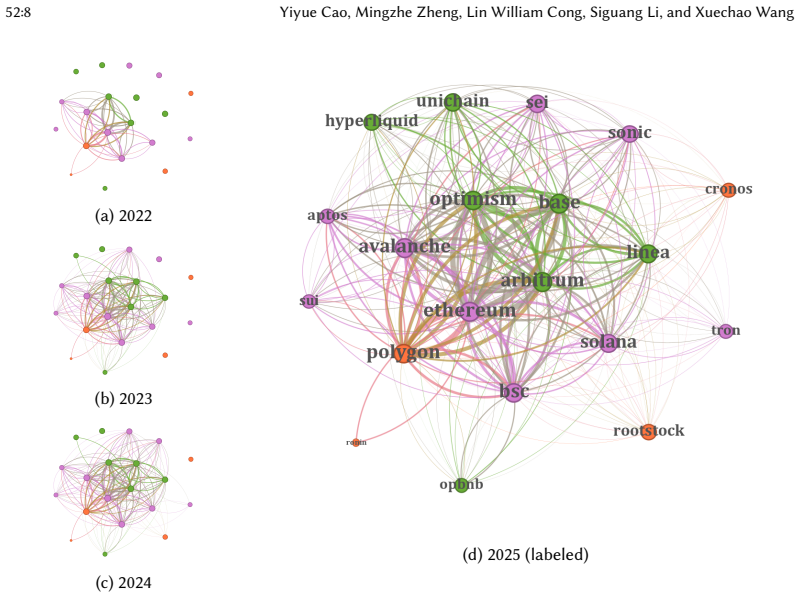
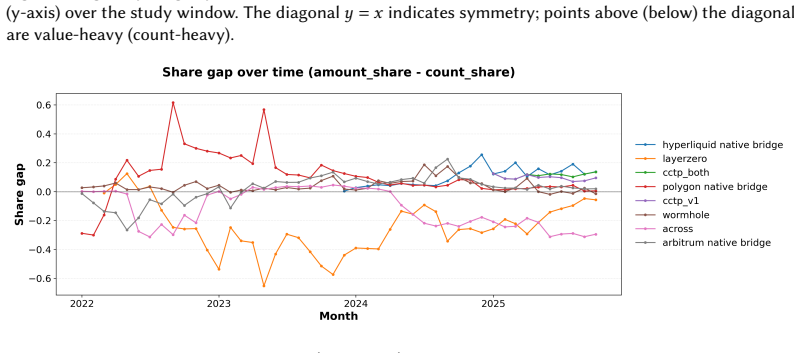
Modeling the multi-chain ecosystem as a time-varying weighted hypergraph yields two metrics: structural interoperability, which reflects bridge coverage and redundancy from deployed infrastructure, and active interoperability, which reflects realized usage through normalized transfer activity. The network evolves into a denser multi-hub core dominated by EVM-compatible chains, yet expansion remains uneven so that many chains achieve wide structural access with limited realized transfers while activity concentrates on narrow routes.
What carries the argument
Time-varying weighted hypergraph that decomposes interoperability into structural coverage from bridges versus normalized transfer activity.
If this is right
- The cross-chain network densifies into a multi-hub structure led by EVM-compatible chains.
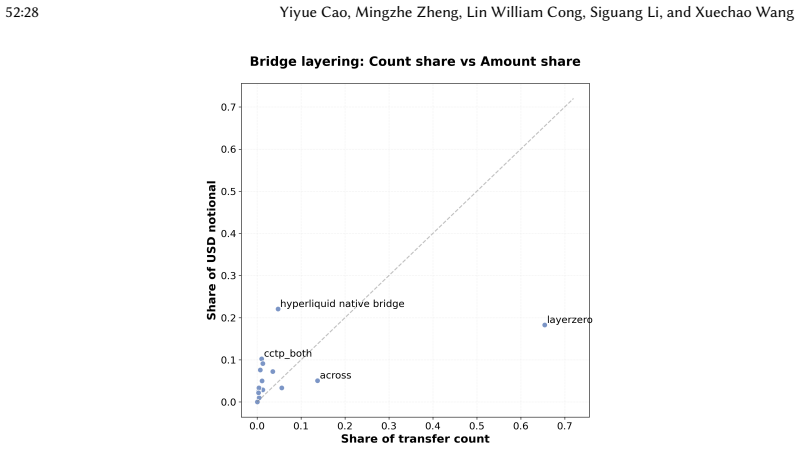
- Some chains obtain broad structural access through bridges yet realize low transfer volumes.
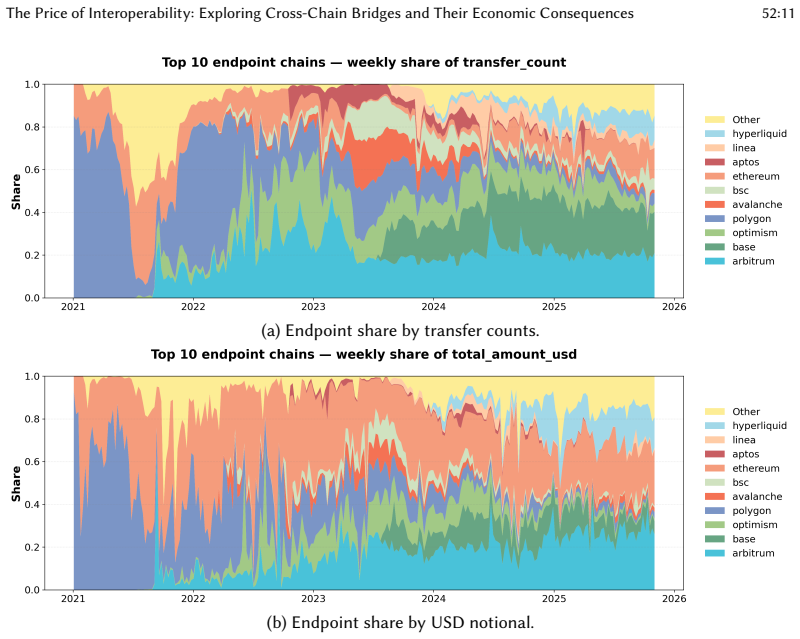
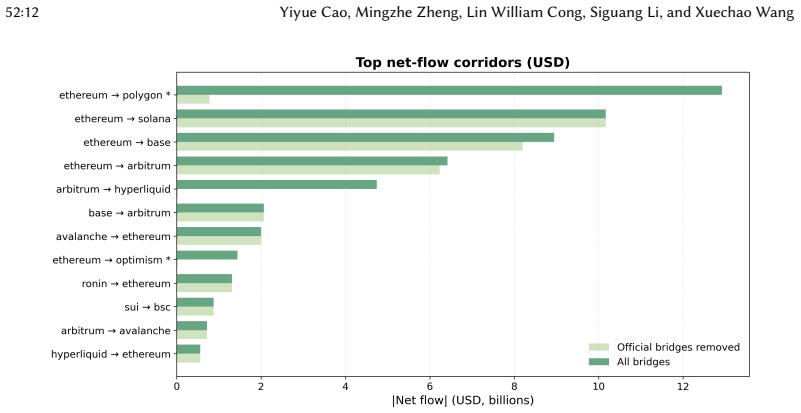
- Cross-chain activity concentrates on a small set of routes rather than spreading broadly.
- Connectivity supplied by infrastructure does not produce economically meaningful liquidity integration.
Where Pith is reading between the lines
- Bridge operators may need usage incentives or route optimization beyond simple deployment to close the gap.
- Liquidity fragmentation across chains could persist even as technical links multiply.
- The hypergraph approach offers a template for measuring integration gaps in other networked payment or asset systems.
Load-bearing premise
The hypergraph model and chosen normalization for transfers accurately separate bridge infrastructure capacity from actual usage without systematic data or metric biases.
What would settle it
A new dataset showing strong positive correlation between structural bridge coverage and normalized transfer volumes across most chains and periods would falsify the divergence result.
Figures


read the original abstract
Modern blockchain ecosystems comprise many heterogeneous networks, creating a growing need for interoperability. Cross-chain bridges provide the core infrastructure for this interoperability by enabling verifiable state transitions that move assets and liquidity across chains. While prior work has focused mainly on bridge design and security, the system-level and economic consequences of cross-chain liquidity interoperability remain less understood. We present a large-scale empirical measurement study of cross-chain interoperability using a dataset spanning 20 blockchains and 16 major bridge protocols from 2022 to 2025. We model the multi-chain ecosystem as a time-varying weighted hypergraph and introduce two complementary metrics. Structural interoperability captures connectivity created by deployed bridge infrastructure, reflecting bridge coverage and redundancy independent of user behavior. Active interoperability captures realized cross-chain usage, measured by normalized transfer activity. This decomposition separates infrastructure capacity from actual utilization and yields several findings. The cross-chain network evolves from a sparse hub-and-spoke structure into a denser multi-hub core led by EVM-compatible chains. Bridge expansion and chain growth are uneven: some chains achieve broad structural access but limited realized usage, whereas others concentrate activity through a small set of routes. Overall, interoperability provision and interoperability use diverge substantially, showing that connectivity alone does not imply economically meaningful integration. These results provide a measurement framework for understanding how cross-chain infrastructure reshapes blockchain market structure and liquidity organization.
Editorial analysis
A structured set of objections, weighed in public.
Referee Report
Summary. The manuscript presents a large-scale empirical measurement study of cross-chain interoperability across 20 blockchains and 16 bridge protocols (2022–2025). It models the ecosystem as a time-varying weighted hypergraph and defines two metrics: structural interoperability (bridge-induced connectivity and redundancy independent of usage) and active interoperability (normalized transfer activity). The central claim is that these diverge substantially—the network evolves from a sparse hub-and-spoke structure to a denser multi-hub core led by EVM-compatible chains—demonstrating that infrastructure provision does not imply economically meaningful integration.
Significance. If the decomposition holds, the work supplies a reproducible measurement framework that separates infrastructure capacity from realized usage, with direct implications for understanding liquidity organization and market structure in multi-chain systems. The temporal scope and scale of the dataset are notable strengths that could support falsifiable follow-on predictions about bridge economics.
major comments (2)
- [§3] §3 (Hypergraph model and metric definitions): The active interoperability metric relies on a normalization of transfer activity whose denominator is not shown to be robust to alternatives such as chain TVL, user-base size, or native-token volatility. Because the reported divergence between structural and active interoperability is the load-bearing claim, any systematic bias in this normalization could artifactually produce the observed gap rather than reflect genuine economic non-integration.
- [§4] §4 (Empirical results and network evolution): No details are supplied on data validation, handling of missing transfers, statistical tests for structural changes, or sensitivity to bridge-selection criteria. These omissions directly affect the reliability of the claim that the network evolves from sparse hub-and-spoke to multi-hub core.
minor comments (2)
- [Figures] Figure 2 (or equivalent time-series plot): axis labels and legend entries for the two interoperability metrics should be made fully explicit so readers can reproduce the normalization step.
- [Methods] The abstract states findings for 2022–2025 but the methods section does not specify the exact end date or any right-censoring adjustments; this should be clarified for reproducibility.
Simulated Author's Rebuttal
We thank the referee for their constructive and detailed comments, which highlight important areas for strengthening the methodological transparency and robustness of our analysis. We address each major comment point by point below and will incorporate the suggested improvements in the revised manuscript.
read point-by-point responses
-
Referee: [§3] The active interoperability metric relies on a normalization of transfer activity whose denominator is not shown to be robust to alternatives such as chain TVL, user-base size, or native-token volatility. Because the reported divergence between structural and active interoperability is the load-bearing claim, any systematic bias in this normalization could artifactually produce the observed gap rather than reflect genuine economic non-integration.
Authors: We agree that robustness checks on the normalization are essential to support the central claim. The active interoperability metric normalizes transfer counts by each chain's total on-chain activity volume to control for scale. In the revision we will add a dedicated sensitivity subsection to §3 that re-computes the metric under three alternative denominators: (i) chain TVL, (ii) number of active addresses as a proxy for user base, and (iii) volatility-adjusted volumes using native-token price data. We will report that the structural-active divergence remains statistically and qualitatively consistent across these specifications, indicating it is not an artifact of the original choice. revision: yes
-
Referee: [§4] No details are supplied on data validation, handling of missing transfers, statistical tests for structural changes, or sensitivity to bridge-selection criteria. These omissions directly affect the reliability of the claim that the network evolves from sparse hub-and-spoke to multi-hub core.
Authors: We acknowledge that the current §4 lacks sufficient methodological detail. In the revised version we will insert a new subsection (4.1) that explicitly describes: (1) data validation steps, including cross-checks against multiple on-chain explorers and bridge APIs; (2) treatment of missing transfers, which are flagged via timestamp gaps and handled by conservative exclusion with robustness checks on imputed subsets; (3) statistical tests for structural evolution, including bootstrap resampling of hypergraph communities and permutation tests for the emergence of the EVM multi-hub core; and (4) sensitivity to bridge-selection criteria, with results replicated on the full set versus a core subset of the 10 largest bridges. These additions will directly substantiate the reported network evolution. revision: yes
Circularity Check
No significant circularity; metrics constructed independently from data
full rationale
The paper defines structural interoperability directly from deployed bridge hyperedges (coverage and redundancy counts) and active interoperability from normalized transfer activity counts, both drawn from the same external dataset of 20 chains and 16 bridges. No equations reduce one metric to a function of the other by construction, no parameters are fitted then relabeled as predictions, and no self-citations or uniqueness theorems are invoked to justify the decomposition. The reported divergence is an empirical comparison of these two independently measured quantities, rendering the central claim self-contained against the raw transfer and bridge-deployment data.
Axiom & Free-Parameter Ledger
axioms (1)
- domain assumption The multi-chain ecosystem can be modeled as a time-varying weighted hypergraph where bridges define hyperedges.
invented entities (2)
-
Structural interoperability metric
no independent evidence
-
Active interoperability metric
no independent evidence
Lean theorems connected to this paper
-
IndisputableMonolith/Cost/FunctionalEquation.leanwashburn_uniqueness_aczel unclearWe model the multi-chain ecosystem as a time-varying weighted hypergraph H_t = (V, E_t) ... Structural interoperability captures the connectivity implied by deployed bridge infrastructure ... Active interoperability captures realized cross-chain usage, measured by normalized transfer activity.
-
IndisputableMonolith/Foundation/ArithmeticFromLogic.leanembed_injective unclearPSI_{ij,t} = ½(1/d_{ij,t} + 1/d_{ji,t}); ASI_{i,t} = Σ_{j≠i} 1/d_{ij,t}; AAI_{i,t} = (F_in + F_out)/TVL_i,t
Forward citations
Cited by 1 Pith paper
-
Unlocking the Forecasting Economy: A Suite of Datasets for the Full Lifecycle of Prediction Market: [Experiments \& Analysis]
A unified relational dataset suite for Polymarket prediction markets integrating over 770k markets, 943M trades, and 2M oracle events with a reproducible collection pipeline.
Reference graph
Works this paper leans on
-
[1]
André Augusto, Rafael Belchior, Miguel Correia, André Vasconcelos, Luyao Zhang, and Thomas Hardjono. 2024. Sok: Security and privacy of blockchain interoperability. In2024 IEEE Symposium on Security and Privacy (SP). IEEE, 3840–3865
work page 2024
- [2]
-
[3]
Anton I Badev and Cy Watsky. 2023. Interconnected DeFi: Ripple effects from the terra collapse. (2023)
work page 2023
-
[4]
Rafael Belchior, André Vasconcelos, Sérgio Guerreiro, and Miguel Correia. 2021. A survey on blockchain interoperability: Past, present, and future trends.Acm Computing Surveys (CSUR)54, 8 (2021), 1–41
work page 2021
-
[5]
Nikita Belenkov, Valerian Callens, Alexandr Murashkin, Kacper Bak, Martin Derka, Jan Gorzny, and Sung-Shine Lee
- [6]
-
[7]
Yinfeng Cao, Jiannong Cao, Dongbin Bai, Long Wen, Yang Liu, and Ruidong Li. 2025. Map the blockchain world: A trustless and scalable blockchain interoperability protocol for cross-chain applications. InProceedings of the ACM on Web Conference 2025. 717–726
work page 2025
-
[8]
Agostino Capponi and Ruizhe Jia. 2025. Liquidity provision on blockchain-based decentralized exchanges.The Review of Financial Studies38, 10 (2025), 3040–3085
work page 2025
-
[9]
Agostino Capponi, Ruizhe Jia, and Shihao Yu. 2026. Price discovery on decentralized exchanges.The Review of Financial Studies(2026), hhag002
work page 2026
-
[10]
Lin William Cong, Xiang Hui, Catherine Tucker, and Luofeng Zhou. 2023. Scaling smart contracts via layer-2 technologies: Some empirical evidence.Management Science69, 12 (2023), 7306–7316
work page 2023
-
[11]
2025.Financial and informational integration through oracle networks
Lin William Cong, Eswar S Prasad, and Daniel Rabetti. 2025.Financial and informational integration through oracle networks. Technical Report. National Bureau of Economic Research
work page 2025
-
[12]
Cosmos SDK. 2026. x/circuit: Circuit Breaker Module Documentation. https://docs.cosmos.network/sdk/v0.50/build/ modules/circuit/README. Accessed 2026-01-13
work page 2026
-
[13]
deBridge. 2026. deBridge DLN API: Daily Statistics Endpoint. https://dln-api.debridge.finance/api/Satistics/getDaily. Accessed 2026-01-13
work page 2026
-
[14]
deBridge. 2026. deBridge DLN API: Orders Filtered List Endpoint. https://stats-api.dln.trade/api/Orders/filteredList. Accessed 2026-01-13
work page 2026
-
[15]
DefiLlama. 2026. DefiLlama API: Historical Chain TVL. https://api.llama.fi/v2/historicalChainTvl/. Accessed 2026-01-13
work page 2026
-
[16]
DefiLlama. 2026. DefiLlama API: Protocol TVL. https://api.llama.fi/protocol. Accessed 2026-01-13
work page 2026
-
[17]
DefiLlama. 2026. DefiLlama Bridges Dashboard. https://defillama.com/bridges. Accessed 2026-01-13
work page 2026
-
[18]
Zhihong Deng, Chunming Tang, Taotao Li, Zhikang Zeng, Parhat Abla, and Debiao He. 2025. SFPoW: Constructing Secure and Flexible Proof-of-Work Sidechains for Cross-Chain Interoperability with Wrapped Assets.IEEE Trans. Comput.(2025)
work page 2025
-
[19]
Dune Analytics. 2026. Dune Analytics. https://dune.com/home. Accessed 2026-01-13
work page 2026
-
[20]
Ethereum Foundation. 2024. Optimistic rollups. https://ethereum.org/developers/docs/scaling/optimistic-rollups/. Accessed 2026-01-13
work page 2024
-
[21]
Ethereum Foundation. 2024. Zero-knowledge rollups. https://ethereum.org/developers/docs/scaling/zk-rollups/. Accessed 2026-01-13
work page 2024
-
[22]
Ethereum Improvement Proposals. 2022. EIP-4844: Shard Blob Transactions. https://eips.ethereum.org/EIPS/eip-4844. Accessed 2026-01-10
work page 2022
-
[23]
Christof Ferreira Torres, Albin Mamuti, Ben Weintraub, Cristina Nita-Rotaru, and Shweta Shinde. 2024. Rolling in the shadows: Analyzing the extraction of mev across layer-2 rollups. InProceedings of the 2024 on ACM SIGSAC Conference on Computer and Communications Security. 2591–2605
work page 2024
-
[24]
Vincent Gramlich, Tobias Guggenberger, Marc Principato, Benjamin Schellinger, and Nils Urbach. 2023. A multivocal literature review of decentralized finance: Current knowledge and future research avenues.Electronic Markets33, 1 (2023), 11
work page 2023
-
[25]
Panpan Han, Zheng Yan, Wenxiu Ding, Shufan Fei, and Zhiguo Wan. 2023. A survey on cross-chain technologies. Distributed ledger technologies: research and practice2, 2 (2023), 1–30
work page 2023
-
[26]
Joel Hasbrouck, Thomas J Rivera, and Fahad Saleh. 2025. An economic model of a decentralized exchange with concentrated liquidity.Management Science(2025)
work page 2025
-
[27]
Joel Hasbrouck, Thomas J Rivera, and Fahad Saleh. 2026. The need for fees at a dex: How increases in fees can increase dex trading volume.Management Science(2026)
work page 2026
- [28]
-
[29]
Xiaohui Hu, Hang Feng, Pengcheng Xia, Gareth Tyson, Lei Wu, Yajin Zhou, and Haoyu Wang. 2024. Piecing Together the Jigsaw Puzzle of Transactions on Heterogeneous Blockchain Networks.Proceedings of the ACM on Measurement and Analysis of Computing Systems8, 3 (2024), 1–27. Proc. ACM Meas. Anal. Comput. Syst., Vol. 10, No. 2, Article 52. Publication date: Ju...
work page 2024
-
[30]
Chuanshan Huang, Tao Yan, and Claudio J Tessone. 2024. Seamlessly Transferring Assets through Layer-0 Bridges: An Empirical Analysis of Stargate Bridge’s Architecture and Dynamics. InCompanion Proceedings of the ACM Web Conference 2024. 1776–1784
work page 2024
-
[31]
Xiaofeng Jia, Zhe Yu, Jun Shao, Rongxing Lu, Guiyi Wei, and Zhenguang Liu. 2023. Cross-chain virtual payment channels.IEEE Transactions on Information Forensics and Security18 (2023), 3401–3413
work page 2023
-
[32]
V. Jose. 2020. yfinance: Yahoo Finance market data downloader. https://github.com/ranaroussi/yfinance. Accessed 2026-01-03
work page 2020
-
[33]
Stefan Kitzler, Friedhelm Victor, Pietro Saggese, and Bernhard Haslhofer. 2023. Disentangling decentralized finance (DeFi) compositions.ACM Transactions on the Web17, 2 (2023), 1–26
work page 2023
-
[34]
Alfred Lehar and Christine Parlour. 2025. Decentralized exchange: The uniswap automated market maker.The Journal of Finance80, 1 (2025), 321–374
work page 2025
-
[35]
Li Li, Jiahao Wu, and Wei Cui. 2023. A review of blockchain cross-chain technology.IET Blockchain3, 3 (2023), 149–158
work page 2023
-
[36]
Wenqing Li, Zhenguang Liu, Jianhai Chen, Zhe Liu, and Qinming He. 2025. Towards Blockchain Interoperability: A Comprehensive Survey on Cross-Chain Solutions.Blockchain: Research and Applications(2025), 100286
work page 2025
-
[37]
MetaMask. 2026. MetaMask Launches Bridge Aggregator in dApp. https://metamask.io/news/metamask-launches- bridge-aggregator-in-dapp-to-easily-move-tokens-across-chains. Accessed 2026-01-13
work page 2026
-
[38]
Mahsa Moosavi, Mehdi Salehi, Daniel Goldman, and Jeremy Clark. 2023. Fast and furious withdrawals from optimistic rollups. In5th Conference on Advances in Financial Technologies (AFT 2023). Schloss Dagstuhl–Leibniz-Zentrum für Informatik, 22–1
work page 2023
-
[39]
2023.Cross-Chain Bridge Stargate’s Volume Soars As Airdrop Hunters Set Sights on LayerZero Token
Binance News. 2023.Cross-Chain Bridge Stargate’s Volume Soars As Airdrop Hunters Set Sights on LayerZero Token. Accessed 2026-01-06
work page 2023
-
[40]
2023.Airdrop hunters send crypto bridge Stargate to new highs
Defillama News. 2023.Airdrop hunters send crypto bridge Stargate to new highs. Accessed 2026-01-06
work page 2023
-
[41]
Jakob Svennevik Notland, Jingyue Li, Mariusz Nowostawski, and Peter Halland Haro. 2025. Sok: Cross-chain bridging architectural design flaws and mitigations.Blockchain: Research and Applications(2025), 100315
work page 2025
-
[42]
Osmosis Labs. 2026. IBC Rate Limit Module. https://github.com/osmosis-labs/osmosis/blob/main/x/ibc-rate-limit/ README.md. Accessed 2026-01-13
work page 2026
-
[43]
Burak Öz, Christof Ferreira Torres, Christoph Schlegel, Bruno Mazorra, Jonas Gebele, Filip Rezabek, and Florian Matthes. 2025. Cross-chain arbitrage: The next frontier of mev in decentralized finance.Proceedings of the ACM on Measurement and Analysis of Computing Systems9, 3 (2025), 1–33
work page 2025
-
[44]
Babu Pillai, Jeyakumar Samantha Tharani, and Vallipuram Muthukkumarasamy. 2025. Wormhole Cross-Chain Bridge Transactions Flow: An Exploratory Study. In2025 IEEE International Conference on Blockchain and Cryptocurrency (ICBC). IEEE, 1–2
work page 2025
-
[45]
Peter Robinson. 2021. Survey of crosschain communications protocols.Computer Networks200 (2021), 108488
work page 2021
-
[46]
Peiyao Sheng, Xuechao Wang, Sreeram Kannan, Kartik Nayak, and Pramod Viswanath. 2023. Trustboost: Boosting trust among interoperable blockchains. InProceedings of the 2023 ACM SIGSAC Conference on Computer and Communications Security. 1571–1584
work page 2023
-
[47]
Shankar Subramanian, André Augusto, Rafael Belchior, André Vasconcelos, and Miguel Correia. 2024. Benchmarking blockchain bridge aggregators. In2024 IEEE International Conference on Blockchain (Blockchain). IEEE, 37–45
work page 2024
-
[48]
Hangyu Tian, Kaiping Xue, Xinyi Luo, Shaohua Li, Jie Xu, Jianqing Liu, Jun Zhao, and David SL Wei. 2021. Enabling cross-chain transactions: A decentralized cryptocurrency exchange protocol.IEEE Transactions on Information Forensics and Security16 (2021), 3928–3941
work page 2021
-
[49]
Wormhole. 2026. WormholeScan Upgrade: Real-Time Data Analytics for the Wormhole Ecosystem. https://wormhole. com/blog/wormholescan-upgrade-real-time-data-analytics-for-the-wormhole-ecosystem. Accessed 2026-01-13
work page 2026
-
[50]
Wormhole Foundation. 2026. WormholeScan API: Operations Endpoint. https://api.wormholescan.io/api/v1/operations. Accessed 2026-01-13
work page 2026
-
[51]
Jiajing Wu, Kaixin Lin, Dan Lin, Bozhao Zhang, Zhiying Wu, and Jianzhong Su. 2025. Safeguarding blockchain ecosystem: Understanding and detecting attack transactions on cross-chain bridges. InProceedings of the ACM on Web Conference 2025. 4902–4912
work page 2025
-
[52]
Kailun Yan, Bo Lu, Pranav Agrawal, Jiasun Li, Wenrui Diao, and Xiaokuan Zhang. 2025. An Empirical Study on Cross-chain Transactions: Costs, Inconsistencies, and Activities. InProceedings of the 20th ACM Asia Conference on Computer and Communications Security. 939–954
work page 2025
-
[53]
Lingyuan Yin, Jing Xu, and Qiang Tang. 2021. Sidechains with fast cross-chain transfers.IEEE Transactions on Dependable and Secure Computing19, 6 (2021), 3925–3940
work page 2021
-
[54]
Alexei Zamyatin, Mustafa Al-Bassam, Dionysis Zindros, Eleftherios Kokoris-Kogias, Pedro Moreno-Sanchez, Aggelos Kiayias, and William J. Knottenbelt. 2021. SoK: Communication across distributed ledgers. InFinancial Cryptography and Data Security (FC) (LNCS, Vol. 12675). Springer, 3–36. doi:10.1007/978-3-662-64331-0_1 Proc. ACM Meas. Anal. Comput. Syst., Vo...
-
[55]
Jiashuo Zhang, Jianbo Gao, Yue Li, Ziming Chen, Zhi Guan, and Zhong Chen. 2022. Xscope: Hunting for cross-chain bridge attacks. InProceedings of the 37th IEEE/ACM International Conference on Automated Software Engineering. 1–4
work page 2022
-
[56]
Mengya Zhang, Xiaokuan Zhang, Yinqian Zhang, and Zhiqiang Lin. 2024. Security of cross-chain bridges: Attack surfaces, defenses, and open problems. InProceedings of the 27th International Symposium on Research in Attacks, Intrusions and Defenses. 298–316. A Dune-Based Extraction Details Dune is used as the primary on-chain measurement back-end for (i) cha...
work page 2024
discussion (0)
Sign in with ORCID, Apple, or X to comment. Anyone can read and Pith papers without signing in.