Recognition: 2 theorem links
· Lean TheoremAlertStar: Path-Aware Alert Prediction on Hyper-Relational Knowledge Graphs
Pith reviewed 2026-05-13 19:39 UTC · model grok-4.3
The pith
AlertStar predicts network alerts by fusing local qualifier metadata with path information entirely in embedding space, outperforming full-graph propagation methods.
A machine-rendered reading of the paper's core claim, the machinery that carries it, and where it could break.
Core claim
AlertStar fuses qualifier context and structural path information entirely in embedding space via cross-attention and learned path composition, while its multi-task extension MT-AlertStar jointly predicts tail, relation, and qualifier values without full knowledge graph propagation, achieving superior mean rank, mean reciprocal rank, and Hits@k on inductive alert prediction tasks.
What carries the argument
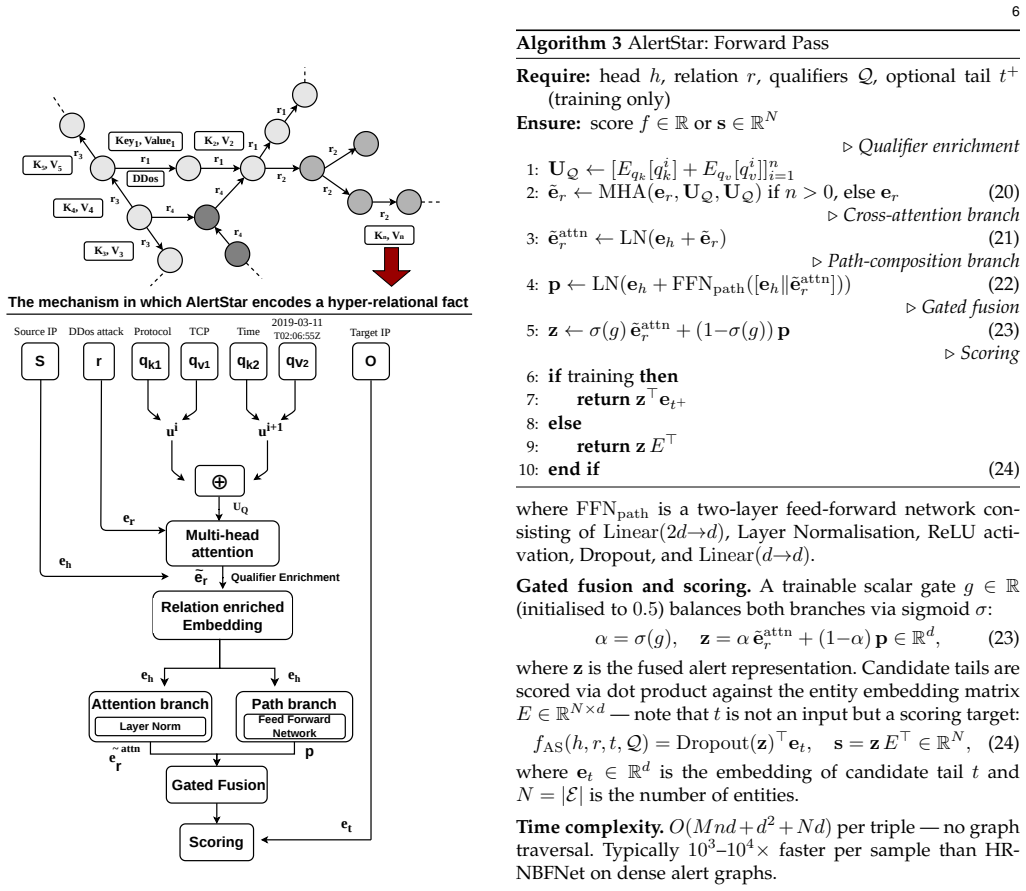
AlertStar, which fuses qualifier context and structural path information entirely in embedding space via cross-attention and learned path composition
Load-bearing premise
Representing network alerts as qualified statements with flow-level metadata captures the semantic depth needed for effective path reasoning over attacker-victim interactions.
What would settle it
An experiment in which a global path-propagation model matches or exceeds AlertStar and MT-AlertStar on MRR and Hits@k across the same Warden and UNSW-NB15 qualifier-density splits would falsify the superiority of local fusion.
Figures




read the original abstract
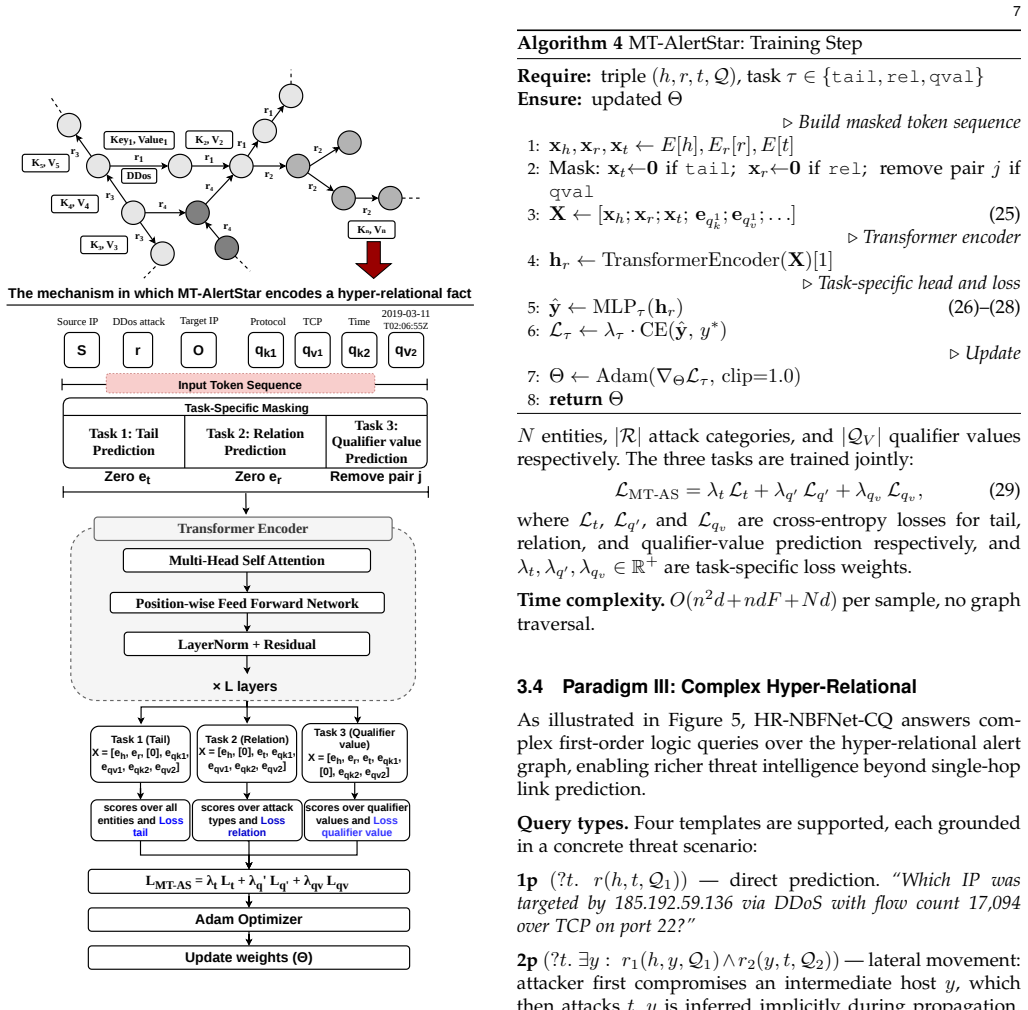
Cyber-attacks continue to grow in scale and sophistication, yet existing network intrusion detection approaches lack the semantic depth required for path reasoning over attacker-victim interactions. We address this by first modelling network alerts as a knowledge graph, then formulating hyper-relational alert prediction as a hyper-relational knowledge graph completion (HR-KGC) problem, representing each network alert as a qualified statement (h, r, t, Q), where h and t are source and destination IPs, r denotes the attack type, and Q encodes flow-level metadata such as timestamps, ports, protocols, and attack intensity, going beyond standard KGC binary triples (h, r, t) that would discard this contextual richness. We introduce five models across three contributions: first, Hyper-relational Neural Bellman-Ford (HR-NBFNet) extends Neural Bellman-Ford Networks to the hyper-relational setting with qualifier-aware multi-hop path reasoning, while its multi-task variant MT-HR-NBFNet jointly predicts tail, relation, and qualifier-value within a single traversal pass; second, AlertStar fuses qualifier context and structural path information entirely in embedding space via cross-attention and learned path composition, and its multi-task extension MT-AlertStar eliminates the overhead of full knowledge graph propagation; third, HR-NBFNet-CQ extends qualifier-aware representations to answer complex first-order logic queries, including one-hop, two-hop chain, two-anchor intersection, and union, enabling multi-condition threat reasoning over the alert knowledge graph. Evaluated inductively on the Warden and UNSW-NB15 benchmarks across three qualifier-density regimes, AlertStar and MT-AlertStar achieve superior MR, MRR, and Hits@k, demonstrating that local qualifier fusion is both sufficient and more efficient than global path propagation for hyper-relational alert prediction.
Editorial analysis
A structured set of objections, weighed in public.
Referee Report
Summary. The manuscript models network alerts as hyper-relational knowledge graphs, representing each alert as a qualified statement (h, r, t, Q) with flow-level metadata. It introduces HR-NBFNet extending Neural Bellman-Ford to hyper-relational settings with qualifier-aware path reasoning, AlertStar using cross-attention for local qualifier fusion, and their multi-task variants, plus HR-NBFNet-CQ for complex queries. Inductive evaluation on Warden and UNSW-NB15 benchmarks across qualifier-density regimes shows AlertStar and MT-AlertStar achieving superior MR, MRR, and Hits@k, claiming local fusion is sufficient and more efficient than global path propagation.
Significance. If the empirical results hold, the work offers an efficient approach to hyper-relational alert prediction in cybersecurity by avoiding full knowledge graph propagation, potentially enabling faster threat reasoning while maintaining semantic depth through qualifiers. The extension to complex queries further broadens applicability to multi-condition threat detection.
major comments (2)
- [Abstract] The central claim that local qualifier fusion is both sufficient and more efficient than global path propagation for hyper-relational alert prediction is not supported by any reported graph statistics, such as the distribution of path lengths between (h,r,t) pairs or average degrees in the induced alert KGs on Warden and UNSW-NB15. Without these, the benchmarks may be dominated by short or isolated statements, rendering the comparison to HR-NBFNet-style multi-hop propagation uninformative.
- [Evaluation] The abstract reports superior MR, MRR, and Hits@k for AlertStar and MT-AlertStar but provides no details on baselines, statistical significance tests, ablation studies, or experimental setup, preventing verification of the performance claims.
minor comments (1)
- [Abstract] The description of the five models across three contributions could be clarified by explicitly listing them and their relationships.
Simulated Author's Rebuttal
We thank the referee for the constructive feedback on our manuscript. The comments highlight opportunities to strengthen the empirical grounding of our claims and improve clarity in the abstract and evaluation sections. We address each major comment below and will revise the manuscript accordingly.
read point-by-point responses
-
Referee: [Abstract] The central claim that local qualifier fusion is both sufficient and more efficient than global path propagation for hyper-relational alert prediction is not supported by any reported graph statistics, such as the distribution of path lengths between (h,r,t) pairs or average degrees in the induced alert KGs on Warden and UNSW-NB15. Without these, the benchmarks may be dominated by short or isolated statements, rendering the comparison to HR-NBFNet-style multi-hop propagation uninformative.
Authors: We agree that graph statistics would better contextualize our central claim. In the revised version, we will add a dedicated paragraph in the experimental setup section reporting the distribution of path lengths between (h,r,t) pairs and average degrees in the induced alert KGs for both Warden and UNSW-NB15 across the three qualifier-density regimes. These statistics will show that the benchmarks contain meaningful multi-hop structure, supporting the informativeness of the comparison between local fusion (AlertStar) and global propagation (HR-NBFNet). revision: yes
-
Referee: [Evaluation] The abstract reports superior MR, MRR, and Hits@k for AlertStar and MT-AlertStar but provides no details on baselines, statistical significance tests, ablation studies, or experimental setup, preventing verification of the performance claims.
Authors: The full manuscript already describes the baselines (HR-NBFNet, MT-HR-NBFNet, and variants), inductive evaluation protocol, and ablation studies in Sections 4 and 5. However, we acknowledge that explicit statistical significance tests are absent. In revision we will add paired significance tests (e.g., Wilcoxon signed-rank) to the results tables and briefly reference the main baselines and qualifier-density regimes in the abstract to improve verifiability without exceeding length limits. revision: partial
Circularity Check
Minor extension of prior Neural Bellman-Ford techniques with no load-bearing circularity
full rationale
The paper models alerts as qualified hyper-relational statements and extends Neural Bellman-Ford Networks to HR-NBFNet while introducing AlertStar for local cross-attention fusion. The superiority claims rest on inductive evaluation across qualifier-density regimes on Warden and UNSW-NB15, without any quoted equations or self-citations that reduce the predictions (MR/MRR/Hits@k) to fitted inputs or prior results by construction. No self-definitional loops, fitted-input predictions, or ansatz smuggling appear in the derivation chain.
Axiom & Free-Parameter Ledger
free parameters (1)
- neural network hyperparameters
Lean theorems connected to this paper
-
IndisputableMonolith/Cost/FunctionalEquation.leanwashburn_uniqueness_aczel unclear?
unclearRelation between the paper passage and the cited Recognition theorem.
AlertStar fuses qualifier context and structural path information entirely in embedding space via cross-attention and learned path composition
-
IndisputableMonolith/Foundation/AbsoluteFloorClosure.leanreality_from_one_distinction unclear?
unclearRelation between the paper passage and the cited Recognition theorem.
HR-NBFNet extends Neural Bellman-Ford Networks to the hyper-relational setting with qualifier-aware multi-hop path reasoning
What do these tags mean?
- matches
- The paper's claim is directly supported by a theorem in the formal canon.
- supports
- The theorem supports part of the paper's argument, but the paper may add assumptions or extra steps.
- extends
- The paper goes beyond the formal theorem; the theorem is a base layer rather than the whole result.
- uses
- The paper appears to rely on the theorem as machinery.
- contradicts
- The paper's claim conflicts with a theorem or certificate in the canon.
- unclear
- Pith found a possible connection, but the passage is too broad, indirect, or ambiguous to say the theorem truly supports the claim.
Reference graph
Works this paper leans on
-
[1]
Pre- dictive methods in cyber defense: Current experience and research challenges,
M. Hus ´ak, V . Barto ˇs, P . Sokol, and A. Gajdo ˇs, “Pre- dictive methods in cyber defense: Current experience and research challenges,”Future Generation Computer Systems, vol. 115, pp. 517–530, 2021
work page 2021
-
[2]
DeepAG: Attack Graph Construction and Threats Prediction With Bi-Directional Deep Learning,
T. Li, Y. Jiang, C. Lin, M. S. Obaidat, Y. Shen, and J. Ma, “DeepAG: Attack Graph Construction and Threats Prediction With Bi-Directional Deep Learning,”IEEE Transactions on Dependable and Secure Computing, vol. 20, no. 1, pp. 740–757, 2023
work page 2023
-
[3]
Message passing for hyper-relational knowledge graphs,
M. Galkin, P . Trivedi, G. Maheshwari, R. Usbeck, and J. Lehmann, “Message passing for hyper-relational knowledge graphs,” inProceedings of the 2020 confer- ence on empirical methods in natural language processing (EMNLP), 2020, pp. 7346–7359
work page 2020
-
[4]
Query embedding on hyper-relational knowledge graphs,
D. Alivanistos, M. Berrendorf, M. Cochez, and M. Galkin, “Query embedding on hyper-relational knowledge graphs,”arXiv preprint arXiv:2106.08166, 2021
-
[5]
Representation learning on hyper-relational and numeric knowledge graphs with transformers,
C. Chung, J. Lee, and J. J. Whang, “Representation learning on hyper-relational and numeric knowledge graphs with transformers,” inProceedings of the 29th ACM SIGKDD Conference on Knowledge Discovery and Data Mining, 2023, pp. 310–322
work page 2023
-
[6]
Neu- ral bellman-ford networks: A general graph neural network framework for link prediction,
Z. Zhu, Z. Zhang, L.-P . Xhonneux, and J. Tang, “Neu- ral bellman-ford networks: A general graph neural network framework for link prediction,”Advances in neural information processing systems, vol. 34, pp. 29 476– 29 490, 2021
work page 2021
-
[7]
RotatE: Knowledge Graph Embedding by Relational Rotation in Complex Space
Z. Sun, Z.-H. Deng, J.-Y. Nie, and J. Tang, “Rotate: Knowledge graph embedding by relational rotation in complex space,”arXiv preprint arXiv:1902.10197, 2019
work page Pith review arXiv 1902
-
[8]
R. Bellman, “On a routing problem,”Quarterly of applied mathematics, vol. 16, no. 1, pp. 87–90, 1958
work page 1958
-
[9]
Shrinking embeddings for hyper-relational knowledge graphs,
B. Xiong, M. Nayyeri, S. Pan, and S. Staab, “Shrinking embeddings for hyper-relational knowledge graphs,” inProceedings of the 61st Annual Meeting of the Associa- tion for Computational Linguistics (Volume 1: Long Papers), 2023, pp. 13 306–13 320
work page 2023
-
[10]
Transformerg2g: Adaptive time-stepping for learning temporal graph embeddings using transformers,
A. J. Varghese, A. Bora, M. Xu, and G. E. Karniadakis, “Transformerg2g: Adaptive time-stepping for learning temporal graph embeddings using transformers,”Neu- ral Networks, vol. 172, p. 106086, 2024
work page 2024
-
[11]
Alert prediction in computer networks using deep graph learning,
Z. M. Nayeri and M. Rezvani, “Alert prediction in computer networks using deep graph learning,” in 2024 10th International Conference on Signal Processing and Intelligent Systems (ICSPIS). IEEE, 2024, pp. 1–5
work page 2024
-
[12]
——, “Alert prediction in computer networks using transformer-based temporal graph neural networks: Identifying the next victim,”Journal of Network and Computer Applications, p. 104455, 2026. Zahra Makki Nayeriis a Ph.D. candidate at Shahrood University of Technology and currently a visiting researcher at the University of Stuttgart, Germany, where she con...
work page 2026
discussion (0)
Sign in with ORCID, Apple, or X to comment. Anyone can read and Pith papers without signing in.