BLADE: Better Language Answers through Dialogue and Explanations
Pith reviewed 2026-05-16 09:19 UTC · model grok-4.3
The pith
A conversational AI that surfaces course excerpts and prompts engagement rather than giving answers improves students' navigation and conceptual performance.
A machine-rendered reading of the paper's core claim, the machinery that carries it, and where it could break.
Core claim
BLADE uses a retrieval-augmented generation framework over curated course content to surface pedagogically relevant excerpts in response to student queries, prompting direct engagement with source materials rather than delivering final answers, and an impact study demonstrates that this improves navigation of course resources and conceptual performance compared to providing the full inventory of resources.
What carries the argument
Retrieval-augmented generation over curated course content that dynamically surfaces excerpts and prompts engagement with sources instead of providing solutions.
If this is right
- Students spend more time directly with course materials rather than relying on synthesized answers.
- Conceptual understanding increases because learners perform the work of connecting excerpts to their questions.
- Active learning and evidence-based reasoning are reinforced in the classroom setting.
- The method can be applied across different course resource configurations without requiring new content creation.
Where Pith is reading between the lines
- The same dialogue pattern could be tested in non-CS courses where resource navigation is similarly fragmented.
- Longer-term retention might improve if students form habits of consulting primary materials instead of accepting generated summaries.
- Integration with existing learning platforms could reduce the temptation for students to bypass assigned readings.
Load-bearing premise
The impact study properly controls for student prior knowledge, motivation, and presentation differences between conditions so that gains can be attributed to the dialogue behavior.
What would settle it
A replication in which students with matched prior knowledge using BLADE show no measurable improvement in resource navigation or conceptual test scores compared to the full-inventory condition would falsify the central claim.
Figures

read the original abstract
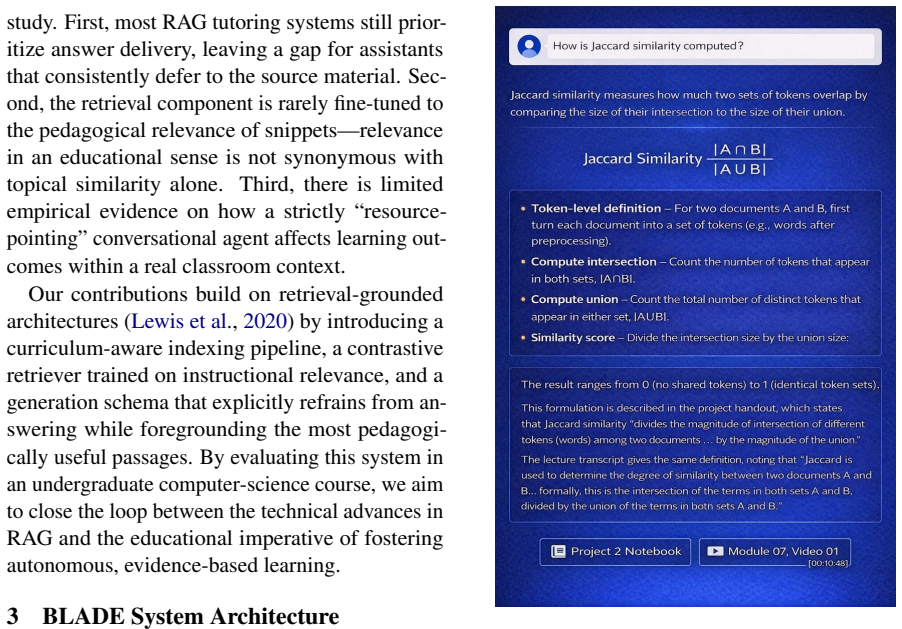
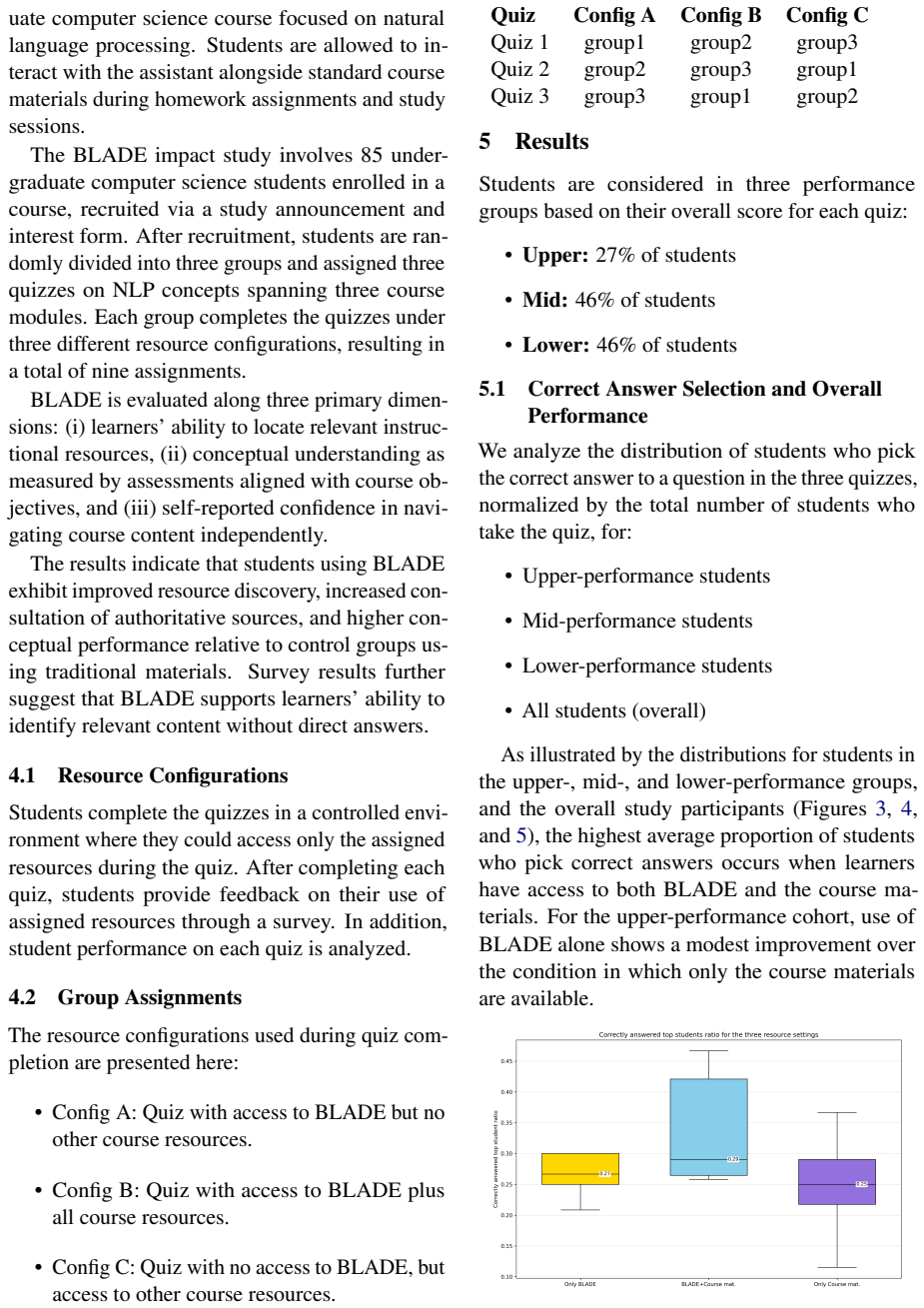
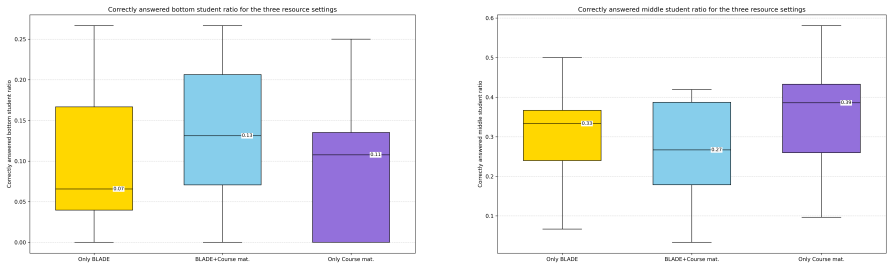
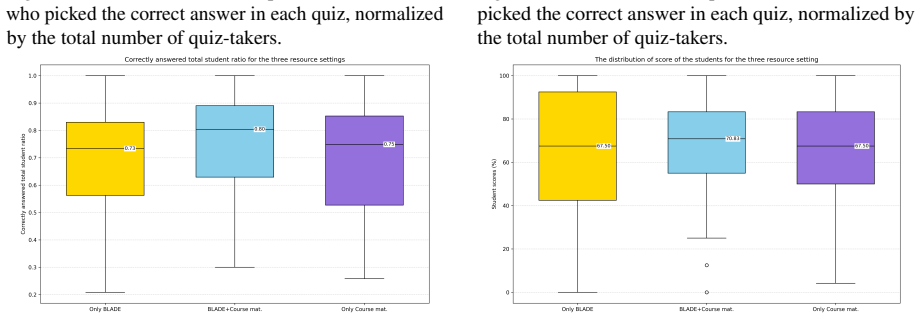
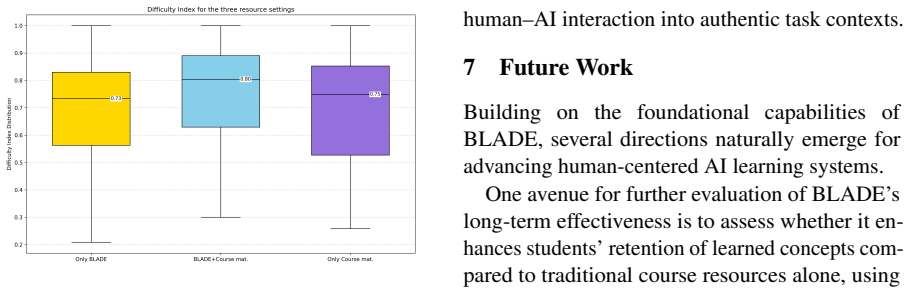
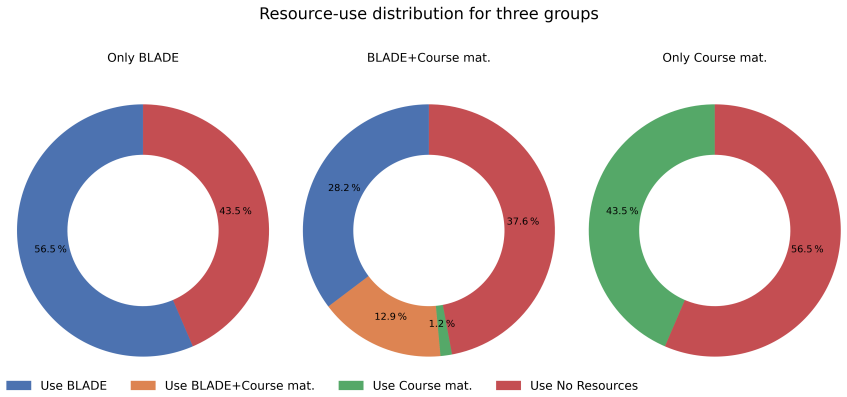
Large language model (LLM)-based educational assistants often provide direct answers that short-circuit learning by reducing exploration, self-explanation, and engagement with course materials. We present BLADE (Better Language Answers through Dialogue and Explanations), a grounded conversational assistant that guides learners to relevant instructional resources rather than supplying immediate solutions. BLADE uses a retrieval-augmented generation (RAG) framework over curated course content, dynamically surfacing pedagogically relevant excerpts in response to student queries. Instead of delivering final answers, BLADE prompts direct engagement with source materials to support conceptual understanding. We conduct an impact study in an undergraduate computer science course, with different course resource configurations and show that BLADE improves students' navigation of course resources and conceptual performance compared to simply providing the full inventory of course resources. These results demonstrate the potential of grounded conversational AI to reinforce active learning and evidence-based reasoning.
Editorial analysis
A structured set of objections, weighed in public.
Referee Report
Summary. The paper introduces BLADE, a RAG-based conversational assistant that uses dialogue to guide learners to relevant course resources and excerpts rather than supplying direct answers, with the goal of supporting active engagement and conceptual understanding. It reports results from an impact study in an undergraduate computer science course claiming that BLADE improves students' navigation of course resources and conceptual performance relative to simply providing the full inventory of course resources.
Significance. If the empirical comparison holds after proper controls and reporting, the work could inform the design of educational AI systems that prioritize guided exploration over direct answers, addressing a known risk that LLMs reduce student engagement with primary materials.
major comments (2)
- [Impact Study] Impact Study section (and abstract): the manuscript asserts positive results on resource navigation and conceptual performance but supplies no information on participant numbers, randomization procedure, pre-test measures of prior knowledge, statistical tests, effect sizes, or exclusion criteria. Without these, the central claim that gains are attributable to BLADE's dialogue behavior cannot be evaluated.
- [Impact Study] Impact Study section: the comparison condition is described only as 'simply providing the full inventory of course resources,' with no detail on whether both arms used identical interfaces, prompting language, or delivery format. This leaves open the possibility that interface differences or selection effects, rather than the RAG-driven explanatory mechanism, produced any observed delta.
minor comments (1)
- [Abstract] Abstract: the phrase 'with different course resource configurations' is used without defining what those configurations are or how they map onto the reported comparison.
Simulated Author's Rebuttal
We thank the referee for the constructive comments on the Impact Study. We agree that additional methodological details are needed to support the claims and will revise the manuscript to provide them.
read point-by-point responses
-
Referee: [Impact Study] Impact Study section (and abstract): the manuscript asserts positive results on resource navigation and conceptual performance but supplies no information on participant numbers, randomization procedure, pre-test measures of prior knowledge, statistical tests, effect sizes, or exclusion criteria. Without these, the central claim that gains are attributable to BLADE's dialogue behavior cannot be evaluated.
Authors: We acknowledge the need for fuller reporting of the experimental design. The revised manuscript will expand the Impact Study section to report participant numbers, the randomization procedure, pre-test measures of prior knowledge, the statistical tests performed (including p-values and effect sizes), and exclusion criteria. These additions will allow readers to properly assess whether the observed gains can be attributed to BLADE. revision: yes
-
Referee: [Impact Study] Impact Study section: the comparison condition is described only as 'simply providing the full inventory of course resources,' with no detail on whether both arms used identical interfaces, prompting language, or delivery format. This leaves open the possibility that interface differences or selection effects, rather than the RAG-driven explanatory mechanism, produced any observed delta.
Authors: We agree that the description of the control condition requires clarification to address potential confounds. In the revision, we will specify that both conditions used identical interfaces and delivery formats, with the sole difference being the presence of BLADE's guided dialogue versus direct access to the complete resource inventory. We will also describe steps taken to minimize selection effects. revision: yes
Circularity Check
No circularity: empirical impact study with no derivations or self-referential reductions
full rationale
The paper describes a RAG-based conversational system (BLADE) and reports results from an impact study comparing it to providing the full inventory of course resources. No equations, fitted parameters, predictions derived from inputs, or self-citations appear in the provided text. The central claim rests on an empirical comparison of student navigation and performance outcomes rather than any quantity defined in terms of itself. The derivation chain is self-contained as a system presentation plus observational study, with no load-bearing steps that reduce by construction to the paper's own inputs.
Axiom & Free-Parameter Ledger
Lean theorems connected to this paper
-
IndisputableMonolith/Cost/FunctionalEquation.leanwashburn_uniqueness_aczel unclear?
unclearRelation between the paper passage and the cited Recognition theorem.
BLADE uses a retrieval-augmented generation (RAG) framework over curated course content, dynamically surfacing pedagogically relevant excerpts... prompts direct engagement with source materials
What do these tags mean?
- matches
- The paper's claim is directly supported by a theorem in the formal canon.
- supports
- The theorem supports part of the paper's argument, but the paper may add assumptions or extra steps.
- extends
- The paper goes beyond the formal theorem; the theorem is a base layer rather than the whole result.
- uses
- The paper appears to rely on the theorem as machinery.
- contradicts
- The paper's claim conflicts with a theorem or certificate in the canon.
- unclear
- Pith found a possible connection, but the passage is too broad, indirect, or ambiguous to say the theorem truly supports the claim.
Reference graph
Works this paper leans on
-
[1]
Zeyad Alshaikh, Lasagn Tamang, and Vasile Rus. 2020. https://doi.org/10.1007/978-3-030-52240-7_3 A Socratic Tutor for Source Code Comprehension . In Artificial Intelligence in Education , pages 15--19, Cham. Springer International Publishing
-
[2]
Owen Henkel, Zach Levonian, Chenglu Li, and Millie Postle. 2024. https://doi.org/10.5281/zenodo.12729824 Retrieval-augmented Generation to Improve Math Question - Answering : Trade -offs Between Groundedness and Human Preference . pages 315--320
-
[3]
Caitlin Kelleher, Randy Pausch, and Sara Kiesler. 2007. https://doi.org/10.1145/1240624.1240844 Storytelling alice motivates middle school girls to learn computer programming . In Proceedings of the SIGCHI Conference on Human Factors in Computing Systems 2007, CHI 2007 , pages 1455--1464. Association for Computing Machinery
-
[4]
Patrick Lewis, Ethan Perez, Aleksandra Piktus, Fabio Petroni, Vladimir Karpukhin, Naman Goyal, Heinrich Küttler, Mike Lewis, Wen-tau Yih, Tim Rocktäschel, Sebastian Riedel, and Douwe Kiela. 2020. https://proceedings.neurips.cc/paper/2020/hash/6b493230205f780e1bc26945df7481e5-Abstract.html Retrieval- Augmented Generation for Knowledge - Intensive NLP Tasks...
work page 2020
-
[5]
Zongxi Li, Zijian Wang, Weiming Wang, Kevin Hung, Haoran Xie, and Fu Lee Wang. 2025. https://doi.org/10.1016/j.caeai.2025.100417 Retrieval-augmented generation for educational application: A systematic survey . Computers and Education: Artificial Intelligence, 8:100417
-
[6]
Jean Piaget. 1973. To understand is to invent: The future of education
work page 1973
-
[7]
Kelly Rivers and Kenneth R. Koedinger. 2014. https://doi.org/10.1007/978-3-319-07221-0_41 Automating Hint Generation with Solution Space Path Construction . In David Hutchison, Takeo Kanade, Josef Kittler, Jon M. Kleinberg, Alfred Kobsa, Friedemann Mattern, John C. Mitchell, Moni Naor, Oscar Nierstrasz, C. Pandu Rangan, Bernhard Steffen, Demetri Terzopoul...
-
[8]
Henry L. Roediger and Andrew C. Butler. 2011. https://doi.org/10.1016/j.tics.2010.09.003 The critical role of retrieval practice in long-term retention . Trends in Cognitive Sciences, 15(1):20--27
-
[9]
ENTRY address archivePrefix author booktitle chapter edition editor eid eprint eprinttype howpublished institution journal key month note number organization pages publisher school series title type volume year doi pubmed url lastchecked label extra.label sort.label short.list INTEGERS output.state before.all mid.sentence after.sentence after.block STRING...
-
[10]
" write newline "" before.all 'output.state := FUNCTION n.dashify 't := "" t empty not t #1 #1 substring "-" = t #1 #2 substring "--" = not "--" * t #2 global.max substring 't := t #1 #1 substring "-" = "-" * t #2 global.max substring 't := while if t #1 #1 substring * t #2 global.max substring 't := if while FUNCTION word.in bbl.in capitalize " " * FUNCT...
discussion (0)
Sign in with ORCID, Apple, or X to comment. Anyone can read and Pith papers without signing in.