Recognition: no theorem link
Design and Implementation of an Open-Source Security Framework for Cloud Infrastructure
Pith reviewed 2026-05-13 20:30 UTC · model grok-4.3
The pith
An open-source framework builds identity-resource graphs across Kubernetes and OpenStack to cut cloud security assessment time from 120 minutes to 18 minutes.
A machine-rendered reading of the paper's core claim, the machinery that carries it, and where it could break.
Core claim
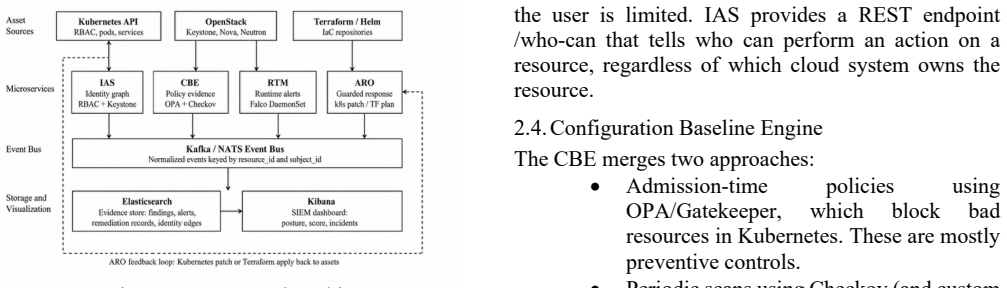
The framework contributes a cross-platform identity-resource graph for Kubernetes and OpenStack, a policy-to-evidence data model that connects OPA/Gatekeeper and Checkov results to live assets, an identity-aware correlation algorithm that reduces noisy alerts, and a guarded remediation workflow that converts violations into Kubernetes patches or Terraform plans. In a 50-200 node private-cloud testbed the system reduced assessment time from 120.4 +/- 6.8 min to 18.2 +/- 1.7 min, lowered the false-positive rate from 12.1% to 4.7%, and increased checked component coverage from 48% to 92%.
What carries the argument
The cross-platform identity-resource graph that links live assets to policy violations and enables the correlation algorithm.
If this is right
- Security assessment time drops by roughly 85 percent in comparable private-cloud settings.
- False-positive alerts fall by more than half, reducing operator overload.
- Checked component coverage rises from under half to over 90 percent.
- Observable events tied to injected violations decrease by 62 percent within the 30-day test window.
- One-year operating costs for a 200-node deployment fall by about 40 percent under the reported model.
Where Pith is reading between the lines
- The same graph-plus-correlation approach could be tested on additional cloud platforms beyond Kubernetes and OpenStack.
- Guarded remediation steps might shorten the time from detection to fix in automated pipelines.
- The identity-aware filtering technique could apply to other high-volume alert systems such as network or application monitoring.
- Releasing the framework as open source allows direct measurement of adoption and maintenance costs outside the original testbed.
Load-bearing premise
Results from a 50-200 node private-cloud testbed with injected misconfigurations and a 30-day operational window accurately represent real production cloud environments and workloads.
What would settle it
Running the same workloads on a public-cloud cluster of several hundred nodes with live traffic and finding that assessment time stays above 60 minutes or false-positive rate stays above 8 percent.
Figures
read the original abstract
Misconfiguration, excessive privilege, and fragmented controls remain major causes of cloud-infrastructure incidents. This paper proposes an open-source framework that contributes a cross-platform identity-resource graph for Kubernetes and OpenStack, a policy-to-evidence data model linking OPA/Gatekeeper and Checkov results to live assets, an identity-aware correlation algorithm for reducing noisy runtime alerts, and a guarded remediation workflow that converts validated policy violations into Kubernetes patches or Terraform plans. The evaluation is made reproducible by specifying workload generation, injected misconfiguration classes, run repetitions, metric definitions, and statistical reporting. In a 50-200 node private-cloud testbed, the framework reduced assessment time from 120.4 +/- 6.8 min to 18.2 +/- 1.7 min, lowered the false-positive rate from 12.1% to 4.7%, and increased checked component coverage from 48% to 92%. The reported 62% reduction in observable events corresponding to injected violations and approximately 40% cost reduction are scoped to the defined 30-day operational test and one-year 200-node cost model, respectively, and are not claimed as hyperscale results.
Editorial analysis
A structured set of objections, weighed in public.
Referee Report
Summary. The paper proposes an open-source security framework for cloud infrastructure featuring a cross-platform identity-resource graph for Kubernetes and OpenStack, a policy-to-evidence data model linking OPA/Gatekeeper and Checkov outputs to live assets, an identity-aware correlation algorithm to reduce noisy alerts, and a guarded remediation workflow that produces Kubernetes patches or Terraform plans. The evaluation, conducted in a 50-200 node private-cloud testbed with specified workload generation, injected misconfiguration classes, 30-day operational runs, and statistical reporting, claims reductions in assessment time (120.4 ± 6.8 min to 18.2 ± 1.7 min), false-positive rate (12.1% to 4.7%), and increases in checked component coverage (48% to 92%), plus a 62% drop in observable events and ~40% cost reduction under a one-year 200-node model.
Significance. If the reported deltas are robust, the work would deliver a practical, reproducible open-source contribution to cloud security by addressing alert fatigue and coverage gaps through graph-based correlation and policy linking. The explicit specification of workload generation, metrics, and statistical methods is a strength that supports potential community reuse and extension, though the private-cloud scope limits immediate claims about hyperscale production impact.
major comments (2)
- [Evaluation] Evaluation section: the manuscript specifies workload generation, injected misconfiguration classes, run repetitions, metric definitions, and statistical reporting to support reproducibility, but does not report sensitivity analysis showing that the identity-resource graph and OPA/Checkov correlation retain the claimed FP reduction (12.1% → 4.7%) and coverage increase (48% → 92%) when the injected violation taxonomy is replaced by an independent set drawn from public incident corpora. This analysis is load-bearing for the central empirical claims.
- [Evaluation] Evaluation section: the 50-200 node private-cloud testbed with fixed injected classes over 30 days is used to support the assessment-time and cost-model results, yet no quantitative comparison or ablation is provided against organic misconfiguration distributions or multi-tenant production workloads; without this, the representativeness of the observed deltas remains unverified.
minor comments (2)
- [Abstract] Abstract: the scoping language ('not claimed as hyperscale results') is appropriate and should be retained or expanded in the main text.
- [Introduction] The paper introduces the terms 'cross-platform identity-resource graph' and 'policy-to-evidence data model' without an early dedicated figure or table summarizing their data schemas; adding one would improve readability.
Simulated Author's Rebuttal
We thank the referee for the constructive and detailed feedback on our manuscript. The comments highlight important aspects of evaluation robustness that we address point-by-point below. We plan to make targeted revisions to the evaluation section to improve clarity on scope and limitations while preserving the reproducibility strengths of the current design.
read point-by-point responses
-
Referee: [Evaluation] Evaluation section: the manuscript specifies workload generation, injected misconfiguration classes, run repetitions, metric definitions, and statistical reporting to support reproducibility, but does not report sensitivity analysis showing that the identity-resource graph and OPA/Checkov correlation retain the claimed FP reduction (12.1% → 4.7%) and coverage increase (48% → 92%) when the injected violation taxonomy is replaced by an independent set drawn from public incident corpora. This analysis is load-bearing for the central empirical claims.
Authors: We acknowledge the value of sensitivity analysis using an independent violation set from public incident corpora. Our injected taxonomy was derived from widely cited sources including CIS Kubernetes and OpenStack benchmarks, OWASP cloud security top risks, and common misconfiguration patterns from industry reports to ensure coverage of high-impact issues. A full re-run with a newly curated public corpus would require extensive additional data collection and mapping effort beyond the current study scope. In the revised manuscript we will add an expanded discussion in the evaluation section justifying the taxonomy selection with explicit references to these sources, report alignment statistics between our classes and public benchmarks, and clearly delineate this as a limitation with planned future work on external corpora validation. This will better contextualize the reported FP reduction and coverage gains without overstating generalizability. revision: partial
-
Referee: [Evaluation] Evaluation section: the 50-200 node private-cloud testbed with fixed injected classes over 30 days is used to support the assessment-time and cost-model results, yet no quantitative comparison or ablation is provided against organic misconfiguration distributions or multi-tenant production workloads; without this, the representativeness of the observed deltas remains unverified.
Authors: The private-cloud testbed with controlled injections was deliberately selected to support statistical rigor, precise timing measurements, and full reproducibility as documented in the workload generation and metric sections. Organic multi-tenant production data introduces privacy constraints, incomplete ground truth, and uncontrolled variability that would undermine the controlled statistical reporting we provide. We agree this limits direct claims about hyperscale representativeness. In the revision we will insert a new limitations subsection that (1) details the rationale for the testbed design, (2) provides a qualitative mapping of our injected classes to distributions reported in public cloud incident surveys (e.g., Verizon DBIR, Cloud Security Alliance reports), and (3) discusses implications for multi-tenant settings. We will also add a brief ablation note on how the identity-resource graph and correlation algorithm contribute to the observed deltas under the tested conditions. revision: partial
Circularity Check
No significant circularity; empirical testbed results are direct measurements
full rationale
The paper reports measured performance deltas (assessment time, false-positive rate, coverage) from running the implemented framework on a specified 50-200 node private-cloud testbed with defined injected misconfiguration classes, workload generation, and metric definitions. These outcomes are presented as experimental results rather than derived predictions or equations. No self-definitional loops, fitted parameters renamed as predictions, load-bearing self-citations, uniqueness theorems, or ansatzes appear in the derivation chain. The reproducibility specifications enable external verification and do not create circularity by construction. The central claims remain independent of the reported inputs.
Axiom & Free-Parameter Ledger
axioms (1)
- domain assumption The 50-200 node private-cloud testbed with injected misconfiguration classes accurately models real-world cloud infrastructure and workloads.
invented entities (2)
-
cross-platform identity-resource graph
no independent evidence
-
policy-to-evidence data model
no independent evidence
Forward citations
Cited by 2 Pith papers
-
AI Native Asset Intelligence
The paper presents a modeling-plus-scoring framework that turns fragmented security signals into stable asset-level importance scores by separating intrinsic exposure from business and data context, evaluated on 131k ...
-
AI Native Asset Intelligence
AI-native asset intelligence framework converts heterogeneous security signals into normalized asset importance scores by separating intrinsic exposure from contextual factors using modeling and deterministic aggregation.
Reference graph
Works this paper leans on
-
[1]
Testbed Tests were conducted in a reproducible laboratory private-cloud testbed
EXPERIMENT 3.1. Testbed Tests were conducted in a reproducible laboratory private-cloud testbed. All nodes used the same OS image, container runtime, clock synchronization settings, and pinned tool versions. Before each run, Elasticsearch indices were cleared, the Terraform state was reset to a known baseline, and Kubernetes/OpenStack inventories were reg...
work page 2024
-
[2]
DISCUSSION The experiments confirm three points. First, breadth of coverage matters more than depth of a single tool. Baseline-A illustrates the cost of a depth-only stance: Falco's runtime sensors detected container-level anomalies—including the privileged-pod, shell-in-container, and crypto-miner classes injected during the experiment—but the tool's sco...
work page 2024
-
[3]
Kubernetes Documentation, "Using RBAC Authorization." [Online]. Available: https://kubernetes.io/docs/reference/access-authn-authz/rbac/. [Accessed: Apr. 2026]
work page 2026
-
[4]
Available: https://kubernetes.io/docs/concepts/security/service-accounts/
[Online]. Available: https://kubernetes.io/docs/concepts/security/service-accounts/. [Accessed: Apr. 2026]
work page 2026
-
[5]
The Falco Project, "Falco Documentation." [Online]. Available: https://falco.org/docs/. [Accessed: Apr. 2026]
work page 2026
-
[6]
The Falco Project, "Basic Elements of Falco Rules." [Online]. Available: https://falco.org/docs/concepts/rules/basic-elements/. [Accessed: Apr. 2026]
work page 2026
-
[7]
Available: https://openpolicyagent.org/docs/kubernetes
[Online]. Available: https://openpolicyagent.org/docs/kubernetes. [Accessed: Apr. 2026]
work page 2026
-
[8]
Open Policy Agent Gatekeeper, "ConstraintTemplates." [Online]. Available: https://open-policy-agent.github.io/gatekeeper/website/docs/constrainttemplates/. [Accessed: Apr. 2026]
work page 2026
- [9]
- [10]
- [11]
- [12]
-
[13]
Get Started with Elastic Security SIEM: Detect and Respond to Threats
Elastic, "Get Started with Elastic Security SIEM: Detect and Respond to Threats." [Online]. Available: https://www.elastic.co/docs/solutions/security/get-started/get-started-detect-with-siem. [Accessed: Apr. 2026]
work page 2026
-
[14]
Terraform plan and apply Command References
HashiCorp Developer, "Terraform plan and apply Command References." [Online]. Available: https://developer.hashicorp.com/terraform/cli/commands/plan; https://developer.hashicorp.com/terraform/cli/commands/apply. [Accessed: Apr. 2026]
work page 2026
-
[15]
Available: https://owasp.org/www-project-kubernetes-top-ten/
[Online]. Available: https://owasp.org/www-project-kubernetes-top-ten/. [Accessed: Apr. 2026]
work page 2026
discussion (0)
Sign in with ORCID, Apple, or X to comment. Anyone can read and Pith papers without signing in.