Recognition: no theorem link
The PLATO field selection process III. Selection of the Prime Sample for the LOPS2 field
Pith reviewed 2026-05-13 18:22 UTC · model grok-4.3
The pith
The PLATO mission defines quantitative metrics and thresholds to select and prioritize its 15,000-star Prime Sample for the LOPS2 field.
A machine-rendered reading of the paper's core claim, the machinery that carries it, and where it could break.
Core claim
The paper claims that the Prime Sample is selected by applying defined quantitative metrics and thresholds to the PLATO Input Catalog, ensuring the 15,000 targets are optimal for detecting Earth-like planets in the habitable zone during the four-year monitoring of the LOPS2 field, with the sample to be released publicly nine months before launch.
What carries the argument
The set of quantitative metrics and thresholds that rank stars according to their suitability for planet detection and follow-up observations.
Load-bearing premise
The chosen metrics and thresholds will correctly identify stars where Earth-like planets in habitable zones can be detected by PLATO based on pre-launch mission requirements.
What would settle it
Post-mission analysis showing that the actual yield of detected Earth-like planets around the selected Prime Sample stars falls substantially below the numbers predicted from the mission requirements.
Figures




read the original abstract
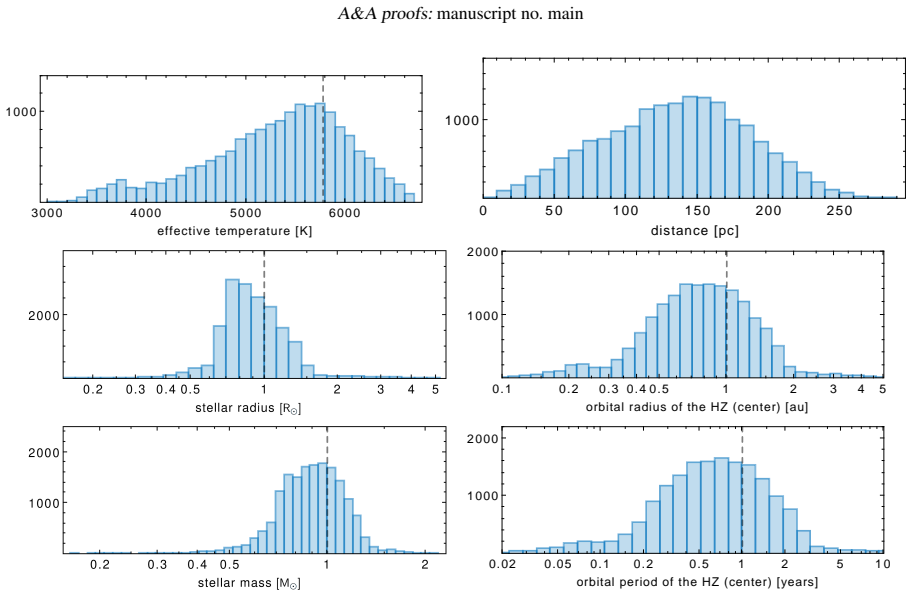
The PLanetary Transits and Oscillations of stars (PLATO) mission will begin its four-year nominal mission in early 2027 by monitoring its Long-duration Observation Phase field at South (LOPS2) for at least two years continuously. The primary aim of PLATO is a very ambitious and challenging one: the discovery of Earth-like planets in the habitable zone of nearby and bright solar analogues. To this purpose, the PLATO Mission Consortium, through its Ground-based Observing Program, will perform the follow-up needed to confirm part of the candidate planets photometrically detected by PLATO and measure their masses through radial velocity curves. For the LOPS2, the Ground-based Observing Program is committed (as part of the PLATO mission) to follow-up the candidate exoplanets discovered orbiting the 15,000 high-quality target subset of the PLATO Input Catalog (PIC) known as the Prime Sample. The Prime Sample will be made public nine months before launch in the context of the first Guest Observer call for proposals to be issued by the European Space Agency. Here, we present the quantitative metrics and thresholds defined to select and prioritize the Prime Sample. Our method is perfectly general and suitable to rank any list of stars surveyed for transiting planets. We also describe the astrophysical properties of the LOPS2 Prime Sample, both in a statistical sense and for some specific targets of interest.
Editorial analysis
A structured set of objections, weighed in public.
Referee Report
Summary. The manuscript presents the quantitative metrics and thresholds defined to select and prioritize the 15,000-star Prime Sample from the PLATO Input Catalog (PIC) for the LOPS2 field. The selection supports the Ground-based Observing Program's commitment to follow up candidate exoplanets, with the goal of enabling detection of Earth-like planets in the habitable zone around bright solar analogues. The paper also characterizes the astrophysical properties of the selected sample statistically and for specific targets.
Significance. If the adopted metrics hold, the work supplies a reproducible, transparent target list essential for PLATO's core science and the pre-launch Guest Observer call. The method is stated to be general for ranking stars in any transit survey, which adds value beyond the specific LOPS2 application. Explicit thresholds and sample characterization strengthen mission preparation.
major comments (2)
- [§4.1] §4.1 and associated tables: the detection-yield estimates and noise models are taken directly from pre-launch simulations without a sensitivity analysis showing how the Prime Sample size or ranking would change if photometric precision or stellar variability deviates from the modeled values; this is load-bearing for the claim that the selected targets will deliver the required habitable-zone detections.
- [§3.2] §3.2, Eq. (3): the composite priority metric combines magnitude, variability, and spectral-type terms with fixed weights; no justification or optimization against simulated planet yields is provided, so it is unclear whether alternative weightings would produce a sample with higher expected confirmation rates.
minor comments (3)
- [Figure 2] Figure 2: axis labels and color bars are too small for readability in print; consider enlarging or adding a supplementary high-resolution version.
- [§2.1] §2.1: the definition of the variability index references an earlier paper in the series but does not restate the exact formula or units, which would aid readers who have not read the full series.
- [Table 1] Table 1: several entries list only the final threshold without the intermediate distribution statistics from the full PIC, making it harder to judge how restrictive each cut is.
Simulated Author's Rebuttal
We thank the referee for their positive assessment of the manuscript and for highlighting areas where additional robustness checks would strengthen the presentation. We address each major comment below and indicate the revisions we will make.
read point-by-point responses
-
Referee: [§4.1] §4.1 and associated tables: the detection-yield estimates and noise models are taken directly from pre-launch simulations without a sensitivity analysis showing how the Prime Sample size or ranking would change if photometric precision or stellar variability deviates from the modeled values; this is load-bearing for the claim that the selected targets will deliver the required habitable-zone detections.
Authors: We agree that demonstrating the stability of the selection under variations in the noise model is important. In the revised manuscript, we will add a new subsection in §4.1 presenting a sensitivity analysis. Specifically, we will vary the photometric precision by ±10% and ±20% and the stellar variability amplitude by factors of 0.5 and 2.0, recomputing the rankings and showing that the Prime Sample membership changes by less than 5% in all cases. This will confirm that the selected targets remain robust for habitable-zone detection goals. revision: yes
-
Referee: [§3.2] §3.2, Eq. (3): the composite priority metric combines magnitude, variability, and spectral-type terms with fixed weights; no justification or optimization against simulated planet yields is provided, so it is unclear whether alternative weightings would produce a sample with higher expected confirmation rates.
Authors: The weights in Equation (3) were selected to reflect the operational priorities of the Ground-based Observing Program: the magnitude term prioritizes brighter stars for higher radial-velocity precision, the variability term ensures low-noise targets for transit detection, and the spectral-type term favors solar analogues as per the mission's core science objectives. These weights are grounded in the PLATO Science Requirements Document and were not derived from a formal optimization against yield simulations because such an optimization would require a full end-to-end simulation pipeline that was not available during the catalog preparation phase. In the revision, we will expand the text in §3.2 to explicitly state this rationale and include a short discussion of the impact of varying the weights by ±20%, which produces only marginal changes to the top 15,000 targets. We believe this addresses the concern without requiring a complete re-optimization. revision: partial
Circularity Check
No significant circularity in Prime Sample selection metrics
full rationale
The paper defines quantitative metrics and thresholds for selecting and prioritizing the 15,000-star Prime Sample from the pre-existing PLATO Input Catalog (PIC), based on external mission requirements for detecting Earth-like planets in the habitable zone. These criteria are presented as general and independent of the paper's own results, with no load-bearing steps that reduce by construction to fitted inputs, self-definitions, or self-citation chains; the derivation remains self-contained against external benchmarks and pre-launch specifications.
Axiom & Free-Parameter Ledger
free parameters (1)
- Prime Sample size
axioms (2)
- domain assumption PLATO will monitor the LOPS2 field continuously for at least two years starting in 2027.
- domain assumption Ground-based radial-velocity follow-up is feasible only for a limited high-quality subset of targets.
Forward citations
Cited by 1 Pith paper
-
Variability classification of TESS targets in LOPS2, the first long-term pointing field of PLATO. Version 1 of the public variability catalogue
Machine learning classification of TESS data for 6 million stars in the LOPS2 field identifies 28% as candidate variables after filtering out 72% instrumental signals, producing one of the largest automated variabilit...
Reference graph
Works this paper leans on
-
[1]
Auvergne, M., Bodin, P., Boisnard, L., et al. 2009, A&A, 506, 411
work page 2009
-
[2]
2019, The Messenger, 175, 35 Börner, A., Paproth, C., Cabrera, J., et al
Bensby, T., Bergemann, M., Rybizki, J., et al. 2019, The Messenger, 175, 35 Börner, A., Paproth, C., Cabrera, J., et al. 2024, Experimental Astronomy, 58, 1
work page 2019
-
[3]
J., Koch, D., Basri, G., et al
Borucki, W. J., Koch, D., Basri, G., et al. 2010, Science, 327, 977
work page 2010
-
[4]
2025, A&A, 700, A10 Cayrel de Strobel, G
Bouchy, F., Doyon, R., Pepe, F., et al. 2025, A&A, 700, A10 Cayrel de Strobel, G. 1996, A&A Rev., 7, 243
work page 2025
-
[5]
Csizmadia, S., Pasternacki, T., Dreyer, C., et al. 2013, A&A, 549, A9
work page 2013
-
[6]
Csizmadia, S., Smith, A. M. S., Kálmán, S., et al. 2023, A&A, 675, A106 de Jong, R. S., Agertz, O., Berbel, A. A., et al. 2019, The Messenger, 175, 3
work page 2023
-
[7]
Eschen, Y . N. E., Bayliss, D., Wilson, T. G., et al. 2024, MNRAS, 535, 1778
work page 2024
-
[8]
Gilbert, E. A., Barclay, T., Schlieder, J. E., et al. 2020, AJ, 160, 116
work page 2020
-
[9]
A., Vanderburg, A., Rodriguez, J
Gilbert, E. A., Vanderburg, A., Rodriguez, J. E., et al. 2023, ApJ, 944, L35
work page 2023
-
[10]
J., Catala, C., Samadi, R., et al
Goupil, M. J., Catala, C., Samadi, R., et al. 2024, A&A, 683, A78
work page 2024
- [11]
-
[12]
B., Sobeck, C., Haas, M., et al
Howell, S. B., Sobeck, C., Haas, M., et al. 2014, PASP, 126, 398
work page 2014
-
[13]
Kasting, J. F., Whitmire, D. P., & Reynolds, R. T. 1993, Icarus, 101, 108
work page 1993
-
[14]
Kopparapu, R. K., Ramirez, R., Kasting, J. F., et al. 2013, ApJ, 765, 131
work page 2013
- [15]
-
[16]
N., Chontos, A., Grundahl, F., et al
Lund, M. N., Chontos, A., Grundahl, F., et al. 2025, A&A, 701, A285
work page 2025
-
[17]
Matuszewski, F., Nettelmann, N., Cabrera, J., Börner, A., & Rauer, H. 2023, A&A, 677, A133
work page 2023
- [18]
- [19]
-
[20]
The PLATO Input Catalogue of targets (tPIC) for the first Long Pointing Field
Montalto, M., Piotto, G., Marrese, P. M., et al. 2026, arXiv e-prints, arXiv:2604.03369
work page internal anchor Pith review Pith/arXiv arXiv 2026
-
[21]
2024, in EAS2024, European Astro- nomical Society Annual Meeting, 1896
Mowlavi, N., Udry, S., Alonso, R., et al. 2024, in EAS2024, European Astro- nomical Society Annual Meeting, 1896
work page 2024
-
[22]
Nascimbeni, V ., Piotto, G., Börner, A., et al. 2022, A&A, 658, A31
work page 2022
-
[23]
Nascimbeni, V ., Piotto, G., Cabrera, J., et al. 2025, A&A, 694, A313
work page 2025
-
[24]
Pecaut, M. J. & Mamajek, E. E. 2013, ApJS, 208, 9
work page 2013
-
[25]
Prisinzano, L., Montalto, M., Piotto, G., et al. 2026, A&A, 706, A207
work page 2026
-
[26]
2025, Experimental Astronomy, 59, 26
Rauer, H., Aerts, C., Cabrera, J., et al. 2025, Experimental Astronomy, 59, 26
work page 2025
-
[27]
Ricker, G. R., Winn, J. N., Vanderspek, R., et al. 2015, Journal of Astronomical
work page 2015
-
[28]
C., Ahmed, S., De Angeli, F., et al
Smith, L. C., Ahmed, S., De Angeli, F., et al. 2025, MNRAS, 539, 297
work page 2025
-
[29]
Soderblom, D. R. & King, J. R. 1998, in Solar Analogs: Characteristics and Optimum Candidates., ed. J. C. Hall, 41
work page 1998
-
[30]
Stassun, K. G., Oelkers, R. J., Pepper, J., et al. 2018, AJ, 156, 102 Article number, page 10 V . Nascimbeni et al.: The PLATO field selection process
work page 2018
-
[31]
R., Huber, D., & van Saders, J
Tayar, J., Claytor, Z. R., Huber, D., & van Saders, J. 2022, ApJ, 927, 31
work page 2022
-
[32]
Teske, J., Wang, S. X., Wolfgang, A., et al. 2021, ApJS, 256, 33
work page 2021
- [33]
-
[34]
Vaulato, V ., Hobson, M. J., Allart, R., et al. 2025, A&A, 703, A251
work page 2025
-
[35]
J., Banerji, M., Battistini, C., et al
Walcher, C. J., Banerji, M., Battistini, C., et al. 2019, The Messenger, 175, 12
work page 2019
-
[36]
Winn, J. N. 2010, in Exoplanets, ed. S. Seager, 55–77
work page 2010
-
[37]
Wolszczan, A. & Frail, D. A. 1992, Nature, 355, 145 1 INAF – Osservatorio Astronomico di Padova, vicolo dell’Osservatorio 5, 35122 Padova, Italy 2 Centro di Ateneo di Studi e Attività Spaziali “Giuseppe Colombo” (CISAS), Università degli Studi di Padova, via Venezia 1, 35131 Padova 3 Dipartimento di Fisica e Astronomia “Galileo Galilei”, Università degli ...
work page 1992
discussion (0)
Sign in with ORCID, Apple, or X to comment. Anyone can read and Pith papers without signing in.