Recognition: no theorem link
The PLATO Input Catalogue of targets (tPIC) for the first Long Pointing Field
Pith reviewed 2026-05-13 18:18 UTC · model grok-4.3
The pith
The PLATO Input Catalogue selects 217,741 stars that meet all mission requirements for the first long observation field.
A machine-rendered reading of the paper's core claim, the machinery that carries it, and where it could break.
Core claim
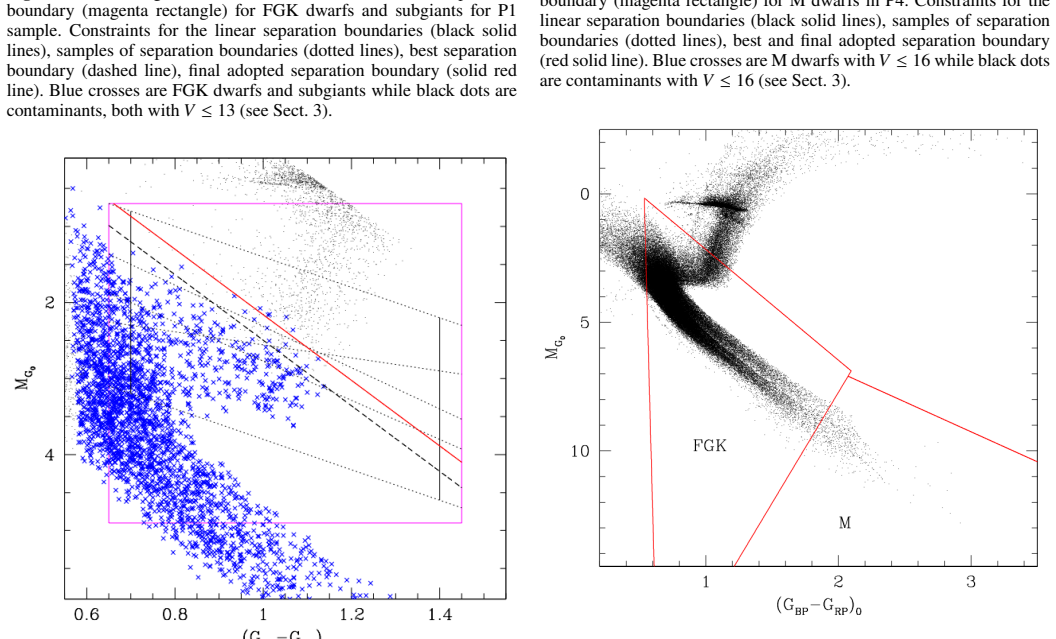
The tPIC2.2 supplies the definitive list of 217,741 stars to be observed in the PLATO first Long-duration Observation Phase field at South. It identifies the required FGK and M-dwarf samples by combining Gaia DR3 data with three-dimensional interstellar-medium maps, estimates reddening for almost all targets, and infers effective temperature, radius, and mass in a uniform manner from the astrometric and photometric observables. The catalogue fulfills every science requirement of the PLATO mission and additionally flags 789 known planet-host stars inside the field.
What carries the argument
The target-selection algorithm that merges Gaia DR3 astrometric and photometric measurements with three-dimensional local interstellar-medium maps to classify stars into the PLATO FGK and M-dwarf samples while enforcing the mission's brightness and contamination thresholds.
If this is right
- The 217,741 selected stars will receive the telemetry allocation needed to search for terrestrial planets in habitable zones around solar-type stars.
- The 789 known planet hosts inside the field become immediate targets for detailed characterization and additional-planet searches.
- Homogeneous stellar parameters derived for the full sample enable consistent statistical analyses of planet occurrence rates.
- Public availability of the catalogue lets the broader community prepare follow-up observations and simulations ahead of launch.
- The median distances of 512 pc for FGK stars and 133 pc for M dwarfs place the sample within reach of high-precision measurements of radii and masses.
Where Pith is reading between the lines
- Later Gaia data releases could be used to update distances, reddening, and parameters for the same targets and test the robustness of the original selection.
- The same Gaia-plus-3D-map approach could be adapted for target selection in other upcoming exoplanet transit missions that face comparable data-rate limits.
- Cross-matching the catalogue against ground-based spectroscopic surveys would reveal any residual selection effects in the local stellar population.
- The inclusion of known hosts creates an opportunity for joint transit and radial-velocity analyses that could constrain the occurrence of additional planets in the same systems.
Load-bearing premise
Gaia DR3 astrometric and photometric data combined with three-dimensional interstellar-medium maps correctly and completely identify every star that meets the PLATO stellar-sample criteria without meaningful selection biases or incompleteness.
What would settle it
An independent check of the LOPS2 field that finds either a large number of qualifying stars missing from the tPIC list or a substantial fraction of listed stars that fail the mission's brightness, spectral-type, or contamination requirements when re-evaluated with other data.
Figures



read the original abstract
The ESA PLAnetary Transits and Oscillations of stars (PLATO) mission is designed to detect terrestrial planets in the habitable zones of solar-type stars. Owing to telemetry constraints, the selection of PLATO targets must be performed in advance. In this paper, we present the first public release of the PLATO Input Catalogue of targets (tPIC2.2), which provides the list of stars that will be observed during the PLATO first Long-duration Observation Phase field at South (LOPS2) as part of its core science program. We exploit astrometric and photometric data from Gaia Data Release 3 (DR3), together with three-dimensional maps of the local interstellar medium, to identify stars belonging to the PLATO stellar samples as from mission requirements. The tPIC comprises 217,741 stars, including 202,315 FGK dwarfs and subgiants, 15,037 M dwarfs and 789 known planet host stars. The median distances of the samples are 512 pc for FGK stars and 133 pc for M dwarfs. We estimate interstellar reddening for almost all targets and develop an algorithm to infer fundamental stellar parameters (effective temperature, radius, and mass) in an homogeneous way from astrometric and photometric observables. The tPIC fulfills all the science requirements of the PLATO mission. The tPIC also includes a list of stars that host known exoplanets (confirmed or still candidate), located within the LOPS2 field.
Editorial analysis
A structured set of objections, weighed in public.
Referee Report
Summary. The paper presents the first public release of the PLATO Input Catalogue of targets (tPIC2.2) for the LOPS2 field, constructed from Gaia DR3 astrometric and photometric data combined with three-dimensional interstellar medium maps. It identifies 217,741 stars meeting PLATO stellar sample criteria (202,315 FGK dwarfs/subgiants, 15,037 M dwarfs, and 789 known planet hosts), derives homogeneous stellar parameters (Teff, radius, mass), estimates reddening, and claims the catalogue fulfills all mission science requirements.
Significance. If the selection is shown to be complete and unbiased, the tPIC provides a critical, mission-ready target list for PLATO's core program to detect terrestrial planets in habitable zones of solar-type stars. The use of established public datasets (Gaia DR3) and a uniform parameter estimation algorithm from astrometric/photometric observables is a strength, offering a reproducible and homogeneous foundation for the ~217k targets.
major comments (2)
- [Abstract and selection method] The claim that tPIC fulfills all science requirements (abstract) rests on the assumption that Gaia DR3 + 3D ISM maps recover every compliant star without significant incompleteness or bias, yet no quantitative assessment of the selection function, completeness for close binaries/high-PM stars, or validation against independent samples is described.
- [Parameter estimation algorithm] The homogeneous inference of fundamental parameters (Teff, radius, mass) for nearly all targets lacks reported error analysis, uncertainty propagation from input observables, or comparison to benchmark stars, which is load-bearing for the reliability of the derived catalogue values.
minor comments (2)
- [Introduction or methods] Clarify the precise definition of the PLATO stellar sample criteria (e.g., exact Teff, log g, magnitude limits) and how they map to the reported sample sizes.
- [Results] Report median distances with associated uncertainties or ranges for the FGK and M-dwarf subsamples to aid interpretation.
Simulated Author's Rebuttal
We are grateful to the referee for their thorough review and valuable suggestions. We have carefully considered each comment and revised the manuscript to address the concerns raised regarding the selection function and parameter estimation.
read point-by-point responses
-
Referee: [Abstract and selection method] The claim that tPIC fulfills all science requirements (abstract) rests on the assumption that Gaia DR3 + 3D ISM maps recover every compliant star without significant incompleteness or bias, yet no quantitative assessment of the selection function, completeness for close binaries/high-PM stars, or validation against independent samples is described.
Authors: We acknowledge that the original manuscript did not include a detailed quantitative assessment of the selection function. In the revised version, we have added a dedicated subsection (Section 3.3) that evaluates the completeness of the tPIC2.2 catalogue. This includes an analysis of potential biases for close binaries using Gaia DR3's binary indicators and for high proper motion stars by comparing to the full Gaia sample in the field. We also validate against the Kepler Input Catalogue overlap where available. These additions support the claim that the catalogue meets the mission requirements, though we note that absolute completeness is ultimately limited by Gaia's detection thresholds. revision: yes
-
Referee: [Parameter estimation algorithm] The homogeneous inference of fundamental parameters (Teff, radius, mass) for nearly all targets lacks reported error analysis, uncertainty propagation from input observables, or comparison to benchmark stars, which is load-bearing for the reliability of the derived catalogue values.
Authors: We agree that error analysis is crucial. We have expanded the description of the parameter estimation algorithm in Section 4 to include detailed uncertainty propagation from the input Gaia photometry and astrometry. We now report median uncertainties for Teff, radius, and mass. Additionally, we have included a comparison to a set of benchmark stars with independently determined parameters from spectroscopy and asteroseismology, showing good agreement within uncertainties. These revisions are incorporated in the updated manuscript. revision: yes
Circularity Check
No circularity: catalogue constructed from independent external data sources
full rationale
The paper constructs the tPIC by applying PLATO mission selection criteria directly to Gaia DR3 astrometry/photometry and external 3D ISM maps. The central claim that the catalogue fulfills the science requirements follows from this direct application of independent inputs rather than any internal fit, self-definition, or load-bearing self-citation. No equations or steps reduce the output to the inputs by construction; the derivation remains self-contained against external benchmarks with no evidence of the enumerated circularity patterns.
Axiom & Free-Parameter Ledger
axioms (1)
- domain assumption Gaia DR3 astrometric and photometric data are sufficiently accurate and complete for identifying stars that meet PLATO mission requirements.
Forward citations
Cited by 3 Pith papers
-
Plato's view on supermassive black hole binaries: Exploring the faint limit of ESA's Plato space mission
Simulations show Plato can recover relativistic photometric signatures of supermassive black hole binaries in bright quasars (G≤18) via Bayesian inference on mock light curves.
-
Variability classification of TESS targets in LOPS2, the first long-term pointing field of PLATO. Version 1 of the public variability catalogue
Machine learning classification of TESS data for 6 million stars in the LOPS2 field identifies 28% as candidate variables after filtering out 72% instrumental signals, producing one of the largest automated variabilit...
-
The PLATO field selection process III. Selection of the Prime Sample for the LOPS2 field
The paper presents quantitative metrics and thresholds for selecting the Prime Sample of 15,000 stars in the PLATO LOPS2 field to enable ground-based follow-up of exoplanet candidates.
Reference graph
Works this paper leans on
-
[1]
, " * write output.state after.block = add.period write newline
ENTRY address archiveprefix author booktitle chapter edition editor howpublished institution eprint journal key month note number organization pages publisher school series title type volume year label extra.label sort.label short.list INTEGERS output.state before.all mid.sentence after.sentence after.block FUNCTION init.state.consts #0 'before.all := #1 ...
-
[2]
" write newline "" before.all 'output.state := FUNCTION n.dashify 't := "" t empty not t #1 #1 substring "-" = t #1 #2 substring "--" = not "--" * t #2 global.max substring 't := t #1 #1 substring "-" = "-" * t #2 global.max substring 't := while if t #1 #1 substring * t #2 global.max substring 't := if while FUNCTION word.in bbl.in " " * FUNCTION format....
-
[3]
" write newline "" before.all 'output.state := FUNCTION fin.entry write newline FUNCTION new.block output.state before.all = 'skip after.block 'output.state := if FUNCTION new.sentence output.state after.block = 'skip output.state before.all = 'skip after.sentence 'output.state := if if FUNCTION not #0 #1 if FUNCTION and 'skip pop #0 if FUNCTION or pop #1...
-
[4]
2020, Astronomy and Computing, 31, 100370
Alei , E., Claudi , R., Bignamini , A., & Molinaro , M. 2020, Astronomy and Computing, 31, 100370
work page 2020
-
[5]
2025, Astronomy and Computing, 51, 100936
Alei , E., Marinoni , S., Bignamini , A., et al. 2025, Astronomy and Computing, 51, 100936
work page 2025
- [6]
-
[7]
Asplund , M., Grevesse , N., Sauval , A. J., & Scott , P. 2009, , 47, 481
work page 2009
-
[8]
Bailer-Jones , C. A. L., Rybizki , J., Fouesneau , M., Demleitner , M., & Andrae , R. 2021, , 161, 147
work page 2021
- [9]
-
[10]
Bohlin , R. C. 2007, in Astronomical Society of the Pacific Conference Series, Vol. 364, The Future of Photometric, Spectrophotometric and Polarimetric Standardization, ed. C. Sterken , 315
work page 2007
-
[11]
2024, Experimental Astronomy, 58, 1
B \"o rner , A., Paproth , C., Cabrera , J., et al. 2024, Experimental Astronomy, 58, 1
work page 2024
-
[12]
J., Koch , D., Basri , G., et al
Borucki , W. J., Koch , D., Basri , G., et al. 2010, Science, 327, 977
work page 2010
- [13]
-
[14]
Brown , T. M., Latham , D. W., Everett , M. E., & Esquerdo , G. A. 2011, , 142, 112
work page 2011
- [15]
- [16]
-
[17]
Casagrande , L., Ram \' rez , I., Mel \'e ndez , J., Bessell , M., & Asplund , M. 2010, , 512, A54
work page 2010
-
[18]
Coelho , P., Barbuy , B., Mel \'e ndez , J., Schiavon , R. P., & Castilho , B. V. 2005, , 443, 735
work page 2005
-
[19]
J., Tessarolo, E., Baccaro, S., et al
Corso, A. J., Tessarolo, E., Baccaro, S., et al. 2018, Opt. Express, 26, 33841
work page 2018
-
[20]
L., Sordo , R., Pailler , F., et al
Creevey , O. L., Sordo , R., Pailler , F., et al. 2023, , 674, A26
work page 2023
-
[21]
Deleuil , M., Meunier , J. C., Moutou , C., et al. 2009, , 138, 649
work page 2009
- [22]
-
[23]
Fitzpatrick , E. L., Massa , D., Gordon , K. D., Bohlin , R., & Clayton , G. C. 2019, , 886, 108
work page 2019
- [24]
-
[25]
Gaia Collaboration , Brown , A. G. A., Vallenari , A., et al. 2021, , 650, C3
work page 2021
-
[26]
Gaia Collaboration , Vallenari , A., Brown , A. G. A., et al. 2023, , 674, A1
work page 2023
-
[27]
Girardi , L., Groenewegen , M. A. T., Hatziminaoglou , E., & da Costa , L. 2005, A&A, 436, 895
work page 2005
-
[28]
G \'o rski , K. M., Hivon , E., Banday , A. J., et al. 2005, , 622, 759
work page 2005
-
[29]
L., Godolt , M., Cabrera , J., et al
Grenfell , J. L., Godolt , M., Cabrera , J., et al. 2020, Experimental Astronomy, 50, 1
work page 2020
- [30]
-
[31]
2016, in Space Telescopes and Instrumentation 2016: Optical, Infrared, and Millimeter Wave, ed
Gullieuszik, M., Magrin, D., Greggio, D., et al. 2016, in Space Telescopes and Instrumentation 2016: Optical, Infrared, and Millimeter Wave, ed. H. A. MacEwen, G. G. Fazio, M. Lystrup, N. Batalha, N. Siegler, & E. C. Tong, Vol. 9904, International Society for Optics and Photonics (SPIE), 996 -- 1004
work page 2016
-
[32]
Gustafsson , B., Edvardsson , B., Eriksson , K., et al. 2008, , 486, 951
work page 2008
- [33]
- [34]
-
[35]
Kostogryz , N. M., Witzke , V., Shapiro , A. I., et al. 2022, , 666, A60
work page 2022
-
[36]
Lallement , R., Capitanio , L., Ruiz-Dern , L., et al. 2018, , 616, A132
work page 2018
-
[37]
Lallement , R., Vergely , J. L., Babusiaux , C., & Cox , N. L. J. 2022, , 661, A147
work page 2022
-
[38]
2016, in Space Telescopes and Instrumentation 2016: Optical, Infrared, and Millimeter Wave, ed
Magrin, D., Ragazzoni, R., Bruno, G., et al. 2016, in Space Telescopes and Instrumentation 2016: Optical, Infrared, and Millimeter Wave, ed. H. A. MacEwen, G. G. Fazio, M. Lystrup, N. Batalha, N. Siegler, & E. C. Tong, Vol. 9904, International Society for Optics and Photonics (SPIE), 988 -- 995
work page 2016
-
[39]
2018, in Space Telescopes and Instrumentation 2018: Optical, Infrared, and Millimeter Wave, ed
Magrin, D., Ragazzoni, R., Rauer, H., et al. 2018, in Space Telescopes and Instrumentation 2018: Optical, Infrared, and Millimeter Wave, ed. M. Lystrup, H. A. MacEwen, G. G. Fazio, N. Batalha, N. Siegler, & E. C. Tong, Vol. 10698, International Society for Optics and Photonics (SPIE), 1462 -- 1471
work page 2018
-
[40]
Mann , A. W., Feiden , G. A., Gaidos , E., Boyajian , T., & von Braun , K. 2015, , 804, 64
work page 2015
- [41]
- [42]
-
[43]
Moya , A., Zuccarino , F., Chaplin , W. J., & Davies , G. R. 2018, , 237, 21
work page 2018
-
[44]
Nascimbeni , V., Piotto , G., B \"o rner , A., et al. 2022, , 658, A31
work page 2022
-
[45]
Nascimbeni , V., Piotto , G., Cabrera , J., et al. 2025, , 694, A313
work page 2025
-
[46]
Paegert , M., Stassun , K. G., Collins , K. A., et al. 2021, arXiv e-prints, arXiv:2108.04778
- [47]
-
[48]
Pecaut , M. J. & Mamajek , E. E. 2013, ApJS, 208, 9
work page 2013
-
[49]
Prisinzano , L., Montalto , M., Piotto , G., et al. 2026, , 706, A207
work page 2026
-
[50]
2016, in Society of Photo-Optical Instrumentation Engineers (SPIE) Conference Series, Vol
Ragazzoni , R., Magrin , D., Rauer , H., et al. 2016, in Society of Photo-Optical Instrumentation Engineers (SPIE) Conference Series, Vol. 9904, Space Telescopes and Instrumentation 2016: Optical, Infrared, and Millimeter Wave, ed. H. A. MacEwen , G. G. Fazio , M. Lystrup , N. Batalha , N. Siegler , & E. C. Tong , 990428
work page 2016
-
[51]
2025, Experimental Astronomy, 59, 26
Rauer , H., Aerts , C., Cabrera , J., et al. 2025, Experimental Astronomy, 59, 26
work page 2025
-
[52]
Ricker , G. R., Winn , J. N., Vanderspek , R., et al. 2014, in , Vol. 9143, Space Telescopes and Instrumentation 2014: Optical, Infrared, and Millimeter Wave, 914320
work page 2014
- [53]
-
[54]
Santerne , A., D \' az , R. F., Almenara , J. M., et al. 2015, , 451, 2337
work page 2015
-
[55]
Stassun , K. G., Oelkers , R. J., Paegert , M., et al. 2019, , 158, 138
work page 2019
-
[56]
Stassun , K. G., Oelkers , R. J., Pepper , J., et al. 2018, AJ, 156, 102
work page 2018
-
[57]
Taylor , M. B. 2005, in Astronomical Society of the Pacific Conference Series, Vol. 347, Astronomical Data Analysis Software and Systems XIV, ed. P. Shopbell , M. Britton , & R. Ebert , 29
work page 2005
-
[58]
2018, in Space Telescopes and Instrumentation 2018: Optical, Infrared, and Millimeter Wave, ed
Umbriaco, G., Biondi, F., Farinato, J., et al. 2018, in Space Telescopes and Instrumentation 2018: Optical, Infrared, and Millimeter Wave, ed. M. Lystrup, H. A. MacEwen, G. G. Fazio, N. Batalha, N. Siegler, & E. C. Tong, Vol. 10698, International Society for Optics and Photonics (SPIE), 1278 -- 1290
work page 2018
-
[59]
Vergely , J. L., Lallement , R., & Cox , N. L. J. 2022, , 664, A174
work page 2022
-
[60]
Viani , L. S., Basu , S., Ong J. , M. J., Bonaca , A., & Chaplin , W. J. 2018, , 858, 28
work page 2018
-
[61]
Witzke , V., Shapiro , A. I., Cernetic , M., et al. 2021, , 653, A65
work page 2021
discussion (0)
Sign in with ORCID, Apple, or X to comment. Anyone can read and Pith papers without signing in.