Recognition: 2 theorem links
· Lean TheoremMultimessenger Signatures of Tilted, Self-Gravitating, Black Hole Disks
Pith reviewed 2026-05-13 18:19 UTC · model grok-4.3
The pith
Tilted self-gravitating black hole disks launch Blandford-Znajek jets and gravitational waves from a persistent m=1 mode.
A machine-rendered reading of the paper's core claim, the machinery that carries it, and where it could break.
Core claim
In fully relativistic GRMHD simulations, massive self-gravitating disks around rapidly spinning black holes with misaligned spins develop a nonaxisymmetric instability across tilt angles from 0 to 180 degrees. Magnetic stresses modify the growth of this mode, damping it when spins are aligned and enhancing it when antialigned through increased angular momentum transport. All configurations produce magnetically driven jets consistent with the Blandford-Znajek mechanism, with collimation depending on spin orientation. The gravitational waves reflect strong nonaxisymmetric structure from a persistent m=1 mode, governed by the coupling between fast MRI turbulence and the slower global nonaxisym-
What carries the argument
The coupling between fast magnetorotational instability turbulence and the slower global nonaxisymmetric instability, with the black hole spin tilt angle controlling how the two interact.
If this is right
- Magnetically driven jets consistent with the Blandford-Znajek mechanism form in every configuration.
- Jet collimation varies directly with the relative orientation of black hole spin and disk angular momentum.
- Gravitational wave emission is dominated by the persistent m=1 nonaxisymmetric mode that reflects the disk structure.
- Magnetic stresses damp the instability in aligned systems while enhancing it in antialigned systems through faster angular momentum transport.
Where Pith is reading between the lines
- Observed gravitational wave events with nonaxisymmetric signatures could be linked to tilted disks around merging black holes.
- The tilt dependence implies that spin orientation shapes the relative strength of electromagnetic and gravitational signals in multimessenger events.
- Results at these mass ratios suggest that self-gravity remains essential for sustaining the m=1 mode against magnetic damping.
- Extending the models to lower disk masses could identify the threshold where the nonaxisymmetric instability weakens.
Load-bearing premise
The selected disk-to-black-hole mass ratios of 16 to 28 percent, black hole spins up to 0.97, and numerical resolution together suffice to capture the interaction between MRI turbulence and the global instability without numerical artifacts taking over.
What would settle it
A gravitational wave detection showing a dominant persistent m=1 mode from a black hole-disk system with disk mass 16-28 percent of the black hole mass, together with a jet whose collimation matches the observed spin-disk misalignment, would confirm the central claim.
Figures


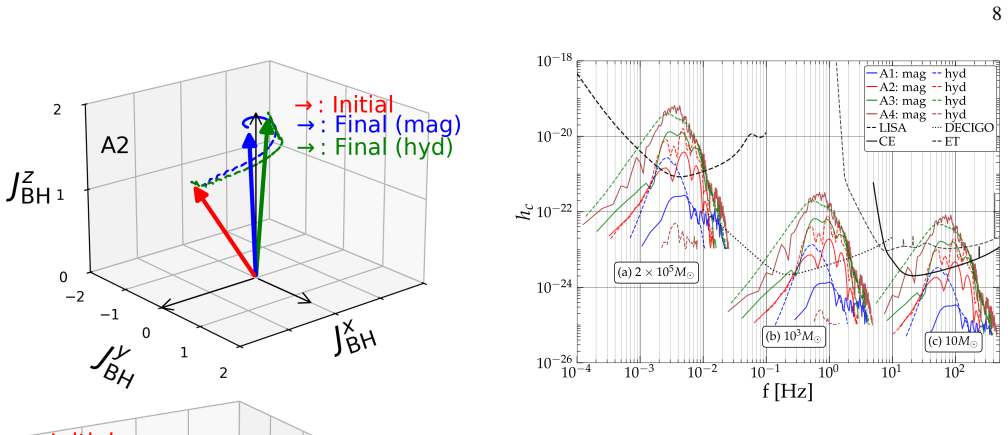

read the original abstract
We perform fully relativistic GRMHD simulations of magnetized, self-gravitating black hole-disk (BHD) systems in which the black hole spin is misaligned with the disk angular momentum. Massive disks (disk to BH mass ratios of $16-28\%$) around rapidly rotating black holes ($\chi\lesssim 0.97$) develop a nonaxisymmetric instability for tilt angles from $0^\circ$ to $180^\circ$. Magnetic stresses damp, but do not completely suppress, the nonaxisymmetric instability, and corresponding gravitational wave (GW) emission, in aligned systems, while they enhance it in antialigned BHDs: MRI-driven turbulence enhances angular momentum transport and accelerates nonlinear instability evolution in misaligned configurations. All models launch magnetically driven jets consistent with the Blandford-Znajek (BZ) mechanism, with collimation depending on spin orientation. The GWs reflect strong nonaxisymmetric structure from a persistent $m=1$ mode. The coupling between fast MRI and the slower nonaxisymmetric instability growth governs the outcome, with tilt controlling how MRI modifies the global mode. These simulations provide the first self-consistent GRMHD treatment of tilted, self-gravitating BHD systems and support their role as multimessenger sources.
Editorial analysis
A structured set of objections, weighed in public.
Referee Report
Summary. The paper reports fully relativistic GRMHD simulations of magnetized, self-gravitating black hole-disk (BHD) systems with misaligned black hole spins. For disk-to-BH mass ratios of 16-28% and spins up to χ≈0.97, the simulations show development of a nonaxisymmetric (m=1) instability across tilt angles 0°–180°. Magnetic stresses from MRI turbulence are claimed to damp the instability in aligned cases but enhance it in antialigned ones via accelerated angular-momentum transport; all models launch Blandford-Znajek jets whose collimation depends on spin orientation, and the gravitational waves exhibit signatures of the persistent m=1 mode. The work presents these as the first self-consistent GRMHD treatments of tilted self-gravitating BHDs and as multimessenger sources.
Significance. If the results are numerically robust, the work is significant because it supplies the first GRMHD simulations that self-consistently include both self-gravity and magnetic fields in tilted BHDs. The reported tilt-dependent coupling between MRI turbulence and the global m=1 mode, together with the distinct jet and GW signatures, provides concrete multimessenger predictions that can be tested against future LIGO/Virgo/KAGRA and Event Horizon Telescope observations of massive accretion systems.
major comments (2)
- [Methods] Methods section: No MRI quality factor Q values are reported for the disk midplane, nor is any resolution or convergence study described. Because the central claim is that MRI-driven turbulence enhances the nonaxisymmetric instability in misaligned configurations (abstract and §4), the absence of evidence that the fastest-growing MRI modes are resolved (Q ≳ 10–20) leaves open the possibility that numerical resistivity, rather than physical transport, controls the reported acceleration of instability growth.
- [Results] Results section: The enhancement (or damping) of the m=1 mode by magnetic stresses is stated qualitatively for different tilts, but no quantitative growth-rate comparisons between magnetized and unmagnetized runs, or between different resolutions, are provided. This makes it difficult to isolate the physical role of MRI turbulence from possible numerical artifacts in the load-bearing claim about tilt-controlled coupling.
minor comments (2)
- [Results] Figure 1 and associated text: The jet collimation dependence on spin orientation is shown visually but lacks a quantitative measure (e.g., opening angle vs. tilt) that would strengthen the multimessenger interpretation.
- [Abstract] Abstract: The phrase 'first self-consistent GRMHD treatment' should be qualified by noting the specific mass-ratio and spin range explored, to avoid overstatement.
Simulated Author's Rebuttal
We thank the referee for the careful and constructive review. The comments highlight important points on numerical validation that we will address in revision. We respond point-by-point below.
read point-by-point responses
-
Referee: [Methods] Methods section: No MRI quality factor Q values are reported for the disk midplane, nor is any resolution or convergence study described. Because the central claim is that MRI-driven turbulence enhances the nonaxisymmetric instability in misaligned configurations (abstract and §4), the absence of evidence that the fastest-growing MRI modes are resolved (Q ≳ 10–20) leaves open the possibility that numerical resistivity, rather than physical transport, controls the reported acceleration of instability growth.
Authors: We agree that explicit reporting of the MRI quality factor Q is necessary to substantiate the turbulence claims. Our grid resolutions were chosen to place at least 10–20 zones per fastest-growing MRI wavelength in the midplane (based on local dispersion-relation estimates), but these values were not tabulated. We will add a dedicated paragraph in the Methods section (and a supplementary table) listing the minimum and time-averaged Q values for each model. A limited internal resolution comparison was performed during code development; we will summarize its outcome (consistent m=1 growth and jet structure) in the revised text. Full convergence across all tilts is computationally prohibitive, but the added Q diagnostics will allow readers to assess whether numerical resistivity dominates. revision: yes
-
Referee: [Results] Results section: The enhancement (or damping) of the m=1 mode by magnetic stresses is stated qualitatively for different tilts, but no quantitative growth-rate comparisons between magnetized and unmagnetized runs, or between different resolutions, are provided. This makes it difficult to isolate the physical role of MRI turbulence from possible numerical artifacts in the load-bearing claim about tilt-controlled coupling.
Authors: The time-series plots of the m=1 Fourier amplitude already show the tilt-dependent divergence between magnetized and reference cases, but we accept that explicit growth-rate fits would strengthen the argument. In revision we will extract and tabulate the linear growth rates (e-folding times) for the m=1 mode across the tilt sequence, together with direct comparisons to the corresponding hydrodynamic runs we performed for a subset of models. For resolution, we will include growth-rate data from two resolutions for at least one aligned and one antialigned case. These additions will be placed in a new subsection of Results and will quantify the MRI contribution without altering the physical conclusions. revision: partial
Circularity Check
No significant circularity: direct numerical GRMHD simulations with no analytical reductions or self-referential fits
full rationale
The paper reports outcomes from fully relativistic GRMHD simulations of tilted, self-gravitating black hole-disk systems. The central claims (jet launching via Blandford-Znajek, m=1 mode persistence, MRI enhancement of nonaxisymmetric instability in misaligned cases) follow from evolving specified initial data under the GRMHD equations on a numerical grid. No derivation chain exists that reduces a 'prediction' to a fitted parameter by construction, nor does any load-bearing step rely on self-citation of an unverified uniqueness theorem or ansatz. Mass ratios (16-28%), spins (up to 0.97), and tilt angles are chosen inputs; the reported behaviors are outputs of the evolution, not tautological redefinitions. Self-citations (if present) support prior code validation or related work but are not required to close the argument. This is a standard self-contained simulation study.
Axiom & Free-Parameter Ledger
free parameters (2)
- Disk-to-BH mass ratio =
16-28%
- Black hole spin parameter chi =
<=0.97
axioms (2)
- standard math Spacetime is governed by general relativity
- domain assumption Plasma obeys ideal magnetohydrodynamics
Lean theorems connected to this paper
-
IndisputableMonolith/Cost/FunctionalEquation.leanwashburn_uniqueness_aczel unclear?
unclearRelation between the paper passage and the cited Recognition theorem.
MRI-driven turbulence enhances angular momentum transport and accelerates nonlinear instability evolution in misaligned configurations
-
IndisputableMonolith/Foundation/DimensionForcing.leanalexander_duality_circle_linking unclear?
unclearRelation between the paper passage and the cited Recognition theorem.
persistent m=1 mode
What do these tags mean?
- matches
- The paper's claim is directly supported by a theorem in the formal canon.
- supports
- The theorem supports part of the paper's argument, but the paper may add assumptions or extra steps.
- extends
- The paper goes beyond the formal theorem; the theorem is a base layer rather than the whole result.
- uses
- The paper appears to rely on the theorem as machinery.
- contradicts
- The paper's claim conflicts with a theorem or certificate in the canon.
- unclear
- Pith found a possible connection, but the passage is too broad, indirect, or ambiguous to say the theorem truly supports the claim.
Reference graph
Works this paper leans on
- [1]
-
[2]
E. O’Connor and C. D. Ott, Astrophys. J.730, 70 (2011), arXiv:1010.5550 [astro-ph.HE]. 6 FIG. 7. EM GW Strainh+for two GW modes for the A3 (left) and A4 (right) cases. Herer A is the areal extraction radius andt ret is retarded time
- [3]
-
[4]
K. Akiyamaet al.(Event Horizon Telescope), Astrophys. J. Lett.930, L12 (2022), arXiv:2311.08680 [astro-ph.HE]
work page internal anchor Pith review Pith/arXiv arXiv 2022
-
[5]
Millimeter Light Curves of Sagittarius A* Observed during the 2017 Event Horizon Telescope Campaign,
M. Wielguset al.(Event Horizon Telescope), Astrophys. J. Lett.930, L19 (2022), arXiv:2207.06829 [astro-ph.HE]
-
[6]
O. Gottlieb, M. Liska, A. Tchekhovskoy, O. Bromberg, A. Lalakos, D. Giannios, and P. M¨osta, Astrophys. J. Lett.933, L9 (2022), arXiv:2204.12501 [astro-ph.HE]
- [7]
-
[8]
R. Abbottet al.(KAGRA, VIRGO, LIGO Scientific), Phys. Rev. X13, 041039 (2023), arXiv:2111.03606 [gr-qc]
work page internal anchor Pith review Pith/arXiv arXiv 2023
- [9]
- [10]
-
[11]
Formation of precessing jets by tilted black hole discs in 3D general relativistic MHD simulations,
M. Liska, C. Hesp, A. Tchekhovskoy, A. Ingram, M. van der Klis, and S. Markoff, Mon. Not. Roy. Astron. Soc.474, L81 (2018), arXiv:1707.06619 [astro-ph.HE]
- [12]
-
[13]
A review of quasi-periodic oscillations from black hole X-ray binaries: Observation and theory,
A. Ingram and S. Motta, New Astron. Rev.85, 101524 (2019), arXiv:2001.08758 [astro-ph.HE]
-
[14]
A. Tsokaros, M. Ruiz, S. L. Shapiro, and V . Paschalidis, Phys. Rev. D106, 104010 (2022), arXiv:2209.04454 [astro-ph.HE]
-
[15]
J. L. G ´omezet al., Astron. Astrophys705, A23 (2026)
work page 2026
- [16]
- [17]
-
[18]
V . Kalogera, Astrophys. J.541, 319 (2000), arXiv:astro- ph/9911417
-
[19]
Abbottet al.(LIGO Scientific and Virgo Collaboration), Astrophys
R. Abbottet al.(LIGO Scientific, Virgo), Astrophys. J. Lett. 913, L7 (2021), arXiv:2010.14533 [astro-ph.HE]
-
[20]
F. Foucart, M. D. Duez, L. E. Kidder, and S. A. Teukol- sky, Phys. Rev. D83, 024005 (2011), arXiv:1007.4203 [astro- ph.HE]
-
[21]
V . Paschalidis, M. Ruiz, and S. L. Shapiro, Astrophys. J.806, L14 (2015), arXiv:1410.7392 [astro-ph.HE]
-
[22]
M. Ruiz, R. N. Lang, V . Paschalidis, and S. L. Shapiro, Astro- phys. J.824, L6 (2016)
work page 2016
- [23]
- [24]
- [25]
-
[26]
Hobbset al., Classical and Quantum Gravity27, 084013 (2010)
G. Hobbset al., Classical and Quantum Gravity27, 084013 (2010)
work page 2010
-
[27]
Z. B. Etienne, V . Paschalidis, and S. L. Shapiro, Phys.Rev.D86, 084026 (2012)
work page 2012
- [28]
- [29]
-
[30]
P. C. Fragile, O. M. Blaes, P. Anninos, and J. D. Salmonson, Astrophys. J.668, 417 (2007), arXiv:0706.4303 [astro-ph]
work page Pith review arXiv 2007
- [31]
- [32]
- [33]
- [34]
-
[35]
J. M. Bardeen and J. A. Petterson, Astrophys. J. Lett.195, L65 (1975)
work page 1975
- [36]
- [37]
-
[38]
J. C. B. Papaloizou and J. E. Pringle, Mon. Not. R. Astron. Soc 208, 721 (1984)
work page 1984
-
[39]
M. Shibata, K. Kiuchi, S. Fujibayashi, and Y . Sekiguchi, Phys. Rev. D103, 063037 (2021), arXiv:2101.05440 [astro-ph.HE]
- [40]
-
[41]
C. J. White, E. Quataert, and O. Blaes, Astrophys. J.878, 51 (2019), arXiv:1902.09662 [astro-ph.HE]
work page Pith review arXiv 2019
-
[42]
J. Dexter and P. C. Fragile, Astrophys. J.730, 36 (2011), arXiv:1101.3783 [astro-ph.HE]
-
[43]
K. Chatterjee, N. Kaaz, M. Liska, A. Tchekhovskoy, and S. Markoff, Phys. Rev. D112, 063013 (2025), arXiv:2311.00432 [astro-ph.HE]
-
[44]
A. Tsokaros, K. Ury ¯u, and S. L. Shapiro, Phys. Rev. D99, 041501 (2019), arXiv:1810.02825 [gr-qc]
-
[45]
H. Komatsu, Y . Eriguchi, and I. Hachisu, Mon. Not. R. Astron. Soc237, 355 (1989)
work page 1989
- [46]
- [47]
-
[48]
E. Schnetter, S. H. Hawley, and I. Hawke, Class. Quant. Grav. 21, 1465 (2004), arXiv:gr-qc/0310042
- [49]
-
[50]
R. D. Blandford and D. G. Payne, Mon. Not. R. Astron. Soc 199, 883 (1982)
work page 1982
- [51]
- [52]
-
[53]
Schmitz, JHEP01, 097 (2021), arXiv:2002.04615 [hep-ph]
K. Schmitz, JHEP01, 097 (2021), arXiv:2002.04615 [hep-ph]. SUPPLEMENTAL MA TERIAL In this section, we further probe the dynamical stability of our BHDs. Accretion.—Fig. 8 shows the evolution of the rest-mass fraction outside the apparent horizon and the corresponding accretion rate. The antialigned case (A4) exhibits the earli- est and most dramatic mass ...
discussion (0)
Sign in with ORCID, Apple, or X to comment. Anyone can read and Pith papers without signing in.