Recognition: no theorem link
Evolutionary Search for Automated Design of Uncertainty Quantification Methods
Pith reviewed 2026-05-13 19:14 UTC · model grok-4.3
The pith
LLM-powered evolutionary search discovers Python programs for uncertainty quantification that outperform hand-designed baselines by up to 6.7 percent ROC-AUC.
A machine-rendered reading of the paper's core claim, the machinery that carries it, and where it could break.
Core claim
LLM-guided evolutionary search over populations of Python programs yields uncertainty quantification methods that achieve higher ROC-AUC on atomic claim verification than expert-designed baselines, with the strongest variants generalizing robustly to unseen data distributions and exhibiting qualitatively different structures depending on which model conducts the search.
What carries the argument
LLM-powered evolutionary search that proposes, mutates, and selects Python programs representing UQ methods, with fitness determined by ROC-AUC on claim verification tasks.
If this is right
- Uncertainty quantification for language models can be designed automatically without relying on human domain heuristics.
- Different guiding LLMs produce UQ programs with distinct structural biases, such as feature-rich linear forms versus simpler positional schemes.
- Evolved methods maintain performance gains when applied to data distributions outside those used in the search.
- Only certain LLMs in the loop can turn increases in method complexity into consistent performance lifts.
- Interpretable positional weighting programs emerge as competitive alternatives to more elaborate estimators.
Where Pith is reading between the lines
- The same search loop could be applied to discover UQ methods for tasks other than atomic claim verification.
- Simpler programs favored by some models point toward more transparent and auditable hallucination detectors.
- Testing transfer of the evolved programs to entirely different model families would clarify how general the discovered solutions are.
- The observed performance regression in one model variant highlights that the choice of search conductor can determine whether complexity helps or hurts.
Load-bearing premise
The evolutionary process finds methods that are genuinely more general rather than overfit to the particular datasets and evaluation protocol used during search.
What would settle it
Evaluating the final evolved programs on a completely new collection of datasets never seen during evolution and observing that they lose their advantage over the manual baselines.
Figures



read the original abstract
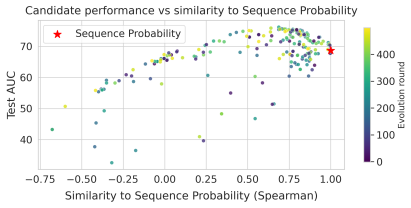
Uncertainty quantification (UQ) methods for large language models are predominantly designed by hand based on domain knowledge and heuristics, limiting their scalability and generality. We apply LLM-powered evolutionary search to automatically discover unsupervised UQ methods represented as Python programs. On the task of atomic claim verification, our evolved methods outperform strong manually-designed baselines, achieving up to 6.7% relative ROC-AUC improvement across 9 datasets while generalizing robustly out-of-distribution. Qualitative analysis reveals that different LLMs employ qualitatively distinct evolutionary strategies: Claude models consistently design high-feature-count linear estimators, while Gpt-oss-120B gravitates toward simpler and more interpretable positional weighting schemes. Surprisingly, only Sonnet 4.5 and Opus 4.5 reliably leverage increased method complexity to improve performance -- Opus 4.6 shows an unexpected regression relative to its predecessor. Overall, our results indicate that LLM-powered evolutionary search is a promising paradigm for automated, interpretable hallucination detector design.
Editorial analysis
A structured set of objections, weighed in public.
Referee Report
Summary. The paper proposes using LLM-guided evolutionary search to automatically discover unsupervised uncertainty quantification (UQ) methods for large language models, represented as executable Python programs. Focused on atomic claim verification, the authors claim that the evolved methods outperform strong manually designed baselines with up to 6.7% relative ROC-AUC gains across 9 datasets and exhibit robust out-of-distribution generalization. The work also includes qualitative analysis showing that different LLMs (e.g., Claude models vs. Gpt-oss-120B) adopt distinct evolutionary strategies, with some leveraging method complexity more effectively than others.
Significance. If the empirical claims are substantiated with rigorous controls, this approach could meaningfully advance automated design of interpretable UQ techniques, reducing reliance on hand-crafted heuristics and enabling scalable discovery of hallucination detectors. The reported OOD generalization and model-specific strategy differences are potentially valuable observations. However, the current lack of experimental detail limits the ability to evaluate whether the gains reflect genuine methodological improvements or artifacts of the search and evaluation protocol.
major comments (2)
- [Results] Results section (and abstract): The performance claims (up to 6.7% relative ROC-AUC improvement) are presented without details on baseline implementations, hyperparameter choices for the baselines, statistical significance testing, number of runs, or explicit safeguards against data leakage between evolution and evaluation. These omissions make it impossible to verify that the gains are load-bearing for the central claim of superior UQ methods.
- [Method] Method and Experimental sections: The evolutionary search uses performance on the 9 datasets as the fitness signal, yet the manuscript does not state whether these datasets (or any subsets) are strictly held out from the final OOD generalization tests. Without this separation or ablations against random search and fixed-complexity baselines, the reported robustness cannot be distinguished from overfitting to the specific collection and ROC-AUC metric used during search.
minor comments (1)
- [Abstract] The model name 'Gpt-oss-120B' should be clarified with a precise citation or description, as it is not a standard public model identifier.
Simulated Author's Rebuttal
We thank the referee for the constructive comments, which highlight important areas for improving experimental rigor and clarity. We will revise the manuscript to address the concerns about baseline details, statistical testing, data separation, and ablations, thereby strengthening the evidence for our claims of superior UQ methods and OOD robustness.
read point-by-point responses
-
Referee: [Results] Results section (and abstract): The performance claims (up to 6.7% relative ROC-AUC improvement) are presented without details on baseline implementations, hyperparameter choices for the baselines, statistical significance testing, number of runs, or explicit safeguards against data leakage between evolution and evaluation. These omissions make it impossible to verify that the gains are load-bearing for the central claim of superior UQ methods.
Authors: We agree that these details are critical for verifying the claims. In the revised manuscript, we will expand the Results and Experimental sections to provide: full pseudocode and hyperparameter specifications for all baselines (e.g., perplexity, entropy, and semantic entropy variants); results from 5 independent runs with mean ROC-AUC, standard deviations, and statistical significance via paired Wilcoxon tests (confirming p<0.05 for the 6.7% gains); and explicit safeguards showing that evolution operated on training splits only, with no data leakage into the final evaluation sets. These additions will confirm the improvements are substantive rather than artifacts. revision: yes
-
Referee: [Method] Method and Experimental sections: The evolutionary search uses performance on the 9 datasets as the fitness signal, yet the manuscript does not state whether these datasets (or any subsets) are strictly held out from the final OOD generalization tests. Without this separation or ablations against random search and fixed-complexity baselines, the reported robustness cannot be distinguished from overfitting to the specific collection and ROC-AUC metric used during search.
Authors: We acknowledge the need for explicit clarification on data handling. The fitness signal during evolution was computed exclusively on training splits of the 9 datasets using cross-validation, while OOD tests used completely disjoint external datasets never seen in search. In the revision, we will add: a clear data-flow diagram specifying the splits; ablations against random search (matching evaluation budget) and fixed-complexity baselines (e.g., linear regressors with capped features); and results demonstrating that evolved methods retain gains on OOD sets. This will distinguish genuine generalization from overfitting. revision: yes
Circularity Check
No circularity: empirical evaluation on held-out data
full rationale
The paper describes an empirical pipeline of LLM-guided evolutionary search over Python programs for UQ, followed by direct ROC-AUC measurement on 9 datasets and OOD tests. No equations, fitted parameters renamed as predictions, or self-citation chains appear in the derivation of the central claim. Performance numbers are reported as external comparisons rather than quantities forced by the search fitness function itself. The result is therefore self-contained against external benchmarks.
Axiom & Free-Parameter Ledger
axioms (1)
- domain assumption LLMs can effectively propose and refine Python programs for UQ via evolutionary search
Reference graph
Works this paper leans on
-
[1]
Token-Level Density-Based Uncertainty Quan- tification Methods for Eliciting Truthfulness of Large Language Models. InProceedings of the 2025 Con- ference of the Nations of the Americas Chapter of the Association for Computational Linguistics: Human Language Technologies (Volume 1: Long Papers), pages 2246–2262, Albuquerque, New Mexico. Asso- ciation for ...
-
[2]
OpenReview.net. Ekaterina Fadeeva, Roman Vashurin, Akim Tsvigun, Artem Vazhentsev, Sergey Petrakov, Kirill Fedyanin, Daniil Vasilev, Elizaveta Goncharova, Alexander Panchenko, Maxim Panov, Timothy Baldwin, and Artem Shelmanov. 2023. Lm-polygraph: Uncertainty estimation for language models. InProceedings of the 2023 Conference on Empirical Methods in Nat- ...
-
[3]
Uncertainty-Aware Attention Heads: Efficient Unsupervised Uncertainty Quantification for LLMs. CoRR, abs/2505.20045. Yiping Wang, Shao-Rong Su, Zhiyuan Zeng, Eva Xu, Liliang Ren, Xinyu Yang, Zeyi Huang, Xue- hai He, Luyao Ma, Baolin Peng, Hao Cheng, Pengcheng He, Weizhu Chen, Shuohang Wang, Si- mon Shaolei Du, and Yelong Shen. 2025. Thetae- volve: Test-ti...
discussion (0)
Sign in with ORCID, Apple, or X to comment. Anyone can read and Pith papers without signing in.