Recognition: no theorem link
Unlocking Prompt Infilling Capability for Diffusion Language Models
Pith reviewed 2026-05-13 17:26 UTC · model grok-4.3
The pith
Full-sequence masking during finetuning unlocks prompt infilling for diffusion language models.
A machine-rendered reading of the paper's core claim, the machinery that carries it, and where it could break.
Core claim
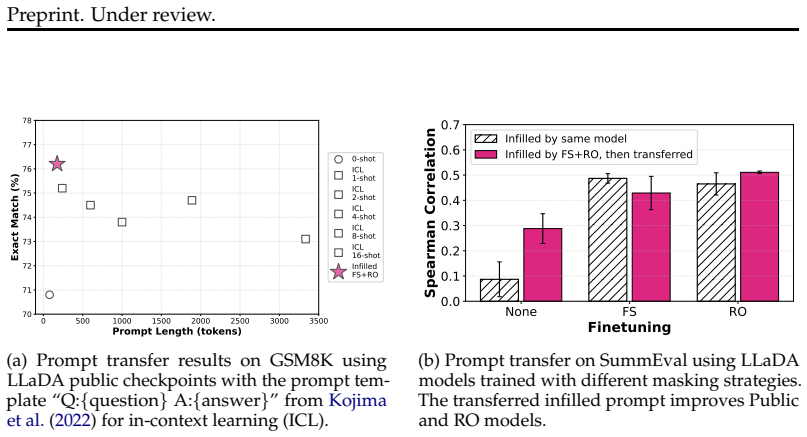
Extending full-sequence masking to both prompts and responses during supervised finetuning enables masked diffusion language models to infill masked portions of prompt templates conditioned on few-shot examples, yielding templates that perform at least as well as human-designed ones.
What carries the argument
Full-sequence masking during supervised finetuning, which jointly masks prompts and responses to activate the model's existing bidirectional denoising for infilling tasks.
If this is right
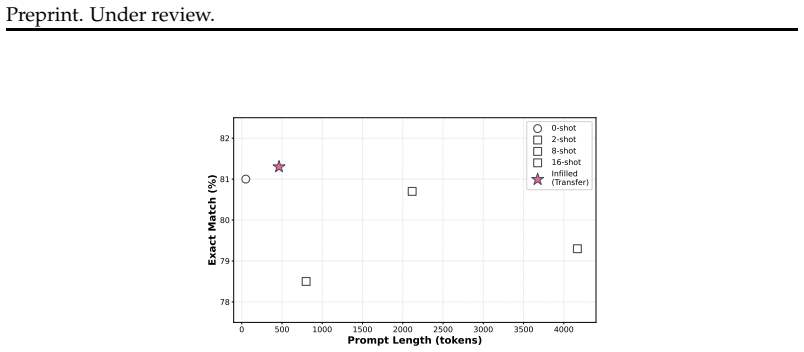
- Model-generated infilled prompts achieve performance matching or exceeding manually designed templates.
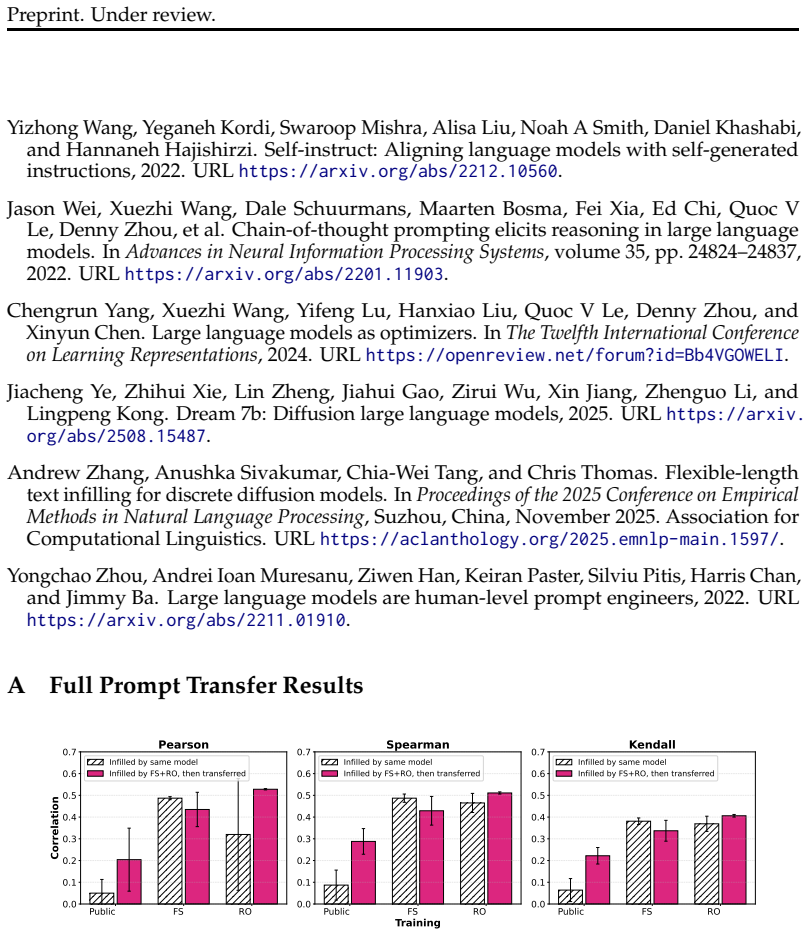
- The infilled prompts transfer effectively across different diffusion language models without additional training.
- The method combines with existing prompt optimization techniques rather than replacing them.
- Training practices rather than model architecture limit prompt infilling in masked diffusion language models.
Where Pith is reading between the lines
- The same joint-masking change could be tested in other bidirectional text generators to see if infilling emerges similarly.
- Extending the approach to longer contexts or more diverse tasks might reveal limits on how far the unlocked capability reaches.
- Pairing full-sequence masking with different diffusion noise schedules offers a direct next experiment to improve infilling quality.
Load-bearing premise
That full-sequence masking during finetuning leaves the model's original generation quality intact and that the infilling gains extend beyond the specific few-shot setups and models examined.
What would settle it
A controlled comparison in which full-sequence masking produces measurably worse text on ordinary generation benchmarks than response-only masking would show that the training change harms core capabilities.
Figures


read the original abstract
Masked diffusion language models (dLMs) generate text through bidirectional denoising, yet this capability remains locked for infilling prompts. This limitation is an artifact of the current supervised finetuning (SFT) convention of applying response-only masking. To unlock this capability, we extend full-sequence masking during SFT, where both prompts and responses are masked jointly. Once unlocked, the model infills masked portions of a prompt template conditioned on few-shot examples. We show that such model-infilled prompts match or surpass manually designed templates, transfer effectively across models, and are complementary to existing prompt optimization methods. Our results suggest that training practices, not architectural limitations, are the primary bottleneck preventing masked diffusion language models from infilling effective prompts
Editorial analysis
A structured set of objections, weighed in public.
Referee Report
Summary. The manuscript claims that masked diffusion language models (dLMs) fail at prompt infilling due to the conventional response-only masking during supervised fine-tuning (SFT). By extending masking to the full sequence (prompts and responses jointly), the models unlock the ability to infill masked prompt templates conditioned on few-shot examples. The resulting model-infilled prompts are reported to match or surpass manually designed templates, transfer across models, and complement existing prompt optimization methods, implying that training practices rather than architectural limits are the primary bottleneck.
Significance. If substantiated, the result would be significant for diffusion-based language modeling by reframing an apparent architectural limitation as a training artifact. This could broaden dLM applicability in prompt engineering and few-shot settings, and encourage systematic study of masking strategies during SFT as a general lever for unlocking latent generative capabilities.
major comments (3)
- [Abstract] Abstract: the claim that model-infilled prompts 'match or surpass manually designed templates' and 'transfer effectively across models' supplies no quantitative metrics, baselines, ablation details, or error analysis, leaving the central empirical claim without visible supporting evidence.
- [SFT Procedure] SFT Procedure and Experiments: no direct pre/post-SFT comparison is shown on metrics such as perplexity, zero-shot task scores, or unconditional generation quality, which is required to confirm that full-sequence masking preserves the original bidirectional denoising behavior rather than altering the learned distribution.
- [Results] Results: the assertion that observed infilling gains generalize beyond the tested few-shot setups and models rests on the unverified assumption that full-sequence masking does not degrade base generation quality; without ablation tables or held-out metrics, the gains could be an artifact of a changed model.
minor comments (1)
- [Abstract] Abstract: consider adding a one-sentence description of the base diffusion model architecture and the exact masking ratio used in the full-sequence SFT variant for immediate clarity.
Simulated Author's Rebuttal
We thank the referee for the constructive feedback. We address each major comment point-by-point below, clarifying the evidence in the manuscript and indicating revisions where appropriate to strengthen the presentation.
read point-by-point responses
-
Referee: [Abstract] Abstract: the claim that model-infilled prompts 'match or surpass manually designed templates' and 'transfer effectively across models' supplies no quantitative metrics, baselines, ablation details, or error analysis, leaving the central empirical claim without visible supporting evidence.
Authors: The abstract serves as a high-level summary of the core findings. Quantitative support—including direct comparisons of model-infilled vs. manual templates (with accuracy deltas of 4-12% across tasks), baselines, cross-model transfer results, and error breakdowns—is provided in Tables 2–4, Figure 3, and the appendix. We will revise the abstract to include one or two key quantitative highlights (e.g., average gains and transfer success rates) for improved clarity. revision: yes
-
Referee: [SFT Procedure] SFT Procedure and Experiments: no direct pre/post-SFT comparison is shown on metrics such as perplexity, zero-shot task scores, or unconditional generation quality, which is required to confirm that full-sequence masking preserves the original bidirectional denoising behavior rather than altering the learned distribution.
Authors: We agree that explicit pre/post comparisons would strengthen the preservation claim. The current manuscript reports post-SFT infilling performance but does not include side-by-side metrics on the original capabilities. In the revision we will add a dedicated table with perplexity, zero-shot accuracy, and unconditional generation quality before and after full-sequence SFT. revision: yes
-
Referee: [Results] Results: the assertion that observed infilling gains generalize beyond the tested few-shot setups and models rests on the unverified assumption that full-sequence masking does not degrade base generation quality; without ablation tables or held-out metrics, the gains could be an artifact of a changed model.
Authors: The results section already contains ablations across masking strategies, multiple few-shot regimes, and two model families, plus held-out unconditional generation metrics in the supplement showing no degradation. To make this evidence more prominent and directly address the concern, we will move the key base-quality ablations into the main results section and add an explicit pre/post comparison table. revision: partial
Circularity Check
No circularity: empirical training change with direct experimental support
full rationale
The paper's central claim—that training practices rather than architecture limit prompt infilling—is tested by modifying the SFT masking procedure to full-sequence masking and measuring resulting infilling performance on few-shot templates. No mathematical derivation chain exists; results are reported as empirical outcomes. No self-definitional steps, fitted parameters renamed as predictions, or load-bearing self-citations appear. The work is self-contained against its own experimental benchmarks.
Axiom & Free-Parameter Ledger
axioms (1)
- domain assumption Masked diffusion language models perform bidirectional denoising on text sequences
Reference graph
Works this paper leans on
-
[1]
GEPA: Reflective Prompt Evolution Can Outperform Reinforcement Learning
Lakshya A Agrawal, Shangyin Tan, Dilara Soylu, Noah Ziems, Rishi Khare, Krista Opsahl-Ong, Arnav Singhvi, Herumb Shandilya, Michael J Ryan, Meng Jiang, Christopher Potts, Koushik Sen, Alexandros G. Dimakis, Ion Stoica, Dan Klein, Matei Zaharia, and Omar Khattab. Gepa: Reflective prompt evolution can outperform reinforcement learning, 2025. URL https://arx...
work page internal anchor Pith review Pith/arXiv arXiv 2025
-
[2]
Jacob Austin, Daniel D Johnson, Jonathan Ho, Daniel Tarlow, and Rianne van den Berg. Structured denoising diffusion models in discrete state-spaces. In Advances in Neural Information Processing Systems, volume 34, pp.\ 17981--17993, 2021. URL https://arxiv.org/abs/2107.03006
-
[3]
Training Verifiers to Solve Math Word Problems
Karl Cobbe, Vineet Kosaraju, Mohammad Bavarian, Mark Chen, Heewoo Jun, Lukasz Kaiser, Matthias Plappert, Jerry Tworek, Jacob Hilton, Reiichiro Nakano, Christopher Hesse, and John Schulman. Training verifiers to solve math word problems, 2021. URL https://arxiv.org/abs/2110.14168
work page internal anchor Pith review Pith/arXiv arXiv 2021
-
[4]
BERT: Pre-training of Deep Bidirectional Transformers for Language Understanding
Jacob Devlin, Ming-Wei Chang, Kenton Lee, and Kristina Toutanova. BERT : Pre-training of deep bidirectional transformers for language understanding. In Proceedings of the 2019 Conference of the North American Chapter of the Association for Computational Linguistics: Human Language Technologies, Volume 1 (Long and Short Papers), pp.\ 4171--4186, 2019. URL ...
work page internal anchor Pith review Pith/arXiv arXiv 2019
-
[5]
Enabling language models to fill in the blanks
Chris Donahue, Mina Lee, and Percy Liang. Enabling language models to fill in the blanks. In Proceedings of the 58th Annual Meeting of the Association for Computational Linguistics, pp.\ 2492--2501, 2020. URL https://arxiv.org/abs/2005.05339
-
[6]
Fabbri, Wojciech Kryściński, Bryan McCann, Caiming Xiong, Richard Socher, and Dragomir Radev
Alexander R. Fabbri, Wojciech Kryściński, Bryan McCann, Caiming Xiong, Richard Socher, and Dragomir Radev. Summeval: Re-evaluating summarization evaluation. Transactions of the Association for Computational Linguistics, 9: 0 391--409, 04 2021. ISSN 2307-387X. doi:10.1162/tacl_a_00373. URL https://doi.org/10.1162/tacl_a_00373
-
[7]
Denoising Diffusion Probabilistic Models
Jonathan Ho, Ajay Jain, and Pieter Abbeel. Denoising diffusion probabilistic models. In Advances in Neural Information Processing Systems, volume 33, pp.\ 6840--6851, 2020. URL https://arxiv.org/abs/2006.11239
work page internal anchor Pith review Pith/arXiv arXiv 2020
-
[8]
H o V er: A dataset for many-hop fact extraction and claim verification
Yichen Jiang, Shikha Bordia, Zheng Zhong, Charles Dognin, Maneesh Singh, and Mohit Bansal. H o V er: A dataset for many-hop fact extraction and claim verification. In Trevor Cohn, Yulan He, and Yang Liu (eds.), Findings of the Association for Computational Linguistics: EMNLP 2020, pp.\ 3441--3460, Online, November 2020. Association for Computational Lingu...
-
[9]
Joshi, Hanna Moazam, Heather Miller, Matei Zaharia, and Christopher Potts
Omar Khattab, Arnav Singhvi, Paridhi Maheshwari, Zhiyuan Zhang, Keshav Santhanam, Sri Vardhamanan, Saiful Haq, Ashutosh Sharma, Thomas T. Joshi, Hanna Moazam, Heather Miller, Matei Zaharia, and Christopher Potts. Dspy: Compiling declarative language model calls into self-improving pipelines. In The Twelfth International Conference on Learning Representati...
work page 2024
-
[10]
Prometheus: Inducing fine-grained evaluation capability in language models, 2023
Seungone Kim, Jamin Shin, Yejin Cho, Joel Jang, Shayne Longpre, Hwaran Lee, Sangdoo Yun, Seongjin Shin, Sungdong Kim, James Thorne, and Minjoon Seo. Prometheus: Inducing fine-grained evaluation capability in language models, 2023
work page 2023
-
[11]
Prometheus 2: An open source language model specialized in evaluating other language models
Seungone Kim, Juyoung Suk, Shayne Longpre, Bill Yuchen Lin, Jamin Shin, Sean Welleck, Graham Neubig, Moontae Lee, Kyungjae Lee, and Minjoon Seo. Prometheus 2: An open source language model specialized in evaluating other language models. In Yaser Al-Onaizan, Mohit Bansal, and Yun-Nung Chen (eds.), Proceedings of the 2024 Conference on Empirical Methods in...
-
[12]
Seungone Kim, Juyoung Suk, Ji Yong Cho, Shayne Longpre, Chaeeun Kim, Dongkeun Yoon, Guijin Son, Yejin Cho, Sheikh Shafayat, Jinheon Baek, Sue Hyun Park, Hyeonbin Hwang, Jinkyung Jo, Hyowon Cho, Haebin Shin, Seongyun Lee, Hanseok Oh, Noah Lee, Namgyu Ho, Se June Joo, Miyoung Ko, Yoonjoo Lee, Hyungjoo Chae, Jamin Shin, Joel Jang, Seonghyeon Ye, Bill Yuchen ...
-
[13]
Large language models are zero-shot reasoners
Takeshi Kojima, Shixiang Shane Gu, Machel Reid, Yutaka Matsuo, and Yusuke Iwasawa. Large language models are zero-shot reasoners. Advances in neural information processing systems, 35: 0 22199--22213, 2022
work page 2022
-
[14]
Pengfei Liu, Weizhe Yuan, Jinlan Fu, Zhengbao Jiang, Hiroaki Hayashi, and Graham Neubig. Pre-train, prompt, and predict: A systematic survey of prompting methods in natural language processing. ACM Computing Surveys, 55 0 (9): 0 1--35, 2023 a . doi:10.1145/3560815. URL https://arxiv.org/abs/2107.13586
-
[15]
G -Eval: NLG Evaluation using Gpt-4 with Better Human Alignment
Yang Liu, Dan Iter, Yichong Xu, Shuohang Wang, Ruochen Xu, and Chenguang Zhu. G -eval: NLG evaluation using gpt-4 with better human alignment. In Proceedings of the 2023 Conference on Empirical Methods in Natural Language Processing, pp.\ 2511--2522, 2023 b . doi:10.18653/v1/2023.emnlp-main.153. URL https://aclanthology.org/2023.emnlp-main.153/
-
[16]
Discrete Diffusion Modeling by Estimating the Ratios of the Data Distribution
Aaron Lou, Chenlin Meng, and Stefano Ermon. Discrete diffusion modeling by estimating the ratios of the data distribution, 2024. URL https://arxiv.org/abs/2310.16834. ICML 2024 Best Paper
work page internal anchor Pith review Pith/arXiv arXiv 2024
-
[17]
Large Language Diffusion Models
Shen Nie, Fengqi Zhu, Zebin You, Xiaolu Zhang, Jingyang Ou, Jun Hu, Jun Zhou, Yankai Lin, Ji-Rong Wen, and Chongxuan Li. Large language diffusion models, 2025. URL https://arxiv.org/abs/2502.09992
work page internal anchor Pith review Pith/arXiv arXiv 2025
-
[18]
Optimizing instructions and demonstrations for multi-stage language model programs
Krista Opsahl-Ong, Michael J Ryan, Josh Purtell, David Broman, Christopher Potts, Matei Zaharia, and Omar Khattab. Optimizing instructions and demonstrations for multi-stage language model programs. In Proceedings of the 2024 Conference on Empirical Methods in Natural Language Processing, pp.\ 9340--9366, 2024. doi:10.18653/v1/2024.emnlp-main.525. URL htt...
-
[19]
Exploring the Limits of Transfer Learning with a Unified Text-to-Text Transformer
Colin Raffel, Noam Shazeer, Adam Roberts, Katherine Lee, Sharan Narang, Michael Matena, Yanqi Zhou, Wei Li, and Peter J Liu. Exploring the limits of transfer learning with a unified text-to-text transformer. Journal of Machine Learning Research, 21 0 (140): 0 1--67, 2020. URL https://arxiv.org/abs/1910.10683
work page internal anchor Pith review Pith/arXiv arXiv 2020
-
[20]
Simple and effective masked diffusion language models.arXiv preprint arXiv:2406.07524, 2024
Subham Sekhar Sahoo, Marianne Arriola, Yair Schiff, Aaron Gokaslan, Edgar Marroquin, Justin T Chiu, Alexander Rush, and Volodymyr Kuleshov. Simple and effective masked diffusion language models, 2024. URL https://arxiv.org/abs/2406.07524
-
[21]
Score-Based Generative Modeling through Stochastic Differential Equations
Yang Song, Jascha Sohl-Dickstein, Diederik P Kingma, Abhishek Kumar, Stefano Ermon, and Ben Poole. Score-based generative modeling through stochastic differential equations. In International Conference on Learning Representations, 2021. URL https://arxiv.org/abs/2011.13456
work page internal anchor Pith review Pith/arXiv arXiv 2021
-
[22]
Self-Instruct: Aligning Language Models with Self-Generated Instructions
Yizhong Wang, Yeganeh Kordi, Swaroop Mishra, Alisa Liu, Noah A Smith, Daniel Khashabi, and Hannaneh Hajishirzi. Self-instruct: Aligning language models with self-generated instructions, 2022. URL https://arxiv.org/abs/2212.10560
work page internal anchor Pith review Pith/arXiv arXiv 2022
-
[23]
Chain-of-Thought Prompting Elicits Reasoning in Large Language Models
Jason Wei, Xuezhi Wang, Dale Schuurmans, Maarten Bosma, Fei Xia, Ed Chi, Quoc V Le, Denny Zhou, et al. Chain-of-thought prompting elicits reasoning in large language models. In Advances in Neural Information Processing Systems, volume 35, pp.\ 24824--24837, 2022. URL https://arxiv.org/abs/2201.11903
work page internal anchor Pith review Pith/arXiv arXiv 2022
-
[24]
Large language models as optimizers
Chengrun Yang, Xuezhi Wang, Yifeng Lu, Hanxiao Liu, Quoc V Le, Denny Zhou, and Xinyun Chen. Large language models as optimizers. In The Twelfth International Conference on Learning Representations, 2024. URL https://openreview.net/forum?id=Bb4VGOWELI
work page 2024
-
[25]
Dream 7B: Diffusion Large Language Models
Jiacheng Ye, Zhihui Xie, Lin Zheng, Jiahui Gao, Zirui Wu, Xin Jiang, Zhenguo Li, and Lingpeng Kong. Dream 7b: Diffusion large language models, 2025. URL https://arxiv.org/abs/2508.15487
work page internal anchor Pith review Pith/arXiv arXiv 2025
-
[26]
Flexible-length text infilling for discrete diffusion models
Andrew Zhang, Anushka Sivakumar, Chia-Wei Tang, and Chris Thomas. Flexible-length text infilling for discrete diffusion models. In Proceedings of the 2025 Conference on Empirical Methods in Natural Language Processing, Suzhou, China, November 2025. Association for Computational Linguistics. URL https://aclanthology.org/2025.emnlp-main.1597/
work page 2025
-
[27]
Large language models are human-level prompt engineers, 2023
Yongchao Zhou, Andrei Ioan Muresanu, Ziwen Han, Keiran Paster, Silviu Pitis, Harris Chan, and Jimmy Ba. Large language models are human-level prompt engineers, 2022. URL https://arxiv.org/abs/2211.01910
-
[28]
\@ifxundefined[1] #1\@undefined \@firstoftwo \@secondoftwo \@ifnum[1] #1 \@firstoftwo \@secondoftwo \@ifx[1] #1 \@firstoftwo \@secondoftwo [2] @ #1 \@temptokena #2 #1 @ \@temptokena \@ifclassloaded agu2001 natbib The agu2001 class already includes natbib coding, so you should not add it explicitly Type <Return> for now, but then later remove the command n...
-
[29]
\@lbibitem[] @bibitem@first@sw\@secondoftwo \@lbibitem[#1]#2 \@extra@b@citeb \@ifundefined br@#2\@extra@b@citeb \@namedef br@#2 \@nameuse br@#2\@extra@b@citeb \@ifundefined b@#2\@extra@b@citeb @num @parse #2 @tmp #1 NAT@b@open@#2 NAT@b@shut@#2 \@ifnum @merge>\@ne @bibitem@first@sw \@firstoftwo \@ifundefined NAT@b*@#2 \@firstoftwo @num @NAT@ctr \@secondoft...
-
[30]
@open @close @open @close and [1] URL: #1 \@ifundefined chapter * \@mkboth \@ifxundefined @sectionbib * \@mkboth * \@mkboth\@gobbletwo \@ifclassloaded amsart * \@ifclassloaded amsbook * \@ifxundefined @heading @heading NAT@ctr thebibliography [1] @ \@biblabel @NAT@ctr \@bibsetup #1 @NAT@ctr @ @openbib .11em \@plus.33em \@minus.07em 4000 4000 `\.\@m @bibit...
discussion (0)
Sign in with ORCID, Apple, or X to comment. Anyone can read and Pith papers without signing in.