Recognition: no theorem link
15 Years of Augmented Human(s) Research: Where Do We Stand?
Pith reviewed 2026-05-13 17:18 UTC · model grok-4.3
The pith
Fifteen years of Augmented Human conference papers show bimodal growth with peaks in 2015 and 2025, dominant topics in haptics and wearables, and definitional ambiguities because many seminal contributions appear at other venues such as CHI
A machine-rendered reading of the paper's core claim, the machinery that carries it, and where it could break.
Core claim
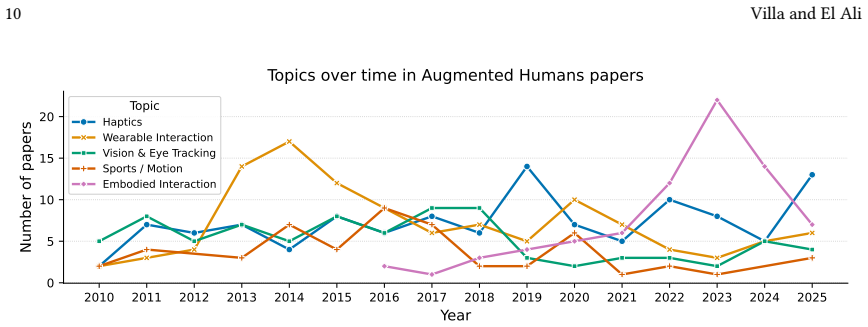
By examining submission and citation timelines, author frequencies, geographic distribution, and topic models across the 735 papers, the authors establish that paper output follows a bimodal pattern peaking in 2015 and 2025 with intervening stagnant periods, that the most persistent topics are Haptics, Wearable Sensing, Vision & Eye Tracking, Embodied Interaction, and Sports/Motion, that some influential augmented human papers have been published at other venues such as CHI rather than within the series, and that the conference maintains an active Japanese HCI community despite its historical concentration in Europe. These patterns lead directly to the observation that the field still faces,
What carries the argument
Scientometric analysis of the complete set of 735 conference papers, combining timeline statistics on submissions and citations, author popularity counts, geographic mapping, and topic modeling to extract temporal and thematic trends.
If this is right
- Periods of stagnant growth in the conference imply that the field has experienced repeated pauses that future organizers may need to address through targeted calls or co-located events.
- The dominance of topics such as haptics and wearable sensing over time indicates that hardware-based sensory augmentation has remained a stable research focus while other areas have risen and fallen.
- The presence of seminal papers outside the series means any complete review of augmented human work must draw from multiple HCI venues rather than relying on this conference alone.
- The sustained Japanese participation despite Eurocentric hosting shows that the community already draws strength from at least one non-European research base.
- Unresolved definitional ambiguities around what counts as augmentation of physical, intellectual, or social capabilities could allow overlapping work in general HCI to drift in or out of the field without clear boundaries.
Where Pith is reading between the lines
- If the observed ambiguities persist, researchers may increasingly publish augmented human work under broader HCI labels, gradually diluting the distinct identity of the series.
- Incorporating citation networks from CHI and other venues into future analyses could reveal whether the bimodal pattern is specific to this conference or reflects wider trends in the area.
- The active Japanese community suggests that targeted outreach to additional geographic clusters could accelerate growth after stagnant periods.
- Testable extension: re-running the topic model on a combined corpus of AH(s) and CHI papers would show how much the core themes shift when the full literature is included.
Load-bearing premise
That the papers appearing in the Augmented Human(s) conference series give a representative picture of the broader augmented human research landscape, even though the analysis itself notes that important work has been published elsewhere.
What would settle it
A follow-up count showing that the majority of the most-cited papers on restoring or extending human capabilities were in fact published inside the Augmented Human(s) series rather than at CHI or similar venues would undermine the claim of significant scope ambiguity.
Figures


read the original abstract
The Augmented Human vision broadly seeks to improve or expand baseline human functioning through the restoration or extension of physical, intellectual, and social capabilities. However, given the rapid pace of technology development, we ask: what exactly does Augmented Human research involve, what are its core themes, and how has the Augmented Human(s) conference series evolved over time? To answer this, we conducted a scientometric analysis on the past 15 years of the Augmented Human(s) conference (N=735 paper), focusing on: geographical aspects, submissions and citation timelines, author frequency and popularity, and topic modeling. We find that: (a) Number of papers in the conference exhibit a bimodal distribution, peaking in 2015 and 2025, but showing periods of stagnant growth; (b) key topics over time include Haptics, Wearable Sensing, Vision & Eye Tracking, Embodied Interaction, and Sports / Motion; (c) some seminal papers on AH are not published in AH(s), but rather at related venues (e.g., CHI); (d) the conference has an active Japanese HCI community despite its historical Eurocentric location dominance. We contribute a closer look at the trajectory of the AH(s) field, and raise considerations of definitional and research scope ambiguities given the core problems/enhancements the field seeks to address.
Editorial analysis
A structured set of objections, weighed in public.
Referee Report
Summary. The paper conducts a scientometric analysis of 735 papers from the Augmented Human(s) conference series spanning 15 years. It examines geographical distribution, submission and citation timelines, author productivity, and applies topic modeling to identify evolving themes. Key reported findings are a bimodal paper-count distribution with peaks in 2015 and 2025, dominant topics including Haptics, Wearable Sensing, Vision & Eye Tracking, Embodied Interaction, and Sports/Motion, the observation that some seminal AH work appears at other venues such as CHI, and an active Japanese HCI community despite historically Eurocentric conference locations. The authors also highlight definitional ambiguities in the field.
Significance. If the methodological details were supplied and the scope limitation were explicitly addressed, the work would provide a useful descriptive baseline for the AH(s) conference community and could inform discussions of field boundaries. The explicit acknowledgment that influential papers lie outside the conference series is a strength, but the absence of any coverage metric means the reported trends and growth patterns remain specific to one venue rather than the broader Augmented Human research landscape.
major comments (2)
- [Abstract and Results] Abstract and Results section on findings (c): the title and abstract frame the contribution as characterizing “Augmented Human research,” yet the entire analysis rests on the 735 AH(s) proceedings papers. Finding (c) itself states that seminal papers appear at CHI and related venues, but no quantitative estimate of coverage or fraction of influential work captured inside the conference corpus is supplied. This load-bearing assumption prevents confident extrapolation of the bimodal counts, topic trajectories, or community observations to the field as a whole.
- [Methods] Methods description (implied in Abstract): the paper states that topic modeling was performed but supplies no information on data extraction criteria, preprocessing steps, topic-model parameters (number of topics, LDA hyperparameters, or alternative models), validation procedures, or stability checks. Without these details the reported topic lists and temporal trends cannot be reproduced or assessed for robustness.
minor comments (1)
- [Abstract] The abstract lists four findings (a–d) but the text does not clearly map each finding to a specific figure or table; adding explicit cross-references would improve readability.
Simulated Author's Rebuttal
We thank the referee for the constructive comments. We will revise the manuscript to explicitly frame the work as an analysis of the Augmented Human(s) conference series and to supply full methodological details.
read point-by-point responses
-
Referee: [Abstract and Results] Abstract and Results section on findings (c): the title and abstract frame the contribution as characterizing “Augmented Human research,” yet the entire analysis rests on the 735 AH(s) proceedings papers. Finding (c) itself states that seminal papers appear at CHI and related venues, but no quantitative estimate of coverage or fraction of influential work captured inside the conference corpus is supplied. This load-bearing assumption prevents confident extrapolation of the bimodal counts, topic trajectories, or community observations to the field as a whole.
Authors: We agree that the current title and abstract framing risks implying coverage of the broader Augmented Human research landscape. The analysis is confined to the 735 AH(s) conference papers. We will revise the title, abstract, and introduction to state clearly that the contribution is a scientometric characterization of the Augmented Human(s) conference series. We will also expand the discussion to highlight the scope limitation, building directly on finding (c) by noting that seminal work appears at venues such as CHI. Because a quantitative coverage metric would require an independent, exhaustive search of the wider literature, we will instead emphasize that all reported trends are specific to the conference corpus and should not be extrapolated to the field at large. revision: yes
-
Referee: [Methods] Methods description (implied in Abstract): the paper states that topic modeling was performed but supplies no information on data extraction criteria, preprocessing steps, topic-model parameters (number of topics, LDA hyperparameters, or alternative models), validation procedures, or stability checks. Without these details the reported topic lists and temporal trends cannot be reproduced or assessed for robustness.
Authors: We apologize for the omission. The revised manuscript will include a dedicated Methods section that specifies: data extraction from the official AH(s) proceedings (primarily ACM Digital Library), preprocessing steps (tokenization, stop-word removal, lemmatization), the LDA implementation with the chosen number of topics (selected via coherence optimization), hyperparameters (alpha, beta, iterations), any alternative models tested, and validation procedures including topic stability across random seeds and qualitative interpretability checks. These additions will make the topic lists and temporal trends fully reproducible. revision: yes
Circularity Check
No circularity in scientometric analysis of conference corpus
full rationale
The paper conducts a descriptive scientometric analysis of the 735 AH(s) conference papers using paper counts over time, citation timelines, author frequencies, geographical distributions, and standard topic modeling. No derivations, equations, or fitted parameters reduce by construction to self-defined inputs or rename predictions. The analysis relies on external paper metadata and established procedures rather than quantities defined in terms of the paper's own outputs. Although the title frames the work as characterizing Augmented Human research broadly, the methods and findings are scoped to the conference series, with explicit acknowledgment that seminal work appears at other venues such as CHI. No self-citation load-bearing steps, uniqueness theorems, or ansatz smuggling are present. This is self-contained data summarization.
Axiom & Free-Parameter Ledger
axioms (1)
- domain assumption Papers published at the Augmented Human(s) conference represent the core of augmented human research
Reference graph
Works this paper leans on
- [1]
-
[2]
Maryam Alimardani and Mory Kaba. 2021. Deep Learning for Neuromarketing; Classification of User Preference using EEG Signals. In12th Augmented Human International Conference (AH2021). Association for Computing Machinery, New York, NY, USA, 1–7. doi:10.1145/3460881.3460930
-
[3]
Christoph Amma, Dirk Gehrig, and Tanja Schultz. 2010. Airwriting Recognition Using Wearable Motion Sensors. InProceedings of the 1st Augmented Human International Conference (AH ’10). Association for Computing Machinery, New York, NY, USA, 1–8. doi:10.1145/1785455.1785465
-
[4]
Leonardo Angelini, Massimo Mecella, Hai-Ning Liang, Maurizio Caon, Elena Mugellini, Omar Abou Khaled, and Danilo Bernardini. 2022. Towards an Emotionally Augmented Metaverse: a Framework for Recording and Analysing Physiological Data and User Behaviour. In13th Augmented Human International Conference (AH2022). Association for Computing Machinery, New York...
-
[5]
Sandra Bardot, Sawyer Rempel, Bradley Rey, Ali Neshati, Yumiko Sakamoto, Carlo Menon, and Pourang Irani. 2020. Eyes-free graph legibility: using skin-dragging to provide a tactile graph visualization on the arm. InProceedings of the 11th Augmented Human International Conference (AH ’20). Association for Computing Machinery, New York, NY, USA, 1–8. doi:10....
-
[6]
Christoph Bartneck and Jun Hu. 2009. Scientometric analysis of the CHI proceedings. InProceedings of the SIGCHI Conference on Human Factors in Computing Systems(Boston, MA, USA)(CHI ’09). Association for Computing Machinery, New York, NY, USA, 699–708. doi:10.1145/1518701.1518810
-
[7]
Jordan Beck and Erik Stolterman. 2017. Reviewing the Big Questions Literature;: or, Should HCI Have Big Questions?. InProceedings of the 2017 Conference on Designing Interactive Systems(Edinburgh, United Kingdom)(DIS ’17). Association for Computing Machinery, New York, NY, USA, 969–981. doi:10.1145/3064663.3064673 Manuscript submitted to ACM 15 Years of A...
-
[8]
Dan Bennett, Oussama Metatla, Anne Roudaut, and Elisa D. Mekler. 2023. How does HCI Understand Human Agency and Autonomy?. InProceedings of the 2023 CHI Conference on Human Factors in Computing Systems(Hamburg, Germany)(CHI ’23). Association for Computing Machinery, New York, NY, USA, Article 375, 18 pages. doi:10.1145/3544548.3580651
-
[9]
Alan F. Blackwell. 2015. Filling the big hole in HCI research.Interactions22, 6 (Oct. 2015), 37–41. doi:10.1145/2830317
-
[10]
Muriel De Boeck and Kristof Vaes. 2024. Human augmentation and its new design perspectives.International Journal of Design Creativity and Innovation12, 1 (2024), 61–80. arXiv:https://doi.org/10.1080/21650349.2023.2288125 doi:10.1080/21650349.2023.2288125
-
[11]
Jaime Carbonell and Jade Goldstein. 1998. The use of MMR, diversity-based reranking for reordering documents and producing summaries. In Proceedings of the 21st Annual International ACM SIGIR Conference on Research and Development in Information Retrieval(Melbourne, Australia) (SIGIR ’98). Association for Computing Machinery, New York, NY, USA, 335–336. d...
-
[12]
Zhilong Chen and Yong Li. 2025. The Sharply Decreasing Disruptiveness of HCI. InProceedings of the 2025 CHI Conference on Human Factors in Computing Systems (CHI ’25). Association for Computing Machinery, New York, NY, USA, Article 454, 24 pages. doi:10.1145/3706598.3713917
-
[13]
Mark Chignell, Lu Wang, Atefeh Zare, and Jamy Li. 2023. The Evolution of HCI and Human Factors: Integrating Human and Artificial Intelligence. ACM Trans. Comput.-Hum. Interact.30, 2, Article 17 (March 2023), 30 pages. doi:10.1145/3557891
-
[14]
Churchill, Anne Bowser, and Jennifer Preece
Elizabeth F. Churchill, Anne Bowser, and Jennifer Preece. 2016. The future of HCI education: a flexible, global, living curriculum.Interactions23, 2 (Feb. 2016), 70–73. doi:10.1145/2888574
-
[15]
2003.Natural-Born Cyborgs: Minds, Technologies, and the Future of Human Intelligence(1 ed.)
Andy Clark. 2003.Natural-Born Cyborgs: Minds, Technologies, and the Future of Human Intelligence(1 ed.). Oxford University Press, Inc., USA
work page 2003
-
[16]
Patricia Cornelio, Patrick Haggard, Kasper Hornbaek, Orestis Georgiou, Joanna BergstrÃ⁄pilcrowm, Sriram Subramanian, and Marianna Obrist. 2022. The sense of agency in emerging technologies for human-computer integration: A review.Frontiers in NeuroscienceVolume 16 - 2022 (2022). doi:10.3389/fnins.2022.949138
-
[17]
António Correia, Hugo Paredes, and Benjamim Fonseca. 2018. Scientometric analysis of scientific publications in CSCW.Scientometrics114, 1 (Jan. 2018), 31–89. doi:10.1007/s11192-017-2562-0
-
[18]
Valdemar Danry, Pat Pataranutaporn, Yaoli Mao, and Pattie Maes. 2020. Wearable Reasoner: Towards Enhanced Human Rationality Through A Wearable Device With An Explainable AI Assistant. InProceedings of the Augmented Humans International Conference(Kaiserslautern, Germany) (AHs ’20). Association for Computing Machinery, New York, NY, USA, Article 23, 12 pag...
-
[19]
Abdallah El Ali, Karthikeya Puttur Venkatraj, Sophie Morosoli, Laurens Naudts, Natali Helberger, and Pablo Cesar. 2024. Transparent AI Disclosure Obligations: Who, What, When, Where, Why, How. InExtended Abstracts of the CHI Conference on Human Factors in Computing Systems(Honolulu, HI, USA)(CHI EA ’24). Association for Computing Machinery, New York, NY, ...
-
[20]
Passant Elagroudy, Jie Li, Kaisa Väänänen, Paul Lukowicz, Hiroshi Ishii, Wendy E. Mackay, Elizabeth F Churchill, Anicia Peters, Antti Oulasvirta, Rui Prada, Alexandra Diening, Giulia Barbareschi, Agnes Gruenerbl, Midori Kawaguchi, Abdallah El Ali, Fiona Draxler, Robin Welsch, and Albrecht Schmidt. 2024. Transforming HCI Research Cycles using Generative AI...
-
[21]
D. C. Engelbart. 1962. Augmenting Human Intellect: A Conceptual Framework. Air Force Office of Scientific Research, AFOSR-3233, www. bootstrap.org/augdocs/friedewald030402/augmentinghumanintellect/ahi62index.html
work page 1962
-
[22]
Shariff A. M. Faleel, Michael Gammon, Yumiko Sakamoto, Carlo Menon, and Pourang Irani. 2020. User gesture elicitation of common smartphone tasks for hand proximate user interfaces. InProceedings of the 11th Augmented Human International Conference (AH ’20). Association for Computing Machinery, New York, NY, USA, 1–8. doi:10.1145/3396339.3396363
-
[23]
Kevin Fan, Jochen Huber, Suranga Nanayakkara, and Masahiko Inami. 2014. SpiderVision: Extending the Human Field of View for Augmented Awareness. InProceedings of the 5th Augmented Human International Conference (AH ’14). Association for Computing Machinery, New York, NY, USA, 1–8. doi:10.1145/2582051.2582100
-
[24]
Florian ‘Floyd’ Mueller, Nathan Semertzidis, Josh Andres, Martin Weigel, Suranga Nanayakkara, Rakesh Patibanda, Zhuying Li, Paul Strohmeier, Jarrod Knibbe, Stefan Greuter, Marianna Obrist, Pattie Maes, Dakuo Wang, Katrin Wolf, Liz Gerber, Joe Marshall, Kai Kunze, Jonathan Grudin, Harald Reiterer, and Richard Byrne. 2022. Human–Computer Integration: Toward...
-
[25]
Rebecca Fribourg, Nami Ogawa, Ludovic Hoyet, Ferran Argelaguet, Takuji Narumi, Michitaka Hirose, and Anatole Lécuyer. 2021. Virtual Co- Embodiment: Evaluation of the Sense of Agency While Sharing the Control of a Virtual Body Among Two Individuals.IEEE Transactions on Visualization and Computer Graphics27, 10 (Oct. 2021), 4023–4038. doi:10.1109/TVCG.2020.2999197
-
[26]
Pablo García-Barranquero and Marcos Alonso Fernández. 2025. Differentiating Human Enhancement and Transhumanism: Better or Perfect? Scientia et Fides13, 1 (2025), 121–142. doi:10.12775/setf.2025.007
-
[27]
Maarten Grootendorst. 2022. BERTopic: Neural topic modeling with a class-based TF-IDF procedure.arXiv preprint arXiv:2203.05794(2022)
work page internal anchor Pith review Pith/arXiv arXiv 2022
-
[28]
Jonathan Grudin. 2009. AI and HCI: Two Fields Divided by a Common Focus.AI Mag.30, 4 (Dec. 2009), 48–57. doi:10.1609/aimag.v30i4.2271
-
[29]
Graciela Guerrero, Fernando JoséMateus da Silva, Antonio Fernández Caballero, and Antà 3nio Pereira. 2022. Augmented Humanity: A Systematic Mapping Review.Sensors22, 2 (2022). doi:10.3390/s22020514
-
[30]
Fatih Gurcan, Nergiz Ercil Cagiltay, and Kursat Cagiltay. 2021. Mapping Humanâ-Computer Interaction Research Themes and Trends from Its Existence to Today: A Topic Modeling-Based Review of past 60 Years.International Journal of HumanâComputer Interaction37, 3 (2021), 267–280. arXiv:https://doi.org/10.1080/10447318.2020.1819668 doi:10.1080/10447318.2020.18...
-
[31]
Natsuki Hamanishi and Jun Rekimoto. 2020. PoseAsQuery: Full-Body Interface for Repeated Observation of a Person in a Video with Ambiguous Pose Indexes and Performed Poses. InProceedings of the Augmented Humans International Conference (AHs ’20). Association for Computing Machinery, New York, NY, USA, 1–11. doi:10.1145/3384657.3384658
-
[32]
Nicole Han, Sudhanshu Srivastava, Aiwen Xu, Devi Klein, and Michael Beyeler. 2021. Deep Learning–Based Scene Simplification for Bionic Vision. InProceedings of the Augmented Humans International Conference 2021(Rovaniemi, Finland)(AHs ’21). Association for Computing Machinery, New York, NY, USA, 45–54. doi:10.1145/3458709.3458982
-
[33]
Chris Harrison, Hrvoje Benko, and Andrew D. Wilson. 2011. OmniTouch: wearable multitouch interaction everywhere. InProceedings of the 24th Annual ACM Symposium on User Interface Software and Technology(Santa Barbara, California, USA)(UIST ’11). Association for Computing Machinery, New York, NY, USA, 441–450. doi:10.1145/2047196.2047255
-
[34]
Chris Harrison, Desney Tan, and Dan Morris. 2011. Skinput: appropriating the skin as an interactive canvas.Commun. ACM54, 8 (Aug. 2011), 111–118. doi:10.1145/1978542.1978564
-
[35]
Khalad Hasan, Debajyoti Mondal, David Ahlström, and Carman Neustaedter. 2020. An exploration of rules and tools for family members to limit co-located smartphone usage. InProceedings of the 11th Augmented Human International Conference (AH ’20). Association for Computing Machinery, New York, NY, USA, 1–8. doi:10.1145/3396339.3396364
-
[36]
Shoichi Hasegawa, Seiichiro Ishijima, Fumihiro Kato, Hironori Mitake, and Makoto Sato. 2012. Realtime sonification of the center of gravity for skiing. InProceedings of the 3rd Augmented Human International Conference(Megève, France)(AH ’12). Association for Computing Machinery, New York, NY, USA, Article 11, 4 pages. doi:10.1145/2160125.2160136
-
[37]
Yuji Hatada, Shigeo Yoshida, Takuji Narumi, and Michitaka Hirose. 2019. Double Shellf: What Psychological Effects Can Be Caused through Interaction with a Doppelganger?. InProceedings of the 10th Augmented Human International Conference 2019 (AH2019). Association for Computing Machinery, New York, NY, USA, 1–8. doi:10.1145/3311823.3311862
-
[38]
Nathalie Henry, Howard Goodell, Niklas Elmqvist, and Jean-Daniel Fekete. 2007. 20 Years of Four HCI Conferences: A Visual Exploration. International Journal of Humanâ-Computer Interaction23, 3 (2007), 239–285. arXiv:https://doi.org/10.1080/10447310701702402 doi:10.1080/ 10447310701702402
-
[39]
Keita Higuchi, Tetsuro Shimada, and Jun Rekimoto. 2011. Flying sports assistant: external visual imagery representation for sports training. In Proceedings of the 2nd Augmented Human International Conference(Tokyo, Japan)(AH ’11). Association for Computing Machinery, New York, NY, USA, Article 7, 4 pages. doi:10.1145/1959826.1959833
-
[40]
Yuichi Hiroi, Yuta Itoh, Takumi Hamasaki, and Maki Sugimoto. 2017. AdaptiVisor: Assisting Eye Adaptation via Occlusive Optical See-through Head-Mounted Displays. InProceedings of the 8th Augmented Human International Conference (AH ’17). Association for Computing Machinery, New York, NY, USA, 1–9. doi:10.1145/3041164.3041178
-
[41]
Yuichi Hiroi, Takumi Kaminokado, Atsushi Mori, and Yuta Itoh. 2020. DehazeGlasses: Optical Dehazing with an Occlusion Capable See-Through Display. InProceedings of the Augmented Humans International Conference (AHs ’20). Association for Computing Machinery, New York, NY, USA, 1–11. doi:10.1145/3384657.3384781
-
[42]
Kasper Hornbæk, Per Ola Kristensson, and Antti Oulasvirta. 2025. Rethinking HCI Education for the Era of AI.Interactions33, 1 (Dec. 2025), 40–43. doi:10.1145/3777517
-
[43]
Masahiko Inami, Daisuke Uriu, Zendai Kashino, Shigeo Yoshida, Hiroto Saito, Azumi Maekawa, and Michiteru Kitazaki. 2022. Cyborgs, Human Augmentation, Cybernetics, and JIZAI Body. InProceedings of the Augmented Humans International Conference 2022(Kashiwa, Chiba, Japan)(AHs ’22). Association for Computing Machinery, New York, NY, USA, 230–242. doi:10.1145/...
-
[44]
Yoshio Ishiguro, Adiyan Mujibiya, Takashi Miyaki, and Jun Rekimoto. 2010. Aided eyes: eye activity sensing for daily life. InProceedings of the 1st Augmented Human International Conference(Megève, France)(AH ’10). Association for Computing Machinery, New York, NY, USA, Article 25, 7 pages. doi:10.1145/1785455.1785480
-
[45]
Shoya Ishimaru, Kai Kunze, Koichi Kise, Jens Weppner, Andreas Dengel, Paul Lukowicz, and Andreas Bulling. 2014. In the Blink of an Eye: Combining Head Motion and Eye Blink Frequency for Activity Recognition with Google Glass. InProceedings of the 5th Augmented Human International Conference (AH ’14). Association for Computing Machinery, New York, NY, USA,...
-
[46]
Yuta Itoh, Jason Orlosky, Kiyoshi Kiyokawa, and Gudrun Klinker. 2016. Laplacian Vision: Augmenting Motion Prediction via Optical See-Through Head-Mounted Displays. InProceedings of the 7th Augmented Human International Conference 2016 (AH ’16). Association for Computing Machinery, New York, NY, USA, 1–8. doi:10.1145/2875194.2875227
-
[47]
Osamu Izuta, Toshiki Sato, Sachiko Kodama, and Hideki Koike. 2010. Bouncing Star Project: Design and Development of Augmented Sports Application Using a Ball Including Electronic and Wireless Modules. InProceedings of the 1st Augmented Human International Conference (AH ’10). Association for Computing Machinery, New York, NY, USA, 1–7. doi:10.1145/1785455.1785477
-
[48]
Jari Kangas, Oleg Špakov, Poika Isokoski, Deepak Akkil, Jussi Rantala, and Roope Raisamo. 2016. Feedback for Smooth Pursuit Gaze Tracking Based Control. InProceedings of the 7th Augmented Human International Conference 2016 (AH ’16). Association for Computing Machinery, New York, NY, USA, 1–8. doi:10.1145/2875194.2875209
-
[49]
Shunichi Kasahara, Mitsuhito Ando, Kiyoshi Suganuma, and Jun Rekimoto. 2016. Parallel Eyes: Exploring Human Capability and Behaviors with Paralleled First Person View Sharing. InProceedings of the 2016 CHI Conference on Human Factors in Computing Systems(San Jose, California, USA) (CHI ’16). Association for Computing Machinery, New York, NY, USA, 1561–157...
-
[50]
Shunichi Kasahara, Jun Nishida, and Pedro Lopes. 2019. Preemptive Action: Accelerating Human Reaction using Electrical Muscle Stimulation Without Compromising Agency. InProceedings of the 2019 CHI Conference on Human Factors in Computing Systems(Glasgow, Scotland Uk)(CHI ’19). Association for Computing Machinery, New York, NY, USA, 1–15. doi:10.1145/32906...
-
[51]
Shunichi Kasahara and Jun Rekimoto. 2014. JackIn: integrating first-person view with out-of-body vision generation for human-human augmentation. InProceedings of the 5th Augmented Human International Conference(Kobe, Japan)(AH ’14). Association for Computing Machinery, New York, NY, USA, Article 46, 8 pages. doi:10.1145/2582051.2582097
-
[52]
Nobuo Kawaguchi, Nobuhiro Ogawa, Yohei Iwasaki, Katsuhiko Kaji, Tsutomu Terada, Kazuya Murao, Sozo Inoue, Yoshihiro Kawahara, Yasuyuki Sumi, and Nobuhiko Nishio. 2011. HASC Challenge: Gathering Large Scale Human Activity Corpus for the Real-World Activity Understandings. InProceedings of the 2nd Augmented Human International Conference (AH ’11). Associati...
-
[53]
Pascal Knierim, Thomas Kosch, Gabrielle LaBorwit, and Albrecht Schmidt. 2020. Altering the Speed of Reality? Exploring Visual Slow-Motion to Amplify Human Perception using Augmented Reality. InProceedings of the Augmented Humans International Conference(Kaiserslautern, Germany) (AHs ’20). Association for Computing Machinery, New York, NY, USA, Article 2, ...
-
[54]
Vassilis Kostakos. 2015. The big hole in HCI research.Interactions22, 2 (Feb. 2015), 48–51. doi:10.1145/2729103
-
[55]
Jiunde Lee. 2024. Bridging Divide with Innovative Media: Telexistence and Human Augmentation.Emerging Media2, 2 (2024), 288–310. arXiv:https://doi.org/10.1177/27523543241266075 doi:10.1177/27523543241266075
-
[56]
Richard Li, Jason Wu, and Thad Starner. 2019. TongueBoard: An Oral Interface for Subtle Input. InProceedings of the 10th Augmented Human International Conference 2019 (AH2019). Association for Computing Machinery, New York, NY, USA, 1–9. doi:10.1145/3311823.3311831
-
[57]
J. C. R. Licklider. 1992. Man-Computer Symbiosis.IEEE Ann. Hist. Comput.14, 1 (Jan. 1992), 24
work page 1992
-
[58]
Xin Liu, Katia Vega, Pattie Maes, and Joe A. Paradiso. 2016. Wearability Factors for Skin Interfaces. InProceedings of the 7th Augmented Human International Conference 2016(Geneva, Switzerland)(AH ’16). Association for Computing Machinery, New York, NY, USA, Article 21, 8 pages. doi:10.1145/2875194.2875248
-
[59]
Yong Liu, Jorge Goncalves, Denzil Ferreira, Bei Xiao, Simo Hosio, and Vassilis Kostakos. 2014. CHI 1994-2013: mapping two decades of intellectual progress through co-word analysis. InProceedings of the SIGCHI Conference on Human Factors in Computing Systems(Toronto, Ontario, Canada) (CHI ’14). Association for Computing Machinery, New York, NY, USA, 3553–3...
-
[60]
Ali Maddahi, Anna Polyvyana, Amir Mahdi Nassiri, Yaser Maddahi, and Mohamed-Amine Choukou. 2020. Caring4Dementia: a mobile application to train people caring for patients with dementia. InProceedings of the 11th Augmented Human International Conference (AH ’20). Association for Computing Machinery, New York, NY, USA, 1–7. doi:10.1145/3396339.3396342
-
[61]
Maggio, Natascha Chtena, Juan Pablo Alperin, Laura Moorhead, and John M
Lauren A. Maggio, Natascha Chtena, Juan Pablo Alperin, Laura Moorhead, and John M. Willinsky. 2024. “The Best Home for This Paper”: A Qualitative Study of How Authors Select Where to Submit Manuscripts.Perspectives on Medical Education13, 1 (2024). doi:10.5334/pme.1517
-
[62]
Katsutoshi Masai, Kai Kunze, and Maki Sugimoto. 2020. Eye-Based Interaction Using Embedded Optical Sensors on an Eyewear Device for Facial Expression Recognition. InProceedings of the Augmented Humans International Conference (AHs ’20). Association for Computing Machinery, New York, NY, USA, 1–10. doi:10.1145/3384657.3384787
-
[63]
Akira Matsuda, Kazunori Nozawa, Kazuki Takata, Atsushi Izumihara, and Jun Rekimoto. 2020. HapticPointer: A Neck-worn Device that Presents Direction by Vibrotactile Feedback for Remote Collaboration Tasks. InProceedings of the Augmented Humans International Conference(Kaiserslautern, Germany)(AHs ’20). Association for Computing Machinery, New York, NY, USA...
-
[64]
Reiji Miura, Shunichi Kasahara, Michiteru Kitazaki, Adrien Verhulst, Masahiko Inami, and Maki Sugimoto. 2021. MultiSoma: Distributed Embodiment with Synchronized Behavior and Perception. InProceedings of the Augmented Humans International Conference 2021 (AHs ’21). Association for Computing Machinery, New York, NY, USA, 1–9. doi:10.1145/3458709.3458878
-
[65]
Omar Mubin, Abdullah Al Mahmud, and Muneeb Ahmad. 2017. HCI down under: reflecting on a decade of the OzCHI conference.Scientometrics 112, 1 (July 2017), 367–382. doi:10.1007/s11192-017-2293-2
-
[66]
Omar Mubin, Max Manalo, Muneeb Ahmad, and Mohammad Obaid. 2017. Scientometric Analysis of the HAI Conference. InProceedings of the 5th International Conference on Human Agent Interaction(Bielefeld, Germany)(HAI ’17). Association for Computing Machinery, New York, NY, USA, 45–51. doi:10.1145/3125739.3125747
-
[67]
Florian Floyd Mueller, Pedro Lopes, Paul Strohmeier, Wendy Ju, Caitlyn Seim, Martin Weigel, Suranga Nanayakkara, Marianna Obrist, Zhuying Li, Joseph Delfa, Jun Nishida, Elizabeth M. Gerber, Dag Svanaes, Jonathan Grudin, Stefan Greuter, Kai Kunze, Thomas Erickson, Steven Greenspan, Masahiko Inami, Joe Marshall, Harald Reiterer, Katrin Wolf, Jochen Meyer, T...
-
[68]
Brad A. Myers. 1998. A brief history of human-computer interaction technology.Interactions5, 2 (March 1998), 44–54. doi:10.1145/274430.274436
-
[69]
Suranga Nanayakkara, Roy Shilkrot, Kian Peen Yeo, and Pattie Maes. 2013. EyeRing: A Finger-Worn Input Device for Seamless Interactions with Our Surroundings. InProceedings of the 4th Augmented Human International Conference (AH ’13). Association for Computing Machinery, New York, NY, USA, 13–20. doi:10.1145/2459236.2459240
-
[70]
Suranga Chandima Nanayakkara, Masahiko Inami, Florian Mueller, Jochen Huber, Chitralekha Gupta, Christophe Jouffrais, Kai Kunze, Rakesh Patibanda, Samantha W T Chan, and Moritz Alexander Messerschmidt. 2023. Exploring the Design Space of Assistive Augmentation. InProceedings Manuscript submitted to ACM 22 Villa and El Ali of the Augmented Humans Internati...
-
[71]
Nichols and Sally Jo Cunningham
David M. Nichols and Sally Jo Cunningham. 2015. A scientometric analysis of 15 years of CHINZ conferences. InProceedings of the 15th New Zealand Conference on Human-Computer Interaction(Hamilton, New Zealand)(CHINZ 2015). Association for Computing Machinery, New York, NY, USA, 73–80. doi:10.1145/2808047.2808060
-
[72]
Kei Nitta, Keita Higuchi, and Jun Rekimoto. 2014. HoverBall: Augmented Sports with a Flying Ball. InProceedings of the 5th Augmented Human International Conference (AH ’14). Association for Computing Machinery, New York, NY, USA, 1–4. doi:10.1145/2582051.2582064
-
[73]
Akane Okuno and Yasuyuki Sumi. 2022. Classification of Daily Activities Based on the Amount of Social and Physical Activity for Behavioral Change Toward Wellbeing. In13th Augmented Human International Conference (AH2022). Association for Computing Machinery, New York, NY, USA, 1–9. doi:10.1145/3532525.3532526
- [74]
-
[75]
Jonas Oppenlaender and Simo Hosio. 2025. Keeping Score: A Quantitative Analysis of How the CHI Community Appreciates Its Milestones. In Proceedings of the 2025 CHI Conference on Human Factors in Computing Systems (CHI ’25). Association for Computing Machinery, New York, NY, USA, Article 452, 17 pages. doi:10.1145/3706598.3713464
-
[76]
Antti Oulasvirta and Kasper Hornbæk. 2016. HCI Research as Problem-Solving. InProceedings of the 2016 CHI Conference on Human Factors in Computing Systems(San Jose, California, USA)(CHI ’16). Association for Computing Machinery, New York, NY, USA, 4956–4967. doi:10.1145/ 2858036.2858283
-
[77]
Carlos Paniagua, Hiroki Ota, Yutaro Hirao, Monica Perusquia-Hernandez, Hideaki Uchiyama, and Kiyoshi Kiyokawa. 2025. Tape-Tics: A Flexible and Modular Vibrotactile Feedback System for Rapid Prototyping of Haptic Applications in Education. InProceedings of the Augmented Humans International Conference 2025 (AHs ’25). Association for Computing Machinery, Ne...
-
[78]
Kong, Pattie Maes, and Misha Sra
Pat Pataranutaporn, Angela Vujic, David S. Kong, Pattie Maes, and Misha Sra. 2020. Living Bits: Opportunities and Challenges for Integrating Living Microorganisms in Human-Computer Interaction. InProceedings of the Augmented Humans International Conference(Kaiserslautern, Germany) (AHs ’20). Association for Computing Machinery, New York, NY, USA, Article ...
-
[79]
M. Perusquía-Hernández, T. Enomoto, T. Martins, M. Otsuki, H. Iwata, and K. Suzuki. 2017. Embodied Interface for Levitation and Navigation in a 3D Large Space. InProceedings of the 8th Augmented Human International Conference (AH ’17). Association for Computing Machinery, New York, NY, USA, 1–9. doi:10.1145/3041164.3041173
-
[80]
Max Pfeiffer, Tim Dünte, Stefan Schneegass, Florian Alt, and Michael Rohs. 2015. Cruise Control for Pedestrians: Controlling Walking Direction using Electrical Muscle Stimulation. InProceedings of the 33rd Annual ACM Conference on Human Factors in Computing Systems(Seoul, Republic of Korea)(CHI ’15). Association for Computing Machinery, New York, NY, USA,...
discussion (0)
Sign in with ORCID, Apple, or X to comment. Anyone can read and Pith papers without signing in.