Recognition: 1 theorem link
· Lean TheoremDiscovery of a Low-Mass Companion to the Accelerating Star HIP 53005 with Strongly Conflicting Mass Estimates
Pith reviewed 2026-05-13 17:13 UTC · model grok-4.3
The pith
The companion HIP 53005 C shows ~80 Jupiter masses from brightness but ~185 from orbital dynamics.
A machine-rendered reading of the paper's core claim, the machinery that carries it, and where it could break.
Core claim
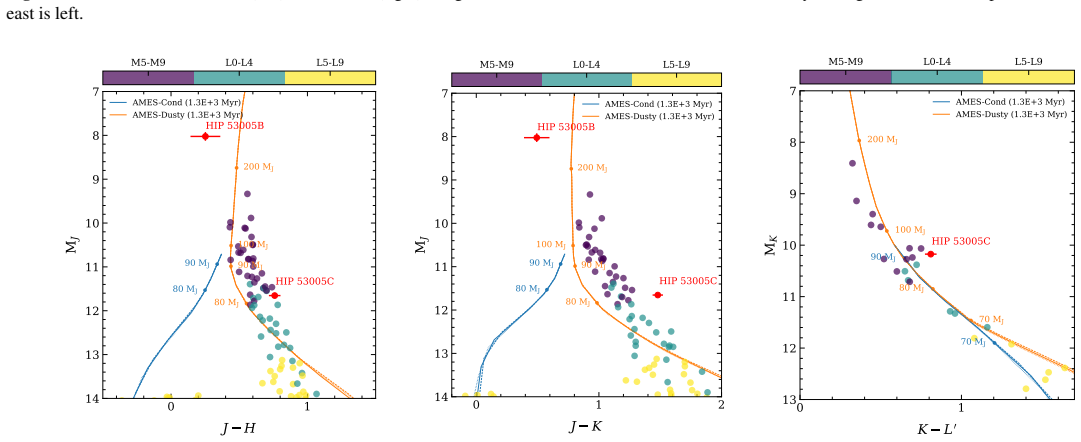
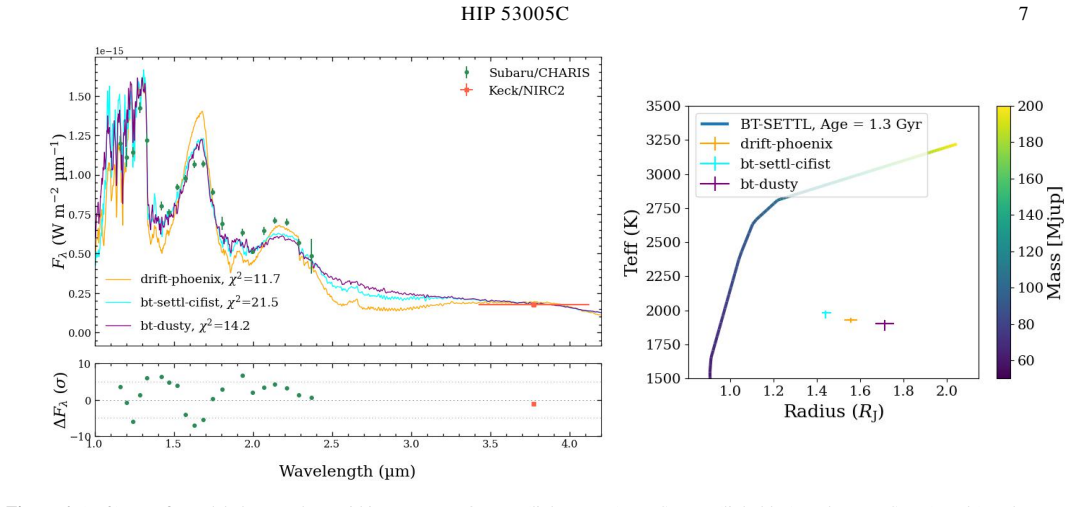
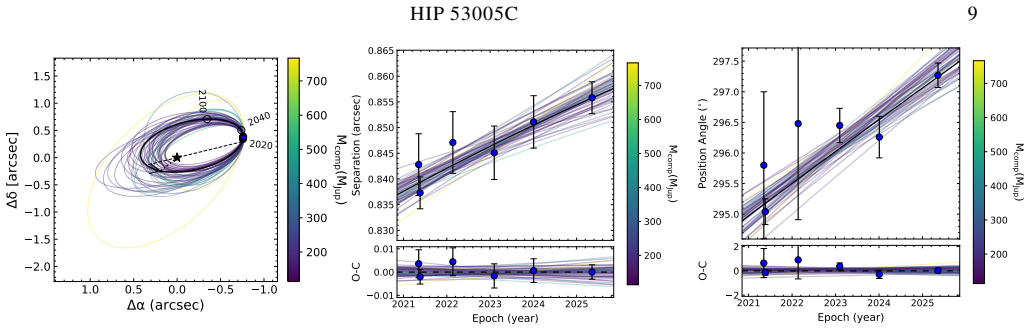
We present the discovery of HIP 53005 C at rho approximately 0.85 arcsec from the early-type star HIP 53005. Its location on color-magnitude diagrams, the fit of its spectral energy distribution to atmosphere models, and its position on an empirical mass-magnitude diagram all indicate a mass near the hydrogen-burning limit of about 80 Jupiter masses. Orbital fitting that incorporates direct-imaging relative astrometry together with proper-motion acceleration from the Hipparcos-Gaia Catalog of Accelerations instead favors a dynamical mass of approximately 185 Jupiter masses. The discrepancy may be explained by an additional unseen companion at rho less than or equal to 0.2 arcsec or by HIP 0
What carries the argument
The contrast between photometric and spectral-energy-distribution mass estimates versus dynamical mass derived from combined direct-imaging astrometry and proper-motion acceleration.
If this is right
- An undetected companion at separation less than or equal to 0.2 arcsec may be contributing to the observed acceleration.
- HIP 53005 C could itself be a close binary similar to Gliese 229B.
- The system offers a test case for how mass estimates behave near the hydrogen-burning limit when both photometric and dynamical data are available.
- Multiple-star formation channels may be required to explain objects whose light and orbit data disagree on mass.
Where Pith is reading between the lines
- Follow-up observations at higher angular resolution could directly detect or rule out a closer companion and settle the mass.
- If the companion is binary, the result would support formation models in which objects near the stellar limit commonly form in pairs.
- Similar mass discrepancies may exist in other accelerating stars that have only one imaged companion.
Load-bearing premise
The observed proper-motion acceleration is produced entirely by the imaged companion at 0.85 arcsec with no contribution from any undetected closer object.
What would settle it
High-resolution imaging or spectroscopy that either resolves a second companion inside 0.2 arcsec or shows HIP 53005 C as a spectroscopic binary with total mass near 185 Jupiter masses.
Figures





read the original abstract
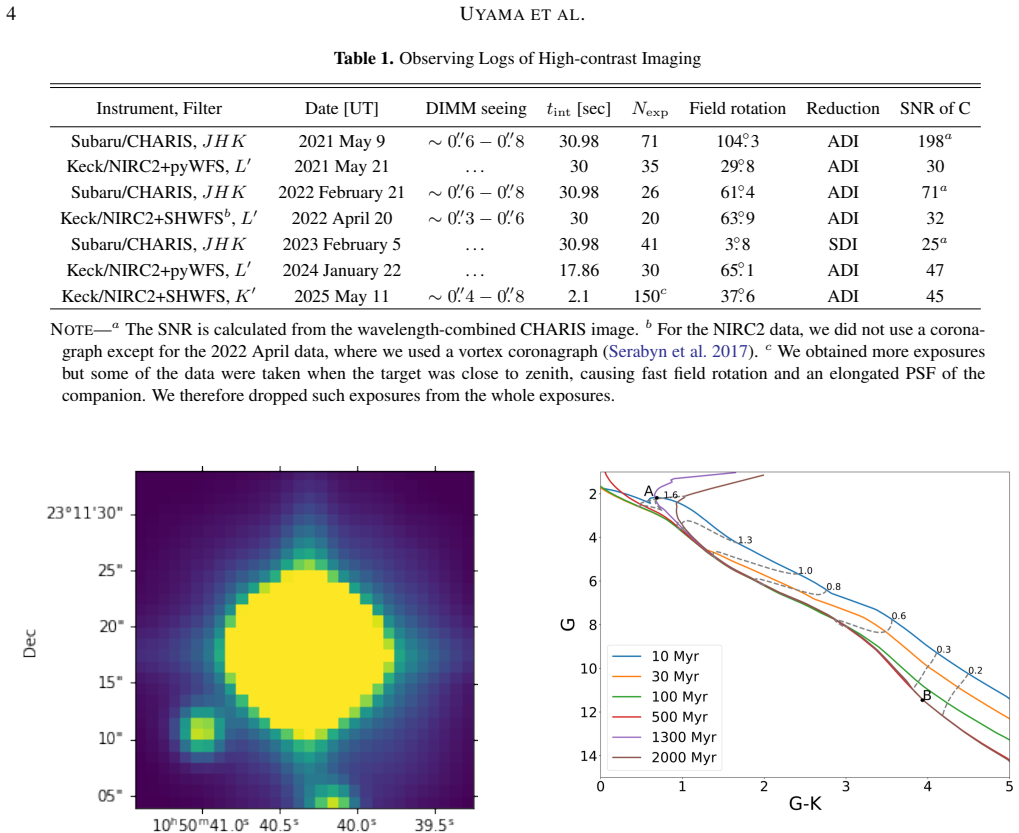
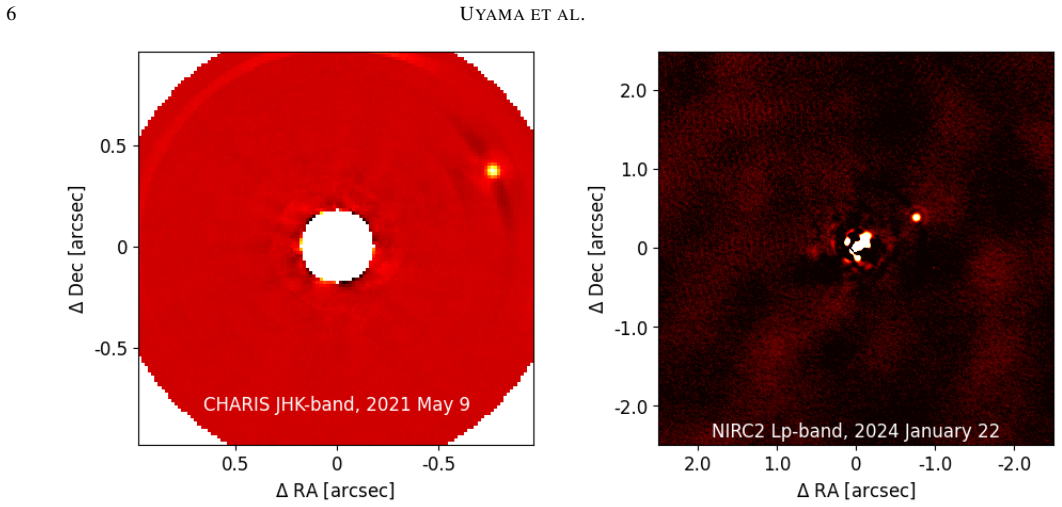
We present the discovery of a low-mass companion located at $\rho$ $\sim$ 0\farcs{}85 ($r_{\rm proj} \approx 62~au$) from the early-type 1.2 Gyr-old star HIP 53005 using direct imaging data from the Subaru and Keck Telescopes and astrometry from the Hipparcos-Gaia Catalog of Accelerations. The companion, HIP 53005 C, is a component of a multiple system also including a $\approx$ 12\farcs{}4-separation M dwarf companion inducing a negligible proper motion acceleration. HIP~53005 C's position on color-magnitude diagrams, the fit of its spectral energy distribution to atmosphere models, and its location on an empirical mass-magnitude diagram all suggest that it lies at the M/L transition and near the hydrogen-burning limit ($\sim80~M_{\rm Jup}$). However, our orbital fitting combining direct-imaging relative astrometry with proper motion acceleration favors a much higher dynamical mass of $\sim185\ M_{\rm Jup}$. An additional unseen, more closely-orbiting companion below the detection limit (at $\rho\lesssim0\farcs2$)) may explain this discrepancy. Alternatively, HIP~53005C could be a low-mass binary like Gliese~229Bab, making this system an intriguing laboratory for studying multiple star formation.
Editorial analysis
A structured set of objections, weighed in public.
Referee Report
Summary. The manuscript reports the discovery of a low-mass companion HIP 53005 C at projected separation ~62 au (ρ ~ 0.85″) to the early-type star HIP 53005 using Subaru/Keck direct imaging and Hipparcos-Gaia acceleration astrometry. Photometric placement on color-magnitude diagrams, SED fitting to atmosphere models, and empirical mass-magnitude relations all indicate a mass near the hydrogen-burning limit (~80 M_Jup). However, orbital fitting that combines the relative astrometry with the observed proper-motion acceleration yields a dynamical mass of ~185 M_Jup. The authors interpret the discrepancy as evidence for either an undetected inner companion (ρ ≲ 0.2″) or binarity of the imaged object itself.
Significance. If the reported mass tension is robust, the system would serve as a valuable laboratory for testing formation scenarios near the stellar-substellar boundary and for the occurrence of hierarchical multiples. The integration of direct-imaging astrometry with acceleration data is a methodological strength, and the explicit discussion of the possible inner companion is appropriately cautious. However, the significance is limited by the lack of quantitative validation for the single-companion acceleration model.
major comments (2)
- Orbital fitting and acceleration modeling: The dynamical mass of ~185 M_Jup is derived under the assumption that the full Hipparcos-Gaia proper-motion acceleration is produced solely by the detected companion at ρ ≈ 0.85″ (with the 12.4″ M dwarf stated to contribute negligibly). No Monte Carlo injection tests or covariance analysis quantifying the possible acceleration contribution from an undetected object at ρ ≲ 0.2″ are presented; such tests are required because even a modest inner contribution would lower the mass required for the imaged companion and reduce or eliminate the reported tension.
- Photometric and SED mass derivation: The ~80 M_Jup estimate relies on color-magnitude diagram placement, atmosphere-model SED fits, and an empirical mass-magnitude relation for a 1.2 Gyr age. The manuscript does not provide a propagated uncertainty budget that includes age uncertainty, model systematics, or photometric errors, making it difficult to assess whether the photometric mass is statistically inconsistent with the dynamical value at the claimed level.
minor comments (2)
- Notation consistency: The abstract and text alternate between “HIP 53005 C” and “HIP~53005C”; a uniform designation should be adopted throughout.
- Figure clarity: Error bars on the companion photometry in the color-magnitude diagram (likely Figure 2 or 3) are not described in the caption; adding them would allow readers to judge the significance of the CMD placement relative to the hydrogen-burning limit.
Simulated Author's Rebuttal
We thank the referee for the thoughtful and constructive report. The two major comments identify important areas where the current analysis can be strengthened with additional quantitative validation. We address each point below and will incorporate the requested material in a revised manuscript.
read point-by-point responses
-
Referee: Orbital fitting and acceleration modeling: The dynamical mass of ~185 M_Jup is derived under the assumption that the full Hipparcos-Gaia proper-motion acceleration is produced solely by the detected companion at ρ ≈ 0.85″ (with the 12.4″ M dwarf stated to contribute negligibly). No Monte Carlo injection tests or covariance analysis quantifying the possible acceleration contribution from an undetected object at ρ ≲ 0.2″ are presented; such tests are required because even a modest inner contribution would lower the mass required for the imaged companion and reduce or eliminate the reported tension.
Authors: We agree that the current orbital fit assumes the observed acceleration is produced entirely by the imaged companion at ~0.85″. While the 12.4″ M dwarf is shown to induce negligible acceleration in the manuscript, we did not perform the Monte Carlo injection tests or covariance analysis for possible inner companions at ρ ≲ 0.2″. We will add these tests in the revised manuscript, injecting synthetic inner companions across a range of masses and separations, recomputing the acceleration contribution, and re-deriving the dynamical mass of the outer companion to quantify how much the reported tension could be reduced. revision: yes
-
Referee: Photometric and SED mass derivation: The ~80 M_Jup estimate relies on color-magnitude diagram placement, atmosphere-model SED fits, and an empirical mass-magnitude relation for a 1.2 Gyr age. The manuscript does not provide a propagated uncertainty budget that includes age uncertainty, model systematics, or photometric errors, making it difficult to assess whether the photometric mass is statistically inconsistent with the dynamical value at the claimed level.
Authors: We acknowledge that the photometric mass derivation does not include a full propagated uncertainty budget. The 1.2 Gyr age is taken from the literature for the primary, but its uncertainty, together with model systematics in the atmosphere grids and photometric measurement errors, were not formally propagated. In the revision we will construct and present a comprehensive uncertainty budget that folds in these contributions (via Monte Carlo sampling over age, model grids, and photometry) and will report the resulting range on the photometric mass so that the tension with the dynamical value can be assessed quantitatively. revision: yes
Circularity Check
Masses from independent photometric/SED data and orbital fit to astrometry+acceleration; no equation reduces one to the other
full rationale
The ~80 M_Jup photometric mass is obtained by placing the companion on color-magnitude diagrams, fitting its SED to atmosphere models, and using an empirical mass-magnitude relation; none of these steps reference the orbital solution or acceleration data. The ~185 M_Jup dynamical mass is the output of a standard orbital fit that ingests two independent observables: relative astrometry from direct imaging and the Hipparcos-Gaia proper-motion acceleration vector. The acceleration is treated as an external constraint produced by the companion's gravity; the fit solves for mass (and other elements) rather than deriving the acceleration from the photometric mass. The paper explicitly flags the single-companion assumption as potentially incomplete and lists an undetected inner object as a viable resolution, so the tension is presented as an empirical discrepancy rather than a definitional identity. No self-citations are invoked to justify uniqueness or to close the derivation loop, and no fitted parameter is relabeled as a prediction.
Axiom & Free-Parameter Ledger
free parameters (1)
- dynamical mass =
~185 M_Jup
axioms (1)
- domain assumption Observed proper-motion acceleration is produced entirely by the imaged companion at 0.85 arcsec
invented entities (1)
-
unseen inner companion at rho less than or equal to 0.2 arcsec
no independent evidence
Lean theorems connected to this paper
-
IndisputableMonolith/Foundation/RealityFromDistinction.leanreality_from_one_distinction unclear?
unclearRelation between the paper passage and the cited Recognition theorem.
HIP 53005 C's position on color-magnitude diagrams, the fit of its spectral energy distribution to atmosphere models, and its location on an empirical mass-magnitude diagram all suggest ... ~80 MJup. However, our orbital fitting ... favors a much higher dynamical mass of ~185 MJup.
What do these tags mean?
- matches
- The paper's claim is directly supported by a theorem in the formal canon.
- supports
- The theorem supports part of the paper's argument, but the paper may add assumptions or extra steps.
- extends
- The paper goes beyond the formal theorem; the theorem is a base layer rather than the whole result.
- uses
- The paper appears to rely on the theorem as machinery.
- contradicts
- The paper's claim conflicts with a theorem or certificate in the canon.
- unclear
- Pith found a possible connection, but the passage is too broad, indirect, or ambiguous to say the theorem truly supports the claim.
Reference graph
Works this paper leans on
-
[1]
Allard, F., Homeier, D., & Freytag, B. 2012, Philosophical Transactions of the Royal Society of London Series A, 370, 2765, doi: 10.1098/rsta.2011.0269
-
[2]
S., Allard, F., & Hauschildt, P
Baraffe, I., Chabrier, G., Barman, T. S., Allard, F., & Hauschildt, P. H. 2003, A&A, 402, 701, doi: 10.1051/0004-6361:20030252
-
[3]
Bowler, B. P., Endl, M., Cochran, W. D., et al. 2021, ApJL, 913, L26, doi: 10.3847/2041-8213/abfec8
-
[4]
Brandt, G. M., Dupuy, T. J., Li, Y ., et al. 2021a, AJ, 162, 301, doi: 10.3847/1538-3881/ac273e
-
[5]
Brandt, T. D. 2018, ApJS, 239, 31, doi: 10.3847/1538-4365/aaec06 —. 2021, ApJS, 254, 42, doi: 10.3847/1538-4365/abf93c
-
[6]
Brandt, T. D., Dupuy, T. J., & Bowler, B. P. 2019, AJ, 158, 140, doi: 10.3847/1538-3881/ab04a8
-
[7]
Brandt, T. D., Dupuy, T. J., Bowler, B. P., et al. 2020, AJ, 160, 196, doi: 10.3847/1538-3881/abb45e
-
[8]
Brandt, T. D., Dupuy, T. J., Li, Y ., et al. 2021b, AJ, 162, 186, doi: 10.3847/1538-3881/ac042e
-
[9]
D., Rizzo, M., Groff, T., et al
Brandt, T. D., Rizzo, M., Groff, T., et al. 2017, Journal of Astronomical Telescopes, Instruments, and Systems, 3, 048002, doi: 10.1117/1.JATIS.3.4.048002
-
[10]
2000, ApJ, 542, 464, doi: 10.1086/309513
Chabrier, G., Baraffe, I., Allard, F., & Hauschildt, P. 2000, ApJ, 542, 464, doi: 10.1086/309513
-
[11]
2018, A&A, 614, A16, doi: 10.1051/0004-6361/201630136
Cheetham, A., S´egransan, D., Peretti, S., et al. 2018, A&A, 614, A16, doi: 10.1051/0004-6361/201630136
-
[12]
Chen, M., Wang, J. J., Brandt, T. D., et al. 2023, RAS Techniques and Instruments, 2, 620, doi: 10.1093/rasti/rzad039
-
[13]
2016, The Astrophysical Journal, 823, 102, doi: 10.3847/0004-637X/823/2/102
Choi, J., Dotter, A., Conroy, C., et al. 2016, ApJ, 823, 102, doi: 10.3847/0004-637X/823/2/102
work page internal anchor Pith review doi:10.3847/0004-637x/823/2/102 2016
-
[14]
Crepp, J. R., Johnson, J. A., Howard, A. W., et al. 2014, ApJ, 781, 29, doi: 10.1088/0004-637X/781/1/29
-
[15]
2023a, in Astronomical Society of the Pacific Conference Series, V ol
Currie, T., Biller, B., Lagrange, A., et al. 2023a, in Astronomical Society of the Pacific Conference Series, V ol. 534, Protostars and Planets VII, ed. S. Inutsuka, Y . Aikawa, T. Muto, K. Tomida, & M. Tamura, 799, doi: 10.48550/arXiv.2205.05696
-
[16]
Currie, T., Brandt, T. D., Uyama, T., et al. 2018, AJ, 156, 291, doi: 10.3847/1538-3881/aae9ea
-
[17]
Currie, T., Brandt, T. D., Kuzuhara, M., et al. 2020, ApJL, 904, L25, doi: 10.3847/2041-8213/abc631
-
[18]
Currie, T., Brandt, G. M., Brandt, T. D., et al. 2023b, Science, 380, 198, doi: 10.1126/science.abo6192
-
[19]
2026, AJ, 171, 5, doi: 10.3847/1538-3881/ae1a82 De Rosa, R
Currie, T., Li, Y ., El Morsy, M., et al. 2026, AJ, 171, 5, doi: 10.3847/1538-3881/ae1a82 De Rosa, R. J., Nielsen, E. L., Wahhaj, Z., et al. 2023, A&A, 672, A94, doi: 10.1051/0004-6361/202345877
-
[20]
2016, ApJS, 222, 8, doi: 10.3847/0067-0049/222/1/8 Ekstr¨ om, S., Georgy, C., Eggenberger, P., et al
Dotter, A. 2016, ApJS, 222, 8, doi: 10.3847/0067-0049/222/1/8
-
[21]
Dupuy, T. J., & Kraus, A. L. 2013, Science, 341, 1492, doi: 10.1126/science.1241917
-
[22]
Dupuy, T. J., & Liu, M. C. 2012, ApJS, 201, 19, doi: 10.1088/0067-0049/201/2/19 —. 2017, ApJS, 231, 15, doi: 10.3847/1538-4365/aa5e4c Ekstr¨om, S., Georgy, C., Eggenberger, P., et al. 2012, A&A, 537, A146, doi: 10.1051/0004-6361/201117751 El Morsy, M., Currie, T., Lacy, B., et al. 2025, ApJL, 995, L4, doi: 10.3847/2041-8213/ae195f
-
[23]
Feiden, G. A. 2016, A&A, 593, A99, doi: 10.1051/0004-6361/201527613
-
[24]
Franson, K., Bowler, B. P., Bonavita, M., et al. 2023, AJ, 165, 39, doi: 10.3847/1538-3881/aca408 Gagn´e, J., Mamajek, E. E., Malo, L., et al. 2018, ApJ, 856, 23, doi: 10.3847/1538-4357/aaae09 Gaia Collaboration, Brown, A. G. A., Vallenari, A., et al. 2021, A&A, 649, A1, doi: 10.1051/0004-6361/202039657 Gaia Collaboration, Vallenari, A., Brown, A. G. A., ...
-
[25]
2019, A&A, 626, A120, doi: 10.1051/0004-6361/201834898 14 U YAMA ET AL
Gallet, F., & Delorme, P. 2019, A&A, 626, A120, doi: 10.1051/0004-6361/201834898 14 U YAMA ET AL
-
[26]
Groff, T. D., Kasdin, N. J., Limbach, M. A., et al. 2015, in Society of Photo-Optical Instrumentation Engineers (SPIE) Conference
work page 2015
-
[27]
9605, Techniques and Instrumentation for Detection of Exoplanets VII, ed
Series, V ol. 9605, Techniques and Instrumentation for Detection of Exoplanets VII, ed. S. Shaklan, 96051C, doi: 10.1117/12.2188465
-
[28]
Hauschildt, P. H. 1992, JQSRT, 47, 433, doi: 10.1016/0022-4073(92)90105-D
-
[29]
2020, PASJ, 72, 93, doi: 10.1093/pasj/psaa085
Hirano, T., Kuzuhara, M., Kotani, T., et al. 2020, PASJ, 72, 93, doi: 10.1093/pasj/psaa085
-
[30]
2015, PASP, 127, 890, doi: 10.1086/682989
Jovanovic, N., Martinache, F., Guyon, O., et al. 2015, PASP, 127, 890, doi: 10.1086/682989
-
[31]
Kounkel, M., Stassun, K. G., Bouma, L. G., et al. 2022, AJ, 164, 137, doi: 10.3847/1538-3881/ac866d
-
[32]
Kurucz, R. L. 1979, ApJS, 40, 1, doi: 10.1086/190589
-
[33]
2018, in Society of Photo-Optical Instrumentation Engineers (SPIE) Conference
Kuzuhara, M., Hirano, T., Kotani, T., et al. 2018, in Society of Photo-Optical Instrumentation Engineers (SPIE) Conference
work page 2018
-
[34]
10702, Ground-based and Airborne Instrumentation for Astronomy VII, ed
Series, V ol. 10702, Ground-based and Airborne Instrumentation for Astronomy VII, ed. C. J. Evans, L. Simard, & H. Takami, 1070260, doi: 10.1117/12.2311832
-
[35]
Leike, R. H., Glatzle, M., & Enßlin, T. A. 2020, A&A, 639, A138, doi: 10.1051/0004-6361/202038169 Lightkurve Collaboration, Cardoso, J. V . d. M., Hedges, C., et al. 2018, Lightkurve: Kepler and TESS time series analysis in
-
[36]
Liu, M. C., Dupuy, T. J., & Allers, K. N. 2016, ApJ, 833, 96, doi: 10.3847/1538-4357/833/1/96
-
[37]
Mann, A. W., Dupuy, T., Kraus, A. L., et al. 2019, ApJ, 871, 63, doi: 10.3847/1538-4357/aaf3bc
-
[38]
2006, ApJ, 641, 556, doi: 10.1086/500401
Marois, C., Lafreni`ere, D., Doyon, R., Macintosh, B., & Nadeau, D. 2006, ApJ, 641, 556, doi: 10.1086/500401
-
[39]
McGahee, C., Gray, R. O., Griffin, R. E. M., Birchard, M., & Day, J. 2020, AJ, 160, 52, doi: 10.3847/1538-3881/ab974c
-
[40]
2023, A&A, 672, A93, doi: 10.1051/0004-6361/202345865
Mesa, D., Gratton, R., Kervella, P., et al. 2023, A&A, 672, A93, doi: 10.1051/0004-6361/202345865
-
[41]
T., Costa, G., Girardi, L., et al
Nguyen, C. T., Costa, G., Girardi, L., et al. 2022, A&A, 665, A126, doi: 10.1051/0004-6361/202244166
-
[42]
Nielsen, E. L., De Rosa, R. J., Macintosh, B., et al. 2019, AJ, 158, 13, doi: 10.3847/1538-3881/ab16e9
-
[43]
2016, ApJ, 824, 117, doi: 10.3847/0004-637X/824/2/117
Pueyo, L. 2016, ApJ, 824, 117, doi: 10.3847/0004-637X/824/2/117
-
[44]
2015, ApJ, 803, 31, doi: 10.1088/0004-637X/803/1/31
Pueyo, L., Soummer, R., Hoffmann, J., et al. 2015, ApJ, 803, 31, doi: 10.1088/0004-637X/803/1/31
-
[45]
Racine, R., Walker, G. A. H., Nadeau, D., Doyon, R., & Marois, C. 1999, PASP, 111, 587, doi: 10.1086/316367
-
[46]
Renson, P., Gerbaldi, M., & Catalano, F. A. 1991, A&AS, 89, 429
work page 1991
-
[47]
2009, A&A, 498, 961, doi: 10.1051/0004-6361/200810788
Renson, P., & Manfroid, J. 2009, A&A, 498, 961, doi: 10.1051/0004-6361/200810788
-
[48]
2017, AJ, 153, 43, doi: 10.3847/1538-3881/153/1/43
Serabyn, E., Huby, E., Matthews, K., et al. 2017, AJ, 153, 43, doi: 10.3847/1538-3881/153/1/43
-
[49]
Service, M., Lu, J. R., Campbell, R., et al. 2016, PASP, 128, 095004, doi: 10.1088/1538-3873/128/967/095004
-
[50]
2012, ApJL, 755, L28, doi: 10.1088/2041-8205/755/2/L28
Soummer, R., Pueyo, L., & Larkin, J. 2012, ApJL, 755, L28, doi: 10.1088/2041-8205/755/2/L28
-
[51]
Spiegel, D. S., & Burrows, A. 2012, ApJ, 745, 174, doi: 10.1088/0004-637X/745/2/174
-
[52]
2022, A&A, 666, A15, doi: 10.1051/0004-6361/202244193
Squicciarini, V ., & Bonavita, M. 2022, A&A, 666, A15, doi: 10.1051/0004-6361/202244193
-
[53]
2017, ApJ, 844, 103, doi: 10.3847/1538-4357/aa7746
Tokovinin, A. 2017, ApJ, 844, 103, doi: 10.3847/1538-4357/aa7746
-
[54]
Valenti, J. A., & Fischer, D. A. 2005, ApJS, 159, 141, doi: 10.1086/430500
-
[55]
Walker, S. A. U., Liu, M. C., Mawet, D., et al. 2025, arXiv e-prints, arXiv:2512.05191, doi: 10.48550/arXiv.2512.05191
-
[56]
Wang, J. J., Ruffio, J.-B., De Rosa, R. J., et al. 2015, in Astrophysics Source Code Library, ascl:1506.001. http://ascl.net/1506.001
work page 2015
-
[57]
Wang, J. J., Graham, J. R., Pueyo, L., et al. 2016, AJ, 152, 97, doi: 10.3847/0004-6256/152/4/97
-
[58]
Whitebook, S., Brandt, T. D., Brandt, G. M., & Martin, E. C. 2024, ApJL, 974, L30, doi: 10.3847/2041-8213/ad7714
-
[59]
Witte, S., Helling, C., Barman, T., Heidrich, N., & Hauschildt, P. H. 2011, A&A, 529, A44, doi: 10.1051/0004-6361/201014105
-
[60]
W., M´erand, A., Thompson, W., et al
Xuan, J. W., M´erand, A., Thompson, W., et al. 2024, Nature, 634, 1070, doi: 10.1038/s41586-024-08064-x
discussion (0)
Sign in with ORCID, Apple, or X to comment. Anyone can read and Pith papers without signing in.