Recognition: no theorem link
Toward a Sustainable Software Architecture Community: Evaluating ICSA's Environmental Impact
Pith reviewed 2026-05-13 17:32 UTC · model grok-4.3
The pith
A carbon audit measures emissions from generative AI in software architecture papers alongside the full footprint of the ICSA conference.
A machine-rendered reading of the paper's core claim, the machinery that carries it, and where it could break.
Core claim
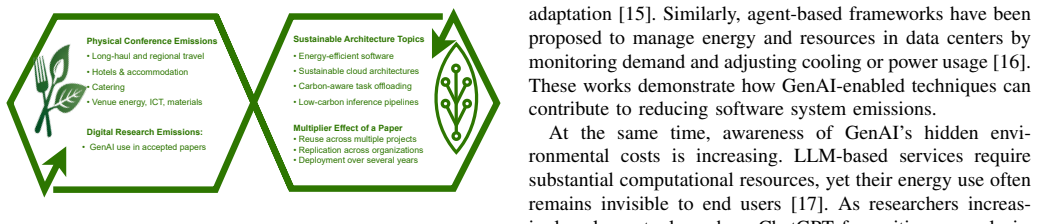
The authors establish two carbon footprints for the ICSA context: one exploratory calculation of emissions from generative AI tools used in preparing accepted papers, bounded by research artifacts, and another complete accounting of emissions from conference attendance and operations for the 2025 event, covering travel, lodging, food, energy, and materials. These inventories, though differing in completeness, together support discussions on how the community can reduce its overall environmental load through transparency and targeted efficiency measures.
What carries the argument
Two separate carbon inventories defined by distinct system boundaries, one for generative AI inference usage and one for conference attendance and operations.
Load-bearing premise
The audit depends on assumptions that the rates of generative AI usage in papers are typical and that standard emission factors accurately represent local conditions for travel and energy use.
What would settle it
Collecting actual usage data from authors on how often they used specific GenAI tools during paper writing or obtaining precise attendee travel records would test the accuracy of the reported emission totals.
Figures


read the original abstract
Generative AI (GenAI) tools are increasingly integrated into software architecture research, yet the environmental impact of their computational usage remains largely undocumented. This study presents the first systematic audit of the carbon footprint of both the digital footprint from GenAI usage in research papers, and the traditional footprint from conference activities within the context of the IEEE International Conference on Software Architecture (ICSA). We report two separate carbon inventories relevant to the software architecture research community: i) an exploratory estimate of the footprint of GenAI inference usage associated with accepted papers within a research-artifact boundary, and ii) the conference attendance and operations footprint of ICSA 2025 (travel, accommodation, catering, venue energy, and materials) within the conference time boundary. These two inventories, with different system boundaries and completeness, support transparency and community reflection. We discuss implications for sustainable software architecture, including recommendations for transparency, greener conference planning, and improved energy efficiency in GenAI operations. Our work supports a more climate-conscious research culture within the ICSA community and beyond
Editorial analysis
A structured set of objections, weighed in public.
Referee Report
Summary. The paper claims to present the first systematic audit of the carbon footprint of both GenAI usage in research papers and traditional conference activities for the IEEE International Conference on Software Architecture (ICSA). It reports two inventories: an exploratory estimate of the GenAI inference footprint associated with accepted papers and the full conference operations footprint for ICSA 2025 (travel, accommodation, catering, venue energy, and materials), followed by discussion of implications and recommendations for sustainable practices.
Significance. If the estimates can be substantiated with primary data and validation, the work could meaningfully advance climate-conscious practices in the software architecture community by highlighting both digital and physical impacts and prompting changes in conference planning and GenAI operations.
major comments (1)
- [Abstract] Abstract: the claim of the 'first systematic audit' of both footprints is load-bearing on the GenAI inventory, which is described as exploratory and rests on assumed representative rates of AI tool usage across accepted papers plus accurate inference energy figures, with no primary data (e.g., author surveys), validation steps, or sensitivity analysis described to support the numbers.
minor comments (2)
- The abstract would be strengthened by including at least headline numerical results and data sources so readers can immediately assess the scale of each inventory.
- Add an explicit limitations subsection that quantifies uncertainty in the GenAI assumptions and discusses boundary choices for both inventories.
Simulated Author's Rebuttal
We thank the referee for their constructive feedback on the abstract and the strength of our claims. We agree that the 'first systematic audit' phrasing requires qualification given the exploratory nature of the GenAI inventory and will revise the manuscript to address this while preserving the value of the conference operations audit.
read point-by-point responses
-
Referee: [Abstract] Abstract: the claim of the 'first systematic audit' of both footprints is load-bearing on the GenAI inventory, which is described as exploratory and rests on assumed representative rates of AI tool usage across accepted papers plus accurate inference energy figures, with no primary data (e.g., author surveys), validation steps, or sensitivity analysis described to support the numbers.
Authors: We agree that the GenAI inventory is exploratory and relies on literature-derived assumptions for usage rates and inference energy rather than primary data such as author surveys. The manuscript already labels this component as an 'exploratory estimate' and notes differing system boundaries. We will revise the abstract to qualify the overall contribution as combining an exploratory GenAI estimate with a more complete conference operations inventory, removing the unqualified 'first systematic audit' claim. We will also add a sensitivity analysis on key parameters (e.g., usage rates and energy figures) and expand the limitations section to discuss uncertainties and the absence of primary data collection. Primary data via surveys cannot be added in revision as it would require new empirical work outside the current study's scope; we will explicitly flag this as a direction for future research. revision: partial
Circularity Check
No circularity: exploratory audit relies on external factors and stated assumptions
full rationale
The paper presents two separate carbon inventories—an exploratory GenAI inference estimate and a conference operations footprint—using external emission factors, standard conversion values, and explicitly stated assumptions about usage rates. No equations, fitted parameters, predictions derived from prior results, or self-citations appear in the provided text that would reduce any claimed quantity to its own inputs by construction. The derivation chain consists of direct multiplication of activity data by independent coefficients; the result is therefore not equivalent to the inputs by definition. This is the normal non-circular outcome for an audit-style study.
Axiom & Free-Parameter Ledger
free parameters (2)
- GenAI inference usage rate per paper
- Conference-specific emission factors
axioms (1)
- domain assumption Standard carbon emission factors from life-cycle databases are accurate and transferable to this conference setting
Reference graph
Works this paper leans on
-
[1]
Generative ai for software architecture. applications, trends, challenges, and future directions,
M. Esposito, X. Li, S. Moreschini, N. Ahmad, T. Cerny, K. Vaid- hyanathan, V . Lenarduzzi, and D. Taibi, “Generative ai for software architecture. applications, trends, challenges, and future directions,” Applications, Trends, Challenges, and Future Directions, 2025
work page 2025
-
[2]
Energy and policy con- siderations for deep learning in nlp,
E. Strubell, A. Ganesh, and A. McCallum, “Energy and policy con- siderations for deep learning in nlp,” inProceedings of the 57th annual meeting of the assoc for computational linguistics, 2019, pp. 3645–3650
work page 2019
-
[3]
How hungry is ai? benchmarking energy, water, and carbon footprint of llm inference,
N. Jegham, M. Abdelatti, C. Y . Koh, L. Elmoubarki, and A. Hendawi, “How hungry is ai? benchmarking energy, water, and carbon footprint of llm inference,”arXiv preprint arXiv:2505.09598, 2025
-
[4]
S. Altman, “The gentle singularity,”Sam Altman Blog, 2025, accessed: 2025-12-10. [Online]. Available: https://blog.samaltman.com/ the-gentle-singularity
work page 2025
-
[5]
Examining the carbon footprint of conferences with an emphasis on energy consumption and catering,
V . Mannheim and J. L. Avat ´o, “Examining the carbon footprint of conferences with an emphasis on energy consumption and catering,” Energies, vol. 18, no. 2, p. 321, 2025
work page 2025
-
[6]
S. Neugebauer, M. Bolz, R. Mankaa, and M. Traverso, “How sustainable are sustainability conferences?–comprehensive life cycle assessment of an international conference series in europe,”Journal of cleaner production, vol. 242, p. 118516, 2020
work page 2020
-
[7]
Generative artificial intelligence for software engineering—a research agenda,
A. Nguyen-Duc, B. Cabrero-Daniel, A. Przybylek, C. Arora, D. Khanna, T. Herda, U. Rafiq, J. Melegati, E. Guerra, K.-K. Kemellet al., “Generative artificial intelligence for software engineering—a research agenda,”Software: Practice and Experience, vol. 55, no. 11, pp. 1806– 1843, 2025
work page 2025
-
[8]
Large language models for software engineering: Sur- vey and open problems,
A. Fan, B. Gokkaya, M. Harman, M. Lyubarskiy, S. Sengupta, S. Yoo, and J. M. Zhang, “Large language models for software engineering: Sur- vey and open problems,” in2023 IEEE/ACM International Conference on Software Engineering: Future of Software Engineering (ICSE-FoSE). IEEE, 2023, pp. 31–53
work page 2023
-
[9]
Can llms generate architec- tural design decisions?-an exploratory empirical study,
R. Dhar, K. Vaidhyanathan, and V . Varma, “Can llms generate architec- tural design decisions?-an exploratory empirical study,” in2024 IEEE 21st International Conference on Software Architecture (ICSA). IEEE, 2024, pp. 79–89
work page 2024
-
[10]
M. Soliman and J. Keim, “Do large language models contain software architectural knowledge?: An exploratory case study with gpt,” in2025 IEEE 22nd International Conference on Software Architecture (ICSA). IEEE, 2025, pp. 13–24
work page 2025
-
[11]
M. Shamsujjoha, Q. Lu, D. Zhao, and L. Zhu, “Swiss cheese model for ai safety: A taxonomy and reference architecture for multi-layered guardrails of foundation model based agents,” in2025 IEEE 22nd Int Conference on Software Architecture (ICSA). IEEE, 2025, pp. 37–48
work page 2025
-
[12]
P. Liu and L. Xiao, “Improving clinical decision support: Architecture design of a multi-agent system based on an argument quality assessment ontology,” in2025 IEEE 22nd International Conference on Software Architecture (ICSA). IEEE, 2025, pp. 313–323
work page 2025
-
[13]
Enabling architec- ture traceability by llm-based architecture component name extraction,
D. Fuchß, H. Liu, T. Hey, J. Keim, and A. Koziolek, “Enabling architec- ture traceability by llm-based architecture component name extraction,” in2025 IEEE 22nd International Conference on Software Architecture (ICSA). IEEE, 2025, pp. 1–12
work page 2025
-
[14]
S. Arun, M. Tedla, and K. Vaidhyanathan, “Llms for generation of architectural components: An exploratory empirical study in the server- less world,” in2025 IEEE 22nd International Conference on Software Architecture (ICSA). IEEE, 2025, pp. 25–36
work page 2025
-
[15]
A. Matathammal, K. Gupta, L. Lavanya, A. V . Halgatti, P. Gupta, and K. Vaidhyanathan, “Edgemlbalancer: A self-adaptive approach for dynamic model switching on resource-constrained edge devices,” in 2025 IEEE 22nd International Conference on Software Architecture Companion (ICSA-C). IEEE, 2025, pp. 543–552
work page 2025
-
[16]
Dynamic architectures leveraging ai agents and human-in-the-loop for data center management,
V . D. Sera and S. Kalra, “Dynamic architectures leveraging ai agents and human-in-the-loop for data center management,” in2025 IEEE 22nd International Conference on Software Architecture Companion (ICSA- C). IEEE, 2025, pp. 324–333
work page 2025
-
[17]
Visualizing ai energy use: Can consumption reminders promote social good mindsets?
E. Barnett, “Visualizing ai energy use: Can consumption reminders promote social good mindsets?” Ph.D. dissertation, Texas Christian University Fort Worth, Texas, 2025
work page 2025
-
[18]
N. Inie, J. Falk, and R. Selvan, “How co2stly is chi? the carbon footprint of generative ai in hci research and what we should do about it,” inProceedings of the 2025 CHI Conference on Human Factors in Computing Systems, 2025, pp. 1–29
work page 2025
-
[19]
Carbon Emissions and Large Neural Network Training
D. Patterson, J. Gonzalez, Q. Le, C. Liang, L.-M. Munguia, D. Rothchild, D. So, M. Texier, and J. Dean, “Carbon emissions and large neural network training,”arXiv preprint arXiv:2104.10350, 2021
work page internal anchor Pith review Pith/arXiv arXiv 2021
-
[20]
R. Desislavov, F. Mart ´ınez-Plumed, and J. Hern´andez-Orallo, “Trends in ai inference energy consumption: Beyond the performance-vs-parameter laws of deep learning,”Sustainable Computing: Informatics and Sys- tems, vol. 38, p. 100857, 2023
work page 2023
-
[21]
Trend towards virtual and hybrid conferences may be an effective climate change mitigation strategy,
Y . Tao, D. Steckel, J. J. Kleme ˇs, and F. You, “Trend towards virtual and hybrid conferences may be an effective climate change mitigation strategy,”Nature communications, vol. 12, no. 1, p. 7324, 2021
work page 2021
-
[22]
A. Cavallin Toscani, A. Atasu, L. N. Van Wassenhove, and A. Vinelli, “Life cycle assessment of in-person, virtual, and hybrid academic conferences: New evidence and perspectives,”Journal of Industrial Ecology, vol. 27, no. 6, pp. 1461–1475, 2023
work page 2023
-
[23]
Emission reduction potentials for academic conference travel,
S. Van Ewijk and P. Hoekman, “Emission reduction potentials for academic conference travel,”Journal of Industrial Ecology, vol. 25, no. 3, pp. 778–788, 2021
work page 2021
-
[24]
Hotel carbon measurement initiative (hcmi) methodology – version 2.0,
Sustainable Hospitality Alliance, “Hotel carbon measurement initiative (hcmi) methodology – version 2.0,” https://sustainablehospitalityalliance. org/wp-content/uploads/2020/02/HCMI-v2.0-introduction.pdf, 2020, ac- cessed: 2025-12-10
work page 2020
-
[25]
V . Filimonau, J. Dickinson, D. Robbins, and M. A. Huijbregts, “Re- viewing the carbon footprint analysis of hotels: Life cycle energy analysis (lcea) as a holistic method for carbon impact appraisal of tourist accommodation,”Journal of cleaner production, vol. 19, no. 17-18, pp. 1917–1930, 2011
work page 1917
-
[26]
Gptzero: Robust detection of llm-generated texts,
G. A. Adam, A. Cui, E. Thomas, E. Napier, N. Shmatko, J. Schnell, J. J. Tian, A. Dronavalli, E. Tian, and D. Lee, “Gptzero: Robust detection of llm-generated texts,” 2026. [Online]. Available: https://arxiv.org/abs/2602.13042
-
[27]
Ecologits: Evaluating the environmental impacts of generative ai,
S. Rinc ´e and A. Banse, “Ecologits: Evaluating the environmental impacts of generative ai,”Journal of Open Source Software, vol. 10, no. 111, p. 7471, 2025
work page 2025
-
[28]
Uk government ghg conversion factors for company reporting,
Department for Environment, Food & Rural Affairs (DEFRA), “Uk government ghg conversion factors for company reporting,” https://www.gov.uk/government/publications/ greenhouse-gas-reporting-conversion-factors-2023, 2023
work page 2023
-
[29]
Myclimate flight co2 emissions calculator,
Myclimate, “Myclimate flight co2 emissions calculator,” https://co2. myclimate.org/en/flight calculators/new, 2025, accessed: 2025-12-10
work page 2025
-
[30]
CarbonLabel.org, “carbonlabel.org data,” https://carbonlabel.org/data, 2025, accessed: 2025-12-10
work page 2025
-
[31]
Climatiq emission factor, co2 (kg) per passenger-km, short-haul flight, economy class,
Climatiq, “Climatiq emission factor, co2 (kg) per passenger-km, short-haul flight, economy class,” https://www.climatiq.io/data/ emission-factor/31c8e342-a53e-4ae0-8fb7-dc1e69fa6965, 2025, accessed: 2025-12-10
work page 2025
-
[32]
Building energy audit, thermal comfort, and iaq assessment of a school building: A case study,
A. Merabtine, C. Maalouf, A. A. W. Hawila, N. Martaj, and G. Polidori, “Building energy audit, thermal comfort, and iaq assessment of a school building: A case study,”Building and Environment, vol. 145, pp. 62–76
-
[33]
NowTricity, “Electricity mix denmark,” https://www.nowtricity.com/ country/denmark/, 2025, accessed: 2025-12-10
work page 2025
-
[34]
Climate is served: Facts and figures on denmark’s food consumption and green- house gas emissions,
Danish Ministry of Food, Agriculture and Fisheries (FVM), “Climate is served: Facts and figures on denmark’s food consumption and green- house gas emissions,” https://en.fvm.dk/Media/638499759964791542/ Climate is Served.pdf, 2021, accessed: 2025-12-10
-
[35]
Den Store Klimadatabase, “Den store klimadatabase,” https://denstoreklimadatabase.dk/en, 2025, accessed: 2025-12-10
work page 2025
-
[36]
Greenhouse gas inventory guidance,
U. EPA, “Greenhouse gas inventory guidance,” inIndirect Emissions from Events and Conferences. US EPA Center for Corporate Climate Leadership, 2018, pp. 2018–12
work page 2018
discussion (0)
Sign in with ORCID, Apple, or X to comment. Anyone can read and Pith papers without signing in.