Recognition: no theorem link
Mechanism and Communication Co-Design for Differentially Private Energy Sharing
Pith reviewed 2026-05-13 17:10 UTC · model grok-4.3
The pith
A differentially private equilibrium-seeking algorithm protects prosumer privacy in wireless energy sharing while quantifying the impact on convergence accuracy.
A machine-rendered reading of the paper's core claim, the machinery that carries it, and where it could break.
Core claim
Under the adversarial attack model, base station observations in OTA MIMO aggregation allow the platform to extract and recover prosumers' private parameters. The proposed differentially private equilibrium-seeking algorithm adds calibrated noise during the process to achieve a target privacy level, and the analysis shows that the algorithm converges to a solution whose distance from the true equilibrium scales with the privacy parameter.
What carries the argument
The differentially private equilibrium-seeking algorithm, which injects noise into the OTA MIMO aggregation step to enforce differential privacy while iteratively solving for the energy sharing equilibrium.
If this is right
- Energy sharing platforms can scale to many prosumers without exposing individual cost or preference data.
- The accuracy loss from privacy noise can be bounded and traded off explicitly against the chosen privacy parameter.
- The same noise-injection approach during aggregation extends to other distributed coordination tasks over wireless links.
- Prosumers receive formal assurance that their data remains hidden even if the platform observes the aggregated signals.
Where Pith is reading between the lines
- If real channels deviate from the assumed conditions, the demonstrated attack risk drops and simpler non-private mechanisms may suffice.
- Adaptive noise scaling based on instantaneous channel quality could reduce the accuracy penalty while preserving the privacy guarantee.
- The co-design pattern may transfer to privacy-sensitive resource allocation in other shared-medium systems such as spectrum or compute markets.
Load-bearing premise
The platform can extract and recover prosumers' private parameters from base station observations when the attack model and channel conditions hold.
What would settle it
A direct test showing that base station observations yield no accurate recovery of prosumer cost functions or preferences when the DP noise is absent, or that the noisy algorithm diverges for privacy levels above a measurable threshold.
Figures


read the original abstract
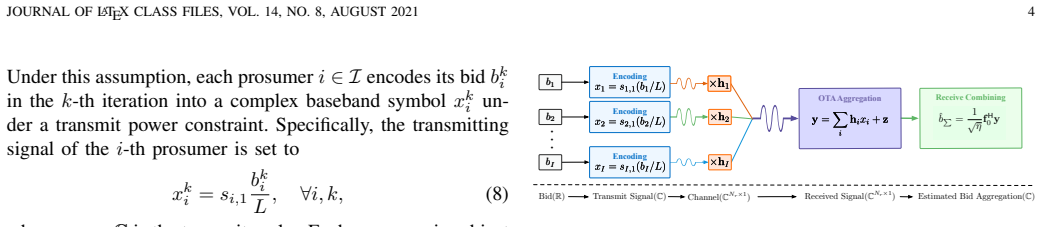
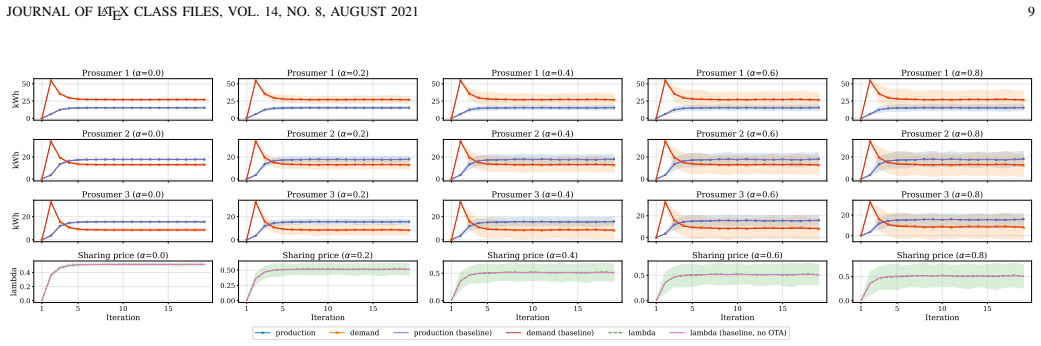
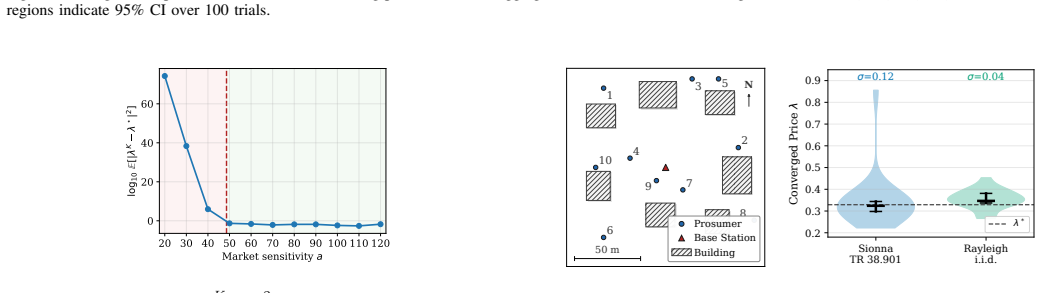
Integrating distributed energy resources (DERs) is a critical step toward addressing the global climate crisis. This transformation has driven the transition from traditional consumers to prosumers and given rise to new energy sharing business models. Existing works have extensively studied prosumer energy sharing mechanisms, yet little attention has been paid to privacy protection, particularly when communication constraints are taken into account. In this paper, we study an energy sharing mechanism where information is exchanged over wireless channels via over-the-air (OTA) multiple-input multiple-output (MIMO) aggregation to exploit spectral efficiency for scalable prosumer coordination. To characterize the privacy leakage risk during data transmission process, we introduce an adversarial attack model and demonstrate that, under certain conditions, the platform can extract and recover prosumers' private parameters from the base station observations. To safeguard the energy sharing mechanism against such attacks, we propose a differentially private equilibrium-seeking algorithm, analyze the achievable privacy level, and establish convergence guarantees that quantify the impact of privacy on the convergence accuracy. Numerical experiments demonstrate that our approach effectively protects prosumers' privacy while converging to near-optimal solutions.
Editorial analysis
A structured set of objections, weighed in public.
Referee Report
Summary. The manuscript proposes a co-design of energy sharing mechanisms and wireless communication for differentially private prosumer coordination. It uses over-the-air MIMO aggregation for scalable information exchange, introduces an adversarial attack model demonstrating that under certain conditions a platform can recover private parameters from base-station observations, proposes a differentially private equilibrium-seeking algorithm, analyzes the achievable privacy level, establishes convergence guarantees quantifying the privacy-convergence trade-off, and validates the approach via numerical experiments showing effective privacy protection with near-optimal solutions.
Significance. If the derivations hold, the work is significant for addressing privacy in communication-constrained energy sharing systems, a key enabler for distributed energy resource integration. The integration of OTA MIMO aggregation with differential privacy and the explicit quantification of privacy's effect on convergence accuracy represent a useful contribution at the intersection of mechanism design and wireless information theory. The empirical results further support practical relevance.
major comments (2)
- [§IV] §IV (Convergence Analysis): The abstract and introduction claim convergence guarantees that quantify the impact of privacy on convergence accuracy, yet the provided text does not include the full derivation, explicit error bounds, or the precise statement of the theorem (e.g., the dependence of the convergence radius on the privacy parameter ε). This is load-bearing for the central claim and must be supplied with complete steps and assumptions.
- [§III] §III (Adversarial Attack Model): The demonstration that the platform can extract and recover prosumers' private parameters is qualified as holding 'under certain conditions' on the MIMO channels and OTA aggregation. Because this leakage result motivates the entire DP algorithm, the manuscript must specify those conditions explicitly (e.g., perfect CSI, ideal aggregation) and discuss robustness to realistic deviations such as imperfect CSI or non-ideal channel models; otherwise the privacy-utility analysis rests on an unverified premise.
minor comments (2)
- [Numerical Experiments] The numerical experiments section mentions convergence to near-optimal solutions but omits key details such as the number of prosumers, specific channel models, and baseline comparisons; these should be added for reproducibility.
- Notation for the privacy parameter and the OTA aggregation function is introduced without a consolidated table; a notation table would improve readability.
Simulated Author's Rebuttal
We thank the referee for the constructive comments, which help us strengthen the manuscript. We address each major comment below and will incorporate the requested clarifications and expansions in the revised version.
read point-by-point responses
-
Referee: [§IV] §IV (Convergence Analysis): The abstract and introduction claim convergence guarantees that quantify the impact of privacy on convergence accuracy, yet the provided text does not include the full derivation, explicit error bounds, or the precise statement of the theorem (e.g., the dependence of the convergence radius on the privacy parameter ε). This is load-bearing for the central claim and must be supplied with complete steps and assumptions.
Authors: We agree that the convergence analysis requires a more complete presentation. In the revised manuscript, we will expand Section IV to include the full step-by-step derivation of the convergence theorem, explicit error bounds, and the precise dependence of the convergence radius on the privacy parameter ε, along with a clear enumeration of all assumptions. revision: yes
-
Referee: [§III] §III (Adversarial Attack Model): The demonstration that the platform can extract and recover prosumers' private parameters is qualified as holding 'under certain conditions' on the MIMO channels and OTA aggregation. Because this leakage result motivates the entire DP algorithm, the manuscript must specify those conditions explicitly (e.g., perfect CSI, ideal aggregation) and discuss robustness to realistic deviations such as imperfect CSI or non-ideal channel models; otherwise the privacy-utility analysis rests on an unverified premise.
Authors: We acknowledge the need for greater explicitness. In the revision, we will clearly specify the conditions (perfect CSI and ideal OTA aggregation) under which the leakage result holds in Section III. We will also add a dedicated paragraph discussing robustness to practical deviations such as imperfect CSI and non-ideal channel models, explaining how these affect the motivation for the differentially private algorithm. revision: yes
Circularity Check
No significant circularity; attack model and DP convergence analysis presented as independent contributions
full rationale
The derivation introduces an adversarial attack model under stated conditions on MIMO channels and OTA aggregation, then proposes a separate differentially private equilibrium-seeking algorithm with privacy-level analysis and convergence guarantees. No equations or steps reduce by construction to fitted parameters, self-definitions, or load-bearing self-citations. The central claims remain externally falsifiable via the stated assumptions on channels and aggregation, consistent with a self-contained contribution.
Axiom & Free-Parameter Ledger
Reference graph
Works this paper leans on
-
[1]
P. Basak, S. Chowdhury, S. H. nee Dey, and S. Chowdhury, “A literature review on integration of distributed energy resources in the perspective of control, protection and stability of microgrid,”Renewable and Sustainable Energy Reviews, vol. 16, no. 8, pp. 5545–5556, 2012
work page 2012
-
[2]
Goldsmith,Wireless communications
A. Goldsmith,Wireless communications. Cambridge university press, 2005
work page 2005
-
[3]
Fully homomorphic encryption using ideal lattices,
C. Gentry, “Fully homomorphic encryption using ideal lattices,” in Proceedings of the forty-first annual ACM symposium on Theory of computing, 2009, pp. 169–178
work page 2009
-
[4]
Protocols for secure computations,
A. C. Yao, “Protocols for secure computations,” in23rd annual sympo- sium on foundations of computer science (sfcs 1982). IEEE, 1982, pp. 160–164
work page 1982
-
[5]
Calibrating noise to sensitivity in private data analysis,
C. Dwork, F. McSherry, K. Nissim, and A. Smith, “Calibrating noise to sensitivity in private data analysis,” inTheory of cryptography conference. Springer, 2006, pp. 265–284
work page 2006
-
[6]
Peer-to- peer trading in electricity networks: An overview,
W. Tushar, T. K. Saha, C. Yuen, D. Smith, and H. V . Poor, “Peer-to- peer trading in electricity networks: An overview,”IEEE transactions on smart grid, vol. 11, no. 4, pp. 3185–3200, 2020
work page 2020
-
[7]
Review of energy sharing: Business models, mechanisms, and prospects,
Y . Chen and C. Zhao, “Review of energy sharing: Business models, mechanisms, and prospects,”IET Renewable Power Generation, vol. 16, no. 12, pp. 2468–2480, 2022
work page 2022
-
[8]
S. Malik, M. Duffy, S. Thakur, B. Hayes, and J. Breslin, “A priority- based approach for peer-to-peer energy trading using cooperative game theory in local energy community,”International Journal of Electrical Power & Energy Systems, vol. 137, p. 107865, 2022
work page 2022
-
[9]
A motivational game-theoretic approach for peer-to-peer energy trading in the smart grid,
W. Tushar, T. K. Saha, C. Yuen, T. Morstyn, M. D. McCulloch, H. V . Poor, and K. L. Wood, “A motivational game-theoretic approach for peer-to-peer energy trading in the smart grid,”Applied energy, vol. 243, pp. 10–20, 2019
work page 2019
-
[10]
G. El Rahi, S. R. Etesami, W. Saad, N. B. Mandayam, and H. V . Poor, “Managing price uncertainty in prosumer-centric energy trading: A prospect-theoretic stackelberg game approach,”IEEE Transactions on Smart Grid, vol. 10, no. 1, pp. 702–713, 2017
work page 2017
-
[11]
Energy sharing management for microgrids with pv prosumers: A Stackelberg game approach,
N. Liu, X. Yu, C. Wang, and J. Wang, “Energy sharing management for microgrids with pv prosumers: A Stackelberg game approach,”IEEE Transactions on Industrial Informatics, vol. 13, no. 3, pp. 1088–1098, 2017
work page 2017
-
[12]
J. Wang and G. Hu, “Game-based optimal aggregation of energy prosumer community with mixed-pricing scheme in two-settlement electricity market,”IEEE Transactions on Automation Science and Engineering, vol. 22, pp. 3433–3444, 2024
work page 2024
-
[13]
An energy sharing mechanism considering network constraints and market power limita- tion,
Y . Chen, C. Zhao, S. H. Low, and A. Wierman, “An energy sharing mechanism considering network constraints and market power limita- tion,”IEEE transactions on smart grid, vol. 14, no. 2, pp. 1027–1041, 2022
work page 2022
-
[14]
Approaching prosumer social optimum via energy sharing with proof of convergence,
Y . Chen, C. Zhao, S. H. Low, and S. Mei, “Approaching prosumer social optimum via energy sharing with proof of convergence,”IEEE Transactions on Smart Grid, vol. 12, no. 3, pp. 2484–2495, 2020
work page 2020
-
[15]
Z. Wang, W. Hao, W. Wei, and Z. Sun, “Online distributed generalized nash equilibrium seeking of energy sharing markets in distribution networks,”IEEE Transactions on Automation Science and Engineering, 2025
work page 2025
-
[16]
Distributed energy trading in smart grid over directed communication network,
M. H. Ullah and J.-D. Park, “Distributed energy trading in smart grid over directed communication network,”IEEE Transactions on Smart Grid, vol. 12, no. 4, pp. 3669–3672, 2021
work page 2021
-
[17]
Communication reliability-restricted energy sharing strategy in active distribution networks,
L. Chen, J. Wang, Z. Wu, G. Li, M. Zhou, P. Li, and Y . Zhang, “Communication reliability-restricted energy sharing strategy in active distribution networks,”Applied Energy, vol. 282, p. 116238, 2021
work page 2021
-
[18]
Accelerating distributed optimization via over-the- air computing,
N. A. Mitsiou, P. S. Bouzinis, P. D. Diamantoulakis, R. Schober, and G. K. Karagiannidis, “Accelerating distributed optimization via over-the- air computing,”IEEE Transactions on Communications, vol. 71, no. 9, pp. 5565–5579, 2023
work page 2023
-
[19]
Z. Lin, Y . Gong, and K. Huang, “Distributed over-the-air computing for fast distributed optimization: Beamforming design and convergence analysis,”IEEE Journal on Selected Areas in Communications, vol. 41, no. 1, pp. 274–287, 2022
work page 2022
-
[20]
D. Wen, G. Zhu, and K. Huang, “Reduced-dimension design of mimo over-the-air computing for data aggregation in clustered iot networks,” IEEE Transactions on Wireless Communications, vol. 18, no. 11, pp. 5255–5268, 2019
work page 2019
-
[21]
Federated learning over wireless device-to-device networks: Algorithms and convergence analysis,
H. Xing, O. Simeone, and S. Bi, “Federated learning over wireless device-to-device networks: Algorithms and convergence analysis,”IEEE Journal on Selected Areas in Communications, vol. 39, no. 12, pp. 3723– 3741, 2021
work page 2021
-
[22]
User- level privacy-preserving federated learning: Analysis and performance optimization,
K. Wei, J. Li, M. Ding, C. Ma, H. Su, B. Zhang, and H. V . Poor, “User- level privacy-preserving federated learning: Analysis and performance optimization,”IEEE Transactions on Mobile Computing, vol. 21, no. 9, pp. 3388–3401, 2021
work page 2021
-
[23]
Differential privacy in distributed optimization with gradient tracking,
L. Huang, J. Wu, D. Shi, S. Dey, and L. Shi, “Differential privacy in distributed optimization with gradient tracking,”IEEE Transactions on Automatic Control, vol. 69, no. 9, pp. 5727–5742, 2024
work page 2024
-
[24]
A differentially private energy trading mechanism approaching social optimum,
Y . Cao and Y . Chen, “A differentially private energy trading mechanism approaching social optimum,”IEEE Transactions on Smart Grid, 2025
work page 2025
-
[25]
H. Liu, S. Lei, L. Zhang, Y . Huang, H. Zhang, and C. Peng, “Dif- ferentially private distributed algorithm for energy sharing game with generalized demand bidding,” in2024 IEEE Power & Energy Society General Meeting (PESGM). IEEE, 2024, pp. 1–5
work page 2024
-
[26]
X. Wei, Y . Xu, H. Sun, and W. K. Chan, “Peer-to-peer energy trading of carbon-aware prosumers: An online accelerated distributed approach with differential privacy,”IEEE Transactions on Smart Grid, vol. 15, no. 6, pp. 5595–5609, 2024
work page 2024
-
[27]
Differentially private nash equilibrium seeking in quadratic network games,
L. Wang, K. Ding, Y . Leng, X. Ren, and G. Shi, “Differentially private nash equilibrium seeking in quadratic network games,”IEEE Transactions on Control of Network Systems, vol. 12, no. 1, pp. 673– 686, 2024
work page 2024
-
[28]
On the differential privacy in federated learning based on over-the-air computation,
S. Park and W. Choi, “On the differential privacy in federated learning based on over-the-air computation,”IEEE Transactions on Wireless Communications, vol. 23, no. 5, pp. 4269–4283, 2023
work page 2023
-
[29]
Differentially private over-the-air federated learning over mimo fading channels,
H. Liu, J. Yan, and Y .-J. A. Zhang, “Differentially private over-the-air federated learning over mimo fading channels,”IEEE Transactions on Wireless Communications, vol. 23, no. 8, pp. 8232–8247, 2024
work page 2024
-
[30]
Strategic gaming analysis for electric power systems: An MPEC approach,
B. F. Hobbs, C. B. Metzler, and J.-S. Pang, “Strategic gaming analysis for electric power systems: An MPEC approach,”IEEE transactions on power systems, vol. 15, no. 2, pp. 638–645, 2000
work page 2000
-
[31]
S. M. Kay,Fundamentals of statistical signal processing: estimation theory. Prentice-Hall, Inc., 1993
work page 1993
-
[32]
Sionna: An Open-Source Library for Next-Generation Physical Layer Research,
J. Hoydis, S. Cammerer, F. Ait Aoudia, A. Vem, N. Bber, G. Marcus, and A. Keller, “Sionna: An Open-Source Library for Next-Generation Physical Layer Research,”arXiv preprint arXiv:2203.11854, 2022. JOURNAL OF LATEX CLASS FILES, VOL. 14, NO. 8, AUGUST 2021 11 APPENDIXA DERIVATION OFOPTIMALINFORMATIONEXTRACTOR This appendix provides the detailed derivation ...
discussion (0)
Sign in with ORCID, Apple, or X to comment. Anyone can read and Pith papers without signing in.