Recognition: no theorem link
Uncertainty-Aware Test-Time Adaptation for Cross-Region Spatio-Temporal Fusion of Land Surface Temperature
Pith reviewed 2026-05-13 16:41 UTC · model grok-4.3
The pith
An uncertainty-aware test-time adaptation method allows a pre-trained land surface temperature fusion model to generalize to new geographic regions using only unlabeled data.
A machine-rendered reading of the paper's core claim, the machinery that carries it, and where it could break.
Core claim
The central claim is that selectively adapting the fusion module at test time, guided by epistemic uncertainty estimates along with land use and land cover consistency and bias correction, produces consistent improvements in RMSE and MAE for cross-region land surface temperature estimation without requiring source data or labeled target samples.
What carries the argument
The uncertainty-aware TTA framework that updates only the fusion module guided by epistemic uncertainty, consistency constraints, and bias correction.
If this is right
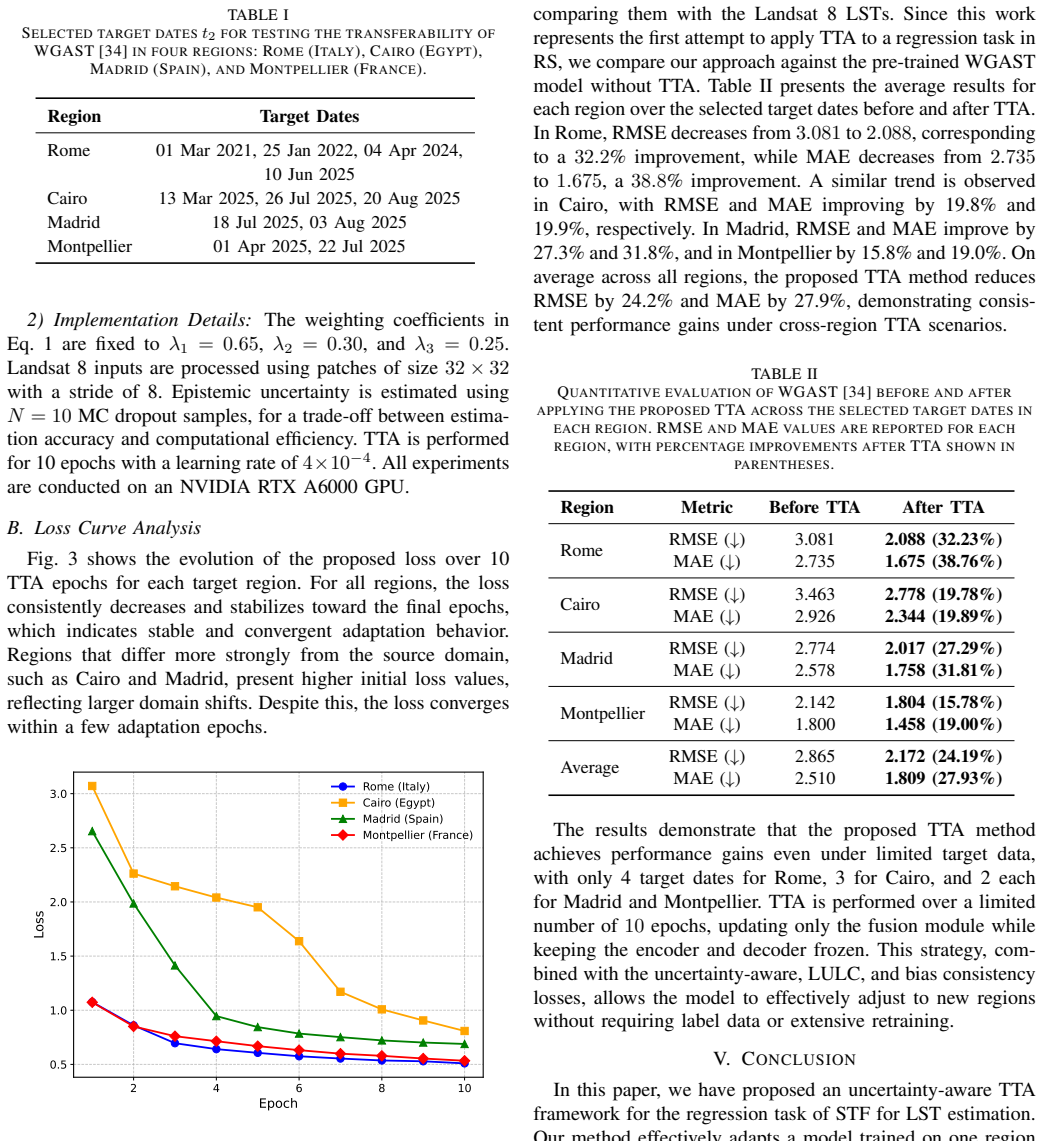
- Improvements in RMSE by an average of 24.2% and MAE by 27.9% across four diverse climate target regions.
- Effective adaptation achieved with limited unlabeled target data and only 10 TTA epochs.
- The method applies to regression tasks in spatio-temporal fusion without needing source data or labels.
- Consistent gains observed for a model pre-trained in Orléans when tested on Rome, Cairo, Madrid, and Montpellier.
Where Pith is reading between the lines
- Similar adaptation strategies could apply to other remote sensing regression problems involving domain shifts due to climate or land cover differences.
- The reliance on epistemic uncertainty suggests potential for combining this with active learning or selective labeling in operational settings.
- Operational deployment could enable near real-time model updates for global temperature monitoring systems.
Load-bearing premise
Epistemic uncertainty estimates, land use and land cover consistency, and bias correction can reliably direct the adaptation of the fusion module to improve generalization on unseen regions.
What would settle it
Observing no improvement or degradation in RMSE and MAE when applying the 10-epoch adaptation to a new target region with the specified guidance would falsify the central claim of consistent gains.
Figures


read the original abstract
Deep learning models have shown great promise in diverse remote sensing applications. However, they often struggle to generalize across geographic regions unseen during training due to domain shifts. Domain shifts occur when data distributions differ between the training region and new target regions, due to variations in land cover, climate, and environmental conditions. Test-time adaptation (TTA) has emerged as a solution to such shifts, but existing methods are primarily designed for classification and are not directly applicable to regression tasks. In this work, we address the regression task of spatio-temporal fusion (STF) for land surface temperature estimation. We propose an uncertainty-aware TTA framework that updates only the fusion module of a pre-trained STF model, guided by epistemic uncertainty, land use and land cover consistency, and bias correction, without requiring source data or labeled target samples. Experiments on four target regions with diverse climates, namely Rome in Italy, Cairo in Egypt, Madrid in Spain, and Montpellier in France, show consistent improvements in RMSE and MAE for a pre-trained model in Orl\'eans, France. The average gains are 24.2% and 27.9%, respectively, even with limited unlabeled target data and only 10 TTA epochs.
Editorial analysis
A structured set of objections, weighed in public.
Referee Report
Summary. The paper proposes an uncertainty-aware test-time adaptation (TTA) framework for the regression task of spatio-temporal fusion (STF) of land surface temperature (LST). It adapts only the fusion module of a pre-trained model (originally trained on Orléans, France) by optimizing with three guidance signals—epistemic uncertainty (via Monte-Carlo or ensemble variance), land-use/land-cover (LULC) consistency constraints, and a bias-correction term—without revisiting source data or using any labeled target samples. Experiments report consistent gains on four unseen target regions (Rome, Cairo, Madrid, Montpellier) with diverse climates, achieving average improvements of 24.2% RMSE and 27.9% MAE after only 10 TTA epochs on limited unlabeled target data.
Significance. If the central claim holds under rigorous verification, the work would be significant for remote-sensing regression tasks where domain shift is pervasive. It fills a gap by extending TTA beyond classification to STF regression and demonstrates practical adaptation with minimal unlabeled data and short optimization horizons. The explicit use of epistemic uncertainty plus domain-specific regularizers (LULC consistency) offers a template that could generalize to other geospatial regression problems.
major comments (3)
- [Experiments] Experiments section (and abstract): the headline gains of 24.2% RMSE and 27.9% MAE are presented without any statistical significance tests, confidence intervals, or error bars across the four regions, and without naming the exact baseline methods or implementation details of the pre-trained STF model. This leaves the robustness of the cross-region claim unverifiable from the reported numbers alone.
- [Methods] Methods section on the TTA objective: no ablation isolates the individual contributions of the three guidance terms (epistemic uncertainty, LULC consistency, bias correction). Because adaptation occurs solely on these signals without target labels or source replay, it is impossible to determine whether any single term is load-bearing or whether the observed gains could arise from any one of them in isolation.
- [Methods] Methods / Experiments: the manuscript contains no calibration analysis (e.g., reliability diagrams or scatter plots) relating the epistemic uncertainty estimates to observed LST errors on the target domains. Without this, the core assumption that uncertainty provides reliable gradients for fusion-module adaptation remains untested and constitutes the weakest link in the argument.
minor comments (2)
- [Abstract] Notation for the pre-training region is rendered as “Orl´eans” in the abstract; consistent use of proper diacritics or a short footnote would improve readability.
- [Methods] The description of the fusion module architecture and the precise form of the LULC consistency loss are referenced but not fully expanded in the provided text; a short equation or pseudocode block would clarify the optimization.
Simulated Author's Rebuttal
We thank the referee for the constructive and detailed comments on our manuscript. We address each of the major comments point-by-point below and outline the revisions we plan to make.
read point-by-point responses
-
Referee: [Experiments] Experiments section (and abstract): the headline gains of 24.2% RMSE and 27.9% MAE are presented without any statistical significance tests, confidence intervals, or error bars across the four regions, and without naming the exact baseline methods or implementation details of the pre-trained STF model. This leaves the robustness of the cross-region claim unverifiable from the reported numbers alone.
Authors: We agree with the referee that statistical significance and detailed baseline information are necessary to substantiate the reported gains. In the revised manuscript, we will include statistical significance tests (e.g., paired t-tests) with p-values, add error bars or confidence intervals to the performance tables for the four regions, explicitly name the baseline methods (including the pre-trained STF model architecture, training details on Orléans data, and comparison methods), and provide full implementation details such as hyperparameters and code references where possible. revision: yes
-
Referee: [Methods] Methods section on the TTA objective: no ablation isolates the individual contributions of the three guidance terms (epistemic uncertainty, LULC consistency, bias correction). Because adaptation occurs solely on these signals without target labels or source replay, it is impossible to determine whether any single term is load-bearing or whether the observed gains could arise from any one of them in isolation.
Authors: We acknowledge the need for an ablation study to isolate the contributions of each guidance term. We will add a comprehensive ablation analysis in the revised Experiments section, evaluating the TTA performance when each term (epistemic uncertainty, LULC consistency, and bias correction) is removed individually, as well as combinations thereof. This will clarify the load-bearing components and demonstrate that the full objective is required for the observed gains. revision: yes
-
Referee: [Methods] Methods / Experiments: the manuscript contains no calibration analysis (e.g., reliability diagrams or scatter plots) relating the epistemic uncertainty estimates to observed LST errors on the target domains. Without this, the core assumption that uncertainty provides reliable gradients for fusion-module adaptation remains untested and constitutes the weakest link in the argument.
Authors: We recognize that a calibration analysis would provide stronger validation for the use of epistemic uncertainty in guiding adaptation. However, given the unsupervised nature of our TTA approach, which does not assume access to labeled target samples, direct computation of observed LST errors on the target domains for calibration purposes is not feasible. We will revise the manuscript to include a dedicated discussion on this limitation, provide indirect validation through the consistent improvements across diverse regions, and explore any available proxies for uncertainty quality. We believe the performance gains serve as empirical support for the approach. revision: partial
- Direct calibration analysis of epistemic uncertainty estimates against ground-truth LST errors on target domains, due to the absence of labeled target data in the test-time adaptation setting.
Circularity Check
No circularity in derivation chain
full rationale
The paper describes an empirical TTA procedure for regression-based spatio-temporal fusion. No equations, first-principles derivations, or parameter-fitting steps are presented that would reduce any reported prediction or performance gain to a fitted input by construction. The claimed improvements (RMSE/MAE gains on four target regions) are experimental outcomes obtained by running the adaptation procedure on unlabeled target data; they are not shown to be mathematically equivalent to the input signals (epistemic uncertainty, LULC consistency, bias correction) or to any self-cited prior result. No self-definitional loops, fitted-input-as-prediction patterns, or load-bearing self-citations appear in the abstract or method outline. The central claim therefore remains an independent empirical statement rather than a tautology.
Axiom & Free-Parameter Ledger
axioms (2)
- domain assumption Epistemic uncertainty from the model provides a reliable signal for updating the fusion module during test-time adaptation.
- domain assumption Land use and land cover consistency can be enforced across regions to improve adaptation.
Reference graph
Works this paper leans on
-
[1]
Deep-learning- based semantic segmentation of remote sensing images: A survey,
L. Huang, B. Jiang, S. Lv, Y . Liu, and Y . Fu, “Deep-learning- based semantic segmentation of remote sensing images: A survey,”IEEE Journal of Selected Topics in Applied Earth Observations and Remote Sensing, vol. 17, pp. 8370–8396, 2023
work page 2023
-
[2]
Semantic segmentation for high-resolution remote sensing images by light-weight network,
C. Deng, L. Liang, Y . Su, C. He, and J. Cheng, “Semantic segmentation for high-resolution remote sensing images by light-weight network,” in2021 IEEE International Geoscience and Remote Sensing Symposium IGARSS. IEEE, 2021, pp. 3456–3459
work page 2021
-
[3]
Remote sensing object detection in the deep learning era—a review,
S. Gui, S. Song, R. Qin, and Y . Tang, “Remote sensing object detection in the deep learning era—a review,”Remote Sensing, vol. 16, no. 2, p. 327, 2024
work page 2024
-
[4]
Three applications of deep learning algorithms for object detection in satellite imagery,
M. Napiorkowska, D. Petit, and P. Marti, “Three applications of deep learning algorithms for object detection in satellite imagery,” inIGARSS 2018-2018 IEEE International Geoscience and Remote Sensing Symposium. IEEE, 2018, pp. 4839–4842
work page 2018
-
[5]
S. Al Shafian and D. Hu, “Integrating machine learning and remote sensing in disaster management: A decadal review of post-disaster building damage assessment,”Buildings, vol. 14, no. 8, p. 2344, 2024
work page 2024
-
[6]
Deep learning based flood mapping using remote sensing big data,
R. Jain, X. Chen, and R. R. Vatsavai, “Deep learning based flood mapping using remote sensing big data,” inIGARSS 2025 - 2025 IEEE International Geoscience and Remote Sensing Symposium, 2025, pp. 5870–5874
work page 2025
-
[7]
Spatiotemporal image fusion in remote sensing,
M. Belgiu and A. Stein, “Spatiotemporal image fusion in remote sensing,”Remote sensing, vol. 11, no. 7, p. 818, 2019
work page 2019
-
[8]
Y . Song, H. Zhang, and L. Zhang, “Remote sensing image spatio-temporal fusion via a generative adversarial network through one prior image pair,” inIGARSS 2020-2020 IEEE In- ternational Geoscience and Remote Sensing Symposium. IEEE, 2020, pp. 7009–7012
work page 2020
-
[9]
J. Qui ˜nonero-Candela, M. Sugiyama, A. Schwaighofer, and N. D. Lawrence,Dataset shift in machine learning. Mit Press, 2008
work page 2008
-
[10]
Domain adaptation for the classification of remote sensing data: An overview of recent advances,
D. Tuia, C. Persello, and L. Bruzzone, “Domain adaptation for the classification of remote sensing data: An overview of recent advances,”IEEE geoscience and remote sensing magazine, vol. 4, no. 2, pp. 41–57, 2016
work page 2016
-
[11]
A comprehensive survey on test- time adaptation under distribution shifts,
J. Liang, R. He, and T. Tan, “A comprehensive survey on test- time adaptation under distribution shifts,”International Journal of Computer Vision, vol. 133, no. 1, pp. 31–64, 2025
work page 2025
-
[12]
S. Bouaziz, A. Hafiane, R. Canals, and R. Nedjai, “Deep learning for spatio-temporal fusion in land surface temperature estimation: A comprehensive survey, experimental analysis, and future trends,”arXiv preprint arXiv:2412.16631, 2024
-
[13]
Transfer learning in environmental remote sensing,
Y . Ma, S. Chen, S. Ermon, and D. B. Lobell, “Transfer learning in environmental remote sensing,”Remote Sensing of Environ- ment, vol. 301, p. 113924, 2024
work page 2024
-
[14]
Deep unsupervised domain adaptation: A review of recent advances and perspectives,
X. Liu, C. Yoo, F. Xing, H. Oh, G. El Fakhri, J.-W. Kang, J. Wooet al., “Deep unsupervised domain adaptation: A review of recent advances and perspectives,”APSIPA Transactions on Signal and Information Processing, vol. 11, no. 1, 2022
work page 2022
-
[15]
Test-time adaptation for geospatial point cloud semantic segmentation with distinct domain shifts,
P. Wang, W. Yao, J. Shao, and Z. He, “Test-time adaptation for geospatial point cloud semantic segmentation with distinct domain shifts,”arXiv preprint arXiv:2407.06043, 2024
-
[16]
Multi- modal continual test-time adaptation for 3d semantic segmenta- tion,
H. Cao, Y . Xu, J. Yang, P. Yin, S. Yuan, and L. Xie, “Multi- modal continual test-time adaptation for 3d semantic segmenta- tion,” inProceedings of the IEEE/CVF international conference on computer vision, 2023, pp. 18 809–18 819
work page 2023
-
[17]
How transfer- able are features in deep neural networks?
J. Yosinski, J. Clune, Y . Bengio, and H. Lipson, “How transfer- able are features in deep neural networks?”Advances in neural information processing systems, vol. 27, 2014
work page 2014
-
[18]
Tent: Fully Test-time Adaptation by Entropy Minimization
D. Wang, E. Shelhamer, S. Liu, B. Olshausen, and T. Darrell, “Tent: Fully test-time adaptation by entropy minimization,” arXiv preprint arXiv:2006.10726, 2020
work page internal anchor Pith review arXiv 2006
-
[19]
Source data-absent unsupervised domain adaptation through hypothesis transfer and labeling transfer,
J. Liang, D. Hu, Y . Wang, R. He, and J. Feng, “Source data-absent unsupervised domain adaptation through hypothesis transfer and labeling transfer,”IEEE Transactions on Pattern Analysis and Machine Intelligence, vol. 44, no. 11, pp. 8602– 8617, 2021
work page 2021
-
[20]
Test-time adaptation for regression by subspace alignment,
K. Adachi, S. Yamaguchi, A. Kumagai, and T. Hamagami, “Test-time adaptation for regression by subspace alignment,” arXiv preprint arXiv:2410.03263, 2024
-
[21]
Beyond model adaptation at test time: A survey,
Z. Xiao and C. G. Snoek, “Beyond model adaptation at test time: A survey,”arXiv preprint arXiv:2411.03687, 2024
-
[22]
Self-correcting inference for land cover mapping via test-time domain adaptation,
M. El Amin Larabi and M. Iftene, “Self-correcting inference for land cover mapping via test-time domain adaptation,” in IGARSS 2025 - 2025 IEEE International Geoscience and Re- mote Sensing Symposium, 2025, pp. 7380–7384
work page 2025
-
[23]
K. Huang, L. Fang, and C. Tian, “Learning to adapt using test-time images for salient object detection in optical remote sensing images,”IEEE Transactions on Geoscience and Remote Sensing, 2024
work page 2024
-
[24]
Uncertainty- aware gan with adaptive loss for robust mri image enhance- ment,
U. Upadhyay, V . P. Sudarshan, and S. P. Awate, “Uncertainty- aware gan with adaptive loss for robust mri image enhance- ment,” inProceedings of the IEEE/CVF international confer- ence on computer vision, 2021, pp. 3255–3264
work page 2021
-
[25]
V . P. Sudarshan, U. Upadhyay, G. F. Egan, Z. Chen, and S. P. Awate, “Towards lower-dose pet using physics-based uncertainty-aware multimodal learning with robustness to out- of-distribution data,”Medical Image Analysis, vol. 73, p. 102187, 2021
work page 2021
-
[26]
A survey of uncertainty in deep neural networks,
J. Gawlikowski, C. R. N. Tassi, M. Ali, J. Lee, M. Humt, J. Feng, A. Kruspe, R. Triebel, P. Jung, R. Roscheret al., “A survey of uncertainty in deep neural networks,”Artificial Intelligence Review, vol. 56, no. Suppl 1, pp. 1513–1589, 2023
work page 2023
-
[27]
A survey on uncertainty quantification methods for deep learning,
W. He, Z. Jiang, T. Xiao, Z. Xu, and Y . Li, “A survey on uncertainty quantification methods for deep learning,”ACM Computing Surveys, 2025
work page 2025
-
[28]
Weight uncertainty in neural network,
C. Blundell, J. Cornebise, K. Kavukcuoglu, and D. Wierstra, “Weight uncertainty in neural network,” inInternational con- ference on machine learning. PMLR, 2015, pp. 1613–1622
work page 2015
-
[29]
Dropconnect is effective in modeling uncer- tainty of bayesian deep networks,
A. Mobiny, P. Yuan, S. K. Moulik, N. Garg, C. C. Wu, and H. Van Nguyen, “Dropconnect is effective in modeling uncer- tainty of bayesian deep networks,”Scientific reports, vol. 11, no. 1, p. 5458, 2021
work page 2021
-
[30]
Dropout as a bayesian approxi- mation: Representing model uncertainty in deep learning,
Y . Gal and Z. Ghahramani, “Dropout as a bayesian approxi- mation: Representing model uncertainty in deep learning,” in international conference on machine learning. PMLR, 2016, pp. 1050–1059
work page 2016
-
[31]
Dropout: a simple way to prevent neural networks from overfitting,
N. Srivastava, G. Hinton, A. Krizhevsky, I. Sutskever, and R. Salakhutdinov, “Dropout: a simple way to prevent neural networks from overfitting,”The journal of machine learning research, vol. 15, no. 1, pp. 1929–1958, 2014
work page 1929
-
[32]
Remote sensing applications in disease mapping and public health analysis,
V . V . Estrela, J. Aroma, R. Sroufer, K. Raimond, A. C. Intorne, A. Deshpande, A. A. Laghari, and L. P. Oliveira, “Remote sensing applications in disease mapping and public health analysis,” inIntelligent Healthcare Systems. CRC Press, 2023, pp. 185–202
work page 2023
-
[33]
Remote sensing and ai for build- ing climate adaptation applications,
B. Sirmacek and R. Vinuesa, “Remote sensing and ai for build- ing climate adaptation applications,”Results in Engineering, vol. 15, p. 100524, 2022
work page 2022
-
[34]
S. Bouaziz, A. Hafiane, R. Canals, and R. Nedjai, “Wgast: Weakly-supervised generative network for daily 10 m land sur- face temperature estimation via spatio-temporal fusion,”arXiv preprint arXiv:2508.06485, 2025
discussion (0)
Sign in with ORCID, Apple, or X to comment. Anyone can read and Pith papers without signing in.