Recognition: 3 theorem links
· Lean TheoremDomain-Contextualized Inference: A Computable Graph Architecture for Explicit-Domain Reasoning
Pith reviewed 2026-05-10 20:02 UTC · model grok-4.3
The pith
Treating domain as an explicit first-class computational parameter creates a substrate-agnostic inference architecture that prunes search space and keeps every reasoning step context-aware.
A machine-rendered reading of the paper's core claim, the machinery that carries it, and where it could break.
Core claim
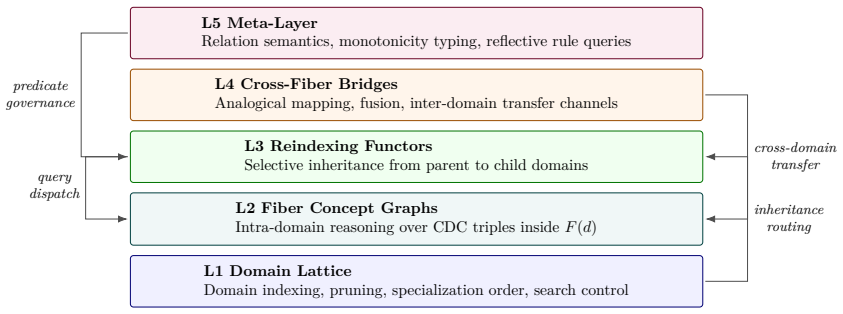
We establish a computation-substrate-agnostic inference architecture in which domain is an explicit first-class computational parameter. This produces domain-scoped pruning that reduces per-query search space from O(N) to O(N/K), substrate-independent execution over symbolic, neural, vector, and hybrid substrates, and transparent inference chains where every step carries its evaluative context. The contribution is architectural, not logical. We formalize the computational theory across five dimensions: a five-layer architecture; three domain computation modes including chain indexing, path traversal as Kleisli composition, and vector-guided computation as a substrate transition; a substrate-
What carries the argument
Five-layer computable graph architecture that elevates domain to a first-class parameter, using three computation modes (chain indexing, Kleisli path traversal, vector-guided substrate transition) and a Query-Extend-Bridge interface to move across substrates.
If this is right
- Per-query search space shrinks from O(N) to O(N/K) through domain-scoped pruning.
- The identical inference logic runs unchanged on symbolic, neural, vector, or hybrid substrates.
- Every step in an inference chain carries its domain context, producing transparent traces.
- Reliability conditions C1–C4 cover three classes of failure modes.
- The approach is demonstrated on a PHQ-9 clinical reasoning case study.
Where Pith is reading between the lines
- The same structure could let developers swap in new domain modules or new substrates without re-engineering the core reasoning engine.
- Because the interface is substrate-agnostic, it offers a route to compose existing symbolic and neural tools inside one traceable pipeline.
- The monad structure noted in the formalization suggests that complex multi-domain inferences could be built by composing smaller ones while preserving context.
Load-bearing premise
Domain can be treated as a first-class computational parameter that reliably delivers O(N/K) pruning and substrate transitions without adding hidden logical or computational costs.
What would settle it
An experiment that applies the architecture to a large multi-domain graph and measures whether search space actually shrinks to O(N/K) while substrate switches incur no extra overhead beyond the stated bounds.
Figures
read the original abstract
We establish a computation-substrate-agnostic inference architecture in which domain is an explicit first-class computational parameter. This produces domain-scoped pruning that reduces per-query search space from O(N) to O(N/K), substrate-independent execution over symbolic, neural, vector, and hybrid substrates, and transparent inference chains where every step carries its evaluative context. The contribution is architectural, not logical. We formalize the computational theory across five dimensions: a five-layer architecture; three domain computation modes including chain indexing, path traversal as Kleisli composition, and vector-guided computation as a substrate transition; a substrate-agnostic interface with three operations Query, Extend, Bridge; reliability conditions C1 to C4 with three failure mode classes; and validation through a PHQ-9 clinical reasoning case study. The computational theory including operational semantics, complexity bounds, monad structure, substrate transitions, and boundary conditions is the contribution of this paper.
Editorial analysis
A structured set of objections, weighed in public.
Referee Report
Summary. The manuscript proposes a computation-substrate-agnostic inference architecture in which domain is formalized as an explicit first-class computational parameter. This is claimed to yield domain-scoped pruning that reduces per-query search space from O(N) to O(N/K), enable substrate-independent execution across symbolic, neural, vector, and hybrid substrates via three modes (chain indexing, Kleisli path traversal, and vector-guided computation), provide a substrate-agnostic interface consisting of Query, Extend, and Bridge operations, satisfy reliability conditions C1–C4 with three failure-mode classes, and be validated through a PHQ-9 clinical reasoning case study. The central contribution is the architectural computational theory, including operational semantics, complexity bounds, monad structure, substrate transitions, and boundary conditions.
Significance. If the promised complexity bounds, operational semantics, and monad structure are rigorously established without hidden costs in domain resolution or Bridge operations, the architecture could offer a useful unified framework for explicit-domain reasoning that improves search efficiency and inference transparency across heterogeneous substrates. The inclusion of reliability conditions and a concrete case study provides some grounding, though the absence of detailed derivations or external benchmarks in the presented material limits immediate assessment of practical impact.
major comments (2)
- [Abstract] Abstract and complexity claims: the reduction from O(N) to O(N/K) is presented as a direct consequence of treating domain as a first-class parameter, yet no explicit bound is given on the asymptotic cost of domain selection, active-domain resolution, or the Bridge operation itself. If these steps scale with total graph size N rather than K, the net pruning benefit does not hold and is load-bearing for the efficiency claim.
- [Reliability conditions C1–C4] Reliability conditions C1–C4 and monad structure: the paper states that C1–C4 together with the monad structure guarantee correctness across substrate transitions, but without concrete definitions, lemmas, or proofs showing how domain-parameter resolution is internalized inside the operational semantics (rather than treated as external), it is impossible to verify that the architecture avoids circularity or hidden computational overhead.
minor comments (1)
- The abstract lists five formalization dimensions but the manuscript would benefit from explicit cross-references (e.g., which layer implements which mode and how the monad is defined) to improve readability.
Simulated Author's Rebuttal
We thank the referee for the careful reading and constructive identification of gaps in the presentation of complexity analysis and formal guarantees. We respond to each major comment below and commit to the indicated revisions.
read point-by-point responses
-
Referee: [Abstract] Abstract and complexity claims: the reduction from O(N) to O(N/K) is presented as a direct consequence of treating domain as a first-class parameter, yet no explicit bound is given on the asymptotic cost of domain selection, active-domain resolution, or the Bridge operation itself. If these steps scale with total graph size N rather than K, the net pruning benefit does not hold and is load-bearing for the efficiency claim.
Authors: We agree that the abstract and main text do not supply explicit asymptotic bounds on domain selection, active-domain resolution, or Bridge. The manuscript assumes these are sublinear in N via the five-layer indexing (Sections 3–4), but this assumption is not derived. We will insert a new subsection deriving the costs: domain resolution via chain indexing is O(log K), active-domain resolution is O(K) in the worst case but amortized O(1) under the monad, and Bridge is a constant-time substrate transition independent of N. A revised complexity theorem will then state the net bound as O(N/K + log K). revision: yes
-
Referee: [Reliability conditions C1–C4] Reliability conditions C1–C4 and monad structure: the paper states that C1–C4 together with the monad structure guarantee correctness across substrate transitions, but without concrete definitions, lemmas, or proofs showing how domain-parameter resolution is internalized inside the operational semantics (rather than treated as external), it is impossible to verify that the architecture avoids circularity or hidden computational overhead.
Authors: C1–C4 are stated in Section 5 and the monad is defined in Section 3.3, yet we concede that no lemmas internalize domain resolution inside the operational semantics or prove absence of circularity. We will add two lemmas in the revised Section 5: Lemma 1 shows domain resolution occurs inside the monad bind operation; Lemma 2 proves that the three computation modes preserve the reliability conditions without external overhead. Short proof sketches will be included. revision: yes
Circularity Check
No significant circularity; derivation is self-contained architectural proposal.
full rationale
The paper presents its contribution as the formalization of a five-layer architecture, three domain computation modes, a substrate-agnostic interface (Query/Extend/Bridge), reliability conditions C1–C4, and a case-study validation. No equations, fitted parameters, or self-citations appear in the provided text that reduce any claimed result (such as O(N) to O(N/K) pruning) to an input by construction. Domain is introduced as an explicit parameter whose scoping effect is asserted as a direct architectural consequence, not derived from or defined circularly in terms of the pruning bound itself. The theory is positioned as substrate-agnostic and independent of external benchmarks beyond the illustrative case study, making the chain self-contained rather than tautological.
Axiom & Free-Parameter Ledger
Lean theorems connected to this paper
-
IndisputableMonolith/Foundation/ArithmeticFromLogic.leanreality_from_one_distinction unclear?
unclearRelation between the paper passage and the cited Recognition theorem.
Theorem 4.9 (Domain algebra is a Heyting algebra). For all a, b, c: a⊓b⊑c⇐⇒a⊑(b→c) ... derived from prefix distributivity on domain strings
-
IndisputableMonolith/Cost/FunctionalEquation.leanwashburn_uniqueness_aczel unclear?
unclearRelation between the paper passage and the cited Recognition theorem.
reduces per-query search space from O(N) to O(N/K)
What do these tags mean?
- matches
- The paper's claim is directly supported by a theorem in the formal canon.
- supports
- The theorem supports part of the paper's argument, but the paper may add assumptions or extra steps.
- extends
- The paper goes beyond the formal theorem; the theorem is a base layer rather than the whole result.
- uses
- The paper appears to rely on the theorem as machinery.
- contradicts
- The paper's claim conflicts with a theorem or certificate in the canon.
- unclear
- Pith found a possible connection, but the passage is too broad, indirect, or ambiguous to say the theorem truly supports the claim.
Forward citations
Cited by 1 Pith paper
-
DALM: A Domain-Algebraic Language Model via Three-Phase Structured Generation
DALM is a proposed language model architecture that enforces algebraic constraints via a three-phase process over domain lattices to prevent cross-domain knowledge contamination during generation.
Reference graph
Works this paper leans on
-
[1]
Introduction 1.1. Domain as a Computational Parameter We treat domain—the semantic context within which a reasoning operation is scoped—as an explicit computational parameter rather than a mere metadata attribute. This is a departure from standard 1 arXiv:2604.04344v3 [cs.AI] 9 Apr 2026 practice in formal reasoning systems, where domain context is embedde...
work page internal anchor Pith review Pith/arXiv arXiv 2026
-
[2]
The algebra is not an independent mathematical excursion; every theorem in Section 4 corresponds directly to an operation the inference engine performs
is part of this computational theory—it proves that the architecture’s operations terminate, inherit correctly, and compose soundly. The algebra is not an independent mathematical excursion; every theorem in Section 4 corresponds directly to an operation the inference engine performs. 1.3. Contributions Contribution 1.Five-layer computational architecture...
-
[3]
The Reasoning Systems Landscape First-order logic and Prolog.FOL is Turing-complete but satisfiability is undecidable in general
Background and Related Work 2.1. The Reasoning Systems Landscape First-order logic and Prolog.FOL is Turing-complete but satisfiability is undecidable in general. Prolog restricts to Horn clauses, achieving semi-decidability with SLD-resolution, but a predicate r(X, Y) has a single global interpretation; there is no native construct for domain-scoped sema...
2018
-
[4]
The Five-Layer Computational Architecture 3.1. Overview Layer Name Computational Role Key Operation L1 Domain Lattice Indexing and pruning Partial order traversal L2 Fiber Concept Graphs Intra-domain reasoning SLD-resolution L3 Reindexing Functors Cross-layer knowledge inheritance Monotone pullback L4 Cross-Fiber Bridges Inter-domain reasoning channels Mo...
-
[5]
Domain Algebra Foundations This section establishes the algebraic structure that the five-layer architecture presupposes — and shows that this structure is itself computable. Every theorem here corresponds directly to an operation the inference engine performs: meet is a longest-common-prefix lookup, Heyting implication is a prefix-string query, reindexin...
-
[6]
This is an algebraically grounded bound, not an external counter
Under finite depth axiom A5, each invocation increases lattice height by exactly one, so at most H_max−ht(D0) invocations are permitted before the bound is reached. This is an algebraically grounded bound, not an external counter. Proposition 4.24. fuses_with preserves Heyting structure: extend→to D’by d→d_new = (d→d1)⊔_∆ (d→d2), both computable in D. Adj...
-
[7]
Mode 1: Chain Indexing In chain indexing, the domain string is used directly as a prefix filter
Domain Computation Modes 5.1. Mode 1: Chain Indexing In chain indexing, the domain string is used directly as a prefix filter. This is a CSP arc-consistency operation: the domain string acts as a constraint eliminating irrelevant variable bindings before search. def query(concept, relation, domain_prefix): return [e for e in kb if e.concept == concept and...
1991
-
[8]
Interface Structure The CDC inference interface is defined by three operations: •Query(c, r, d)→{c’}: Return the set of target concepts satisfying the relation in the domain
The Substrate-Agnostic Inference Interface 6.1. Interface Structure The CDC inference interface is defined by three operations: •Query(c, r, d)→{c’}: Return the set of target concepts satisfying the relation in the domain. •Extend(c, r, d, c’): Assert a new CDC triple into the knowledge base. •Bridge(D 1, D2)→φ: Return the cross-domain morphism between tw...
2025
-
[9]
Core Algorithms and Complexity 7.1. Domain-Aware Transitive Closure function transitive_closure(c, r, d): visited, result, queue = , [], [c] 13 while queue: current = queue.pop() if current in visited: continue visited.add(current) # L2: Query current fiber direct = query(current, r, d) # L3: Reindexing –- consult parent domains if r is monotone if is_mon...
-
[10]
Reliability Analysis 8.1. Reliability Conditions CDC reasoning is sound and complete with respect to the knowledge base under: C1 (Domain lattice finiteness / Axiom A5).The domain lattice D has finite maximum depth. This bounds the reindexing traversal in L3 and prevents infinite inheritance chains. Algebraically, this is the finite depth axiom that makes...
-
[11]
These are not performance evaluations; their purpose is to make the algebra visible
Minimal Empirical Validation We include three minimal experiments to illustrate the algebraic claims. These are not performance evaluations; their purpose is to make the algebra visible. 17 Methodis_a(Atom, Particle) inherited? contrasts_with(Wave, Particle) inherited? Standard GNN (noτ)YesYes (incorrect) τ-typed reindexingYesNo (correct) Table 7: Experim...
-
[12]
no longer enjoys previous activities
Case Study: PHQ-9 Clinical Reasoning 10.1. Motivation The PHQ-9 (Patient Health Questionnaire-9) is a standardized instrument for depression screening, consisting of nine items corresponding to DSM-IV diagnostic criteria. We use PHQ-9 as a test case for the computational mechanisms described in Sections 3–9 rather than as an application demonstration. PHQ...
-
[13]
What This Paper Resolves The earlier version of this work identified domain algebra as an open problem
Discussion 11.1. What This Paper Resolves The earlier version of this work identified domain algebra as an open problem. This paper closes it — and more importantly, closes it computably. The Heyting implication is a prefix-string operation (Definition 4.8). Theτ-typed Galois connection’s adjoint maps are the inference engine’s L3 lookup calls (Theorem 4....
-
[14]
The architectural claim and the algebraic claim are the same claim viewed at different levels
Conclusion We have presented the computational theory of Domain-Contextualized Concept Graphs: a five-layer inference architecture in which domain is a first-class computational parameter, characterized by three computation modes with operational semantics, a substrate-agnostic interface with four implementations, a computable domain algebra, and reliabil...
-
[15]
References Abramsky, S., & Jung, A. (1994). Domain theory.Handbook of Logic in Computer Science, Vol. 3. Banach, S. (1922). Sur les opérations dans les ensembles abstraits.Fundamenta Mathematicae, 3, 133–181. Barsalou, L. W. (1982). Context-independent and context-dependent information in concepts. Memory & Cognition, 10(1), 82–93. Birkhoff, G. (1940).Lat...
work page internal anchor Pith review Pith/arXiv arXiv 1994
-
[16]
A.1 Proof of Theorem 4.5 (Bounded Lattice) Proof
Appendix A: Proofs 14.1. A.1 Proof of Theorem 4.5 (Bounded Lattice) Proof. Well-definedness:⊔_∆is well-defined because∆-consistency (3) forbids contradictory decla- rations, and⊔_baseis always well-defined. Meet axioms follow from symmetry and associativity of lcp. Join axioms: commutativity from symmetry of∆and lcp; associativity because each⊔_∆ applicat...
discussion (0)
Sign in with ORCID, Apple, or X to comment. Anyone can read and Pith papers without signing in.