Recognition: no theorem link
From BV-BFV Quantization to Reshetikhin-Turaev Invariants
Pith reviewed 2026-05-10 19:40 UTC · model grok-4.3
The pith
The BV-BFV quantization of Chern-Simons theory is equivalent to the Reshetikhin-Turaev invariants as (3-2-1)-extended topological quantum field theories.
A machine-rendered reading of the paper's core claim, the machinery that carries it, and where it could break.
Core claim
The main conjecture asserts a natural equivalence between the BV-BFV and RT constructions as (3-2-1)-extended topological quantum field theories. This identification is mediated by the derived character stack Loc_G(Σ) together with its shifted symplectic structure. The program formulates seven conjectures in total, proposes a proof strategy based on deformation quantization of shifted symplectic stacks, and highlights the role of E_n-Koszul duality in relating perturbative and non-perturbative data, with supporting evidence from abelian, low-genus, and Seifert fibered cases.
What carries the argument
The derived character stack Loc_G(Σ) with its shifted symplectic structure, which is conjectured to mediate the equivalence between the BV-BFV quantization and the Reshetikhin-Turaev construction.
If this is right
- If correct, the RT invariants would admit a perturbative description via BV-BFV methods.
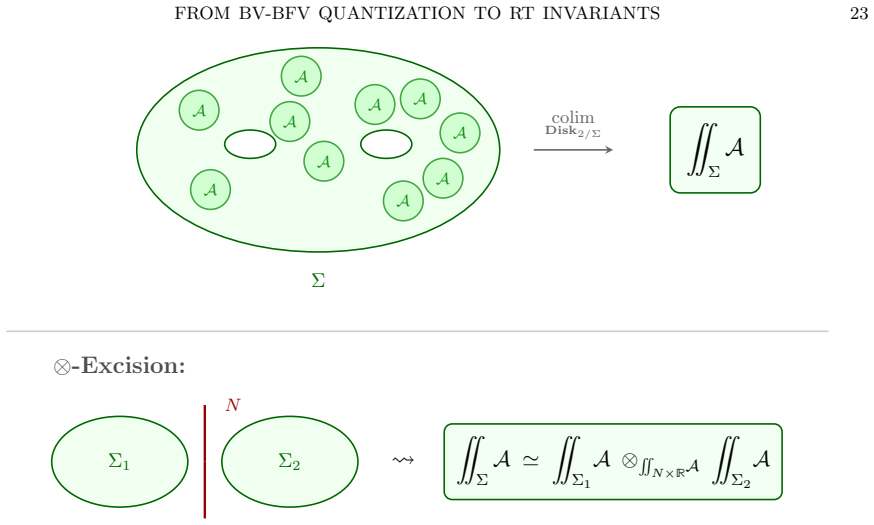
- Factorization homology would serve as the mechanism to glue local data into global manifold invariants.
- The E_2-category from quantization on the disk would reproduce the modular tensor category of the RT theory.
- Deformation quantization of the shifted symplectic stack would yield the non-perturbative invariants.
- The framework would clarify connections between Chern-Simons theory and the geometric Langlands program.
Where Pith is reading between the lines
- This equivalence might enable the application of resurgence methods to connect perturbative series directly to the exact RT invariants.
- It could offer a quantization-based approach to aspects of the geometric Langlands correspondence.
- Further evidence could be sought by explicit computations in higher-genus cases or for non-Seifert manifolds.
- The construction might extend to higher-dimensional or categorified versions of topological invariants.
Load-bearing premise
The modular tensor category underlying the Reshetikhin-Turaev construction arises as the E_2-category coming from the BV-BFV quantization of Chern-Simons theory on the disk.
What would settle it
Explicit computation of the invariants for a specific non-abelian Seifert fibered manifold using both the BV-BFV method and the RT construction, showing a mismatch in the resulting values.
Figures




read the original abstract
We propose a program for bridging the gap between the perturbative BV-BFV quantization of Chern-Simons theory and the non-perturbative Reshetikhin-Turaev (RT) invariants of 3-manifolds, passing through factorization homology of $\mathbb{E}_n$-algebras and the derived algebraic geometry of character stacks. We conjecture that the modular tensor category underlying the RT construction arises as the $\mathbb{E}_2$-category from BV-BFV quantization of Chern-Simons theory on the disk, with the derived character stack $\mathrm{Loc}_G(\Sigma)$ and its shifted symplectic structure mediating the proposed identification. We formulate seven conjectures, including a main conjecture asserting natural equivalence of the BV-BFV and RT constructions as (3-2-1)-extended topological quantum field theories, develop a proof strategy via deformation quantization of shifted symplectic stacks, and clarify the role of $\mathbb{E}_n$-Koszul duality in translating between perturbative and non-perturbative data. Supporting evidence is examined in the abelian, low-genus, and Seifert fibered cases. Connections to resurgence, categorification, and the geometric Langlands program are discussed as further motivation, though significant technical gaps remain open.
Editorial analysis
A structured set of objections, weighed in public.
Referee Report
Summary. The manuscript proposes a program to bridge the perturbative BV-BFV quantization of Chern-Simons theory with the non-perturbative Reshetikhin-Turaev invariants of 3-manifolds, via factorization homology of E_n-algebras and the derived algebraic geometry of character stacks. It formulates seven conjectures, the principal one asserting a natural equivalence between the BV-BFV and RT constructions as (3-2-1)-extended TQFTs, mediated by the derived character stack Loc_G(Σ) and its shifted symplectic structure. A proof strategy based on deformation quantization of shifted symplectic stacks and E_n-Koszul duality is outlined, with supporting evidence restricted to the abelian, low-genus, and Seifert fibered cases.
Significance. If the conjectures can be established, the work would furnish a substantive conceptual link between perturbative and non-perturbative aspects of topological quantum field theories, with possible ramifications for the geometric Langlands program, categorification, and resurgence. The explicit statement of the conjectures together with the identification of remaining technical gaps provides a clear roadmap that could guide subsequent research.
major comments (2)
- The main conjecture (formulated in the body of the paper) asserts equivalence of the two constructions as extended TQFTs, yet the only supporting evidence consists of checks in the abelian, low-genus, and Seifert cases; no general derivation or verification is supplied, leaving the central claim dependent on an unproven extension from these special situations.
- The proof strategy via deformation quantization of shifted symplectic stacks (outlined after the conjectures) relies on the assumption that the modular tensor category of the RT construction arises as the E_2-category obtained from BV-BFV quantization on the disk; the manuscript acknowledges that this step remains open in the non-abelian setting and does not provide a concrete reduction or test that would make the strategy load-bearing.
minor comments (2)
- The abstract refers to seven conjectures without enumerating them; a short numbered list in the introduction would improve navigation for readers.
- Notation for the E_2-category and its relation to the modular tensor category is introduced without an explicit cross-reference to the relevant factorization-homology construction; adding one or two standard citations would clarify the passage from perturbative data to the non-perturbative category.
Simulated Author's Rebuttal
We thank the referee for the careful reading of our manuscript and for the constructive comments on its scope and limitations. We address each major comment below, clarifying the conjectural nature of the work and the status of the evidence provided.
read point-by-point responses
-
Referee: The main conjecture (formulated in the body of the paper) asserts equivalence of the two constructions as extended TQFTs, yet the only supporting evidence consists of checks in the abelian, low-genus, and Seifert cases; no general derivation or verification is supplied, leaving the central claim dependent on an unproven extension from these special situations.
Authors: We agree that the central conjecture is supported only by explicit checks in the abelian, low-genus, and Seifert fibered cases, as we state in the abstract and in the section examining supporting evidence. The manuscript presents the equivalence as a conjecture within a broader program, not as a proven theorem, and explicitly notes that significant technical gaps remain. We will revise the introduction and the statement of the main conjecture to emphasize more clearly that the general case is conjectural and that the special-case verifications do not constitute a general derivation. revision: yes
-
Referee: The proof strategy via deformation quantization of shifted symplectic stacks (outlined after the conjectures) relies on the assumption that the modular tensor category of the RT construction arises as the E_2-category obtained from BV-BFV quantization on the disk; the manuscript acknowledges that this step remains open in the non-abelian setting and does not provide a concrete reduction or test that would make the strategy load-bearing.
Authors: We concur that the key step identifying the E_2-category from BV-BFV quantization with the modular tensor category of the RT construction remains open in the non-abelian setting, as already acknowledged in the manuscript. The outlined strategy is intended as a conceptual roadmap rather than a completed argument. We will expand the discussion following the conjectures to include additional remarks on possible concrete tests in specific non-abelian examples and on the role of E_n-Koszul duality in bridging the perturbative and non-perturbative regimes, while preserving the conjectural status of this identification. revision: partial
Circularity Check
No circularity; explicitly conjectural with no derivations or self-referential steps
full rationale
The paper formulates seven conjectures linking BV-BFV quantization to RT invariants via factorization homology and character stacks, but asserts no proofs or derivations. It states significant technical gaps remain and restricts evidence to abelian/low-genus/Seifert cases. No load-bearing equations, fitted parameters, or self-citations reduce any claim to its own inputs by construction. The framework is self-contained as a proposal without circular reductions.
Axiom & Free-Parameter Ledger
axioms (2)
- ad hoc to paper The modular tensor category underlying RT arises as the E_2-category from BV-BFV quantization on the disk
- ad hoc to paper Deformation quantization of shifted symplectic stacks translates between perturbative and non-perturbative data
Reference graph
Works this paper leans on
-
[1]
D. Arinkin, D. Gaitsgory,Singular support of coherent sheaves and the geometric Langlands conjec- ture, Selecta Math. (N.S.)21(2015), 1–199
work page 2015
-
[2]
Y. Ai, L. Kong, H. Zheng,Topological orders and factorization homology, Adv. Theor. Math. Phys. 21(2017), no. 8, 1845–1894
work page 2017
- [3]
- [4]
-
[5]
S. Axelrod, I. M. Singer,Chern–Simons perturbation theory. II, J. Differential Geom.39(1994), no. 1, 173–213
work page 1994
-
[6]
J. E. Andersen,Asymptotic faithfulness of the quantumSU(n)representations of the mapping class groups, Ann. of Math.163(2006), 347–368. 58 N. MOSHAYEDI
work page 2006
-
[7]
J. E. Andersen,The Witten–Reshetikhin–Turaev invariants of finite order mapping tori I, J. Reine Angew. Math.681(2013), 1–38
work page 2013
-
[8]
J. E. Andersen, K. Ueno,Abelian conformal field theory and determinant bundles, Internat. J. Math. 18(2007), no. 8, 919–993
work page 2007
-
[9]
B. Bakalov, A. Kirillov, Jr.,Lectures on Tensor Categories and Modular Functors, University Lecture Series, vol. 21, AMS, 2001
work page 2001
-
[10]
Bar-Natan,On the Vassiliev knot invariants, Topology34(1995), no
D. Bar-Natan,On the Vassiliev knot invariants, Topology34(1995), no. 2, 423–472
work page 1995
-
[11]
R. Bott, A. S. Cattaneo,Integral invariants of 3-manifolds, J. Differential Geom.48(1998), no. 1, 91–133
work page 1998
-
[12]
D. Ben-Zvi, A. Brochier, D. Jordan,Integrating quantum groups over surfaces, J. Topol.11(2018), no. 4, 874–917
work page 2018
-
[13]
D. Ben-Zvi, A. Brochier, D. Jordan,Quantum character varieties and braided module categories, Selecta Math. (N.S.)24(2018), no. 5, 4711–4748
work page 2018
-
[14]
D. Ben-Zvi, D. Nadler,Betti geometric Langlands, Proc. Sympos. Pure Math.97(2018), 3–41
work page 2018
-
[15]
D. Ben-Zvi, D. Nadler,Loop spaces and representations, Duke Math. J.162(2013), no. 9, 1587–1619
work page 2013
-
[16]
A. Brochier, D. Jordan, N. Snyder,On dualizability of braided tensor categories, Compositio Math. 157(2021), 435–483
work page 2021
-
[17]
A. Brochier, D. Jordan, P. Safronov, N. Snyder,Invertible braided tensor categories, Algebr. Geom. Topol.21(2021), 2107–2140
work page 2021
-
[18]
Calaque,Lagrangian structures on mapping stacks and semi-classical TFTs, Contemp
D. Calaque,Lagrangian structures on mapping stacks and semi-classical TFTs, Contemp. Math. 643(2015), 1–23
work page 2015
-
[19]
Calaque,Shifted cotangent stacks are shifted symplectic, Ann
D. Calaque,Shifted cotangent stacks are shifted symplectic, Ann. Fac. Sci. Toulouse Math.28(2019), no. 1, 67–90
work page 2019
-
[20]
D. Calaque, T. Pantev, B. To¨ en, M. Vaqui´ e, G. Vezzosi,Shifted Poisson structures and deformation quantization, J. Topol.10(2017), 483–584
work page 2017
-
[21]
A. S. Cattaneo, P. Mnev, N. Reshetikhin,Classical BV theories on manifolds with boundary, Com- mun. Math. Phys.332(2014), 535–603
work page 2014
-
[22]
A. S. Cattaneo, P. Mnev, N. Reshetikhin,Semiclassical quantization of classical field theories, in: Mathematical Aspects of Quantum Field Theories, Springer, 2015, 275–324
work page 2015
-
[23]
A. S. Cattaneo, P. Mnev, N. Reshetikhin,Perturbative quantum gauge theories on manifolds with boundary, Commun. Math. Phys.357(2018), 631–730
work page 2018
-
[24]
A. S. Cattaneo, P. Mnev, N. Reshetikhin,A cellular topological field theory, Commun. Math. Phys. 374(2020), 1229–1320
work page 2020
-
[25]
Skein (3+1)-TQFTs from Non-Semisimple Ribbon Categories
F. Costantino, N. Geer, B. Ha¨ ıoun, B. Patureau-Mirand,Skein(3+1)-TQFTs from non-semisimple ribbon categories, arXiv:2306.03225, 2023
work page internal anchor Pith review Pith/arXiv arXiv 2023
-
[26]
K. Costello, O. Gwilliam,Factorization Algebras in Quantum Field Theory, Vol. 1, Cambridge University Press, 2017
work page 2017
-
[27]
K. Costello, O. Gwilliam,Factorization Algebras in Quantum Field Theory, Vol. 2, Cambridge University Press, 2021
work page 2021
-
[28]
Costello, ``Supersymmetric gauge theory and the Yangian,'' [arXiv:1303.2632 [hep-th]]
K. Costello,Supersymmetric gauge theory and the Yangian, arXiv:1303.2632, 2013
-
[29]
M. De Renzi, A. M. Gainutdinov, N. Geer, B. Patureau-Mirand, I. Runkel,3-dimensional TQFTs from non-semisimple modular categories, Selecta Math. (N.S.)28(2022), no. 2, Paper No. 42
work page 2022
-
[30]
C. L. Douglas, C. Schommer-Pries, N. Snyder,The balanced tensor product of module categories, Kyoto J. Math.59(2019), no. 1, 167–179
work page 2019
-
[31]
P. Etingof, D. Kazhdan,Quantization of Lie bialgebras, I, Selecta Math. (N.S.)2(1996), no. 1, 1–41
work page 1996
-
[32]
P. Etingof, S. Gelaki, D. Nikshych, V. Ostrik,Tensor Categories, Mathematical Surveys and Mono- graphs, vol. 205, AMS, 2015
work page 2015
-
[33]
D. S. Freed, M. J. Hopkins, J. Lurie, C. Teleman,Topological quantum field theories from compact Lie groups, CRM Proceedings, 2010, 367–403
work page 2010
-
[34]
J. Francis, D. Gaitsgory,Chiral Koszul duality, Selecta Math. (N.S.)18(2012), no. 1, 27–87
work page 2012
-
[35]
D. S. Freed,Classical Chern–Simons theory, Part 1, Adv. Math.113(1995), 237–303
work page 1995
-
[36]
Gaitsgory,Quantum Langlands correspondence, arXiv:1601.05279, 2016
D. Gaitsgory,Quantum Langlands correspondence, arXiv:1601.05279, 2016
-
[37]
D. Gaitsgory, N. Rozenblyum,A Study in Derived Algebraic Geometry, Math. Surveys and Mono- graphs, vol. 221, AMS, 2017
work page 2017
-
[38]
D. Gaitsgory, J. Lurie,Weil’s Conjecture for Function Fields, Vol. 1, Ann. Math. Studies, vol. 199, Princeton, 2019. FROM BV-BFV QUANTIZATION TO RT INVARIANTS 59
work page 2019
-
[39]
S. Garoufalidis, J. Gu, M. Mari˜ no,Peacock patterns and resurgence in complex Chern–Simons theory, Res. Math. Sci.10(2023), Paper No. 29
work page 2023
-
[40]
Garoufalidis,On the characteristic and deformation varieties of a knot, Geom
S. Garoufalidis,On the characteristic and deformation varieties of a knot, Geom. Topol. Monogr.7 (2004), 291–309
work page 2004
- [41]
- [42]
-
[43]
Gukov,Three-dimensional quantum gravity, Chern–Simons theory, and the A-polynomial, Com- mun
S. Gukov,Three-dimensional quantum gravity, Chern–Simons theory, and the A-polynomial, Com- mun. Math. Phys.255(2005), 577–627
work page 2005
-
[44]
O. Gwilliam, K. Rejzner,Relating nets and factorization algebras of observables, Commun. Math. Phys.373(2020), 107–174
work page 2020
-
[45]
O. Gwilliam, R. Haugseng,Linear Batalin–Vilkovisky quantization as a functor of∞-categories, Selecta Math. (N.S.)24(2018), 1247–1313
work page 2018
-
[46]
Ha¨ ıoun,Non-semisimple WRT at the boundary of Crane-Yetter, arXiv:2503.20905, 2025
B. Ha¨ ıoun,Non-semisimple WRT at the boundary of Crane-Yetter, arXiv:2503.20905, 2025
-
[47]
S. K. Hansen,Reshetikhin–Turaev invariants of Seifert 3-manifolds for classical simple Lie algebras, J. Knot Theory Ramif.13(2004), 617–668
work page 2004
-
[48]
N. J. Hitchin,Flat connections and geometric quantization, Comm. Math. Phys.131(1990), 347– 380
work page 1990
-
[49]
L. C. Jeffrey,Chern–Simons–Witten invariants of lens spaces and torus bundles, and the semiclas- sical approximation, Commun. Math. Phys.147(1992), 563–604
work page 1992
-
[50]
A. Kirillov, Jr., Y. H. Tham,Factorization homology and 4D TQFT, Quantum Topol.13(2022), no. 3, 407–454
work page 2022
-
[51]
Kontsevich,Feynman diagrams and low-dimensional topology, Progr
M. Kontsevich,Feynman diagrams and low-dimensional topology, Progr. Math.120, Birkh¨ auser, 1994, 97–121
work page 1994
-
[52]
Lurie,Higher Algebra, available athttps://www.math.ias.edu/ ~lurie/papers/HA.pdf, 2017
J. Lurie,Higher Algebra, available athttps://www.math.ias.edu/ ~lurie/papers/HA.pdf, 2017
work page 2017
-
[53]
J. Lurie,On the classification of topological field theories, Current Developments in Mathematics 2008, International Press, 2009, 129–280
work page 2008
-
[54]
J. Lurie,Spectral Algebraic Geometry, available athttps://www.math.ias.edu/ ~lurie/papers/ SAG-rootfile.pdf
-
[55]
Mari˜ no,Chern–Simons theory, matrix integrals, and perturbative three-manifold invariants, Com- mun
M. Mari˜ no,Chern–Simons theory, matrix integrals, and perturbative three-manifold invariants, Com- mun. Math. Phys.253(2005), 25–49
work page 2005
- [56]
- [57]
-
[58]
D. B. Ray and I. M. Singer,R-Torsion and the Laplacian on Riemannian Manifolds, Adv. Math.7 (1971), 145–210
work page 1971
-
[59]
N. Reshetikhin, V. G. Turaev,Invariants of 3-manifolds via link polynomials and quantum groups, Invent. Math.103(1991), 547–597
work page 1991
-
[60]
Safronov,Poisson reduction as a coisotropic intersection, Higher Structures1(2017), 87–121
P. Safronov,Poisson reduction as a coisotropic intersection, Higher Structures1(2017), 87–121
work page 2017
-
[61]
Safronov,Poisson-Lie structures as shifted Poisson structures, Adv
P. Safronov,Poisson-Lie structures as shifted Poisson structures, Adv. Math.338(2018), 117–160
work page 2018
-
[62]
Safronov,Braces and Poisson additivity, Compositio Math.154(2018), 1698–1745
P. Safronov,Braces and Poisson additivity, Compositio Math.154(2018), 1698–1745
work page 2018
-
[63]
Safronov,Shifted geometric quantization, J
P. Safronov,Shifted geometric quantization, J. Geom. Phys.169(2021), 104361
work page 2021
-
[64]
Scheimbauer,Factorization Homology as a Fully Extended Topological Field Theory, Ph.D
C. Scheimbauer,Factorization Homology as a Fully Extended Topological Field Theory, Ph.D. thesis, ETH Z¨ urich, 2014
work page 2014
- [65]
-
[66]
V. G. Turaev,Quantum Invariants of Knots and 3-Manifolds, de Gruyter, 1994
work page 1994
-
[67]
Witten,Quantum field theory and the Jones polynomial, Commun
E. Witten,Quantum field theory and the Jones polynomial, Commun. Math. Phys.121(1989), 351–399. Institut f ¨ur Mathematik, Universit ¨at Z ¨urich, Winterthurerstrasse 190 CH-8057 Z ¨urich Email address, N. Moshayedi:nima.moshayedi@math.uzh.ch
work page 1989
discussion (0)
Sign in with ORCID, Apple, or X to comment. Anyone can read and Pith papers without signing in.