Recognition: no theorem link
Erasure or Erosion? Evaluating Compositional Degradation in Unlearned Text-To-Image Diffusion Models
Pith reviewed 2026-05-10 19:09 UTC · model grok-4.3
The pith
Unlearning specific concepts from text-to-image diffusion models often degrades their ability to generate properly composed images.
A machine-rendered reading of the paper's core claim, the machinery that carries it, and where it could break.
Core claim
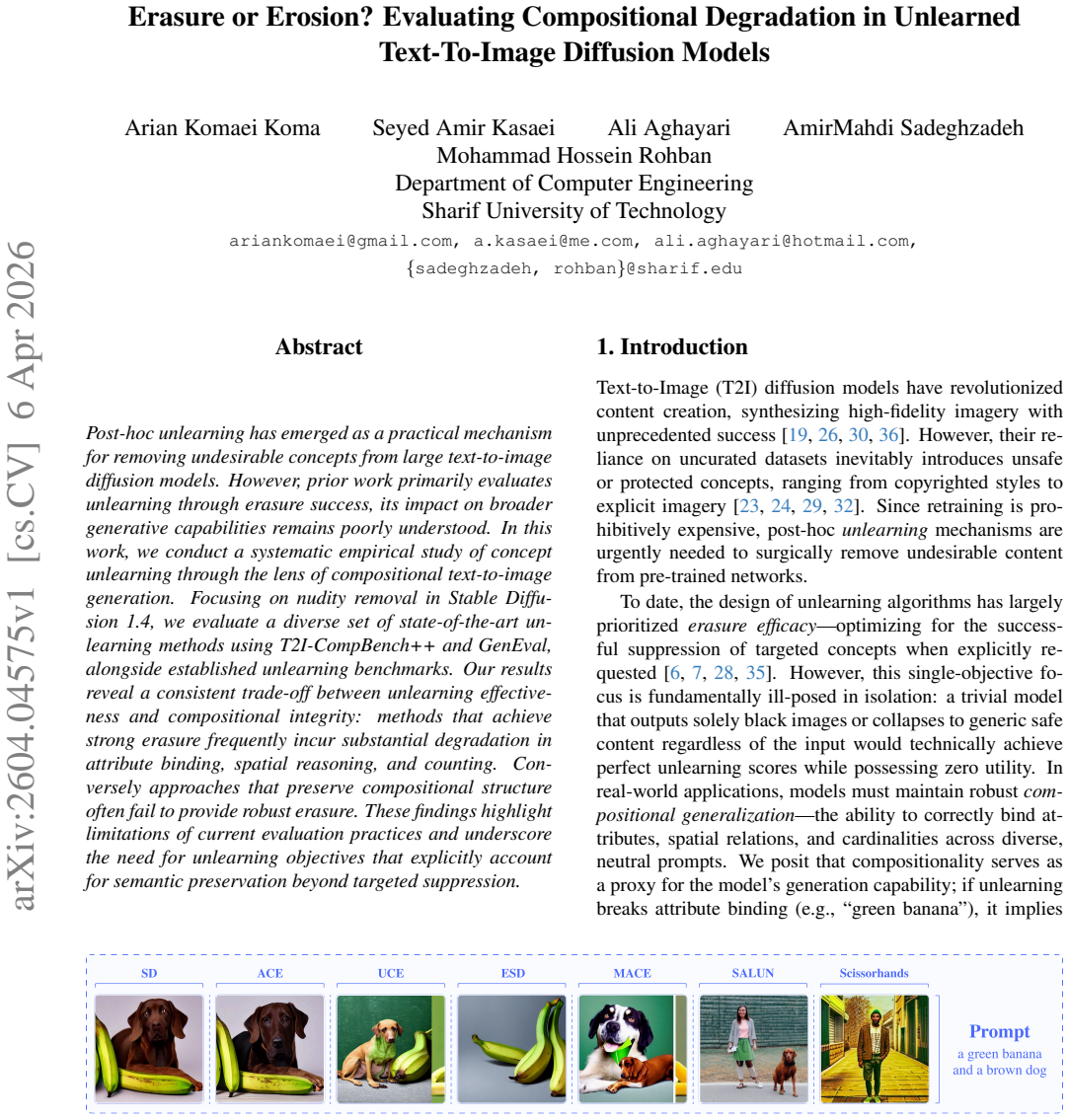
There is a consistent trade-off between unlearning effectiveness and compositional integrity in text-to-image diffusion models. Methods that achieve strong erasure of concepts like nudity frequently cause substantial degradation in attribute binding, spatial reasoning, and counting, as evaluated by T2I-CompBench++ and GenEval. Approaches that preserve compositional structure tend to fail at providing robust erasure.
What carries the argument
Systematic empirical evaluation of state-of-the-art unlearning methods on Stable Diffusion 1.4 using compositional benchmarks T2I-CompBench++ and GenEval alongside unlearning metrics, with focus on nudity removal.
Load-bearing premise
That the benchmarks T2I-CompBench++ and GenEval provide unbiased and comprehensive measures of compositional integrity for the tested scenarios.
What would settle it
Demonstrating an unlearning method that achieves high erasure rates on the target concept while showing no degradation or even improvement on the compositional benchmarks would falsify the trade-off claim.
Figures

read the original abstract
Post-hoc unlearning has emerged as a practical mechanism for removing undesirable concepts from large text-to-image diffusion models. However, prior work primarily evaluates unlearning through erasure success; its impact on broader generative capabilities remains poorly understood. In this work, we conduct a systematic empirical study of concept unlearning through the lens of compositional text-to-image generation. Focusing on nudity removal in Stable Diffusion 1.4, we evaluate a diverse set of state-of-the-art unlearning methods using T2I-CompBench++ and GenEval, alongside established unlearning benchmarks. Our results reveal a consistent trade-off between unlearning effectiveness and compositional integrity: methods that achieve strong erasure frequently incur substantial degradation in attribute binding, spatial reasoning, and counting. Conversely, approaches that preserve compositional structure often fail to provide robust erasure. These findings highlight limitations of current evaluation practices and underscore the need for unlearning objectives that explicitly account for semantic preservation beyond targeted suppression.
Editorial analysis
A structured set of objections, weighed in public.
Referee Report
Summary. The manuscript conducts a systematic empirical evaluation of post-hoc unlearning methods for removing concepts (e.g., nudity) from Stable Diffusion 1.4, focusing on their effects on compositional text-to-image generation. Using T2I-CompBench++ and GenEval alongside unlearning benchmarks, the authors report a consistent trade-off: strong erasure often leads to degradation in attribute binding, spatial reasoning, and counting abilities, while methods that maintain composition tend to have weaker erasure.
Significance. If the findings are robust, this work is significant for highlighting unintended consequences of unlearning on generative capabilities beyond the targeted concept. It provides evidence against the assumption that unlearning is isolated and calls for improved methods and evaluations that consider semantic preservation. The use of established benchmarks adds to its value as a diagnostic study.
major comments (1)
- [Abstract and §4] Abstract and §4 (experimental results): The central claim of a consistent trade-off between erasure effectiveness and compositional integrity rests on T2I-CompBench++ and GenEval faithfully isolating unlearning-induced failures in attribute binding, spatial reasoning, and counting. The provided abstract gives no indication that metric robustness was validated on unlearned checkpoints or that controls were applied for general prompt-following degradation; if the automated scorers (CLIP/VQA-based) penalize latent shifts orthogonal to true composition, the reported erosion may be overstated.
minor comments (2)
- [Figures] Figure captions and legends should explicitly list the unlearning methods, exact prompt templates, and metric definitions to allow direct replication.
- [§3] Ensure the methods section provides precise implementation details (e.g., hyperparameter choices, training steps) for each unlearning baseline so that the trade-off can be reproduced.
Simulated Author's Rebuttal
We thank the referee for the positive summary and for identifying a key point about metric robustness in our evaluation of compositional degradation after unlearning. We address the major comment in detail below and outline planned revisions.
read point-by-point responses
-
Referee: [Abstract and §4] Abstract and §4 (experimental results): The central claim of a consistent trade-off between erasure effectiveness and compositional integrity rests on T2I-CompBench++ and GenEval faithfully isolating unlearning-induced failures in attribute binding, spatial reasoning, and counting. The provided abstract gives no indication that metric robustness was validated on unlearned checkpoints or that controls were applied for general prompt-following degradation; if the automated scorers (CLIP/VQA-based) penalize latent shifts orthogonal to true composition, the reported erosion may be overstated.
Authors: We appreciate the referee highlighting this potential limitation in our evaluation design. T2I-CompBench++ and GenEval are established benchmarks whose CLIP- and VQA-based scorers were validated against human judgments in their original publications; our results show a consistent correlation between erasure strength and compositional score drops across multiple independent unlearning methods, which would be improbable under purely orthogonal metric artifacts. That said, the manuscript does not report dedicated robustness checks on unlearned checkpoints or explicit controls isolating general prompt-following degradation from compositional failures. We will revise §4 to include an expanded discussion of these metric limitations, add a paragraph on potential confounds, and update the abstract to explicitly reference the benchmarks and their scope. We will also note this as an avenue for future work. revision: partial
Circularity Check
No circularity: purely empirical evaluation on external benchmarks
full rationale
The paper performs a systematic empirical study of post-hoc unlearning methods on Stable Diffusion 1.4, measuring erasure success against compositional metrics from T2I-CompBench++ and GenEval. No derivations, equations, fitted parameters, or self-citations are used to establish the central trade-off claim; results are reported directly from benchmark scores on held-out prompts. The evaluation relies on independent, externally developed benchmarks rather than quantities defined or fitted within the paper itself. This is the standard non-circular structure for an empirical benchmarking study.
Axiom & Free-Parameter Ledger
axioms (1)
- domain assumption T2I-CompBench++ and GenEval accurately and comprehensively measure compositional integrity without introducing their own biases.
Reference graph
Works this paper leans on
-
[1]
Anh Bui, Long Vuong, Khanh Doan, Trung Le, Paul Mon- tague, Tamas Abraham, and Dinh Phung. Erasing undesir- able concepts in diffusion models with adversarial preserva- tion.arXiv preprint arXiv:2410.15618, 2024. 2
-
[2]
Anh Bui, Trang Vu, Long Vuong, Trung Le, Paul Montague, Tamas Abraham, Junae Kim, and Dinh Phung. Fantastic tar- gets for concept erasure in diffusion models and where to find them.arXiv preprint arXiv:2501.18950, 2025. 2
-
[3]
Attend-and-excite: Attention-based se- mantic guidance for text-to-image diffusion models.ACM transactions on Graphics (TOG), 42(4):1–10, 2023
Hila Chefer, Yuval Alaluf, Yael Vinker, Lior Wolf, and Daniel Cohen-Or. Attend-and-excite: Attention-based se- mantic guidance for text-to-image diffusion models.ACM transactions on Graphics (TOG), 42(4):1–10, 2023. 2
2023
-
[4]
Pixart-α: Fast training of dif- fusion transformer for photorealistic text-to-image synthesis,
Junsong Chen, Jincheng Yu, Chongjian Ge, Lewei Yao, Enze Xie, Yue Wu, Zhongdao Wang, James Kwok, Ping Luo, Huchuan Lu, and Zhenguo Li. Pixart-α: Fast training of dif- fusion transformer for photorealistic text-to-image synthesis,
-
[5]
arXiv preprint arXiv:2310.12508 (2023)
Chongyu Fan, Jiancheng Liu, Yihua Zhang, Eric Wong, Den- nis Wei, and Sijia Liu. Salun: Empowering machine unlearn- ing via gradient-based weight saliency in both image classi- fication and generation.arXiv preprint arXiv:2310.12508,
-
[6]
Erasing concepts from diffusion models
Rohit Gandikota, Joanna Materzynska, Jaden Fiotto- Kaufman, and David Bau. Erasing concepts from diffusion models. InProceedings of the IEEE/CVF international con- ference on computer vision, pages 2426–2436, 2023. 1, 2
2023
-
[7]
Unified concept editing in diffusion models
Rohit Gandikota, Hadas Orgad, Yonatan Belinkov, Joanna Materzy´nska, and David Bau. Unified concept editing in diffusion models. InProceedings of the IEEE/CVF Win- ter Conference on Applications of Computer Vision, pages 5111–5120, 2024. 1, 2
2024
-
[8]
Geneval: An object-focused framework for evaluating text- to-image alignment.Advances in Neural Information Pro- cessing Systems, 36, 2024
Dhruba Ghosh, Hannaneh Hajishirzi, and Ludwig Schmidt. Geneval: An object-focused framework for evaluating text- to-image alignment.Advances in Neural Information Pro- cessing Systems, 36, 2024. 2
2024
-
[9]
Reliable and efficient concept erasure of text-to- image diffusion models
Chao Gong, Kai Chen, Zhipeng Wei, Jingjing Chen, and Yu- Gang Jiang. Reliable and efficient concept erasure of text-to- image diffusion models. InEuropean Conference on Com- puter Vision, pages 73–88. Springer, 2024. 2
2024
-
[10]
CLIPScore: A Reference-free Evaluation Metric for Image Captioning
Jack Hessel, Ari Holtzman, Maxwell Forbes, Ronan Le Bras, and Yejin Choi. Clipscore: A reference-free evaluation met- ric for image captioning.arXiv preprint arXiv:2104.08718,
work page internal anchor Pith review arXiv
-
[11]
Denoising dif- fusion probabilistic models.Advances in neural information processing systems, 33:6840–6851, 2020
Jonathan Ho, Ajay Jain, and Pieter Abbeel. Denoising dif- fusion probabilistic models.Advances in neural information processing systems, 33:6840–6851, 2020. 2
2020
-
[12]
Re- celer: Reliable concept erasing of text-to-image diffusion models via lightweight erasers
Chi-Pin Huang, Kai-Po Chang, Chung-Ting Tsai, Yung- Hsuan Lai, Fu-En Yang, and Yu-Chiang Frank Wang. Re- celer: Reliable concept erasing of text-to-image diffusion models via lightweight erasers. InEuropean Conference on Computer Vision, pages 360–376. Springer, 2024. 2
2024
-
[13]
T2i-compbench++: An enhanced and comprehensive benchmark for compositional text-to-image generation.IEEE Transactions on Pattern Analysis and Ma- chine Intelligence, 2025
Kaiyi Huang, Chengqi Duan, Kaiyue Sun, Enze Xie, Zhen- guo Li, and Xihui Liu. T2i-compbench++: An enhanced and comprehensive benchmark for compositional text-to-image generation.IEEE Transactions on Pattern Analysis and Ma- chine Intelligence, 2025. 2
2025
-
[14]
Seyed Amir Kasaei, Ali Aghayari, Arash Marioriyad, Niki Sepasian, Shayan Baghayi Nejad, MohammadAmin Fazli, Mahdieh Soleymani Baghshah, and Mohammad Hossein Rohban. Carinox: Inference-time scaling with category- aware reward-based initial noise optimization and explo- ration.arXiv preprint arXiv:2509.17458, 2025. 2
work page internal anchor Pith review Pith/arXiv arXiv 2025
-
[15]
Race: Ro- bust adversarial concept erasure for secure text-to-image dif- fusion model
Changhoon Kim, Kyle Min, and Yezhou Yang. Race: Ro- bust adversarial concept erasure for secure text-to-image dif- fusion model. InEuropean Conference on Computer Vision, pages 461–478. Springer, 2024. 2
2024
-
[16]
Boheng Li, Renjie Gu, Junjie Wang, Leyi Qi, Yiming Li, Run Wang, Zhan Qin, and Tianwei Zhang. Towards resilient safety-driven unlearning for diffusion models against down- stream fine-tuning.arXiv preprint arXiv:2507.16302, 2025. 2
-
[17]
Mace: Mass concept erasure in diffu- sion models
Shilin Lu, Zilan Wang, Leyang Li, Yanzhu Liu, and Adams Wai-Kin Kong. Mace: Mass concept erasure in diffu- sion models. InProceedings of the IEEE/CVF Conference on Computer Vision and Pattern Recognition, pages 6430– 6440, 2024. 2
2024
-
[18]
One-dimensional adapter to rule them all: Concepts diffusion models and erasing applications
Mengyao Lyu, Yuhong Yang, Haiwen Hong, Hui Chen, Xuan Jin, Yuan He, Hui Xue, Jungong Han, and Guiguang Ding. One-dimensional adapter to rule them all: Concepts diffusion models and erasing applications. InProceedings of the IEEE/CVF Conference on Computer Vision and Pattern Recognition, pages 7559–7568, 2024. 2
2024
-
[19]
GLIDE: Towards Photorealistic Image Generation and Editing with Text-Guided Diffusion Models
Alex Nichol, Prafulla Dhariwal, Aditya Ramesh, Pranav Shyam, Pamela Mishkin, Bob McGrew, Ilya Sutskever, and Mark Chen. Glide: Towards photorealistic image generation and editing with text-guided diffusion models.arXiv preprint arXiv:2112.10741, 2021. 1
work page internal anchor Pith review arXiv 2021
-
[20]
Chatgpt (gpt-5.2).https://chat.openai
OpenAI. Chatgpt (gpt-5.2).https://chat.openai. com, 2026. Large language model used for drafting and edit- ing assistance. 2
2026
-
[21]
Scalable diffusion mod- els with transformers
William S Peebles and Saining Xie. Scalable diffusion mod- els with transformers. 2023 ieee. InCVF International Con- ference on Computer Vision (ICCV), 2022. 2
2023
-
[22]
SDXL: Improving Latent Diffusion Models for High-Resolution Image Synthesis
Dustin Podell, Zion English, Kyle Lacey, Andreas Blattmann, Tim Dockhorn, Jonas M ¨uller, Joe Penna, and Robin Rombach. Sdxl: Improving latent diffusion mod- els for high-resolution image synthesis.arXiv preprint arXiv:2307.01952, 2023. 2
work page internal anchor Pith review Pith/arXiv arXiv 2023
-
[23]
Unsafe diffusion: On the generation of unsafe images and hateful memes from text- to-image models
Yiting Qu, Xinyue Shen, Xinlei He, Michael Backes, Sav- vas Zannettou, and Yang Zhang. Unsafe diffusion: On the generation of unsafe images and hateful memes from text- to-image models. InProceedings of the 2023 ACM SIGSAC conference on computer and communications security, pages 3403–3417, 2023. 1
2023
-
[24]
Red-teaming the stable diffusion safety filter.arXiv preprint arXiv:2210.04610, 2022
Javier Rando, Daniel Paleka, David Lindner, Lennart Heim, and Florian Tram`er. Red-teaming the stable diffusion safety filter.arXiv preprint arXiv:2210.04610, 2022. 1
-
[25]
Six-cd: Benchmarking concept removals for benign text-to-image diffusion models, 2025
Jie Ren, Kangrui Chen, Yingqian Cui, Shenglai Zeng, Hui Liu, Yue Xing, Jiliang Tang, and Lingjuan Lyu. Six-cd: Benchmarking concept removals for benign text-to-image diffusion models, 2025. 2
2025
-
[26]
High-Resolution Image Synthesis with Latent Diffusion Models
Robin Rombach, Andreas Blattmann, Dominik Lorenz, Patrick Esser, and Bj ¨orn Ommer. High-resolution image 5 synthesis with latent diffusion models. arxiv 2022.arXiv preprint arXiv:2112.10752, 2021. 1
work page Pith review arXiv 2022
-
[27]
High-resolution image synthesis with latent diffusion models
Robin Rombach, Andreas Blattmann, Dominik Lorenz, Patrick Esser, and Bj ¨orn Ommer. High-resolution image synthesis with latent diffusion models. InProceedings of the IEEE/CVF conference on computer vision and pattern recognition, pages 10684–10695, 2022. 2
2022
-
[28]
Safe latent diffusion: Mitigating inappro- priate degeneration in diffusion models
Patrick Schramowski, Manuel Brack, Bj ¨orn Deiseroth, and Kristian Kersting. Safe latent diffusion: Mitigating inappro- priate degeneration in diffusion models. InProceedings of the IEEE/CVF Conference on Computer Vision and Pattern Recognition, pages 22522–22531, 2023. 1, 2
2023
-
[29]
Laion-5b: An open large-scale dataset for training next generation image-text models.Advances in neural in- formation processing systems, 35:25278–25294, 2022
Christoph Schuhmann, Romain Beaumont, Richard Vencu, Cade Gordon, Ross Wightman, Mehdi Cherti, Theo Coombes, Aarush Katta, Clayton Mullis, Mitchell Worts- man, et al. Laion-5b: An open large-scale dataset for training next generation image-text models.Advances in neural in- formation processing systems, 35:25278–25294, 2022. 1
2022
-
[30]
Denoising Diffusion Implicit Models
Jiaming Song, Chenlin Meng, and Stefano Ermon. Denoising diffusion implicit models.arXiv preprint arXiv:2010.02502, 2020. 1
work page internal anchor Pith review Pith/arXiv arXiv 2010
-
[31]
Ace: Anti-editing concept erasure in text-to-image models
Zihao Wang, Yuxiang Wei, Fan Li, Renjing Pei, Hang Xu, and Wangmeng Zuo. Ace: Anti-editing concept erasure in text-to-image models. InProceedings of the IEEE/CVF Con- ference on Computer Vision and Pattern Recognition, pages 23505–23515, 2025. 2
2025
-
[32]
The emergence of deepfake technology: A review.Technology Innovation Management Review, 9: 40–53, 2019
Mika Westerlund. The emergence of deepfake technology: A review.Technology Innovation Management Review, 9: 40–53, 2019. 1
2019
-
[33]
Scissorhands: Scrub data in- fluence via connection sensitivity in networks
Jing Wu and Mehrtash Harandi. Scissorhands: Scrub data in- fluence via connection sensitivity in networks. InEuropean Conference on Computer Vision, pages 367–384. Springer,
-
[35]
Erasediff: Erasing data influence in diffusion models.arXiv preprint arXiv:2401.05779, 2024
Jing Wu, Trung Le, Munawar Hayat, and Mehrtash Harandi. Erasediff: Erasing data influence in diffusion models.arXiv preprint arXiv:2401.05779, 2024. 1, 2
-
[36]
1 1 n Pn i=1 exp(θT g(xi)) 2 # ≤E
Ling Yang, Zhilong Zhang, Yang Song, Shenda Hong, Run- sheng Xu, Yue Zhao, Yingxia Shao, Wentao Zhang, Bin Cui, and Ming-Hsuan Yang. Diffusion models: A comprehen- sive survey of methods and applications. arxiv 2022.arXiv preprint arXiv:2209.00796, 2022. 1
-
[37]
Jaehong Yoon, Shoubin Yu, Vaidehi Patil, Huaxiu Yao, and Mohit Bansal. Safree: Training-free and adaptive guard for safe text-to-image and video generation.arXiv preprint arXiv:2410.12761, 2024. 2
-
[39]
Forget-me-not: Learning to for- get in text-to-image diffusion models
Gong Zhang, Kai Wang, Xingqian Xu, Zhangyang Wang, and Humphrey Shi. Forget-me-not: Learning to for- get in text-to-image diffusion models. InProceedings of the IEEE/CVF conference on computer vision and pattern recognition, pages 1755–1764, 2024. 2
2024
-
[40]
Defensive unlearning with adversarial training for robust concept erasure in diffusion models.Advances in neu- ral information processing systems, 37:36748–36776, 2024
Yimeng Zhang, Xin Chen, Jinghan Jia, Yihua Zhang, Chongyu Fan, Jiancheng Liu, Mingyi Hong, Ke Ding, and Sijia Liu. Defensive unlearning with adversarial training for robust concept erasure in diffusion models.Advances in neu- ral information processing systems, 37:36748–36776, 2024. 2 6 Appendix A. Qualitative Visualization To facilitate meaningful visual...
2024
discussion (0)
Sign in with ORCID, Apple, or X to comment. Anyone can read and Pith papers without signing in.