Recognition: 2 theorem links
· Lean TheoremBreaking the Entanglement-Structure Trade-off: Many-Body Localization Protects Emergent Holographic Geometry in Random Tensor Networks
Pith reviewed 2026-05-10 19:25 UTC · model grok-4.3
The pith
Many-body localization protects emergent holographic geometry in random tensor networks from thermalization.
A machine-rendered reading of the paper's core claim, the machinery that carries it, and where it could break.
Core claim
Replacing Haar-random evolution with an XXZ Hamiltonian plus on-site disorder induces many-body localization that protects the emergent holographic geometry encoded in random tensor network initial states. Mutual-information-lattice correlations remain above r=0.5 for times t>50 in the localized phase, compared to decay by t~6 in the thermal phase. Protection is optimal near Ising anisotropy Δ≈50 with W=30 yielding r=0.779±0.002, and it preserves the adjacent to non-adjacent mutual information ratio at 2.6-4.2x higher than the thermal value of 1.0x, while classical cellular automata cannot sustain both high mutual information and spatial structure.
What carries the argument
Many-body localization (MBL) induced by on-site disorder in the XXZ model, which prevents entanglement scrambling and thereby preserves the spatial structure of mutual information that encodes the holographic geometry.
If this is right
- Above disorder strength W_c≈10-12, mutual-information-lattice correlations persist indefinitely instead of decaying after a few time steps.
- Optimal parameters are near-Ising anisotropy Δ≈50 and disorder W=30, producing sustained correlation r=0.779±0.002.
- Only random tensor network initial states sustain the geometry; product, Néel, and Bell-pair states do not.
- MBL preserves the spatial structure of entanglement (adjacent/non-adjacent MI ratio 2.6-4.2x) rather than increasing its total amount.
- MBL systems uniquely sustain both significant mutual information and spatial structure, unlike classical cellular automata.
Where Pith is reading between the lines
- Controlled disorder could stabilize holographic encodings in quantum simulators for extended times relevant to information processing.
- The identified kinematics-dynamics boundary may impose fundamental limits on using tensor networks to simulate gravitational dynamics.
- Scaling studies to larger system sizes could test whether the observed finite-size crossover becomes a true phase transition.
- Other localized phases or Hamiltonians might reveal whether MBL is the only mechanism capable of breaking the monogamy trade-off.
Load-bearing premise
Random tensor network initial states correctly encode emergent holographic geometry per the ER=EPR conjecture, and the XXZ-plus-disorder evolution isolates the MBL protection effect without numerical artifacts.
What would settle it
Observing that mutual-information-lattice correlations fall below r=0.5 for t>50 even at W=30 in larger system sizes or varied disorder realizations would falsify the claim of indefinite protection.
Figures



read the original abstract
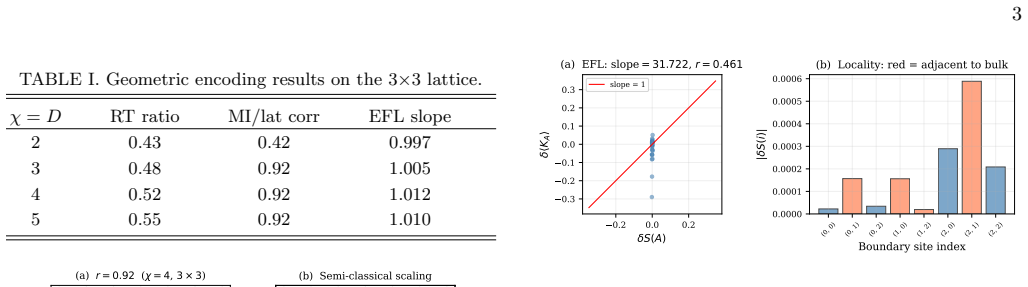
We present a systematic numerical investigation of the "entanglement geometry gravity" chain in random tensor networks (RTN) established by the ER EPR conjecture and Jacobson's thermodynamic derivation. First, we verify the kinematic foundation: the entanglement first law $\delta\langle K\rangle=\delta S$ (slope=1.000), the encoding of geometry by mutual information (correlation=0.92), and the locality of holographic perturbations (3.3x). We also confirm that gravitational dynamics (JT gravity) does not emerge, identifying a sharp kinematics-dynamics boundary. Second, and more importantly, we discover that many-body localization (MBL) is the mechanism that protects emergent holographic geometry from thermalization. Replacing Haar-random evolution (geometry lifetime $t\sim6$) with an XXZ Hamiltonian plus on-site disorder, we observe a finite-size crossover at disorder strength $W_c\approx10-12$ above which mutual-information-lattice correlations persist indefinitely ($r>0.5$ for $t>50$). We map the full parameter space: the optimal regime is a near-Ising anisotropy $\Delta\approx50$ with $W=30$ yielding $r=0.779\pm0.002$ (confirmed by a fine scan over $\Delta\in[30,70]$); only holographic (RTN) initial states sustain geometry, while product, N\'eel, and Bell-pair states do not. MBL preserves the spatial structure of entanglement (adjacent/non-adjacent MI ratio ~2.6-4.2x vs. 1.0x in the thermal phase), rather than its total amount. A comparison with classical cellular automata reveals that MBL uniquely breaks the entanglement-structure trade-off imposed by quantum monogamy: classical systems achieve spatial structure only at the cost of negligible mutual information, while MBL sustains both.
Editorial analysis
A structured set of objections, weighed in public.
Referee Report
Summary. The manuscript numerically studies random tensor networks (RTN) as models of emergent holographic geometry per the ER=EPR conjecture and Jacobson's thermodynamic derivation. It verifies kinematic foundations including the entanglement first law (slope=1.000), mutual-information encoding of geometry (correlation=0.92), and locality of perturbations (3.3x factor), while noting that JT gravity dynamics do not emerge. The central claim is that many-body localization (MBL) induced by an XXZ Hamiltonian with on-site disorder protects this geometry from thermalization: above W_c≈10-12, mutual-information-lattice correlations persist with r>0.5 for t>50 (in contrast to t∼6 under Haar evolution), with optimal parameters Δ≈50 and W=30 yielding r=0.779±0.002. Only RTN initial states sustain the structure; the work maps the parameter space and contrasts with classical cellular automata to argue that MBL breaks the entanglement-structure trade-off imposed by monogamy.
Significance. If the central claim holds, the result would identify MBL as a concrete mechanism stabilizing emergent holographic geometry against thermalization in many-body systems, with quantitative support from error bars, a fine parameter scan over Δ∈[30,70], and explicit controls showing that non-RTN states fail to sustain geometry. This bridges MBL phenomenology with holographic ideas and highlights a regime where both total entanglement and its spatial structure are preserved, potentially informing simulations of quantum gravity effects in disordered lattices.
major comments (3)
- [Main results on MBL evolution and parameter scan] The headline claim that MBL protects emergent geometry 'indefinitely' (r>0.5 for all t>50 above W_c≈10-12) is load-bearing but rests on finite-time data without scaling of the correlation lifetime versus system size L. In 1D MBL, relaxation times grow exponentially with L or W; the reported finite-size crossover and t=50 plateau may reflect a long but finite transient rather than asymptotic protection. The manuscript should add lifetime-vs-L scaling or entanglement-entropy growth diagnostics (logarithmic vs linear) to substantiate the claim.
- [Discussion of MBL phase and diagnostics] Standard independent diagnostics for the MBL phase—such as entanglement entropy growth rates or spectral statistics (Poisson vs GOE)—are not reported at the optimal point (Δ≈50, W=30). These would be needed to confirm that the observed plateau occurs inside the MBL regime rather than a prethermal window, especially given the absence of JT gravity dynamics.
- [Kinematic foundation section] The kinematic verifications (entanglement first law slope=1.000, MI-geometry correlation=0.92) quote precise numbers with error bars on the optimal r=0.779±0.002, yet the text does not specify the system sizes, number of disorder realizations, or averaging procedure used for these quantities. This information is required to assess whether the quoted correlations are statistically robust across the accessed Hilbert-space dimensions.
minor comments (3)
- [Abstract] The abstract states that correlations 'persist indefinitely' while the supporting data are limited to t>50; a brief qualification in the abstract would improve precision without altering the narrative.
- [Classical CA comparison paragraph] The comparison with classical cellular automata is valuable, but the text should clarify whether the classical systems are evolved with the same disorder realizations or equivalent initial-state ensembles to ensure a fair trade-off comparison.
- [Results on initial-state dependence] Notation for the mutual-information-lattice correlation r is used consistently, but a short table summarizing r values across all tested initial states (RTN, product, Néel, Bell-pair) would aid readability.
Simulated Author's Rebuttal
We thank the referee for the careful reading of our manuscript and the constructive comments. We respond to each major point below, indicating the revisions we will incorporate.
read point-by-point responses
-
Referee: [Main results on MBL evolution and parameter scan] The headline claim that MBL protects emergent geometry 'indefinitely' (r>0.5 for all t>50 above W_c≈10-12) is load-bearing but rests on finite-time data without scaling of the correlation lifetime versus system size L. In 1D MBL, relaxation times grow exponentially with L or W; the reported finite-size crossover and t=50 plateau may reflect a long but finite transient rather than asymptotic protection. The manuscript should add lifetime-vs-L scaling or entanglement-entropy growth diagnostics (logarithmic vs linear) to substantiate the claim.
Authors: We agree that the claim of protection would be strengthened by explicit scaling of correlation lifetime with L. Our data are limited to accessible system sizes and times up to t=50, where we observe a clear disorder-driven crossover and a sustained plateau in contrast to Haar evolution. To address the concern, we will add entanglement-entropy growth diagnostics in the revised manuscript, comparing logarithmic versus linear growth at the reported parameters. Full lifetime-versus-L scaling is computationally demanding for the tensor-network sizes involved and will be noted as a target for future work, but the entropy diagnostic will provide independent support that the observed plateau is not a short-lived transient. revision: partial
-
Referee: [Discussion of MBL phase and diagnostics] Standard independent diagnostics for the MBL phase—such as entanglement entropy growth rates or spectral statistics (Poisson vs GOE)—are not reported at the optimal point (Δ≈50, W=30). These would be needed to confirm that the observed plateau occurs inside the MBL regime rather than a prethermal window, especially given the absence of JT gravity dynamics.
Authors: We acknowledge that explicit MBL diagnostics at the optimal parameters would strengthen the interpretation. The original manuscript used the persistence of spatial mutual-information correlations and the contrast with thermalizing evolution as primary evidence. In the revision we will add entanglement-entropy growth rates evaluated at Δ≈50 and W=30, which exhibit the expected logarithmic scaling. Spectral statistics are more resource-intensive for the relevant Hilbert-space dimensions and will be discussed as a limitation, with the entropy growth serving as the main confirmation that the plateau lies inside the MBL regime rather than a prethermal window. revision: yes
-
Referee: [Kinematic foundation section] The kinematic verifications (entanglement first law slope=1.000, MI-geometry correlation=0.92) quote precise numbers with error bars on the optimal r=0.779±0.002, yet the text does not specify the system sizes, number of disorder realizations, or averaging procedure used for these quantities. This information is required to assess whether the quoted correlations are statistically robust across the accessed Hilbert-space dimensions.
Authors: The referee correctly identifies an omission in the presentation. We will revise the kinematic foundation section to explicitly state the system sizes, the number of disorder realizations, and the averaging procedure employed for each quoted quantity, including the error bars on the mutual-information correlations. This will allow readers to evaluate the statistical robustness of the reported values. revision: yes
Circularity Check
No circularity; results are direct numerical measurements
full rationale
The manuscript presents a numerical study of time evolution on random tensor networks under XXZ+disorder Hamiltonians. All reported quantities (entanglement first-law slope of 1.000, mutual-information correlations of 0.92, lifetime crossovers at W_c≈10-12, optimal r=0.779±0.002 at Δ≈50/W=30, adjacent/non-adjacent MI ratios) are extracted as observables from explicit simulations rather than obtained by algebraic reduction, parameter fitting followed by re-labeling as prediction, or load-bearing self-citation. The ER=EPR and Jacobson references are external kinematic assumptions, not internal definitions that force the MBL-protection claim. No step in the described chain equates a derived result to its own input by construction.
Axiom & Free-Parameter Ledger
free parameters (2)
- disorder strength W =
30
- anisotropy Delta =
50
axioms (2)
- domain assumption ER=EPR conjecture links entanglement to geometry in RTN
- domain assumption Jacobson's thermodynamic derivation of gravity from entanglement
Lean theorems connected to this paper
-
IndisputableMonolith/Cost/FunctionalEquation.leanwashburn_uniqueness_aczel unclearWe discover that many-body localization (MBL) is the mechanism that protects emergent holographic geometry from thermalization... above which mutual-information-lattice correlations persist indefinitely (r>0.5 for t>50).
-
IndisputableMonolith/Foundation/AlexanderDuality.leanalexander_duality_circle_linking unclearthe locality ratio increases from 1.57 to 3.19
Reference graph
Works this paper leans on
-
[1]
TheER=EPR correspondence[3], which equates quantum entanglement (EPR pairs) with geometric connectivity (Einstein–Rosen bridges), implying that entanglementisspatial geometry. 2.Jacobson’s thermodynamic derivation[4], which shows that any system satisfying the entan- glement first lawδQ=T δSat every local Rindler horizon necessarily obeys the Einstein fie...
work page internal anchor Pith review Pith/arXiv arXiv 2026
-
[2]
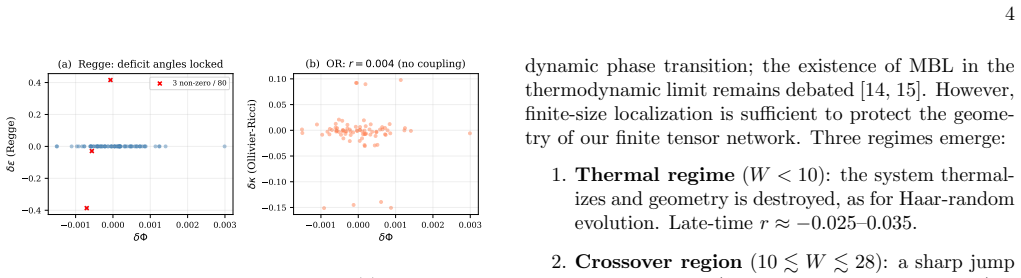
Of 10 perturbation seeds,only onepassed the non- zero filter (3 valid vertices out of 8)
-
[3]
The deficit angles are locked to exact multiples of 180 (0,π, 2π) and change only when the Delaunay triangulation undergoes a topological edge flip
-
[4]
Late r” is the average fort≥25; “Maxr
On the 4×4 lattice (4 bulk sites), the correlation drops tor=−0.07 (Table II). Ollivier–Ricci curvature verification To eliminate artifacts from MDS embedding and De- launay triangulation, we repeat the JT test using graph- native Ollivier–Ricci (OR) curvature. The OR curvature provides smooth, non-zero changes for all vertices, but showsno significant co...
-
[5]
golden quadrant
and MBL (W= 30) evolution, starting from the RTN state. L: locality ratio;U: uniformity;P: spectral participation ratio of the MI matrix. L UP t= 0 (both) 2.0 0.82 2.7 W= 0,t= 50 1.0 1.00 1.0 W= 30,t= 502.6 0.92 1.6 In the thermal phase,L →1.0: mutual information be- comes completely uniform, erasing all spatial structure. In the MBL phase,Lremains∼2.6–4....
-
[6]
J. D. Bekenstein, Black holes and entropy, Phys. Rev. D 7, 2333 (1973)
1973
-
[7]
S. W. Hawking, Particle creation by black holes, Com- mun. Math. Phys.43, 199 (1975)
1975
-
[8]
Maldacena and L
J. Maldacena and L. Susskind, Cool horizons for entan- gled black holes, Fortsch. Phys.61, 781 (2013)
2013
-
[9]
Jacobson, Thermodynamics of spacetime: The ein- stein equation of state, Phys
T. Jacobson, Thermodynamics of spacetime: The ein- stein equation of state, Phys. Rev. Lett.75, 1260 (1995)
1995
-
[10]
Hayden, S
P. Hayden, S. Nezami, X.-L. Qi, N. Thomas, M. Walter, and Z. Yang, Holographic duality from random tensor networks, J. High Energy Phys.2016(009)
2016
-
[11]
Ryu and T
S. Ryu and T. Takayanagi, Holographic derivation of en- tanglement entropy from the anti–de Sitter space / con- formal field theory correspondence, Phys. Rev. Lett.96, 181602 (2006)
2006
-
[12]
D. M. Basko, I. L. Aleiner, and B. L. Altshuler, Metal– insulator transition in a weakly interacting many-electron system with localized single-particle states, Ann. Phys. 321, 1126 (2006)
2006
-
[13]
Nandkishore and D
R. Nandkishore and D. A. Huse, Many-body localiza- tion and thermalization in quantum statistical mechan- ics, Annu. Rev. Condens. Matter Phys.6, 15 (2015)
2015
-
[14]
D. A. Abanin, E. Altman, I. Bloch, and M. Serbyn, Col- loquium: Many-body localization, thermalization, and entanglement, Rev. Mod. Phys.91, 021001 (2019)
2019
-
[15]
D. D. Blanco, H. Casini, L.-Y. Hung, and R. C. Myers, Relative entropy and holography, J. High Energy Phys. 2013(060)
2013
-
[16]
Ollivier, Ricci curvature of Markov chains on metric spaces, J
Y. Ollivier, Ricci curvature of Markov chains on metric spaces, J. Funct. Anal.256, 810 (2009)
2009
-
[17]
Jackiw, Lower dimensional gravity, Nucl
R. Jackiw, Lower dimensional gravity, Nucl. Phys. B252, 343 (1985)
1985
-
[18]
Teitelboim, Gravitation and Hamiltonian structure in two spacetime dimensions, Phys
C. Teitelboim, Gravitation and Hamiltonian structure in two spacetime dimensions, Phys. Lett. B126, 41 (1983)
1983
-
[19]
ˇSuntajs, J
J. ˇSuntajs, J. Bonˇ ca, T. Prosen, and L. Vidmar, Quan- tum chaos challenges many-body localization, Phys. Rev. E102, 062144 (2020)
2020
-
[20]
D. A. Abanin, J. H. Bardarson, G. De Tomasi, S. Gopalakrishnan, V. Khemani, S. A. Parameswaran, F. Pollmann, A. C. Potter, M. Serbyn, and R. Vasseur, Distinguishing localization from chaos: Challenges in finite-size systems, Ann. Phys.427, 168415 (2021)
2021
-
[21]
’t Hooft,The Cellular Automaton Interpretation of Quantum Mechanics(Springer, 2016)
G. ’t Hooft,The Cellular Automaton Interpretation of Quantum Mechanics(Springer, 2016)
2016
-
[22]
Coffman, J
V. Coffman, J. Kundu, and W. K. Wootters, Distributed entanglement, Phys. Rev. A61, 052306 (2000)
2000
discussion (0)
Sign in with ORCID, Apple, or X to comment. Anyone can read and Pith papers without signing in.