Recognition: 2 theorem links
· Lean TheoremWhat quantum computer to buy?
Pith reviewed 2026-05-10 19:29 UTC · model grok-4.3
The pith
Most institutions should start with the smallest quantum capability layer that delivers repeatable near-term value rather than committing to large on-premises systems.
A machine-rendered reading of the paper's core claim, the machinery that carries it, and where it could break.
Core claim
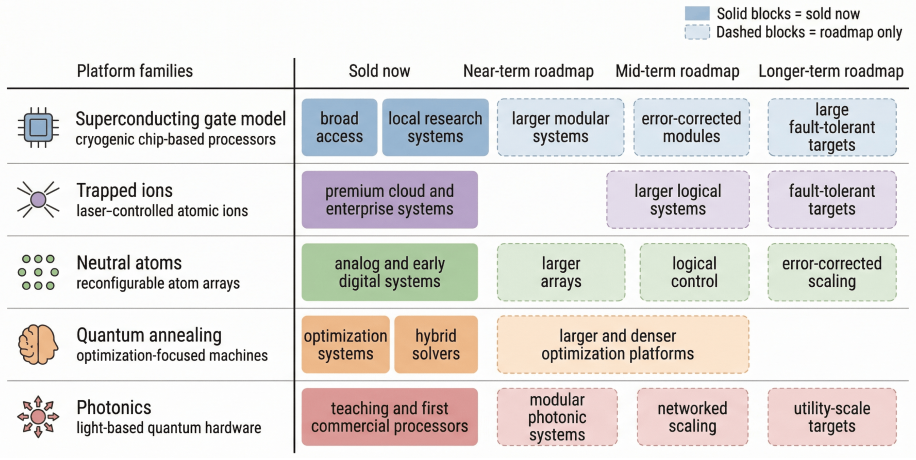
The manuscript develops a practical procurement framework that distinguishes five capability layers, separates peer-reviewed results from commercial offerings, pricing anchors, and public roadmaps, and compares the main commercial platform families through the lens of institutional fit, access model, and refresh pressure. The main conclusion is that most institutions should begin with the smallest layer of capability that produces repeatable near-term value, builds internal expertise, and preserves strategic flexibility. Large on-premises systems are justified only when mission requirements, site readiness, staffing, governance, and upgrade paths are already clear.
What carries the argument
The five capability layers, which map distinct institutional purposes—cloud access for teaching, reserved capacity for research, local instruments for hardware training, optimization appliances, and strategic installations—to appropriate access models and hardware choices while filtering out unverified roadmaps.
If this is right
- Cloud access meets teaching and early exploration needs without ownership or maintenance burdens.
- Reserved capacity supports research programs while avoiding the full cost of site preparation.
- Local instruments enable hardware training only when facilities and technical staff are already in place.
- Optimization appliances address targeted problems such as annealing without requiring general-purpose quantum hardware.
- Strategic installations reshape budgets and staffing only after governance structures and upgrade paths are defined.
Where Pith is reading between the lines
- The layered model suggests that smaller organizations can participate in quantum work without waiting for larger players to set standards.
- Periodic updates to the platform comparisons will be required as new peer-reviewed benchmarks appear.
- Starting at the lowest useful layer may shorten the time to internal expertise compared with waiting for a single large purchase.
Load-bearing premise
The five capability layers are meaningfully distinct and the comparisons of commercial platforms accurately separate peer-reviewed results from marketing roadmaps in a way that remains stable enough for procurement decisions.
What would settle it
A clear case in which two of the proposed layers produce indistinguishable value or costs for the same institution, or in which vendor roadmaps prove consistently more accurate than current peer-reviewed data for predicting useful system lifetime, would undermine the framework.
Figures


read the original abstract
The phrase ``buy a quantum computer'' hides several different procurement problems. An institution may be seeking cloud access for teaching, reserved capacity for research, a local instrument for hardware training, an optimization appliance, or a strategic installation that reshapes facilities, staffing, and budgets. Because these choices differ in purpose, operating burden, and useful lifetime, the decision should be framed as acquisition of \emph{quantum capability} rather than selection of a presumed hardware winner. This manuscript develops a practical procurement framework that distinguishes five capability layers, separates peer-reviewed results from commercial offerings, pricing anchors, and public roadmaps, and compares the main commercial platform families -- superconducting circuits, trapped ions, neutral atoms, quantum annealing, and photonics -- through the lens of institutional fit, access model, and refresh pressure. The main conclusion is that most institutions should begin with the smallest layer of capability that produces repeatable near-term value, builds internal expertise, and preserves strategic flexibility. Large on-premises systems are justified only when mission requirements, site readiness, staffing, governance, and upgrade paths are already clear.
Editorial analysis
A structured set of objections, weighed in public.
Referee Report
Summary. The manuscript develops a procurement framework for quantum computing that reframes the decision as acquiring one of five distinct capability layers rather than selecting a single hardware platform. It separates peer-reviewed results from commercial offerings and roadmaps, then compares the main families (superconducting circuits, trapped ions, neutral atoms, quantum annealing, photonics) according to institutional fit, access model, operating burden, and refresh pressure. The central recommendation is that most institutions should begin at the smallest layer that delivers repeatable near-term value, builds expertise, and preserves flexibility; large on-premises systems are justified only when mission requirements, site readiness, staffing, governance, and upgrade paths are already clear.
Significance. If the five-layer distinctions and platform characterizations remain stable, the framework supplies concrete, actionable guidance that could reduce mismatched investments by institutions entering quantum technology. The explicit separation of peer-reviewed evidence from marketing roadmaps and the emphasis on access models rather than hardware winners constitute a practical contribution in a field where procurement decisions are often driven by hype.
minor comments (2)
- [Abstract] The abstract refers to 'five capability layers' without enumerating them; listing the layers (even in a single sentence) would allow readers to grasp the framework immediately.
- [Platform comparisons] The platform comparisons would benefit from a summary table that aligns each family with the five layers, access models, and refresh-pressure indicators; this would make the institutional-fit analysis easier to use.
Simulated Author's Rebuttal
We thank the referee for the positive assessment of the manuscript, the accurate summary of its contributions, and the recommendation for minor revision. No specific major comments were enumerated in the report, so we have no point-by-point rebuttals to provide. We will make any minor editorial adjustments in the revised version.
Circularity Check
No significant circularity; advisory framework is self-contained
full rationale
The manuscript is an advisory procurement framework that distinguishes five capability layers and compares commercial quantum platforms (superconducting, trapped ions, neutral atoms, annealing, photonics) through institutional fit, access models, and roadmaps. It advances no mathematical derivations, equations, predictions, or first-principles claims. The central recommendation to begin at the smallest useful capability layer follows directly from the explicitly stated distinctions and external separation of peer-reviewed results from commercial offerings. No self-definitional loops, fitted inputs renamed as predictions, or load-bearing self-citations appear; the analysis draws on independent external benchmarks and remains non-circular by construction.
Axiom & Free-Parameter Ledger
axioms (2)
- domain assumption The five capability layers provide a useful and stable distinction for procurement decisions across institutions.
- domain assumption Peer-reviewed results can be reliably separated from commercial offerings and public roadmaps for the purpose of comparison.
Lean theorems connected to this paper
-
IndisputableMonolith/Foundation/RealityFromDistinction.leanreality_from_one_distinction unclearThe manuscript develops a practical procurement framework that distinguishes five capability layers... The main conclusion is that most institutions should begin with the smallest layer of capability...
-
IndisputableMonolith/Cost/FunctionalEquation.leanwashburn_uniqueness_aczel unclearA simple weighted score is sufficient... Sj = w1 Rscience,j + ...
Reference graph
Works this paper leans on
-
[1]
Quantum computing in the NISQ era and beyond.Quantum, 2:79, 2018
John Preskill. Quantum computing in the NISQ era and beyond.Quantum, 2:79, 2018. doi: 10.22331/q-2018-08-06-79
work page internal anchor Pith review doi:10.22331/q-2018-08-06-79 2018
-
[2]
Cerezoet al., Variational quantum al- gorithms, Nat
M. Cerezo, Andrew Arrasmith, Ryan Babbush, et al. Variational quantum algorithms.Nature Reviews Physics, 3:625–644, 2021. doi: 10.1038/s42254-021-00348-9
-
[3]
Kottmann, Tim Menke, Wai-Keong Mok, Sukin Sim, Leong-Chuan Kwek, and Al´ an Aspuru-Guzik
Kishor Bharti, Alba Cervera-Lierta, Thi Ha Kyaw, et al. Noisy intermediate-scale quantum algorithms.Reviews of Modern Physics, 94:015004, 2022. doi: 10.1103/RevModPhys.94.015004
-
[4]
Overview of plans.https://quantum.cloud.ibm.com/docs/guides/plans- overview, 2026
IBM Quantum. Overview of plans.https://quantum.cloud.ibm.com/docs/guides/plans- overview, 2026
2026
-
[5]
Amazon braket pricing, 2026
Amazon Web Services. Amazon braket pricing, 2026. Amazon Braket pricing page; accessed 2026-04-02
2026
-
[6]
The ibm quantum development roadmap, 2026
IBM Quantum. The ibm quantum development roadmap, 2026. IBM roadmap update discussing 2026 milestones; accessed 2026-04-02
2026
-
[7]
Quantinuum. Quantinuum unveils accelerated roadmap to achieve universal fault-tolerant quantum computing by 2030.https://www.quantinuum.com/press-releases/quantinuum- 16 unveils- accelerated- roadmap- to- achieve- universal- fault- tolerant- quantum- computing-by-2030, 2024
2030
-
[8]
Pasqal roadmap update, 2025
Pasqal. Pasqal roadmap update, 2025. Pasqal roadmap announcement dated 2025-06-12; accessed 2026-04-02
2025
-
[9]
Roadmap 2026–2033.https://www.quandela.com/wp-content/uploads/2026/0 3/Quandela-Roadmap-190326-web.pdf, 2026
Quandela. Roadmap 2026–2033.https://www.quandela.com/wp-content/uploads/2026/0 3/Quandela-Roadmap-190326-web.pdf, 2026
2026
-
[10]
Premium access, 2026
QuEra Computing. Premium access, 2026. QuEra premium-access page; accessed 2026-04-02
2026
-
[11]
The leap quantum cloud service.https://www.dwavesys.com/solutions- and-products/cloud-platform/, 2026
D-Wave Quantum. The leap quantum cloud service.https://www.dwavesys.com/solutions- and-products/cloud-platform/, 2026
2026
-
[12]
Leap quantum launchpad, 2025
D-Wave Quantum Inc. Leap quantum launchpad, 2025. D-Wave Leap Quantum LaunchPad page; accessed 2026-04-02
2025
-
[13]
System model helios, 2025
Quantinuum. System model helios, 2025. Quantinuum Helios product page; accessed 2026-04-02
2025
-
[14]
Democratising access to quantum computing: Iqm launches iqm spark for universities and labs
IQM Quantum Computers. Democratising access to quantum computing: Iqm launches iqm spark for universities and labs. https://meetiqm.com/press-releases/democratising- access-to-quantum-computing-iqm-quantum-computers-launches-iqm-spark-for- universities-and-labs/, 2023
2023
-
[15]
Rigetti launches the novera qpu, the company’s first commercially available qpu
Rigetti Computing. Rigetti launches the novera qpu, the company’s first commercially available qpu. https://www.rigetti.com/news/rigetti-launches-novera-qpu-the-companys- first-commercially-available-qpu, 2023
2023
-
[16]
The world’s leading 19-inch rack-mounted quantum computer
Alpine Quantum Technologies. The world’s leading 19-inch rack-mounted quantum computer. https://www.aqt.eu/solution/pine-system-19-rack-mounted-quantum-computer/, 2025
2025
-
[17]
On-premises quantum computing, 2026
QuEra Computing. On-premises quantum computing, 2026. QuEra on-premises/lease page; accessed 2026-04-02
2026
-
[18]
Ac1000.https://atom-computing.com/ac1000/, 2026
Atom Computing. Ac1000.https://atom-computing.com/ac1000/, 2026
2026
-
[19]
The advantage2 quantum computer.https://www.dwavesys.com/solutio ns-and-products/systems/, 2026
D-Wave Quantum. The advantage2 quantum computer.https://www.dwavesys.com/solutio ns-and-products/systems/, 2026
2026
-
[20]
Enterprise-grade quantum, deployed where you need it.https: //oqc.tech/access/deployments/, 2026
Oxford Quantum Circuits. Enterprise-grade quantum, deployed where you need it.https: //oqc.tech/access/deployments/, 2026
2026
-
[21]
Mosaiq, 2026
Quandela. Mosaiq, 2026. Quandela product page; accessed 2026-04-02
2026
-
[22]
Orca pt-2.https://orcacomputing.com/orca-pt-2/, 2024
ORCA Computing. Orca pt-2.https://orcacomputing.com/orca-pt-2/, 2024
2024
-
[23]
New ibm quantum flex plan enables new path to premium access.https: //www.ibm.com/quantum/blog/flex-plan, 2025
IBM Quantum. New ibm quantum flex plan enables new path to premium access.https: //www.ibm.com/quantum/blog/flex-plan, 2025
2025
-
[24]
D-wave quantum press conference presentation: Quantum circuits acquisition
D-Wave Quantum. D-wave quantum press conference presentation: Quantum circuits acquisition. https://s201.q4cdn.com/339170267/files/doc_presentations/2026/Jan/07/D-Wave- Quantum-Press-Conference-Presentation-Quantum-Circuits-Inc-Acquisition.pdf , 2026. 17
-
[25]
Ionq technology and product roadmap, 2025
IonQ. Ionq technology and product roadmap, 2025. IonQ roadmap webpage; accessed 2026-04-02
2025
-
[26]
Engineering high-coherence superconducting qubits.Nature Reviews Materials, 6: 875–891, 2021
Irfan Siddiqi. Engineering high-coherence superconducting qubits.Nature Reviews Materials, 6: 875–891, 2021. doi: 10.1038/s41578-021-00370-4
-
[27]
Evidence for the utility of quantum computing before fault tolerance
Youngseok Kim, Andrew Eddins, Sajant Anand, et al. Evidence for the utility of quantum computing before fault tolerance.Nature, 618:500–505, 2023. doi: 10.1038/s41586-023-06096-3
-
[28]
Rajeev Acharya et al. Suppressing quantum errors by scaling a surface code logical qubit. Nature, 614:676–681, 2023. doi: 10.1038/s41586-022-05434-1
-
[29]
Quantum error correction below the surface code threshold,
Rajeev Acharya et al. Quantum error correction below the surface code threshold.Nature, 638: 920–926, 2025. doi: 10.1038/s41586-024-08449-y
-
[30]
Ibm quantum computing: Hardware and roadmap.https://www.ibm.com/qu antum/hardware, 2026
IBM Quantum. Ibm quantum computing: Hardware and roadmap.https://www.ibm.com/qu antum/hardware, 2026
2026
-
[31]
Rigetti Computing. Rigetti computing reports second quarter 2025 financial results; announces general availability of its 36-qubit multi-chip quantum computer.https://www.rigetti.com/ne ws/rigetti-computing-reports-second-quarter-2025-financial-results-announces- general-availability-of-its-36-qubit-multi-chip-quantum-computer, 2025
2025
-
[32]
Rigetti computing provides update on 108-qubit system.https://www.ri getti.com/news/rigetti-computing-provides-update-108-qubit-system, 2026
Rigetti Computing. Rigetti computing provides update on 108-qubit system.https://www.ri getti.com/news/rigetti-computing-provides-update-108-qubit-system, 2026
2026
-
[33]
Iqm launches iqm radiance: A 150-qubit system paving the way to quantum advantage
IQM Quantum Computers. Iqm launches iqm radiance: A 150-qubit system paving the way to quantum advantage. https://meetiqm.com/press-releases/iqm-launches-iqm-radiance- a-150-qubit-system-paving-the-way-to-quantum-advantage/, 2023
2023
-
[34]
Iqm roadmap toward fault-tolerant quantum computing by 2030,
IQM Quantum Computers. Iqm roadmap toward fault-tolerant quantum computing by 2030,
2030
-
[35]
IQM roadmap announcement dated 2024-11-13; accessed 2026-04-02
2024
-
[36]
Iqm launches halocene, a new quantum computer product line for error correction
IQM Quantum Computers. Iqm launches halocene, a new quantum computer product line for error correction. https://meetiqm.com/press-releases/iqm-launches-halocene-a-new- quantum-computer-product-line-for-error-correction/, 2025
2025
-
[37]
Oqc launches toshiko, 2023
Oxford Quantum Circuits. Oqc launches toshiko, 2023. OQC press release dated 2023-11-27; accessed 2026-04-02
2023
-
[38]
Technical roadmap, 2026
Oxford Quantum Circuits. Technical roadmap, 2026. OQC roadmap page describing Genesis, Titan, Athena, and Atlas
2026
-
[39]
Direct access / oqc cloud, 2026
Oxford Quantum Circuits. Direct access / oqc cloud, 2026. OQC access webpage; accessed 2026-04-02
2026
-
[40]
Roadmap.https://quantumai.google/roadmap, 2026
Google Quantum AI. Roadmap.https://quantumai.google/roadmap, 2026
2026
-
[41]
Trapped-ion quantum computing: Progress and challenges,
Colin D. Bruzewicz, John Chiaverini, Robert McConnell, and Jeremy M. Sage. Trapped-ion quantum computing: Progress and challenges.Applied Physics Reviews, 6(2):021314, 2019. doi: 10.1063/1.5088164. 18
-
[42]
Mohsin Iqbal, Nathanan Tantivasadakarn, Ruben Verresen, Sara L. Campbell, Joan M. Dreiling, Caroline Figgatt, John P. Gaebler, Jacob Johansen, Michael Mills, Steven A. Moses, Juan M. Pino, Anthony Ransford, Mary Rowe, Peter Siegfried, Russell P. Stutz, Michael Foss-Feig, Ashvin Vishwanath, Henrik Dreyer, et al. Non-abelian topological order and anyons on ...
-
[43]
M.et al.Identification of short-range ordering motifs in semiconductors.Science389, 1342–1346 (2025)
C. Ryan-Anderson, N. C. Brown, C. H. Baldwin, J. M. Dreiling, C. Foltz, J. P. Gaebler, T. M. Gatterman, N. Hewitt, C. Holliman, C. V. Horst, J. Johansen, D. Lucchetti, T. Mengle, M. Matheny, Y. Matsuoka, K. Mayer, M. Mills, S. A. Moses, B. Neyenhuis, J. Pino, P. Siegfried, R. P. Stutz, J. Walker, and D. Hayes. High-fidelity teleportation of a logical qubi...
-
[44]
Ionq forte enterprise: Quantum computer for data centers.https://www.ionq.com/qua ntum-systems/forte-enterprise, 2026
IonQ. Ionq forte enterprise: Quantum computer for data centers.https://www.ionq.com/qua ntum-systems/forte-enterprise, 2026
2026
-
[45]
Ionq tempo: 100-qubit quantum computer (#aq 64).https://www.ionq.com/quantum- systems/tempo, 2025
IonQ. Ionq tempo: 100-qubit quantum computer (#aq 64).https://www.ionq.com/quantum- systems/tempo, 2025
2025
-
[46]
Overcoming the last major hurdle to deliver scalable universal fault-tolerant quantum computers by 2029, 2025
Quantinuum. Overcoming the last major hurdle to deliver scalable universal fault-tolerant quantum computers by 2029, 2025. Quantinuum blog/announcement; accessed 2026-04-02
2029
-
[47]
Aqt announces its trapped-ion quantum computer now available on amazon braket
Alpine Quantum Technologies. Aqt announces its trapped-ion quantum computer now available on amazon braket. https://www.aqt.eu/aqt-announces-its-trapped-ion-quantum- computer-now-available-on-amazon-braket/, 2025
2025
-
[48]
Alpine Quantum Technologies. Aqt was awarded a european tender for a trapped-ion quantum computer, with installation set for 2025.https://www.aqt.eu/aqt-wins-european-tender- for-trapped-ions-quantum-computer-installation-set-for-2025/, 2024
2025
- [49]
-
[51]
Dolev Bluvstein, Simon J. Evered, Alexandra A. Geim, Sophie H. Li, Hengyun Zhou, Tom Manovitz, Sepehr Ebadi, Madelyn Cain, Marcin Kalinowski, Dominik Hangleiter, J. Pablo Bonilla Ataides, Nishad Maskara, Iris Cong, Xun Gao, Pedro Sales Rodriguez, Thomas Karolyshyn, Giulia Semeghini, Michael J. Gullans, Markus Greiner, Vladan Vuletić, Mikhail D. Lukin, et ...
-
[52]
Pedro Sales Rodriguez, John M. Robinson, Paul Niklas Jepsen, Zhiyang He, Casey Duckering, Chen Zhao, Kai-Hsin Wu, Joseph Campo, Kevin Bagnall, Minho Kwon, Thomas Karolyshyn, Phillip Weinberg, et al. Experimental demonstration of logical magic state distillation.Nature, 645:620–625, 2025. doi: 10.1038/s41586-025-09367-3
-
[53]
A fault-tolerant neutral-atom architecture for universal quantum computation,
Dolev Bluvstein, Alexandra A. Geim, Sophie H. Li, Simon J. Evered, J. Pablo Bonilla Ataides, Gefen Baranes, Andi Gu, Tom Manovitz, Muqing Xu, Marcin Kalinowski, Shayan Majidy, Christian Kokail, Nishad Maskara, Elias C. Trapp, Luke M. Stewart, Simon Hollerith, Hengyun Zhou, Michael J. Gullans, Susanne F. Yelin, Markus Greiner, Vladan Vuletić, Madelyn Cain,...
-
[54]
Roadmap for advanced error-corrected quantum computers
QuEra Computing. Roadmap for advanced error-corrected quantum computers. https: //www.quera.com/press-releases/quera-computing-releases-a-groundbreaking- roadmap-for-advanced-error-corrected-quantum-computers-pioneering-the-next- frontier-in-quantum-innovation-0, 2024
2024
-
[55]
Quera roadmap, 2026
QuEra Computing. Quera roadmap, 2026. QuEra roadmap webpage; accessed 2026-04-02
2026
-
[56]
Quantum processing units, 2026
Pasqal. Quantum processing units, 2026. Pasqal hardware/product webpage; accessed 2026-04- 02
2026
-
[57]
Software.https://www.pasqal.com/solutions/software/, 2026
Pasqal. Software.https://www.pasqal.com/solutions/software/, 2026
2026
-
[58]
Pasqal delivers a 140-qubit system to cineca, 2026
Pasqal. Pasqal delivers a 140-qubit system to cineca, 2026. Pasqal/CINECA delivery announce- ment; accessed 2026-04-02
2026
-
[59]
Technology, 2026
Atom Computing. Technology, 2026. Atom Computing technology webpage; accessed 2026-04-02
2026
-
[60]
Atom computing: Home.https://atom-computing.com/, 2026
Atom Computing. Atom computing: Home.https://atom-computing.com/, 2026
2026
-
[61]
King, Jack Raymond, Trevor Lanting, Richard Harris, Alex Zucca, Fabio Altomare, Andrew J
Andrew D. King, Jack Raymond, Trevor Lanting, Richard Harris, Alex Zucca, Fabio Altomare, Andrew J. Berkley, Kelly Boothby, Sara Ejtemaee, Colin Enderud, Emile Hoskinson, Shuiyuan Huang, Eric Ladizinsky, Allison J. R. MacDonald, Gaelen Marsden, Reza Molavi, Travis Oh, Gabriel Poulin-Lamarre, Mauricio Reis, Chris Rich, Yuki Sato, Nicholas Tsai, Mark Volkma...
-
[62]
Beyond-classical compu- tation in quantum simulation,
Andrew D. King, Alberto Nocera, Marek M. Rams, et al. Beyond-classical computation in quantum simulation.Science, 388(6743):199–204, 2025. doi: 10.1126/science.ado6285
-
[63]
D-Wave Quantum. D-wave announces agreement to acquire quantum circuits inc.https: //www.dwavequantum.com/company/newsroom/press- release/d- wave- to- acquire- quantum-circuits-inc-establishing-world-s-leading-quantum-computing-company/ , 2026
2026
-
[64]
D-wave demonstrates first scalable, on-chip cryogenic control of gate-model qubits
D-Wave Quantum. D-wave demonstrates first scalable, on-chip cryogenic control of gate-model qubits. https://www.dwavequantum.com/company/newsroom/press-release/d-wave- demonstrates-first-scalable-on-chip-cryogenic-control-of-gate-model-qubits/ , 2026
2026
-
[65]
Belenos / mosaiq 12, 2025
Quandela. Belenos / mosaiq 12, 2025. Quandela product announcement/specification page; accessed 2026-04-02
2025
-
[66]
Technology.https://orcacomputing.com/technology/, 2026
ORCA Computing. Technology.https://orcacomputing.com/technology/, 2026
2026
-
[67]
Orca computing delivers first photonic quantum computing system to uk’s national quantum computing centre
ORCA Computing. Orca computing delivers first photonic quantum computing system to uk’s national quantum computing centre. https://orcacomputing.com/installation-marks- key-milestone-in-the-uks-121m-quantum-initiative-advancing-practical-quantum- research/, 2025. 20
2025
-
[68]
Aghaee Rad et al
H. Aghaee Rad et al. Scaling and networking a modular photonic quantum computer.Nature,
-
[69]
doi: 10.1038/s41586-024-08406-9
-
[70]
doi:10.1038/s4 1586-025-09527-5
Lars S. Madsen, Fabian Laudenbach, Mohsen Falamarzi Askarani, Fabien Rortais, Trevor Vincent, Jacob F. F. Bulmer, Filippo M. Miatto, Leonhard Neuhaus, Lukas G. Helt, Matthew J. Collins, Adriana E. Lita, Thomas Gerrits, Sae Woo Nam, Varun D. Vaidya, Marco Menotti, Ish Dhand, Zachary Vernon, Nicolás Quesada, and Jonathan Lavoie. Quantum computational advant...
work page doi:10.1038/s4 2022
-
[71]
Wein, Alexia Salavrakos, Patrick Sinnott, Dario A
Nicolas Maring, Andreas Fyrillas, Mathias Pont, Edouard Ivanov, Petr Stepanov, Nico Margaria, William Hease, Anton Pishchagin, Aristide Lemaître, Isabelle Sagnes, Thi Huong Au, Sébastien Boissier, Eric Bertasi, Aurélien Baert, Mario Valdivia, Marie Billard, Ozan Acar, Alexandre Brieussel, Rawad Mezher, Stephen C. Wein, Alexia Salavrakos, Patrick Sinnott, ...
-
[72]
Shunya Konno, Warit Asavanant, Fumiya Hanamura, Hironari Nagayoshi, Kosuke Fukui, Akira Sakaguchi, Ryohei Ide, Fumio China, Masahiro Yabuno, Shigehito Miki, Hirotaka Terai, Kento Takase, Masaya Endo, Petr Marek, Radim Filip, Peter van Loock, and Akira Furusawa. Logical states for fault-tolerant quantum computation with propagating light.Science, 383(6680)...
-
[73]
H. Aghaee Rad, T. Ainsworth, Y. Zhang, M. Vasmer, Z. Vernon, L. F. S. S. M. Villalobos, B. W. Walshe, R. Weil, X. Xin, X. Yan, Y. Yao, M. Zamani Abnili, et al. Scaling and networking a modular photonic quantum computer.Nature, 638:912–919, 2025. doi: 10.1038/s41586-024- 08406-9
-
[74]
Nature641(8064), 876–883 (2025) https:// doi.org/10.1038/s41586-025-08820-7
PsiQuantum Team. A manufacturable platform for photonic quantum computing.Nature, 641: 876–883, 2025. doi: 10.1038/s41586-025-08820-7
-
[75]
Orca computing, 2026
ORCA Computing. Orca computing, 2026. ORCA company home page; accessed 2026-04-02
2026
-
[76]
Quantum optics educational kits.https://www.thorlabs.com/quantum-optics- educational-kits, 2026
Thorlabs. Quantum optics educational kits.https://www.thorlabs.com/quantum-optics- educational-kits, 2026
2026
-
[77]
qued.https://qutools.com/qued/, 2026
qutools. qued.https://qutools.com/qued/, 2026
2026
-
[78]
Spinq gemini mini/mini pro 2-qubit portable nmr quantum computer.https://www.sp inquanta.com/products-services/spinq-gemini-mini, 2026
SpinQ. Spinq gemini mini/mini pro 2-qubit portable nmr quantum computer.https://www.sp inquanta.com/products-services/spinq-gemini-mini, 2026
2026
-
[79]
Spinq gemini lab quantum computing experimental platform.https://www.spinquan ta.com/products-services/spinq-gemini-lab, 2026
SpinQ. Spinq gemini lab quantum computing experimental platform.https://www.spinquan ta.com/products-services/spinq-gemini-lab, 2026. 21
2026
discussion (0)
Sign in with ORCID, Apple, or X to comment. Anyone can read and Pith papers without signing in.