Recognition: no theorem link
An infinite series of Gorenstein local algebras failing the affine homogeneity property
Pith reviewed 2026-05-10 19:01 UTC · model grok-4.3
The pith
An infinite series of finite-dimensional Gorenstein local algebras A_n each has a one-dimensional subspace in its maximal ideal, distinct from the socle, that is invariant under the full automorphism group.
A machine-rendered reading of the paper's core claim, the machinery that carries it, and where it could break.
Core claim
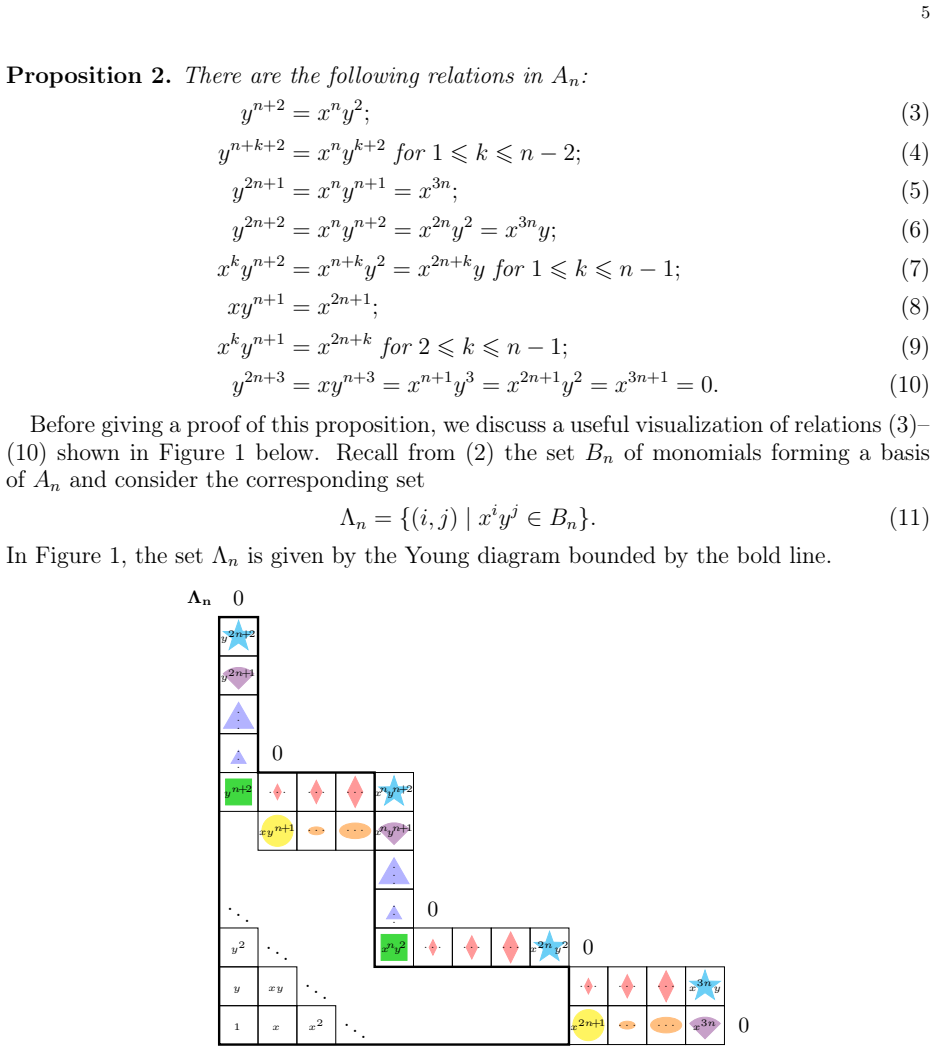
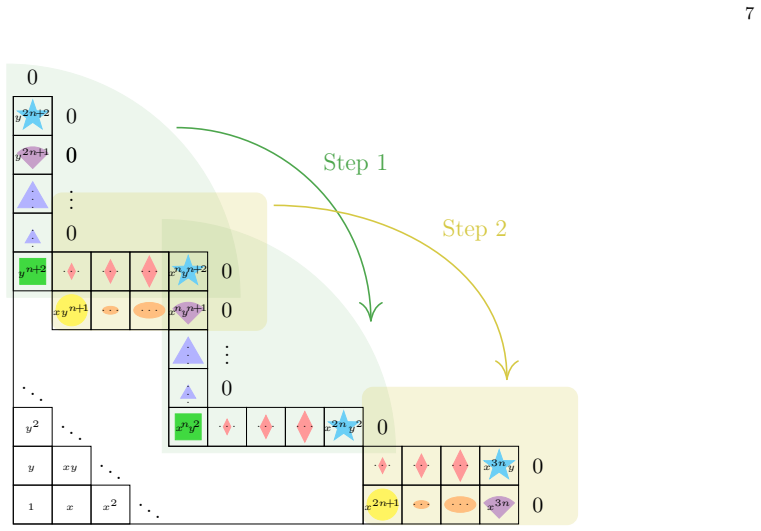
We provide an infinite series of commutative finite-dimensional Gorenstein local algebras A_n for n ≥ 2. We prove that the maximal ideal of every A_n possesses a one-dimensional subspace different from the socle that is invariant under the automorphism group of A_n. This implies that the algebras A_n fail the affine homogeneity property.
What carries the argument
The algebras A_n (n ≥ 2) together with the explicit one-dimensional Aut(A_n)-invariant subspace of the maximal ideal that lies outside the socle.
If this is right
- The algebras A_n provide an infinite collection of counterexamples to affine homogeneity among Gorenstein local algebras.
- The result produces new instances where additive actions on projective hypersurfaces behave differently under the generalized Hassett-Tschinkel correspondence.
- Any classification of affine homogeneous Gorenstein algebras must exclude this infinite family.
Where Pith is reading between the lines
- The same construction technique may be adaptable to produce counterexamples in wider classes of local algebras that are not necessarily Gorenstein.
- For small n the algebras A_n are small enough that the invariant subspace can be verified by direct computation of the automorphism group.
- This family separates the affine homogeneity property from the Gorenstein condition and therefore sharpens questions about which additional assumptions restore homogeneity.
Load-bearing premise
The chosen construction of each A_n makes the algebra Gorenstein and ensures the selected one-dimensional subspace of the maximal ideal is fixed by every automorphism.
What would settle it
An explicit listing of all automorphisms of some A_n (for example A_2) that moves the claimed one-dimensional subspace would show the invariance fails.
Figures



read the original abstract
We provide an infinite series of commutative finite-dimensional Gorenstein local algebras $A_n$ for $n \ge 2$. We give an elementary proof that the maximal ideal of every algebra $A_n$ possesses a one-dimensional subspace that is different from the socle and invariant under the automorphism group of $A_n$. The latter implies that the algebras $A_n$ fail the affine homogeneity property. We also discuss some consequences concerning additive actions on projective hypersurfaces, related to the generalized Hassett-Tschinkel correspondence for these algebras.
Editorial analysis
A structured set of objections, weighed in public.
Referee Report
Summary. The manuscript constructs an infinite family of finite-dimensional commutative Gorenstein local algebras A_n (n ≥ 2) over a field. It gives an elementary proof that for each A_n the maximal ideal m contains a one-dimensional subspace V ≠ socle(A_n) that is invariant under the full automorphism group Aut(A_n). This is used to conclude that the A_n fail the affine homogeneity property. The paper also discusses consequences for additive actions on projective hypersurfaces in relation to the generalized Hassett-Tschinkel correspondence.
Significance. If the central invariance claim holds, the work supplies an explicit infinite series of counterexamples to affine homogeneity within the class of Gorenstein local algebras. This is of interest for the structure theory of automorphism groups of finite-dimensional algebras and for the correspondence between algebra automorphisms and additive actions on varieties. The elementary character of the proof and the parametric family are strengths that allow concrete verification and potential extensions.
major comments (1)
- [§3] §3 (proof of the invariance statement, likely Theorem 3.2 or equivalent): The argument that V is fixed by every automorphism relies on the multiplication rules of A_n forcing preservation of certain annihilator relations or a filtration. However, it is not immediately clear from the presentation whether this enumerates or constrains the entire Aut(A_n), including possible non-graded automorphisms. An explicit description of Aut(A_n) (or a proof that any φ must map the chosen basis elements in a way that stabilizes V) is needed to confirm that no automorphism moves V; without it the failure of affine homogeneity does not fully follow.
minor comments (2)
- [Discussion section] The discussion section on consequences for additive actions would benefit from a short self-contained recall of the generalized Hassett-Tschinkel correspondence to make the geometric implications accessible without external references.
- [§2] Notation for the basis of A_n and the explicit structure constants could be collected in a single table or displayed equation for easier cross-reference when verifying the automorphism constraints.
Simulated Author's Rebuttal
We thank the referee for the careful reading of the manuscript and the constructive comment. We address the major point below and will revise the presentation in Section 3 to improve clarity.
read point-by-point responses
-
Referee: [§3] §3 (proof of the invariance statement, likely Theorem 3.2 or equivalent): The argument that V is fixed by every automorphism relies on the multiplication rules of A_n forcing preservation of certain annihilator relations or a filtration. However, it is not immediately clear from the presentation whether this enumerates or constrains the entire Aut(A_n), including possible non-graded automorphisms. An explicit description of Aut(A_n) (or a proof that any φ must map the chosen basis elements in a way that stabilizes V) is needed to confirm that no automorphism moves V; without it the failure of affine homogeneity does not fully follow.
Authors: We appreciate the referee's observation that the invariance argument could be made more explicit. In the proof, we take an arbitrary automorphism φ of A_n. Because A_n is local, φ necessarily preserves the maximal ideal m and its socle (the annihilator of m). The one-dimensional subspace V is then characterized intrinsically by the multiplication table: it is the unique line in m/socle(A_n) consisting of elements annihilated by a specific subset of the basis elements of m (or equivalently, lying in a particular position in the chain of annihilator ideals determined by the relations x_i x_j = 0 or x_i^2 = x_{i+1} for the chosen generators). Any φ must map this characterizing set of relations to itself, forcing φ(V) = V. The argument uses only the algebra structure and does not assume that φ is graded. Nevertheless, to address the concern directly, we will expand the write-up with an additional paragraph that explicitly verifies the action on the chosen basis and rules out any hypothetical non-graded map that could send the generator of V outside the line. This clarification will be incorporated in the revised manuscript. revision: yes
Circularity Check
Explicit constructions and elementary proofs yield self-contained derivation with no circular steps.
full rationale
The paper defines an explicit infinite family of algebras A_n (n ≥ 2) via concrete multiplication rules on a finite-dimensional vector space, proves each is Gorenstein by direct computation of the socle dimension, and then exhibits a specific 1-dimensional subspace V of the maximal ideal m (distinct from the socle) together with an elementary argument that every algebra automorphism preserves V. These steps rely on basis-dependent structure constants and direct verification of automorphism constraints rather than any self-definition, parameter fitting, or load-bearing self-citation. No equation or claim reduces to its own input by construction; the invariance statement is an independent consequence of the explicit presentation. External references (e.g., to Hassett-Tschinkel) are used only for context and do not carry the central proof.
Axiom & Free-Parameter Ledger
Reference graph
Works this paper leans on
-
[1]
On normality of projective hypersurfaces with an additive action
Ivan Arzhantsev, Ivan Beldiev and Yulia Zaitseva. On normality of projective hypersurfaces with an additive action. J. Algebraic Combin. 62 (2025), no. 3, article 42
2025
-
[2]
Additive actions on projective hypersurfaces
Ivan Arzhantsev and Andrey Popovskiy. Additive actions on projective hypersurfaces. In: Automor- phisms in Birational and Affine Geometry, Springer Proc. Math. Stat. 79, Springer, 2014, 17-33
2014
-
[3]
Hassett-Tschinkel correspondence: Modality and projective hypersurfaces
Ivan Arzhantsev and Elena Sharoyko. Hassett-Tschinkel correspondence: Modality and projective hypersurfaces. J. Algebra 348 (2011), no. 1, 217-232 15
2011
-
[4]
4, 571-650
IvanArzhantsevandYuliaZaitseva.Equivariantcompletionsofaffinespaces.RussianMath.Surveys77 (2022), no. 4, 571-650
2022
-
[5]
Gorenstein algebras and uniqueness of additive actions
Ivan Beldiev. Gorenstein algebras and uniqueness of additive actions. Results Math. 78 (2023), no. 5, article 192
2023
-
[6]
Projective hypersurfaces of high degree admitting an induced additive action
Ivan Beldiev. Projective hypersurfaces of high degree admitting an induced additive action. Bull. Malays. Math. Sci. Soc. 48 (2025), article 195
2025
-
[7]
An introduction to computa- tional algebraic geometry and commutative algebra
David Cox, John Little, Donal O’Shea.Ideals, varieties, and algorithms. An introduction to computa- tional algebraic geometry and commutative algebra. 3rd ed.Undergraduate Texts Math. Springer, New York, 2007
2007
-
[8]
Nilpotent algebras and affinely homogeneous surfaces
Gregor Fels and Wilhelm Kaup. Nilpotent algebras and affinely homogeneous surfaces. Math. Ann. 353 (2012), 1315-1350
2012
-
[9]
Geometry of equivariant compactifications ofGn a
Brendan Hassett and Yuri Tschinkel. Geometry of equivariant compactifications ofGn a. Int. Math. Res. Not. IMRN 1999 (1999), no. 22, 1211-1230
1999
-
[10]
AlexanderIsaev.OntheaffinehomogeneityofalgebraichypersurfacesarisingfromGorensteinalgebras. Asian J. Math. 15 (2011), no. 4, 631-640
2011
-
[11]
Commutative algebraic groups and intersections of quadrics
Friedrich Knop and Herbert Lange. Commutative algebraic groups and intersections of quadrics. Math. Ann. 267 (1984), no. 4, 555-571 Roman A vdeev HSE University, F aculty of Computer Science, Pokrovsky Boulev ard 11, Moscow, 109028 Russia Email address:suselr@yandex.ru Y ulia Zaitseva HSE University, F aculty of Computer Science, Pokrovsky Boulev ard 11, ...
1984
discussion (0)
Sign in with ORCID, Apple, or X to comment. Anyone can read and Pith papers without signing in.