Recognition: 1 theorem link
· Lean TheoremElectron and phonon spectrum in a metallic nanohybrid
Pith reviewed 2026-05-10 18:48 UTC · model grok-4.3
The pith
Spatially varying electron-phonon coupling at interfaces renormalizes spectra in metallic nanohybrids.
A machine-rendered reading of the paper's core claim, the machinery that carries it, and where it could break.
Core claim
In an inhomogeneous electron-phonon system modeled by the real-space Holstein Hamiltonian with strong coupling restricted to interfacial regions in a weakly coupled metallic background, increasing the interfacial fraction leads to broadened electronic spectral functions reflecting enhanced quasiparticle scattering, largely unchanged band dispersion, softened and damped phonon spectra from distorted regions, and a low-frequency shift in the Eliashberg spectral function that enhances the effective electron-phonon coupling constant.
What carries the argument
The real-space formulation of the Holstein model with spatially varying coupling combined with Langevin dynamics for lattice equilibration, enabling direct computation of electronic and phonon spectral functions in inhomogeneous nanohybrid geometries.
If this is right
- Enhanced quasiparticle scattering broadens electronic spectral features without altering the underlying band dispersion.
- Phonon modes soften and damp significantly due to strongly distorted interfacial lattice regions.
- The Eliashberg spectral function redistributes toward lower frequencies, increasing the effective electron-phonon coupling.
- Spatial inhomogeneity alone accounts for interface-driven renormalization in transport and interaction properties.
Where Pith is reading between the lines
- Engineering the density of such interfaces could allow tuning of effective coupling strengths in nanodevices without modifying bulk materials.
- Similar spectral renormalizations might occur in other hybrid nanostructures dominated by interface effects, such as in thermoelectric or superconducting devices.
- Extending the model to include electron-electron interactions could reveal whether they compete with or enhance the inhomogeneity-driven effects.
Load-bearing premise
The real-space Holstein model with Langevin dynamics for lattice equilibration accurately captures the physics of nanoscale interfaces in metallic nanohybrids without contributions from disorder, electron-electron interactions, or quantum fluctuations.
What would settle it
If experiments on metallic nanohybrids with controlled interface fractions show no broadening in electronic spectra or no softening in phonon spectra, that would falsify the claim that spatial inhomogeneity alone drives the observed renormalizations.
Figures


read the original abstract
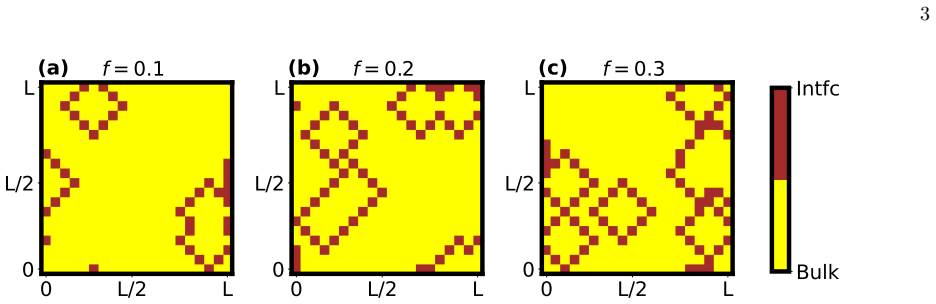
Recent experiments on metallic nanohybrids have revealed unusually strong electron-phonon effects emerging from nanoscale interfaces, despite the weak coupling character of the constituent bulk materials. Motivated by these observations, we investigate the electronic and lattice spectral properties of an inhomogeneous electron phonon system in which strong coupling is confined to interfacial regions embedded in a weakly coupled metallic background. Using a real-space formulation of the Holstein model combined with Langevin dynamics for lattice equilibration, we compute both electronic and phonon spectral functions in the presence of spatially varying coupling. We find that increasing the fraction of interfacial sites leads to a pronounced broadening of electronic spectral features, reflecting enhanced quasiparticle scattering from lattice distortions, but leaves the underlying band dispersion largely intact. Simultaneously, the phonon spectrum exhibits significant softening and damping, originating from strongly distorted interfacial regions. These modifications result in a redistribution of the Eliashberg spectral function toward low frequencies, producing a substantial enhancement of the effective electron-phonon coupling constant. Our results demonstrate that spatial inhomogeneity alone can strongly renormalize both electronic and lattice spectra, and provide a microscopic framework for understanding interface-driven transport and interaction effects in metallic nanohybrids.
Editorial analysis
A structured set of objections, weighed in public.
Referee Report
Summary. The manuscript investigates electron and phonon spectral properties in metallic nanohybrids by modeling an inhomogeneous Holstein system in which strong electron-phonon coupling is confined to interfacial regions embedded in a weakly coupled metallic background. A real-space formulation is solved with Langevin dynamics to equilibrate the lattice, yielding electronic spectral functions that broaden with increasing interfacial fraction while band dispersion remains largely intact, phonon spectra that soften and damp due to interfacial distortions, and a low-frequency redistribution of the Eliashberg function that enhances the effective coupling constant. The central claim is that spatial inhomogeneity alone produces these renormalizations and supplies a microscopic framework for interface-driven effects.
Significance. If the numerical results are robust, the work isolates spatial inhomogeneity as a sufficient driver for strong renormalization of both electronic and lattice spectra even when bulk constituents are weakly coupled, offering a concrete microscopic explanation for experimental observations in nanohybrids. The real-space Holstein plus Langevin approach is a natural choice for treating the inhomogeneous coupling landscape and produces falsifiable predictions for spectral broadening, phonon softening, and Eliashberg-function shifts that can be tested against interface-sensitive spectroscopies.
major comments (1)
- [Abstract and Methods] Abstract and computational-methods description: the phonon spectra, damping, and Eliashberg-function redistribution are obtained from classical Langevin dynamics for the lattice degrees of freedom. This classical treatment omits zero-point motion and quantum phonon fluctuations that are expected to be appreciable in the strongly coupled interfacial regions; restoring quantum statistics (e.g., via path-integral sampling of the same inhomogeneous coupling) can shift the reported softening, damping, and low-frequency weight quantitatively. Because the manuscript presents inhomogeneity as the sole driver of the renormalization, this approximation is load-bearing for the central claim and requires either explicit justification or a quantitative estimate of the quantum correction.
minor comments (2)
- [Abstract] The abstract states that the underlying band dispersion remains “largely intact,” but does not quantify the residual shift or broadening of the dispersion; a supplementary figure or table reporting the momentum-resolved peak positions versus interfacial fraction would strengthen this statement.
- [Introduction/Methods] Notation for the spatially varying coupling constant and the definition of the interfacial fraction should be introduced once in the main text with an explicit equation, rather than left implicit from the abstract.
Simulated Author's Rebuttal
We thank the referee for the careful reading of our manuscript and the constructive comments. We address the major point raised below and will incorporate revisions to strengthen the presentation of our results.
read point-by-point responses
-
Referee: [Abstract and Methods] Abstract and computational-methods description: the phonon spectra, damping, and Eliashberg-function redistribution are obtained from classical Langevin dynamics for the lattice degrees of freedom. This classical treatment omits zero-point motion and quantum phonon fluctuations that are expected to be appreciable in the strongly coupled interfacial regions; restoring quantum statistics (e.g., via path-integral sampling of the same inhomogeneous coupling) can shift the reported softening, damping, and low-frequency weight quantitatively. Because the manuscript presents inhomogeneity as the sole driver of the renormalization, this approximation is load-bearing for the central claim and requires either explicit justification or a quantitative estimate of the quantum correction.
Authors: We agree that the use of classical Langevin dynamics represents an approximation that neglects zero-point motion and quantum fluctuations, which can be significant in regions of strong electron-phonon coupling. This choice was made to enable the study of large inhomogeneous systems over extended timescales while isolating the effects of spatial variation in the coupling. We will revise the Methods section to explicitly discuss this limitation, including a justification that the classical treatment captures the essential qualitative physics of inhomogeneity-driven renormalization. Additionally, we will include a qualitative estimate of quantum corrections by referencing established results from the quantum Holstein model, noting that while quantitative shifts in phonon softening and Eliashberg weight may occur, the low-frequency redistribution and enhancement of the effective coupling due to interfacial inhomogeneity are expected to remain robust. These changes will clarify the scope of our claims without altering the central conclusion. revision: partial
Circularity Check
No significant circularity in numerical model solution
full rationale
The paper sets up an explicit real-space Holstein Hamiltonian with spatially varying coupling, equilibrates the lattice via classical Langevin dynamics, and extracts electronic and phonon spectral functions plus the Eliashberg function from the resulting configurations. All reported renormalizations (broadening, softening, low-frequency redistribution, enhanced lambda) are direct numerical outputs for varying interfacial fractions rather than quantities defined in terms of themselves, fitted parameters renamed as predictions, or results imported solely via self-citation. The central claim that inhomogeneity alone drives the effects follows from the model definition and simulation protocol without reduction to tautology.
Axiom & Free-Parameter Ledger
axioms (1)
- domain assumption The Holstein model with spatially varying coupling strength is sufficient to capture the essential electron-phonon physics at metallic interfaces.
Lean theorems connected to this paper
-
IndisputableMonolith/Cost/FunctionalEquation.leanwashburn_uniqueness_aczel unclear?
unclearRelation between the paper passage and the cited Recognition theorem.
Using a real-space formulation of the Holstein model combined with Langevin dynamics for lattice equilibration, we compute both electronic and phonon spectral functions in the presence of spatially varying coupling.
What do these tags mean?
- matches
- The paper's claim is directly supported by a theorem in the formal canon.
- supports
- The theorem supports part of the paper's argument, but the paper may add assumptions or extra steps.
- extends
- The paper goes beyond the formal theorem; the theorem is a base layer rather than the whole result.
- uses
- The paper appears to rely on the theorem as machinery.
- contradicts
- The paper's claim conflicts with a theorem or certificate in the canon.
- unclear
- Pith found a possible connection, but the passage is too broad, indirect, or ambiguous to say the theorem truly supports the claim.
Forward citations
Cited by 1 Pith paper
-
Apparent Planckian scattering from local polaron formation
Local polaron formation in the disordered Holstein model generates apparent Planckian scattering Γ_tr = Γ0 + α k_B T / ℏ with α ~ O(1) from quasielastic scattering, as evidenced by Monte Carlo simulations.
Reference graph
Works this paper leans on
-
[1]
Microscopically, this behavior originates from lattice distortions induced by strong electron–phonon coupling at the interface
etc. Microscopically, this behavior originates from lattice distortions induced by strong electron–phonon coupling at the interface. These distortions act as an effective, spatially fluctuating potential for the electrons. In this sense, the system realizes a form ofself-generated dis- order, where the scattering landscape is not externally imposed but ar...
2025
-
[2]
T. K. Maji, S. Kumbhakar, B. Tongbram, T. P. Sai, S. Is- lam, P. S. Mahapatra, A. Pandey, and A. Ghosh, ACS Applied Electronic Materials5, 2893 (2023)
2023
-
[3]
Kumbhakar, T
S. Kumbhakar, T. K. Maji, B. Tongbram, S. Mandal, S. H. Soundararaj, B. Debnath, T. P. Sai, M. Jain, H. R. Krishnamurthy, A. Pandey, and A. Ghosh, Nature Com- munications16, 61 (2025)
2025
-
[4]
Kumbhakar, B
S. Kumbhakar, B. Debnath, T. K. Maji, B. Tongbram, S. Mandal, T. P. Sai, T. V. Ramakrishnan, M. Jain, H. R. Krishnamurthy, A. Pandey, and A. Ghosh, Science Ad- vances11, eadz1680 (2025)
2025
-
[5]
J. M. Ziman,Electrons and Phonons(Oxford University Press, 1960). 11
1960
-
[6]
P. B. Allen, inContemporary Concepts of Condensed Matter Science, Vol. 2 (Elsevier, 2006) pp. 165–218
2006
-
[7]
P. B. Allen, inHandbook of Superconductivity, edited by C. P. P. Jr. (Academic Press, 2000)
2000
-
[8]
D. Bose, S. S. Bakshi, and P. Majumdar, arXiv 10.48550/arXiv.2408.12542 (2024), 2408.12542
-
[9]
Sergeev and V
A. Sergeev and V. Mitin, Physical Review B61, 6041 (2000)
2000
-
[10]
Bronold, A
F. Bronold, A. Saxena, and A. Bishop, Physical Review B63, 235109 (2001)
2001
-
[11]
Capone and S
M. Capone and S. Ciuchi, Physical Review Letters91, 186405 (2003)
2003
-
[12]
Xiaoet al., Physical Review B103, L060501 (2021)
B. Xiaoet al., Physical Review B103, L060501 (2021)
2021
-
[13]
Ciuchi, F
S. Ciuchi, F. de Pasquale, S. Fratini, and D. Feinberg, Physical Review B56, 4494 (1997)
1997
-
[14]
Di Sante and S
D. Di Sante and S. Ciuchi, Physical Review B90, 075111 (2014)
2014
-
[15]
Stolpp, J
J. Stolpp, J. Herbrych, F. Dorfner, E. Dagotto, and F. Heidrich-Meisner, Physical Review B101, 035134 (2020)
2020
-
[16]
O. R. Tozer and W. Barford, Physical Review B89, 155434 (2014)
2014
-
[17]
Aperis and P
A. Aperis and P. M. Oppeneer, Physical Review B97, 060501 (2018)
2018
-
[18]
A. V. Chubukovet al., Annals of Physics417, 168190 (2020)
2020
-
[19]
Mandalet al., Physical Review B111, 184507 (2025)
S. Mandalet al., Physical Review B111, 184507 (2025)
2025
-
[20]
Jansen and F
D. Jansen and F. Heidrich-Meisner, Physical Review B 108, L081114 (2023)
2023
-
[21]
T. Ying, Y. Xu, and H. Guo, Physical Review B110, 205145 (2024)
2024
-
[22]
Nosarzewskiet al., Physical Review B103, 235156 (2021)
B. Nosarzewskiet al., Physical Review B103, 235156 (2021)
2021
-
[23]
Emin and M.-N
D. Emin and M.-N. Bussac, Physical Review B49, 14290 (1994)
1994
-
[24]
Kumar and P
S. Kumar and P. Majumdar, Physical Review Letters94, 136601 (2005)
2005
-
[25]
J.-T. Lü, M. Brandbyge, P. Hedegard, T. N. Todorov, and D. Dundas, Physical Review B85, 245444 (2012)
2012
-
[26]
Bhattacharyyaet al., Physical Review B99, 165150 (2019)
S. Bhattacharyyaet al., Physical Review B99, 165150 (2019)
2019
-
[27]
Bhattacharyyaet al., Physical Review B101, 125130 (2020)
S. Bhattacharyyaet al., Physical Review B101, 125130 (2020)
2020
-
[28]
J.K.Freerickset al.,PhysicalReviewB58,11621(1998)
1998
-
[29]
Esterliset al., Physical Review B97, 140501 (2018)
I. Esterliset al., Physical Review B97, 140501 (2018)
2018
-
[30]
Heid,The Physics of Correlated Insulators, Metals, and Superconductors, edited by E
R. Heid,The Physics of Correlated Insulators, Metals, and Superconductors, edited by E. Pavarini, E. Koch, R. Scalettar, and R. Martin (Forschungszentrum Jülich, 2017)
2017
-
[31]
Bergmann, Physical Review B3, 3797 (1971)
G. Bergmann, Physical Review B3, 3797 (1971)
1971
-
[32]
Takayama, J
H. Takayama, J. Phys. Colloq.35, C4 (1974)
1974
-
[33]
Devereaux, D
I.Esterlis, B.Nosarzewski, E.W.Huang, B.Moritz, T.P. Devereaux, D. J. Scalapino, and S. A. Kivelson, Physical Review B97, 140501 (2018)
2018
-
[34]
Y. G. Naidyuk and I. K. Yanson,Point-contact spec- troscopy, Vol. 145 (Springer, 2019)
2019
-
[35]
Baggioliet al., Physical Review B101, 214502 (2020)
M. Baggioliet al., Physical Review B101, 214502 (2020)
2020
-
[36]
Marsiglio and J
F. Marsiglio and J. P. Carbotte, inThe Physics of Conventional and Unconventional Superconductors (Springer, 2003)
2003
-
[37]
G. A. C. Ummarino, inEmergent Phenomena in Corre- lated Matter(Forschungszentrum Jülich, 2013)
2013
-
[38]
Wellein and H
G. Wellein and H. Fehske, Physical Review B56, 4513 (1997)
1997
-
[39]
Hengsberger, D
M. Hengsberger, D. Purdie, P. Segovia, M. Garnier, and Y. Baer, Physical review letters83, 592 (1999)
1999
-
[40]
D. J. Scalapino, inSuperconductivity(CRC Press, 2018) pp. 449–560
2018
-
[41]
Z. Li, D. Baillie, C. Blois, and F. Marsiglio, Physical Review B81, 115114 (2010)
2010
-
[42]
B. L. Altshuler and A. G. Aronov, Zh. Eksp. Teor. Fiz 77, 2028 (1979)
2028
-
[43]
K. B. Efetov, Advances in Physics32, 53 (1983)
1983
-
[44]
J. Ahn, J. Byun, W. Choi, H. Yeom, H. Jeong, and S. Jeong, Physical Review B—Condensed Matter and Materials Physics70, 113304 (2004)
2004
-
[45]
C. Liu, I. Matsuda, M. D’Angelo, S. Hasegawa, J. Ok- abayashi, S. Toyoda, and M. Oshima, Physical Review B 74, 235420 (2006)
2006
-
[46]
Nandakumar, C
P. Nandakumar, C. Vijayan, M. Rajalakshmi, A. K. Arora, and Y. Murti, Physica E: Low-dimensional Sys- tems and Nanostructures11, 377 (2001)
2001
-
[47]
K. K. Ramankutty, H. Yang, A. Baghdasaryan, J. Teyssier, V. P. Nicu, and T. Buergi, Physical Chem- istry Chemical Physics24, 13848 (2022)
2022
-
[48]
A. B. Migdal, Sov. Phys. JETP7, 996 (1958)
1958
-
[49]
G. M. Eliashberg, Sov. Phys. JETP11, 696 (1960)
1960
-
[50]
Alexandrov, EPL (Europhysics Letters)56, 92 (2001)
A. Alexandrov, EPL (Europhysics Letters)56, 92 (2001)
2001
-
[51]
Bauer, J
J. Bauer, J. E. Han, and O. Gunnarsson, Physical Review B—Condensed Matter and Materials Physics84, 184531 (2011)
2011
-
[52]
Grimaldi, L
C. Grimaldi, L. Pietronero, and S. Strässler, Physical Re- view Letters75, 1158 (1995)
1995
-
[53]
Landauer, Journal of Applied Physics23, 779 (1952)
R. Landauer, Journal of Applied Physics23, 779 (1952)
1952
-
[54]
Kirkpatrick, Reviews of Modern Physics45, 574 (1973)
S. Kirkpatrick, Reviews of Modern Physics45, 574 (1973)
1973
-
[55]
E. N. Economou,Green ’s Functions in Quantum Physics (Springer, 2006)
2006
-
[56]
Dobrosavljević,Conductor-Insulator Quantum Phase Transitions(Oxford University Press, 2012)
V. Dobrosavljević,Conductor-Insulator Quantum Phase Transitions(Oxford University Press, 2012)
2012
-
[57]
S. Yu, J. Zhang, Y. Tang, and M. Ouyang, Nano letters 15, 6282 (2015)
2015
-
[58]
Capone, W
M. Capone, W. Stephan, and M. Grilli, Physical Review B56, 4484 (1997)
1997
discussion (0)
Sign in with ORCID, Apple, or X to comment. Anyone can read and Pith papers without signing in.