Recognition: unknown
Apparent Planckian scattering from local polaron formation
Pith reviewed 2026-05-08 13:50 UTC · model grok-4.3
The pith
Local polaron formation in systems with disordered electron-phonon coupling generates an apparent Planckian scattering rate where the temperature-dependent slope remains constant without fine tuning.
A machine-rendered reading of the paper's core claim, the machinery that carries it, and where it could break.
Core claim
The central claim is that a simple mechanism based on local polaron formation accounts for apparent Planckian scattering. In this picture, the transport scattering rate follows Γ_tr = Γ0 + α k_B T / ℏ with α of order one, arising from quasielastic processes without any parameter fine-tuning. Monte Carlo simulations of the adiabatic Holstein model with disordered electron-phonon coupling demonstrate this behavior, with the constant slope α appearing over a range of couplings that coincides with the start of local polaron formation. Notably, in this regime changes to the coupling strength affect the constant term Γ0 rather than the slope, consistent with a modified form of Matthiessen's rule.
What carries the argument
The key mechanism is local polaron formation triggered by disordered electron-phonon coupling, which enforces quasielastic scattering and thereby fixes the temperature slope of the transport scattering rate.
Load-bearing premise
The mechanism has been shown only in the adiabatic limit of the Holstein model with disordered couplings, so its applicability to real materials or non-adiabatic cases is not yet established.
What would settle it
Finding that the linear slope varies with coupling strength in the polaron-forming regime, or that no such constant-slope window exists in the simulations, would disprove the central proposal.
Figures




read the original abstract
We propose a simple mechanism for apparent Planckian scattering based on local polaron formation, in which $\Gamma_\text{tr} = \Gamma_0 + \alpha k_BT / \hbar$ with $\alpha \sim O(1)$ emerges from quasielastic scattering without fine tuning. We provide evidence for our proposal in Monte Carlo simulations of the Holstein model with disordered electron-phonon coupling in the adiabatic limit. Our mechanism generates a finite interval of couplings in which the slope $\alpha$ is approximately constant, coinciding with the onset of local polaron formation. In this regime, Matthiessen's rule is dramatically violated (or obeyed, depending on one's point of view) in that changes to the couplings, which in perturbation theory would alter the slope $\alpha$, instead change the intercept $\Gamma_0$. We conjecture that a version of our mechanism applies to any system with a dominant disordered interaction that can drive polaron formation. This potentially includes regimes of the recently introduced disordered-Yukawa-coupling strange metal models where polaron formation is not suppressed.
Editorial analysis
A structured set of objections, weighed in public.
Referee Report
Summary. The paper proposes a mechanism for apparent Planckian scattering arising from local polaron formation in the adiabatic Holstein model with disordered electron-phonon coupling. Monte Carlo simulations are used to show that the transport scattering rate takes the form Γ_tr = Γ0 + α k_B T / ℏ with α ∼ O(1) emerging naturally from quasielastic scattering over a finite range of couplings near the onset of polaron formation. In this regime, variations in coupling strength affect only the intercept Γ0 rather than the slope α, which the authors interpret as a dramatic violation (or alternative obedience) of Matthiessen's rule. The authors conjecture that analogous physics may apply more broadly to systems dominated by disordered interactions capable of driving polaron formation, including certain disordered-Yukawa strange-metal models.
Significance. If the numerical results are robust, the work is significant because it supplies a concrete, untuned microscopic mechanism that produces linear-in-T scattering rates of Planckian magnitude from standard electron-phonon physics. The demonstration that α remains approximately constant while coupling changes only shift Γ0, together with the use of unbiased Monte Carlo sampling in a well-controlled model, provides falsifiable evidence that distinguishes the proposal from fine-tuned or phenomenological explanations. The explicit labeling of the broader conjecture as such is also a strength.
major comments (2)
- [Monte Carlo simulations and results] The central claim that α is approximately constant over a finite interval of couplings rests on Monte Carlo data whose extraction of Γ_tr is not accompanied by quantitative fit parameters, statistical uncertainties, or checks for finite-size and disorder-averaging convergence. Without these, it is not possible to assess whether the reported constancy of α is robust or sensitive to analysis choices.
- [Model and adiabatic limit] The adiabatic limit is used throughout the simulations, yet the transport scattering rate Γ_tr is extracted from a quasielastic scattering picture whose validity in the adiabatic regime requires explicit justification (e.g., via comparison to the non-adiabatic case or to the phonon frequency scale). This assumption is load-bearing for the claim that the mechanism produces Planckian scattering without fine tuning.
minor comments (2)
- [Introduction] The notation for the transport scattering rate Γ_tr should be defined explicitly in the main text (rather than only in the abstract) and distinguished from the single-particle scattering rate.
- [Figures] Figure captions should include the number of disorder realizations, system sizes, and temperature ranges used for each data set to allow readers to evaluate the statistical quality of the reported α values.
Simulated Author's Rebuttal
We thank the referee for their careful reading, positive assessment of the work's significance, and constructive comments. We address each major point below and have revised the manuscript accordingly to strengthen the presentation of the Monte Carlo analysis and the justification of the adiabatic approximation.
read point-by-point responses
-
Referee: The central claim that α is approximately constant over a finite interval of couplings rests on Monte Carlo data whose extraction of Γ_tr is not accompanied by quantitative fit parameters, statistical uncertainties, or checks for finite-size and disorder-averaging convergence. Without these, it is not possible to assess whether the reported constancy of α is robust or sensitive to analysis choices.
Authors: We agree that quantitative fit parameters, uncertainties, and convergence checks are necessary for robustness. In the revised manuscript we now include explicit least-squares fit results for Γ_tr = Γ0 + α k_B T / ℏ, reporting the extracted values of α and Γ0 together with their statistical uncertainties for each coupling strength. We have added data for multiple system sizes (L = 8, 12, 16) and increased the number of independent disorder realizations to demonstrate that both the intercept and the slope remain stable within error bars over the reported interval of couplings near the polaron onset. revision: yes
-
Referee: The adiabatic limit is used throughout the simulations, yet the transport scattering rate Γ_tr is extracted from a quasielastic scattering picture whose validity in the adiabatic regime requires explicit justification (e.g., via comparison to the non-adiabatic case or to the phonon frequency scale). This assumption is load-bearing for the claim that the mechanism produces Planckian scattering without fine tuning.
Authors: We have added a new subsection justifying the quasielastic picture in the adiabatic limit. In this regime the phonon frequency ω0 is much smaller than the electronic hopping, so lattice distortions evolve slowly and act as essentially static disorder for the electrons; scattering is therefore quasielastic provided T ≫ ω0. We explicitly relate the linear-in-T window to the phonon energy scale and note that the Planckian slope emerges from the thermal population of these distortions. While full non-adiabatic simulations lie outside the present study, the added discussion shows consistency with known adiabatic polaron transport results and clarifies why the mechanism does not require fine tuning of the adiabaticity parameter. revision: yes
Circularity Check
No significant circularity; central claim rests on independent Monte Carlo evidence
full rationale
The paper's derivation consists of proposing a mechanism for apparent Planckian scattering via local polaron formation in the adiabatic Holstein model with disordered electron-phonon coupling, then demonstrating via Monte Carlo simulations that a regime exists where the transport scattering rate slope α is approximately constant (O(1)) without fine-tuning, coinciding with polaron onset and violating Matthiessen's rule in a specific way. No equations reduce the output slope to a fitted input by construction, no self-citations form load-bearing uniqueness theorems or ansatzes, and the conjecture for broader applicability is explicitly labeled as such rather than used to justify the core result. The numerical evidence from a standard model is independent of the claim itself.
Axiom & Free-Parameter Ledger
axioms (1)
- domain assumption The Holstein model with disordered electron-phonon coupling in the adiabatic limit is an appropriate minimal model for studying polaron formation and transport.
Reference graph
Works this paper leans on
-
[1]
J. A. N. Bruin, H. Sakai, R. S. Perry, and A. P. Macken- zie, Similarity of Scattering Rates in Metals Showing T- Linear Resistivity, Science339, 804 (2013)
2013
-
[2]
Legros, S
A. Legros, S. Benhabib, W. Tabis, F. Lalibert´ e, M. Dion, M. Lizaire, B. Vignolle, D. Vignolles, H. Raffy, Z. Z. Li, P. Auban-Senzier, N. Doiron-Leyraud, P. Fournier, D. Colson, L. Taillefer, and C. Proust, Universal T- linear resistivity and Planckian dissipation in overdoped cuprates, Nat. Phys.15, 142 (2019)
2019
-
[3]
Licciardello, J
S. Licciardello, J. Buhot, J. Lu, J. Ayres, S. Kasahara, Y. Matsuda, T. Shibauchi, and N. E. Hussey, Electrical resistivity across a nematic quantum critical point, Na- ture567, 213 (2019)
2019
-
[4]
Y. Cao, D. Chowdhury, D. Rodan-Legrain, O. Rubies- Bigorda, K. Watanabe, T. Taniguchi, T. Senthil, and P. Jarillo-Herrero, Strange Metal in Magic-Angle Graphene with near Planckian Dissipation, Phys. Rev. Lett.124, 076801 (2020)
2020
-
[5]
Grissonnanche, Y
G. Grissonnanche, Y. Fang, A. Legros, S. Verret, F. Lal- ibert´ e, C. Collignon, J. Zhou, D. Graf, P. A. Goddard, L. Taillefer, and B. J. Ramshaw, Linear-in temperature resistivity from an isotropic Planckian scattering rate, Nature595, 667 (2021)
2021
-
[6]
Jaoui, I
A. Jaoui, I. Das, G. Di Battista, J. D´ ıez-M´ erida, X. Lu, K. Watanabe, T. Taniguchi, H. Ishizuka, L. Levitov, and D. K. Efetov, Quantum critical behaviour in magic-angle twisted bilayer graphene, Nat. Phys.18, 633 (2022)
2022
-
[7]
K. Lee, B. Y. Wang, M. Osada, B. H. Goodge, T. C. Wang, Y. Lee, S. Harvey, W. J. Kim, Y. Yu, C. Murthy, S. Raghu, L. F. Kourkoutis, and H. Y. Hwang, Linear- in-temperature resistivity for optimally superconducting (Nd,Sr)NiO2, Nature619, 288 (2023)
2023
-
[8]
Zhakina, R
E. Zhakina, R. Daou, A. Maignan, P. H. McGuinness, M. K¨ onig, H. Rosner, S.-J. Kim, S. Khim, R. Gras- set, M. Konczykowski, E. Tulipman, J. F. Mendez- Valderrama, D. Chowdhury, E. Berg, and A. P. Macken- zie, Investigation of Planckian behavior in a high- conductivity oxide: PdCrO2, Proc. Natl. Acad. Sci. U.S.A.120, e2307334120 (2023)
2023
-
[9]
Zaanen, Why the temperature is high, Nature430, 512 (2004)
J. Zaanen, Why the temperature is high, Nature430, 512 (2004)
2004
-
[10]
S. A. Hartnoll and A. P. Mackenzie, Colloquium: Planck- ian dissipation in metals, Rev. Mod. Phys.94, 041002 (2022)
2022
-
[11]
P. W. Phillips, N. E. Hussey, and P. Abbamonte, Stranger than metals, Science377, eabh4273 (2022)
2022
-
[12]
S. A. Hartnoll, Theory of universal incoherent metallic transport, Nat. Phys.11, 54 (2015)
2015
-
[13]
A. A. Patel, H. Guo, I. Esterlis, and S. Sachdev, Uni- versal theory of strange metals from spatially random interactions, Science381, 790 (2023)
2023
-
[14]
Fratini, Minimal Theory of Strange Carriers, Phys
S. Fratini, Minimal Theory of Strange Carriers, Phys. Rev. Lett.136, 086301 (2026)
2026
-
[15]
Chowdhury, Information, Dissipation, and Planckian Optimality (2026), arXiv:2602.04953 [cond-mat]
D. Chowdhury, Information, Dissipation, and Planckian Optimality (2026), arXiv:2602.04953 [cond-mat]
-
[16]
Murthy, A
C. Murthy, A. Pandey, I. Esterlis, and S. A. Kivelson, A stability bound on the T-linear resistivity of conventional metals, Proc. Natl. Acad. Sci. U.S.A.120, e2216241120 (2023)
2023
-
[17]
Esterlis, B
I. Esterlis, B. Nosarzewski, E. W. Huang, B. Moritz, T. P. Devereaux, D. J. Scalapino, and S. A. Kivelson, Break- down of the Migdal-Eliashberg theory: A determinant quantum Monte Carlo study, Phys. Rev. B97, 140501 (2018)
2018
-
[18]
Breakdown of the Migdal-Eliashberg theory for electron-phonon systems. Role of polarons/bi-polarons
A. Chubukov, I. Esterlis, A. Abanov, and N. Prokof’ev, Breakdown of the Migdal-Eliashberg theory for electron- phonon systems. Role of polarons/bi-polarons (2026), arXiv:2604.14294 [cond-mat]
work page internal anchor Pith review Pith/arXiv arXiv 2026
-
[19]
Limits of validity for Migdal-Eliashberg theory: role of polarons/bi-polarons
N. Prokof’ev, I. Esterlis, A. Abanov, and A. Chubukov, Limits of validity for Migdal-Eliashberg theory: role of polarons/bi-polarons (2026), arXiv:2604.14293 [cond- mat]
work page internal anchor Pith review Pith/arXiv arXiv 2026
-
[20]
A. A. Patel, P. Lunts, and M. S. Albergo, Strange Met- als and Planckian Transport in a Gapless Phase from Spatially Random Interactions, Phys. Rev. X15, 031064 (2025)
2025
-
[21]
Hardy, O
A. Hardy, O. Parcollet, A. Georges, and A. A. Patel, En- hanced Strange Metallicity due to Hubbard-U Coulomb Repulsion, Phys. Rev. Lett.134, 036502 (2025)
2025
-
[22]
E. E. Aldape, T. Cookmeyer, A. A. Patel, and E. Altman, Solvable theory of a strange metal at the breakdown of a heavy Fermi liquid, Phys. Rev. B105, 235111 (2022)
2022
-
[23]
D. Bose, S. Sarkar, and P. Majumdar, Electron and phonon spectrum in a metallic nanohybrid (2026), arXiv:2604.04885 [cond-mat]
work page internal anchor Pith review Pith/arXiv arXiv 2026
-
[24]
J. Meng, Y. Zhang, R. M. Fernandes, T. Ma, and R. T. Scalettar, Supersolid phase in the diluted Holstein model, 7 Phys. Rev. B110, L220506 (2024)
2024
-
[25]
Fratini, D
S. Fratini, D. Mayou, and S. Ciuchi, The Transient Lo- calization Scenario for Charge Transport in Crystalline Organic Materials, Adv. Func. Mat.26, 2292 (2016)
2016
-
[26]
Esterlis, S
I. Esterlis, S. A. Kivelson, and D. J. Scalapino, Pseudo- gap crossover in the electron-phonon system, Phys. Rev. B99, 174516 (2019)
2019
-
[27]
A. J. Millis, R. Mueller, and B. I. Shraiman, Fermi-liquid- to-polaron crossover. I. General results, Phys. Rev. B54, 5389 (1996)
1996
-
[28]
Ciuchi and F
S. Ciuchi and F. de Pasquale, Charge-ordered state from weak to strong coupling, Phys. Rev. B59, 5431 (1999)
1999
-
[29]
Rullier-Albenque, H
F. Rullier-Albenque, H. Alloul, and R. Tourbot, Influence of Pair Breaking and Phase Fluctuations on Disordered High Tc Cuprate Superconductors, Phys. Rev. Lett.91, 047001 (2003)
2003
-
[30]
Ranna, R
A. Ranna, R. Grasset, M. Gonzalez, K. Lee, B. Y. Wang, E. Abarca Morales, F. Theuss, Z. H. Filipiak, M. Moravec, M. Konczykowski, H. Y. Hwang, A. P. Mackenzie, and B. H. Goodge, Disorder-Induced Sup- pression of Superconductivity in Infinite-Layer Nicke- lates, Phys. Rev. Lett.135, 126501 (2025)
2025
-
[31]
Martinez and P
G. Martinez and P. Horsch, Spin polarons in the t-J model, Phys. Rev. B44, 317 (1991)
1991
-
[32]
Ba la, A
J. Ba la, A. M. Ole´ s, and J. Zaanen, Spin polarons in the t-t’-J model, Phys. Rev. B52, 4597 (1995)
1995
-
[33]
Fratini and S
S. Fratini and S. Ciuchi, Displaced Drude peak and bad metal from the interaction with slow fluctuations., Sci- Post Physics11, 039 (2021)
2021
-
[34]
N. V. Smith, Classical generalization of the Drude for- mula for the optical conductivity, Phys. Rev. B64, 155106 (2001)
2001
-
[35]
scouting
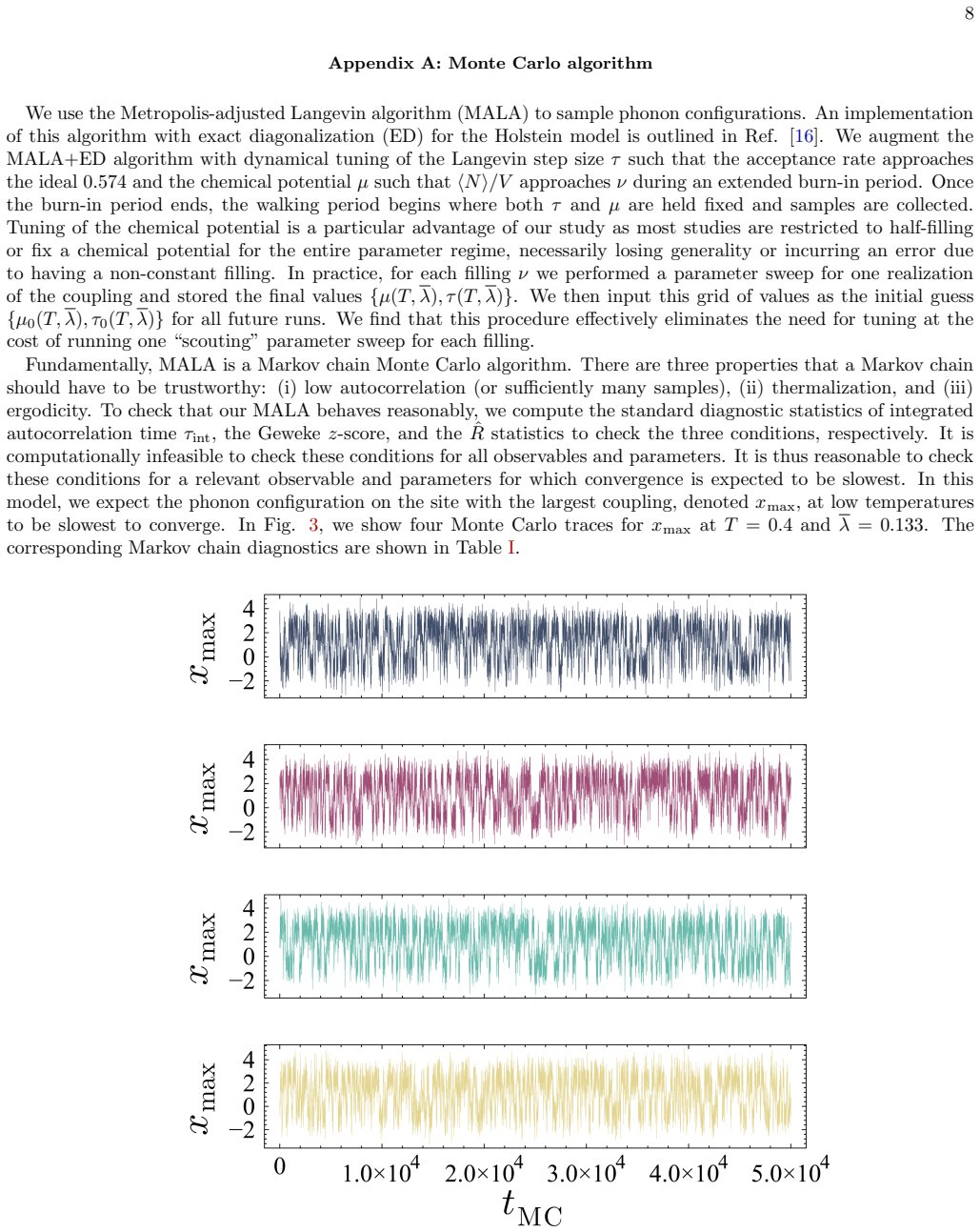
T. L. Cocker, D. Baillie, M. Buruma, L. V. Titova, R. D. Sydora, F. Marsiglio, and F. A. Hegmann, Mi- croscopic origin of the Drude-Smith model, Phys. Rev. B 96, 205439 (2017). 8 Appendix A: Monte Carlo algorithm We use the Metropolis-adjusted Langevin algorithm (MALA) to sample phonon configurations. An implementation of this algorithm with exact diagona...
2017
-
[36]
Nodal/antinodal energy distribution curves We compute the spectral functionA(k, ω) evaluated near the nodal and antinodalk-points of the bare tight- binding Hamiltonian. Then, we fit the resulting energy distribution curveA(ω) to the usual form of the on-shell spectral function near the (remains of the) Fermi surface A(ω) =− Za π ZaImΣR(0) ω2 + [ZaImΣR(0)...
-
[37]
Then, we extract Γtr =D/σ DC whereσ DC =σ α(0)
Drude weight We compute Drude weight of the bare tight-binding Hamiltonian by the optical sum ruleD α =⟨τ α⟩0/Vwhere ⟨τ α⟩0 is the expectation value of the diamagnetic stress tensor with respect to the bare equilibrium state. Then, we extract Γtr =D/σ DC whereσ DC =σ α(0)
-
[38]
As shown in Fig
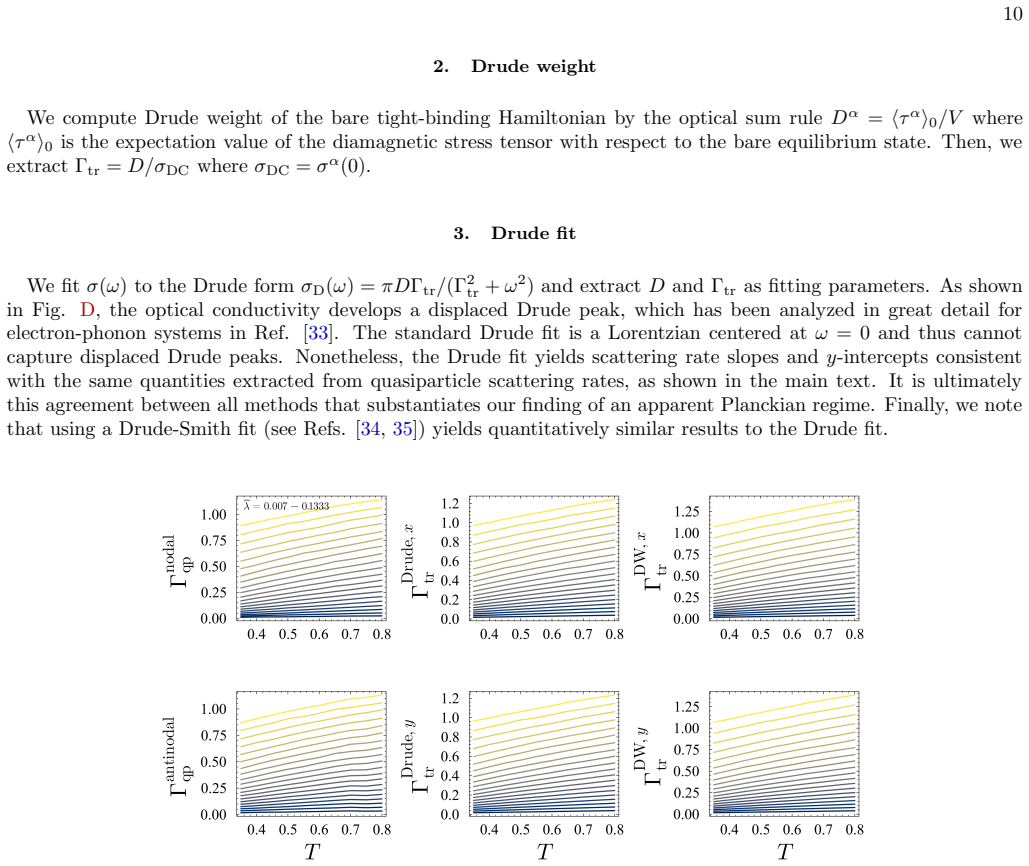
Drude fit We fitσ(ω) to the Drude formσ D(ω) =πDΓ tr/(Γ2 tr +ω 2) and extractDand Γ tr as fitting parameters. As shown in Fig. D, the optical conductivity develops a displaced Drude peak, which has been analyzed in great detail for electron-phonon systems in Ref. [33]. The standard Drude fit is a Lorentzian centered atω= 0 and thus cannot capture displace...
discussion (0)
Sign in with ORCID, Apple, or X to comment. Anyone can read and Pith papers without signing in.