Recognition: no theorem link
Agentic Federated Learning: The Future of Distributed Training Orchestration
Pith reviewed 2026-05-10 18:41 UTC · model grok-4.3
The pith
Language model agents autonomously orchestrate federated learning to adapt to client variability and reduce bias.
A machine-rendered reading of the paper's core claim, the machinery that carries it, and where it could break.
Core claim
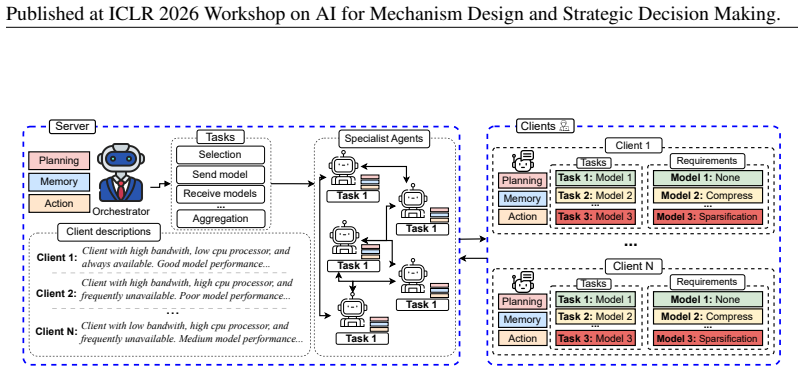
We propose a paradigm shift towards Agentic-FL, a framework where Language Model-based Agents (LMagents) assume autonomous orchestration roles. Unlike rigid protocols, server-side agents can mitigate selection bias through contextual reasoning, while client-side agents act as local guardians, dynamically managing privacy budgets and adapting model complexity to hardware constraints. This integration signals the evolution of FL towards decentralized ecosystems, where collaboration is negotiated autonomously, paving the way for future markets of incentive-based models and algorithmic justice.
What carries the argument
Language Model-based Agents (LMagents) that autonomously handle client selection, privacy budget management, and model adaptation inside federated learning.
Load-bearing premise
Language model agents can reliably perform contextual reasoning for client selection and privacy management without introducing hallucinations, security vulnerabilities, or new biases that outweigh the benefits of static protocols.
What would settle it
A side-by-side test on a heterogeneous client dataset in which the agent-driven version produces equal or greater selection bias and no improvement in convergence or resource use compared with standard federated averaging.
Figures


read the original abstract
Although Federated Learning (FL) promises privacy and distributed collaboration, its effectiveness in real-world scenarios is often hampered by the stochastic heterogeneity of clients and unpredictable system dynamics. Existing static optimization approaches fail to adapt to these fluctuations, resulting in resource underutilization and systemic bias. In this work, we propose a paradigm shift towards Agentic-FL, a framework where Language Model-based Agents (LMagents) assume autonomous orchestration roles. Unlike rigid protocols, we demonstrate how server-side agents can mitigate selection bias through contextual reasoning, while client-side agents act as local guardians, dynamically managing privacy budgets and adapting model complexity to hardware constraints. More than just resolving technical inefficiencies, this integration signals the evolution of FL towards decentralized ecosystems, where collaboration is negotiated autonomously, paving the way for future markets of incentive-based models and algorithmic justice. We discuss the reliability (hallucinations) and security challenges of this approach, outlining a roadmap for resilient multi-agent systems in federated environments.
Editorial analysis
A structured set of objections, weighed in public.
Referee Report
Summary. The paper proposes Agentic Federated Learning (Agentic-FL), a paradigm in which language model-based agents autonomously orchestrate federated learning. Server-side agents are claimed to mitigate selection bias via contextual reasoning, while client-side agents dynamically manage privacy budgets and adapt model complexity to hardware constraints. The work discusses benefits for handling client heterogeneity and system dynamics, acknowledges risks such as hallucinations and security issues, and outlines a roadmap for future multi-agent FL systems.
Significance. If realized with reliable agents, the framework could shift FL from static protocols to adaptive, negotiated collaboration, potentially improving fairness, efficiency, and privacy in heterogeneous environments and enabling incentive-based ecosystems. The conceptual integration of LM agents into FL orchestration is a novel direction, but the absence of any mechanisms, algorithms, or evaluations means the significance remains speculative at present.
major comments (3)
- [Abstract] Abstract: The claim that 'we demonstrate how server-side agents can mitigate selection bias through contextual reasoning' is unsupported, as the manuscript contains no algorithms, decision procedures, prompts, or results showing such mitigation occurs or outperforms static selection methods.
- [Main proposal] Main proposal: No formalization of the Agentic-FL framework is provided, including how LM agents would implement contextual reasoning for client selection, privacy budget management, or model adaptation; without these, the assertions about resolving heterogeneity and bias cannot be evaluated or reproduced.
- [Discussion section] Discussion section: The acknowledgment of hallucinations and security vulnerabilities as challenges does not include any proposed mitigation mechanisms, fallback protocols, or analysis of whether these risks would negate the claimed benefits over existing FL approaches.
minor comments (1)
- The manuscript would benefit from explicit definitions of terms such as 'contextual reasoning' and 'algorithmic justice' as used in the FL setting.
Simulated Author's Rebuttal
We thank the referee for their constructive and detailed review of our manuscript. We acknowledge that the paper is a conceptual position piece proposing a new paradigm rather than providing implemented algorithms or empirical evaluations. Below we address each major comment directly and indicate the revisions we will make to the next version of the manuscript.
read point-by-point responses
-
Referee: [Abstract] Abstract: The claim that 'we demonstrate how server-side agents can mitigate selection bias through contextual reasoning' is unsupported, as the manuscript contains no algorithms, decision procedures, prompts, or results showing such mitigation occurs or outperforms static selection methods.
Authors: We agree that the wording 'we demonstrate' overstates the contribution, as the manuscript offers only a high-level conceptual discussion without specific algorithms, prompts, or empirical results. The original intent was to describe a potential mechanism rather than claim verified performance. In the revised manuscript we will change the abstract to read 'we propose how server-side agents could mitigate selection bias through contextual reasoning' and will add an explicit statement that the discussion is speculative and intended to motivate future research. revision: yes
-
Referee: [Main proposal] Main proposal: No formalization of the Agentic-FL framework is provided, including how LM agents would implement contextual reasoning for client selection, privacy budget management, or model adaptation; without these, the assertions about resolving heterogeneity and bias cannot be evaluated or reproduced.
Authors: The manuscript is framed as a paradigm-level proposal and future roadmap rather than a fully specified algorithmic framework. We accept that the absence of formalization limits evaluability. In the revision we will add a new subsection containing high-level pseudocode and narrative descriptions of how server- and client-side agents could perform contextual client selection, privacy-budget negotiation, and model-complexity adaptation, while clearly stating that these are illustrative sketches and that concrete implementations remain future work. revision: partial
-
Referee: [Discussion section] Discussion section: The acknowledgment of hallucinations and security vulnerabilities as challenges does not include any proposed mitigation mechanisms, fallback protocols, or analysis of whether these risks would negate the claimed benefits over existing FL approaches.
Authors: We appreciate this observation. The current discussion lists the risks but does not analyze their severity relative to benefits or suggest concrete mitigations. We will expand the section to include (1) high-level mitigation approaches such as prompt verification, multi-agent consensus checks, and human oversight for high-stakes decisions, (2) fallback protocols that revert to static FL methods when agent reliability falls below a threshold, and (3) a qualitative comparison of net benefit versus risk in heterogeneous environments. These additions will be presented as initial directions rather than complete solutions. revision: yes
Circularity Check
No significant circularity; conceptual proposal with no derivations or reductions
full rationale
The paper is a high-level conceptual proposal for Agentic-FL without any equations, derivations, fitted parameters, or mathematical chains. No load-bearing steps reduce to inputs by construction, self-citation, or ansatz smuggling. Claims rest on forward-looking descriptions of agent roles rather than self-referential logic, making the work self-contained as a paradigm suggestion.
Axiom & Free-Parameter Ledger
axioms (1)
- domain assumption Language model agents can perform reliable contextual reasoning to mitigate selection bias and manage privacy budgets dynamically
invented entities (1)
-
Agentic-FL framework
no independent evidence
Reference graph
Works this paper leans on
-
[1]
Wei Liu, Li Chen, Yunfei Chen, and Wenyi Zhang
PMLR, 2021. Wei Liu, Li Chen, Yunfei Chen, and Wenyi Zhang. Accelerating federated learning via momentum gradient descent.IEEE Transactions on Parallel and Distributed Systems, 31(8):1754–1766,
2021
-
[2]
doi: 10.1109/TPDS.2020.2975189. Pouya M. Ghari and Yanning Shen. Personalized federated learning with mixture of models for adaptive prediction and model fine-tuning. In A. Globerson, L. Mackey, D. Belgrave, A. Fan, U. Paquet, J. Tomczak, and C. Zhang (eds.),Advances in Neural Information Pro- cessing Systems, volume 37, pp. 92155–92183. Curran Associates...
-
[3]
ISSN 0884-8173. doi: 10.1002/int.22818. URLhttps://doi.org/10.1002/int. 22818. Brendan McMahan, Eider Moore, Daniel Ramage, Seth Hampson, and Blaise Aguera y Arcas. Communication-efficient learning of deep networks from decentralized data. InArtificial intelli- gence and statistics, pp. 1273–1282. PMLR, 2017. Dung Thuy Nguyen, Taylor T. Johnson, and Kevin...
-
[4]
A survey on large language model based autonomous agents , volume =
ISSN 2095-2236. doi: 10.1007/s11704-024-40231-1. URLhttps://doi.org/10. 1007/s11704-024-40231-1. Jason Wei, Xuezhi Wang, Dale Schuurmans, Maarten Bosma, Brian Ichter, Fei Xia, Ed H. Chi, Quoc V . Le, and Denny Zhou. Chain-of-thought prompting elicits reasoning in large language models. InProceedings of the 36th International Conference on Neural Informati...
-
[5]
Association for Computing Machinery. ISBN 9798400714542. doi: 10.1145/3711896. 3736561. URLhttps://doi.org/10.1145/3711896.3736561. Betul Yurdem, Murat Kuzlu, Mehmet Kemal Gullu, Ferhat Ozgur Catak, and Maliha Tabas- sum. Federated learning: Overview, strategies, applications, tools and future directions. Heliyon, 10(19):e38137, 2024. ISSN 2405-8440. doi:...
discussion (0)
Sign in with ORCID, Apple, or X to comment. Anyone can read and Pith papers without signing in.