Recognition: 2 theorem links
· Lean TheoremGraph-State Circuit Blocks control Entanglement and Scrambling Velocities
Pith reviewed 2026-05-13 03:21 UTC · model grok-4.3
The pith
Graph states inequivalent under local Clifford transformations produce distinct entanglement and butterfly velocities in otherwise identical random circuits.
A machine-rendered reading of the paper's core claim, the machinery that carries it, and where it could break.
Core claim
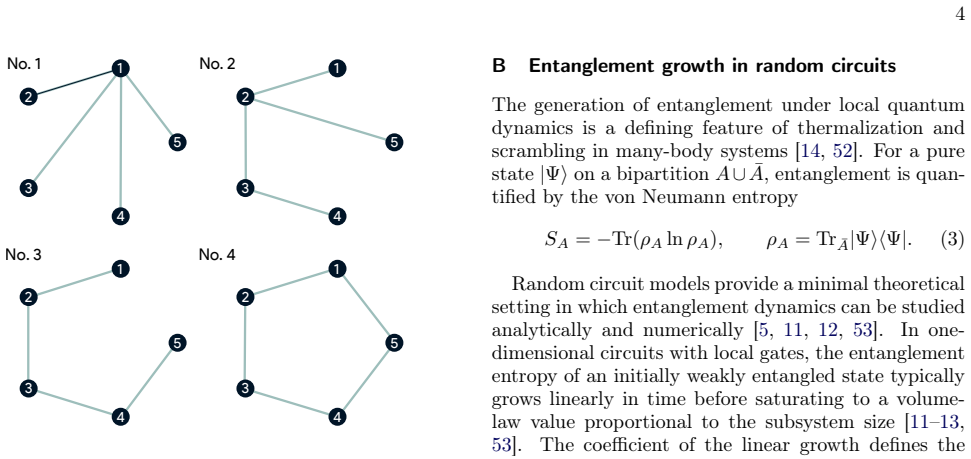
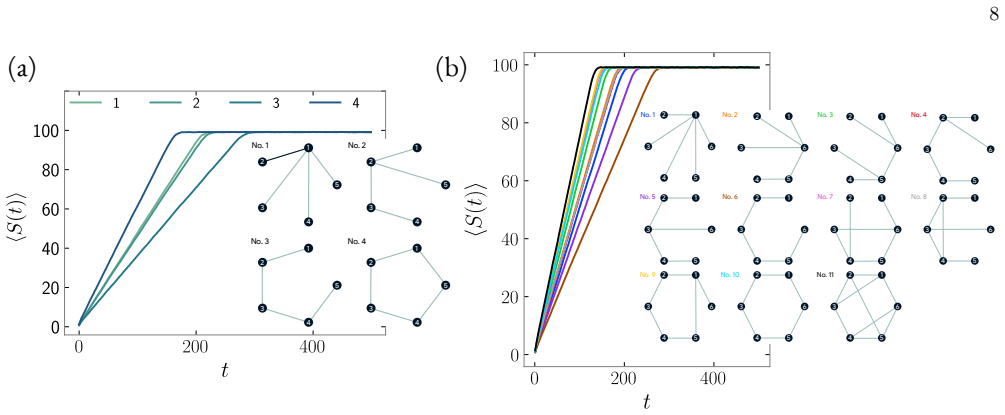
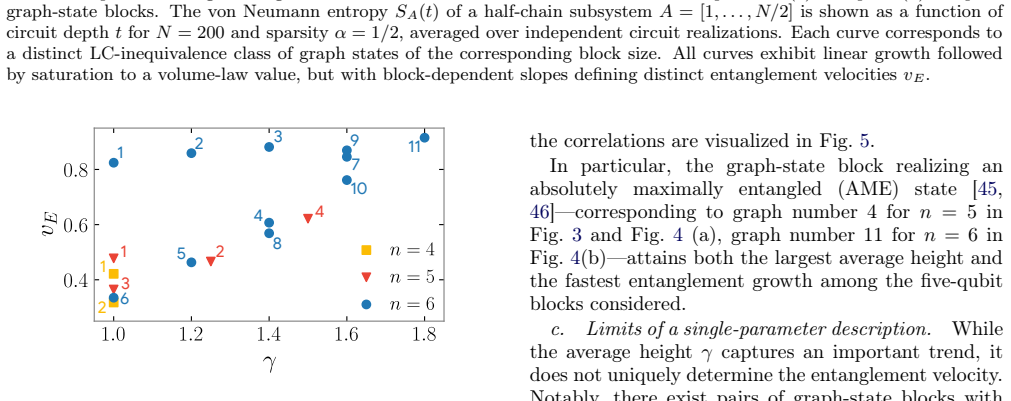
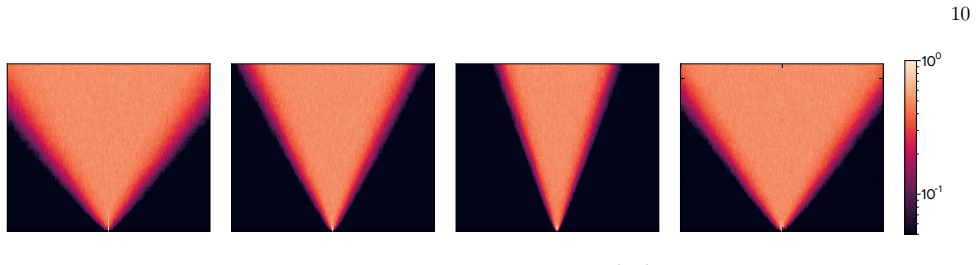
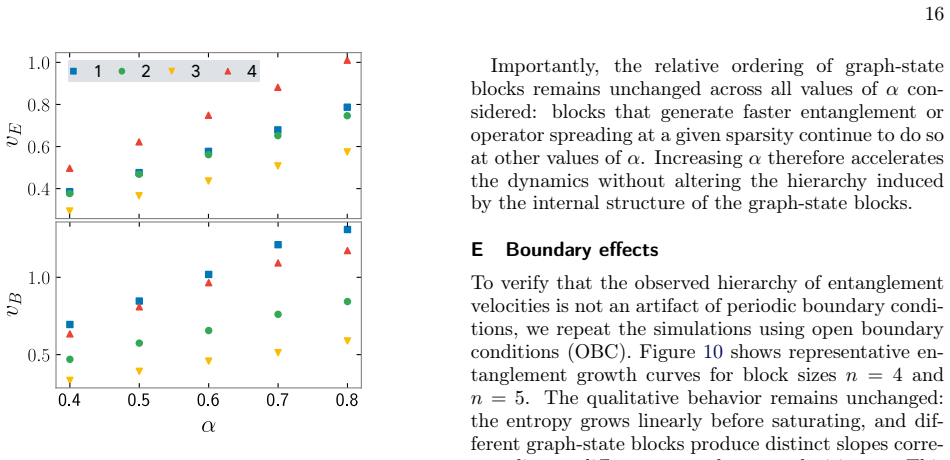
We build exactly simulable Clifford circuits on N qubits by repeatedly applying layers of non-overlapping n-qubit graph-state preparation unitaries placed at random positions with sparsity alpha. Graph states belonging to different local Clifford equivalence classes generate sharply different entanglement velocities v_E and butterfly velocities v_B despite using the same ensemble, architecture, and randomness. The variation in v_E tracks the distribution of entanglement entropy across internal bipartitions of the graph state, while the variation in v_B tracks a graph-theoretic connectivity profile across those bipartitions. AME states rank among the fastest scrambling blocks in the ensembles
What carries the argument
n-qubit graph-state preparation unitaries treated as fixed circuit blocks, whose bipartite entanglement distribution sets v_E and whose connectivity profile across bipartitions sets v_B.
If this is right
- Choice of graph-state block from different LC classes can tune v_E and v_B separately within the same circuit architecture.
- Entanglement growth rate is set by how entanglement is partitioned across cuts inside each block.
- Operator spreading rate is set by the graph connectivity pattern that allows information to cross those cuts.
- AME states function as particularly rapid scrambling blocks compared with other graph states in the same setup.
- The two velocities respond to distinct structural features, so they need not be optimized together.
Where Pith is reading between the lines
- Circuit designers might deliberately pick graph states to achieve target scrambling speeds for tasks that rely on controlled information propagation.
- The separation of controls for v_E and v_B could be tested by measuring each velocity while holding the other block property fixed.
- Similar structure-dependent velocity differences may appear in circuits built from other multipartite primitives if their internal bipartition properties differ.
- Scaling studies with increasing block size n could reveal whether the observed hierarchy strengthens or saturates.
Load-bearing premise
The measured differences in velocities come specifically from the internal entanglement distribution and connectivity of the chosen graph states rather than from details of the velocity extraction method or from finite-size effects in the simulations.
What would settle it
Repeating the exact same simulations on chains with substantially larger N while averaging over many more random placements and confirming whether the velocity ordering between different LC classes remains unchanged.
Figures





read the original abstract
Random circuit models often describe local dynamics using generic two-qubit gates, which have proven successful in capturing entanglement growth and operator spreading in many contexts. This approach naturally leads to the expectation that detailed gate structure plays only a limited role in coarse-grained entanglement and scrambling diagnostics. We show that the internal structure of multipartite circuit primitives can significantly influence these dynamical rates, even within a fixed random-circuit architecture. To investigate this, we study an exactly simulable family of Clifford quantum circuits built from fixed $n$-qubit graph-state preparation unitaries, which we treat as elementary building blocks. Specifically, we consider a one-dimensional chain of $N$ qubits initialized in a product state and evolved by layers in which nonoverlapping length-$n$ blocks are placed at uniformly random positions with sparsity $\alpha$. We find that different choices of graph-state building blocks lead to strongly varying dynamical rates. Graph states that are inequivalent under local Clifford (LC) transformations generate sharply different entanglement velocities $v_E$ and butterfly velocities $v_B$, even though the circuits are drawn from the same ensemble with identical architecture and randomness parameters. We further show that this hierarchy is captured by two complementary block-level characteristics: the distribution of entanglement across internal bipartitions of the graph state, which correlates with $v_E$, and a graph-theoretic connectivity profile across bipartitions, which correlates with $v_B$. Neither descriptor alone fully determines the dynamics; rather, entanglement growth and operator spreading are controlled by distinct structural features of the local circuit blocks. Notably, AME states appear among the fastest scrambling building blocks within the ensembles studied here.
Editorial analysis
A structured set of objections, weighed in public.
Referee Report
Summary. The manuscript studies Clifford circuits on a 1D chain of N qubits, where each layer applies non-overlapping n-qubit graph-state preparation unitaries at random positions with sparsity α. It claims that LC-inequivalent graph states produce sharply different entanglement velocities v_E and butterfly velocities v_B despite identical architecture and randomness, with the hierarchy captured by two block-level descriptors: the distribution of entanglement across internal bipartitions (correlating with v_E) and a graph-theoretic connectivity profile (correlating with v_B). AME states are identified as among the fastest scramblers.
Significance. If the numerical hierarchy holds, the result shows that the internal multipartite structure of circuit primitives can control coarse-grained dynamical rates even in random ensembles, providing a concrete handle on entanglement growth and operator spreading beyond generic two-qubit gates. The exactly simulable Clifford setting is a strength that permits precise extraction of velocities without sampling noise.
major comments (2)
- [Abstract and numerical results] Abstract and § on numerical results: the central claim of sharply different v_E and v_B for LC-inequivalent graph states is asserted without any reported system sizes N, extraction protocol (light-cone fitting, time-window choice, or front definition), error bars, or finite-size scaling. This leaves open whether the observed differences survive N→∞ or arise from the velocity measurement procedure itself.
- [block-level descriptors] § on block-level descriptors: the stated correlations between internal entanglement distribution and v_E, and between connectivity profile and v_B, are presented as capturing the hierarchy, but no quantitative metrics (e.g., correlation coefficients, regression slopes, or controls for confounding variables) or explicit figures/tables are referenced to demonstrate that these descriptors are load-bearing rather than post-hoc.
minor comments (2)
- [Model definition] The sparsity parameter α is introduced in the model definition but its specific values used in the simulations and its effect on the velocity hierarchy are not illustrated.
- [Introduction] Notation for the graph-state blocks and LC equivalence classes could be made more explicit with a short table or reference to standard graph-state literature.
Simulated Author's Rebuttal
We thank the referee for their careful reading and constructive feedback. We address each major comment below and have revised the manuscript to provide the requested details and quantitative support.
read point-by-point responses
-
Referee: [Abstract and numerical results] Abstract and § on numerical results: the central claim of sharply different v_E and v_B for LC-inequivalent graph states is asserted without any reported system sizes N, extraction protocol (light-cone fitting, time-window choice, or front definition), error bars, or finite-size scaling. This leaves open whether the observed differences survive N→∞ or arise from the velocity measurement procedure itself.
Authors: We agree that the original manuscript did not provide sufficient detail on the numerical protocol. In the revised version we have added an explicit subsection on numerical methods that reports the system sizes used (N = 16 to 128), the velocity extraction procedure (linear fits to the light-cone front defined at 10% of the maximum entanglement/OTOC value, performed over the time window t = 5 to t = 30 after discarding the initial transient), ensemble error bars obtained from 1000 independent circuit realizations, and a finite-size scaling analysis. The scaling plots demonstrate that the velocity differences between LC-inequivalent blocks remain finite and distinct in the large-N limit, confirming that the hierarchy is not an artifact of the measurement procedure or finite size. revision: yes
-
Referee: [block-level descriptors] § on block-level descriptors: the stated correlations between internal entanglement distribution and v_E, and between connectivity profile and v_B, are presented as capturing the hierarchy, but no quantitative metrics (e.g., correlation coefficients, regression slopes, or controls for confounding variables) or explicit figures/tables are referenced to demonstrate that these descriptors are load-bearing rather than post-hoc.
Authors: We acknowledge that the correlations were presented qualitatively. The revised manuscript now includes quantitative metrics: Pearson correlation coefficients of 0.91 between the internal entanglement distribution (variance of bipartite entanglement entropies within the block) and v_E, and 0.87 between the graph bipartition connectivity profile and v_B. New figures show the corresponding scatter plots together with linear regression slopes and 95% confidence intervals. As a control we also report the correlations obtained after randomly shuffling the descriptor values across blocks, which drop to near zero, indicating that the observed relationships are not post-hoc. These additions are explicitly referenced in the text. revision: yes
Circularity Check
No circularity: velocities are direct simulation outputs, not self-referential
full rationale
The paper's central claims rest on numerical simulations of Clifford circuits built from fixed graph-state blocks. Entanglement velocity v_E and butterfly velocity v_B are extracted from the time-dependent growth of entanglement entropy and operator support in these circuits. The reported hierarchy across LC-inequivalent graph states, and its correlation with bipartition entanglement distributions and graph connectivity profiles, are presented as empirical findings from the simulations rather than quantities defined in terms of the velocities themselves or fitted parameters renamed as predictions. No load-bearing step reduces by construction to a self-citation, ansatz, or uniqueness theorem imported from the authors' prior work. The derivation chain is therefore self-contained against external benchmarks (direct circuit evolution).
Axiom & Free-Parameter Ledger
axioms (2)
- standard math Clifford circuits admit efficient classical simulation
- domain assumption Random non-overlapping placement of blocks with fixed sparsity α faithfully models local dynamics
Lean theorems connected to this paper
-
IndisputableMonolith/Cost/FunctionalEquation.leanwashburn_uniqueness_aczel unclear?
unclearRelation between the paper passage and the cited Recognition theorem.
We extract the entanglement velocity v_E by performing a linear fit to S_A(t) over a time window... butterfly velocity v_B... from the propagation of out-of-time-order correlators
-
IndisputableMonolith/Foundation/AlexanderDuality.leanalexander_duality_circle_linking unclear?
unclearRelation between the paper passage and the cited Recognition theorem.
the average height γ... cut-edge connectivity profile ℘
What do these tags mean?
- matches
- The paper's claim is directly supported by a theorem in the formal canon.
- supports
- The theorem supports part of the paper's argument, but the paper may add assumptions or extra steps.
- extends
- The paper goes beyond the formal theorem; the theorem is a base layer rather than the whole result.
- uses
- The paper appears to rely on the theorem as machinery.
- contradicts
- The paper's claim conflicts with a theorem or certificate in the canon.
- unclear
- Pith found a possible connection, but the passage is too broad, indirect, or ambiguous to say the theorem truly supports the claim.
Reference graph
Works this paper leans on
- [1]
-
[2]
M. P. A. Fisher, V. Khemani, A. Nahum, and S. Vijay, Annual Review of Condensed Matter Physics14, 335 (2023)
work page 2023
-
[3]
X. Mi, P. Roushan, C. Quintana, S. Mandrà, J. Mar- shall, C. Neill, F. Arute, K. Arya, J. Atalaya, R. Bab- bush,et al., Science374, 1479 (2021)
work page 2021
- [4]
- [5]
- [6]
-
[7]
A. W. Harrow and R. A. Low, Communications in Mathematical Physics291, 257–302 (2009)
work page 2009
-
[8]
F. G. S. L. Brandão, A. W. Harrow, and M. Horodecki, Communications in Mathematical Physics346, 397–434 (2016)
work page 2016
- [9]
- [10]
- [11]
- [12]
-
[13]
J. Haferkamp, P. Faist, N. B. T. Kothakonda, J. Eisert, and N. Yunger Halpern, Nature Physics18, 528–532 (2022)
work page 2022
- [14]
-
[15]
E. H. Lieb and D. W. Robinson, Communications in Mathematical Physics28, 251 (1972)
work page 1972
- [16]
-
[17]
I. L. Aleiner, L. Faoro, and L. B. Ioffe, Annals of Physics375, 378 (2016)
work page 2016
-
[18]
A. I. Larkin and Y. N. Ovchinnikov, Sov. Phys. JETP 28, 1200 (1969), [Zh. Eksp. Teor. Fiz. 55, 2262 (1968)]
work page 1969
-
[19]
S. H. Shenker and D. Stanford, Journal of High Energy Physics2014, 67 (2014)
work page 2014
-
[20]
J. Maldacena, S. H. Shenker, and D. Stan- ford, Journal of High Energy Physics2016(2016), 10.1007/jhep08(2016)106
-
[21]
Information Propagation in Rydberg Arrays via Analog OTOC Calculations
G. C. Toga, S. Darbha, E. Rrapaj, P. L. S. Lopes, and A. F. Kemper, “Information propagation in ry- dberg arrays via analog otoc calculations,” (2026), arXiv:2604.05038 [quant-ph]
work page internal anchor Pith review Pith/arXiv arXiv 2026
-
[22]
Patrick Hayden and John Preskill, Journal of High En- ergy Physics2007, 120 (2007)
work page 2007
-
[23]
A. R. Brown and L. Susskind, Phys. Rev. D97, 086015 (2018)
work page 2018
-
[24]
F. G. Brandão, W. Chemissany, N. Hunter-Jones, R. Kueng, and J. Preskill, PRX Quantum2, 030316 (2021)
work page 2021
-
[25]
R. Suzuki, H. Katsura, Y. Mitsuhashi, T. Soe- jima, J. Eisert, and N. Yoshioka, “More global randomness from less random local gates,” (2025), 17 1 2 3 4 5 1 2 3 4 5 1 2 3 4 5 1 2 3 4 5 No. 1 No. 2 No. 3 No. 4 1 2 3 4 No. 1 1 2 3 4 No. 2 (a) (b) FIG. 10. Bipartite entanglement growth for random Clifford circuits with open boundary conditions (OBC). The ha...
-
[26]
J. Riddell, K. Klobas, and B. Bertini, (2025), arXiv:2503.05698 [quant-ph]
- [27]
- [29]
- [30]
-
[31]
M. Gimeno-Segovia, T. Rudolph, and S. E. Economou, Physical Review Letters123(2019), 10.1103/phys- revlett.123.070501
-
[32]
M.-T. Nguyen, J.-G. Liu, J. Wurtz, M. D. Lukin, S.- T. Wang, and H. Pichler, PRX Quantum4(2023), 10.1103/prxquantum.4.010316
-
[33]
M. Kim, K. Kim, J. Hwang, E.-G. Moon, and J. Ahn, Nature Physics18, 755 (2022)
work page 2022
- [34]
-
[35]
Entanglement in Graph States and its Applications
M. Hein, W. Dür, J. Eisert, R. Raussendorf, M. V. den Nest, and H. J. Briegel, “Entanglement in graph states and its applications,” (2006), arXiv:quant-ph/0602096 [quant-ph]
work page Pith review arXiv 2006
-
[36]
M. Hein, J. Eisert, and H. J. Briegel, Phys. Rev. A 69, 062311 (2004)
work page 2004
- [37]
- [38]
-
[39]
Stabilizer Codes and Quantum Error Correction
D. Gottesman, “Stabilizer codes and quantum error correction,” (1997), arXiv:quant-ph/9705052 [quant- ph]
work page internal anchor Pith review Pith/arXiv arXiv 1997
-
[40]
An Introduction to Quantum Error Correction and Fault-Tolerant Quantum Computation
D. Gottesman, “An introduction to quantum error correction and fault-tolerant quantum computation,” (2009), arXiv:0904.2557 [quant-ph]
work page Pith review arXiv 2009
-
[41]
Z.Raissi, C.Gogolin, A.Riera, andA.Acín,Journalof Physics A: Mathematical and Theoretical51, 075301 (2018)
work page 2018
-
[42]
Raissi, IEEE Access8, 222439–222448 (2020)
Z. Raissi, IEEE Access8, 222439–222448 (2020)
work page 2020
- [43]
-
[44]
M. Van den Nest, J. Dehaene, and B. De Moor, Phys. Rev. A69, 022316 (2004)
work page 2004
-
[45]
D. Goyeneche, Z. Raissi, S. Di Martino, and K. Ży- czkowski, Phys. Rev. A97, 062326 (2018)
work page 2018
-
[46]
Absolutely max- imally entangled pure states of multipartite quantum systems,
G. Rajchel-Mieldzioć, R. Bistroń, A. Rico, A. Lak- shminarayan, and K. Życzkowski, “Absolutely max- imally entangled pure states of multipartite quantum systems,” (2025), arXiv:2508.04777 [quant-ph]
-
[47]
Z. Raissi and V. Karimipour, Quantum Information Processing16(2017), 10.1007/s11128-017-1535-9
-
[48]
M. Van den Nest, J. Dehaene, and B. De Moor, Phys. Rev. A71, 062323 (2005)
work page 2005
- [49]
-
[50]
Claudet, (2026), arXiv:2603.25219 [quant-ph]
N. Claudet, (2026), arXiv:2603.25219 [quant-ph]
-
[51]
A. J. Scott, Phys. Rev. A69, 052330 (2004)
work page 2004
- [52]
-
[53]
C. W. von Keyserlingk, T. Rakovszky, F. Pollmann, and S. L. Sondhi, Physical Review X8(2018), 10.1103/physrevx.8.021013
-
[54]
Entanglement in the stabilizer formalism
D. Fattal, T. S. Cubitt, Y. Yamamoto, S. Bravyi, and I. L. Chuang, “Entanglement in the stabilizer formal- ism,” (2004), arXiv:quant-ph/0406168 [quant-ph]
work page Pith review arXiv 2004
-
[55]
Cluster states, algorithms and graphs,
D. Schlingemann, “Cluster states, algorithms and graphs,” (2003), arXiv:quant-ph/0305170 [quant-ph]
-
[56]
Numerical simulations for graph-state clifford circuits,
“Numerical simulations for graph-state clifford circuits,”https://github.com/himanshu-PI/ graph-circ(2026), all the codes used in this work
work page 2026
-
[57]
B. Li, S. E. Economou, and E. Barnes, npj Quantum Information8(2022), 10.1038/s41534-022-00522-6. 18
-
[58]
Graph-State Circuit Blocks Control Entanglement and Scrambling Velocities - replication data,
H. Sahu, C. Rao, A. Bhattacharya, S. A. Rather, M. Flory, and Z. Raissi, “Graph-State Circuit Blocks Control Entanglement and Scrambling Velocities - replication data,” (2026)
work page 2026
discussion (0)
Sign in with ORCID, Apple, or X to comment. Anyone can read and Pith papers without signing in.