Recognition: 2 theorem links
· Lean TheoremFeature-Aware Anisotropic Local Differential Privacy for Utility-Preserving Graph Representation Learning in Metal Additive Manufacturing
Pith reviewed 2026-05-10 18:44 UTC · model grok-4.3
The pith
A feature-importance prior lets anisotropic noise in local differential privacy recover most of the utility of a hierarchical graph attention network for additive manufacturing defect detection.
A machine-rendered reading of the paper's core claim, the machinery that carries it, and where it could break.
Core claim
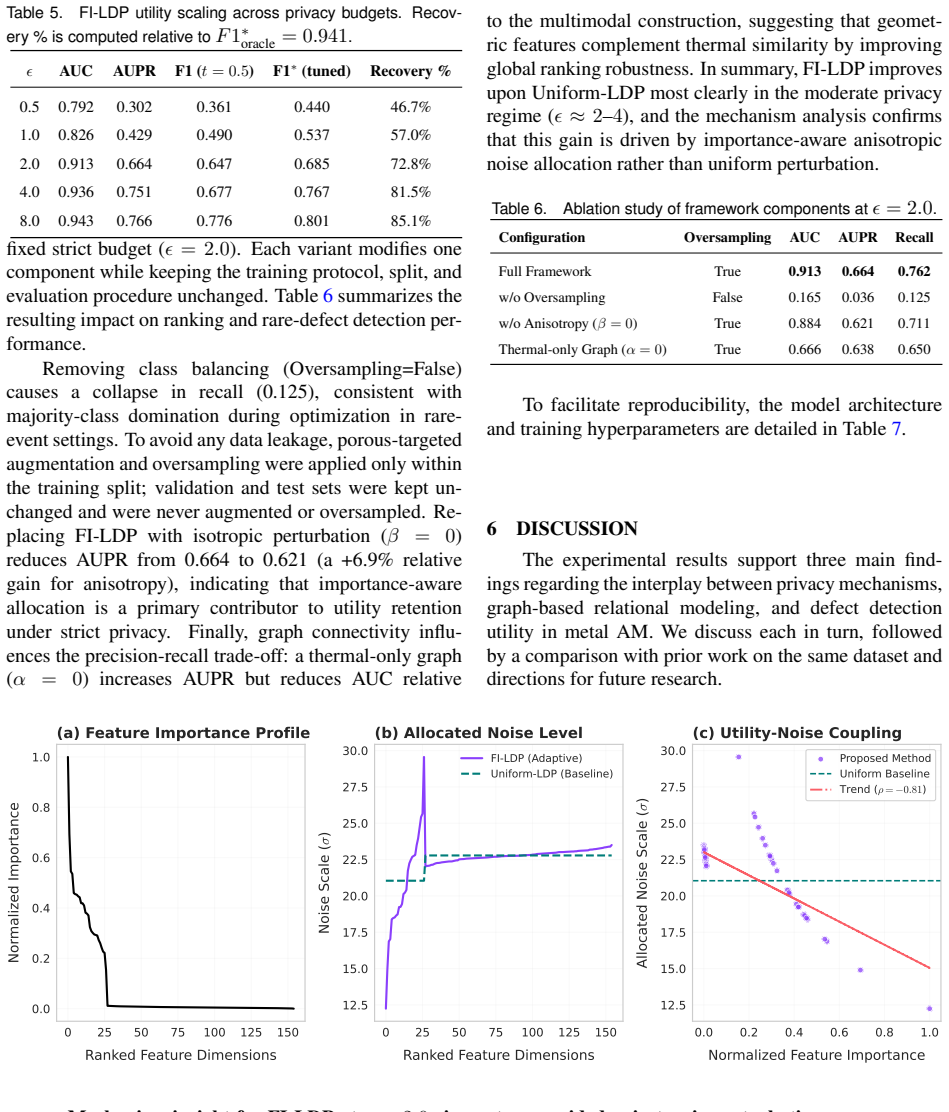
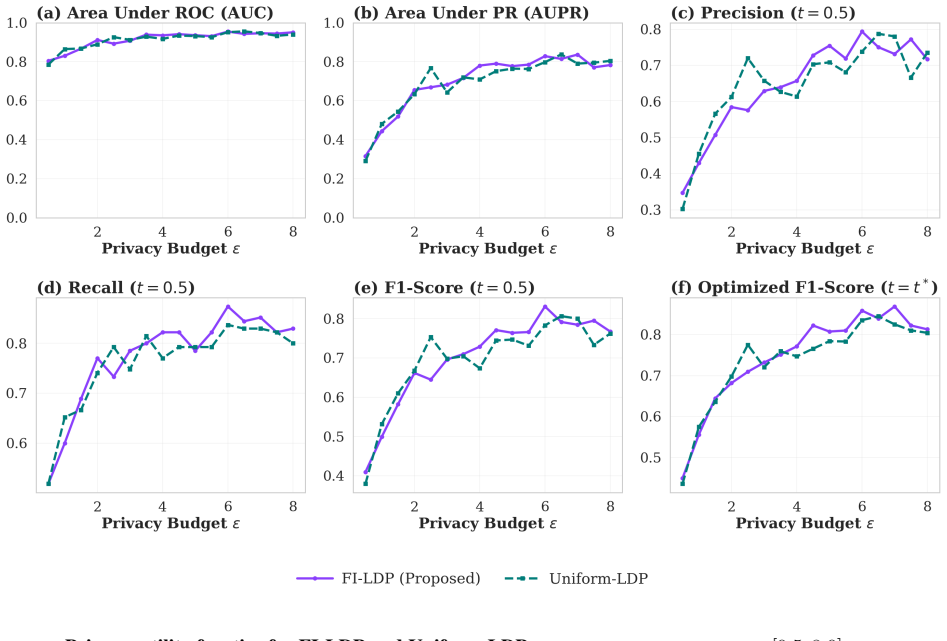
By deriving a feature importance prior from an encoder and using it to scale the variance of an anisotropic Gaussian mechanism, the privacy budget can be redistributed across embedding dimensions without violating local differential privacy; on a Directed Energy Deposition porosity dataset the resulting FI-LDP-HGAT model recovers 81.5 percent utility at a moderate privacy budget and sustains 0.762 defect recall under stricter privacy, with a strong negative correlation between feature importance and added noise magnitude.
What carries the argument
The feature-importance-aware anisotropic Gaussian mechanism (FI-LDP), which assigns per-dimension noise magnitudes inversely proportional to an encoder-derived importance prior while preserving the formal local differential privacy guarantee.
If this is right
- Collaborative training of quality-assurance models becomes feasible without exposing proprietary melt-pool signatures.
- Defect recall remains usable even when the privacy budget is tightened to epsilon equals 2.
- The same anisotropic allocation principle can be applied to any encoder-plus-graph pipeline whose features have heterogeneous task relevance.
Where Pith is reading between the lines
- The approach may extend to other sensor-rich manufacturing processes that exhibit layered spatial structure, such as powder-bed fusion or wire-arc additive manufacturing.
- If the importance prior can be obtained from public auxiliary data rather than the private encoder, the method could be made fully non-interactive from the outset.
Load-bearing premise
The encoder-derived feature importance scores correctly identify which dimensions carry task-critical information and do not themselves leak private information or introduce systematic bias.
What would settle it
Run the same downstream defect-detection task after deliberately randomizing or inverting the feature-importance prior before noise allocation; if utility and recall collapse to the level of isotropic LDP, the central claim is falsified.
Figures


read the original abstract
Metal additive manufacturing (AM) enables the fabrication of safety-critical components, but reliable quality assurance depends on high-fidelity sensor streams containing proprietary process information, limiting collaborative data sharing. Existing defect-detection models typically treat melt-pool observations as independent samples, ignoring layer-wise physical couplings. Moreover, conventional privacy-preserving techniques, particularly Local Differential Privacy (LDP), lead to severe utility degradation because they inject uniform noise across all feature dimensions. To address these interrelated challenges, we propose FI-LDP-HGAT. This computational framework combines two methodological components: a stratified Hierarchical Graph Attention Network (HGAT) that captures spatial and thermal dependencies across scan tracks and deposited layers, and a feature-importance-aware anisotropic Gaussian mechanism (FI-LDP) for non-interactive feature privatization. Unlike isotropic LDP, FI-LDP redistributes the privacy budget across embedding coordinates using an encoder-derived importance prior, assigning lower noise to task-critical thermal signatures and higher noise to redundant dimensions while maintaining formal LDP guarantees. Experiments on a Directed Energy Deposition (DED) porosity dataset demonstrate that FI-LDP-HGAT achieves 81.5% utility recovery at a moderate privacy budget (epsilon = 4) and maintains defect recall of 0.762 under strict privacy (epsilon = 2), while outperforming classical ML, standard GNNs, and alternative privacy mechanisms, including DP-SGD across all evaluated metrics. Mechanistic analysis confirms a strong negative correlation (Spearman = -0.81) between feature importance and noise magnitude, providing interpretable evidence that the privacy-utility gains are driven by principled anisotropic allocation.
Editorial analysis
A structured set of objections, weighed in public.
Referee Report
Summary. The manuscript proposes FI-LDP-HGAT, a framework combining a Hierarchical Graph Attention Network (HGAT) to model spatial-thermal dependencies across scan tracks and layers in Directed Energy Deposition (DED) sensor streams with a feature-importance-aware anisotropic Gaussian mechanism (FI-LDP). The latter redistributes the privacy budget using an encoder-derived importance prior to apply lower noise to task-critical dimensions while claiming to preserve formal local differential privacy. On a porosity dataset, it reports 81.5% utility recovery at ε=4, 0.762 defect recall at ε=2, outperformance versus classical ML, standard GNNs and DP-SGD, and a Spearman correlation of -0.81 between importance and noise magnitude.
Significance. If the privacy guarantees and empirical gains are rigorously supported, the work addresses a concrete barrier to collaborative quality assurance in safety-critical additive manufacturing by mitigating utility loss from uniform noise. The graph modeling of physical couplings and the mechanistic correlation analysis are positive elements that could inform privacy-utility design in other sensor-driven industrial settings.
major comments (2)
- [Methods (FI-LDP definition and privacy analysis)] The FI-LDP mechanism (described in the methods section on the anisotropic Gaussian mechanism): the claim that redistributing the privacy budget via an encoder-derived importance prior preserves formal ε-LDP for the full feature vector is load-bearing for all utility results. Standard calibration of the Gaussian mechanism sets per-coordinate σ from global sensitivity and ε; lowering σ on high-importance coordinates increases the privacy loss in those directions, so the vector mechanism's worst-case ε is determined by the minimum-σ coordinate. No explicit composition, max-loss, or post-processing argument is supplied to show the overall guarantee remains ε when the prior is computed from the same data (even non-interactively). This directly affects whether the reported 81.5% recovery at ε=4 and 0.762 recall at ε=2 reflect the stated privacy level.
- [Experiments and results] Experimental results (Section 5 and associated tables/figures): performance numbers are presented without error bars, number of random seeds, or statistical tests. Baseline implementations (including DP-SGD) are not described with matching privacy budgets, model sizes, or hyperparameter search details. It is also unclear whether the encoder used to derive the importance prior was trained on the evaluation folds or held-out data, which bears on both the utility numbers and the independence assumption required for the privacy claim.
minor comments (2)
- [Abstract and Section 3] The abstract and introduction refer to a 'stratified' HGAT; the precise difference from a standard hierarchical GAT (e.g., any additional stratification step or layer-wise masking) should be stated explicitly with a diagram or pseudocode.
- [Methods] Notation for the importance prior and the diagonal covariance matrix of the anisotropic mechanism should be introduced once and used consistently; currently the mapping from importance scores to per-coordinate variances is described only in prose.
Simulated Author's Rebuttal
We thank the referee for the constructive and detailed comments, which have helped us improve the rigor and clarity of the manuscript. We address each major comment point by point below and have revised the paper to incorporate the suggested enhancements.
read point-by-point responses
-
Referee: [Methods (FI-LDP definition and privacy analysis)] The FI-LDP mechanism (described in the methods section on the anisotropic Gaussian mechanism): the claim that redistributing the privacy budget via an encoder-derived importance prior preserves formal ε-LDP for the full feature vector is load-bearing for all utility results. Standard calibration of the Gaussian mechanism sets per-coordinate σ from global sensitivity and ε; lowering σ on high-importance coordinates increases the privacy loss in those directions, so the vector mechanism's worst-case ε is determined by the minimum-σ coordinate. No explicit composition, max-loss, or post-processing argument is supplied to show the overall guarantee remains ε when the prior is computed from the same data (even non-interactively). This directly affects whether the reported 81.5% recovery at ε=4 and 0.762 recall at ε=2 reflect the stated隐私水平.
Authors: We appreciate the referee's precise identification of the privacy analysis gap. The FI-LDP mechanism derives the importance prior non-interactively from the encoder and then calibrates the per-coordinate Gaussian noise such that the coordinate with the smallest σ (highest importance, lowest noise) is set to achieve exactly the target ε privacy loss; all other coordinates receive strictly larger σ and thus strictly smaller privacy loss. Consequently, the worst-case privacy loss over the entire vector is bounded by ε, satisfying the formal definition of ε-LDP. While the original submission stated the guarantee, it did not include the explicit bounding argument. In the revised manuscript we have added a new subsection (Section 3.3) that supplies the full proof: we bound the log-likelihood ratio for any neighboring pair using the properties of the multivariate Gaussian and the fixed prior, confirming that the reported utility figures (81.5 % at ε=4, 0.762 recall at ε=2) correspond to the claimed privacy level. revision: yes
-
Referee: [Experiments and results] Experimental results (Section 5 and associated tables/figures): performance numbers are presented without error bars, number of random seeds, or statistical tests. Baseline implementations (including DP-SGD) are not described with matching privacy budgets, model sizes, or hyperparameter search details. It is also unclear whether the encoder used to derive the importance prior was trained on the evaluation folds or held-out data, which bears on both the utility numbers and the independence assumption required for the privacy claim.
Authors: We agree that these omissions reduce reproducibility and statistical confidence. In the revised manuscript we have expanded Section 5 and the supplementary material to report all metrics with error bars computed over five independent random seeds, added Wilcoxon signed-rank tests for pairwise comparisons against baselines, and provided exhaustive implementation details: exact privacy-budget allocations, model parameter counts, optimizer settings, and the full hyperparameter grid search procedure for every baseline (including DP-SGD). We have also clarified that the importance encoder was trained on a held-out subset of the training data that is completely disjoint from the cross-validation folds used for final evaluation; this partitioning is now illustrated in a new data-flow diagram (Figure 2) and explicitly stated in the experimental protocol, thereby preserving the non-interactivity assumption required for the privacy analysis. revision: yes
Circularity Check
No significant circularity; empirical results on external dataset with independent privacy claim
full rationale
The paper proposes FI-LDP-HGAT as a combined framework: HGAT for graph modeling of AM layers plus FI-LDP anisotropic noise allocation via an encoder-derived importance prior. Central claims consist of measured utility/recall numbers on a DED porosity dataset (81.5% recovery at ε=4, 0.762 recall at ε=2) rather than any closed-form derivation or prediction that reduces to fitted inputs. No equations or sections exhibit self-definitional loops, fitted parameters renamed as predictions, or load-bearing self-citations. The privacy guarantee is asserted as formal LDP for the vector mechanism despite anisotropic variances; while the skeptic correctly flags that data-dependent importance could affect the actual privacy loss, this is an unproven assumption rather than a circular reduction inside the paper's own chain. The derivation chain is therefore self-contained and externally falsifiable via the reported experiments.
Axiom & Free-Parameter Ledger
axioms (1)
- domain assumption The encoder-derived importance prior accurately ranks feature relevance for the downstream defect task
invented entities (1)
-
FI-LDP anisotropic Gaussian mechanism
no independent evidence
Lean theorems connected to this paper
-
IndisputableMonolith/Cost/FunctionalEquation.leanwashburn_uniqueness_aczel unclear?
unclearRelation between the paper passage and the cited Recognition theorem.
FI-LDP redistributes the privacy budget across embedding coordinates using an encoder-derived importance prior, assigning lower noise to task-critical thermal signatures... (Eq. (20))
-
IndisputableMonolith/Foundation/AlphaCoordinateFixation.leanalpha_pin_under_high_calibration unclear?
unclearRelation between the paper passage and the cited Recognition theorem.
strong negative correlation (Spearman ρ = −0.81) between feature importance and noise magnitude
What do these tags mean?
- matches
- The paper's claim is directly supported by a theorem in the formal canon.
- supports
- The theorem supports part of the paper's argument, but the paper may add assumptions or extra steps.
- extends
- The paper goes beyond the formal theorem; the theorem is a base layer rather than the whole result.
- uses
- The paper appears to rely on the theorem as machinery.
- contradicts
- The paper's claim conflicts with a theorem or certificate in the canon.
- unclear
- Pith found a possible connection, but the passage is too broad, indirect, or ambiguous to say the theorem truly supports the claim.
Reference graph
Works this paper leans on
-
[1]
Deep learning-based data fusion method for in situ porosity detection in laser-based additive manufacturing,
Tian, Q., Guo, S., Melder, E., Bian, L., and Guo, W. G., 2021, “Deep learning-based data fusion method for in situ porosity detection in laser-based additive manufacturing,”Journal of Manufacturing Science and Engineering,143(4), p. 041011
2021
-
[2]
In-situ process monitoring and adaptive quality en- hancement in laser additive manufacturing: a criti- cal review,
Chen, L., Bi, G., Yao, X., Su, J., Tan, C., Feng, W., Benakis, M., Chew, Y ., and Moon, S. K., 2024, “In-situ process monitoring and adaptive quality en- hancement in laser additive manufacturing: a criti- cal review,”Journal of Manufacturing Systems,74, pp. 527–574
2024
-
[3]
In- process monitoring of porosity during laser additive manufacturing process,
Zhang, B., Liu, S., and Shin, Y . C., 2019, “In- process monitoring of porosity during laser additive manufacturing process,”Additive Manufacturing, 28, pp. 497–505
2019
-
[4]
Morphological dynamics-based anomaly de- tection towards in situ layer-wise certification for directed energy deposition processes,
Bappy, M. M., Liu, C., Bian, L., and Tian, W., 2022, “Morphological dynamics-based anomaly de- tection towards in situ layer-wise certification for directed energy deposition processes,”Journal of Manufacturing Science and Engineering,144(11), p. 111007
2022
-
[5]
Machine learning-aided real-time detection of keyhole pore generation in laser powder bed fusion,
Ren, Z., Gao, L., Clark, S. J., Fezzaa, K., Shevchenko, P., Choi, A., Everhart, W., Rollett, A. D., Chen, L., and Sun, T., 2023, “Machine learning-aided real-time detection of keyhole pore generation in laser powder bed fusion,”Science, 379(6627), pp. 89–94
2023
-
[6]
A convolutional neural net- work (cnn) classification to identify the presence of pores in powder bed fusion images,
Ansari, M. A., Crampton, A., Garrard, R., Cai, B., and Attallah, M., 2022, “A convolutional neural net- work (cnn) classification to identify the presence of pores in powder bed fusion images,”The Interna- tional Journal of Advanced Manufacturing Technol- ogy,120(7), pp. 5133–5150
2022
-
[7]
In-situ layer-wise certification for di- rect laser deposition processes based on thermal im- age series analysis,
Esfahani, M. N., Bappy, M. M., Bian, L., and Tian, W., 2022, “In-situ layer-wise certification for di- rect laser deposition processes based on thermal im- age series analysis,”Journal of Manufacturing Pro- cesses,75, pp. 895–902
2022
-
[8]
Dlam: Deep learning based real-time poros- ity prediction for additive manufacturing using ther- mal images of the melt pool,
Ho, S., Zhang, W., Young, W., Buchholz, M., Al Ju- fout, S., Dajani, K., Bian, L., and Mozumdar, M., 2021, “Dlam: Deep learning based real-time poros- ity prediction for additive manufacturing using ther- mal images of the melt pool,”IEEE Access,9, pp. 115100–115114
2021
-
[9]
Predicting de- fects in laser powder bed fusion using in-situ ther- mal imaging data and machine learning,
Estalaki, S. M., Lough, C. S., Landers, R. G., Kinzel, E. C., and Luo, T., 2022, “Predicting de- fects in laser powder bed fusion using in-situ ther- mal imaging data and machine learning,”Additive Manufacturing,58, p. 103008
2022
-
[10]
A deep learning frame- work for layer-wise porosity prediction in metal powder bed fusion using thermal signatures,
Mao, Y ., Lin, H., Yu, C. X., Frye, R., Beckett, D., Anderson, K., Jacquemetton, L., Carter, F., Gao, Z., Liao, W.-k., et al., 2023, “A deep learning frame- work for layer-wise porosity prediction in metal powder bed fusion using thermal signatures,”Jour- nal of Intelligent Manufacturing,34(1), pp. 315– 329
2023
-
[11]
Defects in metal additive manufacturing: formation, process parameters, postprocessing, challenges, economic aspects, and future research directions,
Haribaskar, R., and Kumar, T. S., 2024, “Defects in metal additive manufacturing: formation, process parameters, postprocessing, challenges, economic aspects, and future research directions,”3D Printing and Additive Manufacturing,11(4), pp. 1629–1655
2024
-
[12]
Effect of heat accumulation-induced embrit- tlement on the mechanical behavior of laser pow- der bed fusion ti-6al-4v microstructure,
Rottler, J., Tetzlaff, T. K., Lion, A., and Johlitz, M., 2025, “Effect of heat accumulation-induced embrit- tlement on the mechanical behavior of laser pow- der bed fusion ti-6al-4v microstructure,”Progress in Additive Manufacturing, pp. 1–9
2025
-
[13]
A review on in-situ process sens- ing and monitoring systems for fusion-based ad- ditive manufacturing,
Ozel, T., 2023, “A review on in-situ process sens- ing and monitoring systems for fusion-based ad- ditive manufacturing,”International Journal of Mechatronics and Manufacturing Systems,16(2-3), pp. 115–154
2023
-
[14]
A comprehensive survey on graph neural networks,
Wu, Z., Pan, S., Chen, F., Long, G., Zhang, C., and Yu, P. S., 2020, “A comprehensive survey on graph neural networks,”IEEE transactions on neural net- works and learning systems,32(1), pp. 4–24
2020
-
[15]
Wasi, A. T., Islam, M., Akib, A. R., and Bappy, M. M., 2024, “Graph neural networks in supply chain analytics and optimization: Concepts, per- spectives, dataset and benchmarks,”arXiv preprint arXiv:2411.08550
-
[16]
Veli ˇckovi´c, P., Cucurull, G., Casanova, A., Romero, A., Lio, P., and Bengio, Y ., 2017, “Graph attention networks,”arXiv preprint arXiv:1710.10903
work page internal anchor Pith review Pith/arXiv arXiv 2017
-
[17]
Geometry-agnostic data-driven ther- mal modeling of additive manufacturing processes using graph neural networks,
Mozaffar, M., Liao, S., Lin, H., Ehmann, K., and Cao, J., 2021, “Geometry-agnostic data-driven ther- mal modeling of additive manufacturing processes using graph neural networks,”Additive Manufac- turing,48, p. 102449
2021
-
[18]
Knowledge graph network-driven pro- cess reasoning for laser metal additive manufactur- ing based on relation mining,
Xiong, C., Xiao, J., Li, Z., Zhao, G., and Xiao, W., 2024, “Knowledge graph network-driven pro- cess reasoning for laser metal additive manufactur- ing based on relation mining,”Applied Intelligence, 54(22), pp. 11472–11483
2024
-
[19]
Spatially-informed online prediction of milling surface deformation using multiphysics- infused graph neural network for digital twinning,
Zhou, Q., Zhang, Y ., Kim, J., Imani, F., and Tang, J., 2025, “Spatially-informed online prediction of milling surface deformation using multiphysics- infused graph neural network for digital twinning,” Journal of Manufacturing Science and Engineering, 147(12), p. 121003
2025
-
[20]
Big data driven edge-cloud col- laboration architecture for cloud manufacturing: a software defined perspective,
Yang, C., Lan, S., Wang, L., Shen, W., and Huang, G. G., 2020, “Big data driven edge-cloud col- laboration architecture for cloud manufacturing: a software defined perspective,”IEEE access,8, pp. 45938–45950
2020
-
[21]
M., 2024,Toward privacy-preserving component certification for metal additive manufac- turingMississippi State University
Bappy, M. M., 2024,Toward privacy-preserving component certification for metal additive manufac- turingMississippi State University
2024
-
[22]
Privacy- preserving and utility-aware data sharing strategy for process-defect modeling in metal-based additive manufacturing,
Bappy, M., Bian, L., and Tian, W., 2023, “Privacy- preserving and utility-aware data sharing strategy for process-defect modeling in metal-based additive manufacturing,” In IISE Annual Conference and Expo, IISE
2023
-
[23]
Adaptive thermal history de- identification for privacy-preserving data sharing of directed energy deposition processes,
Bappy, M. M., Fullington, D., Bian, L., and Tian, W., 2025, “Adaptive thermal history de- identification for privacy-preserving data sharing of directed energy deposition processes,”Journal of Computing and Information Science in Engineering, 25(3), p. 031006
2025
-
[24]
Privacy- preserving neural networks for smart manufactur- ing,
Lee, H., Finke, D., and Yang, H., 2024, “Privacy- preserving neural networks for smart manufactur- ing,”Journal of Computing and Information Sci- ence in Engineering,24(7), p. 071002
2024
-
[25]
Sensor data protection through integra- tion of blockchain and camouflaged encryption in cyber-physical manufacturing systems,
Shi, Z., Oskolkov, B., Tian, W., Kan, C., and Liu, C., 2024, “Sensor data protection through integra- tion of blockchain and camouflaged encryption in cyber-physical manufacturing systems,”Journal of Computing and Information Science in Engineering, 24(7), p. 071004
2024
-
[26]
Incremental machine learning- integrated blockchain for real-time security protec- tion in cyber-enabled manufacturing systems,
Oskolkov, B., Kan, C., Tian, W., Law, A. C. C., and Liu, C., 2025, “Incremental machine learning- integrated blockchain for real-time security protec- tion in cyber-enabled manufacturing systems,”Jour- nal of Computing and Information Science in Engi- neering,25(4), p. 041004
2025
-
[27]
Taxonomy-driven graph- theoretic framework for manufacturing cybersecu- rity risk modeling and assessment,
Rahman, M. H., Hamedani, E. Y ., Son, Y .-J., and Shafae, M., 2024, “Taxonomy-driven graph- theoretic framework for manufacturing cybersecu- rity risk modeling and assessment,”Journal of Computing and Information Science in Engineering, 24(7), p. 071003
2024
-
[28]
Layered secu- rity guidance for data asset management in additive manufacturing,
Ali Milaat, F., and Lubell, J., 2024, “Layered secu- rity guidance for data asset management in additive manufacturing,”Journal of computing and informa- tion science in engineering,24(7), p. 071001
2024
-
[29]
A comprehensive survey on local differential pri- vacy toward data statistics and analysis,
Wang, T., Zhang, X., Feng, J., and Yang, X., 2020, “A comprehensive survey on local differential pri- vacy toward data statistics and analysis,”Sensors, 20(24), p. 7030
2020
-
[30]
Local privacy and statistical minimax rates,
Duchi, J. C., Jordan, M. I., and Wainwright, M. J., 2013, “Local privacy and statistical minimax rates,” In 2013 IEEE 54th annual symposium on founda- tions of computer science, IEEE, pp. 429–438
2013
-
[31]
{Utility- optimized}local differential privacy mechanisms for distribution estimation,
Murakami, T., and Kawamoto, Y ., 2019, “{Utility- optimized}local differential privacy mechanisms for distribution estimation,” In 28th USENIX Secu- rity Symposium (USENIX Security 19), pp. 1877– 1894
2019
-
[32]
Context aware local differential privacy,
Acharya, J., Bonawitz, K., Kairouz, P., Ramage, D., and Sun, Z., 2020, “Context aware local differential privacy,” In International Conference on Machine Learning, PMLR, pp. 52–62
2020
-
[33]
Enhancing dp-sgd through non-monotonous adaptive scaling gradient weight,
Huang, T., Huang, Q., Shi, X., Meng, J., Zheng, G., Yang, X., and Yi, X., 2024, “Enhancing dp-sgd through non-monotonous adaptive scaling gradient weight,”arXiv preprint arXiv:2411.03059
-
[34]
Survey: feder- ated learning data security and privacy-preserving in edge-internet of things,
Li, H., Ge, L., and Tian, L., 2024, “Survey: feder- ated learning data security and privacy-preserving in edge-internet of things,”Artificial Intelligence Re- view,57(5), p. 130
2024
-
[35]
Karthikeyan, A., Balhara, H., Hanchate, A., Lianos, A. K., and Bukkapatnam, S. T., 2023, “In-situ sur- face porosity prediction in ded (directed energy de- position) printed ss316l parts using multimodal sen- sor fusion,”arXiv preprint arXiv:2304.08658
-
[36]
In-situ monitoring of melt pool images for porosity prediction in directed energy deposition processes,
Khanzadeh, M., Chowdhury, S., Tschopp, M. A., Doude, H. R., Marufuzzaman, M., and Bian, L., 2019, “In-situ monitoring of melt pool images for porosity prediction in directed energy deposition processes,”Iise Transactions,51(5), pp. 437–455
2019
-
[37]
Stochastic defect localization for coopera- tive additive manufacturing using gaussian mixture maps,
Rescsanski, S., Shah, V ., Tang, J., and Imani, F., 2024, “Stochastic defect localization for coopera- tive additive manufacturing using gaussian mixture maps,”Journal of Computing and Information Sci- ence in Engineering,24(11), p. 111006
2024
-
[38]
A privacy-enhancing fed- erated learning framework for cross-manufacturer lpbf powder bed defect identification,
Wang, Y ., Tang, J., Zhao, Z., Wang, C., Zhang, X., and Chen, X., 2026, “A privacy-enhancing fed- erated learning framework for cross-manufacturer lpbf powder bed defect identification,”Journal of Intelligent Manufacturing, pp. 1–25
2026
-
[39]
Privacy-preserving process-defect modelling for metal-based additive manufacturing processes: A federated learning- based case study,
Zhou, S., and Tian, W., 2025, “Privacy-preserving process-defect modelling for metal-based additive manufacturing processes: A federated learning- based case study,”Manufacturing Letters,44, pp. 1016–1025
2025
-
[40]
Protecting additive manufac- turing information when encryption is insufficient,
Lubell, J., 2022, “Protecting additive manufac- turing information when encryption is insufficient,” In ASTM International Conference on Additive Manufacturing (ICAM 2021), ASTM International, pp. 177–191
2022
-
[41]
An overview of trustworthy ai: advances in ip protection, privacy-preserving feder- ated learning, security verification, and gai safety alignment,
Zheng, Y ., Chang, C.-H., Huang, S.-H., Chen, P.-Y ., and Picek, S., 2024, “An overview of trustworthy ai: advances in ip protection, privacy-preserving feder- ated learning, security verification, and gai safety alignment,”IEEE Journal on Emerging and Se- lected Topics in Circuits and Systems
2024
-
[42]
Lo- cally private graph neural networks,
Sajadmanesh, S., and Gatica-Perez, D., 2021, “Lo- cally private graph neural networks,” In Proceedings of the 2021 ACM SIGSAC conference on computer and communications security, pp. 2130–2145
2021
-
[43]
{GAP}: Differentially pri- vate graph neural networks with aggregation per- turbation,
Sajadmanesh, S., Shamsabadi, A. S., Bellet, A., and Gatica-Perez, D., 2023, “{GAP}: Differentially pri- vate graph neural networks with aggregation per- turbation,” In 32nd USENIX Security Symposium (USENIX Security 23), pp. 3223–3240
2023
-
[44]
C., 2009,Digital image processing Pearson education india
Gonzalez, R. C., 2009,Digital image processing Pearson education india
2009
-
[45]
A sur- vey on image data augmentation for deep learning,
Shorten, C., and Khoshgoftaar, T. M., 2019, “A sur- vey on image data augmentation for deep learning,” Journal of big data,6(1), pp. 1–48
2019
-
[46]
Process monitoring and inspection sys- tems in metal additive manufacturing: Status and applications,
Chua, Z. Y ., Ahn, I. H., and Moon, S. K., 2017, “Process monitoring and inspection sys- tems in metal additive manufacturing: Status and applications,”International Journal of Precision Engineering and Manufacturing-Green Technology, 4(2), pp. 235–245
2017
-
[47]
mixup: Beyond Empirical Risk Minimization
Zhang, H., Cisse, M., Dauphin, Y . N., and Lopez- Paz, D., 2017, “mixup: Beyond empirical risk min- imization,”arXiv preprint arXiv:1710.09412
work page internal anchor Pith review arXiv 2017
-
[48]
Deep residual learning for image recognition,
He, K., Zhang, X., Ren, S., and Sun, J., 2016, “Deep residual learning for image recognition,” In Pro- ceedings of the IEEE conference on computer vision and pattern recognition, pp. 770–778
2016
-
[49]
Rethinking the inception ar- chitecture for computer vision,
Szegedy, C., Vanhoucke, V ., Ioffe, S., Shlens, J., and Wojna, Z., 2016, “Rethinking the inception ar- chitecture for computer vision,” In Proceedings of the IEEE conference on computer vision and pattern recognition, pp. 2818–2826
2016
-
[50]
Dynamic graph cnn for learning on point clouds,
Wang, Y ., Sun, Y ., Liu, Z., Sarma, S. E., Bronstein, M. M., and Solomon, J. M., 2019, “Dynamic graph cnn for learning on point clouds,”ACM Transac- tions on Graphics (tog),38(5), pp. 1–12
2019
-
[51]
Focal loss for dense object de- tection,
Lin, T.-Y ., Goyal, P., Girshick, R., He, K., and Doll´ar, P., 2017, “Focal loss for dense object de- tection,” In Proceedings of the IEEE international conference on computer vision, pp. 2980–2988
2017
-
[52]
Thermal-porosity characterization data of additively manufactured ti-6al-4v thin-walled struc- ture via laser engineered net shaping,
Zamiela, C., Tian, W., Guo, S., and Bian, L., 2023, “Thermal-porosity characterization data of additively manufactured ti-6al-4v thin-walled struc- ture via laser engineered net shaping,”Data in Brief, 51, p. 109722
2023
-
[53]
Differential pri- vacy configurations in the real world: A compar- ative analysis,
Khavkin, M., and Toch, E., 2025, “Differential pri- vacy configurations in the real world: A compar- ative analysis,”IEEE Transactions on Knowledge and Data Engineering
2025
-
[54]
Advancing machine learning ap- plications for in-situ monitoring and control in laser- based metal additive manufacturing: a state-of-the- art review,
Zhang, J., Yin, C., Farbiz, F., Jafary-Zadeh, M., and Sing, S. L., 2025, “Advancing machine learning ap- plications for in-situ monitoring and control in laser- based metal additive manufacturing: a state-of-the- art review,”Virtual and Physical Prototyping,20(1), p. e2592732
2025
discussion (0)
Sign in with ORCID, Apple, or X to comment. Anyone can read and Pith papers without signing in.