Recognition: 3 theorem links
· Lean TheoremDesigning Digital Humans with Ambient Intelligence
Pith reviewed 2026-05-10 19:00 UTC · model grok-4.3
The pith
Ambient intelligence gives digital humans the ability to sense surroundings and act proactively instead of responding only to spoken queries.
A machine-rendered reading of the paper's core claim, the machinery that carries it, and where it could break.
Core claim
Integrating ambient intelligence with digital humans enables situational awareness of the user's environment, anticipatory and proactive assistance, seamless cross-device interactions, and personalized long-term user support. This is achieved by defining key roles that ambient data plays in shaping agent behavior, outlining a design space that includes levels of proactivity and privacy strategies, and demonstrating application patterns through case studies in financial and retail services, along with an overall architecture and responsible-design guidelines.
What carries the argument
The conceptual framework that assigns explicit roles to ambient intelligence data in determining how digital humans behave, together with the accompanying design space that varies proactivity and privacy choices.
If this is right
- Digital humans can maintain awareness of the physical setting around the user rather than operating from dialogue alone.
- Assistance can be offered before a user asks, based on detected conditions in the environment.
- Interactions can move smoothly from one device to another without the user restarting the conversation.
- Support can accumulate knowledge over repeated sessions using ongoing contextual information.
- Design choices about how much initiative the agent takes and how much data it uses become explicit parameters that developers must set.
Where Pith is reading between the lines
- The same role definitions could apply to other classes of AI agents that currently lack environmental context, such as voice assistants in homes or offices.
- The privacy strategies may reduce adoption barriers in regulated industries where data handling rules are strict.
- The architecture could support testing whether proactive behavior improves outcomes in high-stakes service encounters compared with reactive responses.
Load-bearing premise
Ambient intelligence data can be obtained and combined with digital human systems without major technical failures, privacy violations, or user resistance that would prevent the proposed roles and patterns from working in practice.
What would settle it
A deployment study in which adding ambient sensor data to a digital human produces no measurable gain in user task success or satisfaction, or triggers widespread refusal due to privacy concerns, would show that the integration does not deliver the described situational awareness and proactive benefits.
Figures

read the original abstract
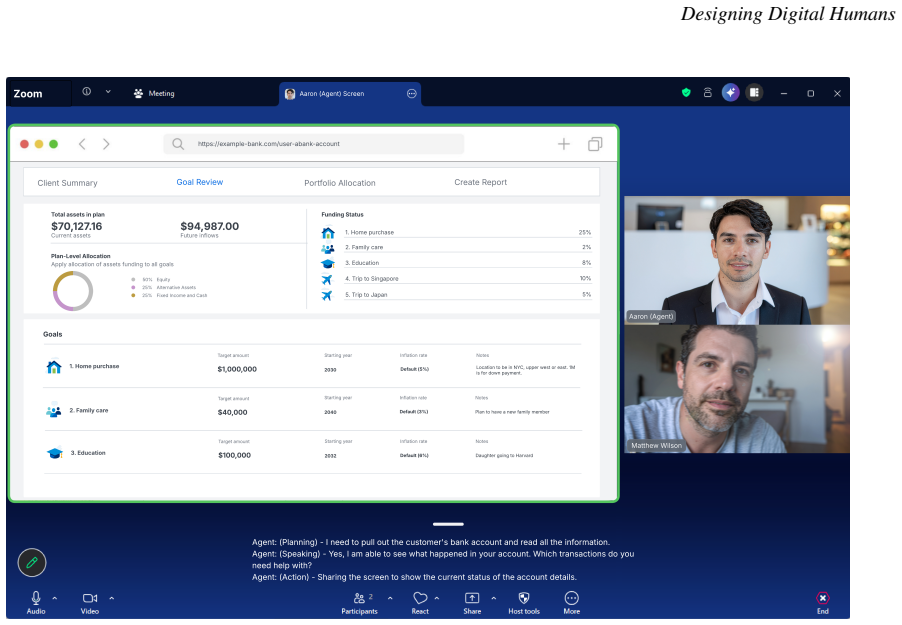
Digital humans are lifelike virtual agents capable of natural conversation and are increasingly deployed in domains like retail and finance. However, most current digital humans operate in isolation from their surroundings and lack contextual awareness beyond the dialogue itself. We address this limitation by integrating ambient intelligence (AmI) - i.e., environmental sensors, IoT data, and contextual modeling - with digital human systems. This integration enables situational awareness of the user's environment, anticipatory and proactive assistance, seamless cross-device interactions, and personalized long-term user support. We present a conceptual framework defining key roles that AmI can play in shaping digital human behavior, a design space highlighting dimensions such as proactivity levels and privacy strategies, and application-driven patterns with case studies in financial and retail services. We also discuss an architecture for ambient-enabled digital humans and provide guidelines for responsible design regarding privacy and data governance. Together, our work positions ambient intelligent digital humans as a new class of interactive agents powered by AI that respond not only to users' queries but also to the context and situations in which the interaction occurs.
Editorial analysis
A structured set of objections, weighed in public.
Referee Report
Summary. The manuscript proposes integrating ambient intelligence (AmI)—environmental sensors, IoT data, and contextual modeling—with digital human systems to address their current isolation from surroundings. It defines key roles for AmI in shaping digital human behavior, a design space covering dimensions such as proactivity levels and privacy strategies, application-driven patterns illustrated by case studies in financial and retail services, an architecture for ambient-enabled digital humans, and guidelines for responsible design on privacy and data governance. The central claim is that this integration enables situational awareness of the user's environment, anticipatory and proactive assistance, seamless cross-device interactions, and personalized long-term user support.
Significance. If the conceptual framework is adopted and followed by implementation work, it could provide a useful structured approach for designing context-aware interactive agents in HCI and AI applications, particularly in domains like retail and finance. The explicit attention to responsible design guidelines and the framing of a new class of agents represent strengths in addressing ethical considerations at the proposal stage.
major comments (2)
- [architecture] The architecture section describes ambient-enabled digital humans at a conceptual level but does not specify data integration mechanisms, sensor fusion approaches, or handling of incomplete/uncertain AmI inputs; this is load-bearing for the claim that the integration enables seamless cross-device interactions and situational awareness.
- [application patterns and case studies] The case studies in financial and retail services assert that the proposed patterns enable anticipatory assistance and personalized support but provide no implementation details, pseudocode, or evaluation criteria; this gap between conceptual description and demonstrated capability undermines the translation to effective real systems.
minor comments (2)
- [design space] The design space discussion of proactivity levels and privacy strategies would benefit from a summary table or explicit mapping to the case studies to improve readability and allow readers to quickly compare options.
- [abstract and introduction] The abstract and introduction could more explicitly distinguish the proposed framework as a design proposal rather than an implemented system to set appropriate expectations for the absence of empirical validation.
Simulated Author's Rebuttal
We thank the referee for the constructive feedback and positive recommendation for minor revision. We address each major comment below, clarifying the conceptual scope of the work while noting where we can strengthen the manuscript.
read point-by-point responses
-
Referee: [architecture] The architecture section describes ambient-enabled digital humans at a conceptual level but does not specify data integration mechanisms, sensor fusion approaches, or handling of incomplete/uncertain AmI inputs; this is load-bearing for the claim that the integration enables seamless cross-device interactions and situational awareness.
Authors: We agree the architecture is presented conceptually, consistent with the paper's focus on a high-level framework rather than system implementation. The claims for situational awareness and cross-device interactions are grounded in the defined AmI roles (context provider, behavior modulator) and design space dimensions, which establish the conceptual mechanisms for integration. We do not claim specific technical solutions such as particular fusion algorithms. To improve clarity, we will add a brief discussion of example data integration strategies and uncertainty handling approaches (e.g., probabilistic context modeling) in the revised architecture section, while preserving the conceptual emphasis. revision: partial
-
Referee: [application patterns and case studies] The case studies in financial and retail services assert that the proposed patterns enable anticipatory assistance and personalized support but provide no implementation details, pseudocode, or evaluation criteria; this gap between conceptual description and demonstrated capability undermines the translation to effective real systems.
Authors: The case studies are illustrative scenarios designed to demonstrate application of the proposed patterns within the framework, not empirical demonstrations or implemented prototypes. As a conceptual contribution, the manuscript does not include pseudocode, system evaluations, or implementation details, which would exceed its stated scope of defining roles, design space, and guidelines. This is standard for framework papers in HCI. We can strengthen the presentation by expanding the scenarios with additional contextual details and suggested evaluation criteria in the revision. revision: partial
Circularity Check
No significant circularity
full rationale
The paper is a purely conceptual design proposal that defines roles for ambient intelligence in digital human systems, a design space, application patterns, an architecture, and responsible-design guidelines. No equations, derivations, fitted parameters, predictions, or first-principles results exist that could reduce to inputs by construction. The central claim follows directly from the stated definition of AmI integration and the components presented; no self-citation load-bearing steps, ansatzes, or renamings of known results appear in any derivation chain.
Axiom & Free-Parameter Ledger
axioms (1)
- domain assumption Ambient intelligence systems can supply reliable, timely contextual data from environmental sensors and IoT devices that meaningfully shapes digital human behavior.
Lean theorems connected to this paper
-
IndisputableMonolith/Foundation/RealityFromDistinction.leanreality_from_one_distinction unclear?
unclearRelation between the paper passage and the cited Recognition theorem.
We present a conceptual framework defining key roles that AmI can play in shaping digital human behavior, a design space highlighting dimensions such as proactivity levels and privacy strategies, and application-driven patterns with case studies in financial and retail services.
-
IndisputableMonolith/Cost/FunctionalEquation.leanwashburn_uniqueness_aczel unclear?
unclearRelation between the paper passage and the cited Recognition theorem.
R1: Situational Awareness... R2: Proactive and Anticipatory Interaction... R5: Continuous Learning and Personalization
-
IndisputableMonolith/Foundation/AlphaCoordinateFixation.leanalpha_pin_under_high_calibration unclear?
unclearRelation between the paper passage and the cited Recognition theorem.
Axis 1: Context Richness... Axis 2: System Initiative... four system archetypes
What do these tags mean?
- matches
- The paper's claim is directly supported by a theorem in the formal canon.
- supports
- The theorem supports part of the paper's argument, but the paper may add assumptions or extra steps.
- extends
- The paper goes beyond the formal theorem; the theorem is a base layer rather than the whole result.
- uses
- The paper appears to rely on the theorem as machinery.
- contradicts
- The paper's claim conflicts with a theorem or certificate in the canon.
- unclear
- Pith found a possible connection, but the passage is too broad, indirect, or ambiguous to say the theorem truly supports the claim.
Reference graph
Works this paper leans on
-
[1]
D., DEY, A
ABOWD, G. D., DEY, A. K., BROWN, P. J., DAVIES, N., SMITH, M.,ANDSTEGGLES, P. Towards a better understanding of context and context-awareness, 1999
1999
-
[2]
ACHIAM, J., ADLER, S., AGARWAL, S., AHMAD, L., AKKAYA, I., ALEMAN, F. L., ALMEIDA, D., AL- TENSCHMIDT, J., ALTMAN, S., ANADKAT, S.,ET AL. Gpt-4 technical report.arXiv preprint arXiv:2303.08774 (2023)
work page internal anchor Pith review Pith/arXiv arXiv 2023
-
[3]
CRC Press, 2018
AKENINE-MÖLLER, T., HAINES, E.,ANDHOFFMAN, N.Real-Time Rendering, 4th ed. CRC Press, 2018
2018
-
[4]
H., EISA, T
ALI, A., ABDRAZAK, S., OTHMAN, S. H., EISA, T. A. E., AL-DHAQM, A., NASSER, M., ELHASSAN, T., ELSHAFIE, H.,ANDSAEED, A. Financial fraud detection based on machine learning: A systematic literature review.Applied Sciences 12, 19 (2022), 9637
2022
-
[5]
Open 3D engine (O3DE)
AMAZONWEBSERVICES,ANDOPEN3D FOUNDATION. Open 3D engine (O3DE). https://o3de.org/, 2021
2021
-
[6]
N., INKPEN, K., TEEVAN, J., KIKIN-GIL, R.,ANDHORVITZ, E
AMERSHI, S., WELD, D., VORVOREANU, M., FOURNEY, A., NUSHI, B., COLLISSON, P., SUH, J., IQBAL, S., BENNETT, P. N., INKPEN, K., TEEVAN, J., KIKIN-GIL, R.,ANDHORVITZ, E. Guidelines for human-AI interaction. InProceedings of the 2019 CHI Conference on Human Factors in Computing Systems(2019), ACM
2019
-
[7]
Deep evidential regression
AMINI, A., SCHWARTING, W., SOLEIMANY, A.,ANDRUS, D. Deep evidential regression. InAdvances in Neural Information Processing Systems(2020), vol. 33
2020
-
[8]
F., MCLOUGHLIN, L., LIAROKAPIS, F., PETERS, C., PETRIDIS, P.,AND DEFREITAS, S
ANDERSON, E. F., MCLOUGHLIN, L., LIAROKAPIS, F., PETERS, C., PETRIDIS, P.,AND DEFREITAS, S. Developing serious games for cultural heritage: A state-of-the-art review.Virtual Reality 14, 4 (2020), 255–275
2020
-
[9]
AI, big data, and the future of consent.AI & Society 37 (2022), 1715–1728
ANDREOTTA, M., KIRKHAM, N.,ANDRIZZI, M. AI, big data, and the future of consent.AI & Society 37 (2022), 1715–1728
2022
-
[10]
Computer use
ANTHROPIC. Computer use. https://docs.anthropic.com/en/docs/agents-and-tools/ computer-use, 2024. Accessed: 2026-03-08
2024
-
[11]
Model card: Claude 3
ANTHROPIC. Model card: Claude 3. https://www-cdn.anthropic.com/ de8ba9b01c9ab7cbabf5c33b80b7bbc618857627/Model_Card_Claude_3.pdf, 2024. PDF
2024
-
[12]
Model context protocol (MCP)
ANTHROPIC. Model context protocol (MCP). https://modelcontextprotocol.io, 2024. Accessed: 2026-03-08
2024
-
[13]
The internet of things: A survey.Computer Networks 54, 15 (2010), 2787–2805
ATZORI, L., IERA, A.,ANDMORABITO, G. The internet of things: A survey.Computer Networks 54, 15 (2010), 2787–2805
2010
-
[14]
N.,ANDBEALL, A
BAILENSON, J. N.,ANDBEALL, A. C. Transformed social interaction: Exploring the digital plasticity of avatars.Avatars at Work and Play(2006), 1–16
2006
-
[15]
A survey on context-aware systems.Int
BALDAUF, M., DUSTDAR, S.,ANDROSENBERG, F. A survey on context-aware systems.Int. J. Ad Hoc Ubiquitous Comput. 2, 4 (2007), 263–277. 21 Designing Digital Humans
2007
-
[16]
Proxemic interaction: Designing for a proximity and orientation-aware environment
BALLENDAT, T., MARQUARDT, N.,ANDGREENBERG, S. Proxemic interaction: Designing for a proximity and orientation-aware environment. InACM International Conference on Interactive Tabletops and Surfaces (ITS)(2010), ACM, pp. 121–130
2010
-
[17]
W., ANDGROSS, M
BEELER, T., HAHN, F., BRADLEY, D., BICKEL, B., BEARDSLEY, P., GOTSMAN, C., SUMNER, R. W., ANDGROSS, M. High-quality passive facial performance capture using anchor frames.ACM Transactions on Graphics 30, 4 (2011), 75:1–75:10
2011
-
[18]
A survey of context modelling and reasoning techniques, 2010
BETTINI, C., BRDICZKA, O., HENRICKSEN, K., INDULSKA, J., NICKLAS, D., RANGANATHAN, A.,AND RIBONI, D. A survey of context modelling and reasoning techniques, 2010. Context Modelling, Reasoning and Management
2010
-
[19]
Social dialogue with embodied conversational agents
BICKMORE, T.,ANDCASSELL, J. Social dialogue with embodied conversational agents. 23–54
-
[20]
W., PFEIFER, L
BICKMORE, T. W., PFEIFER, L. M.,ANDJACK, B. W. Taking the time to care: Empowering low health literacy hospital patients with virtual nurse agents. 1265–1274
-
[21]
W., VARDOULAKIS, L
BICKMORE, T. W., VARDOULAKIS, L. M. P.,ANDSCHULMAN, D. Tinker: A relational agent museum guide. Autonomous Agents and Multi-Agent Systems 27, 2 (2013), 254–276
2013
-
[22]
A morphable model for the synthesis of 3D faces
BLANZ, V.,ANDVETTER, T. A morphable model for the synthesis of 3D faces. 187–194
-
[23]
Workarena++: Towards compositional planning and reasoning-based common knowledge work tasks, 2024
BOISVERT, L., THAKKAR, M., GASSE, M., CACCIA, M., LESELLIERDECHEZELLES, T., CAPPART, Q., CHAPADOS, N.,ANDLACOSTE, A. Workarena++: Towards compositional planning and reasoning-based common knowledge work tasks, 2024
2024
-
[24]
M., GELLY, G., KORSHUNOV, P., LAVECHIN, M., FUSEZ, D., TITEUX, H., BOUAZIZ, W.,ANDGILL, M.-P
BREDIN, H., YIN, R., CORIA, J. M., GELLY, G., KORSHUNOV, P., LAVECHIN, M., FUSEZ, D., TITEUX, H., BOUAZIZ, W.,ANDGILL, M.-P. pyannote.audio: Neural building blocks for speaker diarization. InIEEE International Conference on Acoustics, Speech and Signal Processing (ICASSP)(2020), pp. 7124–7128
2020
-
[25]
RT-2: Vision-language-action models transfer web knowledge to robotic control
BROHAN, A., BROWN, N., CARBAJAL, J., CHEBOTAR, Y., CHEN, X., CHOROMANSKI, K.,ET AL. RT-2: Vision-language-action models transfer web knowledge to robotic control
-
[26]
Genie: Generative interactive environments
BRUCE, J., DENNIS, M., EDWARDS, A., PARKER-HOLDER, J., SHI, Y., HUGHES, E., LAI, M., MBER, A., DASAGI, R.,ET AL. Genie: Generative interactive environments
-
[27]
N.,ANDMARQUARDT, N
BRUDY, F., HOLZ, C., RÄDLE, R., WU, C.-J., HOUBEN, S., KLOKMOSE, C. N.,ANDMARQUARDT, N. Cross-device taxonomy: Survey, opportunities and challenges of interactions spanning across multiple devices. InProceedings of the 2019 CHI Conference on Human Factors in Computing Systems(Glasgow, Scotland, UK, 2019), Association for Computing Machinery, p. Paper 562
2019
-
[28]
A tutorial on human activity recognition using body-worn inertial sensors.ACM Computing Surveys 46, 3 (2014)
BULLING, A., BLANKE, U.,ANDSCHIELE, B. A tutorial on human activity recognition using body-worn inertial sensors.ACM Computing Surveys 46, 3 (2014)
2014
-
[29]
Smartsnap: Proactive evidence seeking for self-verifying agents, 2025
CAI, S., QIN, Y., LIN, H., XU, Z., LI, G., SHI, Y., LI, Z., MAO, Y., CAI, S., TAN, X., LIANG, Y., LI, K., ANDSUN, X. Smartsnap: Proactive evidence seeking for self-verifying agents, 2025
2025
-
[30]
Context-awareness for the design of smart-product service systems: Literature review, 2022
CARRERA-RIVERA, A., LARRINAGA, F.,ANDLASA, G. Context-awareness for the design of smart-product service systems: Literature review, 2022
2022
-
[31]
K.,AND ANDERLJUNG, M
CHAN, A., WEI, K., HUANG, S., RAJKUMAR, N., PERRIER, E., LAZAR, S., HADFIELD, G. K.,AND ANDERLJUNG, M. Infrastructure for AI agents, 2025. Accepted to TMLR
2025
-
[32]
B., MITCHELL, N., PILLUTLA, K.,ANDRUSH, K
CHARLES, Z., GANESH, A., MCKENNA, R., MCMAHAN, H. B., MITCHELL, N., PILLUTLA, K.,ANDRUSH, K. Fine-tuning large language models with user-level differential privacy, 2024
2024
-
[33]
Benchmarking large language models in retrieval-augmented generation
CHEN, J., LIN, H., HAN, X.,ANDSUN, L. Benchmarking large language models in retrieval-augmented generation. InProceedings of the AAAI Conference on Artificial Intelligence(2024), vol. 38
2024
-
[34]
D., COOK, D
CHEN, L., HOEY, J., NUGENT, C. D., COOK, D. J.,ANDYU, Z. Sensor-based activity recognition.IEEE Transactions on Systems, Man, and Cybernetics, Part C (Applications and Reviews) 42, 6 (2012), 790–808
2012
-
[35]
CHEZELLES, T. L. S. D., GASSE, M., DROUIN, A., CACCIA, M., BOISVERT, L., THAKKAR, M., MARTY, T., ASSOUEL, R., SHAYEGAN, S. O., JANG, L. K., LÙ, X. H., YORAN, O., KONG, D., XU, F. F., REDDY, S., CAPPART, Q., NEUBIG, G., SALAKHUTDINOV, R., CHAPADOS, N.,ANDLACOSTE, A. The browsergym ecosystem for web agent research, 2025
2025
-
[36]
J., YANG, H.,ANDMAO, Z
CHO, M., CAO, Y., SUN, J., ZHANG, Q., PAVONE, M., PARK, J. J., YANG, H.,ANDMAO, Z. M. Cocoon: Robust multi-modal perception with uncertainty-aware sensor fusion, 2024
2024
-
[37]
H.,ANDBRENNAN, S
CLARK, H. H.,ANDBRENNAN, S. E. Grounding in communication
-
[38]
Marvelous designer.https://www.marvelousdesigner.com/, 2021
CLO VIRTUALFASHION. Marvelous designer.https://www.marvelousdesigner.com/, 2021. 22 Designing Digital Humans
2021
-
[39]
J., AUGUSTO, J
COOK, D. J., AUGUSTO, J. C.,ANDJAKKULA, V. R. Ambient intelligence: Technologies, applications, and opportunities, 2009
2009
-
[40]
CryEngine documentation.https://docs.cryengine.com/, 2021
CRYTEK. CryEngine documentation.https://docs.cryengine.com/, 2021
2021
-
[41]
The power of noise: Redefining retrieval for RAG systems
CUCONASU, F., TRAPPOLINI, G., SICILIANO, F., FILICE, S., CAMPAGNANO, C., MAAREK, Y., TONEL- LOTTO, N.,ANDSILVESTRI, F. The power of noise: Redefining retrieval for RAG systems. InProceedings of the 47th International ACM SIGIR Conference on Research and Development in Information Retrieval(2024), ACM
2024
-
[42]
CUDEIRO, D., BOLKART, T., LAIDLAW, C., RANJAN, A.,ANDBLACK, M. J. Capture, learning, and synthesis of 3D speaking styles. 10101–10111
-
[43]
Daz Studio and Genesis 8 platform.https://www.daz3d.com/, 2021
DAZ3D. Daz Studio and Genesis 8 platform.https://www.daz3d.com/, 2021
2021
-
[44]
J., MONFORT, S
DEVISSER, E. J., MONFORT, S. S., MCKENDRICK, R., SMITH, M. A. B., MCKNIGHT, P. E., KRUEGER, F.,ANDPARASURAMAN, R. Almost human: Anthropomorphism increases trust resilience in cognitive agents. Journal of Experimental Psychology: Applied 22, 3 (2016), 331–349
2016
-
[45]
J., PEETERS, M
DEVISSER, E. J., PEETERS, M. M. M., JUNG, M. F., KOHN, S., SHAW, T. H., PAK, R.,ANDNEERINCX, M. A. Towards a theory of longitudinal trust calibration in human–robot teams.International Journal of Social Robotics 12(2020), 459–478
2020
-
[46]
Acquiring the reflectance field of a human face
DEBEVEC, P., HAWKINS, T., TCHOU, C., DUIKER, H.-P., SAROKIN, W.,ANDSAGAR, M. Acquiring the reflectance field of a human face. 145–156
-
[47]
Mind2web: Towards a generalist agent for the web
DENG, X., GU, Y., ZHENG, B., CHEN, S., STEVENS, S., WANG, B., SUN, H.,ANDSU, Y. Mind2web: Towards a generalist agent for the web. InAdvances in Neural Information Processing Systems(2023), vol. 36
2023
-
[48]
H.,ANDLAM, W
DENG, Y., LIAO, L., LEI, W., YANG, G. H.,ANDLAM, W. Proactive conversational AI: A comprehensive survey of advancements and opportunities.ACM Transactions on Information Systems 43, 3 (2025), 1–45
2025
-
[49]
Simsensei kiosk: A virtual human interviewer for healthcare decision support
DEVAULT, D., ARTSTEIN, R., BENN, G., DEY, T., FAST, E., GAINER, A., GEORGILA, K., GRATCH, J., HARTHOLT, A., LHOMMET, M., LUCAS, G., MARSELLA, S., MORBINI, F., NAZARIAN, A., SCHERER, S., STRATOU, G., SURI, A., TRAUM, D., WOOD, R., XU, Y., RIZZO, A.,ANDMORENCY, L.-P. Simsensei kiosk: A virtual human interviewer for healthcare decision support. InProceedings...
2014
-
[50]
DEY, A. K. Understanding and using context.Personal and Ubiquitous Computing 5, 1 (2001), 4–7
2001
-
[51]
K., ABOWD, G
DEY, A. K., ABOWD, G. D.,ANDSALBER, D. A conceptual framework and a toolkit for supporting the rapid prototyping of context-aware applications, 2001
2001
-
[52]
Popul8: 3D avatar creation.https://www.didimo.co/, 2023
DIDIMO. Popul8: 3D avatar creation.https://www.didimo.co/, 2023
2023
-
[53]
DRIESS, D., XIA, F., SAJJADI, M. S. M., LYNCH, C., CHOWDHERY, A.,ET AL. PaLM-E: An embodied multimodal language model
-
[54]
Times Books, 2003
EKMAN, P.Emotions Revealed: Recognizing Faces and Feelings to Improve Communication and Emotional Life. Times Books, 2003
2003
-
[55]
Frostbite engine.https://www.ea.com/frostbite, 2020
ELECTRONICARTS. Frostbite engine.https://www.ea.com/frostbite, 2020
2020
-
[56]
MetaHuman creator documentation
EPICGAMES. MetaHuman creator documentation. https://docs.metahuman.unrealengine.com/, 2021
2021
-
[57]
Pixel streaming documentation
EPICGAMES. Pixel streaming documentation. https://docs.unrealengine.com/en-US/ SharingAndReleasing/PixelStreaming/, 2021
2021
-
[58]
Unreal Engine 5 documentation.https://docs.unrealengine.com/5.0/, 2021
EPICGAMES. Unreal Engine 5 documentation.https://docs.unrealengine.com/5.0/, 2021
2021
-
[59]
ERICKSON, T.,ANDKELLOGG, W. A. Social translucence: an approach to designing systems that support social processes.ACM Trans. Comput.-Hum. Interact. 7, 1 (Mar. 2000), 59–83
2000
-
[60]
GPAI code of practice
EU AI OFFICE. GPAI code of practice. https://digital-strategy.ec.europa.eu/en/policies/ gpai-code-practice, 2025. Accessed: 2026-03-08
2025
-
[61]
Regulation (EU) 2024/1689 of the european parliament and of the council laying down harmonised rules on artificial intelligence (AI act)
EUROPEANPARLIAMENT ANDCOUNCIL OF THEEUROPEANUNION. Regulation (EU) 2024/1689 of the european parliament and of the council laying down harmonised rules on artificial intelligence (AI act). Official Journal of the European Union, L series, 2024
2024
-
[62]
User modeling in human–computer interaction.User Modeling and User-Adapted Interaction 11, 1 (2001), 65–86
FISCHER, G. User modeling in human–computer interaction.User Modeling and User-Adapted Interaction 11, 1 (2001), 65–86
2001
-
[63]
P., VANHECKE, K., DECOSTER, L.,ANDNANNI, M
FRIEDMAN, A., KNIJNENBURG, B. P., VANHECKE, K., DECOSTER, L.,ANDNANNI, M. Privacy aspects of recommender systems. InRecommender Systems Handbook. Springer, 2015, pp. 649–688. 23 Designing Digital Humans
2015
-
[64]
Dynamic neural radiance fields for monocular 4D facial avatar reconstruction
GAFNI, G., THIES, J., ZOLLHÖFER, M.,ANDNIESSNER, M. Dynamic neural radiance fields for monocular 4D facial avatar reconstruction
-
[65]
Retrieval-augmented generation for large language models: A survey, 2024
GAO, Y., XIONG, Y., GAO, X., JIA, K., PAN, J., BI, Y., DAI, Y., SUN, J., WANG, M.,ANDWANG, H. Retrieval-augmented generation for large language models: A survey, 2024
2024
-
[66]
GARAU, M., SLATER, M., VINAYAGAMOORTHY, V., BROGNI, A., STEED, A.,ANDSASSE, M. A. The impact of avatar realism and eye gaze control on perceived quality of communication in a shared immersive virtual environment. 529–536
-
[67]
Multi-view conformal learning for heterogeneous sensor fusion, 2024
GARCIA-CEJA, E. Multi-view conformal learning for heterogeneous sensor fusion, 2024
2024
-
[68]
Acting with Technology
GAY, G.,ANDHEMBROOKE, H.Activity-Centered Design: An Ecological Approach to Designing Smart Tools and Usable Systems. Acting with Technology. The MIT Press, 2004
2004
-
[69]
Gemini: A family of highly capable multimodal models, 2023
GEMINITEAM, GOOGLE. Gemini: A family of highly capable multimodal models, 2023
2023
-
[70]
S., XU, M., PATROS, P., WU, H., KAUR, R., KAUR, K., FULLER, S.,ANDSINGH, M
GILL, S. S., XU, M., PATROS, P., WU, H., KAUR, R., KAUR, K., FULLER, S.,ANDSINGH, M. Transformative effects of ChatGPT on modern education: Emerging era of AI chatbots.Internet of Things and Cyber-Physical Systems 4(2024), 19–23
2024
-
[71]
Godot engine documentation.https://docs.godotengine.org/, 2021
GODOTENGINE. Godot engine documentation.https://docs.godotengine.org/, 2021
2021
-
[72]
Agent-to-agent protocol (A2A)
GOOGLE. Agent-to-agent protocol (A2A). https://a2a-protocol.org/latest/, 2025. Accessed: 2026- 03-08
2025
-
[73]
Genie 2: A large-scale foundation world model
GOOGLEDEEPMIND. Genie 2: A large-scale foundation world model. https://deepmind.google/ discover/blog/genie-2-a-large-scale-foundation-world-model/, 2024
2024
-
[74]
Genie 3: Photorealistic interactive world generation
GOOGLEDEEPMIND. Genie 3: Photorealistic interactive world generation. https://deepmind.google/ discover/blog/genie-3/, 2025
2025
-
[75]
GRATTAFIORI, A., DUBEY, A., JAUHRI, A., PANDEY, A., KADIAN, A., AL-DAHLE, A., LETMAN, A., MATHUR, A., SCHELTEN, A., VAUGHAN, A.,ET AL. The llama 3 herd of models.arXiv preprint arXiv:2407.21783(2024)
work page internal anchor Pith review Pith/arXiv arXiv 2024
-
[76]
Internet of things (iot): A vision, architectural elements, and future directions, 2013
GUBBI, J., BUYYA, R., MARUSIC, S.,ANDPALANISWAMI, M. Internet of things (iot): A vision, architectural elements, and future directions, 2013
2013
-
[77]
V., WIEST, O.,ANDZHANG, X
GUO, T., CHEN, X., WANG, Y., CHANG, R., PEI, S., CHAWLA, N. V., WIEST, O.,ANDZHANG, X. Large language model based multi-agents: A survey of progress and challenges, 2024
2024
-
[78]
HA, D.,ANDSCHMIDHUBER, J. World models.arXiv preprint arXiv:1803.10122(2018)
work page internal anchor Pith review arXiv 2018
-
[79]
Dream to control: Learning behaviors by latent imagination
HAFNER, D., LILLICRAP, T., BA, J.,ANDNOROUZI, M. Dream to control: Learning behaviors by latent imagination
-
[80]
Sophia the robot.https://www.hansonrobotics.com/sophia/, 2021
HANSONROBOTICS. Sophia the robot.https://www.hansonrobotics.com/sophia/, 2021
2021
discussion (0)
Sign in with ORCID, Apple, or X to comment. Anyone can read and Pith papers without signing in.