Recognition: no theorem link
Identification of a Radio Counterpart to SN 2025ulz in the S250818k Localization Area
Pith reviewed 2026-05-10 18:46 UTC · model grok-4.3
The pith
Radio observations detect a counterpart to SN 2025ulz consistent with fast ejecta or an off-axis jet
A machine-rendered reading of the paper's core claim, the machinery that carries it, and where it could break.
Core claim
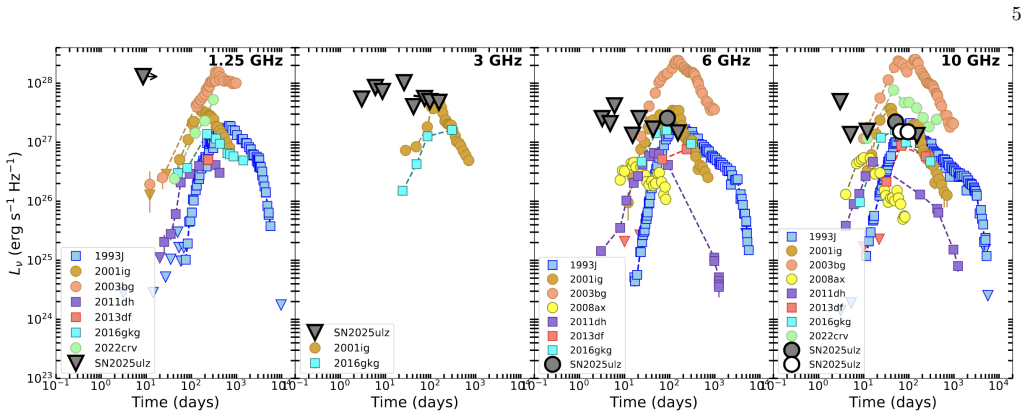
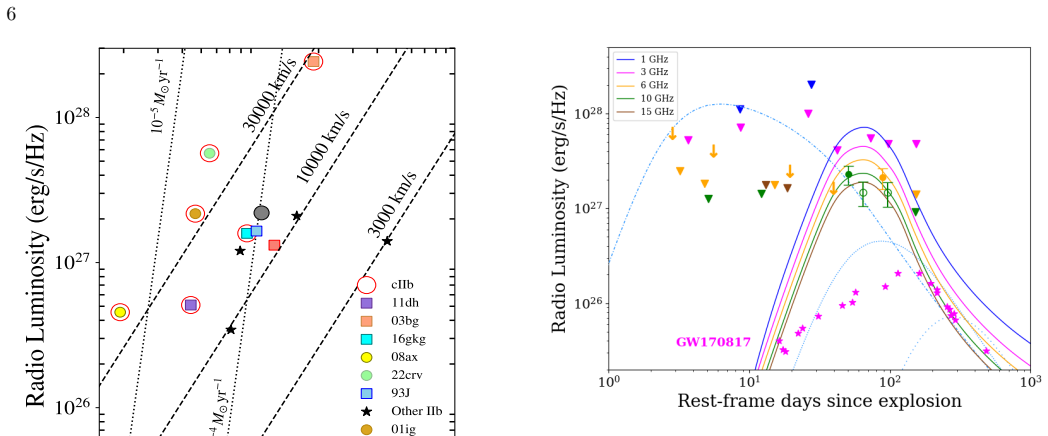
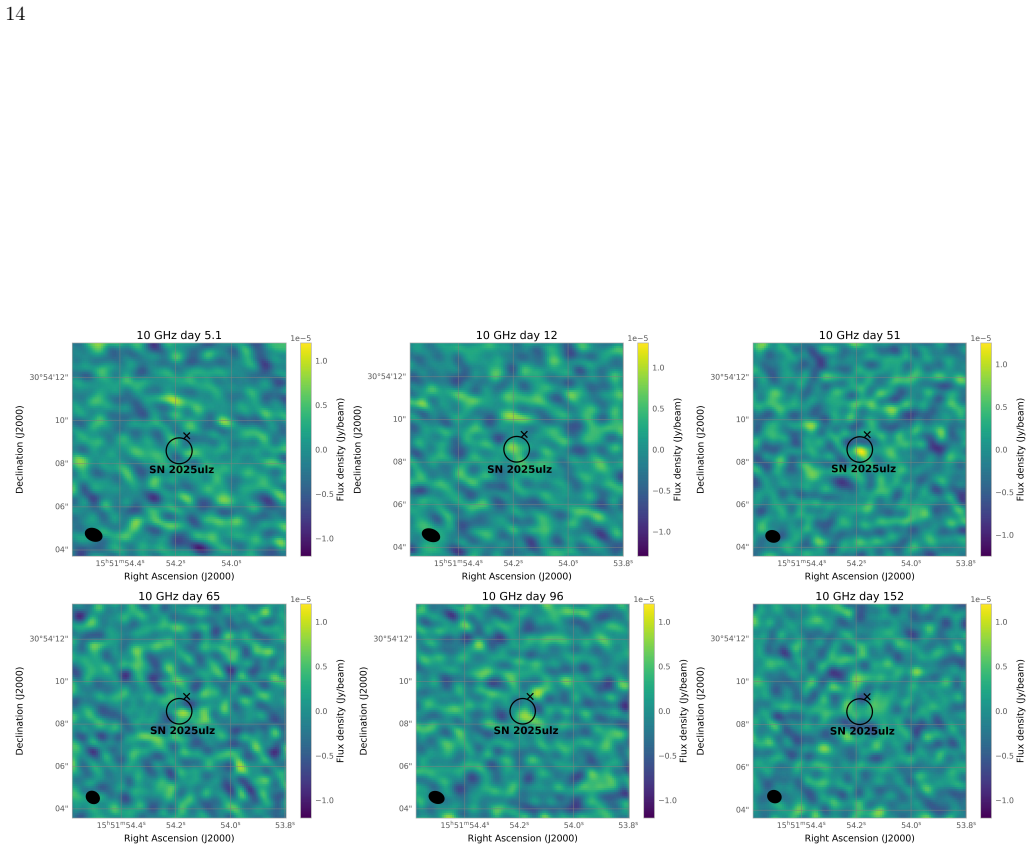
We detect a faint but significant radio counterpart to SN 2025ulz at 6-10 GHz. The data are consistent with non-thermal emission from SN ejecta interacting with circumstellar material, favoring a compact progenitor and relatively fast ejecta akin to those of Type cIIb SNe. Our data are also consistent with emission from an off-axis jet peaking at about 50-100 days after the GW trigger. Overall, our radio detection is compatible with a superkilonova scenario.
What carries the argument
Multi-frequency radio light curves and spectra that test supernova-circumstellar material interaction against off-axis jet models for the transient emission.
If this is right
- The radio properties favor a compact progenitor with fast ejecta for SN 2025ulz.
- The detection is compatible with emission from an off-axis jet linked to a central engine.
- The radio source supports a superkilonova interpretation if the gravitational-wave association holds.
- Systematic multi-wavelength follow-up of core-collapse events near sub-solar-mass neutron-star candidates is motivated.
Where Pith is reading between the lines
- Confirmation would suggest some Type IIb supernovae can be powered by merger remnants rather than standard core collapse.
- Radio monitoring could serve as a practical way to search for hidden jets or central engines in future gravitational-wave coincidences.
- The event might indicate new pathways for jet formation when a sub-solar-mass neutron star merges with a companion.
Load-bearing premise
The supernova SN 2025ulz is physically associated with the gravitational-wave candidate S250818k and the detected radio source is not an unrelated background object or calibration artifact.
What would settle it
An offline gravitational-wave analysis that finds no credible signal at the time and sky position of SN 2025ulz, or higher-resolution radio imaging that shows the emission is not centered on the optical supernova position.
Figures



read the original abstract
On 2025 August 18, the LIGO-Virgo-KAGRA collaboration reported S250818k, a sub-threshold gravitational-wave (GW) candidate consistent with a binary neutron star (NS) merger potentially involving a sub-solar-mass NS. Optical follow-up by the Zwicky Transient Facility identified AT2025ulz, a transient temporally coincident with the GW trigger that initially resembled a kilonova but was later classified as a young stripped-envelope Type IIb supernova (SN), dubbed SN 2025ulz. A key question is whether SN 2025ulz harbors fast, possibly collimated, non-thermal ejecta indicative of a central engine, as invoked in "superkilonova" scenarios linking sub-solar-mass NSs to accretion-disk fragmentation or core fission. We present early-to-late-time multi-band radio observations of SN 2025ulz obtained with the Karl G. Jansky Very Large Array as part of the JAGWAR program, complemented by observations with the upgraded Giant Metrewave Radio Telescope and MeerKAT. We detect a faint but significant radio counterpart to SN 2025ulz at 6-10 GHz. The data are consistent with non-thermal emission from SN ejecta interacting with circumstellar material, favoring a compact progenitor and relatively fast ejecta akin to those of Type cIIb SNe. Our data are also consistent with emission from an off-axis jet peaking at about 50-100 days after the GW trigger. Overall, our radio detection is compatible with a superkilonova scenario and would motivate future systematic multi-wavelength follow-up of core-collapse events coincident with sub-solar NS GW candidates, should the association between S250818k and SN 2025ulz be supported by offline GW analyses.
Editorial analysis
A structured set of objections, weighed in public.
Referee Report
Summary. The paper reports VLA, uGMRT, and MeerKAT radio observations of the optical transient SN 2025ulz, which is temporally coincident with the sub-threshold GW candidate S250818k. It claims detection of a faint but significant 6-10 GHz radio counterpart whose properties are consistent with non-thermal synchrotron emission from SN ejecta interacting with circumstellar material (favoring a compact progenitor and fast ejecta similar to Type cIIb SNe) or with an off-axis jet peaking at 50-100 days post-trigger. The detection is presented as compatible with a superkilonova scenario involving a sub-solar-mass NS, motivating future multi-wavelength follow-up of core-collapse events near sub-solar NS GW candidates, conditional on offline GW analyses confirming the association.
Significance. If the positional association, variability, and non-thermal nature of the radio source are robustly demonstrated, the result would provide one of the first multi-messenger links between a stripped-envelope SN and a sub-threshold BNS merger candidate, offering observational support for superkilonova models that invoke central engines or disk fragmentation. The multi-facility radio campaign (VLA + uGMRT + MeerKAT) is a methodological strength that enables broad frequency coverage and temporal sampling. However, the sub-threshold GW trigger and the faintness of the radio source mean the immediate impact on the field is modest until the associations are quantified and the emission mechanism is distinguished from background contaminants.
major comments (3)
- [Abstract and §3] Abstract and §3 (Observations and Data Reduction): The claim of a 'faint but significant radio counterpart' at 6-10 GHz is central to the paper, yet the provided text gives no quantitative values for flux density, RMS noise level, signal-to-noise ratio, or the measured positional offset relative to the optical SN position. Without these numbers and an explicit calculation of the chance-coincidence probability with unrelated background sources, the physical association cannot be evaluated and all downstream interpretations (CSM interaction or off-axis jet) rest on an unverified premise.
- [§4] §4 (Interpretation and Modeling): The statements that the data are 'consistent with non-thermal emission from SN ejecta interacting with circumstellar material' and 'also consistent with emission from an off-axis jet' are load-bearing for the superkilonova compatibility claim, but no light-curve data points, spectral indices, or model fits (e.g., equipartition parameters, ejecta velocity, CSM density profile) are shown or compared to reference Type cIIb or jet models. This absence prevents assessment of whether the observations actually favor a compact progenitor or merely remain compatible with multiple degenerate scenarios at the observed epochs.
- [Abstract and Discussion] Abstract and Discussion: The final claim that the radio detection is 'compatible with a superkilonova scenario' is explicitly conditioned on future offline GW analyses confirming the S250818k–SN 2025ulz association. Because the paper presents this compatibility as a key result and motivation for systematic follow-up, the evidential weight of the radio detection is undermined until the sub-threshold GW link is either strengthened or the interpretation is reframed as independent of the GW association.
minor comments (2)
- [Abstract] The abstract and introduction use 'superkilonova' without a concise definition or reference to the specific model (e.g., accretion-disk fragmentation or core fission) being tested; a brief clarifying sentence would improve accessibility.
- [Figures] Figure captions and axis labels should explicitly state the observing frequencies, array configurations, and whether the plotted points include upper limits or only detections to aid quick assessment of the temporal coverage.
Simulated Author's Rebuttal
We thank the referee for their detailed and constructive review. Their comments identify key areas where the presentation of quantitative results and interpretations can be strengthened. We address each major comment below and will revise the manuscript accordingly.
read point-by-point responses
-
Referee: [Abstract and §3] Abstract and §3 (Observations and Data Reduction): The claim of a 'faint but significant radio counterpart' at 6-10 GHz is central to the paper, yet the provided text gives no quantitative values for flux density, RMS noise level, signal-to-noise ratio, or the measured positional offset relative to the optical SN position. Without these numbers and an explicit calculation of the chance-coincidence probability with unrelated background sources, the physical association cannot be evaluated and all downstream interpretations (CSM interaction or off-axis jet) rest on an unverified premise.
Authors: We agree that explicit quantitative details are necessary to substantiate the detection claim. The observations section contains the underlying measurements, but they were not summarized with sufficient prominence in the abstract or the start of §3. In the revised manuscript we will explicitly report the flux density, RMS noise level, signal-to-noise ratio, and positional offset in both the abstract and §3. We will also add a calculation of the chance-coincidence probability using standard source-count methods for the relevant frequency and search radius. revision: yes
-
Referee: [§4] §4 (Interpretation and Modeling): The statements that the data are 'consistent with non-thermal emission from SN ejecta interacting with circumstellar material' and 'also consistent with emission from an off-axis jet' are load-bearing for the superkilonova compatibility claim, but no light-curve data points, spectral indices, or model fits (e.g., equipartition parameters, ejecta velocity, CSM density profile) are shown or compared to reference Type cIIb or jet models. This absence prevents assessment of whether the observations actually favor a compact progenitor or merely remain compatible with multiple degenerate scenarios at the observed epochs.
Authors: We acknowledge that the current §4 would benefit from a more explicit presentation of the supporting data. While the manuscript reports multi-epoch observations and notes a non-thermal spectrum, we will add a summary table of flux-density measurements, the derived spectral index, and basic equipartition estimates for ejecta velocity and CSM density in the revised version. Brief comparisons to published Type cIIb and off-axis jet models will also be included to illustrate consistency. A full parameter-grid modeling exercise lies beyond the scope of this discovery paper and is planned for follow-up work. revision: partial
-
Referee: [Abstract and Discussion] Abstract and Discussion: The final claim that the radio detection is 'compatible with a superkilonova scenario' is explicitly conditioned on future offline GW analyses confirming the S250818k–SN 2025ulz association. Because the paper presents this compatibility as a key result and motivation for systematic follow-up, the evidential weight of the radio detection is undermined until the sub-threshold GW link is either strengthened or the interpretation is reframed as independent of the GW association.
Authors: The manuscript already states the conditional nature of the superkilonova interpretation. We will revise the abstract and discussion to more clearly separate the independent scientific value of the radio detection (evidence of non-thermal emission in a stripped-envelope SN) from the additional, speculative multi-messenger implications that would follow if offline GW analyses confirm the association. This reframing preserves the conditional language while underscoring the radio result's standalone interest. revision: yes
Circularity Check
No significant circularity; observational consistency checks rely on external standard models
full rationale
The manuscript reports a radio detection and states that the data are consistent with non-thermal synchrotron emission from standard SN-CSM interaction or an off-axis jet, without presenting any internal derivation chain, fitted parameters renamed as predictions, or load-bearing self-citations. All physical interpretations invoke established astrophysical models external to the paper rather than reducing to the paper's own inputs by construction. The conditional nature of the GW-SN association is explicitly flagged and does not form part of any claimed first-principles result.
Axiom & Free-Parameter Ledger
axioms (1)
- domain assumption Standard synchrotron emission models apply to radio emission from supernova ejecta interacting with circumstellar material
Forward citations
Cited by 2 Pith papers
-
Eccentricity as a signature of hierarchical subsolar-mass mergers in collapsar disks
Numerical relativity simulations of hierarchical mergers in collapsar-disk geometry show eccentricity building to 0.6 and partially surviving (up to 0.1) to merger, offering a gravitational-wave signature for this for...
-
Electromagnetic Follow-up of the Sub-Solar Mass Gravitational Wave Candidate S251112cm: Kilonova Constraints and a Coincident IIb Supernova
No kilonova detected from sub-solar GW candidate S251112cm, but coincident IIb supernova SN 2025adtq yields suggestive evidence for the superkilonova channel, though inconclusive after accounting for chance coincidence.
Reference graph
Works this paper leans on
-
[1]
G., Abouelfettouh, I., Acernese, F., et al
Abac, A. G., Abouelfettouh, I., Acernese, F., et al. 2025, ApJL, 995, L18, doi: 10.3847/2041-8213/ae0c06
-
[2]
2017, PhRvL, 119, 161101, doi: 10.1103/PhysRevLett.119.161101
Abbott, B. P., Abbott, R., Abbott, T. D., et al. 2017, PhRvL, 119, 161101, doi: 10.1103/PhysRevLett.119.161101 9
-
[3]
Abbott, B. P., Abbott, R., Abbott, T. D., et al. 2017, The Astrophysical Journal Letters, 848, L12, doi: 10.3847/2041-8213/aa91c9
-
[4]
Abbott, B. P., Abbott, R., Abbott, T. D., et al. 2020, ApJL, 892, L3, doi: 10.3847/2041-8213/ab75f5
-
[5]
Abbott, R., Abbott, T. D., Abraham, S., et al. 2021, ApJL, 915, L5, doi: 10.3847/2041-8213/ac082e
-
[6]
Abbott, R., Abbott, T. D., Acernese, F., et al. 2023, Physical Review X, 13, 041039, doi: 10.1103/PhysRevX.13.041039
-
[7]
2025, GRB Coordinates Network, 41468, 1
Ackley, K., Kumar, A., O’Neill, D., et al. 2025, GRB Coordinates Network, 41468, 1
2025
-
[8]
D., Berger, E., Fong, W., et al
Alexander, K. D., Berger, E., Fong, W., et al. 2017, The Astrophysical Journal Letters, 848, L21, doi: 10.3847/2041-8213/aa905d
-
[9]
D., Margutti, R., Blanchard, P
Alexander, K. D., Margutti, R., Blanchard, P. K., et al. 2018, The Astrophysical Journal Letters, 863, L18, doi: 10.3847/2041-8213/aad637
-
[10]
P., et al
An, J., Liu, X., Zhu, Z. P., et al. 2025, GRB Coordinates Network, 41503, 1
2025
-
[11]
Andreoni, I., Ackley, K., Cooke, J., et al. 2017, Publications of the Astronomical Society of Australia, 34, doi: 10.1017/pasa.2017.65
-
[12]
M., Dornic, D., et al
Angulo, C., Watson, A. M., Dornic, D., et al. 2025, GRB Coordinates Network, 41518, 1
2025
-
[13]
2025, GRB Coordinates Network, 41519, 1
Antier, S., Pillas, M., Akl, D., et al. 2025, GRB Coordinates Network, 41519, 1
2025
-
[14]
2017, ApJ, 837, 119, doi: 10.3847/1538-4357/aa5ffa
Atteia, J.-L., Heussaff, V., Dezalay, J.-P., et al. 2017, ApJ, 837, 119, doi: 10.3847/1538-4357/aa5ffa
-
[15]
Balasubramanian, A., Corsi, A., Mooley, K. P., et al. 2021, The Astrophysical Journal Letters, 914, L20, doi: 10.3847/2041-8213/abfd38 —. 2022, The Astrophysical Journal, 938, 12, doi: 10.3847/1538-4357/ac9133
-
[16]
2014b, ARA&A, 52, 43, doi: 10.1146/annurev-astro-081913-035926
Berger, E. 2014, ARA&A, 52, 43, doi: 10.1146/annurev-astro-081913-035926
-
[17]
Berger, E., Kulkarni, S. R., Frail, D. A., & Soderberg, A. M. 2003, ApJ, 599, 408, doi: 10.1086/379214
-
[18]
2022, , 134, 114501, 10.1088/1538-3873/ac9642
Busmann, M., Hall, X. J., Gruen, D., et al. 2025b, GRB Coordinates Network, 41535, 1 CASA Team, Bean, B., Bhatnagar, S., et al. 2022, PASP, 134, 114501, doi: 10.1088/1538-3873/ac9642
-
[19]
2018, SSRv, 214, 27, doi: 10.1007/s11214-017-0461-6 —
Chandra, P. 2018, SSRv, 214, 27, doi: 10.1007/s11214-017-0461-6 —. 2025, arXiv e-prints, arXiv:2510.20913, doi: 10.48550/arXiv.2510.20913
-
[20]
Chen, Y.-X., & Metzger, B. D. 2025, ApJL, 991, L22, doi: 10.3847/2041-8213/ae045d
-
[21]
Chevalier, R. A. 1982, ApJ, 259, 302, doi: 10.1086/160167 —. 1998, ApJ, 499, 810, doi: 10.1086/305676
-
[22]
Chevalier, R. A., & Li, Z.-Y. 2000, ApJ, 536, 195, doi: 10.1086/308914
-
[23]
Chevalier, R. A., & Soderberg, A. M. 2010, ApJL, 711, L40, doi: 10.1088/2041-8205/711/1/L40
-
[24]
L., Margutti, R., Guidorzi, C., et al
Coppejans, D. L., Margutti, R., Guidorzi, C., et al. 2018, ApJ, 856, 56, doi: 10.3847/1538-4357/aab36e
-
[25]
Corsi, A., Ofek, E. O., Gal-Yam, A., et al. 2014, ApJ, 782, 42, doi: 10.1088/0004-637X/782/1/42
-
[26]
Corsi, A., Gal-Yam, A., Kulkarni, S. R., et al. 2016, ApJ, 830, 42, doi: 10.3847/0004-637X/830/1/42
-
[27]
Corsi, A., Cenko, S. B., Kasliwal, M. M., et al. 2017, ApJ, 847, 54, doi: 10.3847/1538-4357/aa85e5
-
[28]
Corsi, A., Hallinan, G. W., Lazzati, D., et al. 2018, ApJL, 861, L10, doi: 10.3847/2041-8213/aacdfd
-
[29]
Corsi, A., Ho, A. Y. Q., Cenko, S. B., et al. 2023, ApJ, 953, 179, doi: 10.3847/1538-4357/acd3f2 D’Avanzo, P., Botticella, M. T., Cappellaro, E., et al. 2025, GRB Coordinates Network, 41489, 1
-
[30]
Davies, M. B., King, A., Rosswog, S., & Wynn, G. 2002, ApJL, 579, L63, doi: 10.1086/345288 de Barra, C. 2025, GRB Coordinates Network, 41441, 1 De Colle, F., Kumar, P., & Aguilera-Dena, D. R. 2018, ApJ, 863, 32, doi: 10.3847/1538-4357/aad04d
-
[31]
Dobie, D., Kaplan, D. L., Murphy, T., et al. 2018, The Astrophysical Journal Letters, 858, L15, doi: 10.3847/2041-8213/aac105
-
[32]
Evans, P. A., Cenko, S. B., Kennea, J. A., et al. 2017, Science, 358, 1565–1570, doi: 10.1126/science.aap9580
-
[33]
2015, A&A, 577, A130, doi: 10.1051/0004-6361/201425191
Falanga, M., Bozzo, E., Lutovinov, A., et al. 2015, A&A, 577, A130, doi: 10.1051/0004-6361/201425191
-
[34]
Fong, W., Blanchard, P. K., Alexander, K. D., et al. 2019, ApJL, 883, L1, doi: 10.3847/2041-8213/ab3d9e 10
-
[35]
1998, ApJ, 509, 861, doi: 10.1086/306531
Fransson, C., & Bj¨ ornsson, C.-I. 1998, ApJ, 509, 861, doi: 10.1086/306531
-
[36]
Franz, N., Subrayan, B., Kilpatrick, C. D., et al. 2025, ApJL, 994, L45, doi: 10.3847/2041-8213/ae17a8
-
[37]
J., et al
Freeburn, J., O’Connor, B., Hall, X. J., et al. 2025, GRB Coordinates Network, 41507, 1
2025
-
[38]
L., Belczynski, K., Wiktorowicz, G., et al
Fryer, C. L., Belczynski, K., Wiktorowicz, G., et al. 2012, ApJ, 749, 91, doi: 10.1088/0004-637X/749/1/91
-
[39]
Gal-Yam, A., Ofek, E. O., Poznanski, D., et al. 2006, ApJ, 639, 331, doi: 10.1086/499157
-
[40]
Gillanders, J. H., Huber, M. E., Nicholl, M., et al. 2025b, ApJL, 995, L27, doi: 10.3847/2041-8213/ae2125
-
[41]
Haensel, P., Zdunik, J. L., & Douchin, F. 2002, A&A, 385, 301, doi: 10.1051/0004-6361:20020131
-
[42]
Hajela, A., Margutti, R., Alexander, K. D., et al. 2019, The Astrophysical Journal Letters, 886, L17, doi: 10.3847/2041-8213/ab5226
-
[43]
Hallinan, G., Corsi, A., Mooley, K. P., et al. 2017, Science, 358, 1579–1583, doi: 10.1126/science.aap9855
-
[44]
2020, oxkat: Semi-automated imaging of MeerKAT observations, Astrophysics Source Code Library, record ascl:2009.003
Heywood, I. 2020, oxkat: Semi-automated imaging of MeerKAT observations, Astrophysics Source Code Library, record ascl:2009.003. http://ascl.net/2009.003
2020
-
[45]
Ho, A. Y. Q., Kulkarni, S. R., Perley, D. A., et al. 2020a, ApJ, 902, 86, doi: 10.3847/1538-4357/aba630
-
[46]
Ho, A. Y. Q., Corsi, A., Cenko, S. B., et al. 2020b, ApJ, 893, 132, doi: 10.3847/1538-4357/ab7f3b
-
[47]
Horesh, A., Kulkarni, S. R., Corsi, A., et al. 2013, ApJ, 778, 63, doi: 10.1088/0004-637X/778/1/63
-
[48]
2019, Nature Astronomy, 3, 940, doi: 10.1038/s41550-019-0820-1
Hotokezaka, K., Nakar, E., Gottlieb, O., et al. 2019, Nature Astronomy, 3, 940, doi: 10.1038/s41550-019-0820-1
-
[49]
2015, MNRAS, 450, 1430, doi: 10.1093/mnras/stv620
Hotokezaka, K., & Piran, T. 2015, MNRAS, 450, 1430, doi: 10.1093/mnras/stv620
-
[50]
S., & Popov, D
Imshennik, V. S., & Popov, D. V. 1998, Astronomy Letters, 24, 206
1998
-
[51]
Kale, R., & Ishwara-Chandra, C. H. 2021, Experimental Astronomy, 51, 95, doi: 10.1007/s10686-020-09677-6
-
[52]
Kamble, A., Margutti, R., Soderberg, A. M., et al. 2016, ApJ, 818, 111, doi: 10.3847/0004-637X/818/2/111
-
[53]
M., Hall, X
Karambelkar, V., Kasliwal, M. M., Hall, X. J., Ztf Collaboration, & Growth Collaboration. 2025, GRB Coordinates Network, 41436, 1
2025
-
[54]
Kasliwal, M. M., Nakar, E., Singer, L. P., et al. 2017, Science, 358, 1559, doi: 10.1126/science.aap9455
-
[55]
Kasliwal, M. M., Ahumada, T., Stein, R., et al. 2025a, ApJL, 995, L59, doi: 10.3847/2041-8213/ae2000
-
[56]
M., Ahumada, T., Stein, R., et al
Kasliwal, M. M., Ahumada, T., Stein, R., et al. 2025c, arXiv e-prints, arXiv:2510.23732, doi: 10.48550/arXiv.2510.23732
-
[57]
R., Masters, J
Kent, B. R., Masters, J. S., Chandler, C. J., et al. 2020, in Astronomical Society of the Pacific Conference Series, Vol. 527, Astronomical Data Analysis Software and Systems XXIX, ed. R. Pizzo, E. R. Deul, J. D. Mol, J. de Plaa, & H. Verkouter, 571
2020
-
[58]
2025, GRB Coordinates Network, 41474, 1
Klose, S., Stecklum, B., Nicuesa Guelbenzu, A., & Ludwig, F. 2025, GRB Coordinates Network, 41474, 1
2025
-
[59]
Kulkarni, S. R., Frail, D. A., Wieringa, M. H., et al. 1998, Nature, 395, 663, doi: 10.1038/27139
-
[61]
Lamb, G. P., Lyman, J. D., Levan, A. J., et al. 2019, ApJL, 870, L15, doi: 10.3847/2041-8213/aaf96b
-
[62]
Lazzati, D., Perna, R., Morsony, B. J., et al. 2018, PhRvL, 120, 241103, doi: 10.1103/PhysRevLett.120.241103 Ligo Scientific Collaboration, VIRGO Collaboration, & Kagra Collaboration. 2025, GRB Coordinates Network, 41437, 1
-
[63]
2025, GRB Coordinates Network, 41534, 1
Lipunov, V., Gorbovskoy, E., Kuznetsov, A., et al. 2025, GRB Coordinates Network, 41534, 1
2025
-
[64]
Y., Xu, Z
Liu, Z. Y., Xu, Z. L., Meng, D. Z., et al. 2025, GRB Coordinates Network, 41461, 1
2025
-
[65]
M., Aykutalp, A., & Johnson, J
Lloyd-Ronning, N. M., Aykutalp, A., & Johnson, J. L. 2019, MNRAS, 488, 5823, doi: 10.1093/mnras/stz2155
-
[66]
MacFadyen, A. I., Woosley, S. E., & Heger, A. 2001, ApJ, 550, 410, doi: 10.1086/319698
-
[67]
Makhathini, S., Mooley, K. P., Brightman, M., et al. 2021, The Astrophysical Journal, 922, 154, doi: 10.3847/1538-4357/ac1ffc
-
[68]
B., Boye, A., Izzo, L., et al
Malesani, D. B., Boye, A., Izzo, L., et al. 2025, GRB Coordinates Network, 41492, 1
2025
-
[69]
Margutti, R., Soderberg, A. M., Wieringa, M. H., et al. 2013, ApJ, 778, 18, doi: 10.1088/0004-637X/778/1/18
-
[70]
Margutti, R., Alexander, K. D., Xie, X., et al. 2018, The Astrophysical Journal Letters, 856, L18, doi: 10.3847/2041-8213/aab2ad 11
-
[71]
2007, in Astronomical Society of the Pacific Conference Series, Vol
Golap, K. 2007, in Astronomical Society of the Pacific Conference Series, Vol. 376, Astronomical Data Analysis Software and Systems XVI, ed. R. A. Shaw, F. Hill, & D. J. Bell, 127
2007
-
[72]
Metzger, B. D., Hui, L., & Cantiello, M. 2024, ApJL, 971, L34, doi: 10.3847/2041-8213/ad6990
-
[73]
Metzger, B. D., Thompson, T. A., & Quataert, E. 2008, ApJ, 676, 1130, doi: 10.1086/526418
-
[74]
2025, GRB Coordinates Network, 41456, 1
Mo, G., Stein, R., Kasliwal, M., et al. 2025, GRB Coordinates Network, 41456, 1
2025
-
[75]
Mooley, K. P., Frail, D. A., Dobie, D., et al. 2018, The Astrophysical Journal Letters, 868, L11, doi: 10.3847/2041-8213/aaeda7 M¨ uller, B., Heger, A., & Powell, J. 2025, PhRvL, 134, 071403, doi: 10.1103/PhysRevLett.134.071403
-
[76]
& Piran, T.\ 2017, , 834, 1, 28
Nakar, E., & Piran, T. 2017, ApJ, 834, 28, doi: 10.3847/1538-4357/834/1/28
-
[77]
2024, arXiv e-prints, arXiv:2409.16852, doi: 10.48550/arXiv.2409.16852
Nedora, V., Crosato Menegazzi, L., Peretti, E., Dietrich, T., & Shibata, M. 2024, arXiv e-prints, arXiv:2409.16852, doi: 10.48550/arXiv.2409.16852
-
[78]
Menegazzi, L. C. 2023, Mon. Not. Roy. Astron. Soc, doi: 10.1093/mnras/stad175
-
[79]
R., Aamer, A., et al
Nicholl, M., Young, D. R., Aamer, A., et al. 2025, GRB Coordinates Network, 41439, 1
2025
-
[80]
Nynka, M., Ruan, J. J., Haggard, D., & Evans, P. A. 2018, The Astrophysical Journal Letters, 862, L19, doi: 10.3847/2041-8213/aad32d O’Connor, B., Freeburn, J., Hall, X. J., et al. 2025a, GRB Coordinates Network, 41452, 1 O’Connor, B., Ricci, R., Troja, E., et al. 2025b, arXiv e-prints, arXiv:2510.23728, doi: 10.48550/arXiv.2510.23728 O’Connor, B., Ricci,...
-
[81]
, archivePrefix = "arXiv", eprint =
Offringa, A. R., McKinley, B., Hurley-Walker, N., et al. 2014, MNRAS, 444, 606, doi: 10.1093/mnras/stu1368
discussion (0)
Sign in with ORCID, Apple, or X to comment. Anyone can read and Pith papers without signing in.