Recognition: 2 theorem links
· Lean TheoremElectromagnetic Follow-up of the Sub-Solar Mass Gravitational Wave Candidate S251112cm: Kilonova Constraints and a Coincident IIb Supernova
Pith reviewed 2026-05-12 03:17 UTC · model grok-4.3
The pith
A coincident Type IIb supernova with sub-solar mass GW candidate S251112cm suggests the superkilonova formation channel, though evidence remains inconclusive.
A machine-rendered reading of the paper's core claim, the machinery that carries it, and where it could break.
Core claim
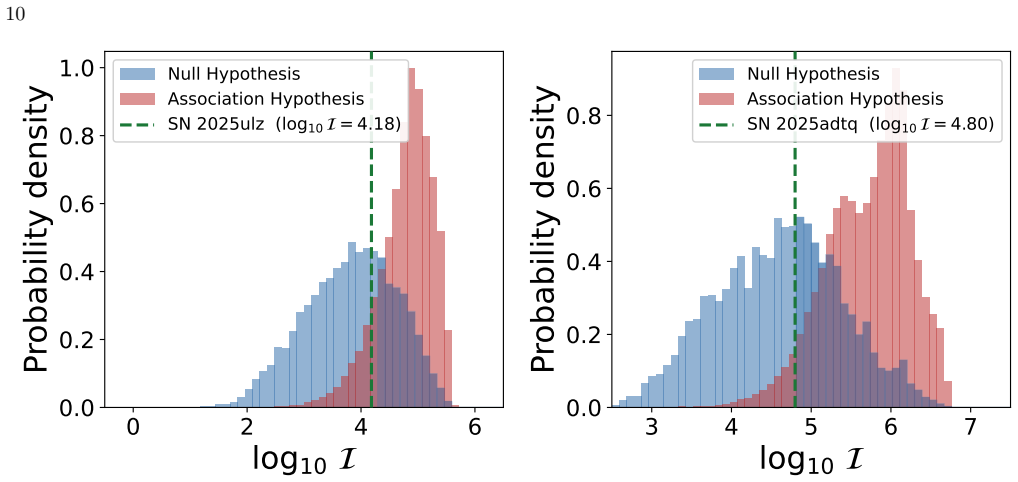
No kilonova counterpart is detected for the sub-solar mass gravitational wave candidate S251112cm, ruling out substantial portions of radiative-transfer models with DECam, ZTF, and FTW data, while a Type IIb supernova SN 2025adtq is found in spatial and temporal coincidence with an odds ratio of log10 I ≈4.8 and chance probability 2-9%; combined with a previous association this yields suggestive but inconclusive evidence favoring the disk-fragmentation superkilonova channel.
What carries the argument
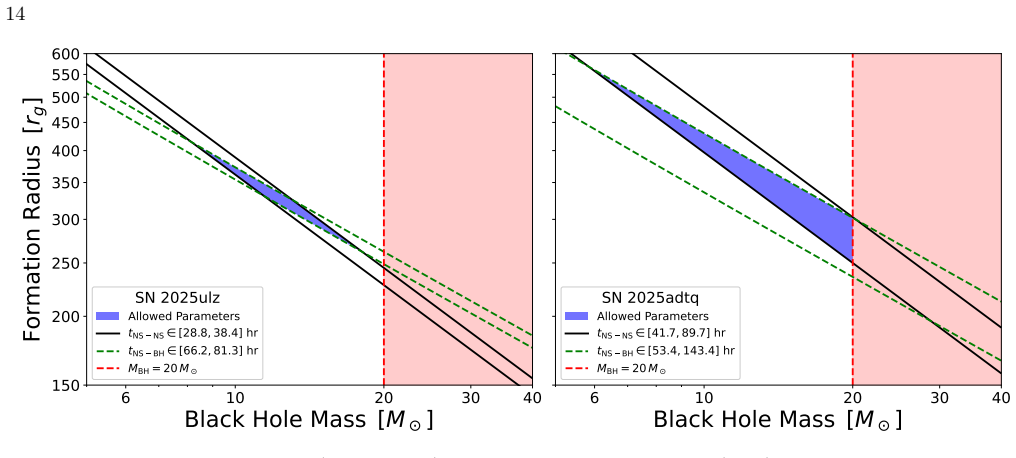
The disk-fragmentation (superkilonova) model, which posits that sub-solar mass neutron star mergers can arise from stellar core-collapse with a delay of less than a few days between the supernova explosion and the gravitational wave merger.
If this is right
- Sub-solar mass gravitational wave events may frequently be accompanied by recent Type IIb supernovae if the disk-fragmentation channel is active.
- Kilonova non-detections constrain the allowed parameter space of emission models for such events.
- Joint analysis of multiple events can refine the odds ratio favoring or disfavoring the superkilonova scenario.
- The short predicted delay time between supernova and merger sets a specific search window for future follow-up observations.
Where Pith is reading between the lines
- If the association is real, search strategies for electromagnetic counterparts should prioritize recent supernova catalogs in GW localization regions.
- This would connect some compact object mergers directly to core-collapse supernova physics, suggesting testable predictions for delay time distributions in upcoming LVK runs.
- The current inconclusive status indicates that larger samples of sub-solar mass events are needed to distinguish physical links from background alignments.
- Non-detections of kilonovae combined with supernova coincidences could motivate targeted spectroscopic searches in future alerts.
Load-bearing premise
The calculated spatial and temporal coincidence of SN 2025adtq with S251112cm reflects a physical association rather than random alignment, even after conditioning on the search for coincident supernovae.
What would settle it
Detection of multiple additional sub-solar mass GW candidates with no associated supernovae, or a refined calculation showing the chance coincidence probability significantly exceeds the reported 2-9% range, would undermine the physical association.
Figures








read the original abstract
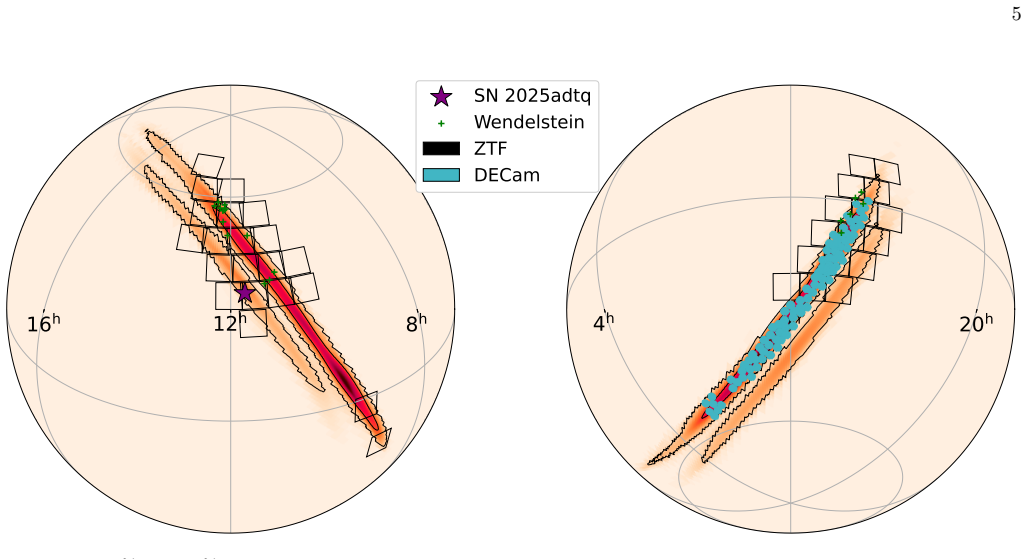
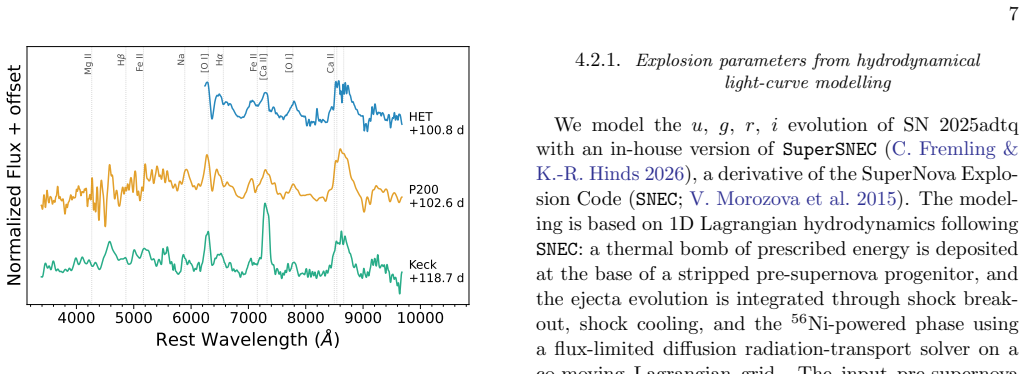
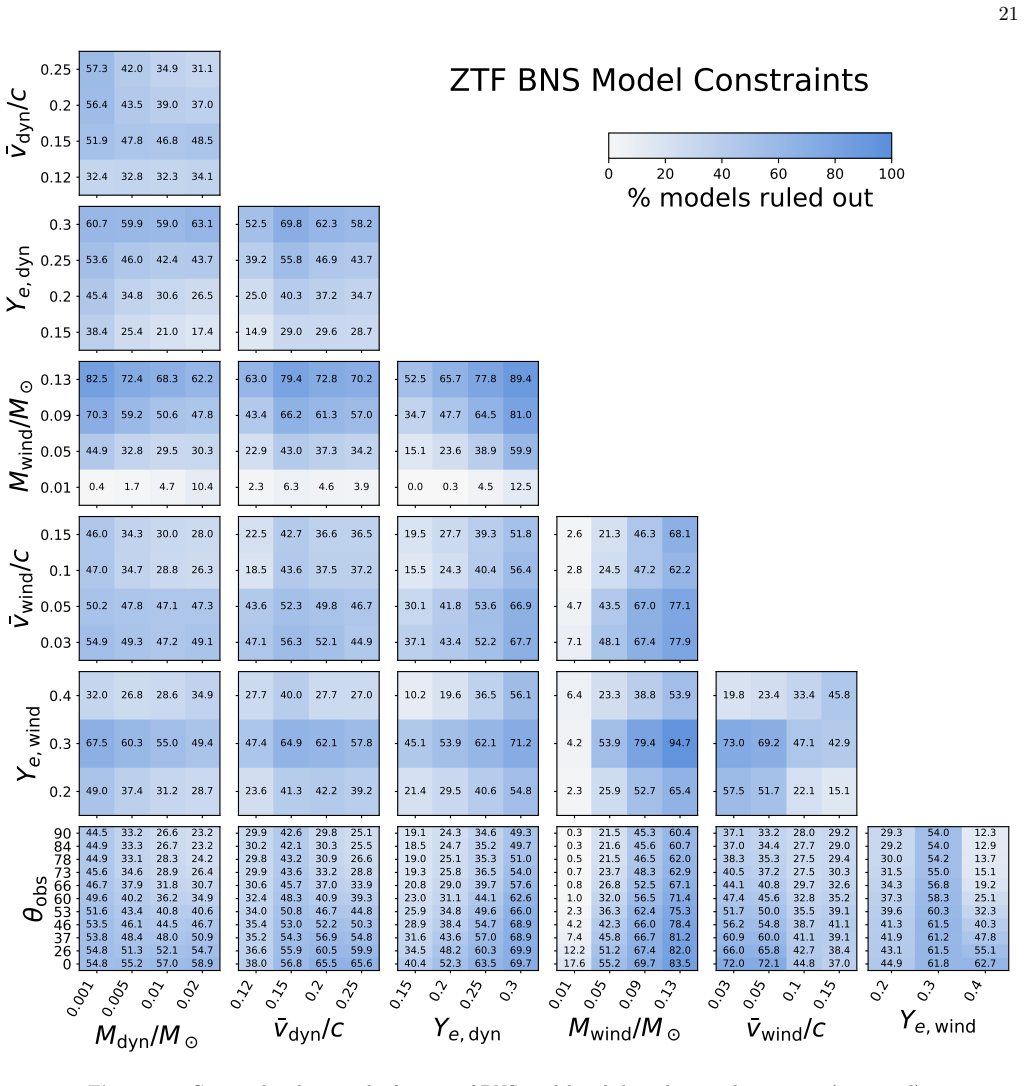
On November 12th, 2025 the LIGO--Virgo--KAGRA (LVK) collaboration reported gravitational waves (GWs) from a compact object merger candidate (S251112cm) with at least one sub-solar mass component. Using the Dark Energy Camera (DECam), the Fraunhofer Telescope at Wendelstein Observatory (FTW), and the Zwicky Transient Facility (ZTF), we surveyed $56\%$ of the GW localization region beginning $2.4$~hours after the GW alert. We find no kilonova (KN) counterpart, and use radiative-transfer models to rule out $42\%$ (ZTF), $68\%$ (DECam), and $92\%$ (FTW) of the KN models as possible emission from this GW candidate. Within the recently proposed disk-fragmentation (``superkilonova'') model for generating sub-solar mass neutron star mergers from stellar core-collapse, the delay between the supernova explosion time and the GW merger time is estimated to be less than a few days. Searching this time window prior to the GW event, we identify and spectroscopically classify a IIb supernova (SN~2025adtq), with a spatial association odds ratio of $\log_{10}\mathcal{I} \approx 4.8$, a chance coincidence probability of ${\sim}2$--$9\%$, and an estimated explosion time ${\sim}2$ days prior to S251112cm. SN~2025adtq is the second Type~IIb supernova found in spatial and temporal coincidence with a sub-solar mass GW candidate, following the previously reported S250818k/SN~2025ulz association; jointly, we measure an odds ratio that favors the association hypothesis over the null, however, when conditioned on finding a coincident supernova by chance, the odds ratio disfavors association. Together, these results provide suggestive but inconclusive evidence for the superkilonova formation channel.
Editorial analysis
A structured set of objections, weighed in public.
Referee Report
Summary. The manuscript reports no kilonova detection in the follow-up of GW candidate S251112cm using DECam, FTW, and ZTF, ruling out 42%, 68%, and 92% of KN models respectively. It identifies a spatially and temporally coincident Type IIb supernova SN 2025adtq with an odds ratio of log10 I ≈ 4.8 and chance probability 2-9%, and jointly with a previous association measures an odds ratio favoring association, though conditioning on the search disfavors it. The results are presented as suggestive but inconclusive evidence for the superkilonova (disk-fragmentation) formation channel for sub-solar mass mergers.
Significance. If the statistical association is robust, this work contributes important upper limits on kilonova emission from sub-solar mass compact object mergers and provides tentative observational support for an alternative formation channel involving core-collapse supernovae with short delay times. The multi-telescope strategy and spectroscopic classification strengthen the observational component. The cautious conclusion is well-matched to the small sample size.
major comments (1)
- The abstract states the odds ratio log10 I ≈4.8 and chance probability ~2-9% for the association of SN 2025adtq with S251112cm, but provides no description of how these quantities were calculated, including the null hypothesis, the effective search volume (solid angle and time window), priors on explosion times, spectroscopic classification criteria, or corrections for the targeted search for coincident supernovae. This information is necessary to assess whether the reported values indicate a physical association rather than a random coincidence, which underpins the claim of suggestive evidence for the superkilonova channel.
Simulated Author's Rebuttal
We thank the referee for their careful and constructive review of our manuscript. We address the major comment below and have revised the abstract to improve clarity on the statistical methodology while preserving the cautious interpretation of the results.
read point-by-point responses
-
Referee: The abstract states the odds ratio log10 I ≈4.8 and chance probability ~2-9% for the association of SN 2025adtq with S251112cm, but provides no description of how these quantities were calculated, including the null hypothesis, the effective search volume (solid angle and time window), priors on explosion times, spectroscopic classification criteria, or corrections for the targeted search for coincident supernovae. This information is necessary to assess whether the reported values indicate a physical association rather than a random coincidence, which underpins the claim of suggestive evidence for the superkilonova channel.
Authors: We agree that the abstract would benefit from a concise description of the methodology. The full calculation is detailed in the Methods section of the manuscript. The null hypothesis is the probability of a random spatial and temporal coincidence with a Type IIb supernova, computed using the local core-collapse supernova rate within the GW localization solid angle and the short (few-day) time window prior to the merger. The effective search volume incorporates the 56% coverage of the localization region and the temporal window. Priors on explosion times are taken as uniform over the delay interval allowed by the superkilonova model. Spectroscopic classification follows standard criteria based on the observed spectra. Because the search was conducted as part of the standard EM follow-up rather than a targeted supernova search, no additional selection corrections were applied beyond survey completeness. We will revise the abstract to include a brief summary of these elements to make the statistical basis more transparent without altering the overall length or the cautious conclusion that the evidence remains suggestive but inconclusive. revision: yes
Circularity Check
No significant circularity: observational data and statistical association tests
full rationale
The paper reports direct observational results (DECam/ZTF/FTW survey coverage, non-detection of kilonova, spectroscopic classification of SN 2025adtq) and computes spatial/temporal coincidence statistics (log10 I ≈4.8, 2-9% chance probability, joint odds ratio). No equations, derivations, model fittings, or predictions appear in the abstract. The odds ratio is presented as a statistical measure of association rather than a quantity derived from or fitted to the same dataset in a self-referential way. No self-citations, uniqueness theorems, or ansatzes are invoked. The work is self-contained observational analysis with no load-bearing steps that reduce to inputs by construction.
Axiom & Free-Parameter Ledger
Reference graph
Works this paper leans on
-
[1]
The Astrophysical Journal Supplement Series , volume =
Long, Gang and Song, Hanfeng and Li, Zheng and Jiang, Chunli and Luo, Xudong and Peng, Qiu-He , title =. The Astrophysical Journal Supplement Series , volume =. 2022 , doi =
work page 2022
-
[2]
arXiv e-prints , year = 2026, month = mar, eid =
SuperSNEC: Fast and Accurate Light Curve Production for Large Hydrodynamic Model Grids Using Adaptive Gridding. arXiv e-prints , year = 2026, month = mar, eid =. doi:10.48550/arXiv.2603.05680 , eprint =
-
[3]
, year = 2015, month = sep, volume =
Light Curves of Core-collapse Supernovae with Substantial Mass Loss Using the New Open-source SuperNova Explosion Code (SNEC). , year = 2015, month = sep, volume =. doi:10.1088/0004-637X/814/1/63 , eprint =
-
[4]
2011, ApJS, 192, 3, doi: 10.1088/0067-0049/192/1/3
Modules for Experiments in Stellar Astrophysics (MESA). , year = 2011, month = jan, volume =. doi:10.1088/0067-0049/192/1/3 , eprint =
-
[5]
2015, ApJS, 220, 15, doi: 10.1088/0067-0049/220/1/15
Modules for Experiments in Stellar Astrophysics (MESA): Binaries, Pulsations, and Explosions. , year = 2015, month = sep, volume =. doi:10.1088/0067-0049/220/1/15 , eprint =
work page internal anchor Pith review doi:10.1088/0067-0049/220/1/15 2015
-
[6]
, year = 2005, month = oct, volume =
Quantitative spectroscopic analysis of and distance to SN1999em. , year = 2005, month = oct, volume =. doi:10.1051/0004-6361:20053217 , eprint =
-
[7]
Evidence for a strong Ni bubble effect on the diffusion time
Light curve and spectral modelling of the type IIb SN 2020acat. Evidence for a strong Ni bubble effect on the diffusion time. , year = 2024, month = mar, volume =. doi:10.1051/0004-6361/202346718 , eprint =
-
[8]
, year = 2015, month = feb, volume =
The Type IIb SN 2011dh: Two years of observations and modelling of the lightcurves. , year = 2015, month = feb, volume =. doi:10.1051/0004-6361/201424592 , eprint =
-
[9]
Annual Review of Nuclear and Particle Science , keywords =
Long-Term Multidimensional Models of Core-Collapse Supernovae: Progress and Challenges. Annual Review of Nuclear and Particle Science , keywords =. doi:10.1146/annurev-nucl-121423-100945 , archivePrefix =. 2502.14836 , primaryClass =
-
[10]
Core-collapse supernova explosion theory. , keywords =. doi:10.1038/s41586-020-03059-w , archivePrefix =. 2009.14157 , primaryClass =
-
[11]
Annual Review of Nuclear and Particle Science , keywords =
Neutron Stars and the Nuclear Matter Equation of State. Annual Review of Nuclear and Particle Science , keywords =. doi:10.1146/annurev-nucl-102419-124827 , adsurl =
-
[12]
Effect of a High Opacity on the Light Curves of Radioactively Powered Transients from Compact Object Mergers. , keywords =. doi:10.1088/0004-637X/775/1/18 , archivePrefix =. 1303.5787 , primaryClass =
-
[13]
Binary neutron star mergers with a subsolar mass star. arXiv e-prints , keywords =. doi:10.48550/arXiv.2603.25102 , archivePrefix =. 2603.25102 , primaryClass =
-
[14]
Collapsars: Gamma-Ray Bursts and Explosions in ``Failed Supernovae''. , keywords =. doi:10.1086/307790 , archivePrefix =. astro-ph/9810274 , primaryClass =
-
[15]
Gamma-Ray Bursts, Supernova Kicks, and Gravitational Radiation. , keywords =. doi:10.1086/345288 , archivePrefix =. astro-ph/0204358 , primaryClass =
-
[17]
Ashton, Gregory and others. BILBY: A user-friendly Bayesian inference library for gravitational-wave astronomy. Astrophys. J. Suppl. 2019. doi:10.3847/1538-4365/ab06fc. arXiv:1811.02042
-
[18]
A joint ranking statistic for multi-messenger astronomical searches with gravitational waves
Piotrzkowski, Brandon and Baylor, Amanda and Hernandez, Ignacio Maga \ n a. A joint ranking statistic for multi-messenger astronomical searches with gravitational waves. Class. Quant. Grav. 2022. doi:10.1088/1361-6382/ac5c00. arXiv:2111.12814
-
[19]
Ashton, G. and Burns, E. and Canton, T. Dal and Dent, T. and Eggenstein, H. -B and Nielsen, A. B. and Prix, R. and Was, M. and Zhu, S. J. Coincident detection significance in multimessenger astronomy. Astrophys. J. 2018. doi:10.3847/1538-4357/aabfd2. arXiv:1712.05392
-
[21]
INTEGRAL Detection of the First Prompt Gamma-Ray Signal Coincident with the Gravitational-wave Event GW170817. , keywords =. doi:10.3847/2041-8213/aa8f94 , archivePrefix =. 1710.05449 , primaryClass =
-
[22]
2017, ApJL, 848, L14, doi: 10.3847/2041-8213/aa8f41
An Ordinary Short Gamma-Ray Burst with Extraordinary Implications: Fermi-GBM Detection of GRB 170817A. , keywords =. doi:10.3847/2041-8213/aa8f41 , archivePrefix =. 1710.05446 , primaryClass =
-
[23]
Follow Up of GW170817 and Its Electromagnetic Counterpart by Australian-Led Observing Programmes. , keywords =. doi:10.1017/pasa.2017.65 , archivePrefix =. 1710.05846 , primaryClass =
-
[24]
The X-ray counterpart to the gravitational-wave event GW170817. , keywords =. 2017. doi:10.1038/nature24290 , archivePrefix =. 1710.05433 , primaryClass =
-
[25]
Swift and NuSTAR observations of GW170817: Detection of a blue kilonova. Science , keywords =. doi:10.1126/science.aap9580 , archivePrefix =. 1710.05437 , primaryClass =
-
[26]
Kilpatrick, Charles D. and others. Hubble Space Telescope Observations of GW170817: Complete Light Curves and the Properties of the Galaxy Merger of NGC 4993. Astrophys. J. 2022. doi:10.3847/1538-4357/ac3e59. arXiv:2109.06211
-
[27]
Blanchard, P. K. and others. The Electromagnetic Counterpart of the Binary Neutron Star Merger LIGO/VIRGO GW170817. VII. Properties of the Host Galaxy and Constraints on the Merger Timescale. Astrophys. J. Lett. 2017. doi:10.3847/2041-8213/aa9055. arXiv:1710.05458
-
[28]
Light curves of the neutron star merger GW170817/SSS17a: Implications for r-process nucleosynthesis. Science , keywords =. doi:10.1126/science.aaq0049 , archivePrefix =. 1710.05443 , primaryClass =
-
[29]
Science358, 1556 (2017) https://doi.org/10.1126/science.aap9811 arXiv:1710.05452 [astro- ph.HE]
Swope Supernova Survey 2017a (SSS17a), the optical counterpart to a gravitational wave source. Science , keywords =. doi:10.1126/science.aap9811 , archivePrefix =. 1710.05452 , primaryClass =
-
[30]
GRB Coordinates Network , year = 2025, month = aug, volume =
LIGO/Virgo/KAGRA S250818k: Properties of the low-significance GW compact binary merger candidate potentially associated with AT 2025ulz. GRB Coordinates Network , year = 2025, month = aug, volume =
work page 2025
-
[31]
GRB Coordinates Network , year = 2025, month = aug, volume =
LIGO/Virgo/KAGRA S250818k: ENGRAVE observations of SN 2025ulz as a type II supernova. GRB Coordinates Network , year = 2025, month = aug, volume =
work page 2025
-
[32]
Ground-based and Airborne Telescopes III , year = 2010, editor =
The Pan-STARRS wide-field optical/NIR imaging survey. Ground-based and Airborne Telescopes III , year = 2010, editor =. doi:10.1117/12.859188 , adsurl =
-
[33]
The Two Micron All Sky Survey (2MASS). , keywords =. doi:10.1086/498708 , adsurl =
-
[34]
Ground-based and Airborne Telescopes V , year = 2014, editor =
Commissioning and science verification of the 2m-Fraunhofer Wendelstein Telescope. Ground-based and Airborne Telescopes V , year = 2014, editor =. doi:10.1117/12.2054498 , adsurl =
-
[35]
Prospector: Stellar population inference from spectra and SEDs
-
[36]
Transient Name Server AstroNote , keywords =
The DECam DESI Transient Survey (2DTS). Transient Name Server AstroNote , keywords =
-
[37]
Ground-based and Airborne Instrumentation for Astronomy VI , year = 2016, editor =
The Wendelstein three channel imager (3KK): alignment, commissioning, and first results. Ground-based and Airborne Instrumentation for Astronomy VI , year = 2016, editor =. doi:10.1117/12.2232039 , adsurl =
-
[38]
Optical emission from a kilonova following a gravitational-wave-detected neutron-star merger. , keywords =. doi:10.1038/nature24291 , archivePrefix =. 1710.05843 , primaryClass =
-
[39]
The Astropy Project: Sustaining and Growing a Community-oriented Open-source Project and the Latest Major Release (v5.0) of the Core Package. , keywords =. doi:10.3847/1538-4357/ac7c74 , archivePrefix =. 2206.14220 , primaryClass =
work page internal anchor Pith review Pith/arXiv arXiv doi:10.3847/1538-4357/ac7c74
-
[40]
The Astronomical Journal , author =
The Astropy Project: Building an Open-science Project and Status of the v2.0 Core Package. , keywords =. doi:10.3847/1538-3881/aabc4f , archivePrefix =. 1801.02634 , primaryClass =
-
[41]
Astropy: A community Python package for astronomy. , keywords =. 2013. doi:10.1051/0004-6361/201322068 , archivePrefix =. 1307.6212 , primaryClass =
-
[42]
SExtractor: Software for source extraction. , keywords =. 1996. doi:10.1051/aas:1996164 , adsurl =
-
[43]
Quantifying the Observational Effort Required for the Radial Velocity Characterization of TESS Planets. , keywords =. 2018. doi:10.3847/1538-3881/aacea9 , archivePrefix =. 1807.01263 , primaryClass =
-
[44]
X-Ray Scattering Echoes and Ghost Halos from the Intergalactic Medium: Relation to the Nature of AGN Variability. , keywords =. 2015. doi:10.1088/0004-637X/805/1/23 , archivePrefix =. 1503.01475 , primaryClass =
- [45]
-
[46]
T _ E X and LAT _ E X Macro Definition Files for Astronomical Publications. , year = "1989", month = "Mar", pages =
work page 1989
-
[47]
LaTeX: A Document Preparation System. 1994
work page 1994
-
[48]
Quasi-periodic Fast Propagating Magnetoacoustic Waves during the Magnetic Reconnection Between Solar Coronal Loops. , keywords =. 2018. doi:10.3847/2041-8213/aaf167 , archivePrefix =. 1811.08553 , primaryClass =
-
[49]
Nominal Values for Selected Solar and Planetary Quantities: IAU 2015 Resolution B3. , keywords =. 2016. doi:10.3847/0004-6256/152/2/41 , archivePrefix =. 1605.09788 , primaryClass =
-
[50]
Swift X-Ray Observations of Classical Novae. II. The Super Soft Source Sample. , keywords =. 2011. doi:10.1088/0067-0049/197/2/31 , archivePrefix =. 1110.6224 , primaryClass =
-
[51]
Galaxy Emission Line Classification Using Three-dimensional Line Ratio Diagrams. , keywords =. 2014. doi:10.1088/0004-637X/793/2/127 , archivePrefix =. 1406.5186 , primaryClass =
-
[52]
2024, AJ, 168, 245, doi: 10.3847/1538-3881/ad76a4
Overview of the. The Astronomical Journal , author =. 2024 , note =. doi:10.3847/1538-3881/ad76a4 , abstract =
-
[53]
Data Release 1 of the Dark Energy Spectroscopic Instrument
Data. 2025 , note =. doi:10.48550/arXiv.2503.14745 , abstract =
work page internal anchor Pith review doi:10.48550/arxiv.2503.14745 2025
-
[54]
arXiv.org , author =
-
[55]
2023, AJ, 165, 144, doi: 10.3847/1538-3881/acb212 18
The. The Astronomical Journal , author =. 2023 , note =. doi:10.3847/1538-3881/acb212 , abstract =
- [56]
-
[57]
Redrock. In Prep. 2025
work page 2025
-
[58]
D., Leja, J., Conroy, C., & Speagle, J
Stellar Population Inference with Prospector. , keywords =. doi:10.3847/1538-4365/abef67 , archivePrefix =. 2012.01426 , primaryClass =
work page internal anchor Pith review Pith/arXiv arXiv doi:10.3847/1538-4365/abef67 2012
-
[59]
Deriving Physical Properties from Broadband Photometry with Prospector: Description of the Model and a Demonstration of its Accuracy Using 129 Galaxies in the Local Universe. , keywords =. doi:10.3847/1538-4357/aa5ffe , archivePrefix =. 1609.09073 , primaryClass =
-
[60]
An updated. Astronomy and Astrophysics , author =. 2011 , note =. doi:10.1051/0004-6361/201116842 , abstract =
-
[62]
The Astrophysical Journal Supplement Series , author =
Revised. The Astrophysical Journal Supplement Series , author =. 2017 , note =. doi:10.3847/1538-4365/aa7053 , abstract =
-
[63]
Photometry of a complete sample of faint galaxies. , keywords =. doi:10.1086/190669 , adsurl =
-
[64]
The DESI Bright Galaxy Survey: Final Target Selection, Design, and Validation. , keywords =. doi:10.3847/1538-3881/accff8 , archivePrefix =. 2208.08512 , primaryClass =
-
[65]
GRB Coordinates Network , year = 2025, month = aug, volume =
LIGO/Virgo/KAGRA S250818k: Candidates from the Zwicky Transient Facility. GRB Coordinates Network , year = 2025, month = aug, volume =
work page 2025
-
[66]
The Astrophysical Journal , author =. 2025 , note =. doi:10.3847/2041-8213/ae16a6 , abstract =
-
[67]
Hall, Xander J. and Busmann, Malte and Koehn, Hauke and Kunnumkai, Keerthi and Palmese, Antonella and O'Connor, Brendan and Freeburn, James and Hu, Lei and Gruen, Daniel and Dietrich, Tim and Bulla, Mattia and Coughlin, Michael W. and Antier, Sarah and Pillas, Marion and Price, Paul A. and Ahumada, Tomás and Amsellem, Ariel and Andreoni, Igor and Augustin...
-
[68]
Hall, Xander J. and. in prep. , title =
-
[69]
Moustakas, J and. in prep. , title =
-
[70]
Jaeger, R and Dietrich, T and. in prep. , title =
-
[71]
The Astrophysical Journal , author =. 2025 , note =. doi:10.3847/2041-8213/ae2000 , abstract =
-
[72]
GRB Coordinates Network , year = 2025, month = aug, volume =
LIGO/Virgo/KAGRA S250818k: FTW Observations Show Continued Reddening of AT 2025ulz. GRB Coordinates Network , year = 2025, month = aug, volume =
work page 2025
-
[73]
Fragmentation of Collapsar Disks and the Production of Gravitational Waves. , keywords =. doi:10.1086/511672 , archivePrefix =. astro-ph/0610696 , primaryClass =
-
[74]
Fragmentation in Gravitationally Unstable Collapsar Disks and Subsolar Neutron Star Mergers. , keywords =. doi:10.3847/2041-8213/ad6990 , archivePrefix =. 2407.07955 , primaryClass =
-
[75]
Gravitational Instability and Fragmentation in Collapsar Disks Supports the Formation of Sub-Solar Neutron Stars. arXiv e-prints , keywords =. doi:10.48550/arXiv.2508.17183 , archivePrefix =. 2508.17183 , primaryClass =
-
[76]
Lerner, Y. and Stone, N. C. and Ofengeim, D. D. , month = may, year =. Fragmentation in. doi:10.48550/arXiv.2505.21617 , abstract =
-
[77]
ZTF18aalrxas: A Type IIb Supernova from a Very Extended Low-mass Progenitor. , keywords =. doi:10.3847/2041-8213/ab218f , archivePrefix =. 1903.09262 , primaryClass =
-
[78]
Gravitational wave cosmology and astrophysics with large spectroscopic galaxy surveys. , keywords =. doi:10.48550/arXiv.1903.04730 , archivePrefix =. 1903.04730 , primaryClass =
-
[79]
and Mucesh , Sunil and Hartley , William G
Palmese , Antonella and Bom , Clecio R. and Mucesh , Sunil and Hartley , William G. A Standard Siren Measurement of the Hubble Constant Using Gravitational-wave Events from the First Three LIGO/Virgo Observing Runs and the DESI Legacy Survey. Astrophys. J. 2023. doi:10.3847/1538-4357/aca6e3. arXiv:2111.06445
-
[80]
Research Notes of the American Astronomical Society , keywords =
A Dark Siren Measurement of the Hubble Constant with the LIGO/Virgo Gravitational Wave Event GW190412 and DESI Galaxies. Research Notes of the American Astronomical Society , keywords =. doi:10.3847/2515-5172/ad0eda , archivePrefix =. 2311.13062 , primaryClass =
-
[81]
2019, Nature Astronomy, 3, 940, doi: 10.1038/s41550-019-0820-1
Hotokezaka, Kenta and Nakar, Ehud and Gottlieb, Ore and Nissanke, Samaya and Masuda, Kento and Hallinan, Gregg and Mooley, Kunal P. and Deller, Adam. T. A Hubble constant measurement from superluminal motion of the jet in GW170817. Nature Astron. 2019. doi:10.1038/s41550-019-0820-1. arXiv:1806.10596
-
[82]
Amsellem, A. J. and others. Probing the Environment around GW170817 with DESI: Insights on Galaxy Group Peculiar Velocities for Standard Siren Measurements. Astrophys. J. 2026. doi:10.3847/1538-4357/ae4b37. arXiv:2512.08818
-
[83]
Challenges for Fast Radio Bursts as Multimessenger Sources from Binary Neutron Star Mergers. , keywords =. doi:10.3847/1538-4357/ad9023 , archivePrefix =. 2306.00948 , primaryClass =
discussion (0)
Sign in with ORCID, Apple, or X to comment. Anyone can read and Pith papers without signing in.