Recognition: no theorem link
Vehicle-as-Prompt: A Unified Deep Reinforcement Learning Framework for Heterogeneous Fleet Vehicle Routing Problem
Pith reviewed 2026-05-10 19:10 UTC · model grok-4.3
The pith
Treating vehicles as prompts enables a single deep reinforcement learning model to solve heterogeneous fleet vehicle routing problems across variants.
A machine-rendered reading of the paper's core claim, the machinery that carries it, and where it could break.
Core claim
The paper establishes that the Vehicle-as-Prompt formulation combined with a cross-semantic encoder and multi-view decoder in a deep reinforcement learning setup provides a unified approach for solving the heterogeneous fleet vehicle routing problem and its complex variants, leading to superior performance over other neural solvers and competitive results against heuristics with significantly reduced computation time and strong generalization to unseen instances.
What carries the argument
The Vehicle-as-Prompt (VaP) mechanism that formulates the heterogeneous routing problem as a single-stage autoregressive decision process, enabling the model to account for vehicle heterogeneity through prompting.
If this is right
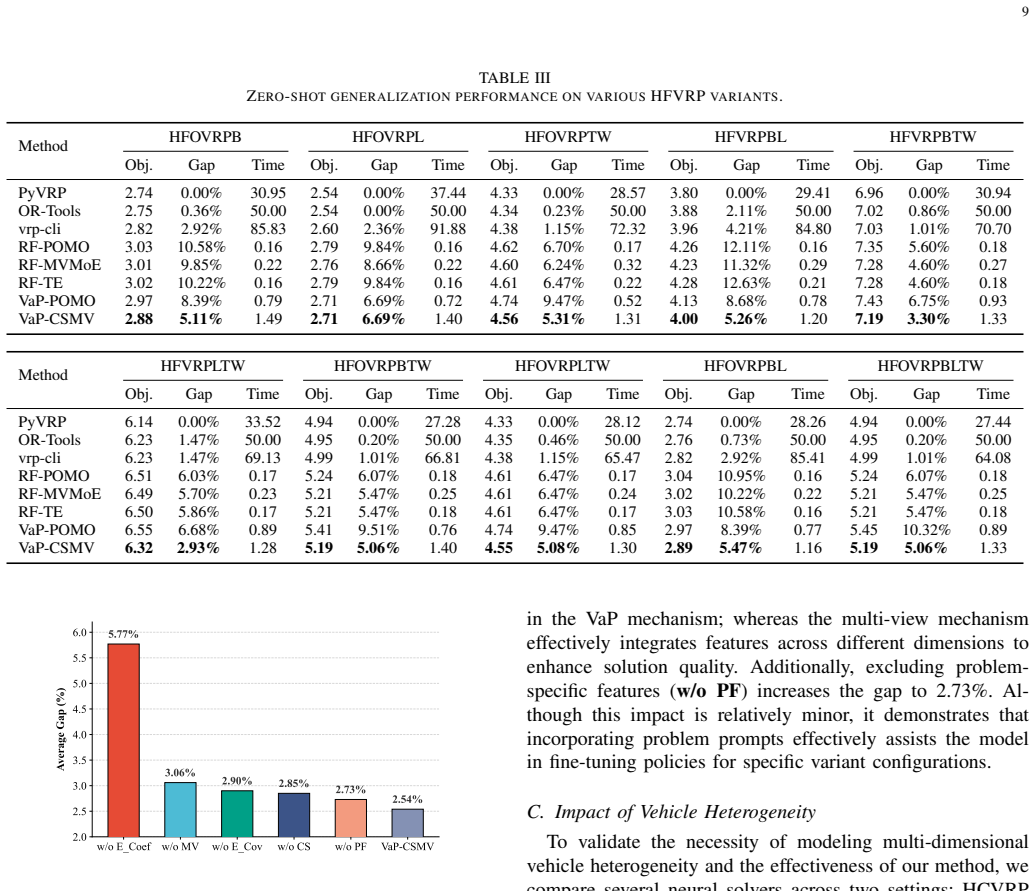
- VaP-CSMV significantly outperforms existing state-of-the-art DRL-based neural solvers on HFVRP.
- It achieves solution quality competitive with traditional heuristic solvers.
- Inference time reduces to mere seconds.
- The framework exhibits strong zero-shot generalization on large-scale and previously unseen problem variants.
Where Pith is reading between the lines
- The prompting approach could extend to other optimization settings where agent types vary, such as machine scheduling with different tool capabilities.
- Pairing VaP with streaming data updates might support dynamic rerouting in logistics without requiring complete retraining.
- The single-stage autoregressive structure may limit error buildup compared with sequential multi-stage routing models.
Load-bearing premise
The single-stage autoregressive formulation with Vehicle-as-Prompt plus the cross-semantic encoder and multi-view decoder can reliably capture the complex mapping between heterogeneous vehicle attributes and customer nodes across all stated variants without post-hoc tuning or hidden data selection.
What would settle it
Training the model on standard HFVRP instances then testing zero-shot on a much larger previously unseen variant with new constraints; if solution quality falls below heuristic levels or inference slows dramatically, the generalization and efficiency claims fail.
Figures



read the original abstract
Unlike traditional homogeneous routing problems, the Heterogeneous Fleet Vehicle Routing Problem (HFVRP) involves heterogeneous fixed costs, variable travel costs, and capacity constraints, rendering solution quality highly sensitive to vehicle selection. Furthermore, real-world logistics applications often impose additional complex constraints, markedly increasing computational complexity. However, most existing Deep Reinforcement Learning (DRL)-based methods are restricted to homogeneous scenarios, leading to suboptimal performance when applied to HFVRP and its complex variants. To bridge this gap, we investigate HFVRP under complex constraints and develop a unified DRL framework capable of solving the problem across various variant settings. We introduce the Vehicle-as-Prompt (VaP) mechanism, which formulates the problem as a single-stage autoregressive decision process. Building on this, we propose VaP-CSMV, a framework featuring a cross-semantic encoder and a multi-view decoder that effectively addresses various problem variants and captures the complex mapping relationships between vehicle heterogeneity and customer node attributes. Extensive experimental results demonstrate that VaP-CSMV significantly outperforms existing state-of-the-art DRL-based neural solvers and achieves competitive solution quality compared to traditional heuristic solvers, while reducing inference time to mere seconds. Furthermore, the framework exhibits strong zero-shot generalization capabilities on large-scale and previously unseen problem variants, while ablation studies validate the vital contribution of each component.
Editorial analysis
A structured set of objections, weighed in public.
Referee Report
Summary. The paper proposes VaP-CSMV, a unified DRL framework for solving the Heterogeneous Fleet Vehicle Routing Problem (HFVRP) and its complex variants. It introduces the Vehicle-as-Prompt (VaP) mechanism to cast the problem as a single-stage autoregressive decision process, augmented by a cross-semantic encoder and multi-view decoder that jointly handle heterogeneous vehicle costs, capacities, and customer attributes. The central empirical claims are that VaP-CSMV significantly outperforms existing DRL-based neural solvers, matches the solution quality of traditional heuristic solvers, reduces inference to seconds, and exhibits strong zero-shot generalization on large-scale and previously unseen problem instances, with ablation studies confirming the contribution of each component.
Significance. If the reported results hold, the work is significant because it extends DRL solvers beyond the homogeneous VRP setting that dominates the literature to the more realistic heterogeneous-fleet case with complex constraints. A single unified architecture that supports zero-shot transfer across variants could reduce the engineering overhead of problem-specific retraining, while the reported inference speed makes the method viable for dynamic logistics applications. The VaP formulation itself offers a clean architectural idea for injecting vehicle-level prompts into autoregressive routing policies.
major comments (2)
- [§4] §4 (Experiments): the central performance claims rest on tables that, per the abstract, are not accompanied by the number of independent runs, standard deviations, or statistical significance tests; without these, it is impossible to judge whether the reported outperformance over DRL baselines is robust or could be explained by variance.
- [§3.2] §3.2 (VaP mechanism): the claim that the single-stage autoregressive formulation plus cross-semantic encoder reliably captures the non-linear mapping between heterogeneous vehicle attributes and nodes for all listed variants is load-bearing; the manuscript should provide either an explicit ablation on constraint complexity or a counter-example analysis showing where the formulation breaks.
minor comments (2)
- [Abstract] Abstract: the phrase 'extensive experimental results' is used without any numeric anchors or table references, which is atypical for an empirical paper and makes the abstract less informative.
- [§3.3] Notation: the multi-view decoder equations would benefit from an accompanying diagram or pseudocode to clarify how the vehicle prompt is injected at each decoding step.
Simulated Author's Rebuttal
We thank the referee for the constructive feedback on experimental reporting and the robustness of the VaP formulation. We address each major comment below and will incorporate the suggested improvements in the revised manuscript.
read point-by-point responses
-
Referee: [§4] §4 (Experiments): the central performance claims rest on tables that, per the abstract, are not accompanied by the number of independent runs, standard deviations, or statistical significance tests; without these, it is impossible to judge whether the reported outperformance over DRL baselines is robust or could be explained by variance.
Authors: We agree that explicit reporting of run counts, variability, and significance testing strengthens the claims. Although the experiments were performed with multiple random seeds, these details were omitted from the tables. In the revision we will update every result table to report means and standard deviations over 5 independent runs and add paired t-tests (with p-values) against the DRL baselines to confirm statistical significance of the observed improvements. revision: yes
-
Referee: [§3.2] §3.2 (VaP mechanism): the claim that the single-stage autoregressive formulation plus cross-semantic encoder reliably captures the non-linear mapping between heterogeneous vehicle attributes and nodes for all listed variants is load-bearing; the manuscript should provide either an explicit ablation on constraint complexity or a counter-example analysis showing where the formulation breaks.
Authors: The existing ablation study (Section 4.4) already isolates the cross-semantic encoder and multi-view decoder and shows consistent gains across the listed HFVRP variants. The zero-shot generalization results on unseen scales and constraint combinations further support that the formulation captures the required mappings. To address the request directly, we will add a dedicated ablation that systematically increases constraint complexity (e.g., adding time windows and mixed constraints) and report any performance changes. No breaking cases were observed in the tested variants, but the new analysis will make this explicit. revision: yes
Circularity Check
No significant circularity detected
full rationale
The paper introduces an architectural proposal (Vehicle-as-Prompt formulation, cross-semantic encoder, multi-view decoder) for solving HFVRP variants via DRL and supports its performance claims through empirical evaluation on external benchmark instances and zero-shot tests. No derivation step reduces by construction to a fitted parameter, self-citation chain, or renamed input; the central mapping is presented as a learned model whose outputs are assessed against independent solvers and datasets rather than being tautological with its own training objectives.
Axiom & Free-Parameter Ledger
free parameters (1)
- Neural network hyperparameters and training schedule
axioms (1)
- domain assumption The HFVRP and its variants can be effectively cast as a single-stage autoregressive decision process
invented entities (1)
-
Vehicle-as-Prompt mechanism
no independent evidence
Reference graph
Works this paper leans on
-
[1]
On the history of combinatorial optimization (till 1960),
A. Schrijver, “On the history of combinatorial optimization (till 1960),” Handbooks in operations research and management science, vol. 12, pp. 1–68, 2005
1960
-
[2]
Goods consumed during transit in split delivery vehicle routing problems: Modeling and solution,
W. Yang, D. Wang, W. Pang, A.-H. Tan, and Y . Zhou, “Goods consumed during transit in split delivery vehicle routing problems: Modeling and solution,”IEEE Access, vol. 8, pp. 110 336–110 350, 2020
2020
-
[3]
A mathematical formulation and a tabu search heuristic for the joint vessel-uav routing problem,
Y . Li, S. Wang, S. Zhou, and Z. Wang, “A mathematical formulation and a tabu search heuristic for the joint vessel-uav routing problem,” Computers & Operations Research, vol. 169, p. 106723, 2024
2024
-
[4]
Collaborative vessel–unmanned aerial vehicle routing for time-window-constrained offshore parcel de- livery,
Y . Li, S. Wang, H. Sun, and S. Zhou, “Collaborative vessel–unmanned aerial vehicle routing for time-window-constrained offshore parcel de- livery,”Transportation Research Part C: Emerging Technologies, vol. 178, p. 105189, 2025
2025
-
[5]
A hybrid evolutionary algorithm for heterogeneous fleet vehicle routing problems with time windows,
C ¸ . Koc ¸, T. Bektas ¸, O. Jabali, and G. Laporte, “A hybrid evolutionary algorithm for heterogeneous fleet vehicle routing problems with time windows,”Computers & Operations Research, vol. 64, pp. 11–27, 2015
2015
-
[6]
Deep reinforcement learning for solving the heterogeneous capacitated vehicle routing problem,
J. Li, Y . Ma, R. Gao, Z. Cao, A. Lim, W. Song, and J. Zhang, “Deep reinforcement learning for solving the heterogeneous capacitated vehicle routing problem,”IEEE Transactions on Cybernetics, vol. 52, no. 12, pp. 13 572–13 585, 2022
2022
-
[7]
Branch-and-bound methods: A survey,
E. L. Lawler and D. E. Wood, “Branch-and-bound methods: A survey,” Operations research, vol. 14, no. 4, pp. 699–719, 1966
1966
-
[8]
An adaptive memory programming metaheuristic for the heterogeneous fixed fleet vehicle routing problem,
X. Li, P. Tian, and Y . Aneja, “An adaptive memory programming metaheuristic for the heterogeneous fixed fleet vehicle routing problem,” Transportation Research Part E: Logistics and Transportation Review, vol. 46, no. 6, pp. 1111–1127, 2010
2010
-
[9]
Attention, Learn to Solve Routing Problems!
W. Kool, H. Van Hoof, and M. Welling, “Attention, learn to solve routing problems!”arXiv preprint arXiv:1803.08475, 2018
work page Pith review arXiv 2018
-
[10]
Pomo: Policy optimization with multiple optima for reinforcement learning,
Y .-D. Kwon, J. Choo, B. Kim, I. Yoon, Y . Gwon, and S. Min, “Pomo: Policy optimization with multiple optima for reinforcement learning,”Advances in Neural Information Processing Systems, vol. 33, pp. 21 188–21 198, 2020
2020
-
[11]
Parallel autoregressive models for multi-agent combinatorial optimization,
F. Berto, C. Hua, L. Luttmann, J. Son, J. Park, K. Ahn, C. Kwon, L. Xie, and J. Park, “Parco: parallel autoregressive models for multi- agent combinatorial optimization,”arXiv preprint arXiv:2409.03811, 2024
-
[12]
X. Wu, D. Wang, C. Wu, K. Qi, C. Miao, Y . Xiao, J. Zhang, and Y . Zhou, “Efficient neural combinatorial optimization solver for the min- max heterogeneous capacitated vehicle routing problem,”arXiv preprint arXiv:2507.21386, 2025
-
[13]
X. Wu, D. Wang, L. Wen, Y . Xiao, C. Wu, Y . Wu, C. Yu, D. L. Maskell, and Y . Zhou, “Neural combinatorial optimization algorithms for solving vehicle routing problems: A comprehensive survey with perspectives,” arXiv preprint arXiv:2406.00415, 2024
-
[14]
Routefinder: Towards foundation models for vehicle routing problems,
F. Berto, C. Hua, N. G. Zepeda, A. Hottung, N. Wouda, L. Lan, J. Park, K. Tierney, and J. Park, “Routefinder: Towards foundation models for vehicle routing problems,”arXiv preprint arXiv:2406.15007, 2024
-
[15]
2d-ptr: 2d array pointer network for solving the heterogeneous capacitated vehicle routing problem,
Q. Liu, C. Liu, S. Niu, C. Long, J. Zhang, and M. Xu, “2d-ptr: 2d array pointer network for solving the heterogeneous capacitated vehicle routing problem,” inProceedings of the 23rd International Conference on Autonomous Agents and Multiagent Systems, 2024, pp. 1238–1246
2024
-
[16]
The fleet size and mix vehicle routing problem,
B. Golden, A. Assad, L. Levy, and F. Gheysens, “The fleet size and mix vehicle routing problem,”Computers & Operations Research, vol. 11, no. 1, pp. 49–66, 1984
1984
-
[17]
A heuristic column generation method for the heteroge- neous fleet vrp,
´E. D. Taillard, “A heuristic column generation method for the heteroge- neous fleet vrp,”RAIRO-Operations Research, vol. 33, no. 1, pp. 1–14, 1999
1999
-
[18]
Formulations and branch-and-cut algorithms for the heterogeneous fleet vehicle routing problem with soft time deadlines,
Y . Han and H. Yaman, “Formulations and branch-and-cut algorithms for the heterogeneous fleet vehicle routing problem with soft time deadlines,”Transportation Research Part B: Methodological, vol. 190, p. 103104, 2024
2024
-
[19]
A branch-and-price algorithm for the heterogeneous fleet green vehicle routing problem with time windows,
Y . Yu, S. Wang, J. Wang, and M. Huang, “A branch-and-price algorithm for the heterogeneous fleet green vehicle routing problem with time windows,”Transportation Research Part B: Methodological, vol. 122, pp. 511–527, 2019
2019
-
[20]
A hybrid population heuristic for the heterogeneous vehicle routing problems,
S. Liu, “A hybrid population heuristic for the heterogeneous vehicle routing problems,”Transportation Research Part E: Logistics and Trans- portation Review, vol. 54, pp. 67–78, 2013
2013
-
[21]
A tabu search heuristic for the heterogeneous vehicle routing problem on a multigraph,
D. S. Lai, O. C. Demirag, and J. M. Leung, “A tabu search heuristic for the heterogeneous vehicle routing problem on a multigraph,”Trans- portation Research Part E: Logistics and Transportation Review, vol. 86, pp. 32–52, 2016
2016
-
[22]
A hybrid algorithm for the heterogeneous fleet vehicle routing problem,
A. Subramanian, P. H. V . Penna, E. Uchoa, and L. S. Ochi, “A hybrid algorithm for the heterogeneous fleet vehicle routing problem,” European Journal of Operational Research, vol. 221, no. 2, pp. 285–295, 2012
2012
-
[23]
The mixed fleet vehicle routing problem with partial recharging by multiple chargers: Mathematical model and adaptive large neighborhood search,
S. D ¨onmez, C ¸ . Koc ¸, and F. Altıparmak, “The mixed fleet vehicle routing problem with partial recharging by multiple chargers: Mathematical model and adaptive large neighborhood search,”Transportation Re- search Part E: Logistics and Transportation Review, vol. 167, p. 102917, 2022
2022
-
[24]
Pointer networks,
O. Vinyals, M. Fortunato, and N. Jaitly, “Pointer networks,”Advances in neural information processing systems, vol. 28, 2015
2015
-
[25]
Neural Combinatorial Optimization with Reinforcement Learning
I. Bello, H. Pham, Q. V . Le, M. Norouzi, and S. Bengio, “Neural combinatorial optimization with reinforcement learning,”arXiv preprint arXiv:1611.09940, 2016
work page Pith review arXiv 2016
-
[26]
Sym-nco: Leveraging symmetricity for neural combinatorial optimization,
M. Kim, J. Park, and J. Park, “Sym-nco: Leveraging symmetricity for neural combinatorial optimization,”Advances in Neural Information Processing Systems, vol. 35, pp. 1936–1949, 2022
1936
-
[27]
Camp: Col- laborative attention model with profiles for vehicle routing problems,
C. Hua, F. Berto, J. Son, S. Kang, C. Kwon, and J. Park, “Camp: Col- laborative attention model with profiles for vehicle routing problems,” arXiv preprint arXiv:2501.02977, 2025
-
[28]
Mvmoe: Multi-task vehicle routing solver with mixture-of-experts,
J. Zhou, Z. Cao, Y . Wu, W. Song, Y . Ma, J. Zhang, and C. Xu, “Mvmoe: Multi-task vehicle routing solver with mixture-of-experts,” arXiv preprint arXiv:2405.01029, 2024
-
[29]
Simple statistical gradient-following algorithms for connectionist reinforcement learning,
R. J. Williams, “Simple statistical gradient-following algorithms for connectionist reinforcement learning,”Machine learning, vol. 8, no. 3, pp. 229–256, 1992
1992
-
[30]
Proximal Policy Optimization Algorithms
J. Schulman, F. Wolski, P. Dhariwal, A. Radford, and O. Klimov, “Prox- imal policy optimization algorithms,”arXiv preprint arXiv:1707.06347, 2017
work page internal anchor Pith review Pith/arXiv arXiv 2017
-
[31]
The Entropy Mechanism of Reinforcement Learning for Reasoning Language Models
G. Cui, Y . Zhang, J. Chen, L. Yuan, Z. Wang, Y . Zuo, H. Li, Y . Fan, H. Chen, W. Chenet al., “The entropy mechanism of re- inforcement learning for reasoning language models,”arXiv preprint arXiv:2505.22617, 2025
work page internal anchor Pith review arXiv 2025
-
[32]
Pyvrp: A high-performance vrp solver package,
N. A. Wouda, L. Lan, and W. Kool, “Pyvrp: A high-performance vrp solver package,”INFORMS Journal on Computing, vol. 36, no. 4, pp. 943–955, 2024
2024
-
[33]
Hybrid genetic search for the cvrp: Open-source implementa- tion and swap* neighborhood,
T. Vidal, “Hybrid genetic search for the cvrp: Open-source implementa- tion and swap* neighborhood,”Computers & Operations Research, vol. 140, p. 105643, 2022
2022
-
[34]
Or-tools,
L. Perron and V . Furnon, “Or-tools,” Google, 2023. [Online]. Available: https://developers.google.com/optimization/
2023
-
[35]
A new solver for rich Vehicle Routing Problem,
I. Builuk, “A new solver for rich Vehicle Routing Problem,” 2023. [Online]. Available: https://doi.org/10.5281/zenodo.4624037
discussion (0)
Sign in with ORCID, Apple, or X to comment. Anyone can read and Pith papers without signing in.