Recognition: no theorem link
Rethinking IRSTD: Single-Point Supervision Guided Encoder-only Framework is Enough for Infrared Small Target Detection
Pith reviewed 2026-05-10 20:02 UTC · model grok-4.3
The pith
Reformulating infrared small target detection as centroid regression with single-point probabilistic supervision enables competitive performance in an encoder-only network.
A machine-rendered reading of the paper's core claim, the machinery that carries it, and where it could break.
Core claim
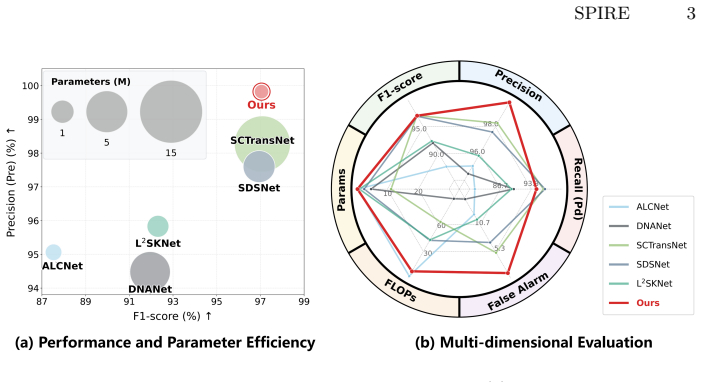
By recasting IRSTD as a centroid regression task and introducing SPIRE, the authors demonstrate that Point-Response Prior Supervision can convert single-point labels into probabilistic maps aligned with infrared target characteristics, allowing a High-Resolution Probabilistic Encoder to perform end-to-end regression that matches the target-level accuracy of full segmentation methods while lowering false alarm rates and computational cost on SIRST-UAVB and SIRST4.
What carries the argument
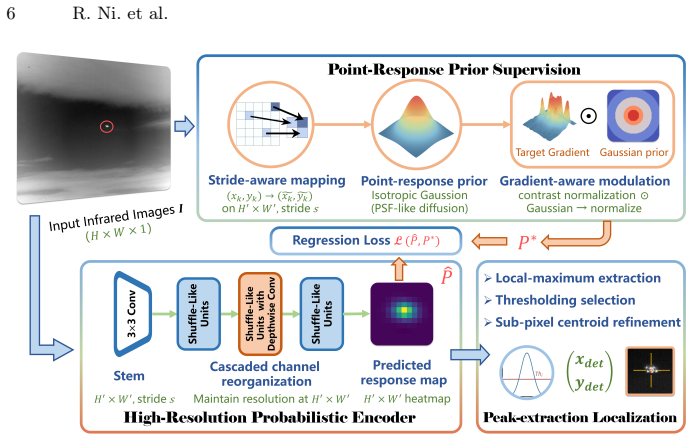
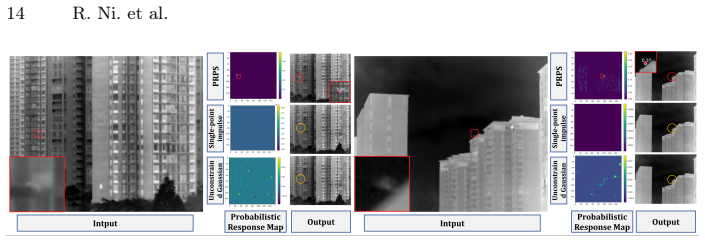
Point-Response Prior Supervision (PRPS) that builds a probabilistic response map from single-point annotations to match infrared point-target blur characteristics, paired with a High-Resolution Probabilistic Encoder (HRPE) that supports stable encoder-only centroid regression by keeping high-resolution features and denser supervision.
If this is right
- Achieves competitive target-level detection performance on SIRST-UAVB and SIRST4 benchmarks.
- Maintains consistently low false alarm rates across tested conditions.
- Reduces computational cost substantially by eliminating the decoder stage.
- Stabilizes training for sparse target distributions through higher-resolution features and increased effective supervision density.
Where Pith is reading between the lines
- The same single-point probabilistic mapping could be tested on other sparse-object problems such as star detection in astronomy images or lesion localization in medical scans where full masks are expensive.
- Lower compute opens the possibility of running detection directly on embedded hardware in drones or portable IR cameras without accuracy loss.
- The approach invites experiments on whether adding multi-scale priors to the response map further improves robustness when target sizes or clutter levels vary.
Load-bearing premise
That a probabilistic response map generated from single-point labels alone supplies enough consistent information to regress accurate target centroids without needing complete segmentation masks.
What would settle it
On the SIRST-UAVB or SIRST4 benchmarks, if the single-point method shows either a higher false alarm rate or lower target detection rate than comparable encoder-decoder segmentation baselines, the claim that the probabilistic map provides sufficient supervision would be refuted.
Figures


read the original abstract
Infrared small target detection (IRSTD) aims to separate small targets from clutter backgrounds. Extensive research is dedicated to the pixel-level supervision-guided "encoder-decoder" segmentation paradigm. Although having achieved promising performance, they neglect the fact that small targets only occupy a few pixels and are usually accompanied with blurred boundary caused by clutter backgrounds. Based on this observation, we argue that the first principle of IRSTD should be target localization instead of separating all target region accompanied with indistinguishable background noise. In this paper, we reformulate IRSTD as a centroid regression task and propose a novel Single-Point Supervision guided Infrared Probabilistic Response Encoding method (namely, SPIRE), which is indeed challenging due to the mismatch between reduced supervision network and equivalent output. Specifically, we first design a Point-Response Prior Supervision (PRPS), which transforms single-point annotations into probabilistic response map consistent with infrared point-target response characteristics, with a High-Resolution Probabilistic Encoder (HRPE) that enables encoder-only, end-to-end regression without decoder reconstruction. By preserving high-resolution features and increasing effective supervision density, SPIRE alleviates optimization instability under sparse target distributions. Finally, extensive experiments on various IRSTD benchmarks, including SIRST-UAVB and SIRST4 demonstrate that SPIRE achieves competitive target-level detection performance with consistently low false alarm rate (Fa) and significantly reduced computational cost. Code is publicly available at: https://github.com/NIRIXIANG/SPIRE-IRSTD.
Editorial analysis
A structured set of objections, weighed in public.
Referee Report
Summary. The paper reformulates infrared small target detection (IRSTD) as a centroid regression task rather than pixel-level segmentation. It introduces Point-Response Prior Supervision (PRPS) to convert single-point annotations into probabilistic response maps that match infrared point-target characteristics, paired with a High-Resolution Probabilistic Encoder (HRPE) that performs end-to-end regression in an encoder-only architecture without a decoder. Experiments on the SIRST-UAVB and SIRST4 benchmarks report competitive target-level detection performance, consistently low false-alarm rates, and substantially reduced computational cost relative to encoder-decoder baselines.
Significance. If the central claims hold, the work offers a meaningful shift toward sparse supervision and lighter architectures in IRSTD, lowering annotation burden and inference cost while maintaining detection quality. The public code release supports reproducibility and enables direct verification of the reported gains.
major comments (2)
- [§3.2] §3.2 (PRPS definition): The claim that PRPS supplies dense, stable gradients for accurate centroid regression rests on the chosen prior shape and variance matching the actual blurred point-spread function of real infrared targets. No sensitivity analysis or ablation on prior parameters is shown for targets with varying blur levels under clutter; if the prior is mis-centered or too narrow, the resulting supervision density becomes insufficient for the encoder-only pipeline, directly undermining both the low false-alarm claim and the assertion that 'encoder-only is enough'.
- [§4.2] §4.2 and Table 2: The reported competitive performance and low Fa on SIRST-UAVB/SIRST4 are presented without full disclosure of data splits, exact training protocols, or ablations isolating HRPE components versus the PRPS signal. This makes it impossible to determine whether the gains are attributable to the proposed supervision or to post-hoc tuning, weakening the load-bearing claim that single-point supervision suffices.
minor comments (2)
- [§1] The abstract and §1 repeatedly contrast the method with 'encoder-decoder' paradigms, yet no explicit complexity table (parameters, FLOPs, latency) is referenced in the main text; adding a dedicated row in Table 3 would strengthen the 'significantly reduced computational cost' assertion.
- [§3.3] Notation for the probabilistic response map (e.g., the exact functional form of the prior) is introduced in §3.1 but not cross-referenced in the HRPE description in §3.3; a single equation label would improve clarity.
Simulated Author's Rebuttal
We appreciate the referee's detailed review and valuable suggestions. We have carefully addressed the concerns regarding the PRPS formulation and experimental details. Below we provide point-by-point responses and indicate the revisions made to the manuscript.
read point-by-point responses
-
Referee: [§3.2] §3.2 (PRPS definition): The claim that PRPS supplies dense, stable gradients for accurate centroid regression rests on the chosen prior shape and variance matching the actual blurred point-spread function of real infrared targets. No sensitivity analysis or ablation on prior parameters is shown for targets with varying blur levels under clutter; if the prior is mis-centered or too narrow, the resulting supervision density becomes insufficient for the encoder-only pipeline, directly undermining both the low false-alarm claim and the assertion that 'encoder-only is enough'.
Authors: We thank the referee for highlighting this important aspect. The PRPS is designed based on the physical characteristics of infrared point targets, where the Gaussian-like response approximates the point spread function (PSF) under typical imaging conditions. While the manuscript demonstrates competitive performance across benchmarks with varying clutter levels, we acknowledge that a dedicated sensitivity analysis on prior parameters (e.g., variance and shape) for different blur levels would further validate the robustness. We have added such an ablation study in the revised manuscript, showing that performance remains stable within a reasonable range of parameters consistent with real IR data. This supports that the supervision provides sufficient density for the HRPE. revision: yes
-
Referee: [§4.2] §4.2 and Table 2: The reported competitive performance and low Fa on SIRST-UAVB/SIRST4 are presented without full disclosure of data splits, exact training protocols, or ablations isolating HRPE components versus the PRPS signal. This makes it impossible to determine whether the gains are attributable to the proposed supervision or to post-hoc tuning, weakening the load-bearing claim that single-point supervision suffices.
Authors: We agree that detailed disclosure of experimental protocols is essential for reproducibility. The original manuscript included the main training settings and data usage, but we have expanded Section 4.2 to provide complete information on data splits (e.g., train/test ratios for each benchmark), hyperparameter choices, and training procedures. Additionally, we have included new ablations that isolate the contributions of HRPE (high-resolution feature preservation) and PRPS (probabilistic supervision), demonstrating that both components are necessary for the observed performance and low false alarm rates. These revisions clarify that the gains stem from the proposed single-point supervision framework rather than tuning alone. revision: yes
Circularity Check
No circularity: supervision constructed from fixed prior, validated externally
full rationale
The paper's chain begins with single-point annotations, applies a fixed Point-Response Prior Supervision (PRPS) transformation to produce a probabilistic response map matching infrared point-target characteristics, then trains the High-Resolution Probabilistic Encoder (HRPE) to regress that map for centroid output. This is standard supervised regression with an independently constructed target map; no equation equates the model's output to its own fitted parameters or prior by definition. No self-citations are load-bearing in the provided text, no uniqueness theorems are imported from the authors, and no ansatz is smuggled. Performance claims rest on external benchmark results rather than tautological reduction.
Axiom & Free-Parameter Ledger
axioms (1)
- domain assumption Infrared point-target response characteristics can be captured by a probabilistic map derived from single-point annotations.
Forward citations
Cited by 1 Pith paper
-
Exploring the Limits of End-to-End Feature-Affinity Propagation for Single-Point Supervised Infrared Small Target Detection
GSACP performs online point-to-mask supervision via in-batch feature-affinity propagation for single-point IRSTD, reaching 0.6674 mIoU and 38% fewer false positives on SIRST3 while mapping self-referential drift limits.
Reference graph
Works this paper leans on
-
[1]
IEEE transactions on acoustics, speech, and signal processing35(1), 60–69 (1987)
Theoretical analysis of the max/median filter. IEEE transactions on acoustics, speech, and signal processing35(1), 60–69 (1987)
1987
-
[2]
In: Proceedings of the AAAI Conference on Artificial Intelligence
An, X., Zhao, L., Gong, C., Wang, N., Wang, D., Yang, J.: Sharpose: Sparse high- resolution representation for human pose estimation. In: Proceedings of the AAAI Conference on Artificial Intelligence. vol. 38, p. 691–699
-
[3]
In: Proceedings of the IEEE/CVF International Conference on Computer Vision
Atrash,A.,Ertekin,S.,Ugur,O.,Moured,O.,Chen,Y.,Zhang,J.:Ty-rist:Tactical yolo tricks for real-time infrared small target detection. In: Proceedings of the IEEE/CVF International Conference on Computer Vision. pp. 2201–2210 (2025) SPIRE 15
2025
-
[4]
IEEE Transactions on Geoscience and Remote Sensing56(4), 2452–2466 (2018)
Bai, X., Bi, Y.: Derivative entropy-based contrast measure for infrared small-target detection. IEEE Transactions on Geoscience and Remote Sensing56(4), 2452–2466 (2018)
2018
-
[5]
Pattern Recognition43(6), 2145–2156 (2010)
Bai, X., Zhou, F.: Analysis of new top-hat transformation and the application for infrared dim small target detection. Pattern Recognition43(6), 2145–2156 (2010)
2010
-
[6]
IEEE transactions on geoscience and remote sensing 52(1), 574–581 (2013)
Chen, C.P., Li, H., Wei, Y., Xia, T., Tang, Y.Y.: A local contrast method for small infrared target detection. IEEE transactions on geoscience and remote sensing 52(1), 574–581 (2013)
2013
-
[7]
Infrared Physics & Technology66, 114–124 (2014)
Chen, Z., Luo, S., Xie, T., Liu, J., Wang, G., Lei, G.: A novel infrared small target detection method based on bemd and local inverse entropy. Infrared Physics & Technology66, 114–124 (2014)
2014
-
[8]
Cheng, B., Xiao, B., Wang, J., Shi, H., Huang, T.S., Zhang, L.: Higherhrnet: Scale- awarerepresentationlearningforbottom-uphumanposeestimation(2020).https: //doi.org/10.1109/cvpr42600.2020.00543
-
[9]
In: IEEE International Conference on Computer Vision
Chuang Yu, Jinmiao Zhao, Y.L.: From easy to hard: Progressive active learning framework for infrared small target detection with single point supervision. In: IEEE International Conference on Computer Vision
-
[10]
IEEE transactions on geoscience and remote sensing61, 1–17 (2023)
Dai, Y., Li, X., Zhou, F., Qian, Y., Chen, Y., Yang, J.: One-stage cascade refine- ment networks for infrared small target detection. IEEE transactions on geoscience and remote sensing61, 1–17 (2023)
2023
-
[11]
Infrared Physics & Technology81, 182–194 (2017)
Dai, Y., Wu, Y., Song, Y., Guo, J.: Non-negative infrared patch-image model: Ro- bust target-background separation via partial sum minimization of singular values. Infrared Physics & Technology81, 182–194 (2017)
2017
-
[12]
In: Proceedings of the IEEE/CVF winter conference on applications of computer vision
Dai, Y., Wu, Y., Zhou, F., Barnard, K.: Asymmetric contextual modulation for in- frared small target detection. In: Proceedings of the IEEE/CVF winter conference on applications of computer vision. pp. 950–959 (2021)
2021
-
[13]
IEEE transactions on geoscience and remote sensing 59(11), 9813–9824 (2021)
Dai, Y., Wu, Y., Zhou, F., Barnard, K.: Attentional local contrast networks for in- frared small target detection. IEEE transactions on geoscience and remote sensing 59(11), 9813–9824 (2021)
2021
-
[14]
IEEE Transactions on Geoscience and Remote Sensing54(7), 4204–4214 (2016)
Deng, H., Sun, X., Liu, M., Ye, C., Zhou, X.: Small infrared target detection based on weighted local difference measure. IEEE Transactions on Geoscience and Remote Sensing54(7), 4204–4214 (2016)
2016
-
[15]
IEEE transactions on image processing22(12), 4996–5009 (2013)
Gao, C., Meng, D., Yang, Y., Wang, Y., Zhou, X., Hauptmann, A.G.: Infrared patch-image model for small target detection in a single image. IEEE transactions on image processing22(12), 4996–5009 (2013)
2013
-
[16]
Neurocomputing658, 131688 (2025)
He, W., Liu, M., Yu, Y.: Hybrid mask generation for infrared small target detection with single-point supervision. Neurocomputing658, 131688 (2025). https://doi.org/https://doi.org/10.1016/j.neucom.2025.131688,https: //www.sciencedirect.com/science/article/pii/S0925231225023604
-
[17]
Hou, Q., Zhang, L., Tan, F., Xi, Y., Zheng, H., Li, N.: Istdu-net: Infrared small- target detection u-net. IEEE Geoscience and Remote Sensing Letters19, 1–5 (2022).https://doi.org/10.1109/LGRS.2022.3141584
-
[18]
Li, B., Xiao, C., Wang, L., Wang, Y., Lin, Z., Li, M., An, W., Guo, Y.: Dense nested attention network for infrared small target detection. IEEE Trans Image Process 32, 1745–1758 (2023).https://doi.org/10.1109/TIP.2022.3199107,https: //www.ncbi.nlm.nih.gov/pubmed/35994532, li, Boyang Xiao, Chao Wang, Long- guang Wang, Yingqian Lin, Zaiping Li, Miao An, We...
-
[19]
In: Proceedings of the IEEE/CVF international conference on computer vision
Li, B., Wang, Y., Wang, L., Zhang, F., Liu, T., Lin, Z., An, W., Guo, Y.: Monte carlo linear clustering with single-point supervision is enough for infrared small target detection. In: Proceedings of the IEEE/CVF international conference on computer vision. p. 1009–1019
-
[20]
Sensors 25(9) (2025).https://doi.org/10.3390/s25092771,https://www.mdpi.com/ 1424-8220/25/9/2771
Li, N., Wei, D.: Redetr-ristd: Real-time long-range infrared small target detec- tion network based on the reparameterized efficient detection transformer. Sensors 25(9) (2025).https://doi.org/10.3390/s25092771,https://www.mdpi.com/ 1424-8220/25/9/2771
-
[21]
Pattern Recognition77, 113–125 (2018)
Li, Y., Zhang, Y.: Robust infrared small target detection using local steering kernel reconstruction. Pattern Recognition77, 113–125 (2018)
2018
-
[22]
In: Proceedings of the IEEE/CVF Conference on Computer Vision and Pattern Recognition
Liu, Q., Liu, R., Zheng, B., Wang, H., Fu, Y.: Infrared small target detection with scale and location sensitivity. In: Proceedings of the IEEE/CVF Conference on Computer Vision and Pattern Recognition. p. 17490–17499
-
[23]
A Survey on Mixture of Experts in Large Language Models , ISSN=
Ni, R., Wu, J., Qiu, Z., Chen, L., Luo, C., Huang, F., Liu, Q., Wang, B., Li, Y., Li, Y.: Point-to-point regression: Accurate infrared small target detection with single- point annotation. IEEE Transactions on Geoscience and Remote Sensing63, 1–19 (2025).https://doi.org/10.1109/tgrs.2025.3554025
-
[24]
In: PROCEEDINGS OF THE THIRTY-THIRD IN- TERNATIONAL JOINT CONFERENCE ON ARTIFICIAL INTELLIGENCE, IJCAI 2024
Song, I., Lee, J., Ryu, M., Lee, J.: Motion-aware heatmap regression for human pose estimation in videos. In: PROCEEDINGS OF THE THIRTY-THIRD IN- TERNATIONAL JOINT CONFERENCE ON ARTIFICIAL INTELLIGENCE, IJCAI 2024. p. 1245–1253. IJCAI-INT JOINT CONF ARTIF INTELL
2024
-
[25]
Sun, H., Bai, J., Yang, F., Bai, X.: Receptive-field and direction induced attention network for infrared dim small target detection with a large-scale dataset irdst. IEEE Transactions on Geoscience and Remote Sensing61, 1–13 (2023).https: //doi.org/10.1109/TGRS.2023.3235150
-
[26]
IEEE Transactions on Geoscience and Remote Sensing62, 1–19 (2024).https://doi
Tong, X., Zuo, Z., Su, S., Wei, J., Sun, X., Wu, P., Zhao, Z.: St-trans: Spatial- temporal transformer for infrared smalltarget detection in sequential images. IEEE Transactions on Geoscience and Remote Sensing62, 1–19 (2024).https://doi. org/10.1109/tgrs.2024.3355947
-
[27]
https://doi.org/10.1109/TPAMI.2020.2983686,https://www.ncbi.nlm.nih
Wang, J., Sun, K., Cheng, T., Jiang, B., Deng, C., Zhao, Y., Liu, D., Mu, Y., Tan, M., Wang, X., Liu, W., Xiao, B.: Deep high-resolution representation learning for visualrecognition.IEEETransPatternAnalMachIntell43(10),3349–3364(2021). https://doi.org/10.1109/TPAMI.2020.2983686,https://www.ncbi.nlm.nih. gov/pubmed/32248092, wang, Jingdong Sun, Ke Cheng, ...
-
[28]
IEEE Journal of Selected TopicsinAppliedEarthObservationsandRemoteSensing17,11146–11162(2024)
Wang, W., Xiao, C., Dou, H., Liang, R., Yuan, H., Zhao, G., Chen, Z., Huang, Y.: Ispanet: A pyramid self-attention network for single-frame high-resolution infrared small target detection with a large-scale dataset shr-irst. IEEE Journal of Selected TopicsinAppliedEarthObservationsandRemoteSensing17,11146–11162(2024). https://doi.org/10.1109/jstars.2024.3381779
-
[29]
Wu, F., Liu, A., Zhang, T., Zhang, L., Luo, J., Peng, Z.: Saliency at the helm: Steering infrared small target detection with learnable kernels. IEEE Transactions on Geoscience and Remote Sensing63, 1–14 (2025).https://doi.org/10.1109/ tgrs.2024.3521947
-
[30]
Pattern Recognition169(2026).https://doi.org/10.1016/j.patcog.2025.111958 SPIRE 17
Wu, J., Luo, C., Qiu, Z., Chen, L., Ni, R., Li, Y., Huang, F., Wu, J.: Dfinet: Dynamic feedback iterative network for infrared small target detection. Pattern Recognition169(2026).https://doi.org/10.1016/j.patcog.2025.111958 SPIRE 17
-
[31]
Wu, X., Hong, D., Chanussot, J.: Uiu-net: U-net in u-net for infrared small ob- ject detection. IEEE Trans Image Process32, 364–376 (2023).https://doi.org/ 10.1109/TIP.2022.3228497,https://www.ncbi.nlm.nih.gov/pubmed/37015404, wu, Xin Hong, Danfeng Chanussot, Jocelyn eng 2023/04/05 IEEE Trans Image Process. 2023;32:364-376. doi: 10.1109/TIP.2022.3228497. ...
-
[32]
IEEE Transactions on Geoscience and Remote Sensing61, 1–16 (2023)
Xu, H., Zhong, S., Zhang, T., Zou, X.: Multiscale multilevel residual feature fusion for real-time infrared small target detection. IEEE Transactions on Geoscience and Remote Sensing61, 1–16 (2023)
2023
-
[33]
IEEE Transactions on Geoscience and Remote Sensing63, 1–15 (2025)
Xu, M., Yu, C., Li, Z., Tang, H., Hu, Y., Nie, L.: Hdnet: A hybrid domain network with multiscale high-frequency information enhancement for infrared small-target detection. IEEE Transactions on Geoscience and Remote Sensing63, 1–15 (2025). https://doi.org/10.1109/tgrs.2025.3574962
-
[34]
IEEE Transactions on Geoscience and Remote Sensing62, 1–11 (2024)
Yang, B., Zhang, X., Zhang, J., Luo, J., Zhou, M., Pi, Y.: Eflnet: Enhancing fea- ture learning network for infrared small target detection. IEEE Transactions on Geoscience and Remote Sensing62, 1–11 (2024)
2024
-
[35]
In: Proceedings of the AAAI Conference on Artificial Intelligence
Yang, J., Liu, S., Wu, J., Su, X., Hai, N., Huang, X.: Pinwheel-shaped convolution and scale-based dynamic loss for infrared small target detection. In: Proceedings of the AAAI Conference on Artificial Intelligence. vol. 39, p. 9202–9210
-
[36]
In: 2023 IEEE/CVF Conference on Computer Vision and Pattern Recogni- tion (CVPR), pp
Ying, X., Liu, L., Wang, Y., Li, R., Chen, N., Lin, Z., Sheng, W., Zhou, S.: Map- ping degeneration meets label evolution: Learning infrared small target detection with single point supervision. In: 2023 IEEE/CVF Conference on Computer Vision and Pattern Recognition (CVPR). p. 15528–15538.https://doi.org/10.1109/ cvpr52729.2023.01490
-
[37]
Yuan, S., Qin, H., Yan, X., Akhtar, N., Mian, A.: Sctransnet: Spatial-channel cross transformer network for infrared small target detection. IEEE Transactions on Geoscience and Remote Sensing62, 1–15 (2024).https://doi.org/10.1109/ tgrs.2024.3383649
-
[38]
Yue, T., Lu, X., Cai, J., Chen, Y., Chu, S.: Sds-net: Shallow–deep synergism- detection network for infrared small target detection. IEEE Transactions on Geo- science and Remote Sensing63, 1–13 (2025).https://doi.org/10.1109/tgrs. 2025.3588117
-
[39]
In: Proceedings of the 30th ACM International Conference on Multimedia
Zhang, M., Yue, K., Zhang, J., Li, Y., Gao, X.: Exploring feature compensation and cross-level correlation for infrared small target detection. In: Proceedings of the 30th ACM International Conference on Multimedia. pp. 1857–1865 (2022)
2022
-
[40]
In: Proceedings of the IEEE/CVF conference on computer vision and pattern recognition
Zhang, M., Zhang, R., Yang, Y., Bai, H., Zhang, J., Guo, J.: Isnet: Shape matters for infrared small target detection. In: Proceedings of the IEEE/CVF conference on computer vision and pattern recognition. pp. 877–886 (2022)
2022
-
[41]
In: Proceedings of the IEEE conference on computer vision and pattern recognition
Zhang, X., Zhou, X., Lin, M., Sun, J.: Shufflenet: An extremely efficient convolu- tional neural network for mobile devices. In: Proceedings of the IEEE conference on computer vision and pattern recognition. pp. 6848–6856 (2018)
2018
-
[42]
IEEE Transactions on Geoscience and Remote Sensing62, 1–19 (2024)
Zhao, E., Dong, L., Li, C., Ji, Y.: Infrared maritime target detection based on temporal weight and total variation regularization under strong wave interferences. IEEE Transactions on Geoscience and Remote Sensing62, 1–19 (2024)
2024
discussion (0)
Sign in with ORCID, Apple, or X to comment. Anyone can read and Pith papers without signing in.