Recognition: 2 theorem links
· Lean TheoremPRISM-MCTS: Learning from Reasoning Trajectories with Metacognitive Reflection
Pith reviewed 2026-05-10 18:51 UTC · model grok-4.3
The pith
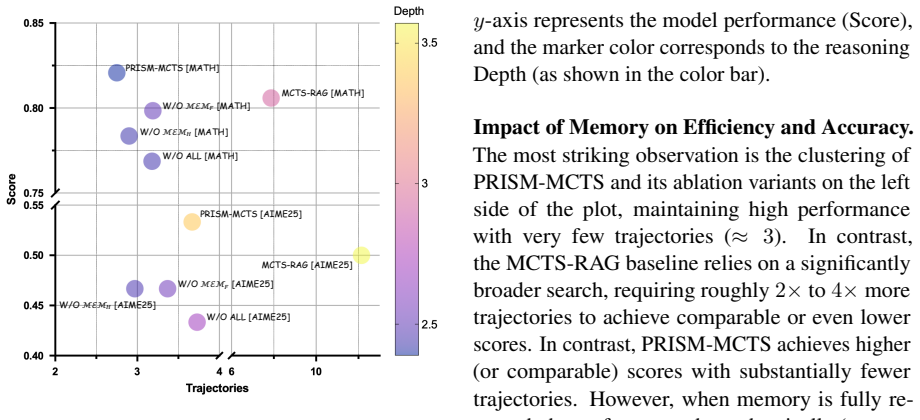
PRISM-MCTS shares heuristics and fallacies across MCTS trajectories via dynamic memory and a process reward model to halve required rollouts on GPQA while outperforming prior methods.
A machine-rendered reading of the paper's core claim, the machinery that carries it, and where it could break.
Core claim
PRISM-MCTS integrates a Process Reward Model with a dynamic shared memory that stores both successful heuristics and identified fallacies from previous trajectories. The system reinforces productive strategies and eliminates error-prone branches, producing more refined reasoning paths. A few-shot training method for the reward model supports reliable evaluation without large labeled datasets. Across multiple reasoning benchmarks the framework reduces trajectory count substantially while improving final answer quality over baselines that treat rollouts independently.
What carries the argument
Dynamic shared memory paired with a Process Reward Model that labels and reuses heuristics while pruning fallacies across parallel trajectories.
If this is right
- MCTS-based reasoning systems can scale inference-time computation through selective reuse rather than uniform expansion of search depth.
- Data requirements for training reward models in reasoning pipelines drop when few-shot regimes suffice for high-fidelity evaluation.
- Error patterns identified in early trajectories become reusable signals that improve later search branches.
- Parallel thinking inspired mechanisms become practical for reducing redundancy in deliberative AI systems.
- Benchmarks such as GPQA become solvable with roughly half the previous rollout budget while retaining or exceeding prior accuracy.
Where Pith is reading between the lines
- The same memory-sharing pattern could be applied to planning domains outside language reasoning, such as tool-use sequences or multi-step code generation.
- If the heuristics and fallacies are stored in a format accessible to future models, the approach might support cumulative improvement across successive model versions without retraining.
- Combining this reflection loop with external retrieval sources could further reduce the need for purely internal search.
- The method suggests that metacognitive overhead can be amortized across many queries when memory persists beyond a single problem.
Load-bearing premise
The process reward model can reliably separate useful heuristics from fallacies and apply them to new trajectories without injecting errors that outweigh the efficiency gains.
What would settle it
An ablation that removes the shared memory component or replaces the trained process reward model with random scoring, then measures whether the reported reduction in GPQA trajectories and performance advantage over MCTS-RAG disappear.
Figures


read the original abstract
PRISM-MCTS: Learning from Reasoning Trajectories with Metacognitive Reflection Siyuan Cheng, Bozhong Tian, Yanchao Hao, Zheng Wei Published: 06 Apr 2026, Last Modified: 06 Apr 2026 ACL 2026 Findings Conference, Area Chairs, Reviewers, Publication Chairs, Authors Revisions BibTeX CC BY 4.0 Keywords: Efficient/Low-Resource Methods for NLP, Generation, Question Answering Abstract: The emergence of reasoning models, exemplified by OpenAI o1, signifies a transition from intuitive to deliberative cognition, effectively reorienting the scaling laws from pre-training paradigms toward test-time computation. While Monte Carlo Tree Search (MCTS) has shown promise in this domain, existing approaches typically treat each rollout as an isolated trajectory. This lack of information sharing leads to severe inefficiency and substantial computational redundancy, as the search process fails to leverage insights from prior explorations. To address these limitations, we propose PRISM-MCTS, a novel reasoning framework that draws inspiration from human parallel thinking and reflective processes. PRISM-MCTS integrates a Process Reward Model (PRM) with a dynamic shared memory, capturing both "Heuristics" and "Fallacies". By reinforcing successful strategies and pruning error-prone branches, PRISM-MCTS effectively achieves refinement. Furthermore, we develop a data-efficient training strategy for the PRM, achieving high-fidelity evaluation under a few-shot regime. Empirical evaluations across diverse reasoning benchmarks substantiate the efficacy of PRISM-MCTS. Notably, it halves the trajectory requirements on GPQA while surpassing MCTS-RAG and Search-o1, demonstrating that it scales inference by reasoning judiciously rather than exhaustively.
Editorial analysis
A structured set of objections, weighed in public.
Referee Report
Summary. The paper proposes PRISM-MCTS, an extension of Monte Carlo Tree Search for reasoning tasks that integrates a Process Reward Model (PRM) with a dynamic shared memory storing 'Heuristics' and 'Fallacies' extracted across trajectories. This enables metacognitive reflection to reinforce successful strategies and prune error-prone branches, reducing redundancy in isolated rollouts. The authors report that the method halves trajectory requirements on GPQA while outperforming MCTS-RAG and Search-o1, using a data-efficient few-shot training regime for the PRM.
Significance. If the empirical gains are reproducible and the shared-memory mechanism is shown to operate without introducing new biases, the work could meaningfully advance efficient test-time scaling for deliberative reasoning. It directly targets computational redundancy in MCTS by cross-trajectory information sharing, offering a practical path toward judicious rather than exhaustive inference that aligns with emerging trends in reasoning models.
major comments (2)
- [Method and Experiments sections] The central efficiency claim (halving GPQA trajectories) rests on the dynamic shared memory + PRM accurately identifying and reinforcing heuristics while pruning fallacies. No quantitative validation of this step is provided: no precision/recall for fallacy detection, no measurement of error rates in memory-augmented vs. baseline trajectories, and no ablation that disables memory updates while holding other factors fixed.
- [Experimental evaluation on GPQA] The GPQA results lack standard controls for the headline comparison: no statistical significance tests, no error bars or variance across seeds, and no controlled baseline that matches exploration budget and base model while removing the metacognitive reflection component. This leaves open whether gains arise from the claimed mechanism or from unmeasured differences in search parameters.
minor comments (2)
- [Abstract and §4] The abstract states results on 'diverse reasoning benchmarks' but highlights only GPQA; the main text should explicitly list all evaluated tasks and report per-benchmark numbers for transparency.
- [Method description] Notation for the shared memory contents ('Heuristics' and 'Fallacies') is introduced in quotes without a formal definition or update rule; a pseudocode or equation for the memory update step would improve clarity.
Simulated Author's Rebuttal
We thank the referee for their thorough review and valuable suggestions. Below, we provide detailed responses to the major comments, committing to revisions that will address the concerns regarding validation of the shared memory mechanism and statistical controls in the experiments.
read point-by-point responses
-
Referee: [Method and Experiments sections] The central efficiency claim (halving GPQA trajectories) rests on the dynamic shared memory + PRM accurately identifying and reinforcing heuristics while pruning fallacies. No quantitative validation of this step is provided: no precision/recall for fallacy detection, no measurement of error rates in memory-augmented vs. baseline trajectories, and no ablation that disables memory updates while holding other factors fixed.
Authors: We recognize the value of direct validation for the shared memory mechanism. While the current manuscript demonstrates the overall benefits through comparative experiments on GPQA and other benchmarks, we did not include component-specific metrics like precision/recall for fallacy detection or explicit error rate comparisons. To strengthen this, we will add an ablation study in the revised manuscript that disables memory updates (while keeping the PRM and other elements fixed) and report trajectory error rates with and without the dynamic memory. This will provide quantitative evidence for the contribution of the metacognitive reflection component. Additionally, we can include examples of extracted heuristics and fallacies to illustrate the process. revision: yes
-
Referee: [Experimental evaluation on GPQA] The GPQA results lack standard controls for the headline comparison: no statistical significance tests, no error bars or variance across seeds, and no controlled baseline that matches exploration budget and base model while removing the metacognitive reflection component. This leaves open whether gains arise from the claimed mechanism or from unmeasured differences in search parameters.
Authors: We agree that incorporating standard statistical controls is important for robust claims. The current results are based on single-run evaluations, which may not fully capture variance. In the revision, we will rerun experiments across multiple random seeds, report mean performance with standard deviation (error bars), conduct statistical significance tests (such as paired t-tests against baselines), and introduce a controlled baseline that uses the same base model, exploration budget, and PRM but disables the shared memory and metacognitive reflection. This will help confirm that the gains stem from the proposed information-sharing mechanism rather than parameter differences. revision: yes
Circularity Check
No circularity detected; results rest on empirical benchmarks
full rationale
The paper introduces PRISM-MCTS as an algorithmic framework combining a Process Reward Model with dynamic shared memory for heuristic reinforcement and fallacy pruning, then reports empirical gains on external benchmarks such as GPQA. No equations, derivations, or first-principles claims appear that reduce the reported performance (e.g., halved trajectories) to a quantity defined by the method's own fitted parameters or self-citations. The central claims are supported by experimental comparisons against baselines, rendering the evaluation chain self-contained and independent of the inputs by construction.
Axiom & Free-Parameter Ledger
invented entities (1)
-
dynamic shared memory capturing Heuristics and Fallacies
no independent evidence
Lean theorems connected to this paper
-
IndisputableMonolith/Cost/FunctionalEquation.leanwashburn_uniqueness_aczel unclear?
unclearRelation between the paper passage and the cited Recognition theorem.
PRISM-MCTS integrates a Process Reward Model (PRM) with a dynamic shared memory, capturing both 'Heuristics' and 'Fallacies'. By reinforcing successful strategies and pruning error-prone branches...
-
IndisputableMonolith/Foundation/AlphaCoordinateFixation.leanJ_uniquely_calibrated_via_higher_derivative unclear?
unclearRelation between the paper passage and the cited Recognition theorem.
halves the trajectory requirements on GPQA while surpassing MCTS-RAG and Search-o1
What do these tags mean?
- matches
- The paper's claim is directly supported by a theorem in the formal canon.
- supports
- The theorem supports part of the paper's argument, but the paper may add assumptions or extra steps.
- extends
- The paper goes beyond the formal theorem; the theorem is a base layer rather than the whole result.
- uses
- The paper appears to rely on the theorem as machinery.
- contradicts
- The paper's claim conflicts with a theorem or certificate in the canon.
- unclear
- Pith found a possible connection, but the passage is too broad, indirect, or ambiguous to say the theorem truly supports the claim.
Reference graph
Works this paper leans on
-
[1]
Alphamath almost zero: Process supervision without process. InAdvances in Neural Information Processing Systems 38: Annual Conference on Neu- ral Information Processing Systems 2024, NeurIPS 2024, Vancouver, BC, Canada, December 10 - 15, 2024. Wenhu Chen, Xueguang Ma, Xinyi Wang, and William W. Cohen. 2023. Program of thoughts prompting: Disentangling com...
-
[2]
uttler, Mike Lewis, Wen-tau Yih, Tim Rockt
MCTS-RAG: enhancing retrieval-augmented generation with monte carlo tree search.CoRR, abs/2503.20757. Aaron Jaech, Adam Kalai, Adam Lerer, Adam Richard- son, Ahmed El-Kishky, Aiden Low, Alec Hel- yar, Aleksander Madry, Alex Beutel, Alex Carney, Alex Iftimie, Alex Karpenko, Alex Tachard Passos, Alexander Neitz, Alexander Prokofiev, Alexander Wei, Allison T...
-
[3]
Large Language Models: A Survey
Let’s verify step by step. InThe Twelfth In- ternational Conference on Learning Representations, ICLR 2024, Vienna, Austria, May 7-11, 2024. Open- Review.net. Shervin Minaee, Tomás Mikolov, Narjes Nikzad, Meysam Chenaghlu, Richard Socher, Xavier Am- atriain, and Jianfeng Gao. 2024. Large language models: A survey.CoRR, abs/2402.06196. OpenAI. 2023. GPT-4 ...
work page internal anchor Pith review arXiv 2024
-
[4]
Coat: Chain-of-associated-thoughts frame- work for enhancing large language models reasoning. CoRR, abs/2502.02390. Zhenting Qi, Mingyuan Ma, Jiahang Xu, Li Lyna Zhang, Fan Yang, and Mao Yang. 2024. Mutual reasoning makes smaller llms stronger problem-solvers.CoRR, abs/2408.06195. David Rein, Betty Li Hou, Asa Cooper Stickland, Jackson Petty, Richard Yuan...
-
[5]
Reflexion: Language Agents with Verbal Reinforcement Learning
Reflexion: Language agents with iterative self-reflection and episodic memory.arXiv preprint arXiv:2303.11366. Gemini Team. 2025. Gemini 2.5: Pushing the frontier with advanced reasoning, multimodality, long con- text, and next generation agentic capabilities.CoRR, abs/2507.06261. Hugo Touvron, Thibaut Lavril, Gautier Izacard, Xavier Martinet, Marie-Anne ...
work page internal anchor Pith review Pith/arXiv arXiv 2025
-
[6]
Solving math word problems with process- and outcome-based feedback
Solving math word problems with process- and outcome-based feedback.CoRR, abs/2211.14275. Xuezhi Wang, Jason Wei, Dale Schuurmans, Quoc V . Le, Ed H. Chi, Sharan Narang, Aakanksha Chowd- hery, and Denny Zhou. 2023. Self-consistency improves chain of thought reasoning in language models. InThe Eleventh International Conference on Learning Representations, ...
work page internal anchor Pith review Pith/arXiv arXiv 2023
-
[7]
ijcai.org. 10 An Yang, Baosong Yang, Beichen Zhang, Binyuan Hui, Bo Zheng, Bowen Yu, Chengyuan Li, Dayi- heng Liu, Fei Huang, Haoran Wei, Huan Lin, Jian Yang, Jianhong Tu, Jianwei Zhang, Jianxin Yang, Ji- axi Yang, Jingren Zhou, Junyang Lin, Kai Dang, and 22 others. 2024. Qwen2.5 technical report.CoRR, abs/2412.15115. Shunyu Yao, Dian Yu, Jeffrey Zhao, Iz...
work page internal anchor Pith review Pith/arXiv arXiv 2024
discussion (0)
Sign in with ORCID, Apple, or X to comment. Anyone can read and Pith papers without signing in.