Recognition: 2 theorem links
· Lean TheoremReconstruction of fast-rotating neutron star observables with the neural network
Pith reviewed 2026-05-10 20:04 UTC · model grok-4.3
The pith
Causal neural networks reconstruct fast-rotating neutron star observables thousands of times faster than traditional solvers.
A machine-rendered reading of the paper's core claim, the machinery that carries it, and where it could break.
Core claim
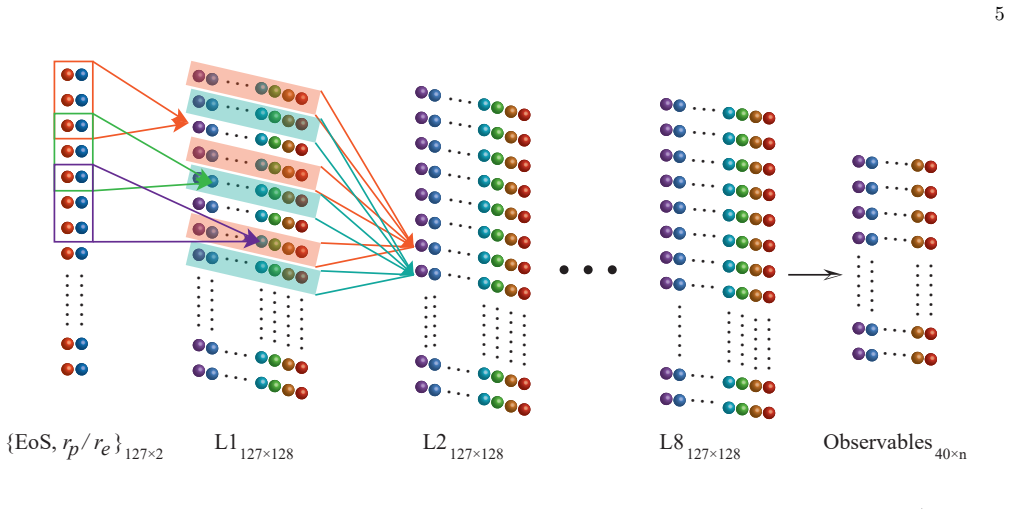
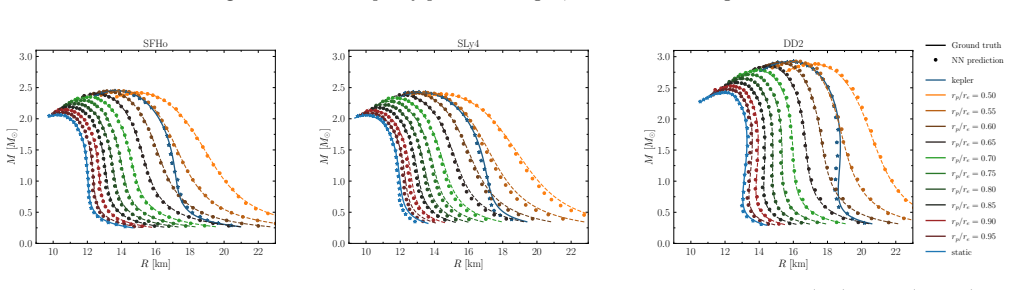
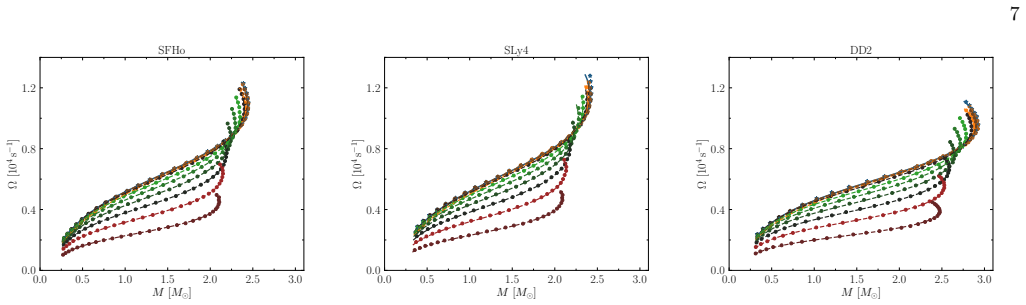
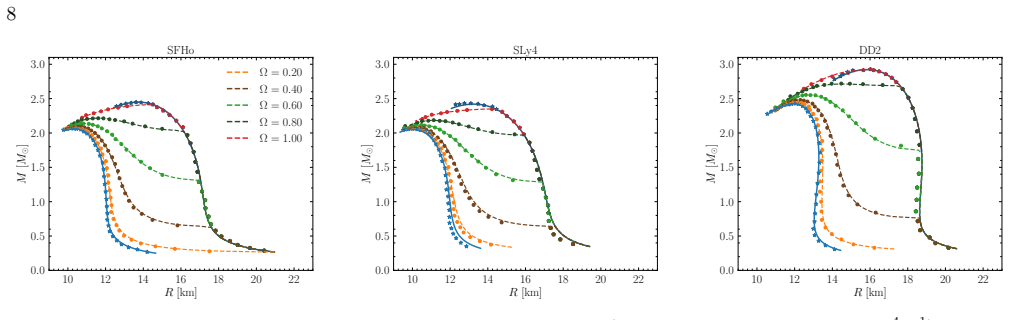
The authors train causal convolutional neural networks on datasets produced by the RNS code to reconstruct neutron star observables. These networks preserve the chronological-like dependence of properties on the equation of state and deliver accurate results for static, Keplerian, and rotating configurations. Validation on the SFHo, SLy4, and DD2 equations of state confirms close agreement with direct RNS output. The trained models evaluate a full configuration for one equation of state in roughly 50 milliseconds, compared with typical RNS runtimes of 30 minutes, thereby enabling large-scale inference studies that involve rapidly rotating neutron stars.
What carries the argument
Causal convolutional neural networks that enforce chronological-like dependence of neutron star observables on the equation of state.
Load-bearing premise
Networks trained on a finite collection of equations of state and rotation rates will generalize accurately to arbitrary equations of state and rotation rates while preserving physical causal relations between inputs and outputs.
What would settle it
Compute network predictions for an equation of state withheld from training, at a high rotation rate near the mass-shedding limit, and compare the full set of output observables against independent RNS runs for the same central density and angular velocity.
Figures



read the original abstract
Rotation can significantly affect neutron-star (NS) properties, but accurate modeling of rapidly rotating NSs requires solving a two-dimensional, axially symmetric system, making traditional calculations too expensive for inference analyses that demand a large amount of model evaluations. We develop a causal convolutional neural networks that preserve the chronological-like dependence of NS properties on the equation of state (EoS) and rapidly reconstruct observables for static, Keplerian, and rotating configurations. Using \texttt{RNS}, we generate a dataset of NS observables and use it to train our networks. We validate our networks with three representative EoS (SFHo, SLy4, and DD2) and find that the they accurately reproduce the \texttt{RNS} results. The trained networks evaluate NS configurations for a single EoS in $\sim 50$ms, providing a substantial speedup over typical \texttt{RNS} runtimes of $\sim 30$ min and enabling efficient inference analyses involving rapidly rotating NSs.
Editorial analysis
A structured set of objections, weighed in public.
Referee Report
Summary. The manuscript develops causal convolutional neural networks trained on RNS-generated datasets to reconstruct neutron-star observables (including for static, Keplerian, and rotating configurations) directly from the equation of state. It reports that the networks reproduce RNS results for the three EoS SFHo, SLy4, and DD2, with per-EoS evaluation times of ~50 ms versus ~30 min for direct RNS integration, thereby enabling efficient inference analyses involving rapidly rotating neutron stars.
Significance. If the reported accuracy and generalization hold, the work would supply a practical surrogate model that removes the computational bottleneck of 2D rotating-NS structure calculations, allowing Bayesian inference or population studies that require thousands of model evaluations to become feasible within current resources.
major comments (2)
- [Abstract / Results] Abstract and Results section: the claim that the networks 'accurately reproduce the RNS results' on SFHo, SLy4, and DD2 is unsupported by any quantitative error metrics (maximum or median relative errors on equatorial radius, moment of inertia, or Kepler frequency), training-set size, or explicit statement of whether these three EoS were held out from training.
- [Methods / Validation] Methods and Validation sections: no information is given on the diversity or number of EoS used to generate the training set, the distribution of rotation rates (especially near the Kepler limit), or any test of generalization to EoS stiffness or spin values outside the three validation cases; without these the central claim that the networks enable inference for arbitrary EoS remains unproven.
minor comments (1)
- [Abstract] Abstract contains a typographical error: 'the they accurately' should read 'they accurately'.
Simulated Author's Rebuttal
We thank the referee for the careful reading and constructive comments, which identify important omissions that will improve the manuscript. We address each point below and will revise the paper to incorporate the requested quantitative details and dataset information.
read point-by-point responses
-
Referee: [Abstract / Results] Abstract and Results section: the claim that the networks 'accurately reproduce the RNS results' on SFHo, SLy4, and DD2 is unsupported by any quantitative error metrics (maximum or median relative errors on equatorial radius, moment of inertia, or Kepler frequency), training-set size, or explicit statement of whether these three EoS were held out from training.
Authors: We agree that quantitative error metrics are needed to support the accuracy statement. In the revised manuscript we will add explicit values for the maximum and median relative errors on equatorial radius, moment of inertia, and Kepler frequency for SFHo, SLy4, and DD2. We will also report the training-set size and state that these three EoS were excluded from training and used exclusively for validation. revision: yes
-
Referee: [Methods / Validation] Methods and Validation sections: no information is given on the diversity or number of EoS used to generate the training set, the distribution of rotation rates (especially near the Kepler limit), or any test of generalization to EoS stiffness or spin values outside the three validation cases; without these the central claim that the networks enable inference for arbitrary EoS remains unproven.
Authors: We acknowledge that the current text lacks sufficient detail on the training data and generalization tests. The training set was generated from a broad collection of EoS spanning a range of stiffnesses, with rotation rates sampled up to the Kepler limit. In the revision we will specify the number of EoS employed, describe the rotation-rate distribution, and present additional validation results on EoS stiffnesses and spin values outside the three reported cases. These additions will directly support the applicability to arbitrary EoS in inference studies. revision: yes
Circularity Check
No circularity: standard supervised surrogate on external RNS simulator
full rationale
The paper generates training data with the independent RNS code, trains a causal CNN to map EoS inputs to NS observables, and validates reproduction on three EoS. This is ordinary supervised regression with no derivation, ansatz, or prediction that reduces to its own fitted inputs by construction. No self-citations are load-bearing for the central claim, and the speedup follows directly from NN inference speed versus RNS runtime. The result is self-contained against the external benchmark.
Axiom & Free-Parameter Ledger
Lean theorems connected to this paper
-
IndisputableMonolith/Foundation/ArrowOfTime.leanarrow_from_z echoeswe adopt the causal convolutional neural network ... which retains this chronological-like feature of the system, to learn the RNS solver. ... the output at a given position depends only on earlier elements of the input sequence, and thus preserves the causality of the sequence.
-
IndisputableMonolith/Foundation/RealityFromDistinction.leanreality_from_one_distinction echoesthe EoS dependence of NS properties is analogous to that of causal time-series data
Reference graph
Works this paper leans on
-
[1]
2017, PhRvL, 119, 161101, doi: 10.1103/PhysRevLett.119.161101
Abbott, B. P., Abbott, R., Abbott, T. D., et al. 2017, Phys. Rev. Lett., 119, 161101, doi: 10.1103/PhysRevLett.119.161101 —. 2018, Physical Review Letters, 121, 161101, doi: 10.1103/PhysRevLett.121.161101 —. 2019, Physical Review X, 9, 011001, doi: 10.1103/PhysRevX.9.011001 —. 2020, ApJL, 892, L3, doi: 10.3847/2041-8213/ab75f5
-
[2]
2022, ApJL, 939, L34, doi: 10.3847/2041-8213/ac9b2a
Altiparmak, S., Ecker, C., & Rezzolla, L. 2022, ApJL, 939, L34, doi: 10.3847/2041-8213/ac9b2a
-
[3]
Andersson, N., & Comer, G. L. 2001, Classical and Quantum Gravity, 18, 969, doi: 10.1088/0264-9381/18/6/302
-
[4]
Gravitational-wave constraints on the neutron-star- matter Equation of State.Phys
Annala, E., Gorda, T., Kurkela, A., & Vuorinen, A. 2018, PhRvL, 120, 172703, doi: 10.1103/PhysRevLett.120.172703
-
[5]
Bassa, C. G., Pleunis, Z., Hessels, J. W. T., et al. 2017, ApJL, 846, L20, doi: 10.3847/2041-8213/aa8400
-
[6]
1971, ApJ, 170, 299, doi: 10.1086/151216
Baym, G., Pethick, C., & Sutherland, P. 1971, ApJ, 170, 299, doi: 10.1086/151216
-
[7]
1998, PhRvD, 58, 104020, doi: 10.1103/PhysRevD.58.104020
Bonazzola, S., Gourgoulhon, E., & Marck, J.-A. 1998, PhRvD, 58, 104020, doi: 10.1103/PhysRevD.58.104020
-
[8]
2021, MNRAS, 505, 1661, doi: 10.1093/mnras/stab1287
Breschi, M., Perego, A., Bernuzzi, S., et al. 2021, MNRAS, 505, 1661, doi: 10.1093/mnras/stab1287
-
[9]
1998, NuPhA, 635, 231, doi: 10.1016/S0375-9474(98)00180-8
Schaeffer, R. 1998, NuPhA, 635, 231, doi: 10.1016/S0375-9474(98)00180-8
-
[10]
2024, ApJL, 971, L20, doi: 10.3847/2041-8213/ad5a6f
Choudhury, D., Salmi, T., Vinciguerra, S., et al. 2024, ApJL, 971, L20, doi: 10.3847/2041-8213/ad5a6f
-
[11]
Cook, G. B., Shapiro, S. L., & Teukolsky, S. A. 1994, ApJ, 422, 227, doi: 10.1086/173721
-
[12]
W., Dietrich, T., Margalit, B., & Metzger, B
Coughlin, M. W., Dietrich, T., Margalit, B., & Metzger, B. D. 2019, MNRAS, 489, L91, doi: 10.1093/mnrasl/slz133
-
[13]
Dietrich, T., Samajdar, A., Khan, S., et al. 2019, PhRvD, 100, 044003, doi: 10.1103/PhysRevD.100.044003
-
[14]
2025, PhRvD, 112, 103023, doi: 10.1103/krc7-kz2l Flanagan, ´E
Finch, E., Legred, I., Chatziioannou, K., et al. 2025, PhRvD, 112, 103023, doi: 10.1103/krc7-kz2l Flanagan, ´E. ´E., & Hinderer, T. 2008, PhRvD, 77, 021502, doi: 10.1103/PhysRevD.77.021502
-
[15]
Fonseca, E., Cromartie, H. T., Pennucci, T. T., et al. 2021, ApJL, 915, L12, doi: 10.3847/2041-8213/ac03b8
-
[16]
2018, PhRvD, 98, 023019, doi: 10.1103/PhysRevD.98.023019 —
Fujimoto, Y., Fukushima, K., & Murase, K. 2018, PhRvD, 98, 023019, doi: 10.1103/PhysRevD.98.023019 —. 2020, PhRvD, 101, 054016, doi: 10.1103/PhysRevD.101.054016
-
[17]
2022, PhRvD, 106, 123529, doi: 10.1103/PhysRevD.106.123529
Ghosh, T., Biswas, B., & Bose, S. 2022, PhRvD, 106, 123529, doi: 10.1103/PhysRevD.106.123529
-
[18]
1999, A&A, 349, 851, doi: 10.48550/arXiv.astro-ph/9907225
Gourgoulhon, E., Haensel, P., Livine, R., et al. 1999, A&A, 349, 851, doi: 10.48550/arXiv.astro-ph/9907225
-
[19]
Gupta, P. K., Puecher, A., Pang, P. T. H., et al. 2022, arXiv e-prints, arXiv:2205.01182, doi: 10.48550/arXiv.2205.01182
-
[20]
2023a, Science Bulletin, 68, 913, doi: 10.1016/j.scib.2023.04.007
Han, M.-Z., Huang, Y.-J., Tang, S.-P., & Fan, Y.-Z. 2023a, Science Bulletin, 68, 913, doi: 10.1016/j.scib.2023.04.007
-
[21]
2021, ApJ, 919, 11, doi: 10.3847/1538-4357/ac11f8
Han, M.-Z., Jiang, J.-L., Tang, S.-P., & Fan, Y.-Z. 2021, ApJ, 919, 11, doi: 10.3847/1538-4357/ac11f8
-
[22]
2023b, ApJ, 950, 77, doi: 10.3847/1538-4357/acd050
Han, M.-Z., Tang, S.-P., & Fan, Y.-Z. 2023b, ApJ, 950, 77, doi: 10.3847/1538-4357/acd050
-
[23]
Hessels, J. W. T., Ransom, S. M., Stairs, I. H., et al. 2006, Science, 311, 1901, doi: 10.1126/science.1123430
-
[24]
2008, The Astrophysical Journal, 677, 1216–1220, doi: 10.1086/533487
Hinderer, T. 2008, ApJ, 677, 1216, doi: 10.1086/533487
-
[25]
Hinderer, T., Lackey, B. D., Lang, R. N., & Read, J. S. 2010, PhRvD, 81, 123016, doi: 10.1103/PhysRevD.81.123016
-
[26]
2022, ApJ, 926, 196, doi: 10.3847/1538-4357/ac490e
Belczynski, K. 2022, ApJ, 926, 196, doi: 10.3847/1538-4357/ac490e
-
[27]
Hu, H., Kramer, M., Wex, N., Champion, D. J., & Kehl, M. S. 2020, MNRAS, 497, 3118, doi: 10.1093/mnras/staa2107
-
[28]
2024, PhRvD, 109, 103035, doi: 10.1103/PhysRevD.109.103035
Huxford, R., Kashyap, R., Borhanian, S., et al. 2024, PhRvD, 109, 103035, doi: 10.1103/PhysRevD.109.103035
-
[29]
Iacovelli, F., Mancarella, M., Foffa, S., & Maggiore, M. 2022, ApJ, 941, 208, doi: 10.3847/1538-4357/ac9cd4
-
[30]
Iacovelli, F., Mancarella, M., Mondal, C., et al. 2023, PhRvD, 108, 122006, doi: 10.1103/PhysRevD.108.122006
-
[31]
1989, MNRAS, 237, 355, doi: 10.1093/mnras/237.2.355
Komatsu, H., Eriguchi, Y., & Hachisu, I. 1989, MNRAS, 237, 355, doi: 10.1093/mnras/237.2.355
-
[32]
Kramer, M., Stairs, I. H., Manchester, R. N., et al. 2021, Physical Review X, 11, 041050, doi: 10.1103/PhysRevX.11.041050
-
[33]
2025, PhRvD, 112, 063003, doi: 10.1103/9kh9-xfpd
Chatziioannou, K. 2025, PhRvD, 112, 063003, doi: 10.1103/9kh9-xfpd
-
[34]
O., Chatziioannou, K., & Essick, R
Legred, I., Sy-Garcia, B. O., Chatziioannou, K., & Essick, R. 2024, PhRvD, 109, 023020, doi: 10.1103/PhysRevD.109.023020
-
[35]
2016, PhRvD, 94, 083010, doi: 10.1103/PhysRevD.94.083010
Li, A., Zhang, B., Zhang, N.-B., et al. 2016, PhRvD, 94, 083010, doi: 10.1103/PhysRevD.94.083010
-
[36]
2017, ApJ, 844, 41, doi: 10.3847/1538-4357/aa7a00
Li, A., Zhu, Z.-Y., & Zhou, X. 2017, ApJ, 844, 41, doi: 10.3847/1538-4357/aa7a00
-
[37]
2024, PhRvD, 110, 103040, doi: 10.1103/PhysRevD.110.103040
Li, B.-A., Grundler, X., Xie, W.-J., & Zhang, N.-B. 2024, PhRvD, 110, 103040, doi: 10.1103/PhysRevD.110.103040
-
[38]
2025, PhRvD, 111, 074026, doi: 10.1103/PhysRevD.111.074026 10
Li, R., Han, S., Lin, Z., et al. 2025, PhRvD, 111, 074026, doi: 10.1103/PhysRevD.111.074026 10
-
[39]
2010, PhRvD, 82, 103011, doi: 10.1103/PhysRevD.82.103011 —
Lindblom, L. 2010, PhRvD, 82, 103011, doi: 10.1103/PhysRevD.82.103011 —. 2022, PhRvD, 105, 063031, doi: 10.1103/PhysRevD.105.063031
-
[40]
2024, PhRvD, 110, 083030, doi: 10.1103/PhysRevD.110.083030
Lindblom, L., & Zhou, T. 2024, PhRvD, 110, 083030, doi: 10.1103/PhysRevD.110.083030
-
[41]
Science Case for the Einstein Telescope
Maggiore, M., Van Den Broeck, C., Bartolo, N., et al. 2020, JCAP, 2020, 050, doi: 10.1088/1475-7516/2020/03/050
-
[42]
Margalit, B., & Metzger, B. D. 2017, ApJL, 850, L19, doi: 10.3847/2041-8213/aa991c
-
[43]
2025, arXiv e-prints, arXiv:2508.08750, doi: 10.48550/arXiv.2508.08750
Markin, I., Puecher, A., Bulla, M., & Dietrich, T. 2025, arXiv e-prints, arXiv:2508.08750, doi: 10.48550/arXiv.2508.08750
-
[44]
Miller, M. C., Lamb, F. K., Dittmann, A. J., et al. 2019, Astrophys. J. Lett., 887, L24, doi: 10.3847/2041-8213/ab50c5 —. 2021, Astrophys. J. Lett., 918, L28, doi: 10.3847/2041-8213/ac089b
-
[45]
2020, A&A, 642, A78, doi: 10.1051/0004-6361/202038130
Morawski, F., & Bejger, M. 2020, A&A, 642, A78, doi: 10.1051/0004-6361/202038130
-
[46]
Most, E. R., Weih, L. R., Rezzolla, L., & Schaffner-Bielich, J. 2018, PhRvL, 120, 261103, doi: 10.1103/PhysRevLett.120.261103
-
[47]
2024, ApJ, 962, 61, doi: 10.3847/1538-4357/ad1758
Musolino, C., Ecker, C., & Rezzolla, L. 2024, ApJ, 962, 61, doi: 10.3847/1538-4357/ad1758
-
[48]
Nathanail, A., Most, E. R., & Rezzolla, L. 2021, ApJL, 908, L28, doi: 10.3847/2041-8213/abdfc6
-
[49]
2025, Classical and Quantum Gravity, 42, 205008, doi: 10.1088/1361-6382/ae1094
Ng, S., Legred, I., Suleiman, L., et al. 2025, Classical and Quantum Gravity, 42, 205008, doi: 10.1088/1361-6382/ae1094
-
[50]
1998, A&AS, 132, 431, doi: 10.1051/aas:1998304
Nozawa, T., Stergioulas, N., Gourgoulhon, E., & Eriguchi, Y. 1998, A&AS, 132, 431, doi: 10.1051/aas:1998304
-
[51]
Papenfort, L. J., Tootle, S. D., Grandcl´ ement, P., Most, E. R., & Rezzolla, L. 2021, PhRvD, 104, 024057, doi: 10.1103/PhysRevD.104.024057
-
[52]
The third generation of gravitational wave observatories and their science reach
Punturo, M., Abernathy, M., Acernese, F., et al. 2010, Classical and Quantum Gravity, 27, 084007, doi: 10.1088/0264-9381/27/8/084007
-
[53]
2018, ApJL, 852, L29, doi: 10.3847/2041-8213/aaa402
Radice, D., Perego, A., Zappa, F., & Bernuzzi, S. 2018, ApJL, 852, L29, doi: 10.3847/2041-8213/aaa402
-
[54]
Raithel, C. A., ¨Ozel, F., & Psaltis, D. 2018, ApJL, 857, L23, doi: 10.3847/2041-8213/aabcbf
-
[55]
T., Somasundaram, R., De, S., et al
Reed, B. T., Somasundaram, R., De, S., et al. 2024, ApJ, 974, 285, doi: 10.3847/1538-4357/ad737c
-
[56]
Cosmic Explorer: The U.S. Contribution to Gravitational-Wave Astronomy beyond LIGO
Reitze, D., Adhikari, R. X., Ballmer, S., et al. 2019, in Bulletin of the American Astronomical Society, Vol. 51, 35, doi: 10.48550/arXiv.1907.04833
work page internal anchor Pith review doi:10.48550/arxiv.1907.04833 2019
-
[57]
Riley, T. E., Watts, A. L., Bogdanov, S., et al. 2019, Astrophys. J. Lett., 887, L21, doi: 10.3847/2041-8213/ab481c
-
[58]
Riley, T. E., Watts, A. L., Ray, P. S., et al. 2021, Astrophys. J. Lett., 918, L27, doi: 10.3847/2041-8213/ac0a81
-
[59]
Romani, R. W., Kandel, D., Filippenko, A. V., Brink, T. G., & Zheng, W. 2022, ApJL, 934, L17, doi: 10.3847/2041-8213/ac8007
-
[60]
2012, Classical and Quantum Gravity, 29, 124013, doi: 10.1088/0264-9381/29/12/124013
Sathyaprakash, B., Abernathy, M., Acernese, F., et al. 2012, Classical and Quantum Gravity, 29, 124013, doi: 10.1088/0264-9381/29/12/124013
-
[61]
Shawqi, S., Konstantinou, A., & Morsink, S. M. 2025, arXiv e-prints, arXiv:2508.18434, doi: 10.48550/arXiv.2508.18434
-
[62]
2022, JCAP, 2022, 071, doi: 10.1088/1475-7516/2022/08/071 —
Soma, S., Wang, L., Shi, S., St ¨ocker, H., & Zhou, K. 2022, JCAP, 2022, 071, doi: 10.1088/1475-7516/2022/08/071 —. 2023, PhRvD, 107, 083028, doi: 10.1103/PhysRevD.107.083028
-
[63]
W., Hempel , M., & Fischer , T
Steiner, A. W., Hempel, M., & Fischer, T. 2013, ApJ, 774, 17, doi: 10.1088/0004-637X/774/1/17
-
[64]
Stergioulas, N., & Friedman, J. L. 1995, ApJ, 444, 306, doi: 10.1086/175605
-
[65]
Suleiman, L., Fantina, A. F., Gulminelli, F., & Read, J. 2025, arXiv e-prints, arXiv:2512.05315, doi: 10.48550/arXiv.2512.05315
-
[66]
Tootle, S. D., Jacques, T. P., & Cassing, M. 2026, arXiv e-prints, arXiv:2601.05176, doi: 10.48550/arXiv.2601.05176
-
[67]
2020, ApJ, 897, 165, doi: 10.3847/1538-4357/ab99c1
Traversi, S., Char, P., & Pagliara, G. 2020, ApJ, 897, 165, doi: 10.3847/1538-4357/ab99c1
-
[68]
2025, PhRvD, 112, 043018, doi: 10.1103/bmb3-ktz6
Tu, Z., Sun, X., Han, S., Miao, Z., & Li, A. 2025, PhRvD, 112, 043018, doi: 10.1103/bmb3-ktz6
-
[69]
Typel, S., R¨opke, G., Kl¨ahn, T., Blaschke, D., & Wolter, H. H. 2010, PhRvC, 81, 015803, doi: 10.1103/PhysRevC.81.015803
-
[70]
Urbanec, M., Miller, J. C., & Stuchl´ ık, Z. 2013, MNRAS, 433, 1903, doi: 10.1093/mnras/stt858 van den Oord, A., Dieleman, S., Zen, H., et al. 2016, arXiv e-prints, arXiv:1609.03499, doi: 10.48550/arXiv.1609.03499
-
[71]
2024, arXiv e-prints, arXiv:2407.15753, doi: 10.48550/arXiv.2407.15753
Vilkha, A., Yelikar, A., O’Shaughnessy, R., & Read, J. 2024, arXiv e-prints, arXiv:2407.15753, doi: 10.48550/arXiv.2407.15753
-
[72]
Walker, K., Smith, R., Thrane, E., & Reardon, D. J. 2024, PhRvD, 110, 043013, doi: 10.1103/PhysRevD.110.043013
-
[73]
2020, ApJS, 250, 6, doi: 10.3847/1538-4365/aba2f3
Wang, B., Zhu, Z., Li, A., & Zhao, W. 2020, ApJS, 250, 6, doi: 10.3847/1538-4365/aba2f3
-
[74]
2018, PhRvC, 98, 054618, doi: 10.1103/PhysRevC.98.054618
Wang, R., Chen, L.-W., & Zhou, Y. 2018, PhRvC, 98, 054618, doi: 10.1103/PhysRevC.98.054618
-
[75]
2025, PhRvC, 111, 054605, doi: 10.1103/PhysRevC.111.054605 11
Wang, S.-P., Li, X., Wang, R., Ye, J.-T., & Chen, L.-W. 2025, PhRvC, 111, 054605, doi: 10.1103/PhysRevC.111.054605 11
-
[76]
2024, PhRvC, 109, 054623, doi: 10.1103/PhysRevC.109.054623
Wang, S.-P., Wang, R., Ye, J.-T., & Chen, L.-W. 2024, PhRvC, 109, 054623, doi: 10.1103/PhysRevC.109.054623
-
[77]
Weih, L. R., Most, E. R., & Rezzolla, L. 2019, ApJ, 881, 73, doi: 10.3847/1538-4357/ab2edd
-
[78]
Wouters, T., Pang, P. T. H., Koehn, H., et al. 2025a, arXiv e-prints, arXiv:2504.15893, doi: 10.48550/arXiv.2504.15893 —. 2025b, PhRvD, 112, 043037, doi: 10.1103/v2y8-kxvx
-
[79]
2025, arXiv e-prints, arXiv:2502.09200, doi: 10.48550/arXiv.2502.09200
Wu, Z., Biswas, B., & Rosswog, S. 2025, arXiv e-prints, arXiv:2502.09200, doi: 10.48550/arXiv.2502.09200
-
[80]
B., O’Shaughnessy, R., Wysocki, D., & Wade, L
Yelikar, A. B., O’Shaughnessy, R., Wysocki, D., & Wade, L. 2024, arXiv e-prints, arXiv:2410.14674, doi: 10.48550/arXiv.2410.14674
discussion (0)
Sign in with ORCID, Apple, or X to comment. Anyone can read and Pith papers without signing in.