Recognition: 2 theorem links
· Lean TheoremFastDiSS: Few-step Match Many-step Diffusion Language Model on Sequence-to-Sequence Generation--Full Version
Pith reviewed 2026-05-10 18:35 UTC · model grok-4.3
The pith
Perturbing the self-conditioning signal during training closes the approximation gap for few-step diffusion language models.
A machine-rendered reading of the paper's core claim, the machinery that carries it, and where it could break.
Core claim
When only a few denoising steps are used, inaccurate self-conditioning creates a substantial approximation gap whose errors compound and dominate sample quality; this gap is closed by a training framework that perturbs the self-conditioning signal to match inference-time noise levels, together with a token-level noise-awareness mechanism that prevents training saturation.
What carries the argument
A training-time perturbation applied to the self-conditioning signal to align it with the estimation errors present during few-step inference, combined with a token-level noise-awareness mechanism.
If this is right
- The trained models surpass standard continuous diffusion models on conditional generation benchmarks.
- Inference speed improves by up to 400 times compared with standard diffusion sampling.
- Performance stays competitive with existing one-step diffusion frameworks.
- The models become more robust to prior-step estimation errors during sampling.
Where Pith is reading between the lines
- The same mismatch-correction idea could be tested in diffusion models for other modalities where self-conditioning is used.
- If the perturbation generalizes, it may allow reliable generation with even fewer than the current few-step regime.
- The approach highlights training-inference distribution shift as a controllable variable rather than an inherent limit of few-step diffusion.
Load-bearing premise
Perturbing the self-conditioning signal during training to match inference noise will close the approximation gap without introducing new instabilities or degrading performance when many steps are still used.
What would settle it
A direct comparison on the same conditional generation benchmarks showing that few-step samples from the perturbed model still lag substantially behind its own many-step samples in quality metrics.
Figures




read the original abstract
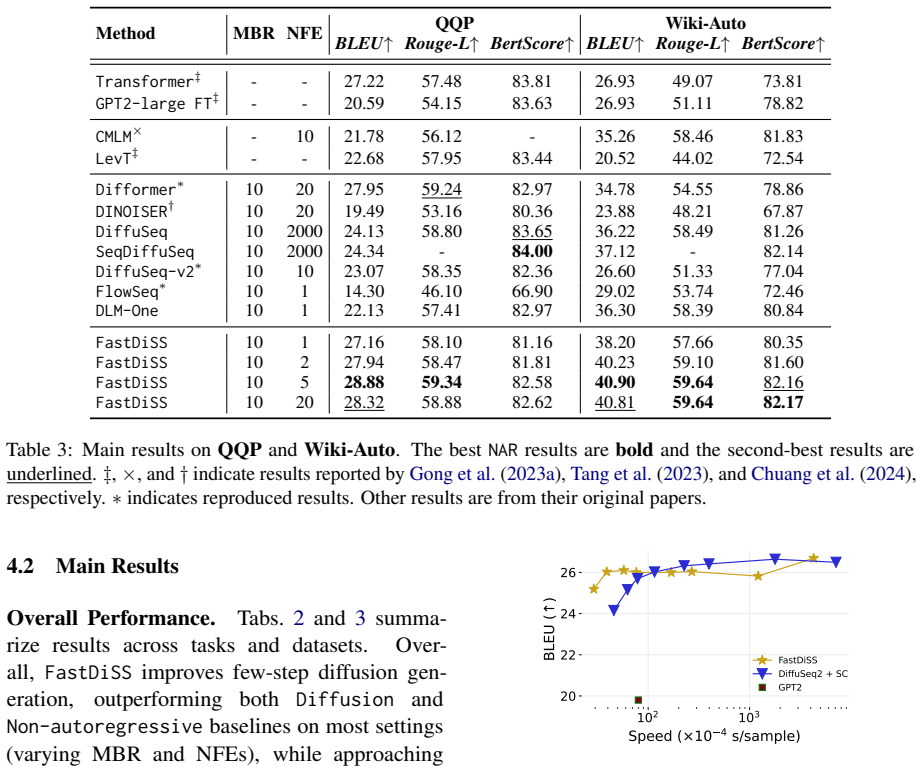
Self-conditioning has been central to the success of continuous diffusion language models, as it allows models to correct previous errors. Yet its ability degrades precisely in the regime where diffusion is most attractive for deployment: few-step sampling for fast inference. In this study, we show that when models only have a few denoising steps, inaccurate self-conditioning induces a substantial approximation gap; this mistake compounds across denoising steps and ultimately dominate the sample quality. To address this, we propose a novel training framework that handles these errors during learning by perturbing the self-conditioning signal to match inference noise, improving robustness to prior estimation errors. In addition, we introduce a token-level noise-awareness mechanism that prevents training from saturation, hence improving optimization. Extensive experiments across conditional generation benchmarks demonstrate that our framework surpasses standard continuous diffusion models while providing up to 400x faster inference speed, and remains competitive against other one-step diffusion frameworks.
Editorial analysis
A structured set of objections, weighed in public.
Referee Report
Summary. The paper introduces FastDiSS, a training framework for continuous diffusion language models on seq2seq tasks. It identifies that self-conditioning degrades in few-step regimes due to compounding approximation errors from inaccurate prior estimates, and addresses this by perturbing the self-conditioning signal during training to align with inference-time noise distributions. A token-level noise-awareness mechanism is added to avoid training saturation. Experiments on conditional generation benchmarks show the method outperforms standard continuous diffusion models, achieves up to 400x faster inference, and remains competitive with other one-step diffusion approaches.
Significance. If the empirical results hold, the work is significant for enabling high-quality few-step sampling in diffusion language models, making them more practical for deployment where inference speed matters. The approach directly targets the train-inference mismatch in self-conditioning, with ablations confirming the contribution of each component. This could help diffusion models compete more effectively with autoregressive baselines in latency-sensitive conditional generation settings.
minor comments (2)
- [§3] §3 (method description): the precise mathematical definition of the perturbation applied to the self-conditioning signal (e.g., how the noise schedule is matched between train and inference) should be stated explicitly with an equation, as the current prose description leaves the implementation details ambiguous for reproduction.
- [Table 2, Figure 4] Table 2 and Figure 4: the reported speedups (up to 400x) are measured against a many-step baseline; adding a direct comparison row against the strongest one-step diffusion baseline at identical step count would strengthen the competitiveness claim.
Simulated Author's Rebuttal
We thank the referee for the positive summary of our work on FastDiSS and for recommending minor revision. We appreciate the recognition that the approach targets the train-inference mismatch in self-conditioning and that the ablations support the contributions of each component.
Circularity Check
No significant circularity detected in derivation or claims
full rationale
The paper proposes a training perturbation to the self-conditioning signal plus token-level noise awareness to close the few-step approximation gap in diffusion LMs. No mathematical derivation chain is presented that reduces by construction to fitted inputs, self-definitions, or self-citation load-bearing premises. Claims rest on experimental benchmarks and ablations showing quality gains and speedups; the skeptic review confirms the argument is internally consistent and motivated by observed compounding errors without circular reduction or unstated bounds that invalidate results. This is the common honest non-finding for method papers whose core contribution is empirical.
Axiom & Free-Parameter Ledger
Lean theorems connected to this paper
-
IndisputableMonolith/Cost/FunctionalEquation.leanwashburn_uniqueness_aczel unclear?
unclearRelation between the paper passage and the cited Recognition theorem.
We propose Self-conditioning Perturbation (SCP)... z'_t = α_t λ_t z_0 + σ_t √(1+γ²_t) ϵ_t ... Model-aware Noise Scaling (MANS)... t_θ = β(n)·t if i=j else t
-
IndisputableMonolith/Foundation/RealityFromDistinction.leanreality_from_one_distinction unclear?
unclearRelation between the paper passage and the cited Recognition theorem.
Extensive experiments... up to 400x faster inference speed
What do these tags mean?
- matches
- The paper's claim is directly supported by a theorem in the formal canon.
- supports
- The theorem supports part of the paper's argument, but the paper may add assumptions or extra steps.
- extends
- The paper goes beyond the formal theorem; the theorem is a base layer rather than the whole result.
- uses
- The paper appears to rely on the theorem as machinery.
- contradicts
- The paper's claim conflicts with a theorem or certificate in the canon.
- unclear
- Pith found a possible connection, but the passage is too broad, indirect, or ambiguous to say the theorem truly supports the claim.
Reference graph
Works this paper leans on
-
[1]
Dlm-one: Diffusion language models for one-step sequence generation
Language models are few-shot learners. In Proceedings of the Annual Conference on Neural Information Processing Systems (NeurIPS). Mauro Cettolo, Jan Niehues, Sebastian Stüker, Luisa Bentivogli, and Marcello Federico. 2014. Report on the 11th IWSLT evaluation campaign. InProceed- ings of the International Workshop on Spoken Lan- guage Translation: Evaluat...
-
[2]
Training Verifiers to Solve Math Word Problems
Training verifiers to solve math word prob- lems.CoRR, abs/2110.14168. Giannis Daras, Yuval Dagan, Alex Dimakis, and Con- stantinos Daskalakis. 2023. Consistent diffusion models: Mitigating sampling drift by learning to be consistent. InAdvances in Neural Information Pro- cessing Systems 36: Annual Conference on Neural Information Processing Systems 2023,...
work page internal anchor Pith review Pith/arXiv arXiv 2023
-
[3]
InPro- ceedings of the AAAI Conference on Artificial Intelli- gence (AAAI), pages 13246–13254
Selective knowledge distillation for non- autoregressive neural machine translation. InPro- ceedings of the AAAI Conference on Artificial Intelli- gence (AAAI), pages 13246–13254. Cheng Lu, Yuhao Zhou, Fan Bao, Jianfei Chen, Chongx- uan Li, and Jun Zhu. 2022. Dpm-solver: A fast ODE solver for diffusion probabilistic model sampling in around 10 steps. InPr...
2022
-
[4]
Large Language Diffusion Models
Don’t give me the details, just the summary! topic-aware convolutional neural networks for ex- treme summarization. InProceedings of the Con- ference on Empirical Methods in Natural Language Processing EMNLP, pages 1797–1807. Alexander Quinn Nichol and Prafulla Dhariwal. 2021. Improved denoising diffusion probabilistic models. InProceedings of the Interna...
work page internal anchor Pith review arXiv 2021
-
[5]
InFindings of EMNLP, pages 2401–2410
Prophetnet: Predicting future N-gram for sequence-to-sequence pre-training. InFindings of EMNLP, pages 2401–2410. Alec Radford, Karthik Narasimhan, Tim Salimans, Ilya Sutskever, et al. 2018. Improving language under- standing by generative pre-training. Alec Radford, Jeffrey Wu, Rewon Child, David Luan, Dario Amodei, Ilya Sutskever, et al. 2019. Language ...
2018
-
[6]
Dream 7B: Diffusion Large Language Models
Dream 7b: Diffusion large language models. CoRR, abs/2508.15487. Jiasheng Ye, Zaixiang Zheng, Yu Bao, Lihua Qian, and Mingxuan Wang. 2023. DINOISER: diffused con- ditional sequence learning by manipulating noises. CoRR, abs/2302.10025. Hongyi Yuan, Zheng Yuan, Chuanqi Tan, Fei Huang, and Songfang Huang. 2024. Text diffusion model with encoder-decoder tran...
work page internal anchor Pith review arXiv 2023
-
[7]
A reparameterized discrete diffusion model for text generation.arXiv preprint arXiv:2302.05737, 2023
A reparameterized discrete diffusion model for text generation.CoRR, abs/2302.05737. Yaoming Zhu, Sidi Lu, Lei Zheng, Jiaxian Guo, Weinan Zhang, Jun Wang, and Yong Yu. 2018. Texygen: A benchmarking platform for text generation models. InProceedings of the ACM SIGIR International Con- ference on Research & Development in Information Retrieval (SIGIR), page...
-
[8]
Then, the supremum of local error expectation: supE i∼[0,n−1] h ∥Dθ(zti,¯zti+1ti+2 θ )−D θ(zti,ˆzti θ )∥ i =O((∆t) p).(14) Proof.Because Dθ(zti,·) is K-Lipschitz, we have E i∼[0,n−1] ∥Dθ(zti,¯zti+1ti+2 θ )−D θ(zti,ˆzti θ )∥ ≤KE i∼[0,n−1] ∥¯zti+1ti+2 θ −ˆzti θ ∥ Furthermore, from our assumption that the local error is bounded by O((ti+1 −t i)p+1), we have ...
-
[9]
Summer Summer
following DiffusionLM and DiffuSeq. MANS.We implement MANS with three training phases and increase the scaling factor β(n) over time. The phase interval and scaling factor are given in Tab. 12. For example, onWMT14we use β(n) = 2.0 for n <100K , β(n) = 3.0 for 100K≤n <200K , and β(n) = 4.0 thereafter. This modification increases total training time by les...
2023
discussion (0)
Sign in with ORCID, Apple, or X to comment. Anyone can read and Pith papers without signing in.