Recognition: 2 theorem links
· Lean TheoremGrassmann corner transfer-matrix renormalization group approach to one-dimensional fermionic models
Pith reviewed 2026-05-10 19:40 UTC · model grok-4.3
The pith
A Grassmann-adapted corner transfer-matrix renormalization group contracts coherent-state tensor networks to compute properties of one-dimensional interacting fermions.
A machine-rendered reading of the paper's core claim, the machinery that carries it, and where it could break.
Core claim
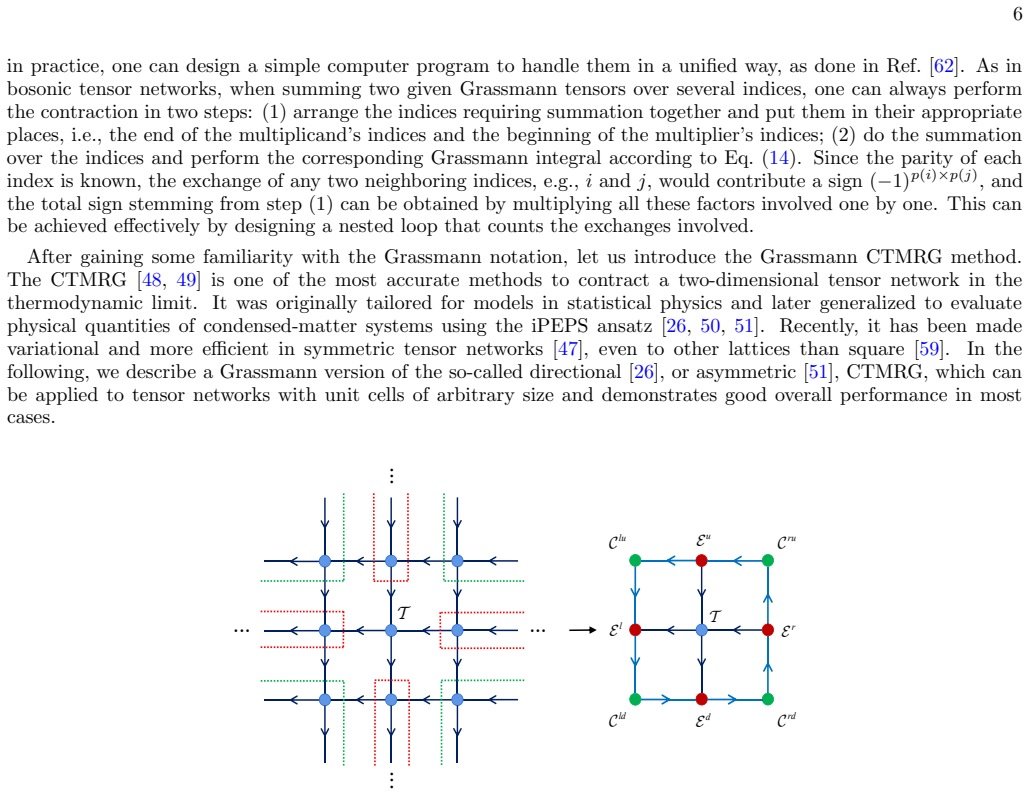
Employing the coherent-state representation, the partition function is effectively represented as a (1+1)-dimensional anisotropic Grassmann-valued tensor network, and the Grassmann version of the corner transfer-matrix renormalization group algorithm is developed to contract the tensor network and evaluate physical quantities. Validation on the one-dimensional fermionic Hubbard model with a magnetic field shows that the essential features of the phase diagram in the (μ, B) plane are quantitatively captured.
What carries the argument
The Grassmann version of the corner transfer-matrix renormalization group applied to coherent-state path-integral tensor networks, which contracts the network while preserving anticommutation relations.
If this is right
- The same contraction procedure can be applied to other one-dimensional fermionic Hamiltonians whose coherent-state representations are constructible.
- Physical observables such as magnetization, density, and correlation functions become directly accessible from the contracted tensor network.
- The method supplies a systematic way to explore the (μ, B) phase diagram without separate variational optimization of a wave function.
- Because the tensors are Grassmann-valued, the algorithm automatically enforces the correct sign structure for fermions at every contraction step.
Where Pith is reading between the lines
- If the Grassmann CTMRG contraction remains stable under modest increases in bond dimension, the same representation could be used to study longer-range interactions or doped regimes that are harder for wave-function methods.
- The coherent-state path-integral starting point might allow direct access to finite-temperature quantities that are not as straightforward in ground-state tensor-network approaches.
- Extension to two-dimensional lattices would require a different contraction strategy, but the Grassmann tensor construction itself is dimension-independent and could serve as a building block.
Load-bearing premise
The Grassmann CTMRG contraction must preserve fermionic statistics exactly enough to produce quantitative accuracy on the Hubbard model without requiring extra error corrections.
What would settle it
Running the algorithm on the Hubbard model at half-filling and comparing the computed magnetization and charge-density curves against exact Bethe-ansatz or high-accuracy DMRG data; a statistically significant mismatch in the location or order of the phase boundaries would falsify the claim of quantitative capture.
Figures




read the original abstract
The strongly correlated fermions play a vital role in modern physics. For a given fermionic Hamiltonian system, the most widely used approach to explore the underlying physics is to study the wave function that incorporates Fermi-Dirac statistics, which can be obtained variationally by energy minimization or by imaginary-time evolution. In this work, we develop an accurate tensor network method for one-dimensional interacting fermionic models based on the coherent-state path-integral representation of the fermionic partition function. Employing the coherent-state representation, the partition function is effectively represented as a (1+1)-dimensional anisotropic Grassmann-valued tensor network, and the Grassmann version of the corner transfer-matrix renormalization group algorithm is developed to contract the tensor network and evaluate physical quantities. We validate our method in the one-dimensional fermionic Hubbard model with a magnetic field, where the essential features of the phase diagram in the $(\mu, B)$ plane are quantitatively captured. Our work offers a promising approach to interacting fermionic models within the framework of tensor networks.
Editorial analysis
A structured set of objections, weighed in public.
Referee Report
Summary. The paper develops an accurate tensor network method for one-dimensional interacting fermionic models based on the coherent-state path-integral representation of the fermionic partition function. This yields a (1+1)-dimensional anisotropic Grassmann-valued tensor network, which is contracted using a Grassmann version of the corner transfer-matrix renormalization group (CTMRG) algorithm to evaluate physical quantities. The approach is validated on the one-dimensional fermionic Hubbard model with a magnetic field, where essential features of the phase diagram in the (μ, B) plane are claimed to be quantitatively captured.
Significance. If the Grassmann CTMRG contraction accurately preserves fermionic statistics without uncontrolled truncation errors, the method provides a promising tensor-network framework for studying strongly correlated 1D fermionic systems, extending beyond standard bosonic TN techniques by directly incorporating anticommuting variables via coherent states. This could enable controlled computations of thermodynamics and phase diagrams in models like the Hubbard chain.
major comments (1)
- The central claim that the Grassmann CTMRG yields quantitative results without uncontrolled errors (as stated in the abstract and validation section) depends on the renormalization step preserving the Z2 grading. The manuscript must specify how the SVD-based truncation of corner tensors handles parity sectors separately and accounts for sign factors from anticommutations; without explicit graded projectors or sector tracking, the free energy and observables risk acquiring spurious signs or violating particle-number conservation, undermining the reported phase-diagram agreement for the Hubbard model.
minor comments (1)
- The abstract and introduction would benefit from a brief comparison to existing fermionic tensor network methods (e.g., those using Jordan-Wigner or superalgebraic representations) to clarify the novelty of the Grassmann CTMRG.
Simulated Author's Rebuttal
We thank the referee for their careful reading of the manuscript and for identifying the need to explicitly document how the Z2 grading is preserved during renormalization. We address this point directly below and have revised the manuscript to incorporate the requested details.
read point-by-point responses
-
Referee: The central claim that the Grassmann CTMRG yields quantitative results without uncontrolled errors (as stated in the abstract and validation section) depends on the renormalization step preserving the Z2 grading. The manuscript must specify how the SVD-based truncation of corner tensors handles parity sectors separately and accounts for sign factors from anticommutations; without explicit graded projectors or sector tracking, the free energy and observables risk acquiring spurious signs or violating particle-number conservation, undermining the reported phase-diagram agreement for the Hubbard model.
Authors: We agree that an explicit description of parity preservation is essential for clarity. In our Grassmann CTMRG implementation, corner tensors are first projected onto even and odd parity sectors using graded projectors that respect the Z2 grading inherent to the coherent-state representation. The SVD is then performed independently within each parity block, with truncation retaining the largest singular values separately in the even and odd sectors. Sign factors from anticommutations are accounted for by the Grassmann multiplication rules applied during all tensor contractions prior to and following the SVD step. We have added a new subsection (Section III.C) and an appendix (Appendix C) that detail this procedure, including pseudocode for the graded SVD and explicit formulas for the projectors. This ensures conservation of particle number and absence of spurious signs. The quantitative reproduction of the Hubbard-model phase diagram in the (μ, B) plane is consistent with this structure-preserving truncation. revision: yes
Circularity Check
No circularity: Grassmann CTMRG is an independent algorithmic construction
full rationale
The paper introduces a coherent-state path-integral representation that maps the fermionic partition function to an anisotropic Grassmann tensor network, then defines a Grassmann-adapted CTMRG contraction procedure. No equation or claim reduces a derived quantity to a fitted parameter or to a self-referential definition; the Hubbard-model validation is presented as an external numerical test rather than an input that forces the result. No load-bearing self-citation chain or uniqueness theorem imported from the authors' prior work is invoked to close the derivation. The central claim therefore remains an independent algorithmic development whose correctness can be assessed against external benchmarks.
Axiom & Free-Parameter Ledger
axioms (2)
- domain assumption The coherent-state path-integral representation faithfully encodes the fermionic partition function with correct statistics.
- domain assumption The Grassmann CTMRG algorithm can be defined and applied to contract the anisotropic (1+1)D tensor network without introducing uncontrolled errors.
Lean theorems connected to this paper
-
IndisputableMonolith/Cost/FunctionalEquation.leanwashburn_uniqueness_aczel unclear?
unclearRelation between the paper passage and the cited Recognition theorem.
the Grassmann version of the corner transfer-matrix renormalization group algorithm is developed to contract the tensor network
-
IndisputableMonolith/Foundation/AlexanderDuality.leanalexander_duality_circle_linking unclear?
unclearRelation between the paper passage and the cited Recognition theorem.
Grassmann tensor networks... parity function p yields 0 (1) if the index belongs to the Grassmann-even (odd) sector
What do these tags mean?
- matches
- The paper's claim is directly supported by a theorem in the formal canon.
- supports
- The theorem supports part of the paper's argument, but the paper may add assumptions or extra steps.
- extends
- The paper goes beyond the formal theorem; the theorem is a base layer rather than the whole result.
- uses
- The paper appears to rely on the theorem as machinery.
- contradicts
- The paper's claim conflicts with a theorem or certificate in the canon.
- unclear
- Pith found a possible connection, but the passage is too broad, indirect, or ambiguous to say the theorem truly supports the claim.
Forward citations
Cited by 1 Pith paper
-
Grassmann tensor networks
Grassmann tensor networks are introduced from basic operations to algorithm Grassmannization and validated on models from particle physics and condensed matter.
Reference graph
Works this paper leans on
-
[1]
Bednorz J G and M¨ uller K A 1986Z. Phys. B: Condens. Matter64189–193
-
[2]
Tsui D C, Stormer H L and Gossard A C 1982Phys. Rev. Lett.481559
-
[3]
Mott N F and Peierls R 1937Proc. Phys. Soc.491559
-
[4]
Anderson P W 1973Mater. Res. Bull8153
-
[5]
Moessner R and Moore J E 2021Topological phases of matter(Cambridge University Press)
-
[6]
Kohn W 1999Rev. Mod. Phys.711253
-
[7]
Troyer M and Wiese UJ 2005Phys. Rev. Lett.94170201
-
[8]
Jones R O 2015Rev. Mod. Phys.87897
-
[9]
Verstraete F and Cirac J I 2004 arXiv:cond-mat/0407066
work page internal anchor Pith review arXiv 2004
-
[10]
Cirac J I, Garcia D P, Schuch N and Verstraete F 2021Rev. Mod. Phys.93045003
-
[11]
Orus R 2014Annals of Physics349117
-
[12]
Orus R 2014Eur. Phys. J. B87280
-
[13]
Orus R 2019Nat. Rev. Phys.1538 14
-
[14]
Phys.57143
Verstraete F, Murg V and Cirac J I 2008Adv. Phys.57143
-
[15]
Xiang T 2023Density Matrix and Tensor Network Renormalization(Cambridge University Press)
-
[16]
Corboz P and Vidal G 2009Phys. Rev. B80165129
-
[17]
Corboz P, Or´ us R, Bauer B and Vidal G 2010Phys. Rev. B81165104
-
[18]
Corboz P, Jordan J and Vidal G 2010Phys. Rev. B82245119
-
[19]
Barthel T, Pineda C and Eisert J 2009Phys. Rev. A80042333
-
[20]
Kraus C V, Schuch N, Verstraete F and Cirac J I 2009Phys. Rev. A81052338
-
[21]
Shi Q Q, Li S H, Zhao J H and Zhou H Q 2009 arXiv:0907.552
2009
-
[22]
Piˇ zorn I and Verstraete F 2010Phys. Rev. B81245110
-
[23]
Zhang H, Dong S, Wang C, Zhang M, and He L 2024Comput. Phys. Commun.305109355
-
[24]
Mortier Q, Devos L, Burgelman L, Vanhecke B, Bultinck N, Verstraete F, Haegeman J and Vanderstraeten L 2025SciPost Phys.18 012
-
[25]
Corboz P, White S R, Vidal G and Troyer M 2011Phys. Rev. B84041108
-
[26]
Corboz P, Rice T M and Troyer M 2014Phys. Rev. Lett.113046402
-
[27]
Zheng B X, Chung C M, Corboz P, Ehlers G, Qin M P, Noack R M, Shi H, White S R, Zhang S and Chan G K L 2017Science358 1155-1160
-
[28]
Ponsioen B, Chung S S and Corboz P 2019Phys. Rev. B100195141
-
[29]
Ponsioen B, Chung S S and Corboz P 2023Phys. Rev. B108205154
-
[30]
Zhang F C and Rice T M 1988Phys. Rev. B373759–3761
-
[31]
Hubbard J 1963Proc. R. Soc. Lond. Ser. A276238–257
-
[32]
Qin M, Sch¨ afer T, Andergassen S, Corboz P and Gull E 2022Annu. Rev. Condens. Matter Phys13275-302
-
[33]
Gu Z C, Verstraete F and Wen X G 2010 arXiv:1004.2563
work page Pith review arXiv 2010
-
[34]
Gu Z C 2013Phys. Rev. B88115139
-
[35]
Lou J and Chen Y 2015 arXiv:1506.03716
work page Pith review arXiv 2015
-
[36]
Gu Z C, Jiang H C, Sheng D N, Yao H, Balents L and Wen X G 2013Phys. Rev. B88155112
-
[37]
Gu Z C, Jiang H C and Baskaran G 2020Phys. Rev. B101205147
-
[38]
Miao J J, Yue Z Y, Zhang H, Chen W Q and Gu Z C 2025Phys. Rev. B111174518
-
[39]
Liu W Y, Zhai H C, Peng R J, Gu Z C and Chan G K L 2025Phys. Rev. Lett.134256502
-
[40]
Levin M and Nave C P 2007Phys. Rev. Lett.99120601
-
[41]
Shimizu Y and Kuramashi Y 2013Phys. Rev. D90014508
-
[42]
Takeda S and Yoshimura Y 2015Prog. Theor. Exp. Phys.2015043B01
-
[43]
Sakai R, Takeda S and Yoshimura Y 2017Prog. Theor. Exp. Phys.2017063B07
-
[44]
Yoshimura Y, Kuramashi Y, Nakamura Y, Takeda S and Sakai R 2018Phys. Rev. D97054511
-
[45]
High Energ
Akiyama S and Kadoh D 2021J. High Energ. Phys.2021188
-
[46]
Phys.: Condens
Akiyama S, Meurice Y and Sakai R 2024J. Phys.: Condens. Matter36343002
-
[47]
Liu X F, Fu Y F, Yu W Q, Yu J F and Xie Z Y 2022Chin. Phys. Lett.39067502
-
[48]
Nishino T and Okunishi K 1996J. Phys. Soc. Jap.65891-894
-
[49]
Nishino T, Okunishi K and Kikuchi M 1996Phys. Lett. A21369-72
-
[50]
Or´ us R and Vidal G 2009Phys. Rev. B80094403
-
[51]
Fishman M T, Vanderstraeten L, Zauner-Stauber V, Haegeman J and Verstraete F 2018Phys. Rev. B98235148
-
[52]
Essler FHL, Frahm H, G¨ ohmann F, Kl¨ umper A and Korepin VE 2005The One-Dimensional Hubbard Model(Cambridge University Press)
-
[53]
Akiyama S and Kuramashi Y 2021Phys. Rev. D104014504
-
[54]
Akiyama S, Kuramashi Y and Yamashita T 2022Prog. Theor. Exp. Phys.2022023I01
-
[55]
Coleman PIntroduction to many-body physics, Cambridge University Press (2015)
2015
-
[56]
Altland A and Simons B D 2010Condensed matter field theory(Cambridge University Press)
-
[57]
Supplementary Materials
-
[58]
Zhao H H, Xie Z Y, Xiang T and Imada M, 2016Phys. Rev. B93125115
-
[59]
Lukin I V and Sotnikov A G 2024Phys. Rev. E109045305
-
[60]
Bultinck N, Williamson D J, Haegeman J and Verstraete F 2017Phys. Rev. B95075108
-
[61]
Vidal G 2007Phys. Rev. Lett.99220405
-
[62]
Codebases20
Yosprakob A 2023SciPost Phys. Codebases20
-
[63]
Xie Z Y, Chen J, Qin M P, Zhu J W, Yang L P and Xiang T 2012Phys. Rev. B86045139
-
[64]
Li W, Ran S J, Gong S S, Zhao Y, Xi B, Ye F and Su G 2011Phys. Rev. Lett.106127202
-
[65]
Dong Y L, Chen L, Liu Y J, and Li W 2017Phys. Rev. B95144428
-
[66]
Orus R and Vidal G 2008Phys. Rev. B78155117
discussion (0)
Sign in with ORCID, Apple, or X to comment. Anyone can read and Pith papers without signing in.