Recognition: 2 theorem links
· Lean TheoremTwisted doughnuts: Thick disk torus around equatorial asymmetric black hole
Pith reviewed 2026-05-10 20:13 UTC · model grok-4.3
The pith
Equatorial asymmetry in black hole spacetimes twists thick accretion tori away from the plane.
A machine-rendered reading of the paper's core claim, the machinery that carries it, and where it could break.
Core claim
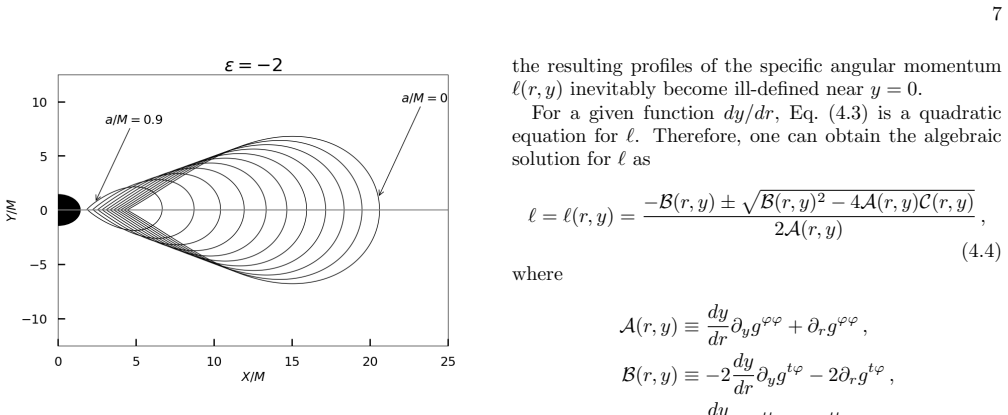
Due to the equatorial asymmetry of the spacetime, the centers and the cusps of tori are distorted away from the original equatorial plane toward the same direction as that experienced by the stable Keplerian orbits, and the entire tori configurations are twisted toward that direction as well. The shape of the distorted tori is demonstrated explicitly using a constant specific angular momentum profile of the disk fluid, but the result applies to non-constant profiles generically, as any attempt to produce symmetric tori with asymmetric angular momentum leads to ill-defined or fine-tuned profiles near the equatorial plane.
What carries the argument
The Polish doughnut model of thick tori with specific angular momentum profiles in spacetimes lacking equatorial symmetry; it maps the distortion of equipotential surfaces onto the torus geometry.
If this is right
- The centers of the tori move off the equatorial plane in the direction of the Keplerian orbit shift.
- The cusps of the tori are similarly displaced vertically.
- The full torus configuration twists toward the direction of the asymmetry.
- Non-constant angular momentum profiles cannot maintain symmetry without becoming ill-defined near the plane or requiring fine-tuning.
Where Pith is reading between the lines
- If the asymmetry arises from effects beyond general relativity, twisted disk observations could help test those effects.
- Models of thin disks may require updates to account for vertical curvature in asymmetric spacetimes.
- Numerical fluid dynamics simulations in such metrics could uncover new instabilities induced by the twist.
Load-bearing premise
The Polish doughnut model for non-self-gravitating thick disks applies directly to spacetimes with equatorial asymmetry, and asymmetric specific angular momentum profiles can be defined without becoming ill-defined or requiring fine-tuning near the equatorial plane.
What would settle it
Finding a specific angular momentum profile that produces an untilted symmetric thick torus in an equatorially asymmetric spacetime without fine-tuning or ill-defined behavior near the plane would disprove the result.
Figures



read the original abstract
The Kerr black hole spacetime is symmetric with respect to a well-defined equatorial plane. When such a symmetry is broken, for instance, by some putative effects beyond general relativity, the Keplerian circular orbits around the black hole are distorted vertically away from the equatorial plane by an amount depending on the orbital radius. As a result, the Keplerian thin disk acquires a curved surface. In this work, we extend such results to thick tori configurations by considering non-self-gravitating Polish doughnut models. We show that due to the equatorial asymmetry of the spacetime, the centers and the cusps of tori are distorted away from the original equatorial plane toward the same direction as that experienced by the stable Keplerian orbits, and the entire tori configurations are twisted toward that direction as well. The shape of the distorted tori is demonstrated explicitly using a constant specific angular momentum profile $\ell(r,y)=\ell_0$ of the disk fluid. However, the result also applies to non-constant profiles of $\ell(r,y)$ generically in the sense that any asymmetric profile of $\ell(r,y)$ that attempts to produce a symmetric tori configuration either turns out to be ill-defined near the equatorial plane or suffers from fine-tuning issues.
Editorial analysis
A structured set of objections, weighed in public.
Referee Report
Summary. The manuscript extends results on thin Keplerian disks in stationary axisymmetric spacetimes lacking equatorial reflection symmetry to thick tori using the non-self-gravitating Polish doughnut model. It claims that for constant specific angular momentum ℓ(r,y)=ℓ₀ the equipotential surfaces exhibit vertical shifts of the center and cusp away from the equatorial plane (in the same sense as stable circular orbits) together with an overall twist of the torus; the result is asserted to hold generically because any ℓ(r,y) profile chosen to enforce a symmetric torus must either become ill-defined near y=0 or require fine-tuning.
Significance. If substantiated, the work supplies a concrete, reproducible construction (constant-ℓ equipotentials of the effective potential W) that demonstrates how equatorial asymmetry propagates into thick-disk geometry. This provides a falsifiable template for accretion models in modified-gravity or exotic spacetimes and highlights a potential constraint on admissible angular-momentum distributions. The explicit constant-ℓ example and the internal consistency of the barotropic Euler integration are strengths.
major comments (1)
- [generic applicability argument] Abstract and the generic-applicability paragraph: the assertion that 'any asymmetric profile of ℓ(r,y) that attempts to produce a symmetric tori configuration either turns out to be ill-defined near the equatorial plane or suffers from fine-tuning issues' is load-bearing for the generic claim yet is stated without an explicit construction or discontinuity calculation. A concrete example showing the required jump or tuning across y=0 would be needed to elevate the statement from plausible to demonstrated.
minor comments (2)
- [model setup] The coordinate choice (r,y) and the precise definition of the asymmetric metric should be stated explicitly in the opening section so that the integration of dW can be followed without external references.
- [results/figures] If figures display the twisted tori, they should include an overlay of the equatorial plane and a quantitative measure (e.g., vertical displacement of the cusp) to make the distortion visually and numerically clear.
Simulated Author's Rebuttal
We thank the referee for the careful reading, positive assessment of the work, and recommendation for minor revision. We address the single major comment below and will revise the manuscript accordingly.
read point-by-point responses
-
Referee: Abstract and the generic-applicability paragraph: the assertion that 'any asymmetric profile of ℓ(r,y) that attempts to produce a symmetric tori configuration either turns out to be ill-defined near the equatorial plane or suffers from fine-tuning issues' is load-bearing for the generic claim yet is stated without an explicit construction or discontinuity calculation. A concrete example showing the required jump or tuning across y=0 would be needed to elevate the statement from plausible to demonstrated.
Authors: We agree that an explicit example would strengthen the generic claim. The constant-ℓ₀ case already provides a fully explicit, reproducible demonstration of the vertical shifts and twist via the equipotentials of W. The generic statement rests on the observation that the metric asymmetry shifts the extrema of W away from y=0; any ℓ(r,y) chosen to cancel this shift exactly must compensate the metric terms that break equatorial symmetry. In the revised manuscript we will add a concrete illustration in the discussion section: consider a trial profile ℓ(r,y)=ℓ₀(1+δ y/r) near the equator. Enforcing symmetric equipotentials then requires δ to cancel the leading odd term in the metric expansion, which either introduces a jump discontinuity in ∂ℓ/∂y at y=0 or forces δ to a precise, non-generic value that is unstable to small changes in the metric coefficients. This example will be presented with the relevant expansion of W and the resulting condition on ℓ. revision: yes
Circularity Check
No significant circularity; derivation applies standard model directly
full rationale
The paper's central derivation applies the standard Polish doughnut construction—equipotentials of the effective potential W obtained from the relativistic Euler equation for barotropic flow—to a given stationary axisymmetric metric that lacks equatorial reflection symmetry. For the constant specific angular momentum profile ℓ(r,y)=ℓ₀ the surfaces are obtained by direct integration and exhibit the vertical shift and twist; this is a straightforward numerical or analytic evaluation rather than a reduction to the input. The generic claim that any ℓ(r,y) chosen to enforce symmetry must be ill-defined or finely tuned near y=0 follows logically from the metric asymmetry and the definition of W, without self-definition or fitted parameters renamed as predictions. Any self-citations to prior thin-disk results are independent supporting context and not load-bearing for the thick-torus computation itself. The chain is therefore self-contained against the stated model assumptions.
Axiom & Free-Parameter Ledger
free parameters (1)
- constant specific angular momentum ℓ0
axioms (2)
- domain assumption Non-self-gravitating Polish doughnut model for thick disks applies in asymmetric spacetimes
- domain assumption Existence of equatorial asymmetry in the spacetime metric
Lean theorems connected to this paper
-
IndisputableMonolith/Cost/FunctionalEquation.leanwashburn_uniqueness_aczel unclear?
unclearRelation between the paper passage and the cited Recognition theorem.
We integrate Eq. (3.6) to get W(r,y) ≡ −∫ dp/ρh = ln|ut| ... The isosurfaces of the effective potential W on the (r,y)-plane can dictate the torus structure
-
IndisputableMonolith/Foundation/AlexanderDuality.leanalexander_duality_circle_linking unclear?
unclearRelation between the paper passage and the cited Recognition theorem.
the centers and the cusps of tori are distorted away from the original equatorial plane ... the entire tori configurations are twisted
What do these tags mean?
- matches
- The paper's claim is directly supported by a theorem in the formal canon.
- supports
- The theorem supports part of the paper's argument, but the paper may add assumptions or extra steps.
- extends
- The paper goes beyond the formal theorem; the theorem is a base layer rather than the whole result.
- uses
- The paper appears to rely on the theorem as machinery.
- contradicts
- The paper's claim conflicts with a theorem or certificate in the canon.
- unclear
- Pith found a possible connection, but the passage is too broad, indirect, or ambiguous to say the theorem truly supports the claim.
Reference graph
Works this paper leans on
-
[1]
For a near-edge-on observer, the curved disk surface may generate special features in its morphol- ogy and leave imprints on the line profiles of the disk [32]
as opposed to a flat disk plane in the usualZ 2 sym- metric scenarios. For a near-edge-on observer, the curved disk surface may generate special features in its morphol- ogy and leave imprints on the line profiles of the disk [32]. One natural question is, what would happen if one considers a more astrophysically relevant disk configura- tion, for instanc...
2025
-
[2]
Observation of Gravitational Waves from a Binary Black Hole Merger
R. P. Kerr, “Gravitational field of a spinning mass as an example of algebraically special metrics,” Phys. Rev. Lett.11(1963) 237–238. [2]LIGO Scientific, VirgoCollaboration, B. P. Abbott et al., “Observation of Gravitational Waves from a Binary Black Hole Merger,” Phys. Rev. Lett.116 (2016) no. 6, 061102,arXiv:1602.03837 [gr-qc]. [3]Event Horizon Telesco...
work page internal anchor Pith review arXiv 1963
-
[3]
Testing the Kerr black hole hypothesis,
C. Bambi, “Testing the Kerr black hole hypothesis,” Mod. Phys. Lett. A26(2011) 2453–2468, arXiv:1109.4256 [gr-qc]
-
[4]
Black holes, gravitational waves and fundamental physics: a roadmap
L. Barack et al., “Black holes, gravitational waves and fundamental physics: a roadmap,” Class. Quant. Grav. 36(2019) no. 14, 143001,arXiv:1806.05195 [gr-qc]
work page Pith review arXiv 2019
-
[5]
Gravitational-wave glitches in chaotic extreme-mass-ratio inspirals,
K. Destounis, A. G. Suvorov, and K. D. Kokkotas, “Gravitational-wave glitches in chaotic extreme-mass-ratio inspirals,” Phys. Rev. Lett.126 (2021) no. 14, 141102,arXiv:2103.05643 [gr-qc]
-
[6]
Resonant orbits of rotating black holes beyond circularity: Discontinuity along a parameter shift,
C.-Y. Chen, H.-W. Chiang, and A. Patel, “Resonant orbits of rotating black holes beyond circularity: Discontinuity along a parameter shift,” Phys. Rev. D 108(2023) no. 6, 064016,arXiv:2306.08356 [gr-qc]. 11
-
[7]
Probing spacetime symmetries using gravitational wave ringdown,
R. Ghosh, A. K. Mishra, and S. Sarkar, “Probing spacetime symmetries using gravitational wave ringdown,” Phys. Rev. D112(2025) no. 6, 064092, arXiv:2412.08942 [gr-qc]
-
[8]
V. Cardoso, M. Kimura, A. Maselli, and L. Senatore, “Black Holes in an Effective Field Theory Extension of General Relativity,” Phys. Rev. Lett.121(2018) no. 25, 251105,arXiv:1808.08962 [gr-qc]. [Erratum: Phys.Rev.Lett. 131, 109903 (2023)]
-
[9]
Leading higher-derivative corrections to Kerr geometry,
P. A. Cano and A. Ruip´ erez, “Leading higher-derivative corrections to Kerr geometry,” JHEP05(2019) 189, arXiv:1901.01315 [gr-qc]. [Erratum: JHEP 03, 187 (2020)]
-
[10]
Black hole multipoles in higher-derivative gravity,
P. A. Cano, B. Ganchev, D. R. Mayerson, and A. Ruip´ erez, “Black hole multipoles in higher-derivative gravity,” JHEP12(2022) 120,arXiv:2208.01044 [gr-qc]
-
[11]
Exact Solution for Rotating Black Holes in Parity-Violating Gravity,
H. W. H. Tahara, K. Takahashi, M. Minamitsuji, and H. Motohashi, “Exact Solution for Rotating Black Holes in Parity-Violating Gravity,” PTEP2024(2024) no. 5, 053E02,arXiv:2312.11899 [gr-qc]
-
[12]
M. Bianchi, D. Consoli, A. Grillo, J. F. Morales, P. Pani, and G. Raposo, “Distinguishing fuzzballs from black holes through their multipolar structure,” Phys. Rev. Lett.125(2020) no. 22, 221601, arXiv:2007.01743 [hep-th]
-
[13]
The multipolar structure of fuzzballs,
M. Bianchi, D. Consoli, A. Grillo, J. F. Morales, P. Pani, and G. Raposo, “The multipolar structure of fuzzballs,” JHEP01(2021) 003,arXiv:2008.01445 [hep-th]
-
[14]
Gravitational footprints of black holes and their microstate geometries,
I. Bah, I. Bena, P. Heidmann, Y. Li, and D. R. Mayerson, “Gravitational footprints of black holes and their microstate geometries,” JHEP10(2021) 138, arXiv:2104.10686 [hep-th]
-
[15]
K. Fransen and D. R. Mayerson, “Detecting equatorial symmetry breaking with LISA,” Phys. Rev. D106 (2022) no. 6, 064035,arXiv:2201.03569 [gr-qc]
-
[16]
Empty space generalization of the Schwarzschild metric,
E. Newman, L. Tamburino, and T. Unti, “Empty space generalization of the Schwarzschild metric,” J. Math. Phys.4(1963) 915
1963
-
[17]
S.-P. Wu and S.-W. Wei, “Topology of light rings for extremal and nonextremal Kerr-Newman-Taub-NUT black holes without Z2 symmetry,” Phys. Rev. D108 (2023) no. 10, 104041,arXiv:2307.14003 [gr-qc]
-
[18]
Precession of spherical orbits for the spacetime withoutZ 2 symmetry induced by NUT charge,
X.-C. Meng, S.-P. Wu, and S.-W. Wei, “Precession of spherical orbits for the spacetime withoutZ 2 symmetry induced by NUT charge,”arXiv:2508.10415 [gr-qc]
-
[19]
Stationary black holes with static and counter rotating horizons,
B. Kleihaus, J. Kunz, and F. Navarro-Lerida, “Stationary black holes with static and counter rotating horizons,” Phys. Rev. D69(2004) 081501, arXiv:gr-qc/0309082
-
[20]
Global structure of the Kerr family of gravitational fields,
B. Carter, “Global structure of the Kerr family of gravitational fields,” Phys. Rev.174(1968) 1559–1571
1968
-
[21]
Black hole photon rings beyond general relativity,
S. Staelens, D. R. Mayerson, F. Bacchini, B. Ripperda, and L. K¨ uchler, “Black hole photon rings beyond general relativity,” Phys. Rev. D107(2023) no. 12, 124026,arXiv:2303.02111 [gr-qc]
-
[22]
Breaking the north-south symmetry: Dyonic spinning black holes with synchronized gauged scalar hair,
P. V. P. Cunha, C. A. R. Herdeiro, E. Radu, and N. M. Santos, “Breaking the north-south symmetry: Dyonic spinning black holes with synchronized gauged scalar hair,” Phys. Rev. D111(2025) no. 4, 044057, arXiv:2410.21421 [gr-qc]
-
[23]
S. E. Gralla and A. Lupsasca, “Lensing by Kerr Black Holes,” Phys. Rev. D101(2020) no. 4, 044031, arXiv:1910.12873 [gr-qc]
-
[24]
Isolated black holes withoutZ 2 isometry,
P. V. P. Cunha, C. A. R. Herdeiro, and E. Radu, “Isolated black holes withoutZ 2 isometry,” Phys. Rev. D98(2018) no. 10, 104060,arXiv:1808.06692 [gr-qc]
-
[25]
Rotating black holes withoutZ 2 symmetry and their shadow images,
C.-Y. Chen, “Rotating black holes withoutZ 2 symmetry and their shadow images,” JCAP05(2020) 040,arXiv:2004.01440 [gr-qc]
-
[26]
Can different black holes cast the same shadow?,
H. C. D. Lima, Junior., L. C. B. Crispino, P. V. P. Cunha, and C. A. R. Herdeiro, “Can different black holes cast the same shadow?,” Phys. Rev. D103(2021) no. 8, 084040,arXiv:2102.07034 [gr-qc]
-
[27]
Testing black hole equatorial reflection symmetry using Sgr A* shadow images,
C.-Y. Chen, “Testing black hole equatorial reflection symmetry using Sgr A* shadow images,” Phys. Rev. D 106(2022) no. 4, 044009,arXiv:2205.06962 [gr-qc]
-
[28]
Possible connection between the reflection symmetry and existence of equatorial circular orbit,
S. Datta and S. Mukherjee, “Possible connection between the reflection symmetry and existence of equatorial circular orbit,” Phys. Rev. D103(2021) no. 10, 104032,arXiv:2010.12387 [gr-qc]
-
[29]
Curved accretion disks around rotating black holes without reflection symmetry,
C.-Y. Chen and H.-Y. K. Yang, “Curved accretion disks around rotating black holes without reflection symmetry,” Eur. Phys. J. C82(2022) no. 4, 307, arXiv:2109.00564 [gr-qc]
-
[30]
Observational features of reflection asymmetric black holes,
C.-Y. Chen and H.-Y. Pu, “Observational features of reflection asymmetric black holes,” JCAP09(2024) 043,arXiv:2404.07055 [gr-qc]
-
[31]
Relativistic fluid disks in orbit around Kerr black holes,
L. G. Fishbone and V. Moncrief, “Relativistic fluid disks in orbit around Kerr black holes,” Astrophys. J. 207(1976) 962–976
1976
-
[32]
Relativistic, accreting disks,
M. Abramowicz, M. Jaroszynski, and M. Sikora, “Relativistic, accreting disks,” Astron. Astrophys.63 (1978) 221–224
1978
-
[33]
S. Chakraborty, “Equilibrium configuration of perfect fluid orbiting around black holes in some classes of alternative gravity theories,” Class. Quant. Grav.32 (2015) no. 7, 075007,arXiv:1406.0417 [gr-qc]
-
[34]
Thick toroidal configurations around scalarized Kerr black holes,
M. C. Teodoro, L. G. Collodel, D. Doneva, J. Kunz, P. Nedkova, and S. Yazadjiev, “Thick toroidal configurations around scalarized Kerr black holes,” Phys. Rev. D104(2021) no. 12, 124047, arXiv:2108.08640 [gr-qc]
-
[35]
Magnetised tori in the background of a deformed compact object,
S. Faraji and A. Trova, “Magnetised tori in the background of a deformed compact object,” Astron. Astrophys.654(2021) A100,arXiv:2011.05945 [astro-ph.HE]
-
[36]
M. Cassing and L. Rezzolla, “Equilibrium non-self-gravitating tori around black holes in parametrized spherically symmetric space–times,” Mon. Not. Roy. Astron. Soc.522(2023) no. 2, 2415–2428, arXiv:2302.09135 [gr-qc]
-
[37]
Magnetized Tori around Kerr Black Holes: Analytic Solutions with a Toroidal Magnetic Field,
S. S. Komissarov, “Magnetized Tori around Kerr Black Holes: Analytic Solutions with a Toroidal Magnetic Field,” Mon. Not. Roy. Astron. Soc.368(2006) 993–1000,arXiv:astro-ph/0601678
-
[38]
Charged perfect fluid tori in strong central gravitational and dipolar magnetic fields,
J. Kov´ aˇ r, P. Slan´ y, C. Cremaschini, Z. Stuchl´ ık, V. Karas, and A. Trova, “Charged perfect fluid tori in strong central gravitational and dipolar magnetic fields,” Phys. Rev. D93(2016) no. 12, 124055
2016
-
[39]
Circular motion in NUT space-time,
P. Jefremov and V. Perlick, “Circular motion in NUT space-time,” Class. Quant. Grav.33(2016) no. 24, 245014,arXiv:1608.06218 [gr-qc]. [Erratum: Class.Quant.Grav. 35, 179501 (2018)]
-
[40]
S. Faraji, A. Trova, and V. Karas, “Magnetized relativistic accretion disk around a spinning, electrically 12 charged, accelerating black hole: Case of the C metric,” Phys. Rev. D105(2022) no. 10, 103017, arXiv:2108.07070 [astro-ph.HE]
discussion (0)
Sign in with ORCID, Apple, or X to comment. Anyone can read and Pith papers without signing in.