Recognition: 2 theorem links
· Lean TheoremScalar axion field of toroidal electromagnetic pulses
Pith reviewed 2026-05-10 19:47 UTC · model grok-4.3
The pith
Superpositions of toroidal electromagnetic pulses create localized regions with nonzero E·B, generating a co-propagating pseudoscalar field under axion electrodynamics.
A machine-rendered reading of the paper's core claim, the machinery that carries it, and where it could break.
Core claim
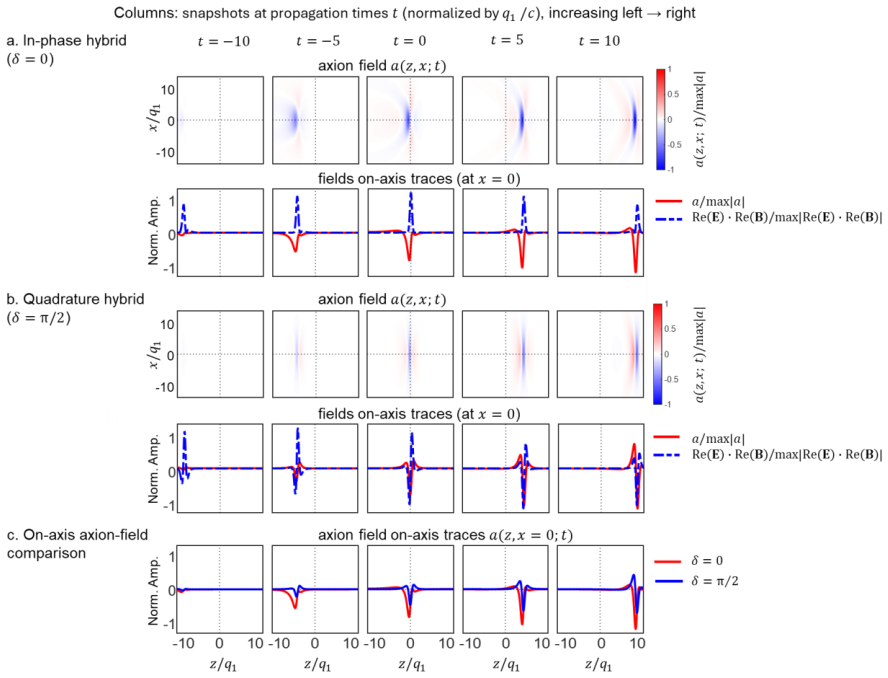
Axion electrodynamics postulates a pseudoscalar field sourced by the scalar product of electric and magnetic fields. A superposition of toroidal electromagnetic pulses propagating in free space naturally exhibits localized regions where E·B is not zero. As a result, these pulses generate a space-time localized pseudoscalar field that co-propagates with them. This outcome follows directly from adopting the axion electrodynamics extension to Maxwell's equations.
What carries the argument
Superposition of toroidal electromagnetic pulses creating localized nonzero E·B regions that source the pseudoscalar field in the extended electrodynamics.
If this is right
- The pseudoscalar field remains localized in space and time while traveling with the electromagnetic pulses.
- This effect arises purely in free space from the pulse structure without needing special materials.
- The result illustrates a vacuum manifestation of axion electrodynamics using classical field configurations.
- It provides a potential platform for exploring extensions of electromagnetic theory with structured light.
Where Pith is reading between the lines
- If realizable, this could allow laboratory tests of axion-like couplings using only electromagnetic pulses.
- Similar effects might appear in other non-plane-wave electromagnetic configurations where E and B are not perpendicular.
- The co-propagating nature suggests the pseudoscalar field could influence subsequent interactions along the path.
Load-bearing premise
The described superposition of toroidal pulses can actually be created and propagated in free space such that the regions of nonzero E·B persist without being disrupted by dispersion or other wave effects.
What would settle it
A direct numerical simulation or experimental realization of the toroidal pulse superposition that shows the E·B product regions dissipate rapidly or fail to produce a measurable pseudoscalar field component.
Figures

read the original abstract
Axion electrodynamics extends Maxwell's theory by postulating a hypothetical pseudoscalar axion field sourced by a scalar product of electric and magnetic fields. In this work, we demonstrate that a superposition of toroidal electromagnetic pulses propagating in free space naturally exhibits localized regions, where $\bm{E}\cdot\bm{B}\ne0$. As a consequence of axion electrodynamics, these structured light pulses generate a space-time localized pseudoscalar field co-propagating with the pulses. This result should not be interpreted as a mechanism for generating axion particles by light, but rather as a consequence of adopting the axion electrodynamics extension to Maxwell's equations.
Editorial analysis
A structured set of objections, weighed in public.
Referee Report
Summary. The paper claims that a superposition of toroidal electromagnetic pulses propagating in free space naturally produces localized regions with E·B ≠ 0. As a direct consequence of the axion electrodynamics extension to Maxwell's equations, these regions source a space-time localized pseudoscalar axion field that co-propagates with the pulses. The result is framed strictly as a feature of the extended theory rather than a mechanism for axion particle production.
Significance. If the superposition is shown to be an exact vacuum solution that maintains the E·B overlap without dispersion, the work supplies a concrete, parameter-free illustration of how structured light configurations source axion fields in the extended electrodynamics. This could serve as a useful benchmark for numerical studies or analytic explorations of axion-photon mixing in non-plane-wave settings.
major comments (1)
- [Abstract and construction of the superposition] The central claim requires that the toroidal-pulse superposition satisfies the source-free Maxwell equations exactly at all times and preserves finite regions with E·B ≠ 0 during propagation. The manuscript must supply the explicit functional form of the fields (or a proof that they obey the wave equation) rather than relying on the abstract assertion; without this, dispersion or truncation effects could decouple the E·B overlap from the pulse envelope, undermining the co-propagating axion field.
minor comments (1)
- Add a brief statement clarifying that the toroidal pulses are taken as exact solutions (or specify any approximation used) and contrast this with the known E·B = 0 property of individual monochromatic plane waves.
Simulated Author's Rebuttal
We thank the referee for their careful reading of the manuscript and for identifying a point that requires clarification to strengthen the central claim. We address the major comment below.
read point-by-point responses
-
Referee: The central claim requires that the toroidal-pulse superposition satisfies the source-free Maxwell equations exactly at all times and preserves finite regions with E·B ≠ 0 during propagation. The manuscript must supply the explicit functional form of the fields (or a proof that they obey the wave equation) rather than relying on the abstract assertion; without this, dispersion or truncation effects could decouple the E·B overlap from the pulse envelope, undermining the co-propagating axion field.
Authors: We agree that an explicit demonstration is essential. In the revised manuscript we will supply the explicit functional forms of the individual toroidal electromagnetic pulses (constructed as exact, non-dispersive solutions to the source-free Maxwell equations in free space) together with the linear superposition. Direct substitution will be used to verify that the superposed fields continue to satisfy the homogeneous wave equation at all times. We will further show analytically that the regions of non-vanishing E·B remain spatially localized and co-propagate with the pulse envelope, with no decoupling arising from dispersion because the underlying solutions are exact vacuum modes. revision: yes
Circularity Check
No significant circularity; result follows from direct application of axion electrodynamics to the given pulse superposition
full rationale
The paper applies the standard axion electrodynamics extension to Maxwell's equations to a superposition of toroidal electromagnetic pulses. The claim that E·B ≠ 0 regions arise naturally in the superposition and source a co-propagating pseudoscalar field is a direct consequence of the sourced equations, not a self-referential definition or fitted prediction. No load-bearing self-citations, ansatzes smuggled via prior work, or renamings of known results are indicated in the abstract or described derivation. The result is self-contained against the external framework of axion electrodynamics and does not reduce to its inputs by construction.
Axiom & Free-Parameter Ledger
axioms (1)
- domain assumption Axion electrodynamics extends Maxwell's equations by adding a pseudoscalar field sourced by E·B
invented entities (1)
-
pseudoscalar axion field
no independent evidence
Lean theorems connected to this paper
-
IndisputableMonolith/Foundation/AlexanderDuality.leanalexander_duality_circle_linking echoes?
echoesECHOES: this paper passage has the same mathematical shape or conceptual pattern as the Recognition theorem, but is not a direct formal dependency.
superposition of toroidal electromagnetic pulses propagating in free space naturally exhibits localized regions, where E·B ≠0 ... drives a classical pseudoscalar axion field co-propagating with the pulses
-
IndisputableMonolith/Foundation/RealityFromDistinction.leanreality_from_one_distinction unclear?
unclearRelation between the paper passage and the cited Recognition theorem.
ä − ∇²a + m_a² a = −κ E·B
What do these tags mean?
- matches
- The paper's claim is directly supported by a theorem in the formal canon.
- supports
- The theorem supports part of the paper's argument, but the paper may add assumptions or extra steps.
- extends
- The paper goes beyond the formal theorem; the theorem is a base layer rather than the whole result.
- uses
- The paper appears to rely on the theorem as machinery.
- contradicts
- The paper's claim conflicts with a theorem or certificate in the canon.
- unclear
- Pith found a possible connection, but the passage is too broad, indirect, or ambiguous to say the theorem truly supports the claim.
Reference graph
Works this paper leans on
-
[1]
Wilczek, Two applications of axion electrodynamics, Phys
F. Wilczek, Two applications of axion electrodynamics, Phys. Rev. Lett. 58, 1799 (1987)
1987
-
[2]
Raffelt and L
G. Raffelt and L. Stodolsky, Mixing of the photon with low-mass particles, Phys. Rev. D 37, 1237 (1988)
1988
-
[3]
invisible
P. Sikivie, Experimental tests of the "invisible" axion, Phys. Rev. Lett. 51, 1415 (1983)
1983
-
[4]
P. W. Graham, I. G. Irastorza, S. K. Lamoreaux, A. Lindner, and K. A. van Bibber, Experimental searches for the axion and axion-like particles, Annu. Rev. Nucl. Part. Sci. 65, 485 (2015)
2015
-
[5]
I. G. Irastorza and J. Redondo, New experimental approaches in the search for axion-like particles, Prog. Part. Nucl. Phys. 102, 89 (2018)
2018
-
[6]
Goodman, M
C. Goodman, M. Guzzetti, C. Hanretty, L. J. Rosenberg, G. Rybka, J. Sinnis, D. Zhang, J. Clarke, I. Siddiqi, A. S. Chou, M. Hollister, S. Knirck, A. Sonnenschein, T. J. Caligiure, J. R. Gleason, A. T. Hipp, P. Sikivie, M. E. Solano, N. S. Sullivan, D. B. Tanner, et al. (ADMX Collaboration), ADMX axion dark matter bounds around 3.3 μeV with Dine-Fischler-S...
2025
-
[7]
J. Liu, K. Dona, G. Hoshino, S. Knirck, N. Kurinsky, M. Malaker, D. W. Miller, A. Sonnenschein, M. H. Awida, P. S. Barry, K. K. Berggren, D. Bowring, G. Carosi, C. Chang, A. Chou, R. Khatiwada, S. Lewis, J. Li, S. W. Nam, O. Noroozian, et al. (BREAD Collaboration), Broadband solenoidal haloscope for terahertz axion detection, Phys. Rev. Lett. 128, 131801 (2022)
2022
-
[8]
J. N. Benabou, M. Buschmann, J. W. Foster, and B. R. Safdi, Axion mass prediction from adaptive mesh refinement cosmological lattice simulations, Phys. Rev. Lett. 134, 241003 (2025)
2025
-
[9]
Carosi, C
G. Carosi, C. Cisneros, N. Du, S. Durham, N. Robertson, C. Goodman, M. Guzzetti, C. Hanretty, K. Enzian, L. J. Rosenberg, G. Rybka, J. Sinnis, D. Zhang, J. Clarke, I. Siddiqi, A. S. Chou, M. Hollister, A. Sonnenschein, S. Knirck, T. J. Caligiure, et al. (ADMX Collaboration), Search for axion dark matter from 1.1 to 1.3 GHz with ADMX, Phys. Rev. Lett. 135,...
2025
-
[10]
S. Ahn, C. Kutlu, S. Lee, S. Youn, S. V. Uchaikin, S. Bae, J. Jeong, A. F. van Loo, Y. Nakamura, S. Oh, J. E. Kim, and Y. K. Semertzidis, Probing KSVZ axion dark matter near 5.9 GHz using an 8-cell cavity haloscope, Phys. Rev. Lett. 135, 211801 (2025)
2025
-
[11]
X.-L. Qi, T. L. Hughes, and S.-C. Zhang, Topological field theory of time-reversal invariant insulators, Phys. Rev. B 78, 195424 (2008)
2008
-
[12]
A. M. Essin, J. E. Moore, and D. Vanderbilt, Magnetoelectric polarizability and axion electrodynamics in crystalline insulators, Phys. Rev. Lett. 102, 146805 (2009)
2009
-
[13]
R. Li, J. Wang, X.-L. Qi, and S.-C. Zhang, Dynamical axion field in topological magnetic insulators, Nat. Phys. 6, 284 (2010)
2010
-
[14]
Tokura, K
Y. Tokura, K. Yasuda, and A. Tsukazaki, Magnetic topological insulators, Nat. Rev. Phys. 1, 126 (2019)
2019
-
[15]
J.-X. Qiu, B. Ghosh, J. Schü tte-Engel, T. Qian, M. Smith, Y.-T. Yao, J. Ahn, Y.-F. Liu, A. Gao, C. Tzschaschel, H. Li, I. Petrides, D. Bé rubé , T. Dinh, T. Huang, O. Liebman, E. M. Been, J. M. Blawat, K. Watanabe, T. Taniguchi, et al., Observation of the axion quasiparticle in 2D MnBi2Te4, Nature 641, 62 (2025)
2025
-
[16]
G.-G. Liu, S. Mandal, X. Xi, Q. Wang, C. Devescovi, A. Morales-Pé rez, Z. Wang, L. Yang, R. Banerjee, Y. Long, Y. Meng, P. Zhou, Z. Gao, Y. Chong, A. Garcí a-Etxarri, M. G. Vergniory, and B. Zhang, Photonic axion insulator, Science 387, 162 (2025)
2025
-
[17]
Lai, Y.-C
H.-S. Lai, Y.-C. Zhou, Z.-Q. Sun, C. He, and Y.-F. Chen, Photonic axion insulator with non- coplanar chiral hinge transport, Nat. Commun. 16, 3826 (2025)
2025
-
[18]
Zhan, Cylindrical vector beams: from mathematical concepts to applications, Adv
Q. Zhan, Cylindrical vector beams: from mathematical concepts to applications, Adv. Opt. Photonics 1, 1 (2009)
2009
-
[19]
R. Dorn, S. Quabis, and G. Leuchs, Sharper focus for a radially polarized light beam, Phys. Rev. Lett. 91, 233901 (2003)
2003
-
[20]
V., & Petek, H., Plasmonic vortices host magnetoelectric interactions
Ghosh, A., Yang, S., Dai, Y., Liu, W. V., & Petek, H., Plasmonic vortices host magnetoelectric interactions. Phys. Rev. Res. 6(1), 013163 (2024)
2024
-
[21]
R. W. Hellwarth and P. Nouchi, Focused one-cycle electromagnetic pulses, Phys. Rev. E 54, 889 (1996)
1996
-
[22]
Zdagkas, Y
A. Zdagkas, Y. Shen, C. McDonnell, J. Deng, G. Li, T. Ellenbogen, N. Papasimakis, and N. I. Zheludev, Observation of toroidal pulses of light, Nat. Photon. 16, 523 (2022)
2022
-
[23]
K. Jana, Y. Mi, S. H. Mø ller, D. H. Ko, S. Gholam-Mirzaei, D. Abdollahpour, S. Sederberg, and P. B. Corkum, Quantum control of flying doughnut terahertz pulses, Sci. Adv. 10, eadl1803 (2024)
2024
-
[24]
Wang, P.-Y
R. Wang, P.-Y. Bao, Z.-Q. Hu, S. Shi, B.-Z. Wang, N. I. Zheludev, and Y. Shen, Observation of resilient propagation and free-space skyrmions in toroidal electromagnetic pulses, Appl. Phys. Rev. 11, 031411 (2024)
2024
-
[25]
L. Niu, X. Feng, X. Zhang, W. Yu, Q. Wang, Y. Lang, Q. Xu, X. Chen, J. Ma, H. Qiu, Y. Shen, W. Zhang, and J. Han, Electric-magnetic-switchable free-space skyrmions in toroidal light pulses via a nonlinear metasurface, Optica 13, 203 (2026)
2026
-
[26]
Zdagkas, N
A. Zdagkas, N. Papasimakis, V. Savinov, M. R. Dennis, and N. I. Zheludev, Singularities in the flying electromagnetic doughnuts, Nanophotonics 8, 1379 (2019)
2019
-
[27]
Y. Shen, Y. Hou, N. Papasimakis, and N. I. Zheludev, Supertoroidal light pulses: propagating electromagnetic skyrmions in free space, Nat. Commun. 12, 5891 (2021)
2021
-
[28]
Ká rmá n vortex streets
Y. Shen, N. Papasimakis, and N. I. Zheludev, Nondiffracting supertoroidal pulses and optical "Ká rmá n vortex streets", Nat. Commun. 15, 4863 (2024)
2024
-
[29]
Vignjevic, Y
L. Vignjevic, Y. Shen, N. Papasimakis, and N. I. Zheludev, Generation of self-dual Lorentz- invariant toroidal light pulses (2025), presented at CLEO/Europe-EQEC 2025, Munich, Germany, 23-27 June 2025
2025
-
[30]
Vignjevic, Y
L. Vignjevic, Y. Shen, N. Papasimakis, and N. I. Zheludev, Generation of self-dual Lorentz- invariant axionic toroidal light pulses (2026), presented at Nanometa 2026, Seefeld in Tirol, Austria, 6-9 Jan 2026
2026
- [31]
discussion (0)
Sign in with ORCID, Apple, or X to comment. Anyone can read and Pith papers without signing in.