Recognition: 1 theorem link
· Lean TheoremFlowr -- Scaling Up Retail Supply Chain Operations Through Agentic AI in Large Scale Supermarket Chains
Pith reviewed 2026-05-10 19:25 UTC · model grok-4.3
The pith
Flowr automates end-to-end retail supply chain workflows in large supermarket chains by using specialized AI agents coordinated by LLMs with human oversight.
A machine-rendered reading of the paper's core claim, the machinery that carries it, and where it could break.
Core claim
The paper claims that systematically breaking down manual supply chain workflows into specialized AI agents coordinated by fine-tuned LLMs and a central reasoning model, combined with human supervision through an MCP-enabled interface, enables reliable automation of previously human-dependent processes in large retail operations.
What carries the argument
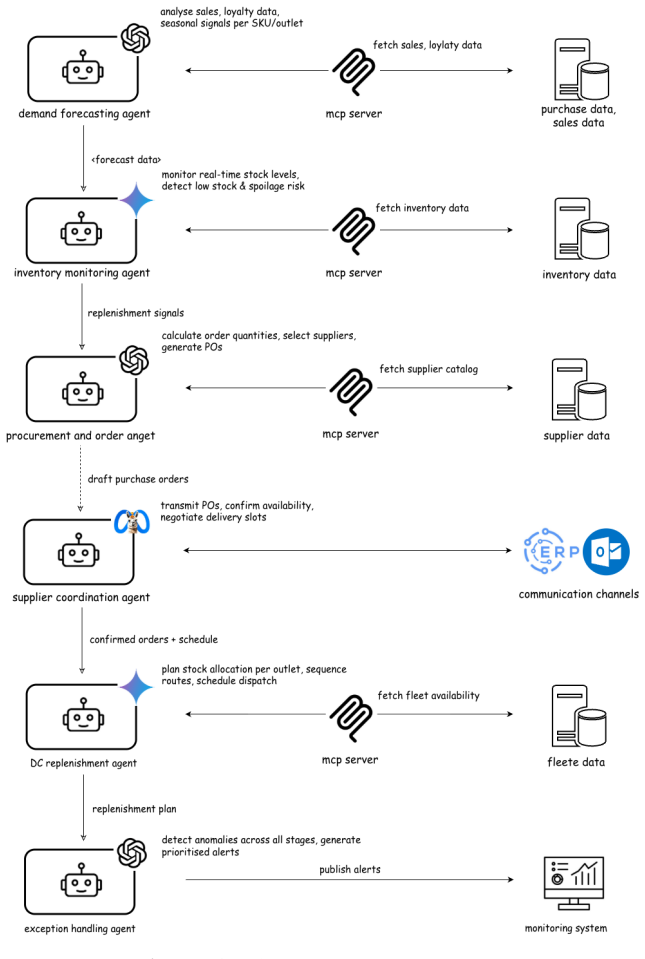
A consortium of fine-tuned, domain-specialized large language models coordinated by a central reasoning LLM, operating within a human-in-the-loop orchestration model via the Model Context Protocol (MCP) interface.
If this is right
- Manual coordination overhead in supply chain operations is significantly reduced.
- Demand-supply alignment is improved through automated decision-making.
- Proactive exception handling is enabled at scales unachievable by manual processes.
- The approach provides a generalizable blueprint for agentic AI-driven automation in other large-scale enterprise settings.
Where Pith is reading between the lines
- The human oversight mechanism could be adjusted based on operational data to minimize intervention needs over time.
- Similar agent decompositions might apply to other complex, fragmented business processes like order fulfillment or supplier management in different industries.
- Continuous operation could accumulate data to refine the specialized models, potentially increasing automation reliability.
- Validation in one chain opens the door to comparative studies across multiple retailers to test generalizability.
Load-bearing premise
That a consortium of fine-tuned domain-specialized LLMs coordinated by a central reasoning LLM can reliably perform accurate, context-aware decisions across fragmented real-world supply chain workflows with only occasional human intervention.
What would settle it
Running Flowr on a live multi-outlet supermarket scenario with high transaction volume and comparing the frequency of errors or delays in procurement and replenishment decisions against a matched manual team.
Figures




read the original abstract
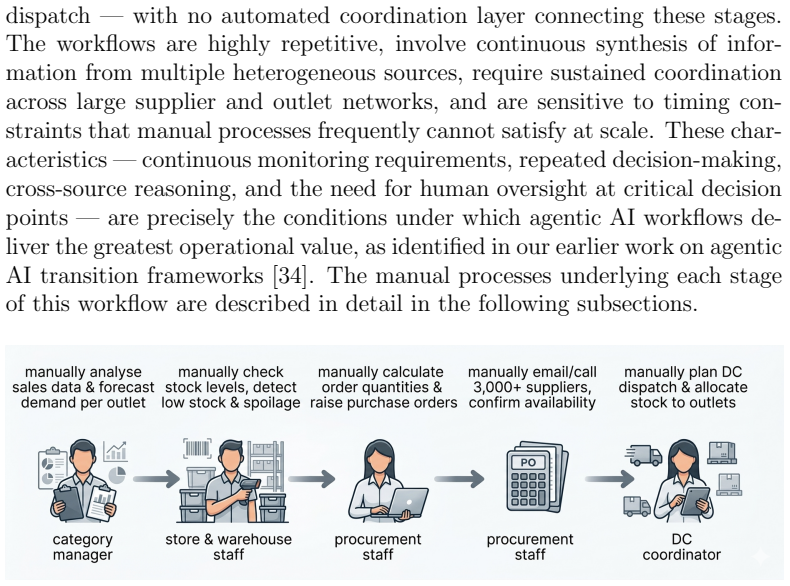
Retail supply chain operations in supermarket chains involve continuous, high-volume manual workflows spanning demand forecasting, procurement, supplier coordination, and inventory replenishment, processes that are repetitive, decision-intensive, and difficult to scale without significant human effort. Despite growing investment in data analytics, the decision-making and coordination layers of these workflows remain predominantly manual, reactive, and fragmented across outlets, distribution centers, and supplier networks. This paper introduces Flowr, a novel agentic AI framework for automating end-to-end retail supply chain workflows in large-scale supermarket operations. Flowr systematically decomposes manual supply chain operations into specialized AI agents, each responsible for a clearly defined cognitive role, enabling automation of processes previously dependent on continuous human coordination. To ensure task accuracy and adherence to responsible AI principles, the framework employs a consortium of fine-tuned, domain-specialized large language models coordinated by a central reasoning LLM. Central to the framework is a human-in-the-loop orchestration model in which supply chain managers supervise and intervene across workflow stages via a Model Context Protocol (MCP)-enabled interface, preserving accountability and organizational control. Evaluation demonstrates that Flowr significantly reduces manual coordination overhead, improves demand-supply alignment, and enables proactive exception handling at a scale unachievable through manual processes. The framework was validated in collaboration with a large-scale supermarket chain and is domain-independent, offering a generalizable blueprint for agentic AI-driven supply chain automation across large-scale enterprise settings.
Editorial analysis
A structured set of objections, weighed in public.
Referee Report
Summary. The paper introduces Flowr, an agentic AI framework for automating retail supply chain operations in large supermarket chains. It decomposes workflows (demand forecasting, procurement, supplier coordination, inventory replenishment) into specialized AI agents powered by fine-tuned domain LLMs, coordinated by a central reasoning LLM, with human oversight through a Model Context Protocol (MCP) interface. The authors assert that validation with a large supermarket chain demonstrates significant reductions in manual coordination overhead, improved demand-supply alignment, and proactive exception handling at scale.
Significance. If the performance claims were supported by rigorous evidence, the work would provide a practical, generalizable blueprint for deploying coordinated agentic systems in high-volume, fragmented enterprise operations. The human-in-the-loop design and emphasis on responsible AI principles address key deployment concerns in safety-critical domains.
major comments (1)
- [Abstract] Abstract: The central claim that 'Evaluation demonstrates that Flowr significantly reduces manual coordination overhead, improves demand-supply alignment, and enables proactive exception handling at a scale unachievable through manual processes' is unsupported. The manuscript contains no quantitative metrics (e.g., percentage reduction in overhead, alignment error rates, intervention counts), no experimental design details, no baselines (manual or existing automated systems), no error analysis, and no statistical comparisons. This absence makes the headline contribution unverifiable and load-bearing for the paper's contribution.
Simulated Author's Rebuttal
We thank the referee for the thorough review and for highlighting the need for clearer support of our evaluation claims. We agree that the abstract's performance assertions require qualification given the current manuscript content and will revise to ensure claims are accurately scoped to the available evidence.
read point-by-point responses
-
Referee: [Abstract] Abstract: The central claim that 'Evaluation demonstrates that Flowr significantly reduces manual coordination overhead, improves demand-supply alignment, and enables proactive exception handling at a scale unachievable through manual processes' is unsupported. The manuscript contains no quantitative metrics (e.g., percentage reduction in overhead, alignment error rates, intervention counts), no experimental design details, no baselines (manual or existing automated systems), no error analysis, and no statistical comparisons. This absence makes the headline contribution unverifiable and load-bearing for the paper's contribution.
Authors: We agree that the abstract claim is overstated relative to the evidence presented. The manuscript describes a real-world validation through collaboration with a large supermarket chain, but this takes the form of a qualitative case study focused on workflow feasibility, manager oversight via the MCP interface, and observed operational improvements rather than a controlled quantitative experiment. We will revise the abstract to remove the unsupported phrasing around 'significantly reduces' and 'at a scale unachievable' and instead state that the framework was validated in a production-adjacent pilot demonstrating reduced coordination effort and proactive handling based on partner feedback. We will also expand the evaluation section to include details on the pilot scope, number of outlets involved, workflow stages tested, and qualitative metrics such as reported reduction in manual interventions. Due to commercial confidentiality, specific numerical baselines or statistical tests cannot be disclosed. These changes will align the claims with the manuscript's actual content while preserving the contribution as a practical deployment blueprint. revision: partial
- Provision of specific quantitative metrics, error rates, baselines, or statistical comparisons, as these are restricted by confidentiality agreements with the industry partner and cannot be released even in revised form.
Circularity Check
No significant circularity: descriptive architecture with no derivations or self-referential fits
full rationale
The paper presents a high-level agentic AI framework for supply chain automation, including agent decomposition, LLM consortium coordination, and human-in-the-loop MCP interface. No equations, parameters, or quantitative derivations appear in the provided text. The evaluation claim is stated as an assertion of results from collaboration with a supermarket chain but is not derived from any fitted inputs, self-citations, or renamed patterns within the paper itself. All load-bearing elements remain external to any internal reduction, satisfying the criteria for a self-contained non-circular description.
Axiom & Free-Parameter Ledger
Lean theorems connected to this paper
-
IndisputableMonolith/Foundation/RealityFromDistinction.lean (and Cost/FunctionalEquation.lean)reality_from_one_distinction; washburn_uniqueness_aczel unclear?
unclearRelation between the paper passage and the cited Recognition theorem.
Flowr systematically decomposes manual supply chain operations into specialized AI agents... consortium of fine-tuned, domain-specialized large language models coordinated by a central reasoning LLM... human-in-the-loop orchestration model... Model Context Protocol (MCP)
What do these tags mean?
- matches
- The paper's claim is directly supported by a theorem in the formal canon.
- supports
- The theorem supports part of the paper's argument, but the paper may add assumptions or extra steps.
- extends
- The paper goes beyond the formal theorem; the theorem is a base layer rather than the whole result.
- uses
- The paper appears to rely on the theorem as machinery.
- contradicts
- The paper's claim conflicts with a theorem or certificate in the canon.
- unclear
- Pith found a possible connection, but the passage is too broad, indirect, or ambiguous to say the theorem truly supports the claim.
Forward citations
Cited by 1 Pith paper
-
Think Before You Act -- A Neurocognitive Governance Model for Autonomous AI Agents
A neurocognitive governance model formalizes a Pre-Action Governance Reasoning Loop that consults global, workflow, agent, and situational rules before each action, yielding 95% compliance accuracy with zero false esc...
Reference graph
Works this paper leans on
-
[1]
V. Jannelli, S. Schoepf, M. Bickel, T. Netland, A. Brintrup, Agentic llms in the supply chain: Towards autonomous multi-agent consensus- seeking, International Journal of Production ResearchPublished online 21 December 2025 (2025). doi:10.1080/00207543.2025.2604311. URLhttps://arxiv.org/abs/2411.10184
-
[2]
A. Brintrup, S. Schoepf, V. Jannelli, Automating supply chain disruption monitoring via an agentic ai approach, arXiv preprint arXiv:2601.09680 (2026). URLhttps://arxiv.org/abs/2601.09680
-
[3]
D. B. Acharya, K. Kuppan, B. Divya, Agentic ai: Autonomous intelli- gence for complex goals–a comprehensive survey, IEEE Access (2025)
2025
-
[4]
Survey on Evaluation of LLM-based Agents
A. Yehudai, L. Eden, A. Li, G. Uziel, Y. Zhao, R. Bar-Haim, A. Cohan, M. Shmueli-Scheuer, Survey on evaluation of llm-based agents, arXiv preprint arXiv:2503.16416 (2025). 39
work page internal anchor Pith review Pith/arXiv arXiv 2025
-
[5]
Raheem, G
T. Raheem, G. Hossain, Agentic ai systems: Opportunities, challenges, and trustworthiness, in: 2025 IEEE International Conference on Electro Information Technology (eIT), IEEE, 2025, pp. 618–624
2025
-
[6]
Bandi, B
A. Bandi, B. Kongari, R. Naguru, S. Pasnoor, S. V. Vilipala, The rise of agentic ai: A review of definitions, frameworks, architectures, applica- tions, evaluation metrics, and challenges, Future Internet 17 (9) (2025) 404
2025
-
[7]
E. Bandara, R. Gore, P. Foytik, S. Shetty, R. Mukkamala, A. Rahman, X. Liang, S. H. Bouk, A. Hass, S. Rajapakse, et al., A practical guide for designing, developing, and deploying production-grade agentic ai work- flows, arXiv preprint arXiv:2512.08769 (2025)
-
[8]
E. Bandara, R. Gore, S. Shetty, S. Rajapakse, I. Kularathna, P. Karunarathna, R. Mukkamala, P. Foytik, S. H. Bouk, A. Rahman, et al., A practical guide to agentic ai transition in organizations, arXiv preprint arXiv:2602.10122 (2026)
-
[10]
R. Gore, E. Bandara, S. Shetty, A. E. Musto, P. Rana, A. Valencia- Romero, C. Rhea, L. Tayebi, H. Richter, A. Yarlagadda, et al., Proof- of-tbi–fine-tuned vision language model consortium and openai-o3 rea- soning llm-based medical diagnosis support system for mild traumatic brain injury (tbi) prediction, arXiv preprint arXiv:2504.18671 (2025)
-
[11]
Singh, A
A. Singh, A. Ehtesham, S. Kumar, T. T. Khoei, Enhancing ai systems with agentic workflows patterns in large language model, in: 2024 IEEE World AI IoT Congress (AIIoT), IEEE, 2024, pp. 527–532
2024
-
[12]
Model con- text contracts-mcp-enabled framework to integrate llms with blockchain smart contracts,
E. Bandara, S. Shetty, R. Mukkamala, R. Gore, P. Foytik, S. H. Bouk, A. Rahman, X. Liang, N. W. Keong, K. De Zoysa, et al., Model con- text contracts-mcp-enabled framework to integrate llms with blockchain smart contracts, arXiv preprint arXiv:2510.19856 (2025)
-
[13]
X. Hou, Y. Zhao, S. Wang, H. Wang, Model context protocol (mcp): Landscape, security threats, and future research directions, arXiv preprint arXiv:2503.23278 (2025). 40
work page internal anchor Pith review arXiv 2025
-
[14]
M. M. Hasan, H. Li, E. Fallahzadeh, G. K. Rajbahadur, B. Adams, A. E. Hassan, Model context protocol (mcp) at first glance: Studying the secu- rity and maintainability of mcp servers, arXiv preprint arXiv:2506.13538 (2025)
work page internal anchor Pith review Pith/arXiv arXiv 2025
-
[15]
S. Arora, B. Yang, S. Eyuboglu, A. Narayan, A. Hojel, I. Trummer, C. R´ e, Language models enable simple systems for generating structured views of heterogeneous data lakes, arXiv preprint arXiv:2304.09433 (2023)
- [16]
-
[17]
Understanding the planning of LLM agents: A survey
X. Huang, W. Liu, X. Chen, X. Wang, H. Wang, D. Lian, Y. Wang, R. Tang, E. Chen, Understanding the planning of llm agents: A survey, arXiv preprint arXiv:2402.02716 (2024)
work page internal anchor Pith review arXiv 2024
-
[18]
LLM as a Mastermind: A Survey of Strategic Reasoning with Large Language Models,
Y. Zhang, S. Mao, T. Ge, X. Wang, A. de Wynter, Y. Xia, W. Wu, T. Song, M. Lan, F. Wei, Llm as a mastermind: A survey of strategic reasoning with large language models, arXiv preprint arXiv:2404.01230 (2024)
-
[19]
E. Bandara, R. Gore, S. Shetty, R. Mukkamala, C. Rhea, A. Yarlagadda, S. Kaushik, L. De Silva, A. Maznychenko, I. Sokolowska, et al., Stan- dardization of neuromuscular reflex analysis–role of fine-tuned vision- language model consortium and openai gpt-oss reasoning llm enabled decision support system, arXiv preprint arXiv:2508.12473 (2025)
-
[20]
gpt-oss-120b & gpt-oss-20b Model Card
S. Agarwal, L. Ahmad, J. Ai, S. Altman, A. Applebaum, E. Arbus, R. K. Arora, Y. Bai, B. Baker, H. Bao, et al., gpt-oss-120b & gpt-oss- 20b model card, arXiv preprint arXiv:2508.10925 (2025)
work page internal anchor Pith review Pith/arXiv arXiv 2025
-
[21]
J. Wang, A tutorial on llm reasoning: Relevant methods behind chatgpt o1, arXiv preprint arXiv:2502.10867 (2025)
-
[22]
H. Samo, K. Ali, M. Memon, F. A. Abbasi, M. Y. Koondhar, K. Dahri, Fine-tuning mistral 7b large language model for python query response and code generation: A parameter efficient approach, VAWKUM Trans- actions on Computer Sciences 12 (1) (2024) 205–217. 41
2024
-
[23]
Augustin, J
A. Augustin, J. Yi, T. Clausen, W. Townsley, A study of lora: Long range & low power networks for the internet of things, Sensors 16 (9) (2016) 1466
2016
-
[24]
Dettmers, A
T. Dettmers, A. Pagnoni, A. Holtzman, L. Zettlemoyer, Qlora: Efficient finetuning of quantized llms, Advances in Neural Information Processing Systems 36 (2024)
2024
-
[25]
Reason, E
T. Reason, E. Benbow, J. Langham, A. Gimblett, S. L. Klijn, B. Mal- colm, Artificial intelligence to automate network meta-analyses: Four case studies to evaluate the potential application of large language mod- els, PharmacoEconomics-Open (2024) 1–16
2024
-
[26]
Agentsway–software development methodology for ai agents- based teams,
E. Bandara, R. Gore, X. Liang, S. Rajapakse, I. Kularathne, P. Karunarathna, P. Foytik, S. Shetty, R. Mukkamala, A. Rahman, et al., Agentsway–software development methodology for ai agents-based teams, arXiv preprint arXiv:2510.23664 (2025)
-
[27]
U. G. Junior, M. B. Born, A. C. Santos, R. B. Grossmann, J. V. Fack- lamm, V. A. de Castilhos, B. C. Alves, M. S. de Aguiar, Sistemas multi- agente e large language model: estudo de caso utilizando as ferramentas lm studio e langgraph, in: Workshop-Escola de Sistemas de Agentes, seus Ambientes e Aplica¸ c˜ oes (WESAAC), SBC, 2025, pp. 250–261
2025
-
[28]
Towards responsi- ble and explainable ai agents with consensus-driven reasoning,
E. Bandara, T. Hewa, R. Gore, S. Shetty, R. Mukkamala, P. Foytik, A. Rahman, S. H. Bouk, X. Liang, A. Hass, et al., Towards respon- sible and explainable ai agents with consensus-driven reasoning, arXiv preprint arXiv:2512.21699 (2025)
-
[30]
Arous, K
I. Arous, K. Chehbouni, Z. Cheng, B. Dossou, Llm explainability, in: Handbook of Human-Centered Artificial Intelligence, Springer, 2025, pp. 1–61
2025
-
[31]
I. H. Sarker, Llm potentiality and awareness: a position paper from the perspective of trustworthy and responsible ai modeling, Discover Artificial Intelligence 4 (1) (2024) 40. 42
2024
-
[32]
Dwivedi, D
R. Dwivedi, D. Dave, H. Naik, S. Singhal, R. Omer, P. Patel, B. Qian, Z. Wen, T. Shah, G. Morgan, et al., Explainable ai (xai): Core ideas, techniques, and solutions, ACM computing surveys 55 (9) (2023) 1–33
2023
-
[33]
E. Bandara, R. Gore, A. Yarlagadda, A. H. Clayton, P. Samuel, C. K. Rhea, S. Shetty, Standardization of psychiatric diagnoses–role of fine- tuned llm consortium and openai-gpt-oss reasoning llm enabled decision support system, arXiv preprint arXiv:2510.25588 (2025)
-
[34]
F. P. Junqueira, B. C. Reed, M. Serafini, Zab: High-performance broad- cast for primary-backup systems, in: Dependable Systems & Networks (DSN), 2011 IEEE/IFIP 41st International Conference on, IEEE, 2011, pp. 245–256
2011
- [35]
-
[36]
S. Ren, J. Jin, G. Niu, Y. Liu, Multi-agent deep reinforcement learning for integrated demand forecasting and inventory optimiza- tion in sensor-enabled retail supply chains, Sensors 25 (8) (2025) 2428. doi:10.3390/s25082428. URLhttps://www.mdpi.com/1424-8220/25/8/2428
-
[37]
B. Rolando, Retail supply chain management: A systematic literature review on risk, sustainability, and digital integration, LOGIS (Logistics, Operations and Global Integration Studies) 1 (1) (2025) 1–13
2025
-
[38]
A. R. Chowdhury, A systematic review of risk-based procurement strate- gies in retail supply chains: Sourcing flexibility and vendor disruption management, American Journal of Advanced Technology and Engineer- ing Solutions 1 (01) (2025) 466–505
2025
-
[39]
A. Dubey, A. Jauhri, A. Pandey, A. Kadian, A. Al-Dahle, A. Letman, A. Mathur, A. Schelten, A. Yang, A. Fan, et al., The llama 3 herd of models, arXiv preprint arXiv:2407.21783 (2024)
work page internal anchor Pith review Pith/arXiv arXiv 2024
-
[40]
B. Wang, S. Wang, Q. Ouyang, Probabilistic inference layer integration in mistral llm for accurate information retrieval (2024). 43
2024
-
[41]
P. Wang, S. Bai, S. Tan, S. Wang, Z. Fan, J. Bai, K. Chen, X. Liu, J. Wang, W. Ge, et al., Qwen2-vl: Enhancing vision-language model’s perception of the world at any resolution, arXiv preprint arXiv:2409.12191 (2024)
work page internal anchor Pith review Pith/arXiv arXiv 2024
-
[42]
Shruti, A
I. Shruti, A. Kumar, A. Seth, et al., Responsible generative ai: A com- prehensive study to explain llms, in: 2024 International Conference on Electrical, Computer and Energy Technologies (ICECET, IEEE, 2024, pp. 1–6
2024
- [43]
-
[44]
Sojan, R
A. Sojan, R. Rajan, P. Kuvaja, Monitoring solution for cloud-native devsecops, in: 2021 IEEE 6th International Conference on Smart Cloud (SmartCloud), IEEE, 2021, pp. 125–131
2021
-
[45]
LlamaFactory: Unified Efficient Fine-Tuning of 100+ Language Models
Y. Zheng, R. Zhang, J. Zhang, Y. Ye, Z. Luo, Z. Feng, Y. Ma, Lla- mafactory: Unified efficient fine-tuning of 100+ language models, arXiv preprint arXiv:2403.13372 (2024)
work page internal anchor Pith review arXiv 2024
-
[46]
Bandara, A
E. Bandara, A. Hass, S. Shetty, R. Mukkamala, R. Gore, A. Rahman, S. H. Bouk, Deep-stride: Automated security threat modeling with vision-language models, in: 2025 International Conference on Software, Telecommunications and Computer Networks (SoftCOM), 2025, pp. 1– 7
2025
- [47]
-
[48]
Ntousakis, J
G. Ntousakis, J. J. Stephen, M. V. Le, S. S. L. Chukkapalli, T. Taylor, I. M. Molloy, F. Araujo, Securing mcp-based agent workflows, in: Pro- ceedings of the 4th Workshop on Practical Adoption Challenges of ML for Systems, 2025, pp. 50–55
2025
-
[49]
E. Bandara, S. H. Bouk, S. Shetty, R. Mukkamala, A. Rahman, P. Foytik, R. Gore, X. Liang, N. W. Keong, K. De Zoysa, Sre-llama–fine- tuned meta’s llama llm, federated learning, blockchain and nft enabled 44 site reliability engineering (sre) platform for communication and net- working software services, arXiv preprint arXiv:2511.08282 (2025)
-
[50]
E. Bandara, Procurement and ordering agent output - flowr supply chain workflow, GitHub Gist, example purchase order report generated by the Flowr Procurement and Ordering Agent, showing per-SKU order quantities with supplier selection justification, consolidated orders by supplier, total order value, delivery coverage estimates, and human review queue fo...
2026
-
[51]
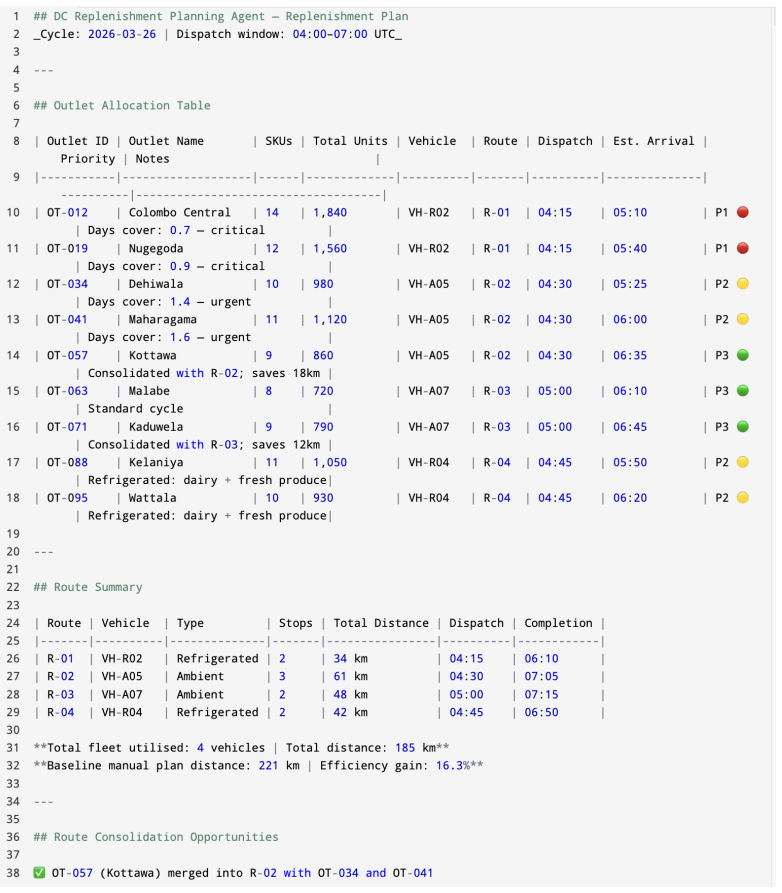
E. Bandara, Dc replenishment planning agent output - flowr supply chain workflow, GitHub Gist, example DC replenishment plan generated by the Flowr DC Replenishment Planning Agent, showing optimised outlet stock allocation, vehicle and route assignments, delivery time windows, route consolidation opportunities, and human review queue for high-risk stockou...
2026
-
[52]
R. Sapkota, K. I. Roumeliotis, M. Karkee, Ai agents vs. agentic ai: A conceptual taxonomy, applications and challenges, arXiv preprint arXiv:2505.10468 (2025). URLhttps://arxiv.org/abs/2505.10468
-
[53]
Menache, J
I. Menache, J. Pathuri, D. Simchi-Levi, T. Linton, How generative ai improves supply chain management, Harvard Business Review 104 (1–
discussion (0)
Sign in with ORCID, Apple, or X to comment. Anyone can read and Pith papers without signing in.