Recognition: 2 theorem links
· Lean TheoremRegimes of Scale in AI Meteorology
Pith reviewed 2026-05-10 19:13 UTC · model grok-4.3
The pith
AI/ML methods struggle to integrate with meteorology because they arise from different infrastructures for scaling data and models.
A machine-rendered reading of the paper's core claim, the machinery that carries it, and where it could break.
Core claim
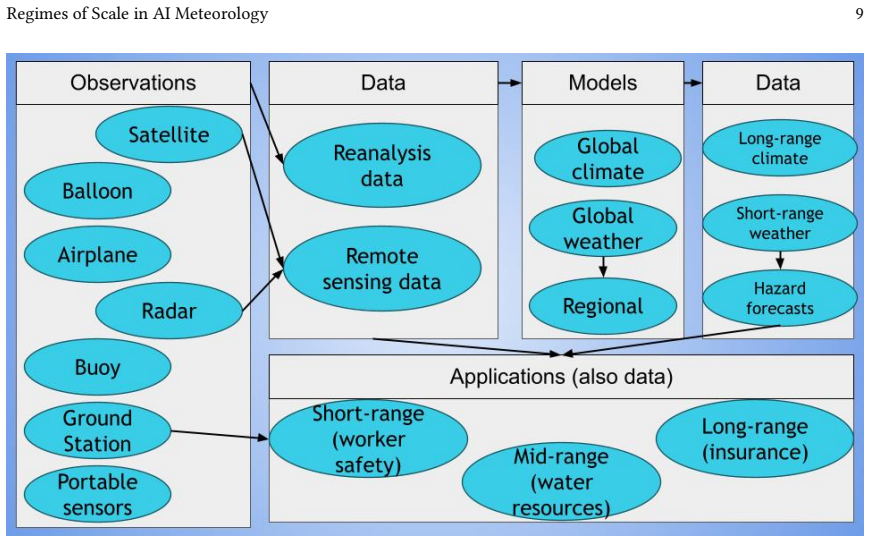
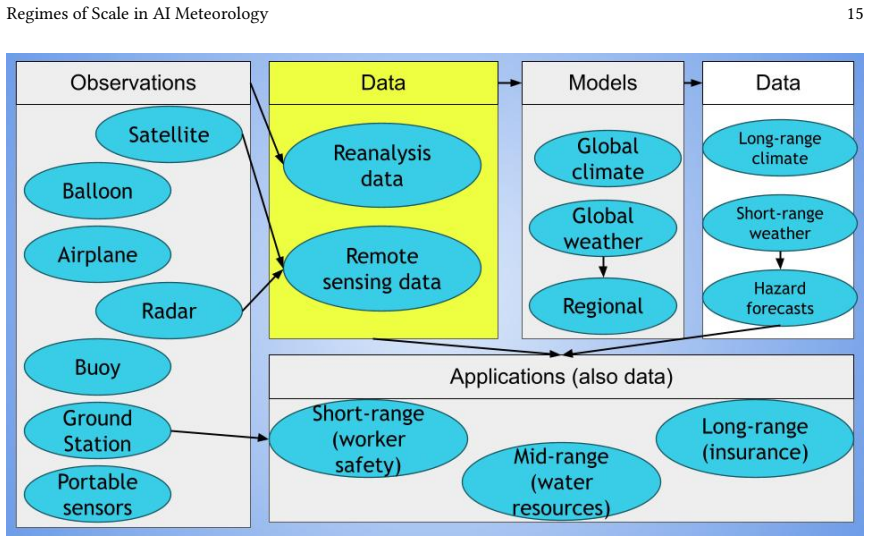
Drawing from 12 interviews, the analysis traces tensions in AI/ML weather application arising from regimes of scale, different ways that AI/ML and meteorological regimes make observations, data, and models scale. The central argument is that AI/ML methods were born from specific platform and internet infrastructures, and so they can struggle to integrate with very different meteorological ways of organizing data pipelines.
What carries the argument
Regimes of scale, the distinct approaches in AI/ML versus meteorology for making observations, data, and models scale up.
If this is right
- AI applications in weather must be tailored to align with meteorological data organization practices rather than applied as universal tools.
- Attempts to deploy general AI tools in meteorology will likely encounter persistent integration challenges rooted in infrastructure differences.
- Development of new AI weather models should incorporate meteorological scaling approaches from the start to reduce tensions.
- Understanding these regimes can improve collaboration between AI developers and meteorologists by highlighting specific points of mismatch.
Where Pith is reading between the lines
- Similar infrastructural mismatches may exist when applying AI to other physics-based scientific fields that rely on established modeling traditions.
- Future studies could map exact steps in data pipelines to identify precise points of scale conflict between AI and domain practices.
- This framing suggests broader HCI research should examine AI integration in additional domains with long-standing data organization methods.
Load-bearing premise
That the twelve interviews capture representative tensions in AI-meteorology integration and that the regimes of scale framing generalizes beyond the sampled participants.
What would settle it
Documenting multiple cases of seamless AI/ML integration into operational meteorological systems with no adjustments for data scaling practices would challenge the claim of inherent struggles.
Figures



read the original abstract
HCI work has explored the effective integration of AI/ML tools across "application domains" from healthcare to finance to transportation. We add to this literature with an analysis of AI/ML tools in meteorology, a domain that already uses "big data" and massive physics-based models. Drawing from 12 interviews with forecasters and meteorologists with varied connections to AI/ML weather modeling, we trace tensions in AI/ML weather application arising from what we call "regimes of scale," different ways that AI/ML and meteorological regimes make observations, data, and models scale. Rather than seeing AI/ML as a domain-agnostic tool, we argue that AI/ML methods were born from specific platform and internet infrastructures, and so they can struggle to integrate with very different (in this case meteorological) ways of organizing data pipelines.
Editorial analysis
A structured set of objections, weighed in public.
Referee Report
Summary. The paper claims that tensions in applying AI/ML tools to meteorology arise from mismatched 'regimes of scale'—distinct ways of organizing observations, data pipelines, and models—between AI/ML practices and meteorological ones. Drawing on 12 interviews with forecasters and meteorologists, it argues that AI/ML methods originated in platform and internet infrastructures and therefore encounter integration difficulties in domains like meteorology that rely on physics-based models and different data practices, rather than treating AI/ML as a domain-agnostic tool.
Significance. If the interpretive framing holds, the work contributes to HCI literature on cross-domain AI integration by emphasizing infrastructural origins as a source of friction in data-intensive scientific fields. It offers qualitative evidence of practical challenges in scaling AI for meteorology, which already handles large-scale data and models, and could inform design approaches that account for domain-specific data regimes.
major comments (2)
- [Methods] Methods section: The sampling strategy, participant selection criteria, interview protocol, and coding/analysis process for the 12 interviews are not described in sufficient detail. This is load-bearing because the central 'regimes of scale' framing and its generalization beyond the sample rest entirely on these accounts.
- [Discussion] Discussion section: The claim that observed tensions originate specifically from AI/ML's 'birth' in platform and internet infrastructures (rather than, e.g., differences in physical constraints or regulatory environments) is presented as explanatory, yet the interview data consists solely of meteorologist accounts with no comparative historical analysis, archival evidence, or input from AI developers to establish the causal link.
minor comments (1)
- [Introduction] The definition and operationalization of 'regimes of scale' could be stated more explicitly early in the paper to distinguish it from related concepts in infrastructure or scale studies.
Simulated Author's Rebuttal
We thank the referee for their constructive and detailed feedback, which has helped us strengthen the manuscript. We address each major comment point by point below, indicating revisions where made.
read point-by-point responses
-
Referee: [Methods] Methods section: The sampling strategy, participant selection criteria, interview protocol, and coding/analysis process for the 12 interviews are not described in sufficient detail. This is load-bearing because the central 'regimes of scale' framing and its generalization beyond the sample rest entirely on these accounts.
Authors: We agree that greater methodological transparency is essential for a qualitative study of this nature. The original submission provided only a high-level description of the 12 interviews. In the revised manuscript we have expanded the Methods section with a dedicated subsection that details: (1) purposive sampling via meteorology professional societies, national weather service contacts, and AI-weather research consortia to achieve variation in AI exposure; (2) explicit selection criteria (minimum five years forecasting experience, range of AI/ML familiarity from none to active model developers); (3) the semi-structured interview protocol, including core questions on observation practices, data pipelines, model validation, and scaling frictions, plus follow-up probes; and (4) the analysis process, which followed reflexive thematic analysis (Braun & Clarke) with two coders, iterative theme development, and member-checking with three participants. These additions make the evidentiary basis for the regimes-of-scale framing explicit and allow readers to assess transferability. revision: yes
-
Referee: [Discussion] Discussion section: The claim that observed tensions originate specifically from AI/ML's 'birth' in platform and internet infrastructures (rather than, e.g., differences in physical constraints or regulatory environments) is presented as explanatory, yet the interview data consists solely of meteorologist accounts with no comparative historical analysis, archival evidence, or input from AI developers to establish the causal link.
Authors: We accept that the meteorologist interviews alone cannot demonstrate historical causality. The manuscript's argument treats the infrastructural origins of contemporary AI/ML as established context from prior HCI and STS literature on platform-scale data practices, while the interviews supply empirical illustration of the resulting regime mismatch with meteorological workflows. In the revised Discussion we have: (a) reframed the claim as an interpretive lens rather than a direct causal assertion derived solely from the data; (b) explicitly noted the limitation of relying on one-sided accounts and the absence of AI-developer perspectives or archival work; and (c) added a forward-looking statement identifying comparative studies as valuable future research. This preserves the paper's contribution to cross-domain AI integration while accurately bounding the evidentiary scope of the present study. revision: partial
Circularity Check
No circularity: interpretive argument from interview data with no derivations or reductions
full rationale
The paper offers a qualitative HCI analysis grounded in 12 interviews, tracing observed tensions in AI/ML-meteorology integration to differing 'regimes of scale' without equations, quantitative predictions, fitted parameters, or any claimed first-principles derivations. The central interpretive claim—that AI/ML methods originated in platform infrastructures and therefore struggle with meteorological data pipelines—is presented as an inference from the interview accounts rather than a self-referential loop, self-citation chain, or renaming of inputs. No load-bearing step reduces by construction to the paper's own data or assumptions, satisfying the criteria for a self-contained non-circular finding.
Axiom & Free-Parameter Ledger
Lean theorems connected to this paper
-
IndisputableMonolith/Foundation/RealityFromDistinction.leanreality_from_one_distinction unclear?
unclearRelation between the paper passage and the cited Recognition theorem.
We trace tensions in AI/ML weather application arising from what we call 'regimes of scale,' different ways that AI/ML and meteorological regimes make observations, data, and models scale.
-
IndisputableMonolith/Cost/FunctionalEquation.leanwashburn_uniqueness_aczel unclear?
unclearRelation between the paper passage and the cited Recognition theorem.
AI/ML methods were born from specific platform and internet infrastructures
What do these tags mean?
- matches
- The paper's claim is directly supported by a theorem in the formal canon.
- supports
- The theorem supports part of the paper's argument, but the paper may add assumptions or extra steps.
- extends
- The paper goes beyond the formal theorem; the theorem is a base layer rather than the whole result.
- uses
- The paper appears to rely on the theorem as machinery.
- contradicts
- The paper's claim conflicts with a theorem or certificate in the canon.
- unclear
- Pith found a possible connection, but the passage is too broad, indirect, or ambiguous to say the theorem truly supports the claim.
Reference graph
Works this paper leans on
-
[1]
Anna Allen, Stratis Markou, Will Tebbutt, James Requeima, Wessel P. Bruinsma, Tom R. Andersson, Michael Herzog, Nicholas D. Lane, Matthew Chantry, J. Scott Hosking, and Richard E. Turner. 2025. End-to-End Data-Driven Weather Prediction.Nature641, 8065 (May 2025), 1172–1179. doi:10.1038/s41586-025-08897-0
-
[2]
Adriana Alvarado Garcia, Heloisa Candello, Karla Badillo-Urquiola, and Marisol Wong-Villacres. 2025. Emerging Data Practices: Data Work in the Era of Large Language Models. InProceedings of the 2025 CHI Conference on Human Factors in Computing Systems (CHI ’25). Association for Computing Machinery, New York, NY, USA, 1–21. doi:10.1145/3706598.3714069
-
[3]
Seyram Avle, Cindy Lin, Jean Hardy, and Silvia Lindtner. 2020. Scaling Techno-Optimistic Visions.Engaging Science, Technology, and Society6 (May 2020), 237–254. doi:10.17351/ests2020.283
-
[4]
K.S. Baker, S.J. Jackson, and J.R. Wanetick. 2005. Strategies Supporting Heterogeneous Data and Interdisciplinary Collaboration: Towards an Ocean Informatics Environment. InProceedings of the 38th Annual Hawaii International Conference on System Sciences. 219b–219b. doi:10.1109/HICSS.2005.565
-
[5]
Peter Bauer, Alan Thorpe, and Gilbert Brunet. 2015. The Quiet Revolution of Numerical Weather Prediction.Nature525, 7567 (Sept. 2015), 47–55. doi:10.1038/nature14956
-
[6]
Aditya Bhattacharya, Simone Stumpf, Robin De Croon, and Katrien Verbert. 2025. Explanatory Debiasing: Involving Domain Experts in the Data Generation Process to Mitigate Representation Bias in AI Systems. InProceedings of the 2025 CHI Conference on Human Factors in Computing Systems (CHI ’25). Association for Computing Machinery, New York, NY, USA, 1–20. ...
-
[7]
Kaifeng Bi, Lingxi Xie, Hengheng Zhang, Xin Chen, Xiaotao Gu, and Qi Tian. 2023. Accurate Medium-Range Global Weather Forecasting with 3D Neural Networks.Nature619, 7970 (July 2023), 533–538. doi:10.1038/s41586-023-06185-3
-
[8]
Sébastien Bubeck, Varun Chandrasekaran, Ronen Eldan, Johannes Gehrke, Eric Horvitz, Ece Kamar, Peter Lee, Yin Tat Lee, Yuanzhi Li, Scott Lundberg, Harsha Nori, Hamid Palangi, Marco Tulio Ribeiro, and Yi Zhang. 2023. Sparks of Artificial General Intelligence: Early Experiments with GPT-4. doi:10.48550/arXiv.2303.12712 arXiv:2303.12712 [cs]
work page internal anchor Pith review doi:10.48550/arxiv.2303.12712 2023
-
[9]
Matt Burton and Steven J. Jackson. 2012. Constancy and Change in Scientific Collaboration: Coherence and Integrity in Long-Term Ecological Data Production. InProceedings of the 2012 45th Hawaii International Conference on System Sciences (HICSS ’12). IEEE Computer Society, USA, 353–362. doi:10.1109/HICSS.2012.178
-
[10]
Mihnea Stefan Calota, Wessel William Nieuwenhuys, Janet Yi-Ching Huang, Lin-Lin Chen, and Mathias Funk. 2025. Sensemaking Through Making: Developing Clinical Domain Knowledge by Crafting Synthetic Datasets and Prototyping System Architectures. InCompanion Publication of the 2025 ACM Designing Interactive Systems Conference. Association for Computing Machi...
2025
-
[11]
A. Feder Cooper, Katherine Lee, Madiha Zahrah Choksi, Solon Barocas, Christopher De Sa, James Grimmelmann, Jon Kleinberg, Siddhartha Sen, and Baobao Zhang. 2023. Is My Prediction Arbitrary? The Confounding Effects of Variance in Fair Classification Benchmarks. doi:10.48550/arXiv.2301. 11562 arXiv:2301.11562 [cs, stat]
-
[12]
1991.Technology Reconciliation in the Remote Sensing ERA of United States Civilian Weather Forecasting: 1957 -1987.Ph
Margaret Eileen Courain. 1991.Technology Reconciliation in the Remote Sensing ERA of United States Civilian Weather Forecasting: 1957 -1987.Ph. D. Dissertation
1991
-
[13]
Amy Dahan Dalmedico. 2001. History and Epistemology of Models: Meteorology (1946—1963) as a Case Study.Archive for History of Exact Sciences 55, 5 (2001), 395–422. jstor:41134119 Manuscript submitted to ACM 24 Martin et al
2001
-
[14]
Yonas B. Dibike and Paulin Coulibaly. 2006. Temporal Neural Networks for Downscaling Climate Variability and Extremes.Neural Networks19, 2 (March 2006), 135–144. doi:10.1016/j.neunet.2006.01.003
-
[15]
Paul Edwards. 2006. Meteorology as Infrastructural Globalism.Osiris(Jan. 2006). doi:10.1086/507143
-
[16]
Paul N. N. Edwards. 2013.A Vast Machine: Computer Models, Climate Data, and the Politics of Global Warming(illustrated edition ed.). The MIT Press, Cambridge, Massachusetts London, England
2013
-
[17]
J. B. Elsner and A. A. Tsonis. 1992. Nonlinear Prediction, Chaos, and Noise.Bulletin of the American Meteorological Society73, 1 (Jan. 1992), 49–60. doi:10.1175/1520-0477(1992)073<0049:NPCAN>2.0.CO;2
-
[18]
Kerry Emanuel. 2020. The Relevance of Theory for Contemporary Research in Atmospheres, Oceans, and Climate.AGU Advances1, 2 (2020), e2019AV000129. doi:10.1029/2019AV000129
-
[19]
Beverly Freeman, Roma Ruparel, and Laura M Vardoulakis. 2025. Zoom in, Zoom out, Reframe: Domain Experts’ Strategies for Addressing Non-Experts’ Complex Questions. InProceedings of the Extended Abstracts of the CHI Conference on Human Factors in Computing Systems (CHI EA ’25). Association for Computing Machinery, New York, NY, USA, 1–7. doi:10.1145/370659...
-
[20]
Alexandra-Elena Gurit,ă and Radu-Daniel Vatavu. 2025. Good Accessibility, Handcuffed Creativity: AI-Generated UIs Between Accessibility Guidelines and Practitioners’ Expectations. InProceedings of the 2025 ACM Designing Interactive Systems Conference (DIS ’25). Association for Computing Machinery, New York, NY, USA, 1197–1209. doi:10.1145/3715336.3735691
-
[21]
Kristian Bondo Hansen and Nanna Thylstrup. 2023. Stack Bricolage and Infrastructural Impermanence in Financial Machine-Learning Modelling. Journal of Cultural Economy(Aug. 2023), 1–19. doi:10.1080/17530350.2023.2229347
-
[22]
Peter Henderson, Riashat Islam, Philip Bachman, Joelle Pineau, Doina Precup, and David Meger. 2019. Deep Reinforcement Learning That Matters. doi:10.48550/arXiv.1709.06560 arXiv:1709.06560 [cs, stat]
-
[23]
Fred Hohman, Kanit Wongsuphasawat, Mary Beth Kery, and Kayur Patel. 2020. Understanding and Visualizing Data Iteration in Machine Learning. InProceedings of the 2020 CHI Conference on Human Factors in Computing Systems (CHI ’20). Association for Computing Machinery, New York, NY, USA, 1–13. doi:10.1145/3313831.3376177
-
[24]
Ju Yeon Jung, Tom Steinberger, John L. King, and Mark S. Ackerman. 2022. How Domain Experts Work with Data: Situating Data Science in the Practices and Settings of Craftwork.Proc. ACM Hum.-Comput. Interact.6, CSCW1 (April 2022), 58:1–58:29. doi:10.1145/3512905
-
[25]
Ju Yeon Jung, Tom Steinberger, and Chaehan So. 2024. Towards Actionable Data Science: Domain Experts as End-Users of Data Science Systems. Computer Supported Cooperative Work (CSCW)33, 3 (Sept. 2024), 389–433. doi:10.1007/s10606-023-09475-6
-
[26]
Dae Hyun Kim, Hyungyu Shin, Shakhnozakhon Yadgarova, Jinho Son, Hariharan Subramonyam, and Juho Kim. 2024. AINeedsPlanner: A Workbook to Support Effective Collaboration Between AI Experts and Clients. InProceedings of the 2024 ACM Designing Interactive Systems Conference (DIS ’24). Association for Computing Machinery, New York, NY, USA, 728–742. doi:10.11...
-
[27]
Ashok Kumar, A. K. Mitra, A. K. Bohra, G. R. Iyengar, and V. R. Durai. 2012. Multi-Model Ensemble (MME) Prediction of Rainfall Using Neural Networks during Monsoon Season in India.Meteorological Applications19, 2 (2012), 161–169. doi:10.1002/met.254
-
[28]
Matthew Lakier, Andrew Irwin, and Daniel Vogel. 2025. Understanding Marine Scientist Software Tool Use. InProceedings of the 2025 CHI Conference on Human Factors in Computing Systems (CHI ’25). Association for Computing Machinery, New York, NY, USA, 1–14. doi:10.1145/3706598.3713621
-
[29]
Remi Lam, Alvaro Sanchez-Gonzalez, Matthew Willson, Peter Wirnsberger, Meire Fortunato, Ferran Alet, Suman Ravuri, Timo Ewalds, Zach Eaton- Rosen, Weihua Hu, Alexander Merose, Stephan Hoyer, George Holland, Oriol Vinyals, Jacklynn Stott, Alexander Pritzel, Shakir Mohamed, and Peter Battaglia. 2023. GraphCast: Learning Skillful Medium-Range Global Weather ...
-
[30]
Simon Lang, Mihai Alexe, Matthew Chantry, Jesper Dramsch, Florian Pinault, Baudouin Raoult, Mariana C. A. Clare, Christian Lessig, Michael Maier-Gerber, Linus Magnusson, Zied Ben Bouallègue, Ana Prieto Nemesio, Peter D. Dueben, Andrew Brown, Florian Pappenberger, and Florence Rabier. 2024. AIFS – ECMWF’s Data-Driven Forecasting System. doi:10.48550/arXiv....
-
[31]
Christine P Lee, Min Kyung Lee, and Bilge Mutlu. 2024. The AI-DEC: A Card-based Design Method for User-centered AI Explanations. InProceedings of the 2024 ACM Designing Interactive Systems Conference (DIS ’24). Association for Computing Machinery, New York, NY, USA, 1010–1028. doi:10.1145/3643834.3661576
-
[32]
Thomas Liao, Rohan Taori, Inioluwa Deborah Raji, and Ludwig Schmidt. 2022. Are We Learning Yet? A Meta Review of Evaluation Failures Across Machine Learning. InThirty-Fifth Conference on Neural Information Processing Systems Datasets and Benchmarks Track (Round 2)
2022
-
[33]
Cindy Kaiying Lin and Steven J. Jackson. 2023. From Bias to Repair: Error as a Site of Collaboration and Negotiation in Applied Data Science Work. Proceedings of the ACM on Human-Computer Interaction7, CSCW1 (April 2023), 131:1–131:32. doi:10.1145/3579607
-
[34]
Edward N. Lorenz. 1963. Deterministic Nonperiodic Flow.Journal of the Atmospheric Sciences20, 2 (March 1963), 130–141. doi:10.1175/1520- 0469(1963)020<0130:DNF>2.0.CO;2
-
[35]
Varshney, Ioana Baldini, Casey Dugan, and Aleksandra Mojsilović
Yaoli Mao, Dakuo Wang, Michael Muller, Kush R. Varshney, Ioana Baldini, Casey Dugan, and Aleksandra Mojsilović. 2019. How Data Scientists Work Together With Domain Experts in Scientific Collaborations: To Find The Right Answer Or To Ask The Right Question?Proc. ACM Hum.-Comput. Interact.3, GROUP (Dec. 2019), 237:1–237:23. doi:10.1145/3361118
-
[36]
Marvin Minsky. 1961. Steps toward Artificial Intelligence.Proceedings of the IRE49, 1 (Jan. 1961), 8–30. doi:10.1109/JRPROC.1961.287775
-
[37]
Devika Narayan. 2022. Platform Capitalism and Cloud Infrastructure: Theorizing a Hyper-Scalable Computing Regime.Environment and Planning A: Economy and Space54, 5 (Aug. 2022), 911–929. doi:10.1177/0308518X221094028
-
[38]
Neang, Will Sutherland, Michael W
Andrew B. Neang, Will Sutherland, Michael W. Beach, and Charlotte P. Lee. 2021. Data Integration as Coordination: The Articulation of Data Work in an Ocean Science Collaboration.Proc. ACM Hum.-Comput. Interact.4, CSCW3 (Jan. 2021), 256:1–256:25. doi:10.1145/3432955 Manuscript submitted to ACM Regimes of Scale in AI Meteorology 25
-
[39]
Neang, Will Sutherland, David Ribes, and Charlotte P
Andrew B. Neang, Will Sutherland, David Ribes, and Charlotte P. Lee. 2023. Organizing Oceanographic Infrastructure: The Work of Making a Software Pipeline Repurposable.Proc. ACM Hum.-Comput. Interact.7, CSCW1 (April 2023), 79:1–79:18. doi:10.1145/3579512
-
[40]
OpenAI, Josh Achiam, Steven Adler, Sandhini Agarwal, Lama Ahmad, Ilge Akkaya, Florencia Leoni Aleman, Diogo Almeida, Janko Altenschmidt, Sam Altman, Shyamal Anadkat, Red Avila, Igor Babuschkin, Suchir Balaji, Valerie Balcom, Paul Baltescu, Haiming Bao, Mo Bavarian, Jeff Belgum, Irwan Bello, Jake Berdine, Gabriel Bernadett-Shapiro, Christopher Berner, Lenn...
work page internal anchor Pith review Pith/arXiv arXiv 2023
-
[41]
Samir Passi and Steven J. Jackson. 2018. Trust in Data Science: Collaboration, Translation, and Accountability in Corporate Data Science Projects. Proceedings of the ACM on Human-Computer Interaction2, CSCW (Nov. 2018), 1–28. doi:10.1145/3274405
-
[42]
Jaideep Pathak, Shashank Subramanian, Peter Harrington, Sanjeev Raja, Ashesh Chattopadhyay, Morteza Mardani, Thorsten Kurth, David Hall, Zongyi Li, Kamyar Azizzadenesheli, Pedram Hassanzadeh, Karthik Kashinath, and Animashree Anandkumar. 2022. FourCastNet: A Global Data-driven High-resolution Weather Model Using Adaptive Fourier Neural Operators. doi:10.4...
work page internal anchor Pith review doi:10.48550/arxiv.2202.11214 2022
-
[43]
Lucy Pei. 2025. Scalar Devices of a Global Movement of Gig Worker Activists.Proc. ACM Hum.-Comput. Interact.9, 7 (Oct. 2025), CSCW473:1– CSCW473:22. doi:10.1145/3757654
-
[44]
Zhaoxia Pu and Eugenia Kalnay. 2018. Numerical Weather Prediction Basics: Models, Numerical Methods, and Data Assimilation. InHandbook of Hydrometeorological Ensemble Forecasting. Springer, Berlin, Heidelberg, 1–31. doi:10.1007/978-3-642-40457-3_11-1
-
[45]
C. S. Ramage. 1971.Monsoon Meteorology. Academic Press
1971
-
[46]
David Ribes. 2014. Ethnography of Scaling, or, How to a Fit a National Research Infrastructure in the Room. InProceedings of the 17th ACM Conference on Computer Supported Cooperative Work & Social Computing (CSCW ’14). Association for Computing Machinery, New York, NY, USA, 158–170. doi:10.1145/2531602.2531624
-
[47]
David Ribes. 2014. The Kernel of a Research Infrastructure. InProceedings of the 17th ACM Conference on Computer Supported Cooperative Work & Social Computing (CSCW ’14). Association for Computing Machinery, New York, NY, USA, 574–587. doi:10.1145/2531602.2531700
-
[48]
David Ribes and Thomas Finholt. 2009. The Long Now of Technology Infrastructure: Articulating Tensions in Development.Journal of the Association for Information Systems10, 5 (May 2009). doi:10.17705/1jais.00199
-
[49]
David Ribes, Andrew S Hoffman, Steven C Slota, and Geoffrey C Bowker. 2019. The Logic of Domains.Social Studies of Science49, 3 (June 2019), 281–309. doi:10.1177/0306312719849709
-
[50]
Everyone wants to do the model work, not the data work
Nithya Sambasivan, Shivani Kapania, Hannah Highfill, Diana Akrong, Praveen Paritosh, and Lora M Aroyo. 2021. “Everyone Wants to Do the Model Work, Not the Data Work”: Data Cascades in High-Stakes AI. InProceedings of the 2021 CHI Conference on Human Factors in Computing Systems (CHI ’21). Association for Computing Machinery, New York, NY, USA, 1–15. doi:1...
-
[51]
Nithya Sambasivan and Rajesh Veeraraghavan. 2022. The Deskilling of Domain Expertise in AI Development. InProceedings of the 2022 CHI Conference on Human Factors in Computing Systems (CHI ’22). Association for Computing Machinery, New York, NY, USA, 1–14. doi:10.1145/3491102.3517578 Manuscript submitted to ACM 26 Martin et al
-
[52]
2024.Evaluating Natural Monopoly Conditions in the AI Foundation Model Market
Jon Schmid, Tobias Sytsma, and Anton Shenk. 2024.Evaluating Natural Monopoly Conditions in the AI Foundation Model Market. RAND
2024
-
[53]
James C. Scott. 1998.Seeing like a State: How Certain Schemes to Improve the Human Condition Have Failed. Yale University Press, New Haven, CT London
1998
-
[54]
Nick Seaver. 2021. Care and Scale: Decorrelative Ethics in Algorithmic Recommendation.Cultural Anthropology36, 3 (Aug. 2021), 509–537. doi:10.14506/ca36.3.11
-
[55]
Donghoon Shin, Tze-Yu Chen, Gary Hsieh, and Lucy Lu Wang. 2025. What About My Design Context?: Exploring the Use of Generative AI to Support Customization of Translational Research Artifacts. InProceedings of the 2025 ACM Designing Interactive Systems Conference (DIS ’25). Association for Computing Machinery, New York, NY, USA, 1210–1227. doi:10.1145/3715...
-
[56]
It’s Like the Value System in the Loop
Dilruba Showkat and Eric P. S. Baumer. 2022. “It’s Like the Value System in the Loop”: Domain Experts’ Values Expectations for NLP Automation. In Proceedings of the 2022 ACM Designing Interactive Systems Conference (DIS ’22). Association for Computing Machinery, New York, NY, USA, 100–122. doi:10.1145/3532106.3533483
-
[57]
Pritpal Singh and Bhogeswar Borah. 2013. Indian Summer Monsoon Rainfall Prediction Using Artificial Neural Network.Stochastic Environmental Research and Risk Assessment27, 7 (Oct. 2013), 1585–1599. doi:10.1007/s00477-013-0695-0
-
[58]
Stephanie B. Steinhardt and Steven J. Jackson. 2014. Material Engagements: Putting Plans and Things Together in Collaborative Ocean Science. In 2014 47th Hawaii International Conference on System Sciences. 1505–1514. doi:10.1109/HICSS.2014.194
-
[59]
Roland B. Stull. 2012.An Introduction to Boundary Layer Meteorology. Springer Science & Business Media
2012
-
[60]
Rich Sutton. 2019. The Bitter Lesson
2019
-
[61]
Divy Thakkar, Azra Ismail, Pratyush Kumar, Alex Hanna, Nithya Sambasivan, and Neha Kumar. 2022. When Is Machine Learning Data Good?: Valuing in Public Health Datafication. InProceedings of the 2022 CHI Conference on Human Factors in Computing Systems (CHI ’22). Association for Computing Machinery, New York, NY, USA, 1–16. doi:10.1145/3491102.3501868
-
[62]
The Economist. 2024. How AI Is Revolutionising Science
2024
-
[63]
2011.Friction: An Ethnography of Global Connection
Anna Lowenhaupt Tsing. 2011.Friction: An Ethnography of Global Connection. Princeton University Press, Princeton
2011
-
[64]
Anna Lowenhaupt Tsing. 2012. On Nonscalability: The Living World Is Not Amenable to Precision-Nested Scales.Common Knowledge18, 3 (Aug. 2012), 505–524. doi:10.1215/0961754X-1630424
-
[65]
Ashish Vaswani, Noam Shazeer, Niki Parmar, Jakob Uszkoreit, Llion Jones, Aidan N. Gomez, Lukasz Kaiser, and Illia Polosukhin. 2023. Attention Is All You Need. doi:10.48550/arXiv.1706.03762 arXiv:1706.03762 [cs]
work page internal anchor Pith review Pith/arXiv arXiv doi:10.48550/arxiv.1706.03762 2023
-
[66]
Bin Wang, Lihong Zheng, De Li Liu, Fei Ji, Anthony Clark, and Qiang Yu. 2018. Using Multi-Model Ensembles of CMIP5 Global Climate Models to Reproduce Observed Monthly Rainfall and Temperature with Machine Learning Methods in Australia.International Journal of Climatology38, 13 (2018), 4891–4902. doi:10.1002/joc.5705
-
[67]
Lingqing Wang, Chidimma Lois Anyi, Kefan Xu, Yifan Liu, Rosa I. Arriaga, and Ashok K. Goel. 2025. Explainable AI for Daily Scenarios from End-Users’ Perspective: Non-Use, Concerns, and Ideal Design. InProceedings of the 2025 ACM Designing Interactive Systems Conference (DIS ’25). Association for Computing Machinery, New York, NY, USA, 2328–2349. doi:10.11...
-
[68]
Chi, Tatsunori Hashimoto, Oriol Vinyals, Percy Liang, Jeff Dean, and William Fedus
Jason Wei, Yi Tay, Rishi Bommasani, Colin Raffel, Barret Zoph, Sebastian Borgeaud, Dani Yogatama, Maarten Bosma, Denny Zhou, Donald Metzler, Ed H. Chi, Tatsunori Hashimoto, Oriol Vinyals, Percy Liang, Jeff Dean, and William Fedus. 2022. Emergent Abilities of Large Language Models. Transactions on Machine Learning Research(June 2022)
2022
-
[69]
Meredith Whittaker. 2021. The Steep Cost of Capture
2021
-
[70]
David Gray Widder, Sarah West, and Meredith Whittaker. 2023. Open (For Business): Big Tech, Concentrated Power, and the Political Economy of Open AI. doi:10.2139/ssrn.4543807
-
[71]
2023.The Politics of Scale and Scaling in Contemporary Chinese Governance and Venture Capitalism
Jamie Jing-Men Wong. 2023.The Politics of Scale and Scaling in Contemporary Chinese Governance and Venture Capitalism. Ph. D. Dissertation
2023
-
[72]
Qian Yang, Aaron Steinfeld, Carolyn Rosé, and John Zimmerman. 2020. Re-Examining Whether, Why, and How Human-AI Interaction Is Uniquely Difficult to Design. InProceedings of the 2020 CHI Conference on Human Factors in Computing Systems (CHI ’20). Association for Computing Machinery, New York, NY, USA, 1–13. doi:10.1145/3313831.3376301
-
[73]
Nur Yildirim, Changhoon Oh, Deniz Sayar, Kayla Brand, Supritha Challa, Violet Turri, Nina Crosby Walton, Anna Elise Wong, Jodi Forlizzi, James McCann, and John Zimmerman. 2023. Creating Design Resources to Scaffold the Ideation of AI Concepts. InProceedings of the 2023 ACM Designing Interactive Systems Conference (DIS ’23). Association for Computing Machi...
-
[74]
Dong Whi Yoo, Austin M. Stroud, Xuan Zhu, Jennifer E. Miller, and Barbara Barry. 2025. Toward Patient-Centered AI Fact Labels: Leveraging Extrinsic Trust Cues. InProceedings of the 2025 ACM Designing Interactive Systems Conference (DIS ’25). Association for Computing Machinery, New York, NY, USA, 676–690. doi:10.1145/3715336.3735758
-
[75]
Lipton, Mu Li, and Alexander J
Aston Zhang, Zachary C. Lipton, Mu Li, and Alexander J. Smola. 2024.Dive into Deep Learning. Cambridge University Press, Cambridge New York Port Melbourne New Delhi Singapore
2024
-
[76]
Haimson, and Michaelanne Thomas
Ben Zefeng Zhang, Oliver L. Haimson, and Michaelanne Thomas. 2022. The Chinese Diaspora and The Attempted WeChat Ban: Platform Precarity, Anticipated Impacts, and Infrastructural Migration.Proc. ACM Hum.-Comput. Interact.6, CSCW2 (Nov. 2022), 397:1–397:29. doi:10.1145/3555122
-
[77]
Shu Zhong, Bon Adriel Aseniero, Allin Irving Groom, Arthur Harsuvanakit, Brian Joon Lee, Dale Zhao, and David Benjamin. 2025. Towards Interactive AI-assisted Material Selection for Sustainable Building Design. InCompanion Publication of the 2025 ACM Designing Interactive Systems Conference. Association for Computing Machinery, New York, NY, USA, 567–573. ...
2025
-
[78]
Parker Ziegler and Sarah E. Chasins. 2023. A Need-Finding Study with Users of Geospatial Data. InProceedings of the 2023 CHI Conference on Human Factors in Computing Systems (CHI ’23). Association for Computing Machinery, New York, NY, USA, 1–16. doi:10.1145/3544548.3581370 Received 26 Aug 2025 Manuscript submitted to ACM
discussion (0)
Sign in with ORCID, Apple, or X to comment. Anyone can read and Pith papers without signing in.