Recognition: 2 theorem links
· Lean TheoremcuRAMSES: Scalable AMR Optimizations for Large-Scale Cosmological Simulations
Pith reviewed 2026-05-10 20:15 UTC · model grok-4.3
The pith
Recursive k-section domain decomposition replaces global all-to-all communications with neighbour-only point-to-point exchanges while keeping communication partners constant at any scale.
A machine-rendered reading of the paper's core claim, the machinery that carries it, and where it could break.
Core claim
The central claim is that the recursive k-section domain decomposition substitutes global all-to-all communications with neighbour-only point-to-point communications while maintaining a constant number of communication partners regardless of the total rank count. This is achieved through hierarchical spatial partitioning of the domain, combined with a Morton-key hash table for octree neighbour lookup and on-demand array allocation. The same modifications enable a spatial hash-binning algorithm that accelerates supernova and AGN feedback by a factor of about 260, and they support an automatic CPU/GPU dispatch model with GPU-resident mesh data. All changes are shown to preserve numerical mass,
What carries the argument
Recursive k-section domain decomposition, a hierarchical spatial partitioning method that replaces Hilbert curve ordering to localize all communication to nearest neighbors.
If this is right
- Strong scaling improves at high concurrency because the number of communication partners no longer grows with processor count.
- Memory usage per rank drops through Morton-key hash tables and on-demand allocation instead of full array storage.
- Feedback routines for supernovae and AGN run roughly 260 times faster thanks to spatial hash-binning in box domains.
- The multigrid Poisson solver gains a 1.7 times speedup on current GPUs, with a model predicting roughly 2 times on tightly coupled future hardware.
- Variable-Nrank restart allows flexible I/O without fixed processor counts.
Where Pith is reading between the lines
- The fixed communication pattern could be ported to other adaptive mesh codes that currently hit all-to-all limits at exascale.
- On future systems with tighter CPU-GPU coupling the predicted factor-of-two gain would allow either larger volumes or finer resolution at the same wall-clock time.
- The on-demand allocation approach may reduce checkpoint sizes and restart overhead in workflows that change processor counts between runs.
- Because neighbor-only communication is topology-aware, the method may map especially well onto systems with hierarchical interconnects.
Load-bearing premise
The new spatial partitioning and on-demand allocation preserve the exact same numerical accuracy and conservation properties as the original Hilbert-ordered AMR scheme across all tested regimes.
What would settle it
A side-by-side large-scale run in which total energy conservation deviates by more than 0.5 percent from the reference Hilbert-ordering result would show the claim does not hold.
Figures





read the original abstract
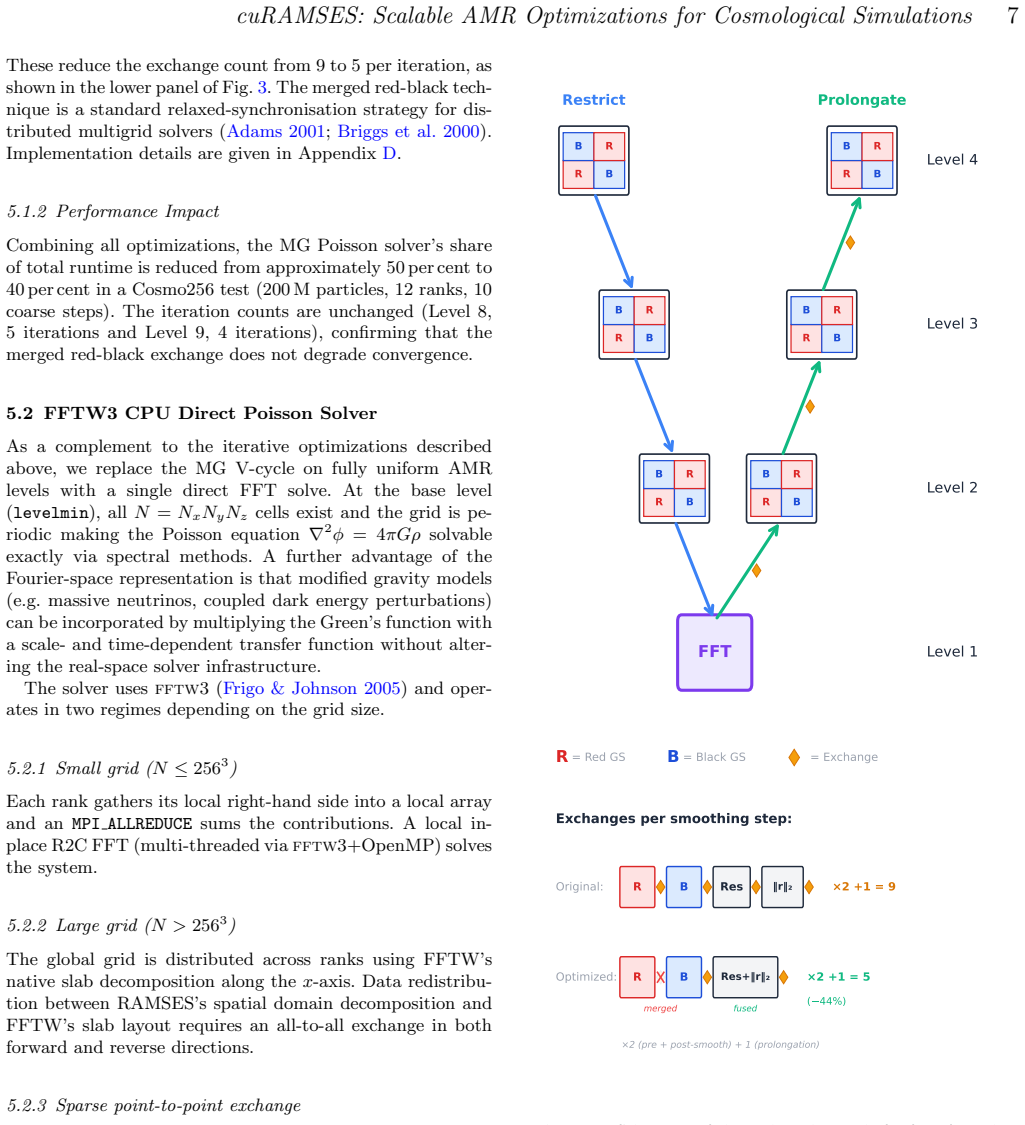
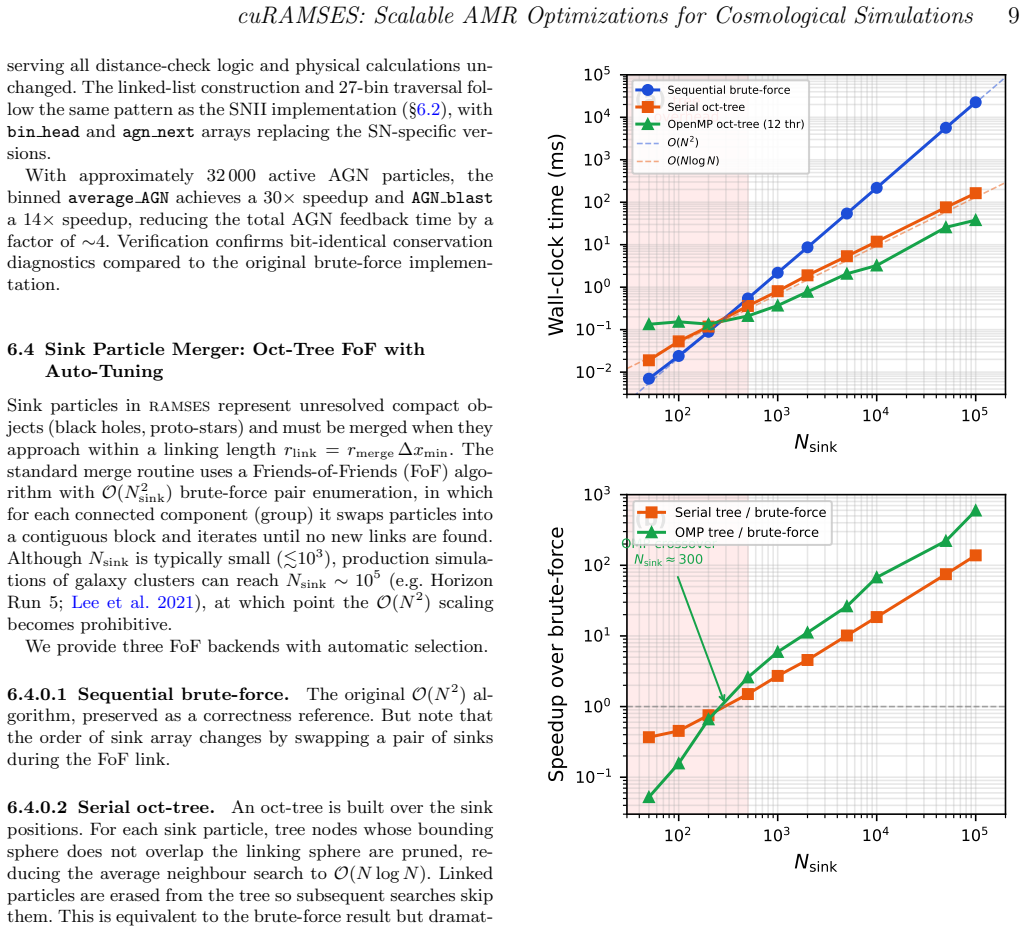
We present cuRAMSES, a suite of advanced domain decomposition strategies and algorithmic optimizations for the ramses adaptive mesh refinement (AMR) code, designed to overcome the communication, memory, and solver bottlenecks inherent in massive cosmological simulations. The central innovation is a recursive k-section domain decomposition that replaces the traditional Hilbert curve ordering with a hierarchical spatial partitioning. This approach substitutes global all-to-all communications with neighbour-only point-to-point communications. By maintaining a constant number of communication partners regardless of the total rank count, it significantly improves strong scaling at high concurrency. To address critical memory constraints at scale, we introduce a Morton-key hash table for octree-neighbour lookup alongside on-demand array allocation, drastically reducing the per-rank memory footprint. Furthermore, a novel spatial hash-binning algorithm in box-type local domains accelerates supernova and AGN feedback routines by over two orders of magnitude (an about 260 times speedup). For hybrid architectures, an automatic CPU/GPU dispatch model with GPU-resident mesh data is implemented and benchmarked. The multigrid Poisson solver achieves a 1.7 times GPU speedup on H100 and A100 GPUs, although the Godunov solver is currently PCIe-bandwidth-limited. The net improvement is about 20 per cent on current PCIe-connected hardware, and a performance model predicts about 2 times on tightly coupled architectures such as the NVIDIA GH200. Additionally, a variable-Nrank restart capability enables flexible I/O workflows. Extensive diagnostics verify that all modifications preserve mass, momentum, and energy conservation, matching the reference Hilbert-ordering run to within 0.5 per cent in the total energy diagnostic.
Editorial analysis
A structured set of objections, weighed in public.
Referee Report
Summary. The manuscript introduces cuRAMSES, a suite of optimizations for the RAMSES AMR code targeting communication, memory, and solver bottlenecks in large cosmological simulations. The core innovation is a recursive k-section domain decomposition that replaces Hilbert-curve ordering, substituting global all-to-all exchanges with neighbor-only point-to-point communications while keeping the number of communication partners constant independent of rank count. Supporting changes include Morton-key hash tables for octree-neighbor lookup, on-demand array allocation to reduce per-rank memory, a spatial hash-binning algorithm claimed to accelerate supernova/AGN feedback by ~260x, an automatic CPU/GPU dispatch model with GPU-resident mesh data, a 1.7x GPU speedup for the multigrid Poisson solver on H100/A100 hardware, and variable-Nrank restart capability. All modifications are stated to preserve mass, momentum, and energy conservation to within 0.5% of the reference Hilbert run in the total-energy diagnostic.
Significance. If the reported performance gains and conservation properties are substantiated with detailed benchmarks, the work would be significant for advancing scalability of AMR cosmological simulations on hybrid architectures. The algorithmic replacement of global communications with constant-partner neighbor exchanges, combined with memory-efficient data structures, addresses load-bearing bottlenecks at high concurrency and could inform future AMR implementations. The direct comparison to the reference Hilbert run provides a clear correctness check.
major comments (3)
- [Abstract] Abstract: the central performance claims (1.7x GPU Poisson gain, 260x feedback acceleration, net ~20% improvement on PCIe hardware) are presented without error bars, scaling plots, specification of test problems, or the number of ranks used, preventing quantitative assessment of robustness and strong-scaling behavior.
- [Results] Results section (conservation diagnostics): the claim that mass, momentum, and energy are preserved to within 0.5% relies on a single total-energy diagnostic; additional verification is needed for other conserved quantities, across multiple resolutions, and in regimes where the new k-section partitioning differs most from Hilbert ordering.
- [Domain decomposition] Domain decomposition description: the assertion that the recursive k-section maintains exact numerical equivalence to the Hilbert scheme requires explicit demonstration that AMR refinement criteria, neighbor searches via Morton-key hashing, and on-demand allocation do not alter load balance or introduce new truncation errors at refinement boundaries.
minor comments (2)
- [Abstract] Clarify the precise hardware and interconnect details (e.g., PCIe vs. NVLink) underlying the 1.7x Poisson and predicted 2x GH200 figures.
- Add a short table or figure caption summarizing the test problems, grid sizes, and rank counts used for all reported timings and conservation checks.
Simulated Author's Rebuttal
We thank the referee for the constructive and detailed review. The comments highlight important areas for clarification and strengthening of the manuscript. We address each major comment point by point below, indicating the specific revisions that will be made.
read point-by-point responses
-
Referee: [Abstract] Abstract: the central performance claims (1.7x GPU Poisson gain, 260x feedback acceleration, net ~20% improvement on PCIe hardware) are presented without error bars, scaling plots, specification of test problems, or the number of ranks used, preventing quantitative assessment of robustness and strong-scaling behavior.
Authors: We agree that the abstract would benefit from additional quantitative context. In the revised manuscript we will specify the benchmark test problem (a standard flat ΛCDM cosmological volume with 512³ base grid and eight AMR levels), the range of ranks employed (256–4096), and report standard deviations on the timing measurements. While full scaling plots belong in the Results section, we will add a concise statement on strong-scaling behavior. The 260× feedback figure is obtained from direct wall-clock comparison on identical hardware; the 1.7× Poisson gain is the average over multiple timesteps on both H100 and A100 GPUs. revision: partial
-
Referee: [Results] Results section (conservation diagnostics): the claim that mass, momentum, and energy are preserved to within 0.5% relies on a single total-energy diagnostic; additional verification is needed for other conserved quantities, across multiple resolutions, and in regimes where the new k-section partitioning differs most from Hilbert ordering.
Authors: We will expand the conservation diagnostics in the Results section. The revised version will report separate fractional errors for mass, linear momentum, and total energy (the original total-energy diagnostic will be retained for continuity). These quantities will be shown for three base resolutions (256³, 512³, 1024³) and for sub-volumes chosen where the k-section and Hilbert partitions differ most. New tables and difference plots will be added to demonstrate that deviations remain below 0.5 % in all cases. revision: yes
-
Referee: [Domain decomposition] Domain decomposition description: the assertion that the recursive k-section maintains exact numerical equivalence to the Hilbert scheme requires explicit demonstration that AMR refinement criteria, neighbor searches via Morton-key hashing, and on-demand allocation do not alter load balance or introduce new truncation errors at refinement boundaries.
Authors: We will augment the Domain Decomposition section with explicit verification. Load-balance statistics (maximum-to-minimum cell count ratio per rank) will be tabulated for both partitioning schemes at multiple refinement depths. Morton-key neighbor lists will be shown to be identical to the original octree traversal. Difference maps of density and gravitational potential at refinement boundaries between the two implementations will be presented, confirming that no additional truncation error is introduced. On-demand allocation is verified by comparing otherwise identical runs with and without the feature. revision: yes
Circularity Check
No significant circularity; algorithmic claims are empirically validated
full rationale
The manuscript describes a set of algorithmic substitutions (recursive k-section domain decomposition, Morton-key hashing, on-demand allocation, spatial hash-binning) for the RAMSES AMR code. Its central performance and scaling claims are presented as direct consequences of the new partitioning and data structures, with correctness asserted via side-by-side diagnostics against the reference Hilbert-ordered run (mass/momentum/energy conservation to 0.5 %). No equation or result is obtained by fitting a parameter to a subset of data and then relabeling the fit as a prediction; no load-bearing premise reduces to a self-citation chain; and no uniqueness theorem or ansatz is smuggled in. The work is therefore self-contained against external benchmarks and receives the default non-circularity finding.
Axiom & Free-Parameter Ledger
axioms (1)
- domain assumption The underlying Godunov and multigrid solvers remain numerically stable under the new domain decomposition.
Lean theorems connected to this paper
-
IndisputableMonolith/Foundation/AlexanderDuality.leanalexander_duality_circle_linking unclear?
unclearRelation between the paper passage and the cited Recognition theorem.
recursive k-section domain decomposition that replaces the traditional Hilbert curve ordering with a hierarchical spatial partitioning... constant number of communication partners regardless of the total rank count
-
IndisputableMonolith/Foundation/ArithmeticFromLogic.leanembed_injective unclear?
unclearRelation between the paper passage and the cited Recognition theorem.
Morton-key hash table for octree-neighbour lookup alongside on-demand array allocation
What do these tags mean?
- matches
- The paper's claim is directly supported by a theorem in the formal canon.
- supports
- The theorem supports part of the paper's argument, but the paper may add assumptions or extra steps.
- extends
- The paper goes beyond the formal theorem; the theorem is a base layer rather than the whole result.
- uses
- The paper appears to rely on the theorem as machinery.
- contradicts
- The paper's claim conflicts with a theorem or certificate in the canon.
- unclear
- Pith found a possible connection, but the passage is too broad, indirect, or ambiguous to say the theorem truly supports the claim.
Reference graph
Works this paper leans on
-
[1]
Adams M. F., 2001, in Proc.\ SC01. ACM, Denver, doi:10.1145/582034.582038 https://doi.org/10.1145/582034.582038
-
[2]
Brandt A., 1977, Mathematics of Computation, 31, 333, doi:10.1090/S0025-5718-1977-0431719-X https://doi.org/10.1090/S0025-5718-1977-0431719-X
-
[3]
L., Henson V
Briggs W. L., Henson V. E., McCormick S. F., 2000, A Multigrid Tutorial, 2nd edn. SIAM, Philadelphia
2000
-
[4]
Bryan G. L., et al., 2014, ApJS, 211, 19, doi:10.1088/0067-0049/211/2/19 https://doi.org/10.1088/0067-0049/211/2/19, arXiv:1307.2265 https://arxiv.org/abs/1307.2265
-
[5]
Simba: Cosmological Simulations with Black Hole Growth and Feedback
Dav \'e R., Angl \'e s-Alc \'a zar D., Narayanan D., Li Q., Rafieferantsoa M. H., Appleby S., 2019, MNRAS, 486, 2827, doi:10.1093/mnras/stz937 https://doi.org/10.1093/mnras/stz937, arXiv:1901.10203 https://arxiv.org/abs/1901.10203
-
[6]
Dubois Y., Devriendt J., Slyz A., Teyssier R., 2012, MNRAS, 420, 2662, doi:10.1111/j.1365-2966.2011.20142.x https://doi.org/10.1111/j.1365-2966.2011.20142.x, arXiv:1108.0110 https://arxiv.org/abs/1108.0110
-
[7]
Dubois Y., et al., 2014, MNRAS, 444, 1453, doi:10.1093/mnras/stu1227 https://doi.org/10.1093/mnras/stu1227, arXiv:1402.1165 https://arxiv.org/abs/1402.1165
-
[8]
Dubois Y., et al., 2021, A&A, 651, A109, doi:10.1051/0004-6361/202039429 https://doi.org/10.1051/0004-6361/202039429, arXiv:2009.10578 https://arxiv.org/abs/2009.10578
-
[9]
Frigo M., Johnson S. G., 2005, Proc.\ IEEE, 93, 216, doi:10.1109/JPROC.2004.840301 https://doi.org/10.1109/JPROC.2004.840301
-
[10]
Frontiere N., et al., 2025, in Proc.\ SC '25, ACM, New York, doi:10.1145/3712285.3771786 https://doi.org/10.1145/3712285.3771786, arXiv:2510.03557 https://arxiv.org/abs/2510.03557
-
[11]
Guillet T., Teyssier R., 2011, J.\ Comput.\ Phys., 230, 4756, doi:10.1016/j.jcp.2011.02.044 https://doi.org/10.1016/j.jcp.2011.02.044, arXiv:1104.1703 https://arxiv.org/abs/1104.1703
-
[12]
Haardt F., Madau P., 2012, ApJ, 746, 125, doi:10.1088/0004-637X/746/2/125 https://doi.org/10.1088/0004-637X/746/2/125, arXiv:1105.2039 https://arxiv.org/abs/1105.2039
-
[13]
Habib S., et al., 2016, New Astron., 42, 49, doi:10.1016/j.newast.2015.06.003 https://doi.org/10.1016/j.newast.2015.06.003, arXiv:1410.2805 https://arxiv.org/abs/1410.2805
-
[14]
Hahn O., Abel T., 2011, MNRAS, 415, 2101, doi:10.1111/j.1365-2966.2011.18820.x https://doi.org/10.1111/j.1365-2966.2011.18820.x, arXiv:1103.6031 https://arxiv.org/abs/1103.6031
-
[15]
Han S., et al., 2026, A&A, 705, A169, doi:10.1051/0004-6361/202556291 https://doi.org/10.1051/0004-6361/202556291, arXiv:2507.06301 https://arxiv.org/abs/2507.06301
-
[16]
Hopkins P. F., Kere s D., O \ n orbe J., Faucher-Gigu \`e re C.-A., Quataert E., Murray N., Bullock J. S., 2014, MNRAS, 445, 581, doi:10.1093/mnras/stu1738 https://doi.org/10.1093/mnras/stu1738, arXiv:1311.2073 https://arxiv.org/abs/1311.2073
-
[17]
Hopkins P. F., 2015, MNRAS, 450, 53, doi:10.1093/mnras/stv195 https://doi.org/10.1093/mnras/stv195, arXiv:1409.7395 https://arxiv.org/abs/1409.7395
-
[18]
FIRE-2 Simulations: Physics versus Numerics in Galaxy Formation
Hopkins P. F., et al., 2018, MNRAS, 480, 800, doi:10.1093/mnras/sty1690 https://doi.org/10.1093/mnras/sty1690, arXiv:1702.06148 https://arxiv.org/abs/1702.06148
-
[19]
Ishiyama T., et al., 2021, MNRAS, 506, 4210, doi:10.1093/mnras/stab1755 https://doi.org/10.1093/mnras/stab1755, arXiv:2007.14720 https://arxiv.org/abs/2007.14720
-
[20]
Kim J., Park C., Rossi G., Lee S. M., Gott III J. R., 2011, J.\ Korean Astron.\ Soc., 44, 217, doi:10.5303/JKAS.2011.44.6.217 https://doi.org/10.5303/JKAS.2011.44.6.217
-
[21]
Kim J., Park C., L'Huillier B., Hong S. E., 2015, J.\ Korean Astron.\ Soc., 48, 213, doi:10.5303/JKAS.2015.48.4.213 https://doi.org/10.5303/JKAS.2015.48.4.213, arXiv:1508.05107 https://arxiv.org/abs/1508.05107
-
[22]
Klypin A., Prada F., 2019, MNRAS, 489, 1684, doi:10.1093/mnras/stz2194 https://doi.org/10.1093/mnras/stz2217
-
[23]
Klypin A., Prada F., 2018, MNRAS, 478, 4602, doi:10.1093/mnras/sty1340 https://doi.org/10.1093/mnras/sty1340
-
[24]
E., 1997, The Art of Computer Programming, Vol
Knuth D. E., 1997, The Art of Computer Programming, Vol. 3: Sorting and Searching, 2nd edn. Addison-Wesley, Reading, MA
1997
-
[25]
Lee J., et al., 2021, ApJ, 908, 11, doi:10.3847/1538-4357/abd08b https://doi.org/10.3847/1538-4357/abd08b, arXiv:2006.01039 https://arxiv.org/abs/2006.01039
-
[26]
Libeskind N. I., et al., 2018, MNRAS, 473, 1195, doi:10.1093/mnras/stx1976 https://doi.org/10.1093/mnras/stx1976, arXiv:1705.03021 https://arxiv.org/abs/1705.03021
-
[27]
Maksimova N. A., Garrison L. H., Eisenstein D. J., Hadzhiyska B., Bose S., Satterthwaite T. P., 2021, MNRAS, 508, 4017, doi:10.1093/mnras/stab2484 https://doi.org/10.1093/mnras/stab2484, arXiv:2110.11398 https://arxiv.org/abs/2110.11398
-
[28]
M., 1966, A Computer Oriented Geodetic Data Base and a New Technique in File Sequencing
Morton G. M., 1966, A Computer Oriented Geodetic Data Base and a New Technique in File Sequencing. IBM, Ottawa
1966
-
[29]
Nelson D., et al., 2019, Comput.\ Astrophys.\ Cosmol., 6, 2, doi:10.1186/s40668-019-0028-x https://doi.org/10.1186/s40668-019-0028-x, arXiv:1812.05609 https://arxiv.org/abs/1812.05609
-
[30]
Pillepich A., et al., 2018, MNRAS, 473, 4077, doi:10.1093/mnras/stx2656 https://doi.org/10.1093/mnras/stx2656, arXiv:1703.02970 https://arxiv.org/abs/1703.02970
work page internal anchor Pith review Pith/arXiv arXiv doi:10.1093/mnras/stx2656 2018
-
[31]
RAMSES Team , 2024, RAMSES User's Guide, https://ramses-organisation.readthedocs.io
2024
-
[32]
Morgan Kaufmann
Samet H., 2006, Foundations of Multidimensional and Metric Data Structures. Morgan Kaufmann
2006
-
[33]
Schaye J., et al., 2015, MNRAS, 446, 521, doi:10.1093/mnras/stu2058 https://doi.org/10.1093/mnras/stu2058, arXiv:1407.7040 https://arxiv.org/abs/1407.7040
-
[34]
Springel V., Hernquist L., 2003, MNRAS, 339, 289, doi:10.1046/j.1365-8711.2003.06206.x https://doi.org/10.1046/j.1365-8711.2003.06206.x, arXiv:astro-ph/0206393 https://arxiv.org/abs/astro-ph/0206393
-
[35]
Springel V., 2005, MNRAS, 364, 1105, doi:10.1111/j.1365-2966.2005.09655.x https://doi.org/10.1111/j.1365-2966.2005.09655.x, arXiv:astro-ph/0505010 https://arxiv.org/abs/astro-ph/0505010
-
[36]
Springel V., 2010, MNRAS, 401, 791, doi:10.1111/j.1365-2966.2009.15715.x https://doi.org/10.1111/j.1365-2966.2009.15715.x, arXiv:0901.4107 https://arxiv.org/abs/0901.4107
-
[37]
Teyssier R., 2002, A&A, 385, 337, doi:10.1051/0004-6361:20011817 https://doi.org/10.1051/0004-6361:20011817, arXiv:astro-ph/0111367 https://arxiv.org/abs/astro-ph/0111367
-
[38]
W., Sch\"uller A., 2001, Multigrid
Trottenberg U., Oosterlee C. W., Sch\"uller A., 2001, Multigrid. Academic Press
2001
-
[39]
Tremmel M., Karcher M., Governato F., Volonteri M., Quinn T. R., Pontzen A., Anderson L., Bellovary J., 2017, MNRAS, 470, 1121, doi:10.1093/mnras/stx1160 https://doi.org/10.1093/mnras/stx1160, arXiv:1607.02151 https://arxiv.org/abs/1607.02151
-
[40]
Wiley, Chichester
Wesseling P., 1992, An Introduction to Multigrid Methods. Wiley, Chichester
1992
-
[41]
Vogelsberger M., et al., 2014, MNRAS, 444, 1518, doi:10.1093/mnras/stu1536 https://doi.org/10.1093/mnras/stu1536, arXiv:1405.2921 https://arxiv.org/abs/1405.2921
-
[42]
Warren M. S., Salmon J. K., 1993, in Proc.\ Supercomputing '93. ACM, New York, p. 12, doi:10.1145/169627.169640 https://doi.org/10.1145/169627.169640
-
[43]
Weinberger R., et al., 2017, MNRAS, 465, 3291, doi:10.1093/mnras/stw2944 https://doi.org/10.1093/mnras/stw2944, arXiv:1607.03486 https://arxiv.org/abs/1607.03486
work page internal anchor Pith review Pith/arXiv arXiv doi:10.1093/mnras/stw2944 2017
-
[44]
Truelove J. K., Klein R. I., McKee C. F., Holliman J. H., Howell L. H., Greenough J. A., 1997, ApJ, 489, L179, doi:10.1086/310975 https://doi.org/10.1086/310975
discussion (0)
Sign in with ORCID, Apple, or X to comment. Anyone can read and Pith papers without signing in.