Recognition: 3 theorem links
· Lean TheoremArtificial Intelligence and the Structure of Mathematics
Pith reviewed 2026-05-10 19:08 UTC · model grok-4.3
The pith
AI offers a complementary path to mathematical logic by revealing the global structure of formal proofs through automated exploration.
A machine-rendered reading of the paper's core claim, the machinery that carries it, and where it could break.
Core claim
The authors argue that AI agents satisfying criteria for automated mathematical discovery can traverse Platonic mathematical worlds represented via universal proofs and structural hypergraphs, thereby illuminating the global structure of formal proofs in a manner complementary to mathematical logic and clarifying both the overall nature of mathematics and the portions accessible to human understanding.
What carries the argument
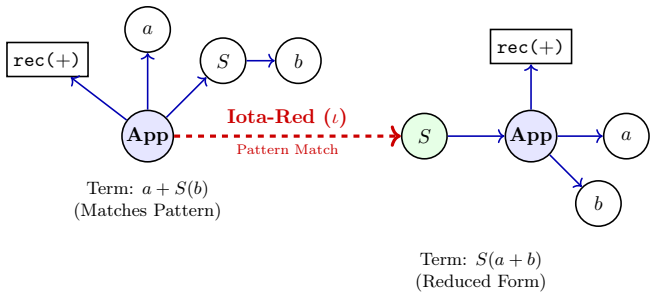
Universal proof and structural hypergraphs, which encode the formal connections across all mathematical statements and allow systematic traversal by AI agents.
Load-bearing premise
AI models can be built that meet the stated criteria for automated discovery and will meaningfully traverse Platonic mathematical worlds to produce new insights about mathematical structure.
What would settle it
An AI system trained on large corpora of formal proofs that fails to identify any previously unrecognized global patterns or cross-proof dependencies beyond those already captured by standard logical analysis.
Figures

read the original abstract
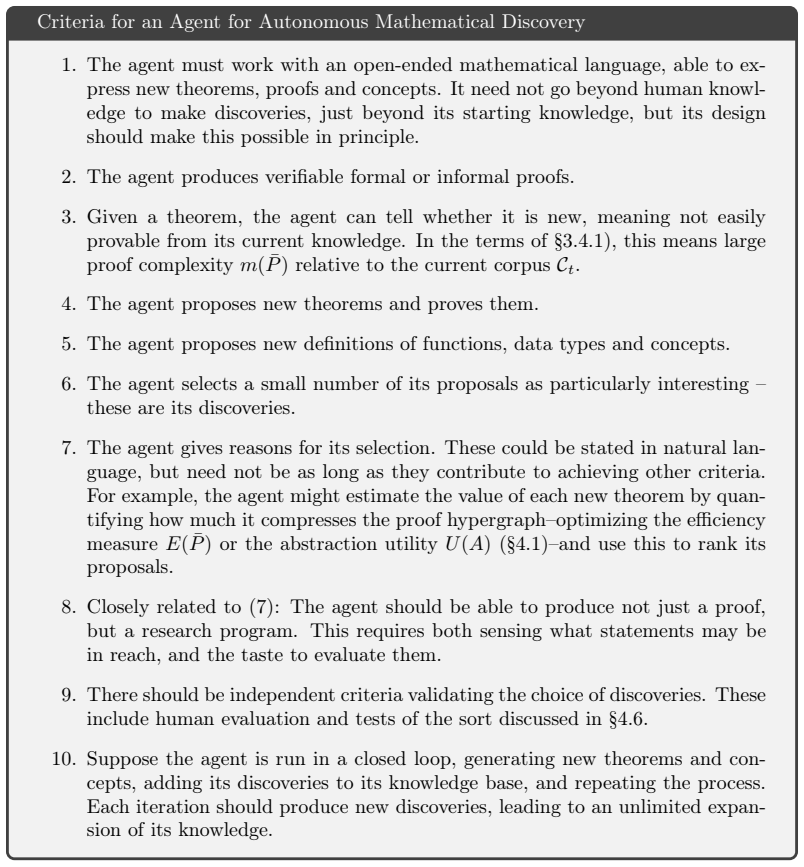
Recent progress in artificial intelligence (AI) is unlocking transformative capabilities for mathematics. There is great hope that AI will help solve major open problems and autonomously discover new mathematical concepts. In this essay, we further consider how AI may open a grand perspective on mathematics by forging a new route, complementary to mathematical\textbf{ logic,} to understanding the global structure of formal \textbf{proof}\textbf{s}. We begin by providing a sketch of the formal structure of mathematics in terms of universal proof and structural hypergraphs and discuss questions this raises about the foundational structure of mathematics. We then outline the main ingredients and provide a set of criteria to be satisfied for AI models capable of automated mathematical discovery. As we send AI agents to traverse Platonic mathematical worlds, we expect they will teach us about the nature of mathematics: both as a whole, and the small ribbons conducive to human understanding. Perhaps they will shed light on the old question: "Is mathematics discovered or invented?" Can we grok the terrain of these \textbf{Platonic worlds}?
Editorial analysis
A structured set of objections, weighed in public.
Referee Report
Summary. The manuscript is an essay arguing that recent AI progress offers a new route, complementary to mathematical logic, for understanding the global structure of formal proofs. It sketches mathematics via 'universal proofs' and 'structural hypergraphs,' outlines high-level criteria for AI models of automated discovery, and posits that AI agents traversing Platonic mathematical worlds will reveal insights into the nature of mathematics, including whether it is discovered or invented.
Significance. If the sketched framework and future AI capabilities are realized, the work could broaden foundational studies by integrating AI-driven exploration of proof structures, potentially yielding global insights inaccessible to logic alone and addressing philosophical questions about mathematics. The essay correctly identifies the prospective value of AI beyond problem-solving, but its significance is prospective and depends on operationalizing the proposed concepts.
major comments (2)
- In the section providing a sketch of the formal structure of mathematics, the concepts of 'universal proof' and 'structural hypergraphs' are introduced without definitions of their nodes, edges, global properties, or any concrete example. This absence is load-bearing for the central claim that AI traversal will reveal new insights into proof structure, as there is no basis to distinguish such traversal from existing automated theorem proving.
- In the section outlining the main ingredients and criteria for AI models capable of automated mathematical discovery, the criteria are presented only as high-level desiderata without formalization, mathematical specification, or a minimal worked example (e.g., for a single axiom system). This undermines the assertion that such models will teach us about the nature of mathematics in ways complementary to logic.
minor comments (2)
- Abstract contains visible LaTeX commands such as boldface markers that should be properly rendered in the final version.
- The manuscript would benefit from citations to related work in automated theorem proving, proof mining, and the philosophy of mathematical discovery to better situate the proposals.
Simulated Author's Rebuttal
We thank the referee for their constructive comments, which correctly identify the need for greater concreteness in our conceptual sketch. We address each point below and will revise the manuscript to incorporate definitions and examples while preserving the essay's exploratory character.
read point-by-point responses
-
Referee: In the section providing a sketch of the formal structure of mathematics, the concepts of 'universal proof' and 'structural hypergraphs' are introduced without definitions of their nodes, edges, global properties, or any concrete example. This absence is load-bearing for the central claim that AI traversal will reveal new insights into proof structure, as there is no basis to distinguish such traversal from existing automated theorem proving.
Authors: We agree that the manuscript introduces 'universal proof' and 'structural hypergraphs' at a conceptual level without formal definitions, node/edge specifications, global properties, or examples. This limits the ability to clearly differentiate the proposed AI-driven traversal from existing automated theorem proving. As the work is an essay outlining prospective ideas rather than a technical formalism, the presentation remained high-level. In revision we will add explicit definitions (nodes as statements or subproofs, edges as inference steps or dependency relations), describe global properties such as hypergraph connectivity and centrality, and include a concrete example based on a small system such as propositional logic to illustrate how AI traversal could yield structural insights beyond standard ATP. revision: yes
-
Referee: In the section outlining the main ingredients and criteria for AI models capable of automated mathematical discovery, the criteria are presented only as high-level desiderata without formalization, mathematical specification, or a minimal worked example (e.g., for a single axiom system). This undermines the assertion that such models will teach us about the nature of mathematics in ways complementary to logic.
Authors: The referee accurately observes that the criteria for AI models of automated discovery are stated as high-level desiderata without formalization or a minimal worked example. This choice aligns with the essay's goal of sketching broad requirements for future systems rather than providing an implemented specification. To better support the claim of complementarity to logic, we will revise the section to include a minimal worked example, such as applying the criteria to a simple axiom system like basic group theory or a fragment of Peano arithmetic, showing how the AI exploration could reveal structural or accessibility features not directly accessible through logical analysis alone. revision: yes
Circularity Check
No circularity: high-level essay with no derivations, equations, or self-referential reductions
full rationale
The paper is a conceptual essay sketching mathematics via universal proofs and structural hypergraphs, then outlining high-level criteria for AI discovery models. It contains no equations, no fitted parameters, no derivations, and no load-bearing self-citations. Claims about AI agents traversing Platonic worlds are presented as expectations and open questions rather than results derived from prior inputs or definitions. The criteria remain desiderata without formalization or reduction to the paper's own assumptions. This matches the reader's zero-circularity assessment; the argument is self-contained as philosophical speculation without any step that reduces by construction to its own inputs.
Axiom & Free-Parameter Ledger
axioms (1)
- domain assumption AI models can be constructed that meet criteria for autonomous mathematical discovery and traversal of proof structures.
invented entities (2)
-
universal proof
no independent evidence
-
structural hypergraphs
no independent evidence
Lean theorems connected to this paper
-
IndisputableMonolith/Foundation/AbsoluteFloorClosure.leanreality_from_one_distinction unclearWe begin by providing a sketch of the formal structure of mathematics in terms of universal proof and structural hypergraphs... AI agents to traverse Platonic mathematical worlds
-
IndisputableMonolith/Cost/FunctionalEquation.leanwashburn_uniqueness_aczel unclearefficiency E(P) := m(P)/l(P)... willow tree of mathematics... hubs and bottlenecks
-
IndisputableMonolith/Foundation/AlexanderDuality.leanalexander_duality_circle_linking unclearcoarse equivalence... many Platonic worlds
Forward citations
Cited by 3 Pith papers
-
NeuroClaw Technical Report
NeuroClaw introduces a three-tier multi-agent framework and NeuroBench benchmark that improve executability and reproducibility scores for neuroimaging tasks when used with multimodal LLMs.
-
Ablation and the Meno: Tools for Empirical Metamathematics
Meno and tactic ablation on Tao's Analysis I generate proof populations that embed on low one- or two-dimensional submanifolds far from human constructions in Goedel Prover space.
-
Astrolabe: A Content-Addressable Hypergraph for Semantic Knowledge Management
Astrolabe is a content-addressable hypergraph for semantic knowledge management using hash-identified entries, arbitrary-width ordered references, and plugin-extensible records.
Reference graph
Works this paper leans on
-
[1]
Why philosophers should care about computational complexity.Com- plexity, 101:5
Scott Aaronson. Why philosophers should care about computational complexity.Com- plexity, 101:5
-
[2]
Mohammed Abouzaid, Andrew J Blumberg, Martin Hairer, Joe Kileel, Tamara G Kolda, Paul D Nelson, Daniel Spielman, Nikhil Srivastava, Rachel Ward, Shmuel Wein- berger, et al. First proof.arXiv preprint arXiv:2602.05192, 2026
-
[3]
The Univalent Foundations Pro- gram Institute for Advanced Study, 2013
Peter Aczel, Benedikt Ahrens, Thorsten Altenkirch, Steve Awodey, Bruno Barras, An- drej Bauer, Yves Bertot, Marc Bezem, Thierry Coquand, Eric Finster, et al.Homotopy type theory: univalent foundations of mathematics. The Univalent Foundations Pro- gram Institute for Advanced Study, 2013
2013
-
[4]
Freedman, and Michael Mulligan
Vitaly Aksenov, Eve Bodnia, Michael H. Freedman, and Michael Mulligan. Compres- sion is all you need: Modeling mathematics. 2026. URLhttps://arxiv.org/abs/26 03.20396
2026
-
[5]
Mathematicians in the age of ai
Jeremy Avigad. Mathematicians in the age of ai. PDF, March 2026. URLhttps: //www.andrew.cmu.edu/user/avigad/Papers/mathematicians.pdf. Accessed 2026-03-04. 39
2026
-
[6]
Putnam2025: Our solution to putnam 2025 (axiomprover lean proofs)
Axiom Math. Putnam2025: Our solution to putnam 2025 (axiomprover lean proofs). https://github.com/AxiomMath/putnam2025, January 2026. GitHub repository (released Jan 2026). Accessed 2026-01-21
2025
-
[7]
Mlfmf: Data sets for machine learning for mathematical formalization
Andrej Bauer, Matej Petković, and Ljupčo Todorovski. Mlfmf: Data sets for machine learning for mathematical formalization. InAdvances in Neural Information Processing Systems (NeurIPS), volume 36, 2023. URLhttps://arxiv.org/abs/2310.16005
-
[8]
Courier Corporation, 2013
Rodney J Baxter.Exactly Solved Models in Statistical Mechanics. Courier Corporation, 2013
2013
-
[9]
Beckenbach
Edwin F. Beckenbach. Interesting integers.The American Mathematical Monthly, 52 (4):211, April 1945
1945
-
[10]
Machine learning and information theory concepts towards an AI mathematician.Bull
Yoshua Bengio and Nikolay Malkin. Machine learning and information theory concepts towards an AI mathematician.Bull. Amer. Math. Soc. (N.S.), 61(3):457–469, July
-
[11]
doi: 10.1090/bull/1839
-
[12]
na, 1988
Charles H Bennett.Logical depth and physical complexity. na, 1988
1988
-
[13]
Erdős problems.https://www.erdosproblems.com/
Thomas Bloom. Erdős problems.https://www.erdosproblems.com/. URLhttps: //www.erdosproblems.com/. Accessed: 2026-01-20
2026
-
[14]
Olausson, Lionel Wong, Gabriel Grand, Joshua B
Matthew Bowers, Theo X. Olausson, Lionel Wong, Gabriel Grand, Joshua B. Tenen- baum, KevinEllis, andArmandoSolar-Lezama. Top-DownSynthesisforLibraryLearn- ing.Proceedings of the ACM on Programming Languages, 7(POPL):41:1182–41:1213, January 2023. doi: 10.1145/3571234. URLhttps://dl.acm.org/doi/10.1145/357 1234
-
[15]
Michael P. Brenner, Vincent Cohen-Addad, and David Woodruff. Solving an open problem in theoretical physics using ai-assisted discovery, 2026. URLhttps://arxiv. org/abs/2603.04735
-
[16]
Jim Bryan, Balázs Elek, Freddie Manners, George Salafatinos, and Ravi Vakil. The motivic class of the space of genus0maps to the flag variety, 2026. URLhttps: //arxiv.org/abs/2601.07222
-
[17]
Samuel R. Buss. On gödel’s theorems on lengths of proofs i: Number of lines and speedup for arithmetics.Journal of Symbolic Logic, 59(3):737–756, 1994. doi: 10.230 7/2275906
1994
-
[18]
How deep neural networks learn compositional data: The random hierarchy model.Physical Review X, 14(3):031001, 2024
Francesco Cagnetta, Leonardo Petrini, Umberto M Tomasini, Alessandro Favero, and Matthieu Wyart. How deep neural networks learn compositional data: The random hierarchy model.Physical Review X, 14(3):031001, 2024
2024
-
[19]
Intrinsically motivated reinforcement learning.Advances in neural information processing systems, 17, 2004
Nuttapong Chentanez, Andrew Barto, and Satinder Singh. Intrinsically motivated reinforcement learning.Advances in neural information processing systems, 17, 2004
2004
-
[20]
Coester,Transposition is nearly optimal for IID list update, preprint, arXiv:2603.10244 (2026)
Christian Coester. Transposition is nearly optimal for iid list update, 2026. URL https://arxiv.org/abs/2603.10244
-
[21]
Springer Science & Business Media, 2012
Simon Colton.Automated theory formation in pure mathematics. Springer Science & Business Media, 2012. 40
2012
-
[22]
Simon Colton, Alan Bundy, and Toby Walsh. On the notion of interestingness in automatedmathematicaldiscovery.International Journal of Human-Computer Studies, 53(3):351–375, 2000. doi: 10.1006/ijhc.2000.0394. URLhttps://www.research.ed. ac.uk/files/408775/On_the_notion_of_interestingness_in_automated_mathe matical_discovery.pdf
-
[23]
Automatic invention of integer sequences
Simon Colton, Alan Bundy, and Toby Walsh. Automatic invention of integer sequences. InAAAI/IAAI, pages 558–563, 2000
2000
-
[24]
Coarse structure.Wikipedia, The Free Encyclopedia, 2025
Wikipedia contributors. Coarse structure.Wikipedia, The Free Encyclopedia, 2025. URLhttps://en.wikipedia.org/wiki/Coarse_structure
2025
-
[25]
Working with machines in mathematics.Bull
Alex Davies. Working with machines in mathematics.Bull. Amer. Math. Soc. (N.S.), 61(3):387–394, July 2024. doi: 10.1090/bull/1843
-
[26]
Automated conjecturing with \emph{TxGraffiti}
Randy Davila. Automated conjecturing in mathematics with\emph{TxGraffiti}.arXiv preprint arXiv:2409.19379, 2024
work page internal anchor Pith review arXiv 2024
-
[27]
Graffiti3: Compact theory libraries for automated mathematical dis- covery.Research Square, 2026
Randy Davila. Graffiti3: Compact theory libraries for automated mathematical dis- covery.Research Square, 2026. doi: 10.21203/rs.3.rs-8493329/v1. Posted January 19, 2026
-
[28]
Z3: An efficient smt solver
Leonardo De Moura and Nikolaj Bjørner. Z3: An efficient smt solver. InInternational conference on Tools and Algorithms for the Construction and Analysis of Systems, pages 337–340. Springer, 2008
2008
-
[29]
Proofs for a price: tomorrow’s ultra-rigorous mathematical culture
Silvia De Toffoli. Proofs for a price: tomorrow’s ultra-rigorous mathematical culture. Bull. Amer. Math. Soc. (N.S.), 61(3):395–410, July 2024. doi: 10.1090/bull/1823
-
[30]
Morgan Kaufmann Publishers, San Francisco, CA, 2003
Rina Dechter.Constraint Processing. Morgan Kaufmann Publishers, San Francisco, CA, 2003. ISBN 978-1558608906
2003
-
[31]
Alephzero and mathematical experience.Bull
Simon DeDeo. Alephzero and mathematical experience.Bull. Amer. Math. Soc. (N.S.), 61(3):375–386, July 2024. doi: 10.1090/bull/1824
-
[32]
Some history of the development of Graffiti
Ermelinda DeLaViña. Some history of the development of Graffiti. In Siemion Fajt- lowicz, Patrick W. Fowler, Pierre Hansen, Melvin F. Janowitz, and Fred S. Roberts, editors,Graphs and Discovery, volume 69 ofDIMACS Series in Discrete Mathemat- ics and Theoretical Computer Science, pages 81–118. American Mathematical Society, Providence, RI, 2005. doi: 10.1...
-
[33]
Kevin Ellis, Catherine Wong, Maxwell Nye, Mathias Sable-Meyer, Luc Cary, Lucas Morales, Luke Hewitt, Armando Solar-Lezama, and Joshua B. Tenenbaum. Dream- Coder: Growing generalizable, interpretable knowledge with wake-sleep Bayesian pro- gram learning.arXiv:2006.08381 [cs], June 2020. URLhttp://arxiv.org/abs/2006 .08381. arXiv: 2006.08381
-
[34]
Ali Enayat. Standard models of arithmetic. In Martin Kaså, editor,Idées Fixes: a Festschrift dedicated to Christian Bennet on the occasion of his 60th birthday, pages 55–64. University of Gothenburg Publications, Gothenburg, 2014. URLhttps://ww w.researchgate.net/publication/281936805_STANDARD_MODELS_OF_ARITHMETIC. Festschrift chapter. 41
-
[35]
Frontiermath: Open problems.https://epoch.ai/frontiermath/open-p roblems,
Epoch AI. Frontiermath: Open problems.https://epoch.ai/frontiermath/open-p roblems, . Accessed: 2026-01-27
2026
-
[36]
Frontiermath: Llm benchmark for advanced ai math reasoning
Epoch AI. Frontiermath: Llm benchmark for advanced ai math reasoning. Online, . URLhttps://epoch.ai/frontiermath. Accessed: 2026-01-25
2026
-
[37]
On conjectures of graffiti
Siemion Fajtlowicz. On conjectures of graffiti. InAnnals of discrete mathematics, volume 38, pages 113–118. Elsevier, 1988
1988
-
[38]
Aletheia tackles FirstProof autonomously.arXiv preprint arXiv:2602.21201, 2026
Tony Feng, Junehyuk Jung, Sang hyun Kim, Carlo Pagano, Sergei Gukov, Chiang- Chiang Tsai, David Woodruff, Adel Javanmard, Aryan Mokhtari, Dawsen Hwang, Yuri Chervonyi, Jonathan N. Lee, Garrett Bingham, Trieu H. Trinh, Vahab Mirrokni, Quoc V. Le, and Thang Luong. Aletheia tackles firstproof autonomously, 2026. URL https://arxiv.org/abs/2602.21201
-
[39]
Truth and speed-up.The Review of Symbolic Logic, 7(2):319–340,
Martin Fischer. Truth and speed-up.The Review of Symbolic Logic, 7(2):319–340,
-
[40]
Will machines change mathematics?Bull
Maia Fraser, Andrew Granville, Michael Harris, Colin McLarty, Emily Riehl, and Ak- shay Venkatesh. Will machines change mathematics?Bull. Amer. Math. Soc. (N.S.), 61(3):373–374, July 2024. doi: 10.1090/bull/1842
-
[41]
Herman Geuvers and Iris Loeb. Natural deduction via graphs: formal definition and computation rules.Mathematical Structures in Computer Science, 17:485–526, 2007. doi: 10.1017/S0960129507006123
-
[42]
Lattice-valued bottleneck duality,
Robert Ghrist, Julian Gould, and Miguel Lopez. Lattice-valued bottleneck duality,
- [43]
-
[44]
Jean-Yves Girard. Linear logic.Theoretical Computer Science, 50:1–102, 1987. doi: 10.1016/0304-3975(87)90045-4
-
[45]
Elliot Glazer, Ege Erdil, Tamay Besiroglu, Diego Chicharro, Evan Chen, Alex Gunning, Caroline Falkman Olsson, Jean-Stanislas Denain, Anson Ho, Emily de Oliveira Santos, Olli Järviniemi, Matthew Barnett, Robert Sandler, Matej Vrzala, Jaime Sevilla, Qiuyu Ren, Elizabeth Pratt, Lionel Levine, Grant Barkley, Natalie Stewart, Bogdan Grechuk, Tetiana Grechuk, S...
-
[46]
Kurt Gödel. What is cantor’s continuum problem?The American Mathematical Monthly, 54(9):515–525, 1947. doi: 10.1080/00029890.1947.11991877
-
[47]
Stephen Jay Gould.Wonderful Life: The Burgess Shale and the Nature of History. W. W. Norton & Company, New York, 1989
1989
-
[48]
Gabriel Grand, Lionel Wong, Matthew Bowers, Theo X. Olausson, Muxin Liu, Joshua B. Tenenbaum, and Jacob Andreas. LILO: Learning Interpretable Libraries by Compressing and Documenting Code, October 2023. URLhttp://arxiv.org/ab s/2310.19791. arXiv:2310.19791 [cs]. 42
-
[49]
Single-minus gluon tree amplitudes are nonzero,
Alfredo Guevara, Alexandru Lupsasca, David Skinner, Andrew Strominger, and Kevin Weil. Single-minus gluon tree amplitudes are nonzero, 2026. URLhttps://arxiv.or g/abs/2602.12176
-
[50]
Fabian Huch. Formal entity graphs as complex networks: Assessing centrality metrics of the archive of formal proofs. InIntelligent Computer Mathematics: 15th International Conference, CICM 2022, Prague, Czech Republic, September 19–23, 2022, Proceedings, pages 151–166. Springer, 2022. doi: 10.1007/978-3-031-16681-5_10
- [51]
-
[52]
Conjecture synthesis for inductive theories.Journal of Automated Reasoning, 47(3):251–289, 2011
Moa Johansson, Lucas Dixon, and Alan Bundy. Conjecture synthesis for inductive theories.Journal of Automated Reasoning, 47(3):251–289, 2011
2011
-
[53]
Martin.Speech and Language Processing
Daniel Jurafsky and James H. Martin.Speech and Language Processing. Prentice Hall, Upper Saddle River, NJ, 2 edition, 2009. ISBN 978-0131873216
2009
-
[54]
Douglas B. Lenat. Automated theory formation in mathematics. InProceedings of the 5th International Joint Conference on Artificial Intelligence (IJCAI-77), pages 833– 842, Cambridge, MA, 1977. URLhttps://www.ijcai.org/Proceedings/77-2/Pap ers/061.pdf
1977
-
[55]
Why does deep and cheap learning work so well?Journal of Statistical Physics, 168(6):1223–1247, 2017
Henry W Lin, Max Tegmark, and David Rolnick. Why does deep and cheap learning work so well?Journal of Statistical Physics, 168(6):1223–1247, 2017
2017
-
[56]
Numina-lean-agent: An open and gen- eral agentic reasoning system for formal mathematics
Junqi Liu, Zihao Zhou, Zekai Zhu, Marco Dos Santos, Weikun He, Jiawei Liu, Ran Wang, Yunzhou Xie, Junqiao Zhao, Qiufeng Wang, Lihong Zhi, Jia Li, and Wenda Li. Numina-lean-agent: An open and general agentic reasoning system for formal mathematics, 2026. URLhttps://arxiv.org/abs/2601.14027
-
[57]
Advanced version of gemini with deep think officially achieves gold-medal standard at the international mathematical olympiad
Thang Luong and Edward Lockhart. Advanced version of gemini with deep think officially achieves gold-medal standard at the international mathematical olympiad. https://deepmind.google/discover/blog/advanced-version-of-gemini-with-d eep-think-officially-achieves-gold-medal-standard-at-the-international -mathematical-olympiad/, 7 2025. Google DeepMind; acce...
2025
-
[58]
Introducing gauss, an agent for autoformalization, 2025
Math, Inc. Introducing gauss, an agent for autoformalization, 2025. URLhttps: //www.math.inc/gauss. Announcement of Gauss; completion of the strong Prime Number Theorem formalization in Lean
2025
-
[59]
Sphere-packing-lean: Sphere packing in lean
Math, Inc. Sphere-packing-lean: Sphere packing in lean. GitHub repository, 2026. URL https://github.com/math-inc/Sphere-Packing-Lean. A Lean formalisation of sphere-packingoptimalityindimensions8and24(andperiodicuniquenessindimension 24). Accessed: 2026-03-05
2026
-
[60]
MathZero, The Classification Problem, and Set-Theoretic Type Theory.arXiv:2005.05512 [cs], May 2020
David McAllester. MathZero, The Classification Problem, and Set-Theoretic Type Theory.arXiv:2005.05512 [cs], May 2020. URLhttp://arxiv.org/abs/2005.05512. arXiv: 2005.05512
-
[61]
Single axioms for groups and abelian groups with various operations
William McCune. Single axioms for groups and abelian groups with various operations. Journal of Automated Reasoning, 10(1):1–13, 1993. 43
1993
-
[62]
Poincaré on the value of reasoning machines.Bull
Colin McLarty. Poincaré on the value of reasoning machines.Bull. Amer. Math. Soc. (N.S.), 61(3):411–422, July 2024. doi: 10.1090/bull/1822
-
[63]
Google a.i
Cade Metz. Google a.i. system wins gold medal in international math olympiad.https: //www.nytimes.com/2025/07/21/technology/google-ai-international-mathema tics-olympiad.html, 7 2025. The New York Times; accessed 2025-10-20
2025
-
[64]
Mathematical discovery in the age of artificial intel- ligence.Nature Physics, pages 1–3, 2025
Bartosz Naskręcki and Ken Ono. Mathematical discovery in the age of artificial intel- ligence.Nature Physics, pages 1–3, 2025
2025
-
[65]
AlphaEvolve: A coding agent for scientific and algorithmic discovery
Alexander Novikov, Ngân V˜ u, Marvin Eisenberger, Emilien Dupont, Po-Sen Huang, Adam Zsolt Wagner, Sergey Shirobokov, Borislav Kozlovskii, Francisco JR Ruiz, Abbas Mehrabian, et al. Alphaevolve: A coding agent for scientific and algorithmic discovery. arXiv preprint arXiv:2506.13131, 2025
work page internal anchor Pith review arXiv 2025
-
[66]
Automatedmathematicsandthereconfigurationofproofandlabor
RodrigoOchigame. Automatedmathematicsandthereconfigurationofproofandlabor. Bull. Amer. Math. Soc. (N.S.), 61(3):423–437, July 2024. doi: 10.1090/bull/1821
-
[67]
Our first proof submissions
OpenAI. Our first proof submissions. OpenAI, February 2026. URLhttps://openai .com/index/first-proof-submissions/. Accessed: 2026-02-25
2026
- [68]
-
[69]
Compositional sparsity of learnable functions.Bull
Tomaso Poggio and Maia Fraser. Compositional sparsity of learnable functions.Bull. Amer. Math. Soc. (N.S.), 61(3):438–456, July 2024. doi: 10.1090/bull/1820
-
[70]
The lengths of proofs
Pavel Pudlák. The lengths of proofs. In Samuel R. Buss, editor,Handbook of Proof Theory, volume 137 ofStudies in Logic and the Foundations of Mathematics, pages 547–637. Elsevier–North-Holland, Amsterdam, 1998. URLhttps://users.math.cas .cz/~pudlak/length.pdf. See Theorem 7.2.2 (speed-up by any function provably total in the base theory) and Theorem 7.3.2
1998
-
[71]
Finite entropy sums in quantum field theory, 2025
Mark Van Raamsdonk. Finite entropy sums in quantum field theory, 2025. URL https://arxiv.org/abs/2508.21276
-
[72]
Mathematical discoveries from program search with large language models.Nature, 625(7995):468–475, 2024
Bernardino Romera-Paredes, Mohammadamin Barekatain, Alexander Novikov, Matej Balog, M Pawan Kumar, Emilien Dupont, Francisco JR Ruiz, Jordan S Ellenberg, Pengming Wang, Omar Fawzi, et al. Mathematical discoveries from program search with large language models.Nature, 625(7995):468–475, 2024
2024
-
[73]
Learning hierarchical cate- gories in deep neural networks
Andrew M Saxe, James L McClellans, and Surya Ganguli. Learning hierarchical cate- gories in deep neural networks. InProceedings of the Annual Meeting of the Cognitive Science Society, volume 35, 2013
2013
- [74]
-
[75]
MIT press Cambridge, 1998
Richard S Sutton, Andrew G Barto, et al.Reinforcement learning: An introduction, volume 1. MIT press Cambridge, 1998. 44
1998
-
[76]
Mastodon post.https://mathstodon.xyz/@tao/115306424727150237, 10 2025
Terence Tao. Mastodon post.https://mathstodon.xyz/@tao/115306424727150237, 10 2025
-
[77]
Hilbert’stwenty-fourthproblem.The American Mathematical Monthly, 110(1):1–24, 2003
RüdigerThiele. Hilbert’stwenty-fourthproblem.The American Mathematical Monthly, 110(1):1–24, 2003. doi: 10.1080/00029890.2003.11919933. URLhttps://doi.org/10 .1080/00029890.2003.11919933
-
[78]
Putnambench leaderboard.https://trishullab.github.io/PutnamB ench/leaderboard.html
Trishul Lab. Putnambench leaderboard.https://trishullab.github.io/PutnamB ench/leaderboard.html. Webpage. Accessed 2026-01-21
2026
-
[79]
George Tsoukalas, Jasper Lee, John Jennings, Jimmy Xin, Michelle Ding, Michael Jen- nings, Amitayush Thakur, and Swarat Chaudhuri. Putnambench: Evaluating neural theorem-provers on the putnam mathematical competition.https://arxiv.org/abs/ 2407.11214, 2024. Accessed 2026-01-21
-
[80]
Learning Interestingness in Automated Mathematical Theory Formation, November 2025
George Tsoukalas, Rahul Saha, Amitayush Thakur, Sabrina Reguyal, and Swarat Chaudhuri. Learning Interestingness in Automated Mathematical Theory Formation, November 2025. URLhttp://arxiv.org/abs/2511.14778. arXiv:2511.14778 [cs] version: 1
discussion (0)
Sign in with ORCID, Apple, or X to comment. Anyone can read and Pith papers without signing in.