Recognition: unknown
Graph theoretic derivation of mutual linearity for transient probabilities and hitting time distributions in Markov networks
Pith reviewed 2026-05-09 20:36 UTC · model grok-4.3
The pith
Mutual linearity of response ratios holds for transient probabilities and hitting times in Markov networks via graph theory.
A machine-rendered reading of the paper's core claim, the machinery that carries it, and where it could break.
Core claim
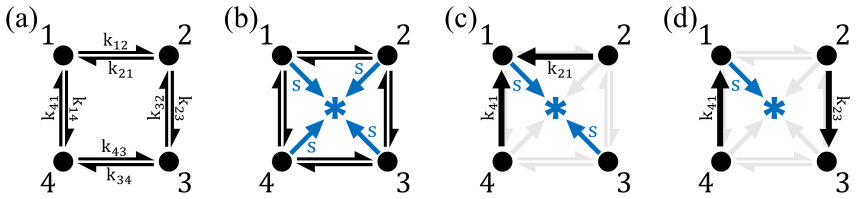
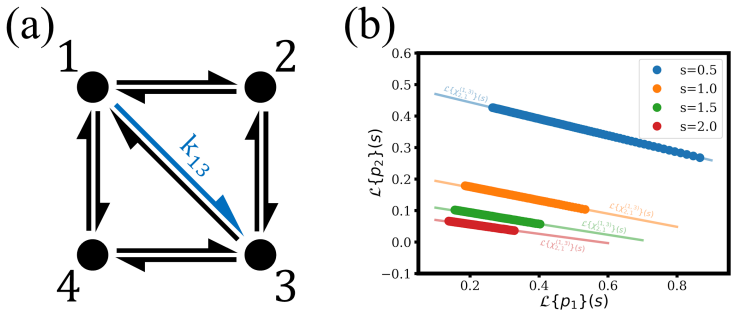
For irreducible, time-homogeneous Markov networks, mutual linearity holds for occupation probabilities and network currents in the stationary regime and in the non-stationary regime in Laplace space. The all-minors matrix-tree theorem yields explicit combinatorial expressions for the non-stationary response ratios under variation of a single transition rate. The stationary result follows as the long-time limit, small-time asymptotics are set by minimal path distances, and mutual linearity extends to hitting time densities.
What carries the argument
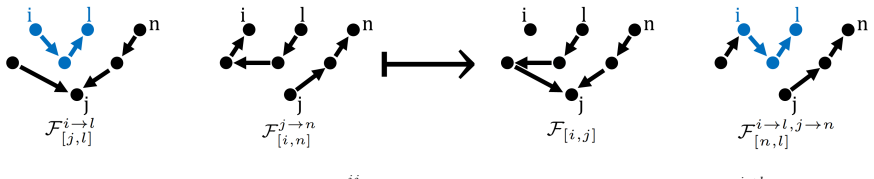
The all-minors matrix-tree theorem applied to the transition graph, which expresses the relevant determinants and cofactors as sums over spanning trees and thereby produces the combinatorial response ratios.
If this is right
- Response ratios under single-rate perturbations admit explicit sums over spanning trees at any finite time.
- The long-time limit of these expressions recovers the known stationary mutual linearity.
- Short-time expansions of the ratios are completely determined by the graph distance between states.
- Hitting-time densities satisfy the same linear response relations as the occupation probabilities.
Where Pith is reading between the lines
- The combinatorial formulas could be used to design efficient numerical schemes that avoid integrating the full master equation for sensitivity calculations.
- Similar graph-theoretic arguments may apply to other linear response properties in continuous-time Markov chains on networks.
- Relaxing time-homogeneity would require a different combinatorial tool, since the matrix-tree theorem relies on constant rates.
Load-bearing premise
The Markov network must be irreducible and time-homogeneous so that the all-minors matrix-tree theorem applies directly to the transient quantities.
What would settle it
Construct a small reducible Markov network, compute its transient probabilities after a rate perturbation, and check whether the response ratios remain mutually linear.
Figures



read the original abstract
For irreducible, time-homogeneous Markov networks, mutual linearity has recently been established for both occupation probabilities and network currents in the stationary regime as well as in the non-stationary regime in Laplace space. The derivation of this property for the stationary distribution utilized the Markov-chain tree theorem, which also allows for an explicit combinatorial expression of the response ratios under variation of a single transition rate. The extension of this result was proven at the trajectory level by employing the Doob-Meyer decomposition. By employing the all-minors matrix-tree theorem, we show that this property also follows from a graph theoretic formulation and derive explicit combinatorial expressions for the non-stationary response ratios. The stationary result follows as the long-time limit and we also show that the small-time asymptotics are entirely determined by minimal path distances in the underlying graph. Finally we use the graph theoretic approach to prove that mutual linearity also extends to hitting time densities.
Editorial analysis
A structured set of objections, weighed in public.
Referee Report
Summary. The manuscript derives mutual linearity for transient occupation probabilities, network currents, and hitting-time densities in irreducible time-homogeneous Markov networks by applying the all-minors matrix-tree theorem to the resolvent of the rate matrix. It supplies explicit combinatorial expressions for the Laplace-space response ratios under single-rate perturbations, recovers the known stationary result as the long-time limit, shows that small-time asymptotics are governed by shortest-path distances in the graph, and extends the linearity property to hitting-time densities.
Significance. If the derivations are correct, the work supplies a direct combinatorial foundation for mutual linearity outside equilibrium, with explicit expressions that could aid exact calculations or asymptotic analysis in stochastic networks. The graph-theoretic approach unifies the stationary and transient regimes and the hitting-time extension without introducing new parameters or fitting procedures.
Simulated Author's Rebuttal
We thank the referee for their positive assessment of the manuscript and for recommending acceptance. The referee's summary correctly identifies the key contributions: the application of the all-minors matrix-tree theorem to obtain explicit combinatorial expressions for mutual linearity of transient occupation probabilities, currents, and hitting-time densities, the recovery of the stationary case as a long-time limit, the short-time asymptotics governed by graph distances, and the unification of regimes without additional parameters.
Circularity Check
No significant circularity; derivation applies standard theorem to extend prior result
full rationale
The paper derives mutual linearity for transient occupation probabilities, currents, and hitting-time densities by applying the all-minors matrix-tree theorem to the resolvent of the rate matrix, yielding explicit combinatorial expressions for Laplace-space response ratios. The stationary result is recovered as the long-time limit, and small-time asymptotics are tied to graph distances. These steps rest on the standard combinatorial matrix-tree theorem (not a self-citation or ansatz) under the necessary assumptions of irreducibility and time-homogeneity. No prediction reduces to a fitted input, no self-definitional loop appears, and the central claim has independent content beyond any prior mutual-linearity citation.
Axiom & Free-Parameter Ledger
axioms (1)
- domain assumption The Markov network is irreducible and time-homogeneous.
Reference graph
Works this paper leans on
-
[1]
Gardiner C Wet al.2004Handbook of stochastic methodsvol 3 (springer Berlin)
-
[2]
Norris J R 1998Markov chains2 (Cambridge university press)
-
[3]
Lyons R and Peres Y 2017Probability on trees and networksvol 42 (Cambridge University Press)
-
[4]
Grimmett G and Stirzaker D 2020Probability and random processes(Oxford university press)
-
[5]
Van Kampen N G 1992Stochastic processes in physics and chemistryvol 1 (Elsevier)
-
[6]
Honerkamp J 1996Stochastic dynamical systems: concepts, numerical methods, data analysis (John Wiley & Sons)
-
[7]
Gillespie D T 1992Physica A: Statistical Mechanics and its Applications188404–425
-
[8]
Paul W and Baschnagel J 1999From Physics to Finance, Springer, Berlin
-
[9]
Bressloff P C 2014Stochastic processes in cell biologyvol 41 (Springer)
-
[10]
Redner S 2001A guide to first-passage processes(Cambridge university press)
-
[11]
Metzler R, Redner S and Oshanin G 2014First-passage phenomena and their applications vol 35 (World Scientific)
-
[12]
Chaiken S 1982SIAM Journal on Algebraic Discrete Methods3319–329
-
[13]
Seneta E 2006Non-negative matrices and Markov chains(Springer Science & Business Media)
-
[14]
Hill T L 1966Journal of theoretical biology10442–459 13
-
[15]
Schnakenberg J 1976Reviews of Modern physics48571
-
[16]
Zia R K and Schmittmann B 2007Journal of Statistical Mechanics: Theory and Experiment 2007P07012–P07012
-
[17]
Bebon R and Speck T 2026Physical Review Letters136137401
-
[18]
Harunari P E, Dal Cengio S, Lecomte V and Polettini M 2024Physical Review Letters133 047401
-
[19]
Zheng J and Lu Z 2026arXiv preprint arXiv:2604.06162
work page internal anchor Pith review Pith/arXiv arXiv
-
[20]
Nam K M and Gunawardena J 2023Frontiers in Cell and Developmental Biology111233808
-
[21]
Voits J B and Schwarz U S 2025PRX Life3(4) 043011
-
[22]
Nam K M and Gunawardena J 2025Bulletin of Mathematical Biology871–43
- [23]
-
[24]
Doetsch G 2012Introduction to the Theory and Application of the Laplace Transformation (Springer Science & Business Media)
-
[25]
Gunawardena J 2012PloS one7e36321
-
[26]
Nam K, Martinez-Corral R and Gunawardena J 2022Interface Focus1220220013
-
[27]
Tkaˇ cik G and Wolde P R t 2025Annual review of biophysics54249–274
-
[28]
Avanzini F, Freitas N and Esposito M 2023Physical Review X13021041 14
discussion (0)
Sign in with ORCID, Apple, or X to comment. Anyone can read and Pith papers without signing in.