Content Platform GenAI Regulation via Compensation
Pith reviewed 2026-05-15 12:24 UTC · model grok-4.3
The pith
A simple creator compensation scheme can increase high-value human content on platforms without detecting AI.
A machine-rendered reading of the paper's core claim, the machinery that carries it, and where it could break.
Core claim
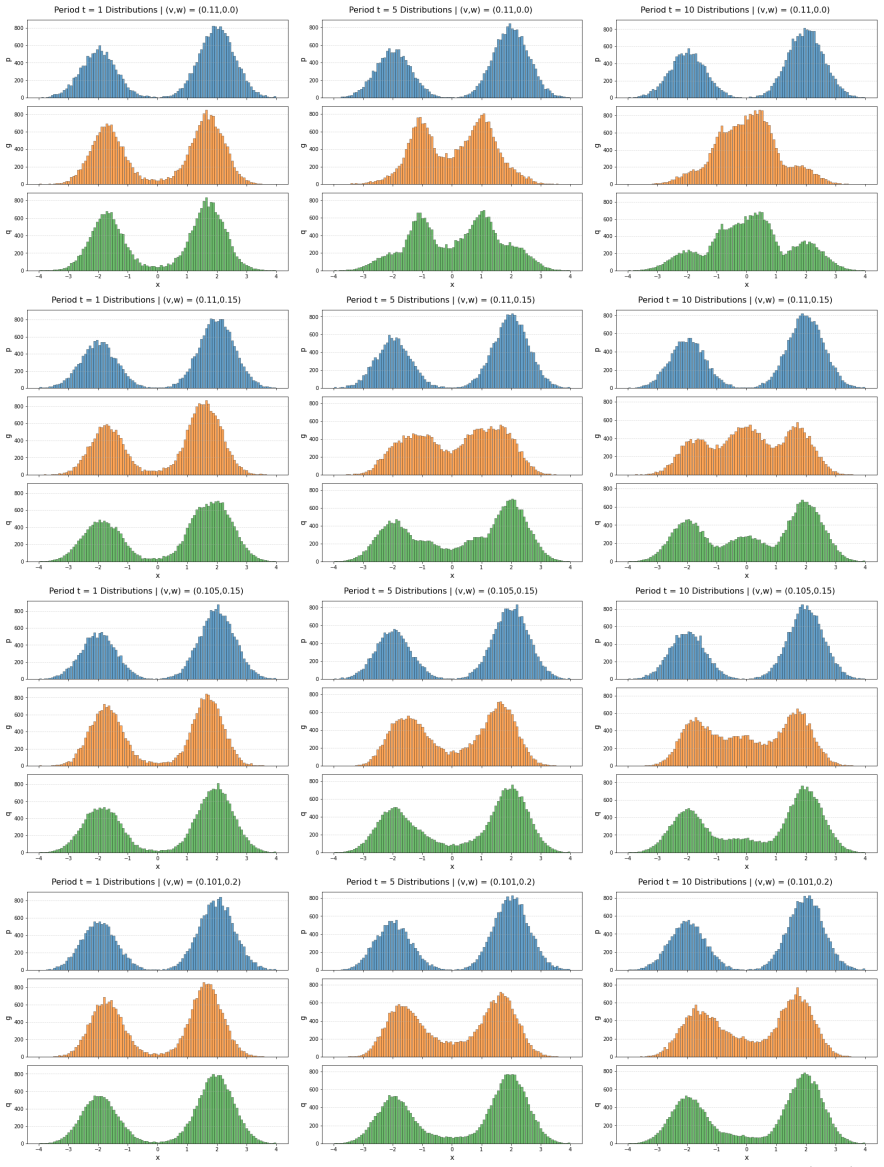
The paper establishes that an unregulated usage of GenAI harms the platform through contents distribution distortion which lowers consumers' engagement and the platform's profit, and demonstrates that a simple economically-driven creator compensation scheme can incentivize more creation of high-value human-generated contents without the need for an AI-detector, thereby reducing the data pollution for future GenAI training while improving the consumer engagement and the platform's profit.
What carries the argument
An economically-driven creator compensation scheme that rewards high-value human-generated content production without requiring AI detection.
Load-bearing premise
Creators will respond to the compensation incentives by creating more high-value human content rather than finding ways to exploit the scheme or continuing with AI-assisted production.
What would settle it
If after implementing the compensation scheme, the proportion of human-generated content does not increase and platform engagement metrics do not improve, or if AI content still dominates, the claim would be falsified.
Figures


read the original abstract
The use of Generative AI (GenAI) for creative content generation has gained popularity in recent years. GenAI allows creators to generate contents that are increasingly becoming indistinguishable to the human--generated counter--part at a much lower cost. While GenAI reshapes the competitive landscape of the contents market, the original creators were typically not compensated for their works that were used in the GenAI training. On the other hands, the wide--spread adoption of GenAI threatens to replace the human--generated shares of contents on content platforms, contaminating training data source for future GenAI models. In this paper, we argue that an unregulated usage of GenAI can also be harmful to the platform by causing a contents distribution distortion which can lower the consumers' engagement and the platform's profit. We show that a simple economically--driven creator compensation scheme, can incentivize more creation of high--value human--generated contents, without the need for an AI--detector. This reduces the data pollution for future GenAI training, while improves the consumer engagement and the platform's profit.
Editorial analysis
A structured set of objections, weighed in public.
Referee Report
Summary. The paper argues that unregulated GenAI content generation on platforms distorts content distribution, lowering consumer engagement and platform profits while polluting future training data. It proposes a simple economically-driven creator compensation scheme that incentivizes production of high-value human-generated content without requiring AI detectors, thereby improving engagement, platform profits, and training data quality.
Significance. If the unshown economic model can be formalized and shown to produce stable incentive effects, the result would provide a detection-free regulatory mechanism for content platforms facing GenAI substitution, with direct implications for platform design, creator economics, and long-term AI training data integrity.
major comments (2)
- [Abstract] Abstract: the central claim that 'a simple economically-driven creator compensation scheme... can incentivize more creation of high-value human-generated contents, without the need for an AI-detector' is asserted without any explicit reward function, creator utility model, or equilibrium analysis showing that the scheme cannot be gamed by low-cost AI outputs that match engagement metrics.
- [Abstract] Abstract: the asserted improvements in 'consumer engagement and the platform's profit' and reduction in 'data pollution' rest on an unshown derivation; no conditions are given under which the human-content equilibrium is stable against strategic substitution by creators.
minor comments (2)
- [Abstract] Abstract: 'On the other hands' should be 'On the other hand'; 'counter--part' should be 'counterpart'.
- [Abstract] Abstract: the phrase 'contents distribution distortion' is vague; a brief definition or example of the distortion would improve clarity.
Simulated Author's Rebuttal
We thank the referee for the detailed and constructive feedback. We agree that the abstract's claims require explicit formalization of the economic model, and we will revise the manuscript to include the reward function, creator utility model, equilibrium analysis, and stability conditions.
read point-by-point responses
-
Referee: [Abstract] Abstract: the central claim that 'a simple economically-driven creator compensation scheme... can incentivize more creation of high-value human-generated contents, without the need for an AI-detector' is asserted without any explicit reward function, creator utility model, or equilibrium analysis showing that the scheme cannot be gamed by low-cost AI outputs that match engagement metrics.
Authors: We agree that the current manuscript presents the compensation scheme at a conceptual level without the requested formal elements. In the revision we will add an explicit reward function tied to engagement metrics, a creator utility model that distinguishes human production costs from low-cost AI substitution, and a game-theoretic equilibrium analysis demonstrating that the scheme cannot be gamed when engagement metrics are imperfectly correlated with true content value. revision: yes
-
Referee: [Abstract] Abstract: the asserted improvements in 'consumer engagement and the platform's profit' and reduction in 'data pollution' rest on an unshown derivation; no conditions are given under which the human-content equilibrium is stable against strategic substitution by creators.
Authors: We acknowledge that the claimed improvements and equilibrium stability are not derived in the present draft. The revised version will include the full derivation from the equilibrium analysis, together with the parameter conditions (compensation level, cost differentials, and engagement-value correlation) under which the human-content equilibrium is stable, yielding higher engagement, platform profits, and lower data pollution. revision: yes
Circularity Check
No derivation chain or equations present; incentive claims are asserted without reduction to inputs.
full rationale
The paper asserts that a simple economically-driven creator compensation scheme incentivizes more high-value human-generated content without AI detectors, thereby reducing data pollution while improving engagement and platform profit. No equations, functional forms, equilibrium models, or parameter-fitting steps appear in the abstract or described content. The central claim is presented as a direct outcome of the scheme but is not derived from any prior inputs, self-citations, or ansatzes that could be shown to reduce circularly by construction. With no load-bearing derivation visible, the argument remains non-circular and self-contained as a policy proposal rather than a formal result.
Axiom & Free-Parameter Ledger
Reference graph
Works this paper leans on
-
[1]
A marketplace for data: An algo- rithmic solution
Agarwal, Anish, Munther Dahleh, and Tuhin Sarkar (2019). “A marketplace for data: An algo- rithmic solution”. In:Proceedings of the 2019 ACM Conference on Economics and Computation, pp. 701–726. Ai, Rui, David Simchi-Levi, and Haifeng Xu (2025). “GenAI vs. Human Creators: Procurement Mechanism Design in Two-/Three-Layer Markets”. In:arXiv preprint arXiv:2...
-
[2]
The Economics of Copyright and AI Empirical Evidence and Opti- mal Policy
Peukert, Christian (2025). “The Economics of Copyright and AI Empirical Evidence and Opti- mal Policy”. In:European Parliament, JURI committee. Pissarides, Christopher A (2000).Equilibrium unemployment theory. MIT press. Schurz, Matthew (2025). “Fair Use Or Foul Play? Copyright Law’s Battle Over Using Sound Recordings In Ai Training”. In:UC Law SF Communi...
work page 2025
-
[3]
The Curse of Recursion: Training on Generated Data Makes Models Forget
Shumailov, Ilia, Zakhar Shumaylov, Yiren Zhao, Yarin Gal, Nicolas Papernot, and Ross Ander- son (2023). “The curse of recursion: Training on generated data makes models forget”. In: arXiv preprint arXiv:2305.17493. Sohl-Dickstein, Jascha, Eric Weiss, Niru Maheswaranathan, and Surya Ganguli (2015). “Deep unsupervised learning using nonequilibrium thermodyn...
work page internal anchor Pith review arXiv 2023
-
[4]
Score-Based Generative Modeling through Stochastic Differential Equations
Song, Yang and Stefano Ermon (2019). “Generative modeling by estimating gradients of the data distribution”. In:Advances in neural information processing systems32. Song, Yang, Jascha Sohl-Dickstein, Diederik P Kingma, Abhishek Kumar, Stefano Ermon, and Ben Poole (2020). “Score-based generative modeling through stochastic differential equa- tions”. In:arX...
work page internal anchor Pith review Pith/arXiv arXiv 2019
-
[5]
Revisiting data attribution for influence func- tions
Zhu, Hongbo and Angelo Cangelosi (2025). “Revisiting data attribution for influence func- tions”. In:arXiv preprint arXiv:2508.07297. Zou, Tianxin, Zijun Shi, and Yue Wu (2026). “Welfare Implications of Democratization in Content Creation: Generative AI and Beyond”. In:Journal of Marketing Research, p. 00222437261423540. Appendix A Omitted Proofs A.1 Proo...
discussion (0)
Sign in with ORCID, Apple, or X to comment. Anyone can read and Pith papers without signing in.