Recognition: 2 theorem links
· Lean TheoremAnisotropic hybrid stars: Interplay of superconductivity and magnetic field leading to gravitational waves
Pith reviewed 2026-05-10 18:50 UTC · model grok-4.3
The pith
Superconductivity and magnetic fields inside hybrid stars create pressure anisotropy that increases their mass and can produce continuous gravitational waves.
A machine-rendered reading of the paper's core claim, the machinery that carries it, and where it could break.
Core claim
The central claim is that the interplay of superconductivity in both quark and proton matter with the internal magnetic field produces pressure anisotropy within hybrid stars, which enhances the maximum stellar mass and can induce a deformation that sources continuous gravitational waves.
What carries the argument
Phenomenological anisotropy profiles defined in a one-dimensional framework that encode the combined effects of color superconductivity, proton superconductivity, and magnetic fields on the pressure distribution.
If this is right
- Hybrid stars reach higher maximum masses than predicted by isotropic equations of state.
- Anisotropy-induced deformation can generate continuous gravitational waves observable by future detectors.
- Mass and gravitational-wave observations can constrain both the anisotropy parameters and the underlying equations of state.
- The Maxwell construction between hadron and quark phases remains applicable under anisotropic conditions.
Where Pith is reading between the lines
- Full three-dimensional magnetohydrodynamic calculations would provide a stronger check on the size of the anisotropy effects.
- The same modeling approach could be applied to other superconducting phases in compact objects to predict additional gravitational-wave sources.
- Absence of continuous waves from high-mass pulsars would tighten limits on the strength of superconductivity-induced anisotropy.
Load-bearing premise
Simple one-dimensional phenomenological profiles can accurately represent the three-dimensional physical effects of superconductivity and magnetic fields on pressure anisotropy.
What would settle it
Detection of a hybrid-star candidate whose measured mass exceeds the isotropic-model limit together with a search for continuous gravitational waves from the same object, or the failure to find either signature, would test whether the anisotropy is present.
Figures



read the original abstract
Neutron stars, at their cores, are highly dense and, thus, are expected to have a number of exotic processes. This includes a possible phase transition to deconfined quark matter at the core, leading to a hybrid star. The quark matter is expected to additionally be color superconducting. The physics of superconductivity plays an important role in understanding the high density matter in the interiors of neutron/hybrid stars. At their high densities, additionally, both proton superconductivity and neutron superfluidity are expected. We study the effect of superconducting (quark/proton) matter, along with the internal magnetic field, leading to pressure anisotropy within hybrid stars. We aim to probe the effect of superconductivity, especially from color superconducting quarks, in hybrid star structure. We propose new phenomenological model anisotropy profiles within a one-dimensional framework. We model quark matter using the vector interaction enhanced Bag model, and hadron matter with the DD2 equation of state. A Maxwell construction joins both phases. We further investigate the possible observational signatures of these hybrid stars. These include mass enhancement and continuous gravitational waves, possibly arising from the anisotropy induced deformation, helping us further constrain our model and its physical parameters.
Editorial analysis
A structured set of objections, weighed in public.
Referee Report
Summary. The manuscript investigates hybrid stars with a quark-hadron phase transition, modeling the effects of color superconductivity in the quark phase and proton superconductivity together with internal magnetic fields as sources of pressure anisotropy. Using the DD2 EOS for hadronic matter and the vector-enhanced Bag model for quark matter joined by Maxwell construction, the authors introduce new phenomenological anisotropy profiles into the one-dimensional Tolman-Oppenheimer-Volkoff framework. They report resulting mass enhancements and continuous gravitational-wave emission arising from anisotropy-induced quadrupolar deformation.
Significance. If the link between the microscopic superconducting phases and the adopted anisotropy profiles can be strengthened, the work would provide a useful phenomenological tool for exploring how exotic matter phases affect neutron-star observables, including mass-radius relations and continuous GW signals detectable by future instruments. The explicit use of Maxwell construction and two specific EOS choices allows direct comparison with existing hybrid-star literature.
major comments (2)
- [§3] §3 (anisotropy profiles): The central claim that superconductivity and magnetic fields 'lead to' pressure anisotropy rests on newly proposed phenomenological functional forms for the anisotropy parameter. No derivation from gap equations, London penetration depth, or magnetohydrostatic equilibrium is provided; the profiles are instead postulated with free parameters. Consequently, the mass increase and GW amplitude reported in §§4–5 are not predictions of the superconducting physics but depend on the chosen functional shape.
- [§2] §2 (framework): The one-dimensional TOV treatment with an added anisotropy term cannot self-consistently incorporate the vector magnetic field or the deformation it induces. Continuous GW emission requires a non-zero quadrupole moment that is only approximately captured in 1D; a 2D or 3D magnetohydrodynamic treatment would be needed to confirm that the reported GW amplitudes are not artifacts of the dimensionality reduction.
minor comments (2)
- [Abstract] Abstract: The functional forms of the 'new phenomenological model anisotropy profiles' are not stated, even schematically; including the explicit expressions would immediately clarify the novelty.
- [Results] Results section: No explicit comparison is shown between the anisotropic sequences and the corresponding isotropic (zero-anisotropy) hybrid-star sequences using the same EOS pair, which would isolate the quantitative effect of the new profiles.
Simulated Author's Rebuttal
We thank the referee for the careful review and constructive feedback on our manuscript. We address each major comment below, providing honest responses based on the scope of our phenomenological study. Revisions have been made to clarify limitations and motivations where appropriate.
read point-by-point responses
-
Referee: [§3] §3 (anisotropy profiles): The central claim that superconductivity and magnetic fields 'lead to' pressure anisotropy rests on newly proposed phenomenological functional forms for the anisotropy parameter. No derivation from gap equations, London penetration depth, or magnetohydrostatic equilibrium is provided; the profiles are instead postulated with free parameters. Consequently, the mass increase and GW amplitude reported in §§4–5 are not predictions of the superconducting physics but depend on the chosen functional shape.
Authors: We acknowledge that the anisotropy profiles in §3 are phenomenological functional forms with free parameters, as explicitly described in the manuscript. These forms are motivated by the expected effects of color superconductivity in the quark phase (via the vector-enhanced Bag model) and proton superconductivity combined with internal magnetic fields in the hadronic phase (DD2 EOS), which literature suggests can induce pressure anisotropy. A direct derivation from microscopic gap equations, London penetration depth, or full magnetohydrostatic equilibrium is not provided, as this would require a separate, more detailed microscopic calculation outside the current scope of exploring macroscopic stellar structure and observables in a 1D framework. We have revised §3 to expand the physical motivation for the chosen profiles, including qualitative links to superconducting phases, and we clarify that the reported mass enhancements and GW amplitudes are results for these specific profiles across the explored parameter space rather than direct predictions from first-principles superconductivity. This phenomenological approach is intended as a tool for investigating potential effects, consistent with the referee's note on its utility for comparison with hybrid-star literature. revision: partial
-
Referee: [§2] §2 (framework): The one-dimensional TOV treatment with an added anisotropy term cannot self-consistently incorporate the vector magnetic field or the deformation it induces. Continuous GW emission requires a non-zero quadrupole moment that is only approximately captured in 1D; a 2D or 3D magnetohydrodynamic treatment would be needed to confirm that the reported GW amplitudes are not artifacts of the dimensionality reduction.
Authors: We agree that the 1D TOV framework with an added anisotropy term is an approximation that cannot fully self-consistently incorporate the vector character of the magnetic field or the resulting non-spherical deformation. The continuous GW emission is estimated via the quadrupole formula applied to the deformation induced by the anisotropy profiles in this 1D setup. We have revised the manuscript by adding explicit discussion in §2 and the conclusions to highlight this limitation, noting that the reported GW amplitudes should be viewed as approximate estimates within the model. A full 2D or 3D magnetohydrodynamic treatment would indeed be needed for more rigorous confirmation, and we indicate this as a direction for future work. The current 1D approach, using Maxwell construction with the specified EOS, nonetheless enables direct comparison with existing hybrid-star studies and provides an initial exploration of anisotropy effects on mass-radius relations and potential GW signals. revision: yes
- Derivation of the specific anisotropy profiles from microscopic gap equations, London penetration depth, or magnetohydrostatic equilibrium
- Self-consistent 2D or 3D magnetohydrodynamic simulations to precisely quantify the GW amplitudes and confirm they are not artifacts of the 1D reduction
Circularity Check
No significant circularity; phenomenological profiles are explicitly posited rather than derived or fitted as predictions.
full rationale
The paper explicitly states it 'propose[s] new phenomenological model anisotropy profiles within a one-dimensional framework' to model the effects of superconductivity and magnetic fields, then computes mass and GW signatures from the modified TOV equations under those inputs plus the DD2 and vector-enhanced Bag EOS with Maxwell construction. No load-bearing step reduces a claimed first-principles result to an input by construction: the profiles are not asserted to follow from microscopic gap equations or MHD equilibrium, nor are parameters fitted to data and then relabeled as predictions. The work is an exploratory parameter study whose outputs follow directly from the stated assumptions without self-citation chains or self-definitional reductions.
Axiom & Free-Parameter Ledger
free parameters (1)
- anisotropy profile parameters
axioms (2)
- domain assumption Maxwell construction joins the hadron and quark phases
- domain assumption Vector-interaction-enhanced bag model describes quark matter
Lean theorems connected to this paper
-
IndisputableMonolith/Cost/FunctionalEquation.leanwashburn_uniqueness_aczel unclear?
unclearRelation between the paper passage and the cited Recognition theorem.
We propose new phenomenological model anisotropy profiles within a one-dimensional framework... σ_aniso = p_t − p_r = ±B²(2m/r)(1 + Δ_SC²μ²/pr)(pr/pc) (Profile 1) and ±(B² + Δ_SC²μ²)(2m/r)(pr/pc) (Profile 2)
-
IndisputableMonolith/Foundation/RealityFromDistinction.leanreality_from_one_distinction unclear?
unclearRelation between the paper passage and the cited Recognition theorem.
modified Tolman-Oppenheimer-Volkoff (TOV) equations... dm/dr = 4πr²(ε + B²/8π)
What do these tags mean?
- matches
- The paper's claim is directly supported by a theorem in the formal canon.
- supports
- The theorem supports part of the paper's argument, but the paper may add assumptions or extra steps.
- extends
- The paper goes beyond the formal theorem; the theorem is a base layer rather than the whole result.
- uses
- The paper appears to rely on the theorem as machinery.
- contradicts
- The paper's claim conflicts with a theorem or certificate in the canon.
- unclear
- Pith found a possible connection, but the passage is too broad, indirect, or ambiguous to say the theorem truly supports the claim.
Reference graph
Works this paper leans on
-
[1]
INTRODUCTION Neutron stars (NSs) are among the most theoretically rich objects in our Universe. The cores of NSs are the sites of extremely dense matter - several times denser than the densities inside atomic nuclei. In these highly dense regions, a number of exotic processes could arise. Among these are the generation of non-terrestrially sta- ble partic...
work page internal anchor Pith review Pith/arXiv arXiv 2026
-
[2]
FORMALISM Following previous work [7–9], we model anisotropic compact stars in approximate spherical symmetry by modifying the Tolman-Oppenheimer-Volkoff (TOV) equations to incorporate the anisotropic and/or magnetic field effects. The stellar structure is then described by 1, dm dr = 4πr2 ϵ+ B2 8π ,(2.1) dpr dr = −(ϵ+pr) 4πr3 pr − B2 8π +m ...
-
[3]
Similar modeling has been used in previous studies of HSs as well [21, 22]
MODELING ANISOTROPY IN SUPERCONDUCTING, MAGNETIZED HYBRID STARS We have previously used a modified phenomenological prescription to describe pressure anisotropy within NSs [7, 8, 20]. Similar modeling has been used in previous studies of HSs as well [21, 22]. In the present work, we propose two new phenomenological profiles, directly tied to the physical ...
-
[4]
(2.1) and (2.2) in order to obtain HSs with various properties
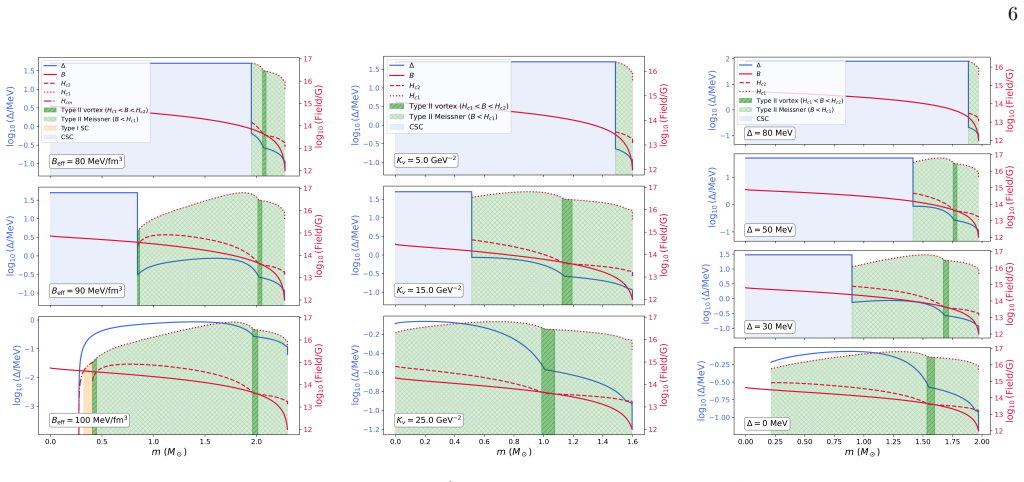
SUPERCONDUCTIVITY ZONES We are now all set to solve Eqs. (2.1) and (2.2) in order to obtain HSs with various properties. A few rep- resentative cases for the variation of the superconducting pairing gap and superconducting regions within the star for different HSs are given in Figs. 2 and 3. Each subfig- ure shows how changing the parameters -K v,B eff an...
-
[5]
AnincreaseinB eff leads to the point of PT shifting to higher densities, and thusdecreasingthe extent of CSC matter in the star. A higher effective Bag constant refers to a higher energy cost to decon- fine the quark phase, thus leading to higher pres- sures/densities required for the stable quark phase to appear in the star
-
[6]
Higher values ofK v result in stiffer EoS in the quark phase, as now we have an additional vector repulsion contribution
AnincreaseinK v similarly shifts the point of PT to higher densities, anddecreasesthe extent of CSC matter in the star. Higher values ofK v result in stiffer EoS in the quark phase, as now we have an additional vector repulsion contribution. This re- sults in the pressure at a givenµreducing and, hence, we require higher pressures for the PT
-
[7]
This is due to the pressure and en- ergy density being enhanced by the pairing energy ∼∆ 2 CSCµ2
Anincreasein ∆ CSC shifts the point of PT to lower densities, andincreasesthe extent of CSC matter in the star. This is due to the pressure and en- ergy density being enhanced by the pairing energy ∼∆ 2 CSCµ2. This leads to the point of PT being reached at lower pressures. In summary, bothB eff andK v tend to decrease the extent of the quark core, with th...
-
[8]
Isotropic
EFFECT ON OBSERVABLES 5.1. Effect onM max Although the effect of color superconductivity on the EoS (≃∆ 2 CSCµ2) is expected to be sub-dominant when compared to theµ 4 contribution from the Fermi sea, there are still situations where it can have a significant ef- fect on the EoS. In particular, there may be regions in the star where theµ 4 kinetic contrib...
2000
-
[9]
mass gap
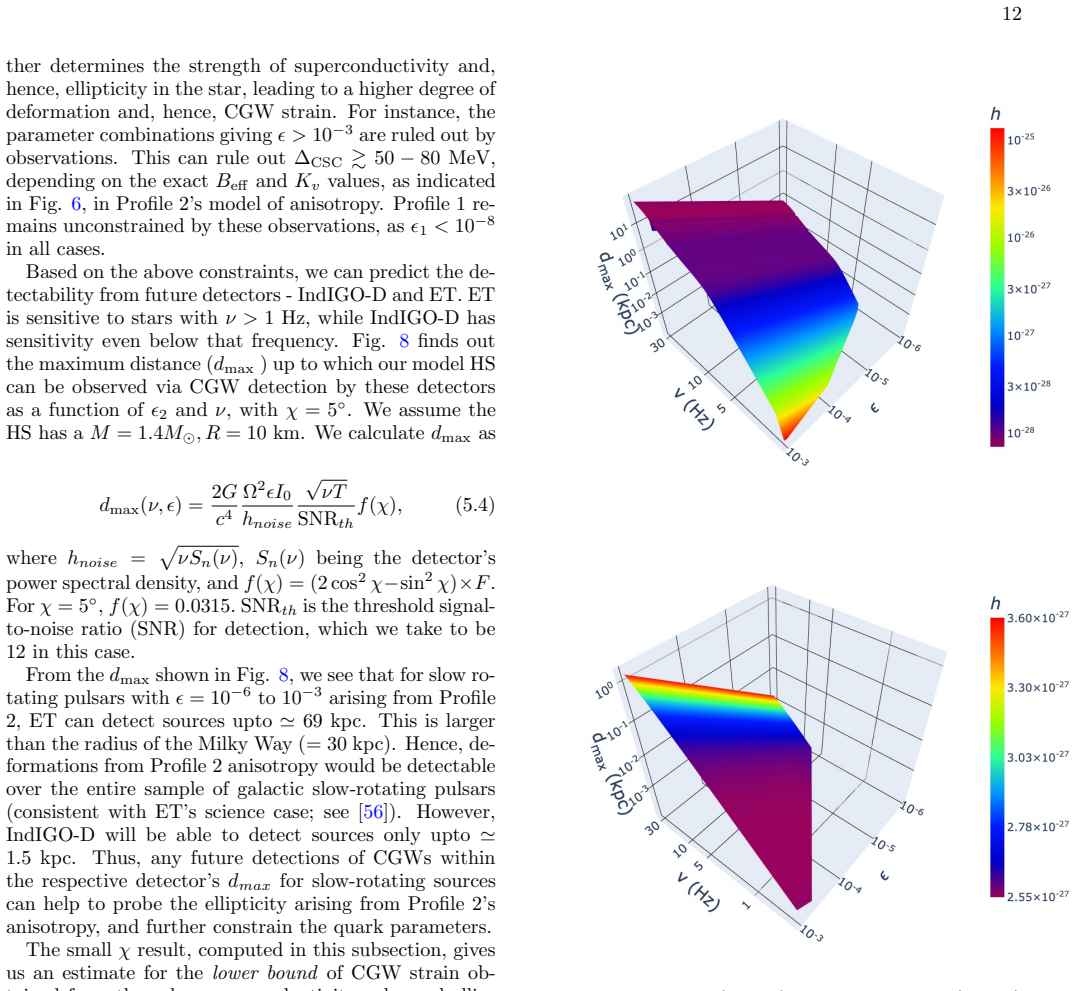
DISCUSSION AND CONCLUSIONS The study of HSs is complex and challenging. The uncertainties of high-density matter are combined with the uncertainties associated with the hadron-quark PT. Additional physics such as color superconductivity and magnetic fields serve to make this a physically rich av- enue of study. Our approach addresses the possible in- terp...
2022
-
[10]
F. Weber, Prog. Part. Nucl. Phys.54, 193 (2005), arXiv:astro-ph/0407155
-
[11]
A. R. Bodmer, Phys. Rev. D4, 1601 (1971)
1971
-
[12]
Witten, Phys
E. Witten, Phys. Rev. D30, 272 (1984)
1984
-
[13]
M. G. Alford, A. Schmitt, K. Rajagopal, and T. Sch¨ afer, Rev. Mod. Phys.80, 1455 (2008), arXiv:0709.4635 [hep- ph]
work page Pith review arXiv 2008
- [14]
-
[15]
M. Sinha and A. Sedrakian, Physics of Particles and Nu- clei46, 826 (2015), arXiv:1403.2829 [astro-ph.SR]
- [16]
- [17]
- [18]
-
[19]
D. Bandyopadhyay, S. Chakrabarty, and S. Pal, Phys. Rev. Lett.79, 2176 (1997), arXiv:astro-ph/9703066
- [20]
-
[21]
J. Braithwaite, Mon. Not. R. Astron. Soc.397, 763 (2009), arXiv:0810.1049 [astro-ph]
-
[22]
Composition and thermodynamics of nuclear matter with light clusters
S. Typel, G. R¨ opke, T. Kl¨ ahn, D. Blaschke, and H. H. Wolter, Phys. Rev. C81, 015803 (2010), arXiv:0908.2344 [nucl-th]
work page Pith review arXiv 2010
-
[23]
T. Klahn and T. Fischer, Astrophys. J.810, 134 (2015), arXiv:1503.07442 [nucl-th]
-
[24]
M. Cierniak, T. Kl¨ ahn, T. Fischer, and N.-U. Bastian, Universe4, 30 (2018), arXiv:1802.03214 [nucl-th]
-
[25]
Chodos, R
A. Chodos, R. L. Jaffe, K. Johnson, C. B. Thorn, and V. F. Weisskopf, Phys. Rev. D9, 3471 (1974)
1974
- [26]
-
[27]
J. Soldateschi, N. Bucciantini, and L. Del Zanna, Astron. Astrophys.654, A162 (2021), arXiv:2106.00603 [astro- ph.HE]
-
[28]
P. Haensel and A. Y. Potekhin, Astron. Astrophys.428, 191 (2004), arXiv:astro-ph/0408324
work page internal anchor Pith review arXiv 2004
-
[29]
R. L. Bowers and E. P. T. Liang, Astrophys. J.188, 657 (1974)
1974
- [30]
- [31]
-
[32]
Easson and C
I. Easson and C. J. Pethick, Phys. Rev. D16, 275 (1977)
1977
- [33]
-
[34]
L. Paulucci, E. J. Ferrer, V. de la Incera, and J. E. Hor- vath, Phys. Rev. D83, 043009 (2011), arXiv:1010.3041 [astro-ph.HE]
- [35]
- [36]
-
[37]
Hoffberg, A
M. Hoffberg, A. E. Glassgold, R. W. Richardson, and M. Ruderman, Phys. Rev. Lett.24, 775 (1970)
1970
-
[38]
Takatsuka and R
T. Takatsuka and R. Tamagaki, Progress of Theoretical Physics46, 114 (1971)
1971
- [39]
-
[40]
M. Mannarelli, K. Rajagopal, and R. Sharma, Phys. Rev. D76, 074026 (2007), arXiv:hep-ph/0702021
-
[41]
M. Sinha and A. Sedrakian, Phys. Rev. C91, 035805 (2015), arXiv:1502.02979 [astro-ph.HE]
-
[42]
T. Mandal and P. Jaikumar, Phys. Rev. D94, 074016 (2016), arXiv:1608.00882 [hep-ph]
-
[43]
K. Glampedakis, N. Andersson, and L. Samuels- son, Mon. Not. R. Astron. Soc.410, 805 (2011), arXiv:1001.4046 [astro-ph.SR]
- [44]
- [45]
-
[46]
A. Sedrakian, Phys. Rev. D71, 083003 (2005), arXiv:astro-ph/0408467 [astro-ph]
-
[47]
G. Baym, C. Pethick, and D. Pines, Nature224, 673 (1969)
1969
- [48]
-
[49]
M. Alford and S. Reddy, Phys. Rev. D67, 074024 (2003), arXiv:nucl-th/0211046
-
[50]
I. Vida˜ na, Proc. Roy. Soc. Lond. A474, 0145 (2018), arXiv:1803.00504 [nucl-th]
-
[51]
A. Mastrano, A. Melatos, A. Reisenegger, and T. Akg¨ un, Mon. Not. R. Astron. Soc.417, 2288 (2011), arXiv:1108.0219 [astro-ph.HE]
-
[52]
S. Kalita and B. Mukhopadhyay, Mon. Not. Roy. Astron. Soc.490, 2692 (2019), [Erratum: Mon.Not.Roy.Astron.Soc. 491, 4396–4397 (2020)], arXiv:1905.02730 [astro-ph.HE]
-
[53]
S. Bonazzola and E. Gourgoulhon, Astron. Astrophys. 312, 675 (1996), arXiv:astro-ph/9602107
-
[54]
K. Glampedakis, D. I. Jones, and L. Samuelsson, Phys. Rev. Lett.109, 081103 (2012), arXiv:1204.3781 [astro- ph.SR]
-
[55]
B. Haskell, N. Andersson, D. I. Jones, and L. Samuels- son, Phys. Rev. Lett.99, 231101 (2007), arXiv:0708.2984 [gr-qc]. 15
- [56]
-
[57]
C. J. Moore, R. H. Cole, and C. P. L. Berry, Class. Quant. Grav.32, 015014 (2015), arXiv:1408.0740 [gr-qc]
work page Pith review arXiv 2015
- [58]
- [59]
-
[60]
R. N. Manchester, G. B. Hobbs, A. Teoh, and M. Hobbs, Astron. J.129, 1993 (2005), arXiv:astro-ph/0412641
work page Pith review arXiv 1993
- [61]
- [62]
-
[63]
Abbottet al.(LIGO Scientific, VIRGO, KAGRA), Astrophys
R. Abbottet al.(LIGO Scientific, VIRGO, KAGRA), Astrophys. J.935, 1 (2022), arXiv:2111.13106 [astro- ph.HE]
- [64]
-
[65]
M. Maggioreet al.(ET), JCAP03, 050 (2020), arXiv:1912.02622 [astro-ph.CO]
- [66]
-
[67]
W. Wei, B. Irving, T. Kl¨ ahn, and P. Jaikumar, (2018), 10.3847/1538-4357/ab53ea, arXiv:1811.09441 [nucl-th]
- [68]
- [69]
discussion (0)
Sign in with ORCID, Apple, or X to comment. Anyone can read and Pith papers without signing in.