Recognition: 2 theorem links
· Lean TheoremHigher Nishimori Criticality and Exact Results at the Learning Transition of Deformed Toric Codes
Pith reviewed 2026-05-10 18:09 UTC · model grok-4.3
The pith
The learning-induced tricritical point in a deformed toric code under weak measurements is a higher Nishimori critical point.
A machine-rendered reading of the paper's core claim, the machinery that carries it, and where it could break.
Core claim
The learning tricritical point lies on a distinct higher Nishimori line that possesses an emergent gauge-invariant formulation, just like the ordinary Nishimori line but realized as a replica statistical-mechanics model in the R to 2 limit where disorder is averaged according to the Born rule. As a direct consequence, the power-law exponent of the Edwards-Anderson correlation function is exactly equal to that of the spin correlation function at the unmeasured Ising critical point. Using the c-effective theorem, the Casimir effective central charge c_eff decreases under renormalization-group flow from the higher Nishimori critical point to the unmeasured 2D Ising critical point and is thus大于
What carries the argument
The higher Nishimori line in the replica statistical-mechanics model at R approaching 2, which supplies the gauge-invariant formulation and the exact duality to the 2D Ising model that produces the stated equalities and inequalities.
If this is right
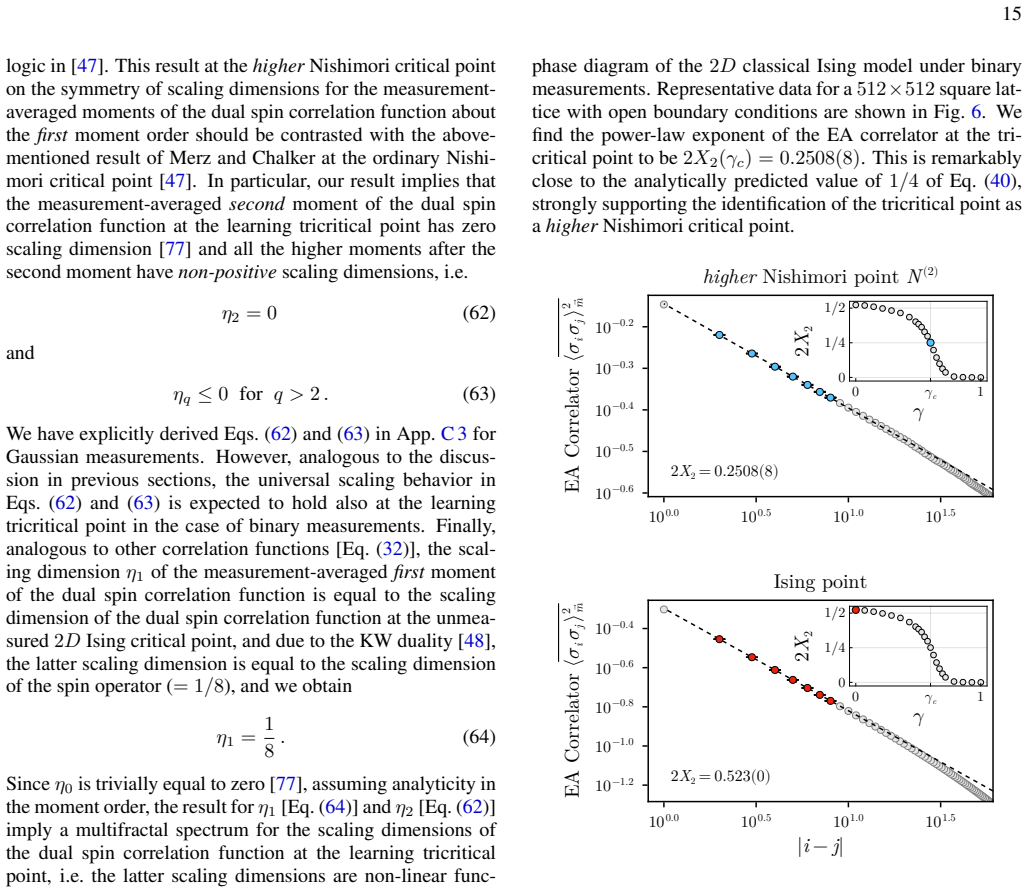
- The Edwards-Anderson correlation function shares exactly the same power-law exponent as the spin correlation function at the unmeasured Ising critical point.
- The Casimir effective central charge decreases under renormalization-group flow from the higher Nishimori critical point to the unmeasured 2D Ising critical point.
- c_eff at the higher Nishimori critical point is greater than 1/2.
- Higher Nishimori criticality exists and can be studied in general dimensions D greater than 1.
Where Pith is reading between the lines
- The same duality technique may map other measurement-induced transitions in quantum error-correcting codes onto classical inference problems with higher-replica symmetry.
- Numerical checks of the c_eff decrease in three or higher dimensions would test whether the flow property is universal for higher Nishimori points.
- The link to Bayesian inference suggests that decoding thresholds in quantum codes could be located by monitoring the higher-replica classical model near the identified critical line.
Load-bearing premise
The exact duality between the deformed toric code wavefunction with weak measurements and the classical Bayesian inference phase diagram of the 2D Ising model continues to hold at the tricritical point, permitting its identification with the higher Nishimori line in the R to 2 replica limit.
What would settle it
A high-precision numerical extraction of the power-law exponent of the Edwards-Anderson correlation function at the identified learning tricritical point that differs from the known exponent of the unmeasured 2D Ising spin correlation function would falsify the exact equality.
Figures





read the original abstract
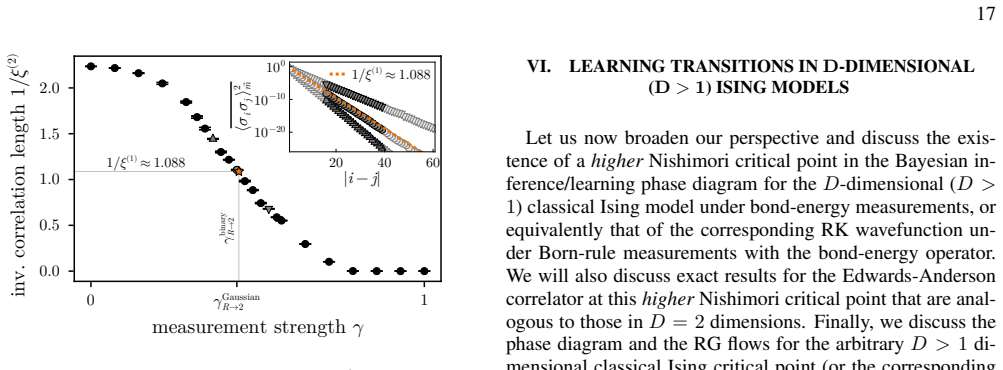
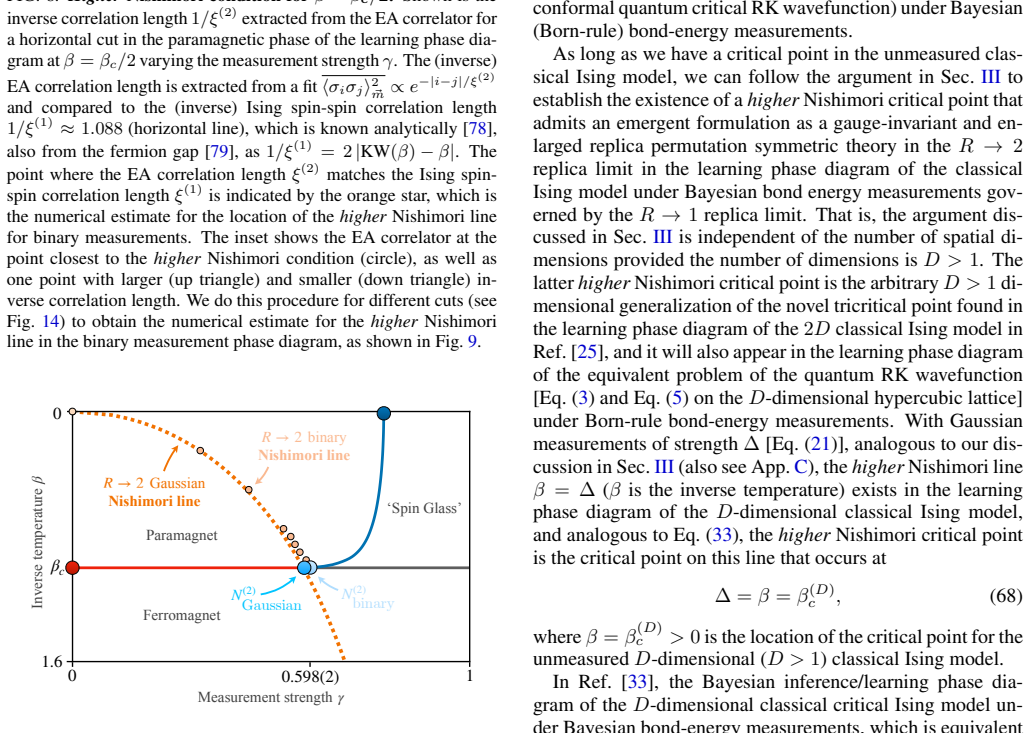
We revisit a learning-induced tricritical point, at which three phases with strong, weak, and broken $Z_2$ symmetry meet, in the phase diagram of a deformed toric code wavefunction subjected to weak measurements. This setting is exactly dual to a classical Bayesian inference phase diagram of the $2D$ classical Ising model. Here we demonstrate that this tricritical point lies on a distinct $\textit{higher Nishimori line}$, which has an emergent gauge-invariant formulation, just like the ordinary Nishimori line but with a higher replica symmetry as a replica stat-mech model in the replica number $R\rightarrow2$ limit, where disorder is averaged according to the Born rule. As such, the learning tricritical point is in fact a $\textit{higher Nishimori critical point}$. Using this identification, we obtain a number of $\textit{exact results}$ at this $\textit{higher}$ Nishimori critical point; e.g., we show that the power-law exponent of the Edwards-Anderson correlation function is exactly equal to that of the spin correlation function at the unmeasured Ising critical point and verify this in numerical simulations. Using the tools of the proof of a $c$-effective theorem [arXiv:2507.07959], we show that the Casimir effective central charge $c_{\text{eff}}$ $\textit{decreases}$ under renormalization group (RG) flow from the $\textit{higher}$ Nishimori critical point to the unmeasured $2D$ Ising critical point, and is thus greater than $1/2$. This is corroborated by extensive numerical simulations finding $c_{\text{eff}} = 0.522(1)$. The analytical result also explains, with a physically motivated assumption, the numerically observed increase of the Casimir effective central charge under the RG flow from the ordinary Nishimori critical point to the clean Ising critical point in the random-bond Ising model. We also discuss $\textit{higher}$ Nishimori criticality in general dimensions $D>1$.
Editorial analysis
A structured set of objections, weighed in public.
Referee Report
Summary. The manuscript revisits a learning-induced tricritical point in the phase diagram of a deformed toric code wavefunction under weak measurements. This point is exactly dual to the classical 2D Ising Bayesian inference phase diagram. The authors identify the tricritical point as lying on a higher Nishimori line (with emergent gauge invariance and higher replica symmetry in the R→2 limit under Born-rule averaging), yielding exact results such as equality between the Edwards-Anderson correlation exponent and the clean Ising spin correlation exponent. They further show via the c-effective theorem that c_eff decreases under RG flow from this higher Nishimori point to the unmeasured 2D Ising critical point (hence c_eff > 1/2), with numerical confirmation c_eff = 0.522(1). The work also discusses higher Nishimori criticality in D > 1 and explains related observations in the random-bond Ising model.
Significance. If the identification of the tricritical point as a higher Nishimori critical point holds, the results supply exact, parameter-free relations at a measurement-induced transition, including the correlation exponent equality and the RG flow direction for c_eff. The numerical verification of c_eff = 0.522(1) and the application of the c-effective theorem (from arXiv:2507.07959) are concrete strengths. This connects quantum information, replica-symmetric disordered stat-mech, and RG flows in a falsifiable way, with potential implications for learning transitions and higher-replica constructions.
major comments (3)
- [Abstract and duality construction] The central identification that the tricritical point lies on the higher Nishimori line in the R→2 limit (Abstract and the duality discussion) is load-bearing for all exact results. The duality to classical Bayesian Ising inference is stated to be exact for the phase diagram, but the manuscript does not explicitly demonstrate that higher-replica symmetry and emergent gauge invariance survive at this codimension-2 locus (rather than only along the ordinary Nishimori line). If the R→2 limit and tricritical-point location do not commute, or if the Born-rule disorder fails the higher-replica Nishimori condition, the exponent equality and c_eff theorem application do not follow.
- [exact results section] § on exact results: the claim that the Edwards-Anderson correlation power-law exponent equals the unmeasured Ising spin correlation exponent is derived from the higher Nishimori identification. A direct check (e.g., via the gauge-invariant formulation or explicit disorder averaging at the tricritical point) independent of the full replica-limit identification would be needed to confirm this equality holds precisely there.
- [c_eff and RG flow discussion] c_eff analysis (using the c-effective theorem): the demonstration that c_eff decreases under RG flow from the higher Nishimori point to the Ising point (and is thus >1/2) assumes the point satisfies the higher Nishimori condition. The manuscript should verify that the measurement-induced disorder distribution at the tricritical point meets the required replica symmetry for the theorem to apply directly.
minor comments (3)
- [Introduction] The notation for the replica number R, the R→2 limit, and the Born-rule averaging could be introduced with an explicit equation early in the manuscript to aid readability.
- [Numerical simulations] Numerical details for c_eff = 0.522(1): the fitting procedure, system sizes, and extrapolation method should be specified more explicitly to allow independent assessment of the quoted precision.
- [higher dimensions section] In the general D>1 discussion, clarify whether the higher Nishimori construction and exact exponent results extend directly or require additional assumptions.
Simulated Author's Rebuttal
We thank the referee for the careful reading of our manuscript and for the constructive comments, which help clarify the presentation of the higher Nishimori identification and its consequences. We address each major comment below and indicate the revisions that will be incorporated.
read point-by-point responses
-
Referee: [Abstract and duality construction] The central identification that the tricritical point lies on the higher Nishimori line in the R→2 limit (Abstract and the duality discussion) is load-bearing for all exact results. The duality to classical Bayesian Ising inference is stated to be exact for the phase diagram, but the manuscript does not explicitly demonstrate that higher-replica symmetry and emergent gauge invariance survive at this codimension-2 locus (rather than only along the ordinary Nishimori line). If the R→2 limit and tricritical-point location do not commute, or if the Born-rule disorder fails the higher-replica Nishimori condition, the exponent equality and c_eff theorem application do not follow.
Authors: The exact duality maps the deformed toric code under Born-rule measurements to the classical 2D Ising Bayesian inference problem, with the tricritical point corresponding to the codimension-2 locus in the dual phase diagram. By definition, the higher Nishimori line in the R→2 limit is the set of points where the Born-rule-averaged disorder realizes the higher replica symmetry and emergent gauge invariance. The tricritical point lies on this line because the duality preserves the structure of the disorder distribution at that specific point; the limits commute as the location is determined within the already R→2 dual model. We will revise the duality section to include an explicit paragraph confirming that the higher-replica Nishimori condition holds at the tricritical point, with a short calculation showing the relevant disorder moments match the required symmetry. revision: yes
-
Referee: [exact results section] § on exact results: the claim that the Edwards-Anderson correlation power-law exponent equals the unmeasured Ising spin correlation exponent is derived from the higher Nishimori identification. A direct check (e.g., via the gauge-invariant formulation or explicit disorder averaging at the tricritical point) independent of the full replica-limit identification would be needed to confirm this equality holds precisely there.
Authors: The equality is obtained by mapping the Edwards-Anderson correlator to the gauge-invariant spin correlator in the higher Nishimori formulation at R→2. The manuscript already contains numerical evidence that the exponents match. To provide the requested independent check, we will add a short subsection deriving the exponent equality directly from the gauge-invariant variables evaluated at the tricritical point (without invoking the full replica construction beyond the definition of the line), using the same disorder distribution that appears in the duality. revision: yes
-
Referee: [c_eff and RG flow discussion] c_eff analysis (using the c-effective theorem): the demonstration that c_eff decreases under RG flow from the higher Nishimori point to the Ising point (and is thus >1/2) assumes the point satisfies the higher Nishimori condition. The manuscript should verify that the measurement-induced disorder distribution at the tricritical point meets the required replica symmetry for the theorem to apply directly.
Authors: The c-effective theorem application follows once the higher Nishimori condition is satisfied, which the duality ensures for the Born-rule disorder at the tricritical point. We will revise the c_eff section to include a brief verification that the measurement-induced disorder moments at this point obey the replica symmetry required by the theorem (e.g., by explicit computation of the first few moments from the dual Bayesian posterior), thereby confirming direct applicability without additional assumptions. revision: yes
Circularity Check
No significant circularity: identification and exact results follow from duality without reduction to inputs by construction
full rationale
The paper's central chain begins with the stated exact duality between the deformed toric code under weak measurements and the classical 2D Ising Bayesian inference phase diagram. From this duality the tricritical point is shown to satisfy the higher-replica Nishimori condition in the R→2 Born-rule limit, yielding the gauge-invariant formulation and the exact equality of Edwards-Anderson and clean-Ising exponents. These steps are derived mappings, not definitions or fits. The subsequent c_eff decrease applies tools from the cited prior theorem to the newly identified point and is independently corroborated by numerics (c_eff = 0.522(1)). No equation reduces to a prior result by renaming or self-referential fitting, and the duality benchmark remains external to the present fitted quantities. The derivation is therefore self-contained.
Axiom & Free-Parameter Ledger
axioms (2)
- domain assumption Exact duality between the deformed toric code with weak measurements and the classical 2D Ising Bayesian inference phase diagram
- domain assumption Validity of the replica limit R to 2 for Born-rule disorder averaging with higher replica symmetry
invented entities (1)
-
higher Nishimori line
no independent evidence
Lean theorems connected to this paper
-
IndisputableMonolith.Cost.FunctionalEquationwashburn_uniqueness_aczel unclear?
unclearRelation between the paper passage and the cited Recognition theorem.
the learning tricritical point lies on a distinct higher Nishimori line, which has an emergent gauge-invariant formulation... in the replica number R→2 limit... power-law exponent of the Edwards-Anderson correlation function is exactly equal to that of the spin correlation function at the unmeasured Ising critical point
-
IndisputableMonolith.Foundation.RealityFromDistinctionreality_from_one_distinction unclear?
unclearRelation between the paper passage and the cited Recognition theorem.
c_eff decreases under renormalization group (RG) flow from the higher Nishimori critical point to the unmeasured 2D Ising critical point, and is thus greater than 1/2
What do these tags mean?
- matches
- The paper's claim is directly supported by a theorem in the formal canon.
- supports
- The theorem supports part of the paper's argument, but the paper may add assumptions or extra steps.
- extends
- The paper goes beyond the formal theorem; the theorem is a base layer rather than the whole result.
- uses
- The paper appears to rely on the theorem as machinery.
- contradicts
- The paper's claim conflicts with a theorem or certificate in the canon.
- unclear
- Pith found a possible connection, but the passage is too broad, indirect, or ambiguous to say the theorem truly supports the claim.
Forward citations
Cited by 1 Pith paper
-
Bayesian phase transition for the critical Ising model: Enlarged replica symmetry in the epsilon expansion and in 2D
Measurement phases in the critical Ising model exhibit an enlarged replica symmetry, analogous to the Nishimori phenomenon, that exactly determines the Edwards-Anderson correlator exponent in 2D and near six dimensions.
Reference graph
Works this paper leans on
-
[1]
Replica Theory Following the steps in App. A, the measurement-averaged moments of expectation values for the case of Gaussian mea- surements are given by [⟨O1⟩⃗m⟨O2⟩⃗m...⟨ON ⟩⃗m] ∝ lim R→1 Z ⃗m X {σ(a) i } O(1) 1 O(2) 2 · · · O(N) N × e−β PR a=1 H[{σ(a) i }]− ∆ 2 P ⟨ij⟩ PR a=1(mij −σ(a) i σ(a) j )2 . (C6) 23 Then performing the integration over mij and us...
-
[2]
(33), which is the tricritical point in the 2D Ising learning phase diagram, are readily seen without the use of replicas
Simplification of Edwards-Anderson Correlation Function Without Replicas In this appendix, we will demonstrate that with Gaussian measurements various features of the higher Nishimori line β = ∆ and the higher Nishimori critical point Eq. (33), which is the tricritical point in the 2D Ising learning phase diagram, are readily seen without the use of repli...
-
[3]
Fol- lowing Ref
Dual Spin Correlation Function at the Tricritical Point In this section of the appendix, we will follow both Kadanoff and Ceva [48] in the (unmeasured) 2D Ising model and Read and Ludwig [76] in the 2D RBIM to define the dual spin correlation function in a given measurement trajec- tory {mij} and also its measurement-averaged moments. Fol- lowing Ref. [48...
-
[4]
The Derivation In this appendix, we will obtain the bound ceff > c Ising = 1/2 discussed in Sec. IV C. To obtain this bound, apart from the usual assumptions about translational invariance, rota- tional (Lorentz) invariance, conformal invariance, and (unbro- ken) replica permutation symmetry of the discussed replica CFTs, we will make the following fairly...
-
[5]
(E1) and the corresponding replica R → 0 Casimir effective central charge c(R→0) eff de- fined as c(R→0) eff := dc(R) dR R=0
A comment on the effective central charge at the ordinary Nishimori critical point Lastly, an interesting observation can be made about the R → 0 replica theory in Eq. (E1) and the corresponding replica R → 0 Casimir effective central charge c(R→0) eff de- fined as c(R→0) eff := dc(R) dR R=0 . (E18) This replica R → 0 Casimir effective central charge char...
-
[6]
– one atR = 0 and one at R = 1, as illustrated in Fig. 11. The latter zero at R = 1 follows because, exactly at R = 1, we only have a single copy of the 2D Ising model at βc(R =
-
[7]
(33)], which corresponds to the critical point of the 2D clean Ising model and therefore has central charge 1/2
[Eq. (33)], which corresponds to the critical point of the 2D clean Ising model and therefore has central charge 1/2. The former zero at R = 0 results trivially since f(R = 0) = 0 × (1/2) − c(R = 0) = c(R = 0), which vanishes because the partition function is unity in this limit by the definition of the replica trick [98]. The result we obtained in Eq. (E...
-
[8]
Kitaev, Fault-tolerant quantum computation by anyons, An- nals of Physics 303, 2 (2003)
A. Kitaev, Fault-tolerant quantum computation by anyons, An- nals of Physics 303, 2 (2003)
2003
-
[9]
Dennis, A
E. Dennis, A. Kitaev, A. Landahl, and J. Preskill, Topological quantum memory, Journal of Mathematical Physics 43, 4452 (2002)
2002
-
[10]
Nishimori, Exact results and critical properties of the Ising model with competing interactions, Journal of Physics C: Solid State Physics 13, 4071 (1980)
H. Nishimori, Exact results and critical properties of the Ising model with competing interactions, Journal of Physics C: Solid State Physics 13, 4071 (1980)
1980
-
[11]
Nishimori, Internal Energy, Specific Heat and Correlation Function of the Bond-Random Ising Model, Progress of The- oretical Physics 66, 1169 (1981)
H. Nishimori, Internal Energy, Specific Heat and Correlation Function of the Bond-Random Ising Model, Progress of The- oretical Physics 66, 1169 (1981)
1981
-
[12]
Nishimori, Statistical Physics of Spin Glasses and Infor- mation Processing: An Introduction(Oxford University Press, 2001)
H. Nishimori, Statistical Physics of Spin Glasses and Infor- mation Processing: An Introduction(Oxford University Press, 2001)
2001
-
[13]
G.-Y . Zhu, N. Tantivasadakarn, A. Vishwanath, S. Trebst, and R. Verresen, Nishimori’s Cat: Stable Long-Range Entangle- ment from Finite-Depth Unitaries and Weak Measurements, Phys. Rev. Lett. 131, 200201 (2023)
2023
- [14]
-
[15]
E. H. Chen, G.-Y . Zhu, R. Verresen, A. Seif, E. B ¨aumer, D. Layden, N. Tantivasadakarn, G. Zhu, S. Sheldon, A. Vish- wanath, S. Trebst, and A. Kandala, Nishimori transition across the error threshold for constant-depth quantum circuits, Nature Physics 21, 161 (2025)
2025
-
[16]
R. Fan, Y . Bao, E. Altman, and A. Vishwanath, Diagnostics of Mixed-State Topological Order and Breakdown of Quantum Memory, PRX Quantum 5, 020343 (2024)
2024
-
[17]
Y . Bao, R. Fan, A. Vishwanath, and E. Altman, Mixed- state topological order and the errorfield double formulation of decoherence-induced transitions (2023), arXiv:2301.05687 [quant-ph]
work page internal anchor Pith review Pith/arXiv arXiv 2023
-
[18]
J. Y . Lee, C.-M. Jian, and C. Xu, Quantum Criticality Un- der Decoherence or Weak Measurement, PRX Quantum 4, 030317 (2023)
2023
-
[19]
P. Sala, S. Gopalakrishnan, M. Oshikawa, and Y . You, Sponta- neous strong symmetry breaking in open systems: Purification perspective, Phys. Rev. B110, 155150 (2024)
2024
-
[20]
T. D. Ellison and M. Cheng, Toward a Classification of Mixed- State Topological Orders in Two Dimensions, PRX Quantum 6, 010315 (2025)
2025
-
[21]
Z. Wang, Z. Wu, and Z. Wang, Intrinsic Mixed-State Topolog- ical Order, PRX Quantum 6, 010314 (2025)
2025
-
[22]
Chen and T
Y .-H. Chen and T. Grover, Unconventional topological mixed- state transition and critical phase induced by self-dual coher- ent errors, Phys. Rev. B 110, 125152 (2024)
2024
-
[23]
Chen and T
Y .-H. Chen and T. Grover, Separability Transitions in Topo- logical States Induced by Local Decoherence, Phys. Rev. Lett. 132, 170602 (2024)
2024
-
[24]
L. A. Lessa, R. Ma, J.-H. Zhang, Z. Bi, M. Cheng, and C. Wang, Strong-to-Weak Spontaneous Symmetry Breaking in Mixed Quantum States, PRX Quantum 6, 010344 (2025)
2025
-
[25]
Sohal and A
R. Sohal and A. Prem, Noisy Approach to Intrinsically Mixed- State Topological Order, PRX Quantum 6, 010313 (2025)
2025
-
[26]
K. Su, Z. Yang, and C.-M. Jian, Tapestry of dualities in de- cohered quantum error correction codes, Phys. Rev. B 110, 085158 (2024)
2024
-
[27]
J. Y . Lee, Exact Calculations of Coherent Information for Toric Codes under Decoherence: Identifying the Fundamen- tal Error Threshold, Phys. Rev. Lett. 134, 250601 (2025)
2025
-
[28]
Eckstein, B
F. Eckstein, B. Han, S. Trebst, and G.-Y . Zhu, Robust Telepor- tation of a Surface Code and Cascade of Topological Quantum Phase Transitions, PRX Quantum 5, 040313 (2024)
2024
- [29]
-
[30]
F. Eckstein, B. Han, S. Trebst, and G.-Y . Zhu, Learning tran- sitions of topological surface codes (2025), arXiv:2512.19786 [quant-ph]
-
[31]
Iba, The Nishimori line and Bayesian statistics, Journal of Physics A: Mathematical and General 32, 3875 (1999)
Y . Iba, The Nishimori line and Bayesian statistics, Journal of Physics A: Mathematical and General 32, 3875 (1999)
1999
-
[32]
Learning transitions in classical Ising models and deformed toric codes
M. P ¨utz, S. J. Garratt, H. Nishimori, S. Trebst, and G.-Y . Zhu, Learning transitions in classical Ising models and deformed toric codes (2025), arXiv:2504.12385 [cond-mat.stat-mech]
work page internal anchor Pith review Pith/arXiv arXiv 2025
-
[33]
Castelnovo and C
C. Castelnovo and C. Chamon, Quantum topological phase transition at the microscopic level, Phys. Rev. B 77, 054433 (2008)
2008
-
[34]
Papanikolaou, K
S. Papanikolaou, K. S. Raman, and E. Fradkin, Topological phases and topological entropy of two-dimensional systems with finite correlation length, Phys. Rev. B76, 224421 (2007)
2007
-
[35]
Ardonne, P
E. Ardonne, P. Fendley, and E. Fradkin, Topological order and conformal quantum critical points, Annals of Physics310, 493 (2004)
2004
-
[36]
S. V . Isakov, P. Fendley, A. W. W. Ludwig, S. Trebst, and M. Troyer, Dynamics at and near conformal quantum critical points, Phys. Rev. B 83, 125114 (2011)
2011
-
[37]
Zhu and G.-M
G.-Y . Zhu and G.-M. Zhang, Gapless Coulomb State Emerg- ing from a Self-Dual Topological Tensor-Network State, Phys. Rev. Lett. 122, 176401 (2019)
2019
-
[38]
Huxford, D
J. Huxford, D. X. Nguyen, and Y . B. Kim, Gaining insights on anyon condensation and 1-form symmetry breaking across a topological phase transition in a deformed toric code model, SciPost Phys. 15, 253 (2023)
2023
- [39]
-
[40]
Bayesian critical points in classical lattice models,
A. Nahum and J. L. Jacobsen, Bayesian critical points in clas- sical lattice models (2025), arXiv:2504.01264 [cond-mat.stat- mech]
-
[41]
Hauser, Y
J. Hauser, Y . Bao, S. Sang, A. Lavasani, U. Agrawal, and M. P. A. Fisher, Information dynamics in decohered quantum memory with repeated syndrome measurements, Phys. Rev. B 113, 054303 (2026)
2026
-
[42]
In- formation dynamics and symmetry breaking in generic monitoredZ 2-symmetric open quantum systems,
J. Hauser, A. Lavasani, S. Vijay, and M. P. A. Fisher, Information dynamics and symmetry breaking in generic monitored Z2-symmetric open quantum systems (2025), arXiv:2512.03031 [quant-ph]
-
[43]
Revisiting Nishimori multicriticality through the lens of information measures
Z.-Q. Wan, X.-D. Dai, and G.-Y . Zhu, Revisiting Nishi- mori multicriticality through the lens of information measures (2025), arXiv:2511.02907 [cond-mat.stat-mech]
work page internal anchor Pith review Pith/arXiv arXiv 2025
-
[44]
Colmenarez, Z.-M
L. Colmenarez, Z.-M. Huang, S. Diehl, and M. M ¨uller, Accu- rate optimal quantum error correction thresholds from coher- ent information, Phys. Rev. Res. 6, L042014 (2024)
2024
-
[45]
Huang, L
Z.-M. Huang, L. Colmenarez, M. M ¨uller, and S. Diehl, Coher- ent information as a mixed-state topological order parameter of fermions, Phys. Rev. Res. 7, 043009 (2025)
2025
- [46]
-
[47]
Le Doussal and A
P. Le Doussal and A. B. Harris, Location of the Ising Spin- Glass Multicritical Point on Nishimori’s Line, Phys. Rev. Lett. 61, 625 (1988)
1988
-
[48]
Le Doussal and A
P. Le Doussal and A. B. Harris, ϵ expansion for the Nishi- mori multicritical point of spin glasses, Phys. Rev. B40, 9249 (1989)
1989
-
[49]
Georges, A., Hansel, D., Le Doussal, P., and Maillard, J.M., The replica momenta of a spin-glass and the phase diagram of n-colour Ashkin-Teller models, J. Phys. France 48, 1 (1987)
1987
-
[50]
I. A. Gruzberg, N. Read, and A. W. W. Ludwig, Random-bond Ising model in two dimensions: The Nishimori line and super- symmetry, Phys. Rev. B63, 104422 (2001)
2001
-
[51]
C.-M. Jian, Y .-Z. You, R. Vasseur, and A. W. W. Ludwig, Measurement-induced criticality in random quantum circuits, Phys. Rev. B 101, 104302 (2020), arXiv:1908.08051 [cond- mat.stat-mech]
-
[52]
Y . Bao, S. Choi, and E. Altman, Theory of the phase transition in random unitary circuits with measurements, Phys. Rev. B 101, 104301 (2020)
2020
-
[53]
Standing for ‘Positive Operator Valued Measure’
-
[54]
Merz and J
F. Merz and J. T. Chalker, Negative scaling dimensions and conformal invariance at the Nishimori point in the ±J random-bond Ising model, Phys. Rev. B 66, 054413 (2002)
2002
-
[55]
L. P. Kadanoff and H. Ceva, Determination of an Operator Al- gebra for the Two-Dimensional Ising Model, Phys. Rev. B 3, 3918 (1971)
1971
- [56]
-
[57]
Zabalo, M
A. Zabalo, M. J. Gullans, J. H. Wilson, R. Vasseur, A. W. W. Ludwig, S. Gopalakrishnan, D. A. Huse, and J. H. Pixley, Operator Scaling Dimensions and Multifractal- ity at Measurement-Induced Transitions, Phys. Rev. Lett.128, 050602 (2022)
2022
-
[58]
Kumar, K
A. Kumar, K. Aziz, A. Chakraborty, A. W. W. Ludwig, S. Gopalakrishnan, J. H. Pixley, and R. Vasseur, Boundary transfer matrix spectrum of measurement-induced transitions, Phys. Rev. B 109, 014303 (2024)
2024
-
[59]
Honecker, M
A. Honecker, M. Picco, and P. Pujol, Universality Class of the Nishimori Point in the 2D ±J Random-Bond Ising Model, Phys. Rev. Lett. 87, 047201 (2001)
2001
-
[60]
Picco, A
M. Picco, A. Honecker, and P. Pujol, Strong disorder fixed points in the two-dimensional random-bond Ising model, Jour- nal of Statistical Mechanics: Theory and Experiment 2006, P09006 (2006)
2006
-
[61]
C. L. Henley, From classical to quantum dynamics at Rokhsar–Kivelson points, Journal of Physics: Condensed Matter 16, S891 (2004)
2004
-
[62]
Chang, V
C.-H. Chang, V . Dommes, R. S. Erramilli, A. Homrich, P. Kravchuk, A. Liu, M. S. Mitchell, D. Poland, and D. Simmons-Duffin, Bootstrapping the 3d Ising stress tensor, Journal of High Energy Physics 2025, 136 (2025)
2025
-
[63]
El-Showk, M
S. El-Showk, M. F. Paulos, D. Poland, S. Rychkov, D. Simmons-Duffin, and A. Vichi, Solving the 3D Ising model with the conformal bootstrap, Phys. Rev. D86, 025022 (2012)
2012
-
[64]
Note that the logarithmic corrections to scaling of the spin- spin correlation function at the (unmeasured) classical Ising critical point in D = 4 dimensions, will also appear in the EA correlation function at the higher Nishimori critical point in the D = 4 dimensional learning phase diagram
-
[65]
P ¨utz, R
M. P ¨utz, R. Vasseur, A. W. Ludwig, S. Trebst, and G.-Y . Zhu, Flow to Nishimori Universality in Weakly Monitored Quantum Circuits with Qubit Loss, PRX Quantum 6, 040372 (2025)
2025
-
[66]
The (undeformed) toric code wavefunction can be written as an equal weight superposition of certain eigenstates of the {ˆσz ij} operators [1], where each eigenstate in the superposition corresponds to a loop configuration on the dual square lattice where the loops cut-through the links ⟨ij⟩ with ˆσz ij = −1 on the original lattice. The factor of e β 2 P ⟨...
-
[67]
The operator ˆσz k and its eigenstates |{σi}⟩ are naturally de- fined as ˆσz k|{σi}⟩ = σk|{σi}⟩
-
[68]
Although, we note that the boundary conditions decide the ground state of the toric code on the cylinder (surface code), and hence are important in evaluations of properties like co- herent information (see the discussion in Ref. [25]). In this work, we will be only interested in calculating bulk correla- tion functions that distinguish different phases i...
-
[69]
Sourlas, Spin Glasses, Error-Correcting Codes and Finite- Temperature Decoding, Europhysics Letters 25, 159 (1994)
N. Sourlas, Spin Glasses, Error-Correcting Codes and Finite- Temperature Decoding, Europhysics Letters 25, 159 (1994)
1994
-
[70]
M. J. Gullans and D. A. Huse, Scalable Probes of Measurement-Induced Criticality, Phys. Rev. Lett. 125, 070606 (2020)
2020
-
[71]
Zhang, Y
C. Zhang, Y . Xu, J.-H. Zhang, C. Xu, Z. Bi, and Z.-X. Luo, Strong-to-weak spontaneous breaking of 1-form symmetry and intrinsically mixed topological order, Phys. Rev. B 111, 115137 (2025)
2025
-
[72]
4] also meets the other two line of transitions at the tricritical point
The line of transitions between the dephased ‘classical mem- ory’ (‘spin glass’) phase and the trivial ‘no memory’ (ferro- magnet) phase [gray line in Fig. 4] also meets the other two line of transitions at the tricritical point. This line of transi- tions flows under RG to the point of perfect (projective) mea- surements corresponding to ∆ = ∞ at the 2D ...
-
[73]
Note that ⟨ ˆO1⟩ ⃗ m= X ⃗ m ˜P ( ⃗ m)⟨Ψ ⃗ m| ˆO1|Ψ ⃗ m⟩ = X ⃗ m ⟨RK| ˆK † ⃗ m ˆK ⃗ m|RK⟩ ⟨RK| ˆK † ⃗ m ˆO1 ˆK ⃗ m|RK⟩ ⟨RK| ˆK † ⃗ m ˆK ⃗ m|RK⟩ = X ⃗ m ⟨RK| ˆK † ⃗ m ˆO1 ˆK ⃗ m|RK⟩ = ⟨RK| ˆO1 X ⃗ m ˆK † ⃗ m ˆK ⃗ m|RK⟩ = ⟨RK| ˆO1|RK⟩ = ⟨ ˆO1⟩, where we have commuted ˆO1 through the Kraus operator ˆK ⃗ m, since both are diagonal in |{σi}⟩ basis, and then use...
-
[74]
H. A. Kramers and G. H. Wannier, Statistics of the Two- Dimensional Ferromagnet, Phys. Rev. 60, 252 (1941), parts I and II; see also Phys. Rev. 60, 263 (1941)
1941
-
[75]
(20) on the β = 0 line to the Nishi- mori line in the replica R → 0 RBIM with Gaussian bond disorder [53, 69]
The location (β = 0, ∆ ≈ 1) of the ordinary Nishimori crit- ical point can be obtained by exact mapping of the replica R → 1 theory in Eq. (20) on the β = 0 line to the Nishi- mori line in the replica R → 0 RBIM with Gaussian bond disorder [53, 69]. This should be contrasted with the loca- tion of the ordinary Nishimori critical point in the phase di- agr...
-
[76]
W. L. McMillan, Domain-wall renormalization-group study of the two-dimensional random Ising model, Phys. Rev. B 29, 4026 (1984)
1984
-
[77]
S. L. A. de Queiroz and R. B. Stinchcombe, Correlation- function distributions at the Nishimori point of two- dimensional Ising spin glasses, Phys. Rev. B 68, 144414 (2003)
2003
-
[78]
Feller, An Introduction to Probability Theory and Its Ap- plications, Volume 2 (J.Wiley and Sons, New York, 1966)
W. Feller, An Introduction to Probability Theory and Its Ap- plications, Volume 2 (J.Wiley and Sons, New York, 1966)
1966
-
[79]
A. W. Ludwig and J. L. Cardy, Perturbative evaluation of the conformal anomaly at new critical points with applications to random systems, Nuclear Physics B 285, 687 (1987)
1987
-
[80]
Cardy, Logarithmic conformal field theories as limits of ordinary CFTs and some physical applications, Journal of Physics A: Mathematical and Theoretical 46, 494001 (2013)
J. Cardy, Logarithmic conformal field theories as limits of ordinary CFTs and some physical applications, Journal of Physics A: Mathematical and Theoretical 46, 494001 (2013)
2013
discussion (0)
Sign in with ORCID, Apple, or X to comment. Anyone can read and Pith papers without signing in.