"Don't Be Afraid, Just Learn": Insights from Industry Practitioners to Prepare Software Engineers in the Age of Generative AI
Pith reviewed 2026-05-10 18:34 UTC · model grok-4.3
The pith
Industry practitioners say generative AI creates demand for new prompting and output evaluation skills while strengthening problem solving, critical thinking, architecture design, and debugging in software engineering.
A machine-rendered reading of the paper's core claim, the machinery that carries it, and where it could break.
Core claim
Through direct input from software developers, technical leads, and managers, the authors establish that generative AI creates demand for new skills such as prompting and output evaluation, while strengthening the importance of soft-skills such as problem solving and critical thinking and traditional competencies such as architecture design and debugging. They synthesize these findings into actionable recommendations for how universities can incorporate GenAI into curricula and redesign evaluations to prepare students for current industry environments.
What carries the argument
Survey responses and interview data from industry practitioners that identify specific skill shifts triggered by generative AI adoption in development workflows.
Where Pith is reading between the lines
- Educators could test revised courses that require students to prompt AI tools and then critique the results to build both new and traditional skills simultaneously.
- Hiring processes may begin to include practical tasks that measure ability to collaborate with generative AI systems rather than relying only on unaided coding exercises.
- Wider adoption of these insights could shorten the time new graduates need to become productive in teams that already use AI tools daily.
- The same practitioner perspectives might apply to related fields such as data science or systems administration where generative tools are also spreading.
Load-bearing premise
The 51 survey respondents and 11 interviewees accurately represent typical industry expectations for software engineering roles and the curricula needed to meet them.
What would settle it
A larger survey or set of interviews across varied company sizes, regions, and role types that finds no rise in demand for prompting skills or no continued need for debugging and architecture competencies would contradict the reported pattern.
Figures
read the original abstract
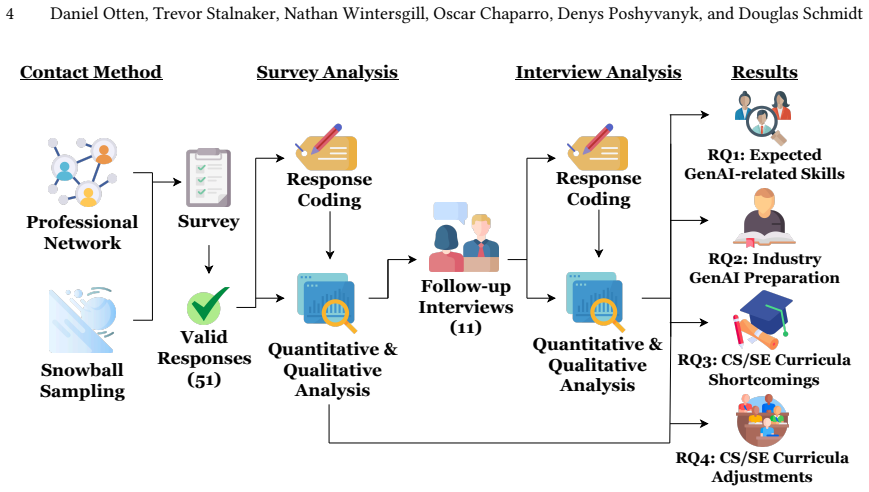
Although tension between university curricula and industry expectations has existed in some form for decades, the rapid integration of generative AI (GenAI) tools into software development has recently widened the gap between the two domains. To better understand this disconnect, we surveyed 51 industry practitioners (software developers, technical leads, upper management, \etc) and conducted 11 follow-up interviews focused on hiring practices, required job skills, perceived shortcomings in university curricula, and views on how university learning outcomes can be improved. Our results suggest that GenAI creates demand for new skills (\eg prompting and output evaluation), while strengthening the importance of soft-skills (\eg problem solving and critical thinking) and traditional competencies (\eg architecture design and debugging). We synthesize these findings into actionable recommendations for academia (\eg how to incorporate GenAI into curricula and evaluation redesign). Our work offers empirical guidance to help educators prepare students for modern software engineering environments.
Editorial analysis
A structured set of objections, weighed in public.
Referee Report
Summary. The paper presents results from a survey of 51 industry practitioners (software developers, technical leads, and managers) and 11 follow-up interviews examining hiring practices, required skills, perceived gaps in university curricula, and recommendations for preparing software engineers in the presence of generative AI tools. The central claim is that GenAI creates demand for new competencies such as prompting and output evaluation while elevating the importance of soft skills (problem solving, critical thinking) and traditional technical skills (architecture design, debugging); the authors synthesize these observations into actionable advice for curriculum redesign.
Significance. If the sample proves representative, the work supplies timely empirical grounding for software engineering education research by documenting how GenAI shifts skill priorities. The translation of practitioner views into concrete curricular recommendations is a practical contribution that could help close the long-standing academia-industry gap.
major comments (2)
- [Survey and Interview Methodology] The description of the survey and interview methodology (abstract and §3) provides no information on sampling frame, recruitment channels, response rate, or respondent demographics (years of experience, company size, geographic distribution). Without these details the claim that the 51+11 responses reflect typical industry expectations cannot be evaluated and selection bias remains a plausible alternative explanation for the reported emphasis on GenAI-related skills.
- [Results and Analysis] The results section presents synthesized themes but does not report quantitative breakdowns (e.g., percentage of respondents mentioning each skill category) or inter-rater reliability for the thematic analysis of interviews. This makes it difficult to assess the strength or consistency of the evidence supporting the central claim that GenAI “strengthens” traditional competencies.
minor comments (2)
- [Abstract] The abstract uses “etc.” in the participant description; replace with an explicit list or “and similar roles” for precision.
- [Figures and Tables] Figure captions and table headings should explicitly state the number of respondents or interviewees contributing to each data point.
Simulated Author's Rebuttal
We thank the referee for the constructive feedback, which helps strengthen the clarity and rigor of our work. We address each major comment below and will revise the manuscript accordingly to improve transparency around methodology and results presentation.
read point-by-point responses
-
Referee: [Survey and Interview Methodology] The description of the survey and interview methodology (abstract and §3) provides no information on sampling frame, recruitment channels, response rate, or respondent demographics (years of experience, company size, geographic distribution). Without these details the claim that the 51+11 responses reflect typical industry expectations cannot be evaluated and selection bias remains a plausible alternative explanation for the reported emphasis on GenAI-related skills.
Authors: We agree that the current methodology description is insufficient for evaluating potential biases. In the revised manuscript we will expand §3 with: (1) sampling frame as a convenience sample drawn from industry practitioners; (2) recruitment via LinkedIn posts in software engineering groups, personal professional contacts, and targeted emails; (3) a demographics table summarizing years of experience (mean and range), roles (developers, leads, managers), company sizes, and geographic distribution where available; and (4) explicit statement that response rate could not be calculated because the survey was distributed openly without a defined population frame. We will also add a dedicated limitations subsection clarifying that the study is exploratory and does not claim statistical representativeness, while still arguing that the practitioner perspectives provide timely, actionable insights. revision: yes
-
Referee: [Results and Analysis] The results section presents synthesized themes but does not report quantitative breakdowns (e.g., percentage of respondents mentioning each skill category) or inter-rater reliability for the thematic analysis of interviews. This makes it difficult to assess the strength or consistency of the evidence supporting the central claim that GenAI “strengthens” traditional competencies.
Authors: We accept that adding quantitative support and analysis transparency will improve the paper. For the survey data we will report the percentage of the 51 respondents who mentioned each skill category (e.g., prompting, output evaluation, problem-solving) in both text and a new summary table. For the 11 interviews, we will expand the description of the thematic analysis process (inductive coding by the lead author followed by team review and consensus), note that formal inter-rater reliability statistics were not computed, and provide illustrative coded excerpts. These additions will allow readers to better gauge the prevalence and consistency of the reported themes without altering the qualitative nature of the study. revision: yes
Circularity Check
No significant circularity in empirical survey and interview study
full rationale
The paper reports direct empirical observations from a survey of 51 industry practitioners and 11 follow-up interviews focused on hiring practices, skills, and curricula views. There are no mathematical derivations, equations, fitted parameters, predictions, or models that could reduce to inputs by construction. The central claims synthesize findings from the collected data into recommendations, with no self-citation load-bearing steps, uniqueness theorems, or ansatz smuggling. The work is self-contained as a qualitative/quantitative empirical study without any reduction to prior fitted values or self-referential definitions.
Axiom & Free-Parameter Ledger
axioms (1)
- domain assumption Responses from 51 practitioners and 11 interviewees are representative of industry expectations for software engineering skills and curricula.
Reference graph
Works this paper leans on
-
[1]
NORTH AMERICAN INDUSTRY CLASSIFICATION SYSTEM
2022. NORTH AMERICAN INDUSTRY CLASSIFICATION SYSTEM. https://www .census.gov/naics/reference_files_tools/2022_NAICS_Manual.pdf
work page 2022
-
[2]
openai/whisper-base·Hugging Face 2023
2023. openai/whisper-base·Hugging Face 2023. https://huggingface.co/openai/whisper-base
work page 2023
-
[3]
[n.d.]. Claude Code. https://code.claude.com/docs/en/overview. Accessed: 2025-12-31
work page 2025
-
[4]
[n.d.]. GitHub Copilot. https://github.com/features/copilot. Accessed: 2025-12-31
work page 2025
- [5]
- [6]
- [7]
-
[8]
[n.d.]. Zoom. https://www.zoom.com/. Accessed: 2025-12-31
work page 2025
- [9]
-
[10]
Daniel Ajiga, Patrick Azuka Okeleke, Samuel Olaoluwa Folorunsho, and Chinedu Ezeigweneme. 2024. Enhancing software development practices with AI insights in high-tech companies.Computer Science & IT Research Journal(2024). https://api.semanticscholar.org/CorpusID:272094485
work page 2024
-
[11]
Deniz Akdur. 2021. Skills Gaps in the Industry: Opinions of Embedded Software Practitioners.ACM Trans. Embed. Comput. Syst.20, 5, Article 43 (July 2021), 39 pages. doi:10.1145/3463340
-
[12]
Deniz Akdur. 2022. Analysis of Software Engineering Skills Gap in the Industry.ACM Trans. Comput. Educ.23, 1, Article 16 (Dec. 2022), 28 pages. doi:10.1145/3567837
-
[13]
Sohaib Alam, Ansa Hameed, Martyna Madej, and Aleksander Kobylarek. 2024. Perception and practice of using Artificial Intelligence in education: An opinion based study.XLinguae17 (01 2024), 216–233. doi:10.18355/XL.2024.17.01.15
-
[14]
Mamdouh Alenezi and Mohammed Akour. 2025. AI-Driven Innovations in Software Engineering: A Review of Current Practices and Future Directions.Applied Sciences15, 3 (2025). doi:10.3390/app15031344
-
[15]
Anonymous Authors. 2026. Online replication package. https://anonymous.4open.science/r/dont-be-afraid-just-learn-replication-DFCC/
work page 2026
-
[16]
Leili Babashahi, Carlos Eduardo Barbosa, Yuri Lima, Alan Lyra, Herbert Salazar, Matheus Argôlo, Marcos Antonio de Almeida, and Jano Moreira de Souza. 2024. AI in the Workplace: A Systematic Review of Skill Transformation in the Industry.Administrative Sciences14, 6 (2024). doi:10 .3390/ Manuscript submitted to ACM “Don’t Be Afraid, Just Learn”: Insights f...
work page 2024
-
[17]
Matthew Barr and Jack Parkinson. 2019. Developing a Work-based Software Engineering Degree in Collaboration with Industry(UKICER ’19). Association for Computing Machinery, New York, NY, USA, Article 9, 7 pages. doi:10.1145/3351287.3351292
-
[18]
Anastasia Berg. 2025. Why Even Basic A.I. Use Is So Bad for Students. https://www .nytimes.com/2025/10/29/opinion/ai-students-thinking-school- reading.html
work page 2025
-
[19]
Alyssia Chen, Timothy Huo, Yunhee Nam, Anthony Peruma, and Daniel Port. 2025. The Impact of Generative AI-Powered Code Generation Tools on Software Engineer Hiring: Recruiters’ Experiences, Perceptions, and Strategies.Proceedings of the ... Annual Hawaii International Conference on System Sciences/Proceedings of the Annual Hawaii International Conference ...
-
[20]
Todsanai Chumwatana and A.K.K. Hpone. 2025. Bridging the IT skill gap with industry demands: An AI-driven text mining approach to job market trends using large language model.Journal of Theoretical and Applied Information Technology103, 6 (2025), 2270–2282
work page 2025
-
[21]
Orges Cico, Letizia Jaccheri, Anh Nguyen-Duc, and He Zhang. 2021. Exploring the intersection between software industry and Software Engineering education - A systematic mapping of Software Engineering Trends.Journal of Systems and Software172 (2021), 110736. doi:10 .1016/j.jss.2020.110736
-
[22]
Celeste Combrinck and Nelé Loubser. 2025. Student self-reflection as a tool for managing GenAI use in large class assessment.Discover Education4, 1 (2025), 72
work page 2025
-
[23]
Hannah Estes, Katie Hollowell, John Cheek, Shiv Patel, Hanna Reese, and Kathryn T. Stolee. 2025. Advancing Software Product Management Education: Insights from an Industry Survey. InProceedings of the 33rd ACM International Conference on the Foundations of Software Engineering (Clarion Hotel Trondheim, Trondheim, Norway)(FSE Companion ’25). Association fo...
-
[24]
Robert M. Groves, Floyd J. Jr. Fowler, Mick P. Couyper, James M. Lepkowski, Eleanor Singer, and Roger Tourangeau. 2009.Survey Methodology, 2nd edition. Wiley
work page 2009
-
[25]
Robin Gröpler, Steffen Klepke, Jack Johns, Andreas Dreschinski, Klaus Schmid, Benedikt Dornauer, Eray Tüzün, Joost Noppen, Mohammad Reza Mousavi, Yongjian Tang, Johannes Viehmann, Selin Şirin Aslangül, Beum Seuk Lee, Adam Ziolkowski, and Eric Zie. 2025. The Future of Generative AI in Software Engineering: A Vision from Industry and Academia in the Europea...
- [26]
-
[27]
Orit Hazzan and Yael Erez. 2025. Rethinking Computer Science Education in the Age of GenAI.ACM Transactions on Computing Education25, 3 (2025), 1–9
work page 2025
-
[28]
James Hutson and Jason Ceballos. 2023. Rethinking education in the age of AI: The importance of developing durable skills in the industry 4.0. Journal of Information Economics1, 2 (2023), 26–35. doi:10.58567/jie01020002
-
[29]
Khushi Jaiswal, Ievgeniia Kuzminykh, and Sanjay Modgil. 2025. Understanding the skills gap between higher education and industry in the UK in artificial intelligence sector.Industry and Higher Education39, 2 (2025), 234–246. arXiv:https://doi.org/10.1177/09504222241280441 doi:10 .1177/ 09504222241280441
-
[30]
Gül Kadan, Hamit Emeç, and I Yilmaz. 2024. Investigation of teachers’ opinions on the inclusion of artificial intelligence in educational activities. Isarpublisher. com2, 5 (2024), 37–45
work page 2024
-
[31]
Karen Kaiser. 2009. Protecting respondent confidentiality in qualitative research.Qualitative health research19, 11 (2009), 1632–1641
work page 2009
-
[32]
Valerie Kasper. 2025. From Policing to Partnering: Rethinking Assignments for the Age of GenAI. https://blog .cengage.com/from-policing-to- partnering-rethinking-assignments-for-the-age-of-genai/
work page 2025
-
[33]
Kitchenham and Shari Lawrence Pfleeger
Barbara A. Kitchenham and Shari Lawrence Pfleeger. 2002. Principles of Survey Research Part 2: Designing a Survey.ACM SIGSOFT Software Engineering Notes27, 1 (2002), 18–20. https://doi.org/10.1145/566493.566495
-
[34]
Kitchenham and Shari Lawrence Pfleeger
Barbara A. Kitchenham and Shari Lawrence Pfleeger. 2002. Principles of Survey Research: Part 3: Constructing a Survey Instrument.ACM SIGSOFT Software Engineering Notes27, 2 (2002), 20–24. https://doi.org/10.1145/511152.511155
-
[35]
Kitchenham and Shari Lawrence Pfleeger
Barbara A. Kitchenham and Shari Lawrence Pfleeger. 2002. Principles of Survey Research Part 4: Questionnaire Evaluation.ACM SIGSOFT Software Engineering Notes27, 3 (2002), 20–23. https://doi.org/10.1145/638574.638580
-
[36]
Kitchenham and Shari Lawrence Pfleeger
Barbara A. Kitchenham and Shari Lawrence Pfleeger. 2002. Principles of Survey Research: Part 5: Populations and Samples.ACM SIGSOFT Software Engineering Notes27, 5 (2002), 17–20. https://doi.org/10.1145/571681.571686
-
[37]
Kitchenham and Shari Lawrence Pfleeger
Barbara A. Kitchenham and Shari Lawrence Pfleeger. 2003. Principles of Survey Research Part 6: Data Analysis.ACM SIGSOFT Software Engineering Notes28, 2 (2003), 24–27. https://doi.org/10.1145/638750.638758
-
[38]
Jeonghyun Lee, Jui-Tse Hung, Meryem Yilmaz Soylu, Diana Popescu, Christopher Zhang Cui, Gayane Grigoryan, David A Joyner, and Stephen W Harmon. 2025. Socratic Mind: Impact of a Novel GenAI-Powered Assessment Tool on Student Learning and Higher-Order Thinking.arXiv preprint arXiv:2509.16262(2025)
-
[39]
Yishu Li, Jacky Keung, and Xiaoxue Ma. 2024. Integrating Generative AI in Software Engineering Education: Practical Strategies. In2024 International Symposium on Educational Technology (ISET). 49–53. doi:10.1109/ISET61814.2024.00019
-
[40]
Johan Linåker, Sardar Muhammad Sulaman, Rafael Maiani de Mello, and Martin Höst. 2015. Guidelines for conducting surveys in software engineering. (2015). Manuscript submitted to ACM 22 Daniel Otten, Trevor Stalnaker, Nathan Wintersgill, Oscar Chaparro, Denys Poshyvanyk, and Douglas Schmidt
work page 2015
-
[41]
McKinsey & Company. 2024. The state of AI in early 2024: Gen AI adoption spikes and starts to generate value. https://www .mckinsey.com/ capabilities/quantumblack/our-insights/the-state-of-ai-2024
work page 2024
-
[42]
McKinsey & Company. 2025. The state of AI: How organizations are rewiring to capture value. https://www .mckinsey.com/capabilities/ quantumblack/our-insights/the-state-of-ai
work page 2025
-
[43]
Jefferson Seide Molléri, Kai Petersen, and Emilia Mendes. 2020. An empirically evaluated checklist for surveys in software engineering.Information and Software Technology119 (2020), 106240
work page 2020
- [44]
-
[45]
Quynh Hoa Nguyen. 2023. AI and plagiarism: Opinion from teachers, administrators and policymakers. InProceedings of the AsiaCALL International Conference, Vol. 4. 75–85
work page 2023
- [46]
-
[48]
Wei Hung Pan, Ming Jie Chok, Jonathan Leong Shan Wong, Yung Xin Shin, Yeong Shian Poon, Zhou Yang, Chun Yong Chong, David Lo, and Mei Kuan Lim. 2024. Assessing AI Detectors in Identifying AI-Generated Code: Implications for Education(ICSE-SEET ’24). Association for Computing Machinery, New York, NY, USA, 1–11. doi:10.1145/3639474.3640068
-
[49]
Shari Lawrence Pfleeger and Barbara A. Kitchenham. 2001. Principles of Survey Research: Part 1: Turning Lemons into Lemonade.ACM SIGSOFT Software Engineering Notes26, 6 (2001), 16–18. https://doi.org/10.1145/505532.505535
-
[50]
D Ramezani and M Wagner. 2025. REDEFINING STUDENT AGENCY IN THE AGE OF GENAI. InEDULEARN25 Proceedings. IATED, 7102–7107
work page 2025
-
[51]
Carlo Rotella. 2025. I’m a Professor. A.I. Has Changed My Classroom, but Not for the Worse. https://www .nytimes.com/2025/11/25/magazine/ai- higher-education-students-teachers.html
work page 2025
-
[52]
Vinu Sankar Sadasivan, Aounon Kumar, Sriram Balasubramanian, Wenxiao Wang, and Soheil Feizi. 2025. Can AI-Generated Text be Reliably Detected? arXiv:2303.11156 [cs.CL] https://arxiv.org/abs/2303.11156
work page Pith review arXiv 2025
-
[53]
Chandan Kumar Sah, Lian Xiaoli, Muhammad Mirajul Islam, and Md Kamrul Islam. 2024. Navigating the AI Frontier: A Critical Literature Review on Integrating Artificial Intelligence into Software Engineering Education. In2024 36th International Conference on Software Engineering Education and Training (CSEE&T). 1–5. doi:10.1109/CSEET62301.2024.10663054
-
[54]
Douglas C. Schmidt and Dan Runfola. 2025. Liberating Logic in the Age of AI: Going Beyond Programming with Computational Thinking. arXiv:2511.17696 [cs.CY] https://arxiv.org/abs/2511.17696
-
[55]
Elsje Scott, Zadirov Alexander, Feinberg Sean, and Jayakody Ruwanga. 2004. The Alignment of Software Testing Skills of IS Students with Industry Practices - A South African Perspective.Journal of Information Technology Education3 (01 2004). doi:10.28945/295
-
[56]
Elsje Scott, Robert Alger, Simon Pequeno, and Nicky Sessions. 2002. The skills gap as observed between IS graduates and the systems development industry–a South African Experience. (07 2002)
work page 2002
-
[57]
Griswold, and Adalbert Gerald Soosai Raj
Anshul Shah, Thomas Rexin, Elena Tomson, Leo Porter, William G. Griswold, and Adalbert Gerald Soosai Raj. 2025. Evolution of Programmers’ Trust in Generative AI Programming Assistants. arXiv:2509.13253 [cs.HC] https://arxiv.org/abs/2509.13253
-
[58]
Hanlie Smuts and Stefan Smuts. 2022. Society 5.0 and the future of work skills for software engineers and developers. doi:10.29007/9kzd
-
[59]
2009.Card sorting: Designing usable categories
Donna Spencer. 2009.Card sorting: Designing usable categories. Rosenfeld Media
work page 2009
-
[60]
William H. Walters. 2023. The Effectiveness of Software Designed to Detect AI-Generated Writing: A Comparison of 16 AI Text Detectors.Open Information Science7, 1 (2023), 20220158. doi:doi:10.1515/opis-2022-0158
-
[61]
Demétrio Weber. 2024. AI in the Classroom: Teachers’ Views on Artificial Intelligence
work page 2024
-
[62]
Debora Weber-Wulff, Alla Anohina-Naumeca, Sonja Bjelobaba, Tomáš Folt `ynek, Jean Guerrero-Dib, Olumide Popoola, Petr Šigut, and Lorna Waddington. 2023. Testing of detection tools for AI-generated text.International Journal for Educational Integrity19, 1 (2023), 1–39
work page 2023
-
[63]
Ramazan Yurtseven, Emine Akkaş Baysal, and Gurbuz Ocak. 2025. Education and Artificial Intelligence: An Analysis Based on Teachers’ Opinions. Pertanika Journal of Social Sciences and Humanities33 (10 2025). doi:10.47836/pjssh.33.5.11
-
[64]
Jonathan Álvarez Ariza, Milena Restrepo, and Carola Hernández. 2025. Generative AI in Engineering and Computing Education: A Scoping Review of Empirical Studies and Educational Practices.IEEE AccessPP (01 2025), 1–22. doi:10.1109/ACCESS.2025.3541424 Manuscript submitted to ACM
discussion (0)
Sign in with ORCID, Apple, or X to comment. Anyone can read and Pith papers without signing in.