Recognition: no theorem link
Navigating Marginalization: Toward Justice-Oriented Socio-Technical Design for Parent-Child Learning among Southeast Asian Immigrant Mothers in Taiwan
Pith reviewed 2026-05-10 19:25 UTC · model grok-4.3
The pith
Southeast Asian immigrant mothers in Taiwan creatively engage in children's home learning despite structural marginalization, and justice-oriented socio-technical designs can address resulting harms by centering recognition, reciprocity, at
A machine-rendered reading of the paper's core claim, the machinery that carries it, and where it could break.
Core claim
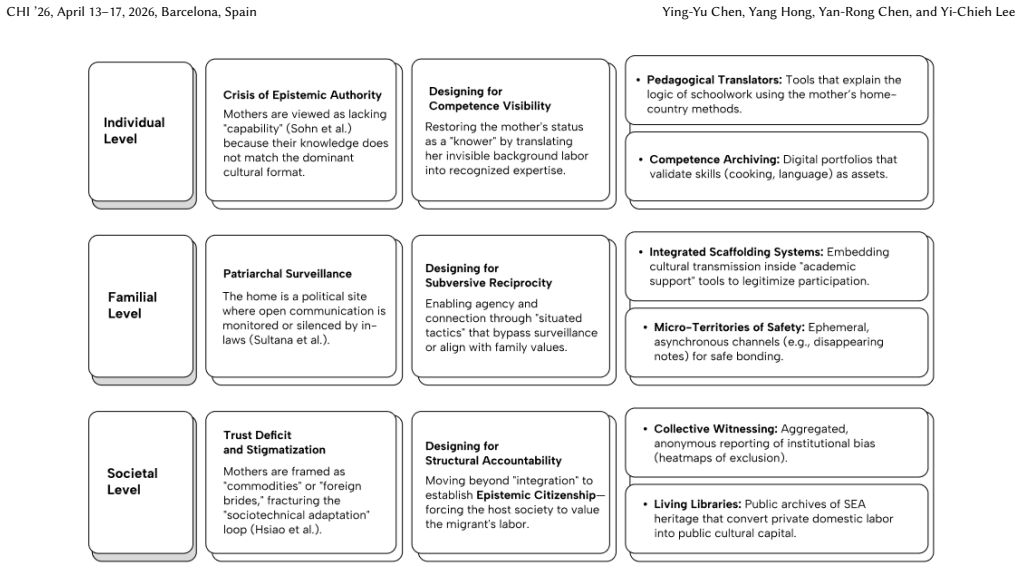
Despite facing diminished agency and structural marginalization, Southeast Asian immigrant mothers in Taiwan engage creatively in their children's everyday learning interactions. Guided by a justice-oriented lens, the study identifies various harms and proposes design implications for socio-technical systems that center recognition, reciprocity, and accountability in parent-child learning at the individual, familial, and societal levels.
What carries the argument
The justice-oriented lens for analyzing parent-child learning, which reveals harms from marginalization and guides socio-technical design toward recognition, reciprocity, and accountability.
If this is right
- Socio-technical systems should recognize mothers' creative daily practices at the individual level.
- Designs must promote reciprocity in mother-child interactions within families.
- Systems need to build accountability mechanisms for societal structures impacting immigrant families.
- Foregrounding intersectional identities leads to more inclusive approaches in educational technologies.
Where Pith is reading between the lines
- Similar justice-oriented designs could be tested with other groups of marginalized caregivers using technology for education.
- These principles might inform how digital tools address language or cultural barriers in family learning across borders.
- Applying the lens to existing educational apps could reveal overlooked harms in how they handle diverse family roles.
Load-bearing premise
The semi-structured interviews and diary studies with Southeast Asian immigrant mothers in Taiwan give a representative picture of their experiences, and the justice-oriented lens correctly identifies harms without bias.
What would settle it
A larger empirical study of Southeast Asian immigrant mothers in Taiwan that finds no evidence of creative engagement in children's learning or shows that designs emphasizing recognition, reciprocity, and accountability fail to increase agency.
Figures
read the original abstract
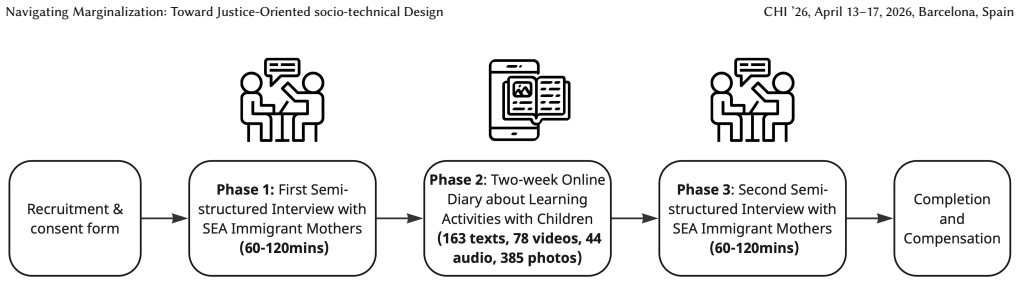
This study investigates how Southeast Asian (SEA) immigrant mothers in Taiwan participate in their children's home-based learning. Drawing on semi-structured interviews and diary studies, we explore how these mothers navigate sociocultural constraints while fostering engagement and transmitting cultural values. Despite facing diminished agency and structural marginalization, mothers engage creatively in their children's everyday learning interactions. Guided by a justice-oriented lens, we identify various harms and propose design implications for socio-technical systems that center recognition, reciprocity, and accountability in parent-child learning at the individual, familial, and societal levels. Our contribution lies in foregrounding the role of intersectional identity in parent-child learning and proposing justice-oriented design directions that support the flourishing of immigrant mothers within socio-technical systems.
Editorial analysis
A structured set of objections, weighed in public.
Referee Report
Summary. This paper investigates how Southeast Asian immigrant mothers in Taiwan participate in their children's home-based learning through semi-structured interviews and diary studies. It claims that despite diminished agency and structural marginalization, these mothers engage creatively in everyday learning interactions while navigating sociocultural constraints and transmitting cultural values. Guided by a justice-oriented lens, the study identifies various harms and proposes design implications for socio-technical systems that emphasize recognition, reciprocity, and accountability at the individual, familial, and societal levels. The contribution centers on foregrounding intersectional identity in parent-child learning and advancing justice-oriented design directions.
Significance. If the empirical claims are robustly supported, this work could advance HCI scholarship by extending justice-oriented and socio-technical design approaches to immigrant family contexts in East Asia, an area that remains underexplored. It offers a nuanced account of creative agency amid marginalization that could inform more equitable technologies for parent-child learning. The multi-level design implications (individual/familial/societal) provide a structured framework that, if grounded in data, may influence future research on recognition and accountability in socio-technical systems.
major comments (2)
- [Abstract and Methods] Abstract and Methods section: No details are provided on sample size, participant demographics (e.g., countries of origin, duration of residence in Taiwan), recruitment process, interview protocols, diary study duration or prompts, or the analytical procedures (including how the justice-oriented lens was operationalized in data coding or theme derivation). This is load-bearing because the claims of creative engagement, identified harms, and the resulting design implications at multiple levels rest directly on the interpretation of this unshown data.
- [Findings and Discussion] Findings/Discussion sections: The application of the justice-oriented lens to identify 'various harms' lacks any description of reflexivity, researcher positionality, member checking, negative case analysis, or alternative interpretations. This is load-bearing for the central contribution, as the design recommendations for recognition, reciprocity, and accountability derive directly from these harm identifications; without such documentation, it is unclear whether patterns are data-driven or imposed by the framework.
minor comments (2)
- [Abstract] The abstract refers to 'various harms' without providing even one concrete example or high-level category, which would aid reader comprehension of the scope before the design implications are introduced.
- [Title] The title is lengthy; a more concise phrasing could better highlight the core focus on justice-oriented design for parent-child learning.
Simulated Author's Rebuttal
We thank the referee for their careful reading and constructive feedback. We appreciate the recognition of the work's potential to extend justice-oriented socio-technical design to underexplored immigrant family contexts in East Asia. We address the two major comments below by committing to specific revisions that enhance methodological transparency and analytical rigor without altering the core claims or contribution.
read point-by-point responses
-
Referee: [Abstract and Methods] Abstract and Methods section: No details are provided on sample size, participant demographics (e.g., countries of origin, duration of residence in Taiwan), recruitment process, interview protocols, diary study duration or prompts, or the analytical procedures (including how the justice-oriented lens was operationalized in data coding or theme derivation). This is load-bearing because the claims of creative engagement, identified harms, and the resulting design implications at multiple levels rest directly on the interpretation of this unshown data.
Authors: We agree that the Methods section requires substantially more detail to allow readers to evaluate the robustness of the empirical claims. In the revised manuscript, we will expand the Methods section to report the exact sample size, full participant demographics (including countries of origin, years of residence in Taiwan, and other relevant characteristics), recruitment procedures, semi-structured interview protocols, diary study duration and prompts, and the full analytical procedures. We will also add an explicit description of how the justice-oriented lens was operationalized during coding and theme derivation, including the specific sensitizing concepts drawn from the framework and the iterative process used to derive themes. These additions will directly ground the reported creative engagements, harms, and multi-level design implications in the data. revision: yes
-
Referee: [Findings and Discussion] Findings/Discussion sections: The application of the justice-oriented lens to identify 'various harms' lacks any description of reflexivity, researcher positionality, member checking, negative case analysis, or alternative interpretations. This is load-bearing for the central contribution, as the design recommendations for recognition, reciprocity, and accountability derive directly from these harm identifications; without such documentation, it is unclear whether patterns are data-driven or imposed by the framework.
Authors: We concur that qualitative research employing a justice-oriented lens must document reflexivity and positionality to demonstrate that identified harms and subsequent design implications are data-driven. In the revision, we will add a new subsection (likely in Methods or as a dedicated 'Reflexivity and Positionality' section) that describes the research team's positionality, the reflexive practices employed throughout data collection and analysis, any member checking conducted with participants, consideration of negative cases, and how alternative interpretations were evaluated. This will clarify the process by which harms were identified from the data and how the justice-oriented lens was applied without imposing external categories, thereby strengthening the link between findings and the proposed design directions at individual, familial, and societal levels. revision: yes
Circularity Check
No circularity: qualitative empirical study with independent data grounding
full rationale
The paper presents a qualitative HCI study drawing on semi-structured interviews and diary studies with SEA immigrant mothers. The justice-oriented lens functions as an interpretive framework applied to primary data rather than a self-referential derivation or fitted parameter. No equations, predictions, self-citations, or reductions of claims to prior inputs appear in the provided text or abstract. The identification of harms and design implications rests on collected participant accounts, making the analysis self-contained against external benchmarks with no load-bearing circular steps.
Axiom & Free-Parameter Ledger
axioms (1)
- domain assumption A justice-oriented lens is an appropriate and unbiased framework for identifying harms and guiding design in studies of marginalized parent-child learning
Reference graph
Works this paper leans on
-
[1]
Leah Hope Ajmani, Talia Bhatt, and Michael Ann DeVito. 2025. Moving Towards Epistemic Autonomy: A Paradigm Shift for Centering Participant Knowledge. In Proceedings of the 2025 CHI Conference on Human Factors in Computing Systems (CHI ’25). Association for Computing Machinery, New York, NY, USA, Article 474, 17 pages. https://doi.org/10.1145/3706598.3714252
-
[2]
Asam Almohamed and Dhaval Vyas. 2016. Designing for the marginalized: A step towards understanding the lives of refugees and asylum seekers. InDIS 2016 Companion - Proceedings of the 2016 ACM Conference on Designing Interactive Systems: Fuse. https://doi.org/10.1145/2908805.2909415
-
[3]
Aloha Hufana Ambe, Margot Brereton, Alessandro Soro, Laurie Buys, and Paul Roe. 2019. The Adventures of Older Authors: Exploring Futures through Co- Design Fictions. InProceedings of the 2019 CHI Conference on Human Factors in Computing Systems (CHI ’19). Association for Computing Machinery, Glasgow, Scotland, UK, 1–16. https://doi.org/10.1145/3290605.3300588
-
[4]
Rahul Banerjee, Leanne Liu, Kiley Sobel, Caroline Pitt, Kung Jin Lee, Meng Wang, Sijin Chen, Lydia Davison, Jason C. Yip, Amy J. Ko, and Zoran Popovic. 2018. Empowering Families Facing English Literacy Challenges to Jointly Engage in Computer Programming. InProceedings of the 2018 CHI Conference on Human Factors in Computing Systems(Montreal QC, Canada)(C...
-
[5]
2020.Beyond Work: Reducing Social Isolation for Refugee Women and Other Marginalized Newcomers
Natalia Banulescu-Bogdan. 2020.Beyond Work: Reducing Social Isolation for Refugee Women and Other Marginalized Newcomers. Technical Report. Migration Policy Institute, Washington, DC. https://www.migrationpolicy.org/research/ reducing-social-isolation-refugee-women-newcomers
2020
-
[6]
Shaowen Bardzell. 2010. Feminist HCI: taking stock and outlining an agenda for design. InProceedings of the SIGCHI Conference on Human Factors in Computing Systems (CHI ’10). Association for Computing Machinery, New York, NY, USA, 1301–1310. https://doi.org/10.1145/1753326.1753521
-
[7]
Brigid Barron, Caitlin Kennedy Martin, Lori Takeuchi, and Rachel Fithian. 2009. Parents as Learning Partners in the Development of Technological Fluency. International Journal of Learning and Media1, 2 (2009), 55–77. https://doi.org/ 10.1162/ijlm.2009.0021
- [8]
-
[9]
Eric P. S. Baumer, Morgan G. Ames, Jenna Burrell, Jed R. Brubaker, and Paul Dourish. 2015. Why study technology non-use?First Monday(Nov. 2015). https://doi.org/10.5210/fm.v20i11.6310
-
[10]
I Hardly Understand English, But
Andrew O. Behnke, Brent A. Taylor, and Jose Ruben Parra-Cardona. 2008. “I Hardly Understand English, But. . . ”: Mexican Origin Fathers Describe Their Commitment as Fathers Despite the Challenges of Immigration.Journal of Comparative Family Studies39, 2 (2008), 187–205. https://doi.org/10.3138/jcfs. 39.2.187 arXiv:https://doi.org/10.3138/jcfs.39.2.187
-
[11]
Rosanna Bellini, Debora de Castro Leal, Hazel Anneke Dixon, Sarah E Fox, and Angelika Strohmayer. 2022. “There is no justice, just us”: Making mosaics of justice in social justice Human-Computer Interaction. InExtended Abstracts of the 2022 CHI Conference on Human Factors in Computing Systems (CHI EA ’22). Association for Computing Machinery, New York, NY...
-
[12]
Ann Peterson Bishop and Karen E. Fisher. 2015. Using ICT Design to Learn about Immigrant Teens from Myanmar. InACM International Conference Proceeding Series, Vol. 15. https://doi.org/10.1145/2737856.2737903
-
[13]
C. G. Bletscher. 2020. Communication Technology and Social Integration: Access and Use of Communication Technologies among Floridian Resettled Refugees.Journal of International Migration and Integration21, 2 (2020), 431–451. https://doi.org/10.1007/s12134-019-00661-4
-
[14]
Who is sitting across from me?
Marc H Bornstein and Linda R Cote. 2004. “Who is sitting across from me?” Immigrant mothers’ knowledge of parenting and children’s development.Pedi- atrics114, 5 (2004), e557–e564
2004
-
[15]
Brooke Bosley, Christina N. Harrington, Susana M. Morris, and Christopher A. Le Dantec. 2022. Healing Justice: A Framework for Collective Healing and Well-Being from Systemic Traumas. InProceedings of the 2022 ACM Designing Interactive Systems Conference(Virtual Event, Australia)(DIS ’22). Association for Computing Machinery, New York, NY, USA, 471–484. h...
-
[16]
Virginia Braun and Victoria Clarke. 2006. Using thematic analysis in psychology. Qualitative Research in Psychology3 (2006). Issue 2. https://doi.org/10.1191/ 1478088706qp063oa
2006
-
[17]
Virginia Braun and Victoria Clarke. 2019. Reflecting on reflexive thematic analysis.Qualitative Research in Sport, Exercise and Health11, 4 (Aug. 2019), 589–597. https://doi.org/10.1080/2159676X.2019.1628806 Publisher: Routledge _eprint: https://doi.org/10.1080/2159676X.2019.1628806
-
[18]
Deana Brown, Victoria Ayo, and Rebecca E. Grinter. 2014. Reflection through design: Immigrant women’s self-reflection on managing health and wellness. InConference on Human Factors in Computing Systems - Proceedings. https: //doi.org/10.1145/2556288.2557119
-
[19]
Cliff Yung-Chi Chen. 2019. Understanding School–Family Contact and Aca- demic and Behavioral Performance among Adolescent Students in Taiwan. International Journal of School & Educational Psychology7, 1 (2019), 42–55. https://doi.org/10.1080/21683603.2017.1385551
-
[20]
Huey-Jiuan Chen, Hsin-I Lin, and Po-Yi Chen. 2025. The Relationship of Parent Involvement, Motivational Resilience, Flourishing, and Academic Performance: A Comparison of New Immigrant and Non-Immigrant Adolescents in Taiwan. Bulletin of Educational Psychology56, 3 (2025), 651–682. https://doi.org/10.6251/ BEP.202503_56(3).0007
2025
-
[21]
Ishita Chordia, Leya Breanna Baltaxe-Admony, Ashley Boone, Alyssa Sheehan, Lynn Dombrowski, Christopher A Le Dantec, Kathryn E. Ringland, and Angela D. R. Smith. 2024. Social Justice in HCI: A Systematic Literature Review. In Proceedings of the 2024 CHI Conference on Human Factors in Computing Systems (CHI ’24). Association for Computing Machinery, New Yo...
-
[22]
Wen-Jiun Chou. 2010. Maternal Mental Health and Child Development in Asian Immigrant Mothers in Taiwan.Journal of the Formosan Medical Association109 (2010). Issue 4. https://doi.org/10.1016/S0929-6646(10)60055-1
-
[23]
Eric Corbett and Yanni Loukissas. 2019. Engaging Gentrification as a Social Justice Issue in HCI. InProceedings of the 2019 CHI Conference on Human Factors in Computing Systems (CHI ’19). Association for Computing Machinery, New York, NY, USA, 1–16. https://doi.org/10.1145/3290605.3300510
-
[24]
I. Correa-Velez, A. Green, K. Murray, R. D. Schweitzer, L. Vromans, C. Lenette, and M. Brough. 2020. Social Context Matters: Predictors of Quality of Life among Recently Arrived Refugee Women-at-Risk Living in Australia.Journal of Immigrant & Refugee Studies18, 4 (2020), 498–514. https://doi.org/10.1080/ 15562948.2020.1734893
-
[25]
Andy Crabtree and Peter Tolmie. 2016. A Day in the Life of Things in the Home. InProceedings of the 19th ACM Conference on Computer-Supported Cooperative Work & Social Computing (CSCW ’16). Association for Computing Machinery, New York, NY, USA, 1736–1748. https://doi.org/10.1145/2818048.2819954
-
[26]
Crenshaw
Kimberlé W. Crenshaw. 2017.On Intersectionality: Essential Writings. The New Press, New York, NY. https://scholarship.law.columbia.edu/books/255 Collected key essays on intersectionality with a new introduction by the author
2017
-
[27]
Mary Daly. 2002. Care as a Good for Social Policy.Journal of Social Policy31, 2 (2002), 251–270. https://doi.org/10.1017/S0047279402006006
-
[28]
Kayla DesPortes, Shiri Mund, and Clarisa James. 2021. Examining the Design and Development of a Social Justice Makerspace.Proc. ACM Hum.-Comput. Interact.5, CSCW2 (Oct. 2021), 397:1–397:26. https://doi.org/10.1145/3479541 CHI ’26, April 13–17, 2026, Barcelona, Spain Ying-Yu Chen, Yang Hong, Yan-Rong Chen, and Yi-Chieh Lee
-
[29]
Lynn Dombrowski, Ellie Harmon, and Sarah Fox. 2016. Social Justice-Oriented Interaction Design: Outlining Key Design Strategies and Commitments. In Proceedings of the 2016 ACM Conference on Designing Interactive Systems (DIS ’16). Association for Computing Machinery, New York, NY, USA, 656–671. https: //doi.org/10.1145/2901790.2901861
-
[30]
Stefania Druga, Fee Lia Christoph, and Amy J Ko. 2022. Family as a Third Space for AI Literacies: How do children and parents learn about AI together?. In Proceedings of the 2022 CHI Conference on Human Factors in Computing Systems (New Orleans, LA, USA)(CHI ’22). Association for Computing Machinery, New York, NY, USA, Article 225, 17 pages. https://doi.o...
-
[31]
Sheena Erete, Yolanda A. Rankin, and Jakita O. Thomas. 2021. I Can’t Breathe: Reflections from Black Women in CSCW and HCI.Proc. ACM Hum.-Comput. Interact.4, CSCW3 (Jan. 2021), 234:1–234:23. https://doi.org/10.1145/3432933
-
[32]
Sarah Fox, Mariam Asad, Katherine Lo, Jill P. Dimond, Lynn S. Dombrowski, and Shaowen Bardzell. 2016. Exploring Social Justice, Design, and HCI. In Proceedings of the 2016 CHI Conference Extended Abstracts on Human Factors in Computing Systems (CHI EA ’16). Association for Computing Machinery, New York, NY, USA, 3293–3300. https://doi.org/10.1145/2851581.2856465
-
[33]
Sarah Fox, Jill Dimond, Lilly Irani, Tad Hirsch, Michael Muller, and Shaowen Bardzell. 2017. Social Justice and Design: Power and oppression in collaborative systems. InCompanion of the 2017 ACM Conference on Computer Supported Cooperative Work and Social Computing (CSCW ’17 Companion). Association for Computing Machinery, New York, NY, USA, 117–122. http...
-
[34]
Suzanne Fraser, David Moore, Andrea Waling, and Adrian Farrugia. 2021. Mak- ing epistemic citizens: Young people and the search for reliable and credi- ble sexual health information.Social Science & Medicine276 (2021), 113817. https://doi.org/10.1016/j.socscimed.2021.113817
-
[35]
Nora Fronemann, Kathrin Pollmann, Alicia Weisener, and Matthias Peissner
-
[36]
Happily Ever After: Positive Aging through Positive Design. InProceed- ings of the 9th Nordic Conference on Human-Computer Interaction(Gothenburg, Sweden)(NordiCHI ’16). Association for Computing Machinery, New York, NY, USA, Article 105, 6 pages. https://doi.org/10.1145/2971485.2996740
-
[37]
Jennifer E. Glick. 2010. Connecting Complex Processes: A Decade of Research on Immigrant Families.Journal of Marriage and Fam- ily72, 3 (2010), 498–515. https://doi.org/10.1111/j.1741-3737.2010. 00715.x arXiv:https://onlinelibrary.wiley.com/doi/pdf/10.1111/j.1741- 3737.2010.00715.x
-
[38]
Koeli Goel. 2021. Motherhood and Education. https://doi.org/10.1093/acrefore/ 9780190264093.013.1606
-
[39]
Roberta Michnick Golinkoff, Erika Hoff, Meredith L. Rowe, Catherine S. Tamis- LeMonda, and Kathy Hirsh-Pasek. 2019. Language Matters: Denying the Existence of the 30-Million-Word Gap Has Serious Consequences. Issue 3. https://doi.org/10.1111/cdev.13128
-
[40]
Andrea Grimes and Richard Harper. 2008. Celebratory technology: new di- rections for food research in HCI. InProceedings of the SIGCHI Conference on Human Factors in Computing Systems(Florence, Italy)(CHI ’08). Asso- ciation for Computing Machinery, New York, NY, USA, 467–476. https: //doi.org/10.1145/1357054.1357130
-
[41]
Christina Harrington, Sheena Erete, and Anne Marie Piper. 2019. Deconstructing Community-Based Collaborative Design: Towards More Equitable Participatory Design Engagements.Proc. ACM Hum.-Comput. Interact.3, CSCW (Nov. 2019), 216:1–216:25. https://doi.org/10.1145/3359318
-
[42]
Arlie Russell Hochschild. 2015. Global Care Chains and Emotional Surplus Value. InJustice, Politics, and the Family. Routledge, 130–146. https://doi.org/ 10.4324/9781315633794-21
-
[43]
Hsiao-chuan Hsia. 2000. Transnational marriage and internalization of capital the case of the foreign bride phenomenon in Taiwan.Taiwan: A Radical Quarterly in Social Studies Vol39 (2000), 45–92
2000
-
[44]
Joey Chiao-Yin Hsiao, Sylvia Darling, and Tawanna R. Dillahunt. 2023. How Re- cent Migrants Develop Trust Through Community Commerce: The Emergence of Sociotechnical Adaptation.Proceedings of the ACM on Human-Computer Inter- action7, CSCW1, Article 135 (2023), 24 pages. https://doi.org/10.1145/3579611
-
[45]
Joey Chiao Yin Hsiao and Tawanna R. Dillahunt. 2018. Technology to support immigrant access to social capital and adaptation to a new country.Proceedings of the ACM on Human-Computer Interaction2 (2018). Issue CSCW. https: //doi.org/10.1145/3274339
-
[46]
Chia-Lin Hung. 2007. Family, Schools and Taiwanese Children’s Out- comes.Educational Research49, 2 (2007), 115–125. https://doi.org/10.1080/ 00131880701369644
2007
-
[47]
Lilly Irani, Janet Vertesi, Paul Dourish, Kavita Philip, and Rebecca E. Grinter
-
[48]
InProceedings of the SIGCHI Conference on Human Factors in Computing Systems (CHI ’10)
Postcolonial computing: a lens on design and development. InProceedings of the SIGCHI Conference on Human Factors in Computing Systems (CHI ’10). Association for Computing Machinery, New York, NY, USA, 1311–1320. https: //doi.org/10.1145/1753326.1753522
-
[49]
William H. Jeynes. 2005. A Meta-Analysis of the Relation of Parental Involve- ment to Urban Elementary School Student Academic Achievement.Urban Education40, 3 (2005), 237–269. https://doi.org/10.1177/0042085905274540 arXiv:https://doi.org/10.1177/0042085905274540
-
[50]
John Jost and Aaron Kay. 2010. Social Justice: History, Theory, and Research. In Handbook of Social Psychology. Wiley. https://doi.org/10.1002/9780470561119. socpsy002030
-
[51]
2001.Children’s Stress and After-School Lives in Tai- wan
Chin-Cheng Kao. 2001.Children’s Stress and After-School Lives in Tai- wan. Ph. D. Dissertation. State University of New York at Albany. https: //www.proquest.com/openview/631f497bd5cddcfd39ff2ed2e3144123/1?pq- origsite=gscholar&cbl=18750&diss=y Unpublished doctoral dissertation
2001
-
[52]
Tzu-Yi Kao. 2021. Outsourcing mothering for schooling: Why Taiwanese middle- class mothers hire tutors.Women’s Studies International Forum89 (2021), 102535. https://doi.org/10.1016/j.wsif.2021.102535
-
[53]
Vikki S. Katz. 2015. Kids in the Middle. How Children of Immigrants Negotiate Community Interactions for Their Families.International Journal of Migration, Health and Social Care11, 4 (Jan. 2015), 299–300. https://doi.org/10.1108/ IJMHSC-11-2014-0045 Publisher: Emerald Group Publishing Limited
2015
-
[54]
Lynn Kirabo, Elizabeth Jeanne Carter, Devon Barry, and Aaron Steinfeld. 2021. Priorities, Technology, & Power: Co-Designing an Inclusive Transit Agenda in Kampala, Uganda. InProceedings of the 2021 CHI Conference on Human Factors in Computing Systems (CHI ’21)(Yokohama, Japan). Association for Computing Machinery, New York, NY, USA, Article 377, 11 pages....
-
[55]
Leda Kuneva and Karen Latricia Hough. 2023. Fostering Inclusion for Refugees and Migrants and Building Trust in the Digital Public Space.Transforming Government: People, Process and Policy17, 3 (2023), 412–423. https://doi.org/10. 1108/TG-10-2022-0137
2023
-
[56]
Kwon, M Jeong, E
T. Kwon, M Jeong, E. S. Ko, and Y. Lee. 2022. Captivate! Contextual Language Guidance for Parent–Child Interaction. InIn CHI Conference on Human Factors in Computing Systems. 1–17
2022
-
[57]
2006.Global Cinderellas: Migrant Domestics and Newly Rich Employers in Taiwan
Pei-Chia Lan. 2006.Global Cinderellas: Migrant Domestics and Newly Rich Employers in Taiwan. Duke University Press, Durham, NC. https://doi.org/10. 1215/9780822387787
2006
-
[58]
Pei-Chia Lan. 2019. From Reproductive Assimilation to Neoliberal Mul- ticulturalism: Framing and Regulating Immigrant Mothers and Children in Taiwan.Journal of Intercultural Studies40, 3 (May 2019), 318–333. https://doi.org/10.1080/07256868.2019.1598952 Publisher: Routledge _eprint: https://doi.org/10.1080/07256868.2019.1598952
-
[59]
Landry and Karen E
Susan H. Landry and Karen E. Smith. 2006. The Influence of Parenting on Emerging Literacy Skills. InHandbook of Early Literacy Research, David K. Dickinson and Susan B. Neuman (Eds.). Vol. 2. Guilford Press, New York, 135– 148
2006
-
[60]
Hwey-Fang Liang, Kuang-Ming Wu, Ying-Hsiang Wang, and Yong-Chuan Chen
-
[61]
Journal of Advanced Nursing76, 2 (2020), 632–641
Child-rearing experiences and home environment concerns among South- east Asian immigrant mothers in transnational marriage families in Taiwan. Journal of Advanced Nursing76, 2 (2020), 632–641. https://doi.org/10.1111/jan. 14259 _eprint: https://onlinelibrary.wiley.com/doi/pdf/10.1111/jan.14259
work page doi:10.1111/jan 2020
-
[62]
Hwey Fang Liang, Kuang Ming Wu, Ying Hsiang Wang, and Yong Chuan Chen
-
[63]
Journal of Advanced Nursing76 (2020)
Child-rearing experiences and home environment concerns among South- east Asian immigrant mothers in transnational marriage families in Taiwan. Journal of Advanced Nursing76 (2020). Issue 2. https://doi.org/10.1111/jan.14259
-
[64]
Amna Liaqat. 2021. Intersectional Approaches for Supporting Casual Language and Culture Learning in Immigrant Families. InCompanion Publication of the 2021 Conference on Computer Supported Cooperative Work and Social Computing (CSCW ’21 Companion). Association for Computing Machinery, New York, NY, USA, 267–269. https://doi.org/10.1145/3462204.3481791
-
[65]
Amna Liaqat, Benett Axtell, and Cosmin Munteanu. 2021. Participatory De- sign for Intergenerational Culture Exchange in Immigrant Families: How Col- laborative Narration and Creation Fosters Democratic Engagement.Proceed- ings of the ACM on Human-Computer Interaction5 (2021). Issue CSCW1. https://doi.org/10.1145/3449172
-
[66]
Cecilia I. C. Lin, An Chun Chang, and Feng-Yang Kuo. 2016. How Marriage- Immigrant Females Obtain Social Capital through Facebook: A Case Study of Vietnamese Females in Taiwan. InProceedings of the 2016 Pacific Asia Conference on Information Systems (PACIS). Association for Information Systems, 1–9. https: //aisel.aisnet.org/pacis2016/374
2016
-
[67]
Shuhao Ma. 2024. Advancing HCI and Design Methods to Empower Gig Work- ers. InCompanion Publication of the 2024 ACM Designing Interactive Systems Conference (DIS ’24 Companion). Association for Computing Machinery, New York, NY, USA, 37–40. https://doi.org/10.1145/3656156.3665123
-
[68]
Jesse J. Martinez, Travis W. Windleharth, Qisheng Li, Arpita Bhattacharya, Katy E. Pearce, Jason Yip, and Jin Ha Lee. 2022. Joint Media Engagement in Families Playing Animal Crossing: New Horizons during the COVID-19 Pandemic.Proc. ACM Hum.-Comput. Interact.6, CSCW1, Article 100 (April 2022), 22 pages. https://doi.org/10.1145/3512947
-
[69]
Charles W. Mills. 2009. Rawls on Race/Race in Rawls.The Southern Jour- nal of Philosophy47, S1 (2009), 161–184. https://doi.org/10.1111/j.2041-6962. 2009.tb00147.x _eprint: https://onlinelibrary.wiley.com/doi/pdf/10.1111/j.2041- 6962.2009.tb00147.x. Navigating Marginalization: Toward Justice-Oriented socio-technical Design CHI ’26, April 13–17, 2026, Barc...
-
[70]
Ministry of Education, Taiwan. 2020. Sustainable Development Goals (SDGs) Education Manual: Taiwan Guide. , 53–55 pages. In Chinese
2020
- [71]
-
[72]
Jesús Muñoz-Alcántara and Mendel Broekhuijsen. 2024. A Justice-Led Design Toolbox for Promoting Fair Electronics. In2024 Electronics Goes Green 2024+ (EGG). 1–6. https://doi.org/10.23919/EGG62010.2024.10631204
-
[73]
National Statistical Bureau. 2022. Directorate General of Budget, Accounting and Statistics, Executive Yuan, R.O.C. https://eng.dgbas.gov.tw/Default.aspx
2022
-
[74]
Nussbaum
Martha C. Nussbaum. 2004. Beyond the social contract: capabilities and global justice. an Olaf Palme lecture, delivered in Oxford on 19 June 2003.Ox- ford Development Studies32, 1 (March 2004), 3–18. https://doi.org/10.1080/ 1360081042000184093
2004
-
[75]
Ministry of Education. 2023. The New Southbound Talent Development Program. https://english.moe.gov.tw/cp-48-17252-7F227-1.html
2023
-
[76]
Siu, Mike Sinclair, Robert Kovacs, Eyal Ofek, Christian Holz, and Edward Cutrell
Ihudiya Finda Ogbonnaya-Ogburu, Angela D.R. Smith, Alexandra To, and Ken- taro Toyama. 2020. Critical Race Theory for HCI. InProceedings of the 2020 CHI Conference on Human Factors in Computing Systems (CHI ’20). Association for Computing Machinery, New York, NY, USA, 1–16. https://doi.org/10.1145/ 3313831.3376392
-
[77]
Laura Padilla-Walker, Sarah Coyne, and Ashley Fraser. 2012. Getting a High- Speed Family Connection: Associations Between Family Media Use and Family Connection.Family Relations61 (07 2012), 426–440. https://doi.org/10.2307/ 41495220
2012
-
[78]
Kylie Peppler, Erica Halverson, and Yasmin B. Kafai (Eds.). 2016.Makeology: Makerspaces as Learning Environments (Volume 1). Routledge, New York. https: //doi.org/10.4324/9781315726519
-
[79]
Maria Platt, Brenda S. A. Yeoh, Kristel A. Acedera, Khoo Choon Yen, Grace Baey, and Theodora Lam. 2016. Renegotiating Migration Experiences: Indone- sian Domestic Workers in Singapore and Use of Information Communica- tion Technologies.New Media & Society18, 10 (2016), 2207–2223. https: //doi.org/10.1177/1461444816655614
-
[80]
Maria Platt, Brenda S. A. Yeoh, Grace Baey, Kristel A. Acedera, Theodora Lam, and Y. C. Khoo. 2013.Financing Migration, Generating Remittancesand the Building of Livelihood Strategies: A Case Study of Indonesian Migrant Women as Domestic Workers in Singapore. Working Paper 10. The Institute of Development Studies and Partner Organisations. https://hdl.han...
2013
discussion (0)
Sign in with ORCID, Apple, or X to comment. Anyone can read and Pith papers without signing in.