Recognition: 2 theorem links
· Lean TheoremRevisiting Fairness Impossibility with Endogenous Behavior
Pith reviewed 2026-05-10 18:02 UTC · model grok-4.3
The pith
Adjusting the consequences of classification decisions can eliminate the impossibility between error-rate balance and predictive parity when people respond strategically to those consequences.
A machine-rendered reading of the paper's core claim, the machinery that carries it, and where it could break.
Core claim
In a setting with endogenous behavior, the incompatibility between error-rate balance and predictive parity disappears because a two-stage procedure can first equalize statistical performance across groups and then adjust stakes to induce comparable patterns of behavior, although this requires treating groups differently in the consequences attached to identical classification decisions.
What carries the argument
A two-stage design that first standardizes statistical performance across groups and then adjusts stakes (the consequences attached to classification) to induce comparable behavioral responses, treating stakes as primary design variables rather than fixed features of the environment.
If this is right
- Fairness in strategic settings cannot be assessed solely by how algorithms map data into decisions.
- The human consequences of classification must be treated as primary design variables that interact with statistical fairness criteria.
- New normative criteria are needed to govern the use of stakes in classification.
- The interaction between statistical fairness criteria and adjustable consequences generates qualitatively new tradeoffs that standard impossibility results do not capture.
Where Pith is reading between the lines
- Fairness definitions may need to incorporate equity in stakes as an explicit dimension alongside error rates and predictive values.
- Policymakers could achieve statistical parity by altering consequences rather than retraining classifiers, but this raises questions about the limits of behavioral controllability and potential for strategic manipulation.
- The approach connects to mechanism-design problems in which incentive structures must be aligned across heterogeneous populations.
Load-bearing premise
Institutions can freely choose and predictably control the stakes attached to classification decisions in ways that produce comparable behavioral responses across groups without introducing other distortions.
What would settle it
An empirical demonstration that, for any choice of group-differentiated stakes, behavioral responses cannot be made comparable across groups or that any such equalization necessarily produces new, normatively unacceptable inequalities in outcomes.
Figures


read the original abstract
In many real-world settings, institutions can and do adjust the consequences attached to algorithmic classification decisions, such as the size of fines, sentence lengths, or benefit levels. We refer to these consequences as the stakes associated with classification. These stakes can give rise to behavioral responses to classification, as people adjust their actions in anticipation of how they will be classified. Much of the algorithmic fairness literature evaluates classification outcomes while holding behavior fixed, treating behavioral differences across groups as exogenous features of the environment. Under this assumption, the stakes of classification play no role in shaping outcomes. We revisit classic impossibility results in algorithmic fairness in a setting where people respond strategically to classification. We show that, in this environment, the well-known incompatibility between error-rate balance and predictive parity disappears, but only by potentially introducing a qualitatively different form of unequal treatment. Concretely, we construct a two-stage design in which a classifier first standardizes its statistical performance across groups, and then adjusts stakes so as to induce comparable patterns of behavior. This requires treating groups differently in the consequences attached to identical classification decisions. Our results demonstrate that fairness in strategic settings cannot be assessed solely by how algorithms map data into decisions. Rather, our analysis treats the human consequences of classification as primary design variables, introduces normative criteria governing their use, and shows that their interaction with statistical fairness criteria generates qualitatively new tradeoffs. Our aim is to make these tradeoffs precise and explicit.
Editorial analysis
A structured set of objections, weighed in public.
Referee Report
Summary. The paper claims that the classic impossibility between error-rate balance and predictive parity vanishes once classification stakes are treated as endogenous design variables that elicit strategic behavioral responses. It constructs a two-stage procedure: a classifier is first chosen to equalize statistical performance metrics across groups on the initial distribution, after which group-specific stakes are tuned to induce comparable action distributions; the resulting unequal treatment appears only in the consequences attached to identical decisions rather than in the mapping from features to decisions.
Significance. If the construction is internally consistent, the result is significant because it reframes fairness assessment away from purely statistical criteria toward joint design of classifiers and consequence schedules. The explicit introduction of normative criteria for stake adjustment and the demonstration of qualitatively new tradeoffs between statistical parity and equalized behavioral responses constitute a genuine extension of the impossibility literature. The paper earns credit for making the interaction between endogenous behavior and fairness criteria precise rather than leaving it at the level of informal intuition.
major comments (2)
- [§3.2] §3.2, two-stage construction (paragraphs following Definition 2): the argument that both fairness criteria can be satisfied simultaneously treats the distribution used to calibrate the classifier as fixed, yet the subsequent stake adjustment alters the joint distribution of features, actions, and labels. No fixed-point argument or existence proof is supplied showing that there exist stakes such that the original classifier continues to satisfy error-rate balance and predictive parity under the induced behavior; without this, the claimed disappearance of the incompatibility may be an artifact of sequential rather than simultaneous solution.
- [§4.1] §4.1, Proposition 1 and surrounding text: the claim that 'the incompatibility disappears' is load-bearing on the assumption that institutions can select stakes to achieve any desired behavioral response pattern without introducing new distortions or multiple equilibria. The manuscript provides no comparative-static or robustness analysis of how sensitive the equalized-behavior outcome is to small perturbations in the behavioral response function; this leaves open whether the resolution survives plausible misspecification of the strategic model.
minor comments (2)
- [Definition 1] Notation for the behavioral response function (Definition 1) is introduced without an explicit domain or codomain; adding a short formal statement would improve readability.
- [page 7] The normative criteria for stake adjustment (page 7) are stated informally; a compact axiomatic list parallel to the statistical fairness axioms would make the comparison clearer.
Simulated Author's Rebuttal
We thank the referee for the constructive and insightful comments. We address each major comment point by point below and indicate the revisions we will incorporate to strengthen the manuscript.
read point-by-point responses
-
Referee: [§3.2] §3.2, two-stage construction (paragraphs following Definition 2): the argument that both fairness criteria can be satisfied simultaneously treats the distribution used to calibrate the classifier as fixed, yet the subsequent stake adjustment alters the joint distribution of features, actions, and labels. No fixed-point argument or existence proof is supplied showing that there exist stakes such that the original classifier continues to satisfy error-rate balance and predictive parity under the induced behavior; without this, the claimed disappearance of the incompatibility may be an artifact of sequential rather than simultaneous solution.
Authors: We agree that the two-stage construction as written is sequential and that stake adjustments can alter the joint distribution, so an explicit consistency argument is needed. In the revision we will add a fixed-point existence result (invoking Brouwer’s theorem under standard continuity and compactness assumptions on the behavioral response functions) showing that there exist stake schedules inducing the target action distributions while preserving error-rate balance and predictive parity on the resulting equilibrium distribution. This converts the sequential procedure into one with a well-defined equilibrium and removes the concern that the result is an artifact of the ordering. revision: yes
-
Referee: [§4.1] §4.1, Proposition 1 and surrounding text: the claim that 'the incompatibility disappears' is load-bearing on the assumption that institutions can select stakes to achieve any desired behavioral response pattern without introducing new distortions or multiple equilibria. The manuscript provides no comparative-static or robustness analysis of how sensitive the equalized-behavior outcome is to small perturbations in the behavioral response function; this leaves open whether the resolution survives plausible misspecification of the strategic model.
Authors: The referee correctly notes the lack of robustness analysis. The current manuscript assumes a given behavioral response function without examining sensitivity or equilibrium multiplicity. In the revision we will insert a comparative-statics subsection after Proposition 1. Under a Lipschitz-continuity assumption on the response functions we will show that small perturbations in behavioral parameters induce only small changes in the required stakes and that the equalized-behavior outcome remains unique in a neighborhood of the baseline parameters. We will also discuss sufficient conditions (e.g., strict monotonicity of payoffs) that preclude multiple equilibria, thereby addressing the concern about misspecification. revision: yes
Circularity Check
No circularity: explicit two-stage construction with independent modeling assumptions
full rationale
The paper defines a two-stage design explicitly in the abstract: first standardize classifier statistical performance across groups, then adjust group-specific stakes to induce comparable behavior. This is a modeling choice presented as resolving the impossibility result under endogenous responses, without reducing to fitted parameters, self-definitional loops, or load-bearing self-citations. No equations or derivations in the provided text equate outputs to inputs by construction; the claim rests on the constructed environment rather than tautological redefinition. The skeptic concern about fixed-point existence is a potential modeling gap but does not indicate circularity in the derivation chain.
Axiom & Free-Parameter Ledger
axioms (1)
- domain assumption Individuals respond strategically to the stakes attached to classification decisions
Lean theorems connected to this paper
-
IndisputableMonolith/Cost/FunctionalEquation.leanwashburn_uniqueness_aczel unclear?
unclearRelation between the paper passage and the cited Recognition theorem.
We construct a two-stage mechanism in which a classifier first standardizes its statistical performance across groups... then adjusts stakes so as to induce comparable patterns of behavior.
-
IndisputableMonolith/Foundation/RealityFromDistinction.leanreality_from_one_distinction unclear?
unclearRelation between the paper passage and the cited Recognition theorem.
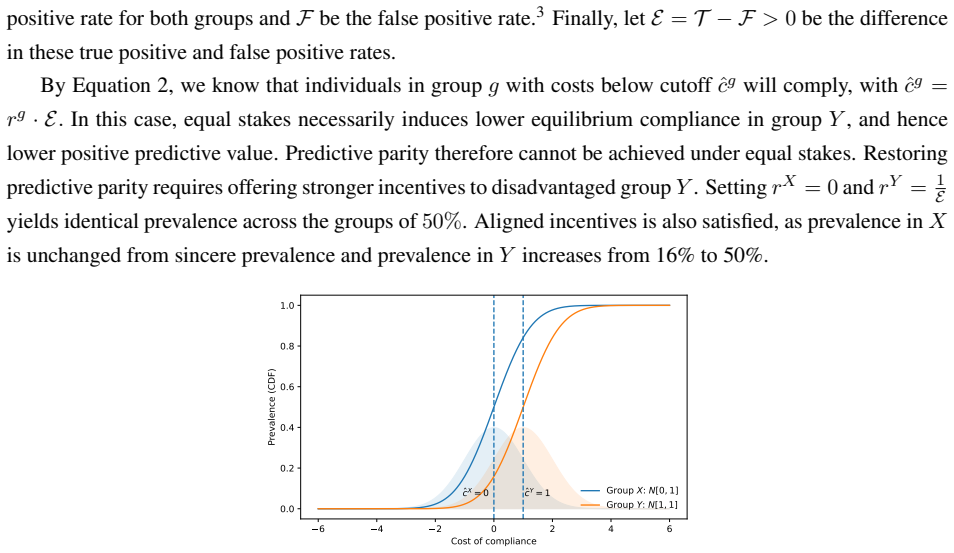
Theorem 1... exists an informative classification rule δ and a system of classification stakes (r_X, r_Y) satisfying aligned incentives such that predictive parity and error-rate balance are jointly satisfied in equilibrium.
What do these tags mean?
- matches
- The paper's claim is directly supported by a theorem in the formal canon.
- supports
- The theorem supports part of the paper's argument, but the paper may add assumptions or extra steps.
- extends
- The paper goes beyond the formal theorem; the theorem is a base layer rather than the whole result.
- uses
- The paper appears to rely on the theorem as machinery.
- contradicts
- The paper's claim conflicts with a theorem or certificate in the canon.
- unclear
- Pith found a possible connection, but the passage is too broad, indirect, or ambiguous to say the theorem truly supports the claim.
Reference graph
Works this paper leans on
-
[1]
InProceedings of the ACM Conference on Economics and Compu- tation
Strategic Clas- sification from Revealed Preferences. InProceedings of the ACM Conference on Economics and Compu- tation. Eubanks, Virginia. 2018.Automating Inequality: How High-Tech Tools Profile, Police, and Punish the Poor. St. Martin’s Press. Hardt, Moritz and Celestine Mendler-D ¨unner
2018
-
[2]
Performative Prediction: Past and Future
“Performative Prediction: Past and Future.”arXiv preprint arXiv:2310.16608. Hardt, Moritz, Eric Price and Nathan Srebro
-
[3]
Equality of Opportunity in Supervised Learning
“Equality of Opportunity in Supervised Learning.”arXiv preprint arXiv:1610.02413. Hardt, Moritz, Nimrod Megiddo, Christos Papadimitriou and Mary Wootters
-
[4]
InProceedings of the 2016 ACM conference on innovations in theoretical computer science
Strategic Classification. InProceedings of the 2016 ACM conference on innovations in theoretical computer science. pp. 111–122. Hsu, Brian, Rahul Mazumder, Preetam Nandy and Kinjal Basu
2016
-
[5]
Making Decisions under Outcome Performativity
“Making Decisions under Outcome Performativity.”. URL:https://arxiv.org/abs/2210.01745 Kleinberg, Jon, Sendhil Mullainathan and Manish Raghavan
-
[6]
Inherent trade-offs in the fair determination of risk scores.arXiv preprint arXiv:1609.05807, 2016
“Inherent Trade-Offs in the Fair Deter- mination of Risk Scores.”arXiv preprint arXiv:1609.05807. Lazar Reich, Claire and Suhas Vijaykumar
-
[7]
Schloss Dagstuhl-Leibniz-Zentrum f ¨ur Informatik
A Possibility in Algorithmic Fairness: Can Calibration and Equal Error Rates Be Reconciled? In2nd Symposium on Foundations of Responsible Computing (FORC 2021). Schloss Dagstuhl-Leibniz-Zentrum f ¨ur Informatik. Milli, Smitha, John Miller, Anca D Dragan and Moritz Hardt
2021
-
[8]
Classification in Equilibrium: Structure of Optimal Decision Rules
“Classification in Equilibrium: Structure of Optimal Decision Rules.”arXiv preprint arXiv:2511.08347. Penn, Elizabeth Maggie and John W. Patty. Forthcoming. “Classification Algorithms and Social Outcomes.” American Journal of Political Science. Perdomo, Juan, Tijana Zrnic, Celestine Mendler-D ¨unner and Moritz Hardt
-
[9]
Incentive-Aware Machine Learning: Robustness, Fairness, Improvement & Causal- ity
“Incentive-Aware Machine Learning: Robustness, Fairness, Improvement & Causal- ity.” SIGecom Exchanges. arXiv:2505.05211. Puranik, Bhagyashree, Upamanyu Madhow and Ramtin Pedarsani
-
[10]
InICLR 2022 Workshop on Socially Responsible Machine Learning
Dynamic positive reinforcement for long-term fairness. InICLR 2022 Workshop on Socially Responsible Machine Learning. Shavit, Yonadav, Benjamin Edelman and Brian Axelrod
2022
-
[11]
InProceedings of the 2024 ACM Conference on Fairness, Accountability, and Transparency
Algorithmic fairness in performative policy learning: Escaping the impossibility of group fairness. InProceedings of the 2024 ACM Conference on Fairness, Accountability, and Transparency. pp. 616–630. Yin, Tongxin, Reilly Raab, Mingyan Liu and Yang Liu
2024
-
[12]
InInternational Conference on Machine Learning
Fair- ness interventions as (dis) incentives for strategic manipulation. InInternational Conference on Machine Learning. PMLR pp. 26239–26264. 18 A Proofs Theorem 1For any two groupsXandY, there exists an informative classification ruleδand a system of classification stakes(r X , rY )satisfying aligned incentives such that predictive parity and error-rate...
2016
discussion (0)
Sign in with ORCID, Apple, or X to comment. Anyone can read and Pith papers without signing in.