Recognition: no theorem link
Attention Flows: Tracing LLM Conceptual Engagement via Story Summaries
Pith reviewed 2026-05-10 19:33 UTC · model grok-4.3
The pith
LLM-generated summaries of novels place more emphasis on story endings than human summaries do.
A machine-rendered reading of the paper's core claim, the machinery that carries it, and where it could break.
Core claim
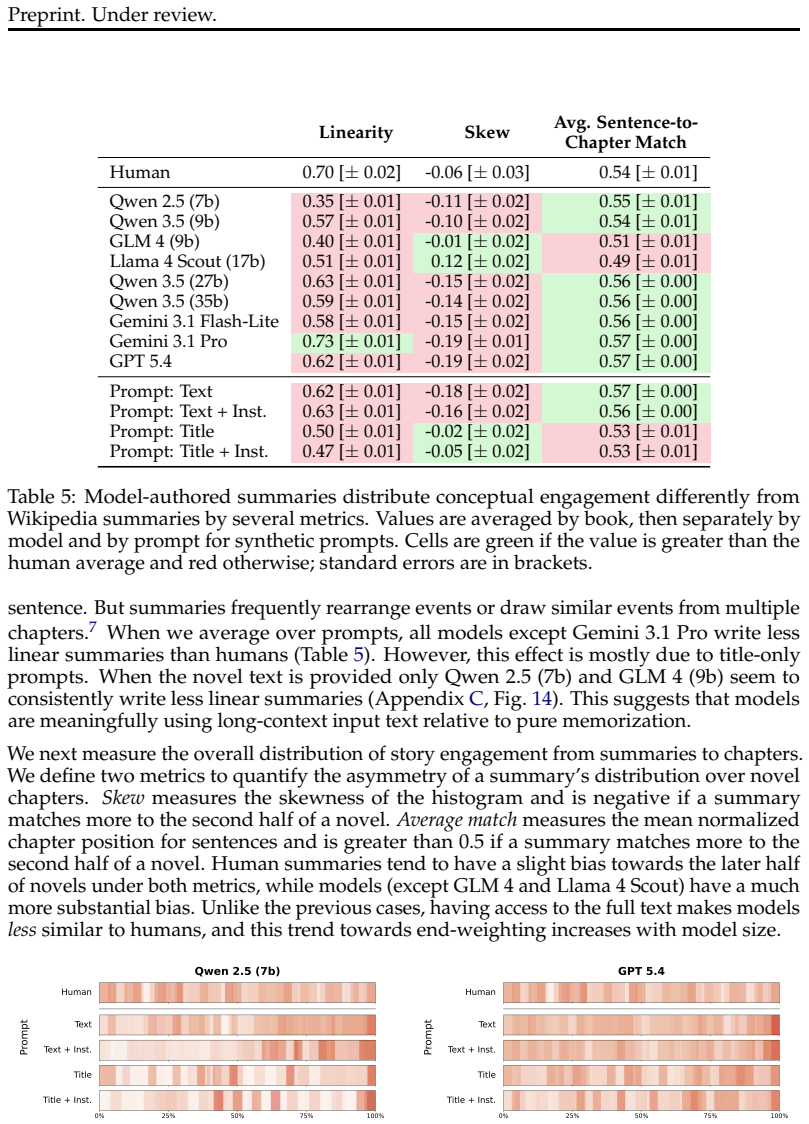
When sentences from 150 human novel summaries and from summaries generated by nine state-of-the-art LLMs are aligned to the chapters they reference, models emphasize the ends of texts more than humans, while also exhibiting stylistic differences; aligning these focus patterns to model attention mechanisms offers explanations for degraded narrative comprehension.
What carries the argument
Sentence-to-chapter alignment applied to summaries, which traces where summarizers direct their attention across the original narrative structure.
Load-bearing premise
Sentence-level alignment to chapters in summaries reliably tracks conceptual engagement with the story rather than merely reflecting summarization style or compression decisions.
What would settle it
An independent measure of narrative importance, such as reader ratings of key plot points per chapter, that fails to match the chapter distribution found in the human summaries.
Figures


read the original abstract
Although LLM context lengths have grown, there is evidence that their ability to integrate information across long-form texts has not kept pace. We evaluate one such understanding task: generating summaries of novels. When human authors of summaries compress a story, they reveal what they consider narratively important. Therefore, by comparing human and LLM-authored summaries, we can assess whether models mirror human patterns of conceptual engagement with texts. To measure conceptual engagement, we align sentences from 150 human-written novel summaries with the specific chapters they reference. We demonstrate the difficulty of this alignment task, which indicates the complexity of summarization as a task. We then generate and align additional summaries by nine state-of-the-art LLMs for each of the 150 reference texts. Comparing the human and model-authored summaries, we find both stylistic differences between the texts and differences in how humans and LLMs distribute their focus throughout a narrative, with models emphasizing the ends of texts. Comparing human narrative engagement with model attention mechanisms suggests explanations for degraded narrative comprehension and targets for future development. We release our dataset to support future research.
Editorial analysis
A structured set of objections, weighed in public.
Referee Report
Summary. The paper claims that aligning sentences from novel summaries to referenced chapters provides a proxy for conceptual engagement with long narratives. By comparing 150 human-written summaries against summaries generated by nine state-of-the-art LLMs, the authors identify both stylistic differences and differences in focus distribution, with LLMs disproportionately emphasizing the ends of texts. They release the resulting dataset and suggest this reveals targets for improving LLM narrative comprehension.
Significance. If the alignment reliably isolates engagement patterns rather than summarization artifacts, the work supplies a concrete empirical lens on where LLMs diverge from human narrative processing, which could guide targeted improvements in long-context models. The public dataset release is a clear strength that supports reproducibility and follow-on research.
major comments (2)
- [Methods section describing the alignment procedure] The central claim that LLMs emphasize narrative ends differently from humans rests on the sentence-to-chapter alignment step. The manuscript acknowledges the difficulty of alignment yet reports no quantitative validation (accuracy, inter-annotator agreement, or error rates stratified by summary type). Without these metrics, systematic differences in how LLM summaries compress or abstract content could produce the observed end-bias as an alignment artifact rather than a genuine engagement difference.
- [Results section on focus distribution] The results section comparing focus distributions across human and model summaries does not include controls for summary length, abstraction level, or alignment success rate. These factors are load-bearing for interpreting the end-emphasis finding as evidence of conceptual engagement rather than a byproduct of differing compression styles.
minor comments (2)
- [Abstract] The abstract would benefit from a concise statement of the number of models and texts analyzed to give readers immediate context for the scale of the comparison.
- [Introduction] Clarify the distinction between the proposed 'attention flows' and standard transformer attention mechanisms early in the introduction to prevent terminological confusion.
Simulated Author's Rebuttal
We thank the referee for their constructive and detailed feedback. The comments correctly identify areas where additional validation and controls would strengthen the interpretation of our results. We address each point below and have revised the manuscript to incorporate the suggested improvements.
read point-by-point responses
-
Referee: [Methods section describing the alignment procedure] The central claim that LLMs emphasize narrative ends differently from humans rests on the sentence-to-chapter alignment step. The manuscript acknowledges the difficulty of alignment yet reports no quantitative validation (accuracy, inter-annotator agreement, or error rates stratified by summary type). Without these metrics, systematic differences in how LLM summaries compress or abstract content could produce the observed end-bias as an alignment artifact rather than a genuine engagement difference.
Authors: We agree that quantitative validation of the alignment is necessary to support the central claim. The original manuscript noted the inherent difficulty of the task but did not report numerical metrics. In the revised manuscript we have added a dedicated validation subsection in Methods. On a stratified sample of 30 summaries (15 human, 15 LLM), two independent annotators achieved Cohen's kappa of 0.71 for chapter assignment. Alignment success rates are 84% for human summaries and 81% for LLM summaries, with error analysis showing no systematic over- or under-alignment to final chapters. These results are now reported and indicate that the end-bias is unlikely to be an alignment artifact. revision: yes
-
Referee: [Results section on focus distribution] The results section comparing focus distributions across human and model summaries does not include controls for summary length, abstraction level, or alignment success rate. These factors are load-bearing for interpreting the end-emphasis finding as evidence of conceptual engagement rather than a byproduct of differing compression styles.
Authors: We acknowledge that the original results lacked explicit controls for these variables. The revised Results section now includes three robustness checks. First, focus distributions are recomputed after length-normalization (proportion of summary sentences per chapter divided by novel length in chapters); the LLM end-emphasis remains statistically significant. Second, we introduce proxies for abstraction level (mean sentence length and type-token ratio) and show they do not correlate with end-chapter focus (r < 0.12). Third, we restrict the analysis to summaries with alignment success >80% and confirm the pattern persists. These controls are presented in a new subsection. revision: yes
Circularity Check
No circularity: purely empirical comparison of summary alignments
full rationale
The paper conducts an empirical study: it aligns sentences from human and LLM-generated novel summaries to chapters in 150 reference texts, then compares focus distributions. No equations, fitted parameters, self-citations, or derivations appear in the provided text. The central claims rest on direct observation of alignment results and stylistic differences rather than any step that reduces by construction to its own inputs. The alignment task is explicitly noted as difficult, but this is treated as a methodological challenge, not a self-referential premise. The study releases its dataset, allowing external verification independent of any internal chain.
Axiom & Free-Parameter Ledger
axioms (1)
- domain assumption Sentence alignment to chapters in summaries accurately reflects which parts of the narrative the summarizer engaged with conceptually.
Reference graph
Works this paper leans on
-
[1]
System Card: Claude Opus 4 & Claude Sonnet 4 , 2025
Anthropic . System Card: Claude Opus 4 & Claude Sonnet 4 , 2025
2025
-
[2]
Controlling the false discovery rate: a practical and powerful approach to multiple testing
Yoav Benjamini and Yosef Hochberg. Controlling the false discovery rate: a practical and powerful approach to multiple testing. Journal of the Royal statistical society: Series B (Methodological), 57 0 (1): 0 289--300, 1995
1995
-
[3]
L iterary QA : Towards Effective Evaluation of Long-document Narrative QA
Tommaso Bonomo, Luca Gioffr \'e , and Roberto Navigli. L iterary QA : Towards Effective Evaluation of Long-document Narrative QA . In Proceedings of the 2025 Conference on Empirical Methods in Natural Language Processing, pp.\ 34086--34107, Suzhou, China, 2025. doi:10.18653/v1/2025.emnlp-main.1729
-
[4]
LongLeader : A Comprehensive Leaderboard for Large Language Models in Long-context Scenarios
Pei Chen, Hongye Jin, Cheng-Che Lee, Rulin Shao, Jingfeng Yang, Mingyu Zhao, Zhaoyu Zhang, Qin Lu, Kaiwen Men, Ning Xie, Huasheng Li, Bing Yin, Han Li, and Lingyun Wang. LongLeader : A Comprehensive Leaderboard for Large Language Models in Long-context Scenarios . In Proceedings of the 2025 Conference of the Nations of the Americas Chapter of the Associat...
2025
-
[5]
Cohn-Sheehy, Angelique I Delarazan, Jordan E Crivelli-Decker, Zachariah M
Brendan I. Cohn-Sheehy, Angelique I Delarazan, Jordan E Crivelli-Decker, Zachariah M. Reagh, Nidhi S. Mundada, Andrew P. Yonelinas, Jeffrey M. Zacks, and Charan Ranganath. Narratives bridge the divide between distant events in episodic memory. Memory & Cognition, 50: 0 478 -- 494, 2020. doi:10.3758/s13421-021-01178-x
-
[6]
BERT: Pre-training of Deep Bidirectional Transformers for Language Understanding
Jacob Devlin, Ming-Wei Chang, Kenton Lee, and Kristina Toutanova. BERT: Pre-training of Deep Bidirectional Transformers for Language Understanding . In Proceedings of the 2019 Conference of the North American Chapter of the Association for Computational Linguistics, pp.\ 4171--4186, 2019
2019
-
[7]
Yufeng Du, Minyang Tian, Srikanth Ronanki, Subendhu Rongali, Sravan Babu Bodapati, Aram Galstyan, Azton Wells, Roy Schwartz, Eliu A Huerta, and Hao Peng. Context Length Alone Hurts LLM Performance Despite Perfect Retrieval . In Findings of the Association for Computational Linguistics: EMNLP 2025, pp.\ 23281--23298, 2025. doi:10.18653/v1/2025.findings-emnlp.1264
-
[8]
Narrative Comprehension: A Discourse Perspective
Catherine Emmott. Narrative Comprehension: A Discourse Perspective. Clarendon Press, Oxford, 1997. ISBN 0198236492
1997
-
[9]
Large-scale study of human memory for meaningful narratives
Antonios Georgiou, Tankut Can, Mikhail Katkov, and Misha Tsodyks. Large-scale study of human memory for meaningful narratives. Learning & Memory, 32(2), 2023. doi:10.1101/lm.054043.124
-
[10]
ChatGLM: A Family of Large Language Models from GLM-130B to GLM-4 All Tools , 2024
Team GLM, Aohan Zeng, Bin Xu, Bowen Wang, Chenhui Zhang, Da Yin, Dan Zhang, Diego Rojas, Guanyu Feng, Hanlin Zhao, Hanyu Lai, Hao Yu, Hongning Wang, Jiadai Sun, Jiajie Zhang, Jiale Cheng, Jiayi Gui, Jie Tang, Jing Zhang, Jingyu Sun, Juanzi Li, Lei Zhao, Lindong Wu, Lucen Zhong, Mingdao Liu, Minlie Huang, Peng Zhang, Qinkai Zheng, Rui Lu, Shuaiqi Duan, Shu...
2024
-
[11]
Mamba: Linear-time sequence modeling with selective state spaces
Albert Gu and Tri Dao. Mamba: Linear-time sequence modeling with selective state spaces. In Proceedings of the First Conference on Language Modeling, 2024
2024
-
[12]
Context Rot: How Increasing Input Tokens Impacts LLM Performance
Kelly Hong, Anton Troynikov, and Jeff Huber. Context Rot: How Increasing Input Tokens Impacts LLM Performance . Technical report, Chroma, July 2025. URL https://research.trychroma.com/context-rot
2025
-
[13]
RULER: What’s the Real Context Size of Your Long-Context Language Models? In Proceedings of the First Conference on Language Modeling, 2024
Cheng-Ping Hsieh, Simeng Sun, Samuel Kriman, Shantanu Acharya, Dima Rekesh, Fei Jia, and Boris Ginsburg. RULER: What’s the Real Context Size of Your Long-Context Language Models? In Proceedings of the First Conference on Language Modeling, 2024
2024
-
[14]
One thousand and one pairs: A "novel" challenge for long-context language models
Marzena Karpinska, Katherine Thai, Kyle Lo, Tanya Goyal, and Mohit Iyyer. One Thousand and One Pairs: A novel challenge for long-context language models . In Proceedings of the 2024 Conference on Empirical Methods in Natural Language Processing, pp.\ 17048--17085, 2024. doi:10.18653/v1/2024.emnlp-main.948
-
[15]
The treatment of ties in ranking problems
Maurice G Kendall. The treatment of ties in ranking problems. Biometrika, 33 0 (3): 0 239--251, 1945
1945
-
[16]
Learning from text, levels of comprehension, or: Why anyone would read a story anyway
Walter Kintsch. Learning from text, levels of comprehension, or: Why anyone would read a story anyway. Poetics, 9 0 (1): 0 87--98, 1980. ISSN 0304-422X. doi:10.1016/0304-422X(80)90013-3. Special Issue Story Comprehension
-
[17]
The role of culture‐specific schemata in the comprehension and recall of stories
Walter Kintsch and Edith Greene. The role of culture‐specific schemata in the comprehension and recall of stories. Discourse Processes, 1 0 (1): 0 1--13, 1978. doi:10.1080/01638537809544425
-
[18]
Unsupervised Multilingual Sentence Boundary Detection
Tibor Kiss and Jan Strunk. Unsupervised Multilingual Sentence Boundary Detection . Computational Linguistics, 32 0 (4): 0 485--525, 2006. doi:10.1162/coli.2006.32.4.485
-
[19]
Tom \'a s Ko c isk \'y , Jonathan Schwarz, Phil Blunsom, Chris Dyer, Karl Moritz Hermann, G \'a bor Melis, and Edward Grefenstette. The N arrative QA Reading Comprehension Challenge . Transactions of the Association for Computational Linguistics, 6: 0 317--328, 2018. doi:10.1162/tacl_a_00023
-
[20]
BookSum: A Collection of Datasets for Long-form Narrative Summarization , 2021
Wojciech Kry \'s ci \'n ski, Nazneen Rajani, Divyansh Agarwal, Caiming Xiong, and Dragomir Radev. BookSum: A Collection of Datasets for Long-form Narrative Summarization , 2021
2021
-
[21]
Wendy G. Lehnert. Plot units and narrative summarization. Cognitive Science, 5 0 (4): 0 293--331, 1981. doi:10.1016/S0364-0213(81)80016-X
-
[22]
Jiaqi Li, Mengmeng Wang, Zilong Zheng, and Muhan Zhang. L oo GLE : Can Long-Context Language Models Understand Long Contexts? In Proceedings of the 62nd Annual Meeting of the Association for Computational Linguistics (Volume 1: Long Papers), pp.\ 16304--16333, 2024. doi:10.18653/v1/2024.acl-long.859
-
[23]
NeedleBench: Evaluating LLM Retrieval and Reasoning Across Varying Information Densities
Mo Li, Songyang Zhang, Taolin Zhang, Haodong Duan, Yunxin Liu, and Kai Chen. NeedleBench: Evaluating LLM Retrieval and Reasoning Across Varying Information Densities . Transactions on Machine Learning Research, 2025
2025
-
[24]
Jamba: A hybrid transformer-mamba language model , 2024
Opher Lieber, Barak Lenz, Hofit Bata, Gal Cohen, Jhonathan Osin, Itay Dalmedigos, Erez Safahi, Shaked Meirom, Yonatan Belinkov, Shai Shalev-Shwartz, et al. Jamba: A hybrid transformer-mamba language model , 2024
2024
-
[25]
Dependency distance as a metric of language comprehension difficulty
Haitao Liu. Dependency distance as a metric of language comprehension difficulty. Journal of Cognitive Science, 9 0 (2): 0 159--191, 2008
2008
-
[26]
Liu, Kevin Lin, John Hewitt, Ashwin Paranjape, Michele Bevilacqua, Fabio Petroni, and Percy Liang
Nelson F. Liu, Kevin Lin, John Hewitt, Ashwin Paranjape, Michele Bevilacqua, Fabio Petroni, and Percy Liang. Lost in the Middle: How Language Models Use Long Contexts . Transactions of the Association for Computational Linguistics, 12: 0 157--173, 2024. doi:10.1162/tacl_a_00638
-
[27]
Jean M. Mandler and Nancy S. Johnson. Remembrance of things parsed: Story structure and recall . Cognitive Psychology, 9 0 (1): 0 111--151, 1977. doi:10.1016/0010-0285(77)90006-8
-
[28]
The Llama 4 Herd: The Beginning of a New Era of Natively Multimodal AI Innovation , 2025
Meta AI . The Llama 4 Herd: The Beginning of a New Era of Natively Multimodal AI Innovation , 2025
2025
-
[29]
Random-Access Infinite Context Length for Transformers
Amirkeivan Mohtashami and Martin Jaggi. Random-Access Infinite Context Length for Transformers . In Proceedings of the 37th Conference on Neural Information Processing Systems, 2023
2023
-
[30]
Introducing GPT-5.4 , 2025
OpenAI . Introducing GPT-5.4 , 2025
2025
-
[31]
OpenAI, Aaron Hurst, Adam Lerer, Adam P. Goucher, Adam Perelman, Aditya Ramesh, Aidan Clark, AJ Ostrow, Akila Welihinda, Alan Hayes, Alec Radford, Aleksander Mądry, Alex Baker-Whitcomb, Alex Beutel, Alex Borzunov, Alex Carney, Alex Chow, Alex Kirillov, Alex Nichol, Alex Paino, Alex Renzin, Alex Tachard Passos, Alexander Kirillov, Alexi Christakis, Alexis ...
2024
-
[32]
OpenAI, Sandhini Agarwal, Lama Ahmad, Jason Ai, Sam Altman, Andy Applebaum, Edwin Arbus, Rahul K. Arora, Yu Bai, Bowen Baker, Haiming Bao, Boaz Barak, Ally Bennett, Tyler Bertao, Nivedita Brett, Eugene Brevdo, Greg Brockman, Sebastien Bubeck, Che Chang, Kai Chen, Mark Chen, Enoch Cheung, Aidan Clark, Dan Cook, Marat Dukhan, Casey Dvorak, Kevin Fives, Vlad...
2025
-
[33]
Pedregosa, G
F. Pedregosa, G. Varoquaux, A. Gramfort, V. Michel, B. Thirion, O. Grisel, M. Blondel, P. Prettenhofer, R. Weiss, V. Dubourg, J. Vanderplas, A. Passos, D. Cournapeau, M. Brucher, M. Perrot, and E. Duchesnay. Scikit-learn: Machine Learning in P ython . Journal of Machine Learning Research, 12: 0 2825--2830, 2011
2011
-
[34]
Qwen2.5 Technical Report , 2025
Qwen, An Yang, Baosong Yang, Beichen Zhang, Binyuan Hui, Bo Zheng, Bowen Yu, Chengyuan Li, Dayiheng Liu, Fei Huang, Haoran Wei, Huan Lin, Jian Yang, Jianhong Tu, Jianwei Zhang, Jianxin Yang, Jiaxi Yang, Jingren Zhou, Junyang Lin, Kai Dang, Keming Lu, Keqin Bao, Kexin Yang, Le Yu, Mei Li, Mingfeng Xue, Pei Zhang, Qin Zhu, Rui Men, Runji Lin, Tianhao Li, Ti...
2025
-
[35]
Qwen3.5: Towards Native Multimodal Agents , 2026
Qwen Team . Qwen3.5: Towards Native Multimodal Agents , 2026
2026
-
[36]
Language Models are Unsupervised Multitask Learners
Alec Radford, Jeffrey Wu, Rewon Child, David Luan, Dario Amodei, Ilya Sutskever, et al. Language Models are Unsupervised Multitask Learners . OpenAI blog, 1 0 (8): 0 9, 2019
2019
-
[37]
Sentence-BERT: Sentence Embeddings using Siamese BERT-Networks
Nils Reimers and Iryna Gurevych. Sentence-BERT: Sentence Embeddings using Siamese BERT-Networks . In Proceedings of the 2019 Conference on Empirical Methods in Natural Language Processing, 2019
2019
-
[38]
David E. Rumelhart. Notes on a Schema for Stories . In Representation and Understanding, pp.\ 211--236. Morgan Kaufmann, 1975. ISBN 978-0-12-108550-6. doi:10.1016/B978-0-12-108550-6.50013-6
-
[39]
Cary Hudson
Aaditya Singh, Adam Fry, Adam Perelman, Adam Tart, Adi Ganesh, Ahmed El-Kishky, Aidan McLaughlin, Aiden Low, AJ Ostrow, Akhila Ananthram, Akshay Nathan, Alan Luo, Alec Helyar, Aleksander Madry, Aleksandr Efremov, Aleksandra Spyra, Alex Baker-Whitcomb, Alex Beutel, Alex Karpenko, Alex Makelov, Alex Neitz, Alex Wei, Alexandra Barr, Alexandre Kirchmeyer, Ale...
2025
-
[40]
RoFormer : Enhanced Transformer with Rotary Position Embedding , 2023
Jianlin Su, Yu Lu, Shengfeng Pan, Ahmed Murtadha, Bo Wen, and Yunfeng Liu. RoFormer : Enhanced Transformer with Rotary Position Embedding , 2023
2023
-
[41]
Idan Brusilovsky
Gemma Team, Aishwarya Kamath, Johan Ferret, Shreya Pathak, Nino Vieillard, Ramona Merhej, Sarah Perrin, Tatiana Matejovicova, Alexandre Ramé, Morgane Rivière, Louis Rouillard, Thomas Mesnard, Geoffrey Cideron, Jean bastien Grill, Sabela Ramos, Edouard Yvinec, Michelle Casbon, Etienne Pot, Ivo Penchev, Gaël Liu, Francesco Visin, Kathleen Kenealy, Lucas Bey...
2025
-
[42]
Gemini 3.1 Pro: A Smarter Model for Your Most Complex Tasks , 2026
The Gemini Team . Gemini 3.1 Pro: A Smarter Model for Your Most Complex Tasks , 2026
2026
-
[43]
Causal thinking and the representation of narrative events
Tom Trabasso and Paul van den Broek . Causal thinking and the representation of narrative events. Journal of Memory and Language, 24 0 (5): 0 612--630, 1985. doi:10.1016/0749-596X(85)90049-X
-
[44]
Paul van den Broek and Anne Helder. Cognitive Processes in Discourse Comprehension: Passive Processes, Reader-Initiated Processes, and Evolving Mental Representations . Discourse Processes, 54 0 (5-6): 0 360--372, 2017. doi:10.1080/0163853X.2017.1306677
-
[45]
EmbeddingGemma: Powerful and Lightweight Text Representations , 2025
Henrique Schechter Vera, Sahil Dua, Biao Zhang, Daniel Salz, Ryan Mullins, Sindhu Raghuram Panyam, Sara Smoot, Iftekhar Naim, Joe Zou, Feiyang Chen, Daniel Cer, Alice Lisak, Min Choi, Lucas Gonzalez, Omar Sanseviero, Glenn Cameron, Ian Ballantyne, Kat Black, Kaifeng Chen, Weiyi Wang, Zhe Li, Gus Martins, Jinhyuk Lee, Mark Sherwood, Juyeong Ji, Renjie Wu, ...
2025
-
[46]
Leave No Document Behind: Benchmarking Long-Context LLM s with Extended Multi-Doc QA
Minzheng Wang, Longze Chen, Fu Cheng, Shengyi Liao, Xinghua Zhang, Bingli Wu, Haiyang Yu, Nan Xu, Lei Zhang, Run Luo, Yunshui Li, Min Yang, Fei Huang, and Yongbin Li. Leave No Document Behind: Benchmarking Long-Context LLM s with Extended Multi-Doc QA . In Proceedings of the 2024 Conference on Empirical Methods in Natural Language Processing, pp.\ 5627--5...
-
[47]
LV-Eval : A Balanced Long-Context Benchmark with 5 Length Levels Up to 256K , 2024
Tao Yuan, Xuefei Ning, Dong Zhou, Zhijie Yang, Shiyao Li, Minghui Zhuang, Zheyue Tan, Zhuyu Yao, Dahua Lin, Boxun Li, Guohao Dai, Shengen Yan, and Yu Wang. LV-Eval : A Balanced Long-Context Benchmark with 5 Length Levels Up to 256K , 2024
2024
-
[48]
Big Bird: Transformers for Longer Sequences
Manzil Zaheer, Guru Guruganesh, Kumar Avinava Dubey, Joshua Ainslie, Chris Alberti, Santiago Ontanon, Philip Pham, Anirudh Ravula, Qifan Wang, Li Yang, et al. Big Bird: Transformers for Longer Sequences . Advances in Neural Information Processing Systems, 33: 0 17283--17297, 2020
2020
-
[49]
NarraSum: A Large-Scale Dataset for Abstractive Narrative Summarization , 2023
Chao Zhao, Faeze Brahman, Kaiqiang Song, Wenlin Yao, Dian Yu, and Snigdha Chaturvedi. NarraSum: A Large-Scale Dataset for Abstractive Narrative Summarization , 2023
2023
-
[50]
Zwaan and Gabriel A
Rolf A. Zwaan and Gabriel A. Radvansky. Situation models in language comprehension and memory. Psychological bulletin, 123 0 (2): 0 162--85, 1998
1998
-
[51]
Rolf A. Zwaan, Mark C. Langston, and Arthur C. Graesser. The Construction of Situation Models in Narrative Comprehension: An Event-Indexing Model . Psychological Science, 6 0 (5): 0 292--297, 1995. doi:10.1111/j.1467-9280.1995.tb00513.x
-
[52]
write newline
" write newline "" before.all 'output.state := FUNCTION n.dashify 't := "" t empty not t #1 #1 substring "-" = t #1 #2 substring "--" = not "--" * t #2 global.max substring 't := t #1 #1 substring "-" = "-" * t #2 global.max substring 't := while if t #1 #1 substring * t #2 global.max substring 't := if while FUNCTION format.date year duplicate empty "emp...
-
[53]
@esa (Ref
\@ifxundefined[1] #1\@undefined \@firstoftwo \@secondoftwo \@ifnum[1] #1 \@firstoftwo \@secondoftwo \@ifx[1] #1 \@firstoftwo \@secondoftwo [2] @ #1 \@temptokena #2 #1 @ \@temptokena \@ifclassloaded agu2001 natbib The agu2001 class already includes natbib coding, so you should not add it explicitly Type <Return> for now, but then later remove the command n...
-
[54]
\@lbibitem[] @bibitem@first@sw\@secondoftwo \@lbibitem[#1]#2 \@extra@b@citeb \@ifundefined br@#2\@extra@b@citeb \@namedef br@#2 \@nameuse br@#2\@extra@b@citeb \@ifundefined b@#2\@extra@b@citeb @num @parse #2 @tmp #1 NAT@b@open@#2 NAT@b@shut@#2 \@ifnum @merge>\@ne @bibitem@first@sw \@firstoftwo \@ifundefined NAT@b*@#2 \@firstoftwo @num @NAT@ctr \@secondoft...
-
[55]
@open @close @open @close and [1] URL: #1 \@ifundefined chapter * \@mkboth \@ifxundefined @sectionbib * \@mkboth * \@mkboth\@gobbletwo \@ifclassloaded amsart * \@ifclassloaded amsbook * \@ifxundefined @heading @heading NAT@ctr thebibliography [1] @ \@biblabel @NAT@ctr \@bibsetup #1 @NAT@ctr @ @openbib .11em \@plus.33em \@minus.07em 4000 4000 `\.\@m @bibit...
discussion (0)
Sign in with ORCID, Apple, or X to comment. Anyone can read and Pith papers without signing in.