Recognition: 2 theorem links
· Lean TheoremAnticipating tipping in spatiotemporal systems with machine learning
Pith reviewed 2026-05-10 18:07 UTC · model grok-4.3
The pith
Reservoir computing on reduced spatiotemporal data predicts the timing of tipping events across dynamical systems and climate models.
A machine-rendered reading of the paper's core claim, the machinery that carries it, and where it could break.
Core claim
By applying non-negative matrix factorization to generate dimensionally reduced spatiotemporal data as input, parameter-adaptable reservoir computing accurately anticipates tipping, identifying the tipping time within a narrow prediction window across a variety of spatiotemporal dynamical systems as well as in CMIP5 climate projections. The framework is robust against common forecasting challenges and significantly reduces the computational overhead of processing full spatiotemporal data.
What carries the argument
Parameter-adaptable reservoir computing fed with non-negative matrix factorization reduced spatiotemporal data, which compresses the input while retaining enough dynamical information to detect an approaching saddle-node bifurcation and estimate its timing.
Load-bearing premise
Non-negative matrix factorization applied to the spatiotemporal data preserves the dynamical features required for the reservoir computer to detect and time the impending tipping event.
What would settle it
Applying the same pipeline to additional spatiotemporal systems or higher-resolution climate ensembles and finding that the predicted tipping window either misses the actual transition or becomes arbitrarily wide would falsify the claim that a narrow, reliable prediction window is routinely obtained.
Figures




read the original abstract
In nonlinear dynamical systems, tipping refers to a critical transition from one steady state to another, typically catastrophic, steady state, often resulting from a saddle-node bifurcation. Recently, the machine-learning framework of parameter-adaptable reservoir computing has been applied to predict tipping in systems described by low-dimensional stochastic differential equations. However, anticipating tipping in complex spatiotemporal dynamical systems remains a significant open problem. The ability to forecast not only the occurrence but also the precise timing of such tipping events is crucial for providing the actionable lead time necessary for timely mitigation. By utilizing the mathematical approach of non-negative matrix factorization to generate dimensionally reduced spatiotemporal data as input, we exploit parameter-adaptable reservoir computing to accurately anticipate tipping. We demonstrate that the tipping time can be identified within a narrow prediction window across a variety of spatiotemporal dynamical systems, as well as in CMIP5 (Coupled Model Intercomparison Project 5) climate projections. Furthermore, we show that this reservoir-computing framework, utilizing reduced input data, is robust against common forecasting challenges and significantly alleviates the computational overhead associated with processing full spatiotemporal data.
Editorial analysis
A structured set of objections, weighed in public.
Referee Report
Summary. The paper proposes combining non-negative matrix factorization (NMF) for dimensionality reduction of spatiotemporal fields with parameter-adaptable reservoir computing to anticipate the timing of tipping events driven by saddle-node bifurcations. It claims that this framework identifies tipping times within narrow prediction windows for a variety of model spatiotemporal systems as well as CMIP5 climate projections, while remaining robust to common forecasting issues and reducing computational cost relative to full-data approaches.
Significance. If the central claims hold with rigorous validation, the work would offer a computationally tractable ML route to early-warning signals for high-dimensional tipping phenomena, including in climate applications. The parameter-adaptable reservoir component and explicit focus on timing (rather than mere occurrence) are potentially useful extensions of prior reservoir-computing tipping studies, provided the NMF reduction demonstrably retains the relevant slow-drift statistics.
major comments (3)
- [Abstract and §3] Abstract and §3 (results): the headline claim of 'accurate anticipation' and 'narrow prediction window' is stated without any reported quantitative metrics (e.g., mean absolute error in tipping time, success rate across realizations, or comparison to baselines such as critical-slowing-down indicators or standard reservoir computing without NMF). This absence prevents evaluation of whether the method actually outperforms simpler alternatives or meets the precision asserted for CMIP5 runs.
- [§2.2] §2.2 (NMF preprocessing): the manuscript applies NMF to obtain low-rank non-negative factors but supplies no diagnostic showing that the reduced representation preserves the slow manifold or critical-slowing signatures (rising variance/autocorrelation in the relevant spatial modes) that the subsequent reservoir must exploit. Because tipping can be carried by spatially localized, low-amplitude modes that NMF may split or suppress under its reconstruction objective, this step is load-bearing for the claim that the pipeline works across general spatiotemporal systems.
- [§4] §4 (CMIP5 application): the assertion that tipping time is recovered 'within a narrow prediction window' for climate projections requires explicit reporting of the window width, ensemble validation, and comparison against known or simulated bifurcation times; without these, the real-world applicability claim cannot be assessed.
minor comments (2)
- [§2.3] Notation for the reservoir update equations and the parameter-adaptation rule should be stated explicitly (currently only referenced) so that readers can reproduce the training protocol.
- [Figures 2-4] Figure captions for the spatiotemporal examples should include the precise NMF rank chosen and the prediction-window length used in each panel.
Simulated Author's Rebuttal
We thank the referee for the constructive and detailed review. We address each major comment point by point below, clarifying our approach and indicating revisions where the manuscript will be strengthened.
read point-by-point responses
-
Referee: [Abstract and §3] Abstract and §3 (results): the headline claim of 'accurate anticipation' and 'narrow prediction window' is stated without any reported quantitative metrics (e.g., mean absolute error in tipping time, success rate across realizations, or comparison to baselines such as critical-slowing-down indicators or standard reservoir computing without NMF). This absence prevents evaluation of whether the method actually outperforms simpler alternatives or meets the precision asserted for CMIP5 runs.
Authors: We agree that explicit quantitative metrics are necessary to substantiate the claims and enable direct comparison with alternatives. In the revised manuscript we have added mean absolute error values for predicted tipping times, success rates over multiple realizations, and side-by-side performance comparisons against critical-slowing-down indicators as well as reservoir computing applied to the unreduced data. These additions are placed in §3 and the abstract has been updated to reference the new metrics. revision: yes
-
Referee: [§2.2] §2.2 (NMF preprocessing): the manuscript applies NMF to obtain low-rank non-negative factors but supplies no diagnostic showing that the reduced representation preserves the slow manifold or critical-slowing signatures (rising variance/autocorrelation in the relevant spatial modes) that the subsequent reservoir must exploit. Because tipping can be carried by spatially localized, low-amplitude modes that NMF may split or suppress under its reconstruction objective, this step is load-bearing for the claim that the pipeline works across general spatiotemporal systems.
Authors: We acknowledge that explicit verification of preserved slow-drift statistics is required. The revised §2.2 now includes diagnostic panels showing the evolution of variance and lag-1 autocorrelation within the retained NMF modes for each example system; these confirm that the critical-slowing signatures remain intact and are not suppressed by the non-negativity constraint. We also note that the subsequent reservoir training directly uses these modes, so any loss of relevant dynamics would have been visible in the prediction results. revision: yes
-
Referee: [§4] §4 (CMIP5 application): the assertion that tipping time is recovered 'within a narrow prediction window' for climate projections requires explicit reporting of the window width, ensemble validation, and comparison against known or simulated bifurcation times; without these, the real-world applicability claim cannot be assessed.
Authors: We have expanded §4 to report the precise widths of the prediction windows (in model years) for each CMIP5 projection examined, together with results from an ensemble of reservoir initializations. We also include direct comparisons of the predicted tipping times against the bifurcation points obtained from the underlying model runs when the forcing is continued past the tipping threshold. These additions allow quantitative evaluation of the method on the climate data. revision: yes
Circularity Check
No significant circularity in the ML-based tipping anticipation framework
full rationale
The paper applies non-negative matrix factorization to reduce spatiotemporal data and then trains a parameter-adaptable reservoir computer to forecast tipping times. This is an empirical, data-driven pipeline whose outputs are generated by supervised training on observed trajectories rather than any algebraic derivation that reduces predictions to fitted inputs by construction. No self-citation chains, uniqueness theorems, or ansatzes are invoked to justify load-bearing steps; the central claim rests on empirical performance across model systems and CMIP5 projections, which is independently falsifiable and does not collapse to the method's own definitions.
Axiom & Free-Parameter Ledger
Lean theorems connected to this paper
-
IndisputableMonolith/Cost/FunctionalEquation.leanwashburn_uniqueness_aczel unclearBy utilizing the mathematical approach of non-negative matrix factorization to generate dimensionally reduced spatiotemporal data as input, we exploit parameter-adaptable reservoir computing to accurately anticipate tipping.
-
IndisputableMonolith/Foundation/ArrowOfTime.leanarrow_from_z unclearWe demonstrate that the tipping time can be identified within a narrow prediction window across a variety of spatiotemporal dynamical systems, as well as in CMIP5 climate projections.
Reference graph
Works this paper leans on
-
[1]
The equation governing the dynamics of the spatially ex- tended vegetation grazing system is given in Eq
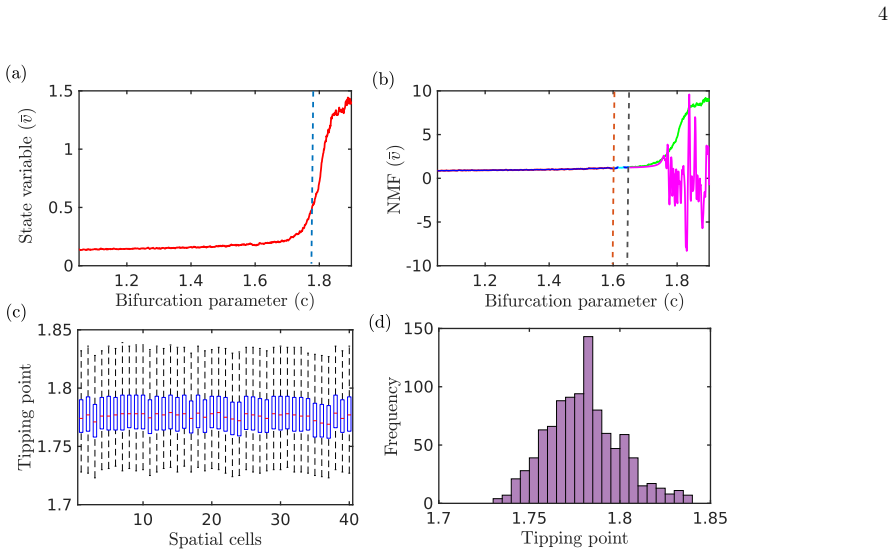
Vegetation grazing system and cellular automata Figure 6(a) shows the spatial mean abundance of vege- tation exhibiting an abrupt shift from a higher to a lower abundance state as the grazing rate increases, which acts as the gradually changing bifurcation parameter. The equation governing the dynamics of the spatially ex- tended vegetation grazing system...
-
[2]
supervised
CMIP5 climate data CMIP5 is a global, standardized climate modelling ef- fort coordinated by the World Climate Research Pro- gramme [50]. It provides historical climate simulations ranging from 1850 to 2005, which are known to have reproduced observed long-term global climate metrics closely (with correct trends and magnitudes). It also provides future cl...
2005
-
[3]
Grebogi, E
C. Grebogi, E. Ott, and J. A. Yorke, Chaotic attractors in crisis, Phys. Rev. Lett.48, 1507 (1982)
1982
-
[4]
Grebogi, E
C. Grebogi, E. Ott, and J. A. Yorke, Crises, sudden changes in chaotic attractors and chaotic transients, Physica D7, 181 (1983)
1983
-
[5]
Dhamala and Y.-C
M. Dhamala and Y.-C. Lai, Controlling transient chaos in deterministic flows with applications to electrical power systems and ecology, Phys. Rev. E59, 1646 (1999)
1999
-
[6]
McCann and P
K. McCann and P. Yodzis, Nonlinear dynamics and pop- ulation disappearances, Ame. Naturalist144, 873 (1994)
1994
-
[7]
Hastings, K
A. Hastings, K. C. Abbott, K. Cuddington, T. Fran- cis, G. Gellner, Y.-C. Lai, A. Morozov, S. Petrivskii, K. Scranton, and M. L. Zeeman, Transient phenomena in ecology, Science361, eaat6412 (2018)
2018
-
[8]
W.-X. Wang, R. Yang, Y.-C. Lai, V. Kovanis, and C. Grebogi, Predicting catastrophes in nonlinear dynami- cal systems by compressive sensing, Phys. Rev. Lett.106, 154101 (2011)
2011
-
[9]
Wang, Y.-C
W.-X. Wang, Y.-C. Lai, and C. Grebogi, Data based identification and prediction of nonlinear and complex dynamical systems, Phys. Rep.644, 1 (2016)
2016
-
[10]
Kong, H.-W
L.-W. Kong, H.-W. Fan, C. Grebogi, and Y.-C. Lai, Ma- chine learning prediction of critical transition and system collapse, Phys. Rev. Research3, 013090 (2021)
2021
-
[11]
Kong, H.-W
L.-W. Kong, H.-W. Fan, C. Grebogi, and Y.-C. Lai, Emergence of transient chaos and intermittency in ma- chine learning, J. Phys. Complex.2, 035014 (2021)
2021
-
[12]
Ikeda, Multiple-valued stationary state and its insta- bility of the transmitted light by a ring cavity system, Opt
K. Ikeda, Multiple-valued stationary state and its insta- bility of the transmitted light by a ring cavity system, Opt. Commun.30, 257 (1979)
1979
-
[13]
Ikeda, H
K. Ikeda, H. Daido, and O. Akimoto, Optical turbulence: Chaotic behavior of transmitted light from a ring cavity, Phys. Rev. Lett.45, 709 (1980)
1980
-
[14]
S. M. Hammel, C. K. R. T. Jones, and J. V. Moloney, Global dynamical behavior of the optical field in a ring cavity, J. Opt. Soc. Am. B2, 552 (1985)
1985
-
[15]
Patel and E
D. Patel and E. Ott, Using machine learning to anticipate tipping points and extrapolate to post-tipping dynamics of non-stationary dynamical systems, Chaos33, 023143 (2023)
2023
-
[16]
L.-W. Kong, Y. Weng, B. Glaz, M. Haile, and Y.-C. Lai, Reservoir computing as digital twins for nonlinear dy- namical systems, Chaos33, 033111 (2023)
2023
-
[17]
Scheffer,Ecology of Shallow Lakes(Springer Science & Business Media, 2004)
M. Scheffer,Ecology of Shallow Lakes(Springer Science & Business Media, 2004)
2004
-
[18]
Scheffer, J
M. Scheffer, J. Bascompte, W. A. Brock, V. Brovkin, S. R. Carpenter, V. Dakos, H. Held, E. H. Van Nes, M. Rietkerk, and G. Sugihara, Early-warning signals for critical transitions, Nature461, 53 (2009)
2009
-
[19]
Scheffer, Foreseeing tipping points, Nature467, 411 (2010)
M. Scheffer, Foreseeing tipping points, Nature467, 411 (2010)
2010
-
[20]
D. B. Wysham and A. Hastings, Regime shifts in ecolog- ical systems can occur with no warning, Ecol. Lett.13, 464 (2010)
2010
-
[21]
J. M. Drake and B. D. Griffen, Early warning signals of extinction in deteriorating environments, Nature467, 456 (2010)
2010
-
[22]
L. Chen, R. Liu, Z.-P. Liu, M. Li, and K. Aihara, De- tecting early-warning signals for sudden deterioration of complex diseases by dynamical network biomarkers, Sci. Rep.2, 342 (2012)
2012
-
[23]
Boettiger and A
C. Boettiger and A. Hastings, Quantifying limits to de- tection of early warning for critical transitions, J. R. Soc. Interface9, 2527 (2012)
2012
-
[24]
L. Dai, D. Vorselen, K. S. Korolev, and J. Gore, Generic indicators for loss of resilience before a tipping point lead- ing to population collapse, Science336, 1175 (2012)
2012
-
[25]
Panahi, L.-W
S. Panahi, L.-W. Kong, M. Moradi, Z.-M. Zhai, B. Glaz, M. Haile, and Y.-C. Lai, Machine learning prediction of tipping in complex dynamical systems, Phys. Rev. Res. 6, 043194 (2024)
2024
-
[26]
Zhai, L.-W
Z.-M. Zhai, L.-W. Kong, and Y.-C. Lai, Emergence of a resonance in machine learning, Phys. Rev. Res.5, 033127 (2023)
2023
-
[27]
Rietkerk, R
M. Rietkerk, R. Bastiaansen, S. Banerjee, J. van de Kop- pel, M. Baudena, and A. Doelman, Evasion of tipping in complex systems through spatial pattern formation, Sci- ence374, eabj0359 (2021)
2021
-
[28]
T. M. Lenton, J. F. Abrams, A. Bartsch, S. Bathiany, C. A. Boulton, J. E. Buxton, A. Conversi, A. M. Cun- liffe, S. Hebden, T. Lavergne,et al., Remotely sensing po- 15 tential climate change tipping points across scales, Nat. Commun.15, 343 (2024)
2024
-
[29]
K´ efi, V
S. K´ efi, V. Guttal, W. A. Brock, S. R. Carpenter, A. M. Ellison, V. N. Livina, D. A. Seekell, M. Scheffer, E. H. Van Nes, and V. Dakos, Early warning signals of ecolog- ical transitions: methods for spatial patterns, PloS One 9, e92097 (2014)
2014
-
[30]
Pascual and F
M. Pascual and F. Guichard, Criticality and disturbance in spatial ecological systems, Trends Ecol. Evo.20, 88 (2005)
2005
-
[31]
Majumder, K
S. Majumder, K. Tamma, S. Ramaswamy, and V. Guttal, Inferring critical thresholds of ecosystem transitions from spatial data, Ecology100, e02722 (2019)
2019
-
[32]
T. M. Lenton, H. Held, E. Kriegler, J. W. Hall, W. Lucht, S. Rahmstorf, and H. J. Schellnhuber, Tipping elements in the earth’s climate system, Proc. Nat. Aca. Sci. (USA) 105, 1786 (2008)
2008
-
[33]
Drijfhout, E
S. Drijfhout, E. Gleeson, H. A. Dijkstra, and V. Liv- ina, Spontaneous abrupt climate change due to an atmo- spheric blocking–sea-ice–ocean feedback in an unforced climate model simulation, Proc. Nat. Acad. Sci. (USA) 110, 19713 (2013)
2013
-
[34]
Taherkhani, S
M. Taherkhani, S. Vitousek, P. L. Barnard, N. Frazer, T. R. Anderson, and C. H. Fletcher, Sea-level rise expo- nentially increases coastal flood frequency, Sci. Rep.10, 1 (2020)
2020
-
[35]
Ditlevsen and S
P. Ditlevsen and S. Ditlevsen, Warning of a forthcoming collapse of the Atlantic meridional overturning circula- tion, Nat. Commun.14, 4254 (2023)
2023
-
[36]
R. M. van Westen, M. Kliphuis, and H. A. Dijkstra, Physics-based early warning signal shows that AMOC is on tipping course, Sci. Adv.10, eadk1189 (2024)
2024
-
[37]
O. C. Changeet al., Intergovernmental panel on climate change, World Meteorological Organization52, 1 (2007)
2007
-
[38]
Eisenman and J
I. Eisenman and J. Wettlaufer, Nonlinear threshold be- havior during the loss of arctic sea ice, Proc. Nat. Aca. Sci. (USA)106, 28 (2009)
2009
-
[39]
R. Wang, J. A. Dearing, P. G. Langdon, E. Zhang, X. Yang, V. Dakos, and M. Scheffer, Flickering gives early warning signals of a critical transition to a eutrophic lake state, Nature492, 419 (2012)
2012
-
[40]
Nystr¨ om and C
M. Nystr¨ om and C. Folke, Spatial resilience of coral reefs, Ecosys.4, 406 (2001)
2001
-
[41]
S. Eby, A. Agrawal, S. Majumder, A. P. Dobson, and V. Guttal, Alternative stable states and spatial indica- tors of critical slowing down along a spatial gradient in a savanna ecosystem, Global Ecol. Biogeo.26, 638 (2017)
2017
-
[42]
Gillis,Nonnegative Matrix Factorization(SIAM, Philadelphia, PA, 2020)
N. Gillis,Nonnegative Matrix Factorization(SIAM, Philadelphia, PA, 2020)
2020
-
[43]
Wang and Y.-J
Y.-X. Wang and Y.-J. Zhang, Nonnegative matrix factor- ization: A comprehensive review, IEEE Trans. Knowle. Data Eng.25, 1336 (2012)
2012
-
[44]
S. R. Carpenter, D. Ludwig, and W. A. Brock, Manage- ment of eutrophication for lakes subject to potentially irreversible change, Ecol. Appl.9, 751 (1999)
1999
-
[45]
Andersen, J
T. Andersen, J. Carstensen, E. Hern´ andez-Garc´ ıa, and C. M. Duarte, Ecological thresholds and regime shifts: approaches to identification, Trends Ecol. Evo.24, 49 (2009)
2009
-
[46]
B. T. Bestelmeyer, A. M. Ellison, W. R. Fraser, K. B. Gorman, S. J. Holbrook, C. M. Laney, M. D. Ohman, D. P. Peters, F. C. Pillsbury, A. Rassweiler,et al., Anal- ysis of abrupt transitions in ecological systems, Ecosphere 2, 1 (2011)
2011
-
[47]
E. B. Wilson, On confidence intervals, Proc. Nat. Aca. Sci. (USA)28, 88 (1942)
1942
-
[48]
Scheffer, S
M. Scheffer, S. R. Carpenter, T. M. Lenton, J. Bas- compte, W. Brock, V. Dakos, J. Van de Koppel, I. A. Van de Leemput, S. A. Levin, E. H. Van Nes,et al., An- ticipating critical transitions, Science338, 344 (2012)
2012
-
[49]
Dakos, S
V. Dakos, S. R. Carpenter, W. A. Brock, A. M. Ellison, V. Guttal, A. R. Ives, S. K´ efi, V. Livina, D. A. Seekell, E. H. van Nes,et al., Methods for detecting early warn- ings of critical transitions in time series illustrated using simulated ecological data, PloS One7, e41010 (2012)
2012
-
[50]
Guttal and C
V. Guttal and C. Jayaprakash, Spatial variance and spa- tial skewness: leading indicators of regime shifts in spa- tial ecological systems, Theo. Ecol.2, 3 (2009)
2009
-
[51]
Sankaran, S
S. Sankaran, S. Majumder, A. Viswanathan, and V. Gut- tal, Clustering and correlations: Inferring resilience from spatial patterns in ecosystems, Meth. Ecol. Evo.10, 2079 (2019)
2079
-
[52]
K. E. Taylor, R. J. Stouffer, and G. A. Meehl, An overview of cmip5 and the experiment design, Bull. Ame. Meteorol. Soc.93, 485 (2012)
2012
-
[53]
Bathiany, J
S. Bathiany, J. Hidding, and M. Scheffer, Edge detection reveals abrupt and extreme climate events, J. Climate 33, 6399 (2020)
2020
-
[54]
Ghojogh, M
B. Ghojogh, M. Crowley, F. Karray, and A. Ghodsi,Ele- ments of Dimensionality Reduction and Manifold Learn- ing(Springer, Cham, Switzerland, 2023)
2023
-
[55]
Panahi, L.-W
S. Panahi, L.-W. Kong, B. Glaz, M. Haile, and Y.-C. Lai, Unsupervised learning for anticipating critical tran- sitions, Phys. Rev. Lett.136, 077301 (2026)
2026
-
[56]
Scheffer and S
M. Scheffer and S. R. Carpenter, Catastrophic regime shifts in ecosystems: linking theory to observation, Trends Ecol. Evo.18, 648 (2003)
2003
-
[57]
Weber and J
M. Weber and J. Buceta, Stochastic stabilization of phe- notypic states: the genetic bistable switch as a case study, PloS One8, e73487 (2013)
2013
-
[58]
Noy-Meir, Stability of grazing systems: an application of predator-prey graphs, J
I. Noy-Meir, Stability of grazing systems: an application of predator-prey graphs, J. Ecol. , 459 (1975)
1975
-
[59]
J. H. Steele and E. W. Henderson, Modeling long-term fluctuations in fish stocks, Science224, 985 (1984)
1984
-
[60]
R. M. May, Thresholds and breakpoints in ecosystems with a multiplicity of stable states, Nature269, 471 (1977)
1977
-
[61]
Pathak, B
J. Pathak, B. Hunt, M. Girvan, Z. Lu, and E. Ott, Model- free prediction of large spatiotemporally chaotic systems from data: A reservoir computing approach, Phys. Rev. Lett.120, 024102 (2018)
2018
-
[62]
C. M. Bishop and N. M. Nasrabadi,Pattern recognition and machine learning, Vol. 4 (Springer, New York, NY, 2006). 16 SUPPLEMENTARY INFORMATION FIG. S1. Test of false positives. Shown is the NMF-reduced density of the state variablevversus a gradual change in the parametercfor each spatial cell. Plots are displayed for the training, validation, and testing...
2006
-
[63]
Split the data into two regions: (ti, yi) = ( Region 1, t i ≤θ k, Region 2, t i > θ k
-
[64]
Fit independent smoothing functionsf 1 andf 2 on the two regions
-
[65]
Reconstruct the signal: ˆyi(θk) = ( f1(ti), t i ≤θ k, f2(ti), t i > θ k
-
[66]
Compute the residual sum of squares: RSS(θk) = NX i=1 (yi −ˆyi(θk))2 . 21
-
[67]
The optimal tipping point is given by θ∗ = arg min θk AIC(θk)
Next, evaluate the Akaike Information Criterion: AIC(θk) =Nln RSS(θk) N + 2k, wherek(= 1, for determining a tipping point) is the number of estimated threshold parameters. The optimal tipping point is given by θ∗ = arg min θk AIC(θk). We implement the TGAM to estimate tipping points from both the original and reservoir-computer-predicted time series. The ...
1900
discussion (0)
Sign in with ORCID, Apple, or X to comment. Anyone can read and Pith papers without signing in.